
A low-smoke density halogen-containing flame-retardant reinforced PBT/PET compound and its preparation method and application
A smoke density and compound technology, which is applied in the field of engineering plastics, can solve the problems of not paying attention to the amount of smoke or smoke density index, and the smoke density cannot be satisfied, and achieve the effect of high appearance gloss.
Patent Information
- Authority / Receiving Office
- CN · China
- Patent Type
- Patents(China)
- Current Assignee / Owner
- Publication Date
- 2022-03-22
Smart Images
Figure 1 
Figure 2 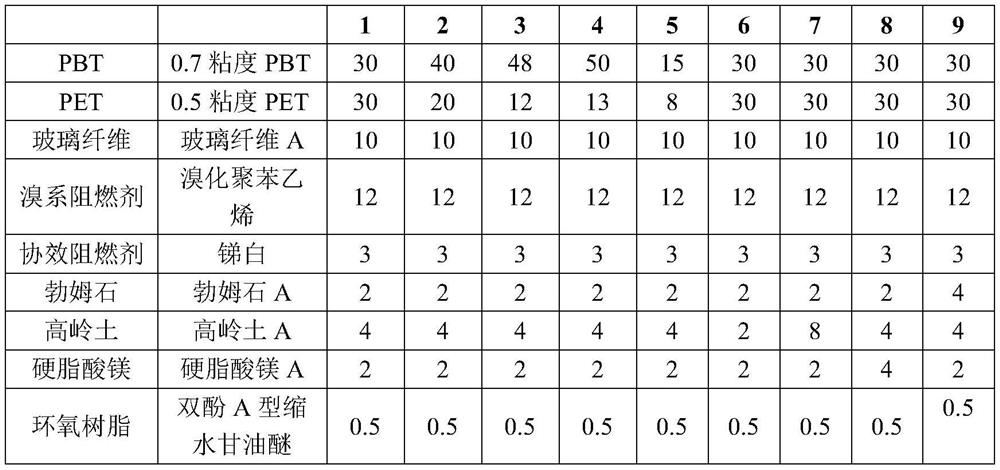
Figure 3
Abstract
Description
technical field
[0001] The invention relates to the technical field of engineering plastics, and more specifically, to a low-smoke density halogen-containing flame-retardant reinforced PBT / PET compound and a preparation method and application thereof. Background technique
[0002] Plastic materials are generally accompanied by a large amount of smoke during the combustion process, which will cause environmental pollution and cause great harm to the human body. In recent years, with the development of plastic flame retardant technology, low-smoke flame retardant has become a new direction for the development of flame retardant plastics. Rail transit, building materials, cables and other industries have increasingly clear and standardized requirements for low-smoke flame retardancy. Such industries have clearly required that plastic parts in applications must meet the smoke density level 2 or above required by the EN45545-2 standard (Level 2 requires ISO5659-2 test smoke dens...
Examples
Embodiment 1~18
[0058] The content of each component in the PBT / PET composites of Examples 1-18 is shown in Table 1.
[0059] The preparation method is as follows: according to Table 1, the brominated flame retardant and the synergistic flame retardant are mixed to make the first premix; the epoxy resin is mixed with boehmite, kaolin, and magnesium stearate to make the second premix. Mixture; PBT, PET, glass fiber, the first premix, and the second premix are added to the twin-screw extruder, mixed and dispersed, melt-extruded and granulated to obtain low-smoke density halogen-containing flame-retardant reinforced PBT / PET compound.
[0060] Among them, the temperature of the first zone of the twin-screw extruder from the feeding port to the machine head is 200-230°C, the temperature of the second zone is 240-260°C, the temperature of the third zone is 235-255°C, and the temperature of the fourth zone is 235-255°C , the temperature in zone five is 235-255°C, the temperature in zone six is 2...