
Multi-array camera imaging system and method therefor
a camera imaging and camera technology, applied in the field of imaging, can solve the problems of inability to fully stitch images in the prior-art multi-sensor array imaging approach to display devices, inability to achieve full stitching images, and inability to achieve the effect of delivering large amounts of raw pixel data between imagers and display devices, and achieving fast imaging systems. , the effect of overcoming latency and bandwidth problems
Patent Information
- Authority / Receiving Office
- US · United States
- Patent Type
- Patents(United States)
- Current Assignee / Owner
- Publication Date
- 2019-10-29
Smart Images
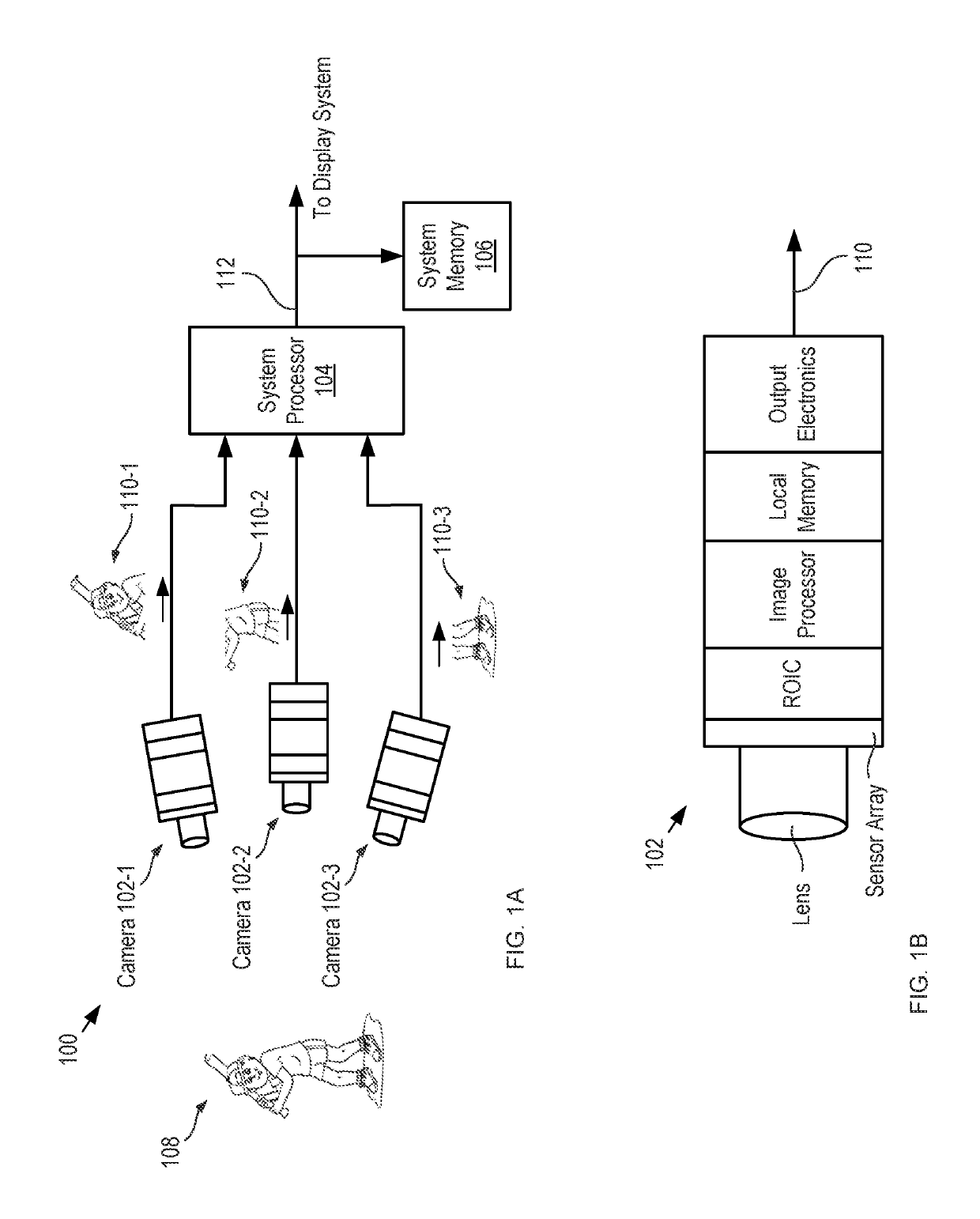
Figure 1 
Figure 2 
Figure 3
Abstract
Description
CROSS REFERENCE TO RELATED APPLICATIONS
[0001] This case claims priority of U.S. Provisional Patent Application Ser. No. 62 / 132,861, filed Mar. 13, 2015, which is incorporated by reference. If there are any contradictions or inconsistencies in language between this application and one or more of the cases that have been incorporated by reference that might affect the interpretation of the claims in this case, the claims in this case should be interpreted to be consistent with the language in this case.FIELD OF THE INVENTION
[0002] The present invention relates to imaging in general, and, more particularly, to forming images with camera systems having a plurality of focal-plane arrays.BACKGROUND OF THE INVENTION
[0003] Prior to the development of digital imaging systems, cameras were based on a lens and a film-based a photographic emulsion located at the focal plane of the lens. An optical image of a scene would be projected onto the emulsion, which would permanently record the image via a...
Examples
Embodiment Construction
[0026]FIG. 1A-B depict schematic drawings of a conventional array camera and an individual microcamera of the array, respectively. Array camera 100 includes a plurality of microcameras 102-1 through 102-3, system processor 104, and system memory 106. Array camera 100 is representative of typical prior-art multi-sensor-array cameras wherein the sensor arrays reside in individual microcameras.
[0027]Each of microcameras 102-1 through 102-3 (referred to, collectively, as microcameras 102) is a conventional digital video camera that includes independent sensor arrays, image processing capability and memory. Each of microcameras 102 comprises an objective lens, sensor array, read-out integrated circuit (ROIC), image processor, local memory, and output electronics. Microcameras 102 are arranged such that each microcamera provides a video stream of a different portion of scene 108.
[0028]In each video frame of the video stream, the objective lens of each of microcameras 102 forms an optical ...