
Method for separating 2-alkylanthracenes and use thereof for producing hydrogen peroxide
Patent Information
- Authority / Receiving Office
- US · United States
- Current Assignee / Owner
- Publication Date
- 2022-06-09
Smart Images
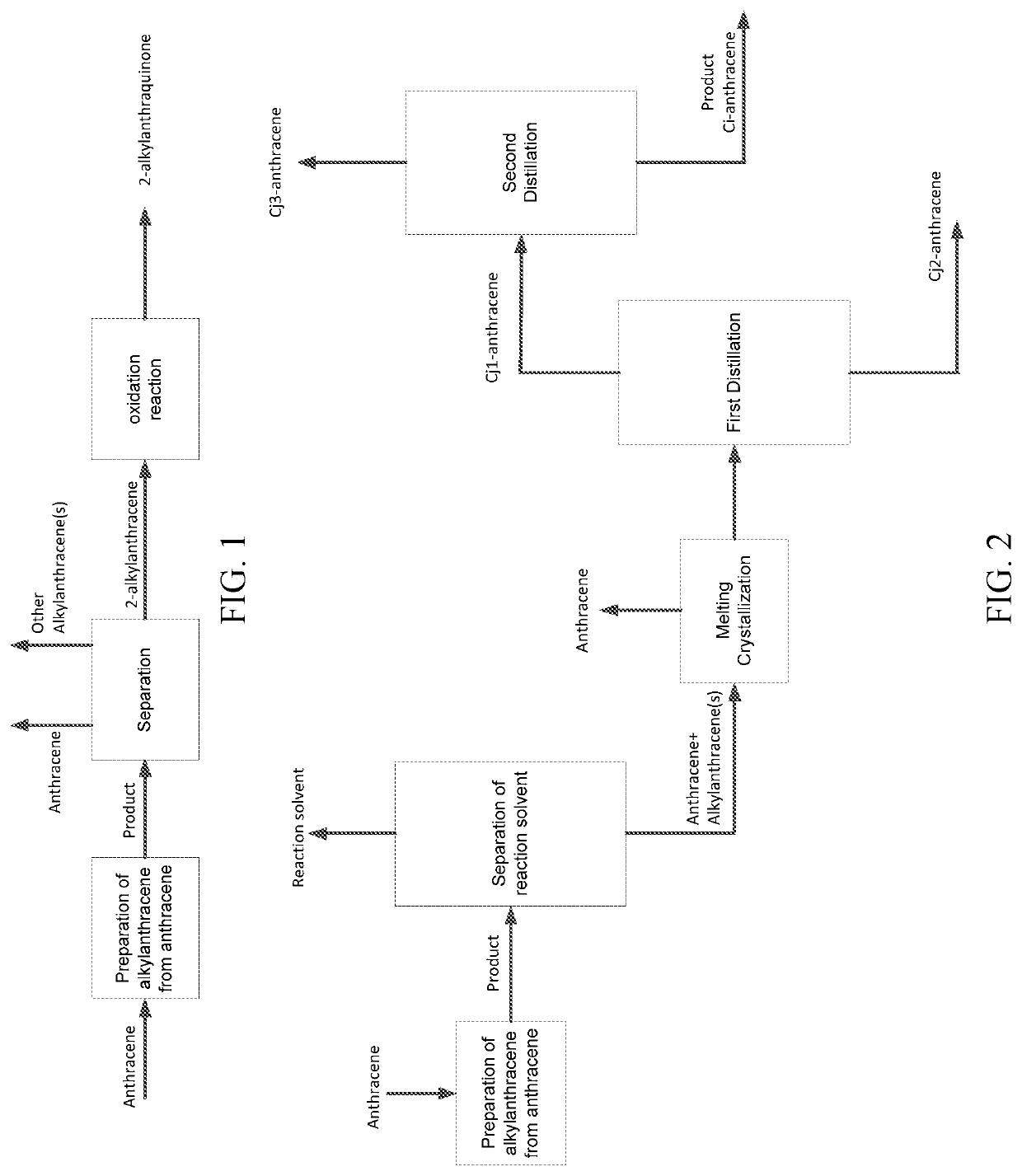
Figure 1 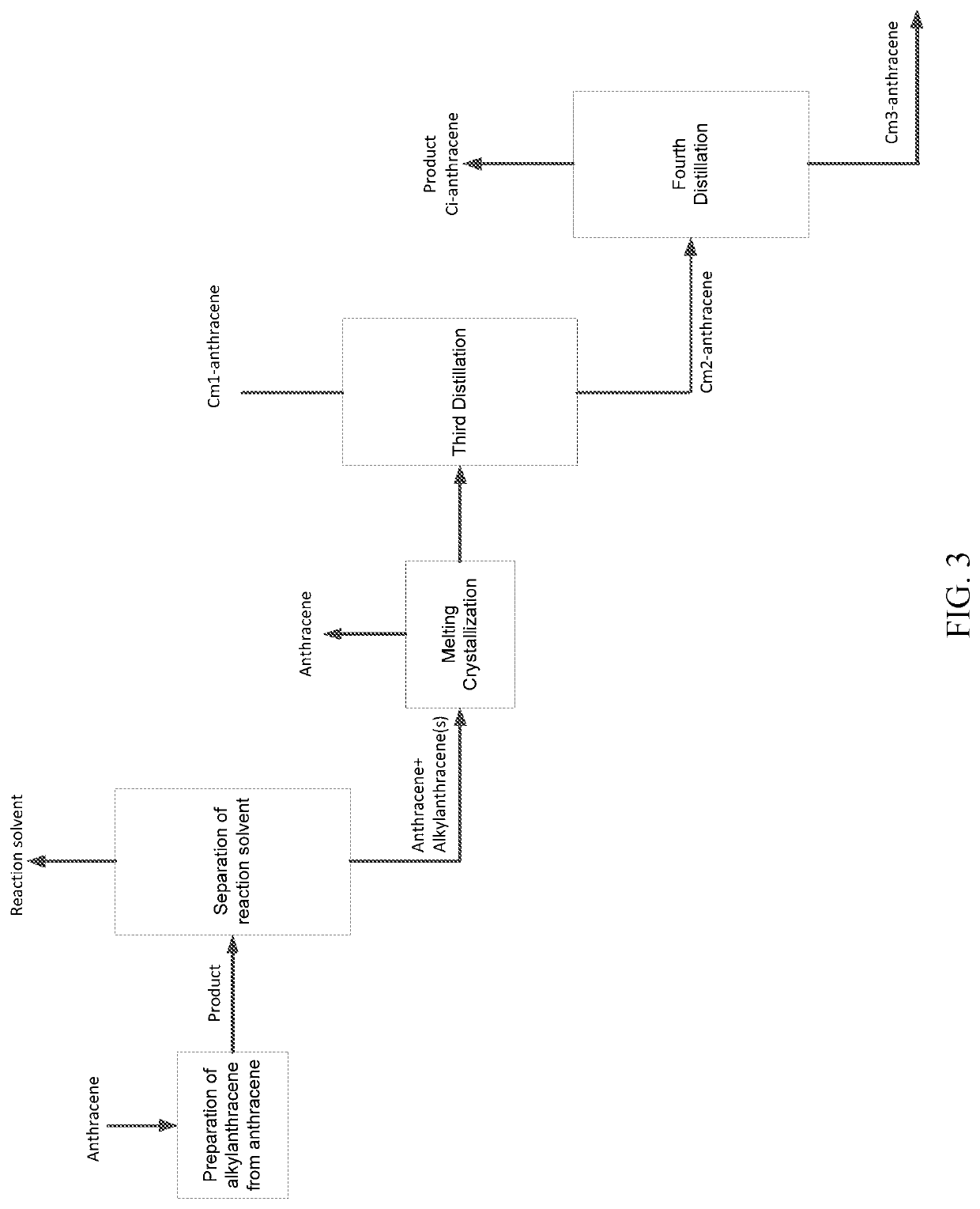
Figure 2 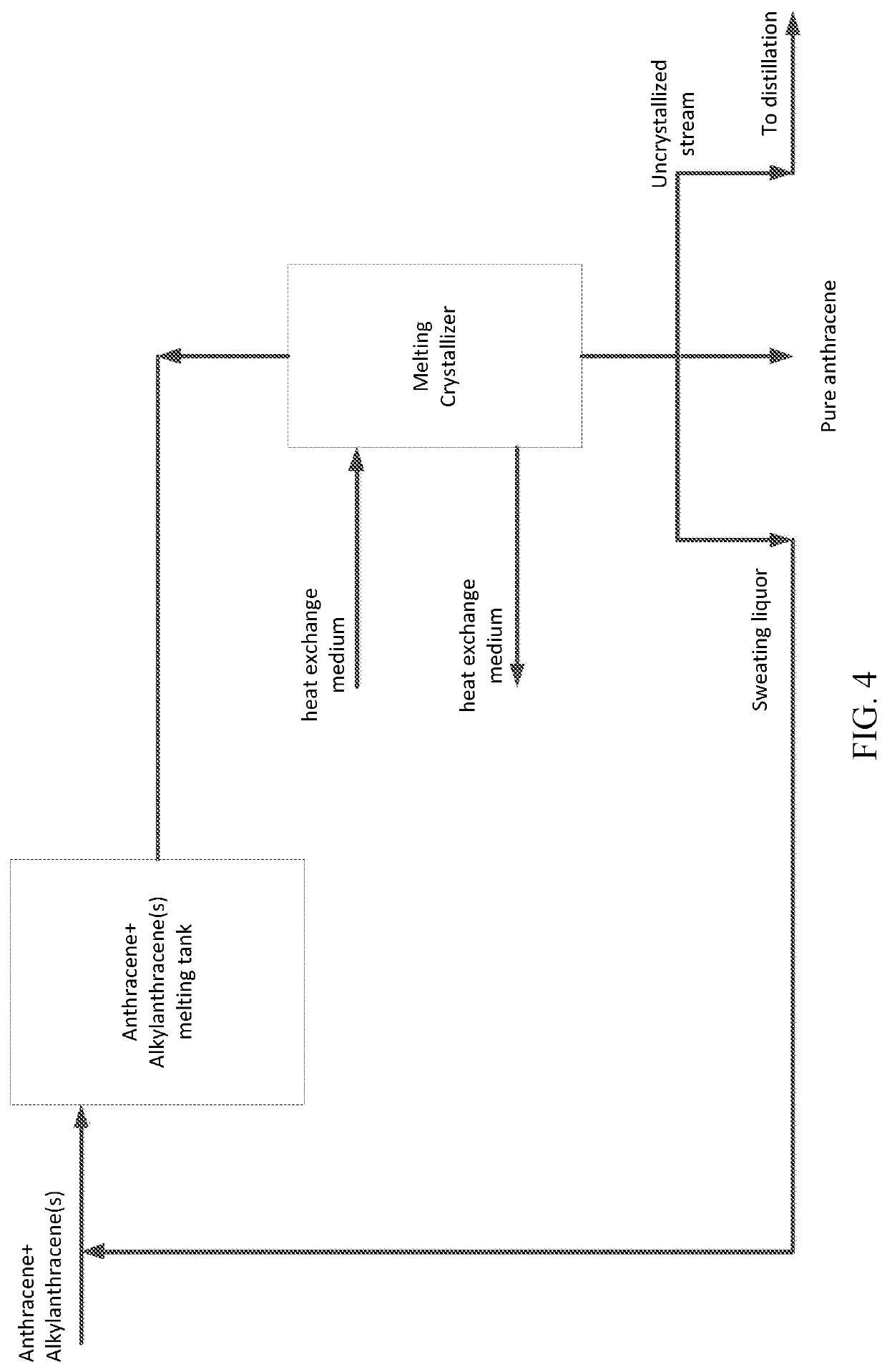
Figure 3
Abstract
Description
TECHNICAL FIELD
[0001] The invention relates to a separation method of 2-alkylanthracene, in particular to a method for preparing 2-alkylanthraquinone by separating 2-alkylanthracene from the reaction (such as alkylation) of anthracene and then carrying out a catalytic oxidation and a pretreatment method of 2-alkylanthraquinone working fluid.BACKGROUND TECHNOLOGY
[0002] Hydrogen peroxide is an important green basic chemical and has high industrial relevance, China becomes the first major country for the production of hydrogen peroxide since 2008, and the consumption is over 10,000,000 t / a (calculated as 27.5%) in 2015. At present, the technology for producing hydrogen peroxide at home and abroad is mainly an anthraquinone method. The 2-alkylanthraquinone in the technology is used as a “carrier” of the technological process, and the quality and the yield of the hydrogen peroxide are directly influenced.
[0003] The phthalic anhydride process is the primary method for producing 2-alkylanthra...
Examples
Example
Example A1
[0514](I) Alkylation Reaction.
[0515]2-pentylanthracene (i.e., 2-tert-pentylanthracene, the same applied hereinafter) was prepared by alkylation of anthracene and isopentene (i.e., 2-isopentene or 2-methyl-2-butene, the same applied hereinafter), wherein mesitylene and N,N-dimethylformamide were used as a combined solvent, the catalyst was a spherical catalyst containing an active Y zeolite, alumina was used as binder, based on the total weight of the catalyst, the content of the active Y zeolite was 82 wt %, the content of the binder was 18 wt %, and the average particle diameter of catalyst particles was 100 μm. 460 g of anthracene, 640 mL of mesitylene, 160 mL of N,N-dimethylformamide, and 205 g of the catalyst were charged into a 2 L stirring tank at room temperature. After sealing, the temperature was raised to 165° C. at the rotation speed of 1000 rpm, and the pressure was 0.3 MPa. 151 g of isopentene was added to the tank by means of a plunger pump at a feeding rate ...
Example
Comparative Example A1
[0521]2-Alkylanthraquinone was prepared according to the method of Example A1, except that in step (I), mesitylene alone was used as the reaction solvent; in step (II), after removing by distillation light components with boiling points less than that of anthracene, anthracene was directly separated by vacuum distillation instead of melting crystallization. The distillation column for separating anthracene was a vacuum distillation system for the separation of anthracene, wherein the column top pressure was 8 KPa, the distillation temperature was 275° C., the theoretical plate number was 20, the top reflux ratio was 0.7. The column bottom distillates were sent to the first vacuum distillation and the second vacuum distillation under the same conditions as in Example A1.
[0522]In step (III), 3000 ml of methanol, 150 g of 2-pentylanthracene, and 307 g of 36 wt % hydrochloric acid were sent to a 5 L glass tank. The reaction was performed under normal pressure at 65...
Example
Example A13
[0556](I) Alkylation Reaction.
[0557]2-pentylanthracene was prepared by alkylation of anthracene and isopentene, wherein mesitylene and N,N-dimethylformamide were used as a combined solvent, the catalyst was a spherical catalyst containing an active Y zeolite, alumina was used as binder, based on the total weight of the catalyst, the content of the active Y zeolite was 82 wt %, the content of the binder was 18 wt %, and the average particle diameter of catalyst particles was 100 μm. 76 g of anthracene, 640 mL of mesitylene, 160 mL of N,N-dimethylformamide, and 333.6 g of the catalyst were charged into a 2 L stirring tank at room temperature. After sealing, the temperature was raised to 110° C. at the rotation speed of 1000 rpm, and the pressure was 0.15 MPa. 60 g of isopentene was added to the tank by means of a plunger pump at a feeding rate of 3 g / min. When the feeding of isopentene was finished, the reaction was continued for 270 min while the reaction condition was kep...