
Laminate web
a laminate web and multi-layer technology, applied in the field of laminate webs, can solve the problems of low laminate quality, low laminate quality, and inability to teach apertured laminate webs containing completely dissimilar materials
Patent Information
- Authority / Receiving Office
- US · United States
- Current Assignee / Owner
- Publication Date
- 2005-04-26
- Estimated Expiration
- Not applicable · inactive patent
Smart Images
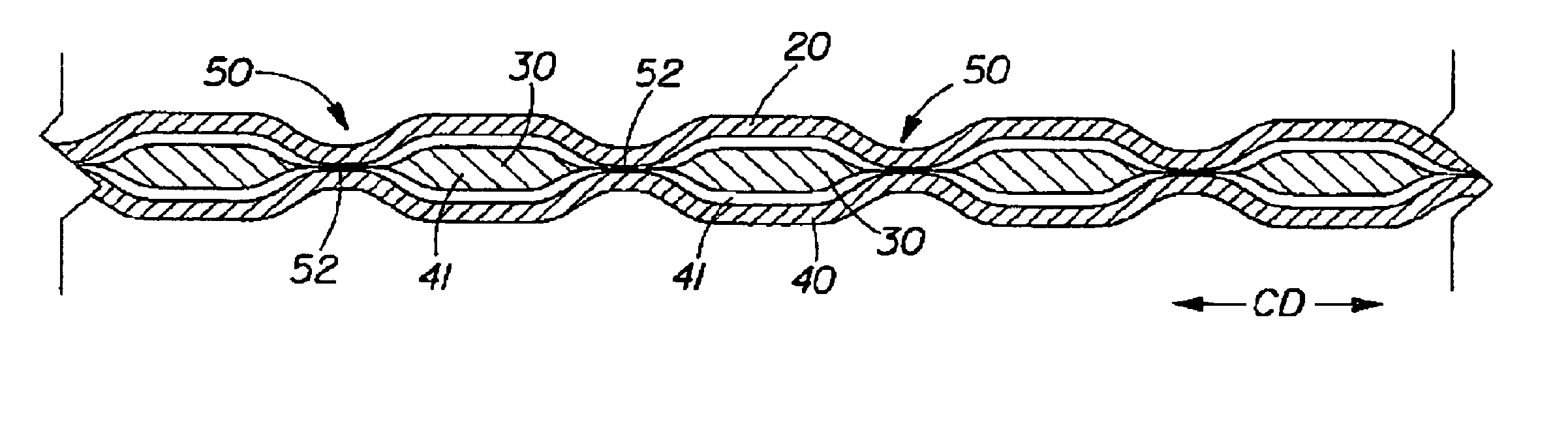
Figure 1 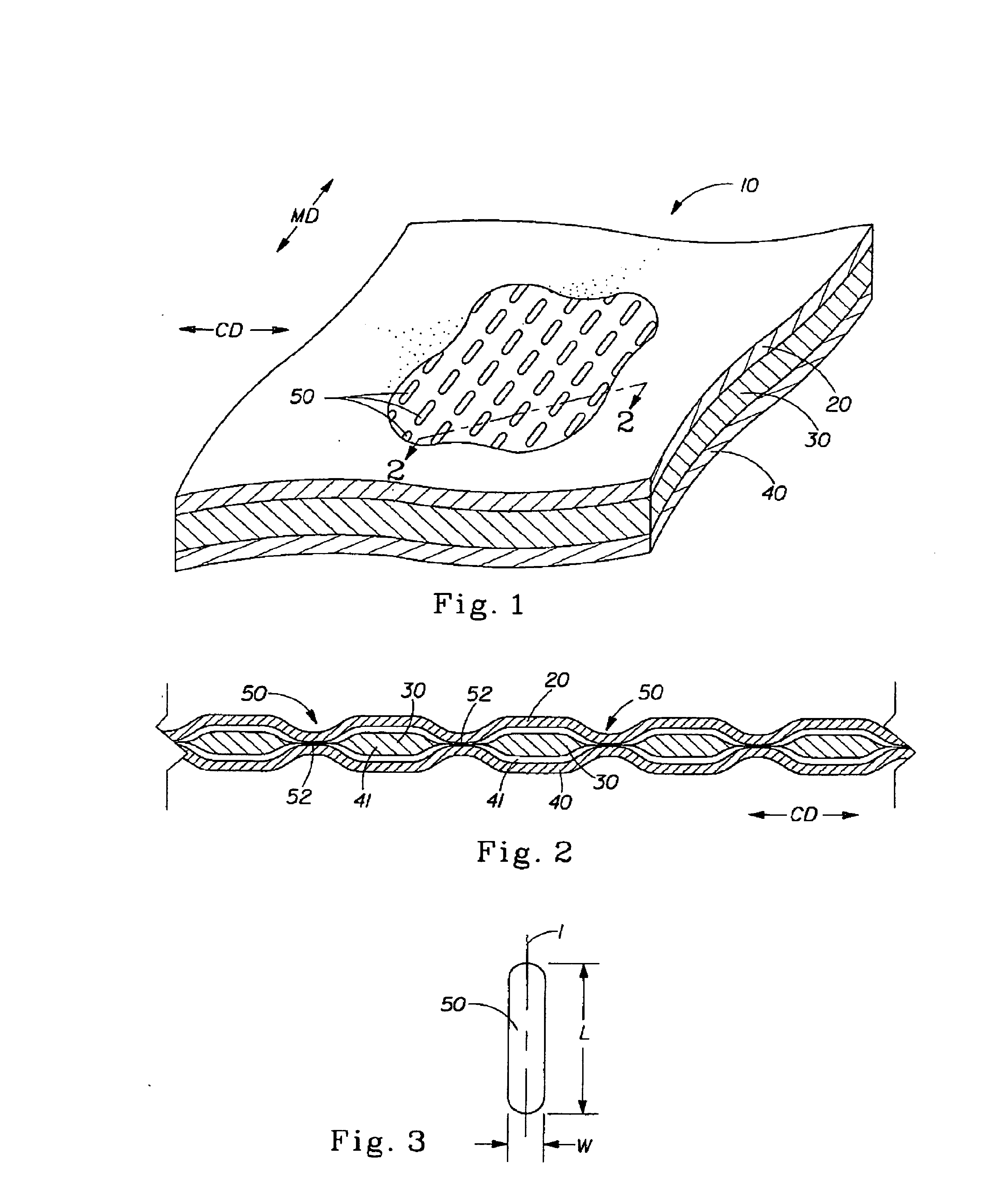
Figure 2 
Figure 3
Abstract
Description
FIELD OF THE INVENTION
[0001] This invention relates to a multilayer laminate web, and more particularly to a laminate web wherein at least a central layer is apertured. In some embodiments the entire multilayer laminate web is apertured.BACKGROUND OF THE INVENTION
[0002] Laminate webs formed by the joining of discrete webs in a layered relationship are well known in the art. For example, often laminate nonwoven webs are utilized in disposable absorbent articles such as diapers and adult incontinence products. Such laminated webs can be used as a topsheet, backsheet, or side panels. One example of a laminate web is a film / nonwoven laminate useful for a stretch side panel of a disposable diaper. Nonwoven / nonwoven laminates are also utilized to provide additional bulk or softness to a web component. Likewise, film / film laminate webs can provide benefits by combining the characteristics of various films in a layered relationship. Laminate webs can also be called composite webs.
[0003] Less c...
Examples
examples
[0093]The following examples are shown in Table 1 as exemplary of the claimed invention. Because the choice of outer and inner layers and combinations is virtually infinite, the examples shown are meant to be illustrative of possible structures, and are not meant to be limiting to any particular material or structure.
[0094]In Table 1 various combinations of materials are shown. The layers are numbered in order of structural proximity from one outer layer to the other. Therefore, layer 1 is always an outer layer, and the last numbered layer is likewise an outer layer.
[0095]For all the samples shown, the calendaring line speed was 100 feet per minute, but the line speed is not considered critical to the operation of the method. The calendaring pressure was 700 psig for all the samples, but the pressure can be varied as desired as long as bonding is achieved between the outer layers.
[0096]To form apertured embodiments of the samples below, the thermally bonded laminate was processed by...