
System and method for moving an object employing piezo actuators
a technology of piezo actuators and actuators, which is applied in the field of system and method of moving an object using piezo actuators, can solve the problems of limited piezo actuator range, large range of linear movement of objects, and limited lengthening or shearing of piezo materials
Patent Information
- Authority / Receiving Office
- US · United States
- Patent Type
- Patents(United States)
- Current Assignee / Owner
- Publication Date
- 2005-12-20
- Estimated Expiration
- Not applicable · inactive patent
Smart Images
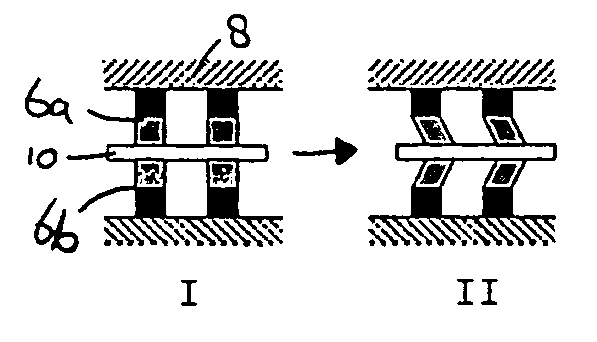
Figure 1 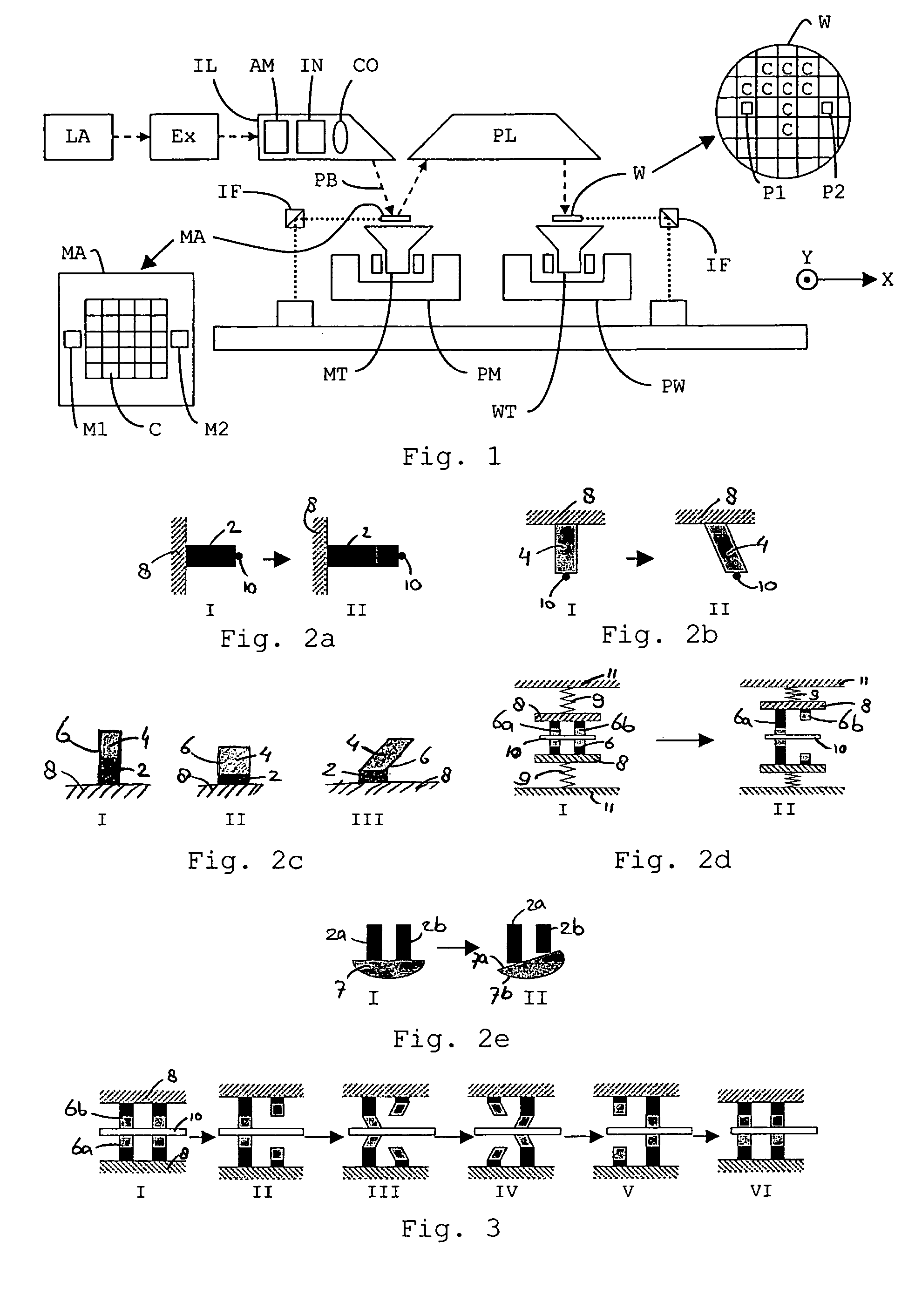
Figure 2 
Figure 3
Abstract
Description
BACKGROUND OF THE INVENTION
[0001] 1. Field of the Invention
[0002] The present invention relates to a system and method for moving an object using piezo actuators and, more particularly, to a system for moving an object associated with lithographic apparatus.
[0003] 2. Description of the Related Art
[0004] A lithographic apparatus is a machine that applies a desired pattern onto a target portion of a substrate. Lithographic apparatus can be used, for example, in the manufacture of integrated circuits (ICs). In that circumstance, a patterning device, such as a mask, may be used to generate a circuit pattern corresponding to an individual layer of the IC, and this pattern can be imaged onto a target portion (e.g. comprising part of, one or several dies) on a substrate (e.g. a silicon wafer) that has a layer of radiation-sensitive material (resist).
[0005] In general, a single substrate will contain a network of adjacent target portions that are successively exposed. Known lithographic apparatu...
Examples
second embodiment
[0074]FIG. 2d (I) illustrates an embodiment of an actuator comprising four piezo actuators 6 as shown in FIG. 2c. An object 10 is engaged by said four piezo actuators 6. The piezo actuators 6 are positioned on a base material 8. The base material 8 is attached to a reference system 11 using springs 9. When no control signal is supplied to the piezo actuators 6, i.e. the piezo actuators 6 are relaxed (I), the object 10 is engaged by the piezo actuators 6 as a result of the spring load. To release the engagement with the object 10, a first piezo actuator 6a may expand while a second piezo actuator 6b contracts, as illustrated in FIG. 2d (II). Thus, the first piezo actuator 6a grips the object 10, while the second piezo actuator 6b releases its engagement.
third embodiment
[0075]FIG. 2e (I) shows another embodiment of a piezo actuator system for moving an object 10. The piezo actuator system comprises two lengthening piezo actuators 2a and 2b, and a semi-circular friction element 7. A flat surface 7a of the friction element 7 is positioned against the piezo actuators 2a and 2b. A convex surface 7b of the friction element 7 may engage an object. As shown in FIG. 2e (II), by expanding one piezo actuator 2a and possibly contracting another piezo actuator 2b, the friction element 7 rotates over a predetermined angle. When the friction element 7 is positioned with its convex surface 7b against an object 10, the object 10 will move due to friction between the friction element 7 and the object 10. Contracting both piezo actuators 2a and 2b releases the engagement of the friction element 7 with the object 10.
[0076]It is noted that in the embodiment shown in FIG. 2e, the piezo actuator system lengthens when both piezo actuators 2a and 2b contract or expand. Th...
fourth embodiment
[0077]FIG. 3 illustrates a prior art system comprising a number of piezo actuators 6, in this case two, for moving an object 10 over a larger distance than the maximum lengthening or shearing of a single piezo actuator 6. In the system shown in FIG. 3, the piezo actuators 6 comprise two sub-actuators 6a, 6b which are positioned opposite to each other. The actuators 6 grip the object 10 by clamping the object 10 between the two sub-actuators 6a and 6b (I).
[0078]In a first step (II) to move the object 10, one of the actuators 6 releases its engagement with the object 10 by contracting away from the object 10. Then, in a second step (III), the actuator 6 still engaging the object 10 shears in a desired movement direction, for example right, while the other actuator 6, still contracted, shears opposite to the movement direction, e.g. left. The actuator 6 engaging the object 10 and shearing in the direction of movement takes the object 10 along, and thus the object 10 moves in the desire...