
Polyarylene sulfide resin composition and a molded article formed therefrom
a polyarylene sulfide resin and composition technology, applied in the direction of special tyres, transportation and packaging, tyre parts, etc., can solve the problems of poor voltage resistance of pps resin, insufficient improvement of voltage resistance, and inability to use pps resin under high voltage, etc., to achieve good balance, improve electric insulation properties, fluidity and toughness
Patent Information
- Authority / Receiving Office
- US · United States
- Patent Type
- Patents(United States)
- Current Assignee / Owner
- Publication Date
- 2013-07-16
- Estimated Expiration
- Not applicable · inactive patent
Smart Images
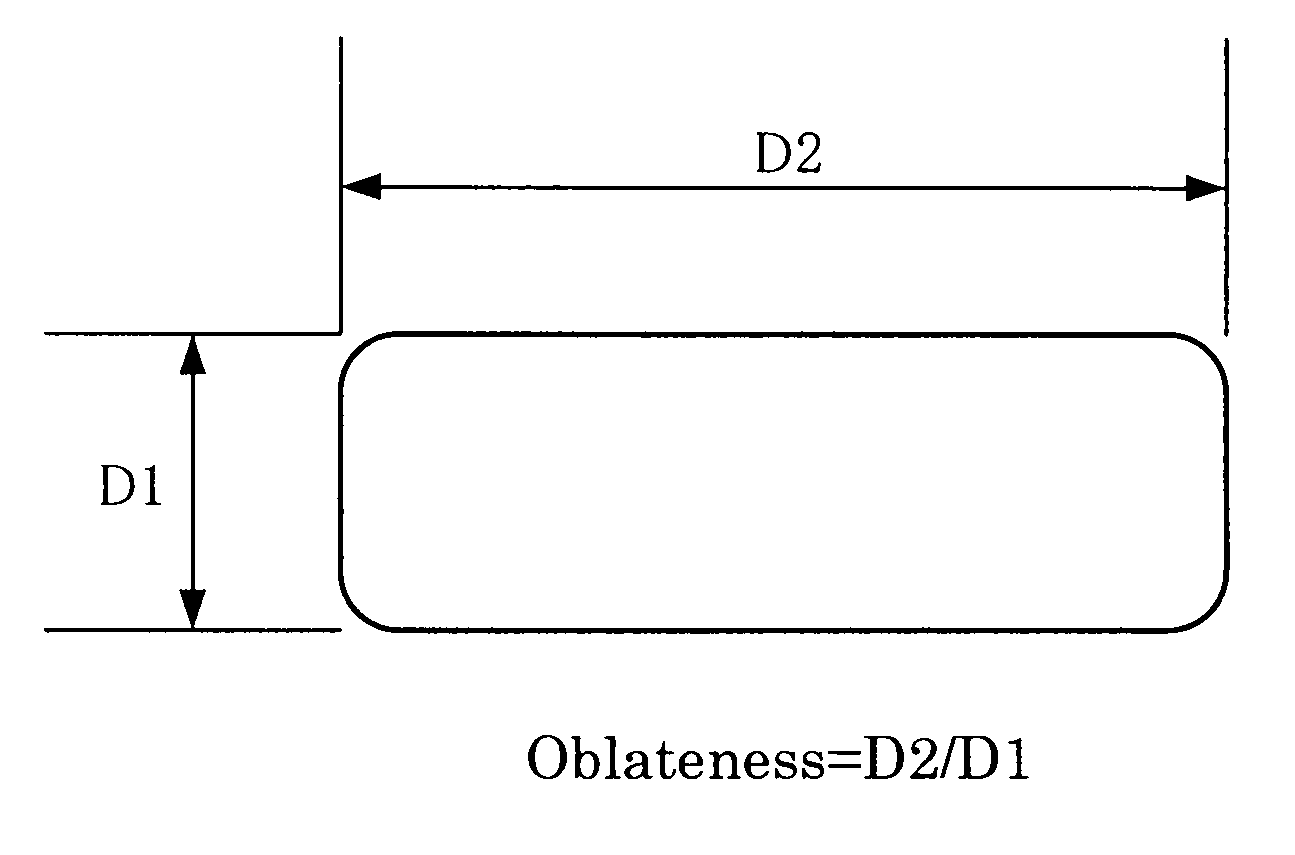
Figure 1 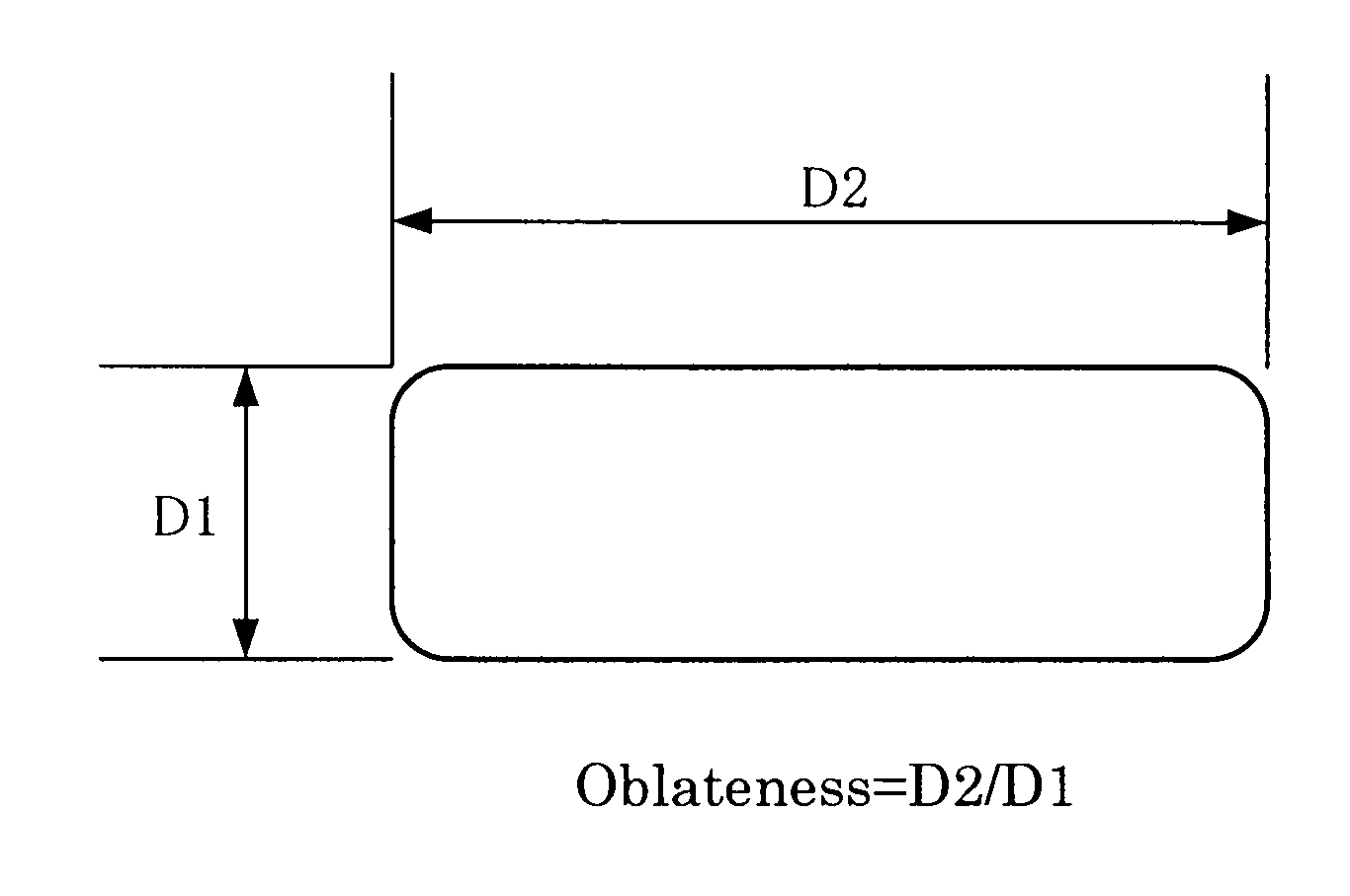
Figure 2 
Figure 3
Abstract
Description
[0001] This application is a 371 of PCT / JP08 / 58406, filed May 2, 2008.TECHNICAL FIELD
[0002] The invention relates to a resin composition and a molded article formed therefrom. More particularly, the invention relates to a resin composition which is improved in voltage resistance, electric insulating properties, heat resistance, heat conductivity, fluidity and toughness in a well-balanced manner, and is suitable for use as electric and electronic components, or the like.BACKGROUND ART
[0003] A polyarylene resin-based resin, in particular, a polyphenylene sulfide resin (hereinafter referred to as a “PPS resin”) is widely used in electric and electronic components, mechanical components, automobile components or the like since it is improved in heat resistance, chemicals resistance, fire retardancy, rigidity, dimensional stability or the like.
[0004] However, as compared with other engineering plastics such as a syndiotactic polystyrene resin (hereinafter referred to as a “SPS resin”), a nyl...
Examples
examples
[0078]The invention will be described in more detail by way of examples.
[0079]In the Examples and Comparative Examples, the following raw materials were used.
[0080]PPS resin: H-1G (manufactured by the DIC Corporation)
[0081]Hexagonal boron nitride: PT110 (average particle diameter, 40 μm, manufactured by Momentive's Quarts & Ceramics)
[0082]Flat glass fibers: CSG 3PA-830 (cross-sectional oblateness, 4, manufactured by Nitto Boseki Co., Ltd.)
[0083]Silica-coated aluminum nitride: FLE (average particle size, 17.4 μm, manufactured by Toyo Aluminum K.K.)
[0084]Silica-coated magnesium oxide: CF2-100B (average particle size, 25 μm, manufactured by Tateho Chemical Industries Co., Ltd.)
[0085]Talc: SP38 (average particle size, 20 μm, manufactured by Fuji Talc Industrial Co., Ltd.)
[0086]Glass fibers: 03JAFT591 (cross-sectional oblateness, 1, manufactured by Owens Corning Corporation)
examples 1 to 4
[0087]Each of the PPS resin and the hexagonal boron nitride was weighted such that the amount ratio shown in Table 1 was attained. These raw materials were dry-blended to form a mixed raw material. Using a twin-axis kneading extruder (TEM37BS, manufactured by Toshiba Machine Co., Ltd.), the raw materials were melt-kneaded at a resin temperature of 320° C. while supplying a suitable amount of flat glass fibers such that the amount ratio shown in Table 1 was attained. The pellets obtained by melt kneading were dried at 120° C. for 3 hours by means of a hot air drier and evaluated. The results obtained are shown in Table 1.
[0088]The evaluation method of the resulting pellets is as follows.
(1) Dielectric Breakdown Strength
[0089]Using an injection molding machine (IS80EPN (80t)) (manufactured by Toshiba Machine Co., Ltd.), a 80×80×1 mm (thickness) square plate molded article formed of the resulting pellets was prepared at a resin temperature and a mold temperature shown in the table. Acc...