

Artificial Intelligence in Perovskite Solar Cell Material Design
AUG 8, 20259 MIN READ
Generate Your Research Report Instantly with AI Agent
PatSnap Eureka helps you evaluate technical feasibility & market potential.
AI in PSC: Background and Objectives
Perovskite solar cells (PSCs) have emerged as a promising technology in the field of photovoltaics, offering the potential for high efficiency, low-cost, and flexible solar energy conversion. The integration of Artificial Intelligence (AI) in PSC material design represents a significant leap forward in accelerating the development and optimization of these next-generation solar cells.
The evolution of PSC technology can be traced back to 2009 when the first perovskite-based solar cell was reported. Since then, the efficiency of PSCs has rapidly increased from an initial 3.8% to over 25% in just a decade, surpassing many traditional photovoltaic technologies. This remarkable progress has been driven by intensive research efforts in material science, device engineering, and fabrication techniques.
AI's role in PSC material design is a relatively recent development, gaining traction in the last five years. The application of machine learning algorithms, particularly deep learning and generative models, has opened up new avenues for rapid material discovery and optimization. These AI-driven approaches are capable of processing vast amounts of experimental and computational data, identifying complex structure-property relationships, and predicting novel perovskite compositions with desired properties.
The primary objective of integrating AI in PSC material design is to overcome the limitations of traditional trial-and-error approaches and accelerate the discovery of high-performance, stable perovskite materials. Specifically, AI aims to address key challenges in PSC development, including improving power conversion efficiency, enhancing long-term stability, and reducing toxicity associated with lead-based perovskites.
AI techniques are being employed to explore the vast chemical space of perovskite materials, which includes thousands of possible combinations of organic and inorganic components. Machine learning models are trained on existing experimental data and first-principles calculations to predict the properties of new perovskite compositions, such as bandgap, carrier mobility, and defect tolerance. These predictions guide researchers towards promising candidates for experimental validation, significantly reducing the time and resources required for material screening.
Furthermore, AI is being utilized to optimize the fabrication processes of PSCs. Neural networks and other machine learning algorithms are employed to analyze and optimize various parameters in the deposition and annealing processes, leading to improved film quality and device performance. This data-driven approach enables the fine-tuning of manufacturing conditions, which is crucial for scaling up PSC production for commercial applications.
As the field progresses, the integration of AI with high-throughput experimentation and in-situ characterization techniques is expected to create a closed-loop system for autonomous materials discovery and optimization. This synergy between AI and advanced experimental methods holds the promise of revolutionizing not only PSC development but also the broader field of materials science and energy technologies.
The evolution of PSC technology can be traced back to 2009 when the first perovskite-based solar cell was reported. Since then, the efficiency of PSCs has rapidly increased from an initial 3.8% to over 25% in just a decade, surpassing many traditional photovoltaic technologies. This remarkable progress has been driven by intensive research efforts in material science, device engineering, and fabrication techniques.
AI's role in PSC material design is a relatively recent development, gaining traction in the last five years. The application of machine learning algorithms, particularly deep learning and generative models, has opened up new avenues for rapid material discovery and optimization. These AI-driven approaches are capable of processing vast amounts of experimental and computational data, identifying complex structure-property relationships, and predicting novel perovskite compositions with desired properties.
The primary objective of integrating AI in PSC material design is to overcome the limitations of traditional trial-and-error approaches and accelerate the discovery of high-performance, stable perovskite materials. Specifically, AI aims to address key challenges in PSC development, including improving power conversion efficiency, enhancing long-term stability, and reducing toxicity associated with lead-based perovskites.
AI techniques are being employed to explore the vast chemical space of perovskite materials, which includes thousands of possible combinations of organic and inorganic components. Machine learning models are trained on existing experimental data and first-principles calculations to predict the properties of new perovskite compositions, such as bandgap, carrier mobility, and defect tolerance. These predictions guide researchers towards promising candidates for experimental validation, significantly reducing the time and resources required for material screening.
Furthermore, AI is being utilized to optimize the fabrication processes of PSCs. Neural networks and other machine learning algorithms are employed to analyze and optimize various parameters in the deposition and annealing processes, leading to improved film quality and device performance. This data-driven approach enables the fine-tuning of manufacturing conditions, which is crucial for scaling up PSC production for commercial applications.
As the field progresses, the integration of AI with high-throughput experimentation and in-situ characterization techniques is expected to create a closed-loop system for autonomous materials discovery and optimization. This synergy between AI and advanced experimental methods holds the promise of revolutionizing not only PSC development but also the broader field of materials science and energy technologies.
Market Analysis for AI-Driven PSC
The market for AI-driven perovskite solar cell (PSC) design is experiencing rapid growth and transformation. As renewable energy becomes increasingly crucial in addressing global climate challenges, the demand for more efficient and cost-effective solar technologies has surged. Perovskite solar cells have emerged as a promising alternative to traditional silicon-based cells, offering potential advantages in efficiency, flexibility, and manufacturing costs.
The global solar photovoltaic market is projected to reach significant value in the coming years, with perovskite solar cells poised to capture a growing share. The integration of artificial intelligence in PSC material design is expected to accelerate this growth by enhancing the efficiency of research and development processes, optimizing material compositions, and improving overall cell performance.
Key market drivers for AI-driven PSC include the increasing focus on sustainable energy solutions, government initiatives promoting clean energy adoption, and the need for more efficient solar technologies. The potential for AI to dramatically reduce the time and cost associated with developing new perovskite materials and optimizing their properties is attracting significant investment from both private and public sectors.
Several industry segments are likely to benefit from advancements in AI-driven PSC technology. These include solar panel manufacturers, building-integrated photovoltaics (BIPV) companies, and energy storage solution providers. The automotive industry is also showing interest in perovskite solar cells for electric vehicle applications, further expanding the potential market.
Geographically, Asia-Pacific is expected to lead the market growth, with China and Japan at the forefront of research and development in perovskite solar cell technology. Europe and North America are also significant markets, driven by strong environmental policies and investment in renewable energy infrastructure.
Despite the promising outlook, challenges remain in the widespread adoption of AI-driven PSC technology. These include concerns about the long-term stability of perovskite materials, scalability of production processes, and the need for standardization in AI algorithms and data sharing within the industry.
The competitive landscape is characterized by a mix of established solar companies investing in perovskite research and AI startups specializing in materials science. Collaborations between academic institutions, research laboratories, and industry players are becoming increasingly common, fostering innovation and accelerating market development.
As the technology matures, we can expect to see a shift from research-focused activities to commercial applications. This transition will likely be accompanied by increased merger and acquisition activity, as larger companies seek to incorporate AI-driven PSC expertise into their existing solar portfolios.
The global solar photovoltaic market is projected to reach significant value in the coming years, with perovskite solar cells poised to capture a growing share. The integration of artificial intelligence in PSC material design is expected to accelerate this growth by enhancing the efficiency of research and development processes, optimizing material compositions, and improving overall cell performance.
Key market drivers for AI-driven PSC include the increasing focus on sustainable energy solutions, government initiatives promoting clean energy adoption, and the need for more efficient solar technologies. The potential for AI to dramatically reduce the time and cost associated with developing new perovskite materials and optimizing their properties is attracting significant investment from both private and public sectors.
Several industry segments are likely to benefit from advancements in AI-driven PSC technology. These include solar panel manufacturers, building-integrated photovoltaics (BIPV) companies, and energy storage solution providers. The automotive industry is also showing interest in perovskite solar cells for electric vehicle applications, further expanding the potential market.
Geographically, Asia-Pacific is expected to lead the market growth, with China and Japan at the forefront of research and development in perovskite solar cell technology. Europe and North America are also significant markets, driven by strong environmental policies and investment in renewable energy infrastructure.
Despite the promising outlook, challenges remain in the widespread adoption of AI-driven PSC technology. These include concerns about the long-term stability of perovskite materials, scalability of production processes, and the need for standardization in AI algorithms and data sharing within the industry.
The competitive landscape is characterized by a mix of established solar companies investing in perovskite research and AI startups specializing in materials science. Collaborations between academic institutions, research laboratories, and industry players are becoming increasingly common, fostering innovation and accelerating market development.
As the technology matures, we can expect to see a shift from research-focused activities to commercial applications. This transition will likely be accompanied by increased merger and acquisition activity, as larger companies seek to incorporate AI-driven PSC expertise into their existing solar portfolios.
Current AI Applications in PSC Design
Artificial Intelligence (AI) has emerged as a powerful tool in the design and optimization of perovskite solar cells (PSCs). Current applications of AI in PSC design span various aspects of the development process, from material discovery to performance prediction and optimization.
Machine learning algorithms, particularly deep learning models, are being employed to predict the properties of perovskite materials. These models can rapidly screen thousands of potential perovskite compositions, significantly accelerating the discovery of new, high-performance materials. By analyzing vast datasets of known perovskites and their properties, AI can identify patterns and correlations that human researchers might overlook, leading to the identification of promising candidates for further experimental investigation.
In the realm of device architecture optimization, AI-driven simulations are being used to model the complex interplay between different layers in PSCs. These simulations can predict how changes in layer thickness, composition, and interface properties affect overall device performance. This approach allows researchers to explore a wide range of design parameters virtually, reducing the need for time-consuming and costly experimental iterations.
AI is also being applied to image analysis in PSC research. Convolutional neural networks are being used to analyze microscopy images of perovskite films, automatically detecting defects, grain boundaries, and other microstructural features that impact cell performance. This automated analysis can provide rapid feedback on film quality and uniformity, guiding process optimization efforts.
Another significant application of AI in PSC design is in the optimization of fabrication processes. Machine learning models are being developed to predict the optimal processing conditions for perovskite deposition, taking into account factors such as temperature, humidity, and solvent composition. These models can suggest process parameters that lead to improved film quality and device performance, even in the face of complex, multi-variable interactions.
Predictive maintenance and quality control in PSC production are also benefiting from AI applications. By analyzing real-time data from production lines, AI algorithms can detect anomalies and predict potential issues before they lead to defects or reduced efficiency. This proactive approach can significantly improve manufacturing yield and consistency.
Lastly, AI is playing a crucial role in the interpretation and analysis of characterization data from PSCs. Machine learning algorithms are being used to extract meaningful insights from complex spectroscopic and electrical measurements, helping researchers better understand the fundamental properties and behavior of perovskite materials and devices.
Machine learning algorithms, particularly deep learning models, are being employed to predict the properties of perovskite materials. These models can rapidly screen thousands of potential perovskite compositions, significantly accelerating the discovery of new, high-performance materials. By analyzing vast datasets of known perovskites and their properties, AI can identify patterns and correlations that human researchers might overlook, leading to the identification of promising candidates for further experimental investigation.
In the realm of device architecture optimization, AI-driven simulations are being used to model the complex interplay between different layers in PSCs. These simulations can predict how changes in layer thickness, composition, and interface properties affect overall device performance. This approach allows researchers to explore a wide range of design parameters virtually, reducing the need for time-consuming and costly experimental iterations.
AI is also being applied to image analysis in PSC research. Convolutional neural networks are being used to analyze microscopy images of perovskite films, automatically detecting defects, grain boundaries, and other microstructural features that impact cell performance. This automated analysis can provide rapid feedback on film quality and uniformity, guiding process optimization efforts.
Another significant application of AI in PSC design is in the optimization of fabrication processes. Machine learning models are being developed to predict the optimal processing conditions for perovskite deposition, taking into account factors such as temperature, humidity, and solvent composition. These models can suggest process parameters that lead to improved film quality and device performance, even in the face of complex, multi-variable interactions.
Predictive maintenance and quality control in PSC production are also benefiting from AI applications. By analyzing real-time data from production lines, AI algorithms can detect anomalies and predict potential issues before they lead to defects or reduced efficiency. This proactive approach can significantly improve manufacturing yield and consistency.
Lastly, AI is playing a crucial role in the interpretation and analysis of characterization data from PSCs. Machine learning algorithms are being used to extract meaningful insights from complex spectroscopic and electrical measurements, helping researchers better understand the fundamental properties and behavior of perovskite materials and devices.
AI-Enabled PSC Design Solutions
01 Perovskite material composition optimization
Researchers are focusing on optimizing the composition of perovskite materials to enhance their stability and efficiency. This includes exploring various combinations of organic and inorganic components, as well as investigating the effects of different cations and anions on the overall performance of the solar cells.- Perovskite material composition optimization: Researchers are focusing on optimizing the composition of perovskite materials to enhance the efficiency and stability of solar cells. This includes exploring various combinations of organic and inorganic components, as well as investigating the effects of different cations and anions on the material's properties.
- Interface engineering for improved performance: Interface engineering techniques are being developed to enhance charge transport and reduce recombination losses in perovskite solar cells. This involves designing and implementing novel electron and hole transport layers, as well as optimizing the interfaces between different layers in the device structure.
- Tandem and multi-junction perovskite solar cell designs: Researchers are exploring tandem and multi-junction perovskite solar cell designs to achieve higher efficiencies by combining perovskite materials with other photovoltaic technologies. This approach allows for better utilization of the solar spectrum and potentially higher overall conversion efficiencies.
- Stability enhancement strategies: Various strategies are being developed to improve the long-term stability of perovskite solar cells. These include encapsulation techniques, incorporation of additives, and development of moisture-resistant perovskite compositions to address degradation issues and extend device lifetimes.
- Large-scale fabrication and commercialization: Efforts are being made to develop scalable manufacturing processes for perovskite solar cells, including roll-to-roll printing and other large-area deposition techniques. This research aims to bridge the gap between laboratory-scale devices and commercial production, addressing challenges related to uniformity, reproducibility, and cost-effectiveness.
02 Interface engineering for improved charge transport
Developing effective interface materials and structures is crucial for enhancing charge transport and reducing recombination losses in perovskite solar cells. This involves designing and implementing novel electron and hole transport layers, as well as optimizing the interfaces between different layers of the device.Expand Specific Solutions03 Tandem and multi-junction perovskite solar cell designs
Researchers are exploring tandem and multi-junction architectures that combine perovskite materials with other photovoltaic technologies to achieve higher overall efficiencies. This approach allows for better utilization of the solar spectrum and can potentially overcome the theoretical efficiency limits of single-junction cells.Expand Specific Solutions04 Nanostructured perovskite materials
Incorporating nanostructures into perovskite materials is being investigated as a means to enhance light absorption, charge collection, and overall device performance. This includes the development of quantum dots, nanowires, and other nanostructured forms of perovskite materials for solar cell applications.Expand Specific Solutions05 Encapsulation and stability enhancement techniques
Improving the long-term stability of perovskite solar cells is a critical area of research. This involves developing effective encapsulation methods and materials to protect the perovskite layer from environmental factors, as well as exploring additives and modifications to the perovskite structure itself to enhance its intrinsic stability.Expand Specific Solutions
Key Players in AI-PSC Integration
The field of Artificial Intelligence in Perovskite Solar Cell Material Design is in an early growth stage, with significant potential for expansion. The market size is rapidly increasing as renewable energy demands grow globally. Technologically, it's still evolving, with varying levels of maturity among key players. Companies like Contemporary Amperex Technology Co., Ltd. and Panasonic Intellectual Property Management Co. Ltd. are leveraging their expertise in battery technology to advance AI-driven perovskite solar cell design. Academic institutions such as Massachusetts Institute of Technology and Nanyang Technological University are at the forefront of research, while specialized entities like CSEM Centre Suisse d'Electronique et Microtechnique SA are bridging the gap between research and commercialization. The competitive landscape is diverse, with a mix of established tech giants, innovative startups, and research-focused organizations collaborating and competing to drive technological advancements in this promising field.
Massachusetts Institute of Technology
Technical Solution: MIT has developed an AI-driven approach for perovskite solar cell material design, utilizing machine learning algorithms to predict and optimize the composition and structure of perovskite materials. Their method employs a combination of high-throughput experimental data and computational modeling to rapidly screen thousands of potential perovskite compositions[1]. The AI system can predict key properties such as bandgap, stability, and power conversion efficiency with high accuracy. MIT's approach also incorporates a feedback loop that continuously improves the AI model's predictions based on experimental results[3].
Strengths: Rapid screening of materials, high accuracy in property prediction, and continuous improvement through feedback. Weaknesses: Reliance on large datasets and computational resources, potential for overlooking unconventional but promising compositions.
Kaneka Corp.
Technical Solution: Kaneka has developed an AI-driven approach for tandem perovskite-silicon solar cell optimization. Their method uses machine learning algorithms to optimize the interface properties and layer thicknesses in tandem cell structures[9]. The AI system can predict the performance of various tandem configurations and suggest optimal designs for maximizing overall efficiency. Kaneka's approach also incorporates cost and manufacturability considerations into the optimization process[10].
Strengths: Focus on commercially relevant tandem structures, consideration of cost and manufacturability. Weaknesses: Specificity to tandem structures may limit applicability to other perovskite solar cell types.
Breakthrough AI Algorithms for PSC
Method and apparatus for designing solar cell using artificial intelligence
PatentActiveKR1020230057130A
Innovation
- An apparatus and method using artificial intelligence to predict and provide an optimal combination of solar cell components by randomly selecting amounts and types of components, analyzing output results, and recommending combinations that meet specified conditions.


Design and implementation of solar cells that are based on perovskite and organic materials for increasing the absorption capacity
PatentPendingIN202221024026A
Innovation
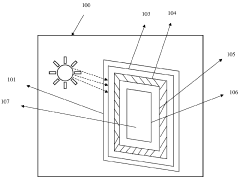
- A framework for solar cells is developed that integrates perovskite and organic materials, featuring multiple layers including a transparent conductive oxide layer, electron conductor, perovskite layer, and organic tandem solar cells to enhance absorption and conversion of solar energy into electrical energy.
Environmental Impact of AI-PSC
The integration of Artificial Intelligence (AI) in Perovskite Solar Cell (PSC) material design brings significant environmental implications that warrant careful consideration. While AI-driven PSC development offers promising advancements in renewable energy technology, it also introduces complex environmental trade-offs that must be thoroughly evaluated.
One of the primary environmental benefits of AI-PSC is the potential for increased solar cell efficiency and longevity. By optimizing material compositions and manufacturing processes, AI can help create more durable and higher-performing solar cells. This improvement in efficiency translates to a reduced need for raw materials and energy during production, ultimately lowering the overall environmental footprint of solar energy systems.
However, the environmental impact of AI-PSC extends beyond just improved efficiency. The use of AI in material design may lead to the discovery of novel perovskite compositions that are more environmentally friendly. Traditional perovskite solar cells often contain lead, which poses potential environmental and health risks. AI-driven research could potentially identify lead-free alternatives or develop encapsulation techniques that mitigate the risk of lead leaching, thereby reducing the long-term environmental impact of PSC deployment.
The application of AI in PSC manufacturing processes also has the potential to optimize resource utilization and reduce waste. Machine learning algorithms can fine-tune production parameters, leading to more precise material deposition and reduced material wastage. This optimization not only conserves resources but also minimizes the environmental impact associated with the disposal of manufacturing by-products.
Nevertheless, the environmental benefits of AI-PSC must be weighed against the potential drawbacks. The increased computational power required for AI-driven material design and optimization contributes to higher energy consumption in the research and development phase. This energy demand could potentially offset some of the environmental gains achieved through improved solar cell performance.
Furthermore, the rapid advancement of AI-PSC technology may accelerate the obsolescence of existing solar panel installations, potentially leading to increased electronic waste. The environmental impact of disposing of or recycling these outdated panels must be carefully managed to ensure that the net environmental benefit of AI-PSC remains positive.
In conclusion, while AI-PSC holds great promise for advancing sustainable energy solutions, its environmental impact is multifaceted. The technology offers significant potential for improving solar cell efficiency, reducing harmful materials, and optimizing manufacturing processes. However, these benefits must be balanced against the increased energy demands of AI research and the potential for accelerated electronic waste generation. As the field progresses, ongoing assessment and mitigation of these environmental factors will be crucial to ensuring that AI-PSC truly contributes to a more sustainable future.
One of the primary environmental benefits of AI-PSC is the potential for increased solar cell efficiency and longevity. By optimizing material compositions and manufacturing processes, AI can help create more durable and higher-performing solar cells. This improvement in efficiency translates to a reduced need for raw materials and energy during production, ultimately lowering the overall environmental footprint of solar energy systems.
However, the environmental impact of AI-PSC extends beyond just improved efficiency. The use of AI in material design may lead to the discovery of novel perovskite compositions that are more environmentally friendly. Traditional perovskite solar cells often contain lead, which poses potential environmental and health risks. AI-driven research could potentially identify lead-free alternatives or develop encapsulation techniques that mitigate the risk of lead leaching, thereby reducing the long-term environmental impact of PSC deployment.
The application of AI in PSC manufacturing processes also has the potential to optimize resource utilization and reduce waste. Machine learning algorithms can fine-tune production parameters, leading to more precise material deposition and reduced material wastage. This optimization not only conserves resources but also minimizes the environmental impact associated with the disposal of manufacturing by-products.
Nevertheless, the environmental benefits of AI-PSC must be weighed against the potential drawbacks. The increased computational power required for AI-driven material design and optimization contributes to higher energy consumption in the research and development phase. This energy demand could potentially offset some of the environmental gains achieved through improved solar cell performance.
Furthermore, the rapid advancement of AI-PSC technology may accelerate the obsolescence of existing solar panel installations, potentially leading to increased electronic waste. The environmental impact of disposing of or recycling these outdated panels must be carefully managed to ensure that the net environmental benefit of AI-PSC remains positive.
In conclusion, while AI-PSC holds great promise for advancing sustainable energy solutions, its environmental impact is multifaceted. The technology offers significant potential for improving solar cell efficiency, reducing harmful materials, and optimizing manufacturing processes. However, these benefits must be balanced against the increased energy demands of AI research and the potential for accelerated electronic waste generation. As the field progresses, ongoing assessment and mitigation of these environmental factors will be crucial to ensuring that AI-PSC truly contributes to a more sustainable future.
Scalability of AI-Driven PSC Production
The scalability of AI-driven perovskite solar cell (PSC) production represents a critical factor in the widespread adoption and commercialization of this promising technology. As AI continues to revolutionize material design and manufacturing processes, its integration into PSC production offers significant potential for enhancing efficiency, reducing costs, and accelerating the transition to sustainable energy solutions.
One of the primary advantages of AI-driven PSC production lies in its ability to optimize material composition and fabrication parameters at scale. Machine learning algorithms can analyze vast datasets of experimental results and theoretical predictions, identifying optimal combinations of materials and processing conditions that maximize cell efficiency and stability. This data-driven approach enables rapid iteration and refinement of PSC designs, potentially reducing the time and resources required for large-scale production.
Furthermore, AI can play a crucial role in quality control and process monitoring during PSC manufacturing. Computer vision systems and predictive analytics can detect defects and anomalies in real-time, allowing for immediate adjustments to production parameters. This level of precision and adaptability is particularly valuable for PSC fabrication, where subtle variations in environmental conditions or material properties can significantly impact cell performance.
The scalability of AI-driven PSC production is also enhanced by the technology's ability to optimize supply chain management and resource allocation. Predictive models can forecast demand, manage inventory, and streamline logistics, ensuring a steady supply of materials and components for large-scale manufacturing operations. This integration of AI across the entire production ecosystem can lead to substantial improvements in overall efficiency and cost-effectiveness.
However, challenges remain in fully realizing the scalability of AI-driven PSC production. The development of robust, generalizable AI models that can adapt to different production environments and material systems is an ongoing area of research. Additionally, the integration of AI systems with existing manufacturing infrastructure and the training of personnel to effectively utilize these tools present logistical hurdles that must be addressed.
Despite these challenges, the potential for AI to drive scalable PSC production is immense. As the technology continues to mature and computational resources become increasingly accessible, the integration of AI into PSC manufacturing processes is poised to accelerate the commercialization of this promising solar technology, potentially revolutionizing the renewable energy landscape.
One of the primary advantages of AI-driven PSC production lies in its ability to optimize material composition and fabrication parameters at scale. Machine learning algorithms can analyze vast datasets of experimental results and theoretical predictions, identifying optimal combinations of materials and processing conditions that maximize cell efficiency and stability. This data-driven approach enables rapid iteration and refinement of PSC designs, potentially reducing the time and resources required for large-scale production.
Furthermore, AI can play a crucial role in quality control and process monitoring during PSC manufacturing. Computer vision systems and predictive analytics can detect defects and anomalies in real-time, allowing for immediate adjustments to production parameters. This level of precision and adaptability is particularly valuable for PSC fabrication, where subtle variations in environmental conditions or material properties can significantly impact cell performance.
The scalability of AI-driven PSC production is also enhanced by the technology's ability to optimize supply chain management and resource allocation. Predictive models can forecast demand, manage inventory, and streamline logistics, ensuring a steady supply of materials and components for large-scale manufacturing operations. This integration of AI across the entire production ecosystem can lead to substantial improvements in overall efficiency and cost-effectiveness.
However, challenges remain in fully realizing the scalability of AI-driven PSC production. The development of robust, generalizable AI models that can adapt to different production environments and material systems is an ongoing area of research. Additionally, the integration of AI systems with existing manufacturing infrastructure and the training of personnel to effectively utilize these tools present logistical hurdles that must be addressed.
Despite these challenges, the potential for AI to drive scalable PSC production is immense. As the technology continues to mature and computational resources become increasingly accessible, the integration of AI into PSC manufacturing processes is poised to accelerate the commercialization of this promising solar technology, potentially revolutionizing the renewable energy landscape.
Unlock deeper insights with PatSnap Eureka Quick Research — get a full tech report to explore trends and direct your research. Try now!
Generate Your Research Report Instantly with AI Agent
Supercharge your innovation with PatSnap Eureka AI Agent Platform!