
Band Pass Filter vs Non-causal Filter: System Delay Minimization
MAR 25, 20269 MIN READ
Generate Your Research Report Instantly with AI Agent
Patsnap Eureka helps you evaluate technical feasibility & market potential.
Band Pass vs Non-causal Filter Background and Objectives
Digital signal processing systems have long grappled with the fundamental trade-off between filtering performance and system latency. Traditional band pass filters, while effective at isolating desired frequency components, introduce inherent delays that can significantly impact real-time applications. This challenge has become increasingly critical as modern systems demand both high-fidelity signal processing and minimal latency constraints.
The evolution of filtering technologies has witnessed a paradigm shift from purely causal implementations toward more sophisticated approaches that challenge conventional temporal constraints. Band pass filters, rooted in classical signal processing theory, operate under strict causality principles where output depends solely on current and past input samples. This fundamental limitation creates unavoidable group delays, particularly problematic in applications requiring instantaneous response.
Non-causal filtering represents a revolutionary departure from traditional approaches by leveraging future signal information to achieve superior performance characteristics. These systems can theoretically eliminate phase distortion and significantly reduce overall system delay by processing signals bidirectionally or through predictive algorithms. The mathematical foundation allows for zero-phase filtering, where the filter's impulse response is symmetric around the time origin.
The primary objective of comparing these filtering paradigms centers on quantifying and minimizing system delay while maintaining acceptable signal quality metrics. This involves comprehensive analysis of group delay characteristics, phase linearity, and computational complexity trade-offs. Understanding how each approach handles different signal types and frequency distributions becomes crucial for optimal system design.
Contemporary applications driving this research include high-frequency trading systems, real-time audio processing, telecommunications infrastructure, and control systems where microsecond-level delays can have substantial consequences. The increasing prevalence of edge computing and IoT devices further amplifies the importance of delay optimization in resource-constrained environments.
The technical challenge extends beyond simple delay reduction to encompass stability considerations, implementation complexity, and power consumption implications. Non-causal systems, while theoretically superior in delay performance, introduce practical challenges including buffer requirements, computational overhead, and potential stability issues that must be carefully evaluated against their benefits.
The evolution of filtering technologies has witnessed a paradigm shift from purely causal implementations toward more sophisticated approaches that challenge conventional temporal constraints. Band pass filters, rooted in classical signal processing theory, operate under strict causality principles where output depends solely on current and past input samples. This fundamental limitation creates unavoidable group delays, particularly problematic in applications requiring instantaneous response.
Non-causal filtering represents a revolutionary departure from traditional approaches by leveraging future signal information to achieve superior performance characteristics. These systems can theoretically eliminate phase distortion and significantly reduce overall system delay by processing signals bidirectionally or through predictive algorithms. The mathematical foundation allows for zero-phase filtering, where the filter's impulse response is symmetric around the time origin.
The primary objective of comparing these filtering paradigms centers on quantifying and minimizing system delay while maintaining acceptable signal quality metrics. This involves comprehensive analysis of group delay characteristics, phase linearity, and computational complexity trade-offs. Understanding how each approach handles different signal types and frequency distributions becomes crucial for optimal system design.
Contemporary applications driving this research include high-frequency trading systems, real-time audio processing, telecommunications infrastructure, and control systems where microsecond-level delays can have substantial consequences. The increasing prevalence of edge computing and IoT devices further amplifies the importance of delay optimization in resource-constrained environments.
The technical challenge extends beyond simple delay reduction to encompass stability considerations, implementation complexity, and power consumption implications. Non-causal systems, while theoretically superior in delay performance, introduce practical challenges including buffer requirements, computational overhead, and potential stability issues that must be carefully evaluated against their benefits.
Market Demand for Low-Latency Signal Processing Systems
The telecommunications industry represents the largest market segment driving demand for low-latency signal processing systems, particularly in 5G and beyond wireless networks. Modern cellular base stations require sophisticated filtering mechanisms that can process signals with minimal delay while maintaining signal integrity across multiple frequency bands. The transition from traditional band pass filters to advanced non-causal filtering approaches has become critical as network operators strive to meet stringent latency requirements for applications such as autonomous vehicle communication and industrial IoT.
Financial trading platforms constitute another significant market driver, where microsecond-level delays can translate to substantial financial losses. High-frequency trading systems demand signal processing solutions that can minimize system delay while preserving the accuracy of market data feeds. The competition between traditional filtering methods and emerging non-causal approaches has intensified as trading firms seek competitive advantages through reduced signal processing latency.
The automotive sector's evolution toward autonomous vehicles has created unprecedented demand for real-time signal processing capabilities. Advanced driver assistance systems and vehicle-to-everything communication protocols require filtering solutions that can process sensor data and communication signals with minimal delay. The choice between band pass filters and non-causal filtering architectures directly impacts vehicle safety systems and their ability to respond to dynamic road conditions.
Medical device manufacturers increasingly require low-latency signal processing for critical applications such as real-time patient monitoring and surgical robotics. The healthcare industry's adoption of telemedicine and remote surgical procedures has amplified the need for signal processing systems that can maintain both accuracy and minimal delay. Regulatory requirements in medical applications add complexity to the selection between different filtering approaches.
Industrial automation and smart manufacturing sectors represent rapidly growing markets for low-latency signal processing systems. Factory automation systems, robotic control networks, and predictive maintenance applications require real-time data processing capabilities where system delay minimization directly affects production efficiency and equipment safety. The integration of artificial intelligence and machine learning algorithms in industrial settings further emphasizes the importance of optimized signal processing architectures.
Financial trading platforms constitute another significant market driver, where microsecond-level delays can translate to substantial financial losses. High-frequency trading systems demand signal processing solutions that can minimize system delay while preserving the accuracy of market data feeds. The competition between traditional filtering methods and emerging non-causal approaches has intensified as trading firms seek competitive advantages through reduced signal processing latency.
The automotive sector's evolution toward autonomous vehicles has created unprecedented demand for real-time signal processing capabilities. Advanced driver assistance systems and vehicle-to-everything communication protocols require filtering solutions that can process sensor data and communication signals with minimal delay. The choice between band pass filters and non-causal filtering architectures directly impacts vehicle safety systems and their ability to respond to dynamic road conditions.
Medical device manufacturers increasingly require low-latency signal processing for critical applications such as real-time patient monitoring and surgical robotics. The healthcare industry's adoption of telemedicine and remote surgical procedures has amplified the need for signal processing systems that can maintain both accuracy and minimal delay. Regulatory requirements in medical applications add complexity to the selection between different filtering approaches.
Industrial automation and smart manufacturing sectors represent rapidly growing markets for low-latency signal processing systems. Factory automation systems, robotic control networks, and predictive maintenance applications require real-time data processing capabilities where system delay minimization directly affects production efficiency and equipment safety. The integration of artificial intelligence and machine learning algorithms in industrial settings further emphasizes the importance of optimized signal processing architectures.
Current State and Delay Challenges in Filter Design
Filter design in modern signal processing systems faces significant challenges in balancing frequency selectivity with minimal system delay. Traditional band pass filters, while effective at isolating desired frequency bands, introduce inherent group delay that varies across the passband. This delay characteristic stems from the causal nature of realizable filters, where the impulse response cannot precede the input signal, creating fundamental limitations in achieving both sharp frequency transitions and low latency.
Current band pass filter implementations predominantly rely on IIR and FIR architectures, each presenting distinct delay profiles. IIR filters offer computational efficiency and sharp roll-off characteristics but suffer from nonlinear phase response, resulting in frequency-dependent delays that can distort signal timing relationships. The group delay in IIR filters typically peaks near cutoff frequencies, creating particularly problematic delays for signals with spectral content in transition bands.
FIR filters provide linear phase response, ensuring constant group delay across all frequencies, but require significantly higher filter orders to achieve comparable frequency selectivity to IIR designs. This increased complexity directly translates to longer delays, as the group delay equals half the filter length. For applications requiring sharp frequency discrimination, FIR filters may introduce delays spanning hundreds or thousands of samples, making them unsuitable for real-time systems with strict latency requirements.
Non-causal filtering approaches theoretically eliminate delay constraints by allowing future samples to influence current outputs. Zero-phase filtering, achieved through forward-backward filtering techniques, represents the most common non-causal implementation. This method processes signals in both forward and reverse directions, effectively creating a zero-delay response with doubled filter order characteristics. However, non-causal filters require complete signal availability, limiting their application to offline processing scenarios.
The fundamental trade-off between causality and delay performance creates a critical design challenge. Real-time systems must accept the delay penalties of causal filters, while offline applications can leverage non-causal techniques for optimal frequency response without delay constraints. Current research focuses on developing hybrid approaches that minimize delay while maintaining real-time processing capabilities, including predictive filtering algorithms and adaptive delay compensation techniques.
Emerging applications in 5G communications, autonomous systems, and high-frequency trading demand increasingly stringent delay requirements, often measured in microseconds. These constraints push conventional filter design approaches to their limits, necessitating innovative solutions that challenge traditional causality assumptions while maintaining practical implementation feasibility.
Current band pass filter implementations predominantly rely on IIR and FIR architectures, each presenting distinct delay profiles. IIR filters offer computational efficiency and sharp roll-off characteristics but suffer from nonlinear phase response, resulting in frequency-dependent delays that can distort signal timing relationships. The group delay in IIR filters typically peaks near cutoff frequencies, creating particularly problematic delays for signals with spectral content in transition bands.
FIR filters provide linear phase response, ensuring constant group delay across all frequencies, but require significantly higher filter orders to achieve comparable frequency selectivity to IIR designs. This increased complexity directly translates to longer delays, as the group delay equals half the filter length. For applications requiring sharp frequency discrimination, FIR filters may introduce delays spanning hundreds or thousands of samples, making them unsuitable for real-time systems with strict latency requirements.
Non-causal filtering approaches theoretically eliminate delay constraints by allowing future samples to influence current outputs. Zero-phase filtering, achieved through forward-backward filtering techniques, represents the most common non-causal implementation. This method processes signals in both forward and reverse directions, effectively creating a zero-delay response with doubled filter order characteristics. However, non-causal filters require complete signal availability, limiting their application to offline processing scenarios.
The fundamental trade-off between causality and delay performance creates a critical design challenge. Real-time systems must accept the delay penalties of causal filters, while offline applications can leverage non-causal techniques for optimal frequency response without delay constraints. Current research focuses on developing hybrid approaches that minimize delay while maintaining real-time processing capabilities, including predictive filtering algorithms and adaptive delay compensation techniques.
Emerging applications in 5G communications, autonomous systems, and high-frequency trading demand increasingly stringent delay requirements, often measured in microseconds. These constraints push conventional filter design approaches to their limits, necessitating innovative solutions that challenge traditional causality assumptions while maintaining practical implementation feasibility.
Existing Solutions for System Delay Minimization
01 Digital filter design with group delay compensation
Digital filters, particularly bandpass filters, can be designed with specific group delay characteristics to minimize system delay. Techniques include implementing finite impulse response (FIR) filters with linear phase characteristics, which provide constant group delay across the passband. Advanced design methods involve optimizing filter coefficients to achieve desired frequency response while controlling delay properties. Digital signal processing algorithms can compensate for non-linear phase distortion introduced by infinite impulse response (IIR) filters.- Digital filter design with group delay compensation: Digital filters, particularly band pass filters, can be designed with specific group delay characteristics to minimize system delay. Techniques include implementing finite impulse response (FIR) filters with linear phase characteristics, which provide constant group delay across the passband. Advanced design methods involve optimizing filter coefficients to achieve desired frequency response while controlling delay characteristics. Digital signal processing algorithms can be employed to compensate for inherent delays in filter structures.
- Non-causal filter implementation using look-ahead buffering: Non-causal filters require future signal samples for processing, which can be implemented through buffering techniques. Look-ahead buffers store incoming signal data, allowing the filter to access both past and future samples. This approach introduces a fixed delay equal to the buffer length but enables symmetric filter responses. Time-domain processing methods can utilize stored samples to achieve non-causal filtering effects while managing overall system latency.
- Adaptive delay equalization in filter systems: Adaptive equalization techniques can dynamically adjust filter parameters to compensate for varying system delays. These methods monitor signal characteristics and automatically modify filter coefficients to maintain desired phase and amplitude responses. Feedback mechanisms can be incorporated to measure actual delay and adjust processing accordingly. Such systems are particularly useful in applications where delay requirements change over time or vary with signal conditions.
- Parallel filter architectures for delay reduction: Parallel processing architectures can reduce effective system delay by distributing filtering operations across multiple processing paths. Polyphase filter structures decompose the filtering task into parallel sub-filters operating at lower rates, reducing computational delay. Multi-rate signal processing techniques enable efficient implementation of band pass filters with minimized latency. These architectures are especially beneficial in real-time applications requiring low-delay filtering.
- Frequency domain processing for phase control: Frequency domain filtering techniques using Fast Fourier Transform (FFT) enable precise control over filter phase characteristics and system delay. Transform-based methods allow independent manipulation of magnitude and phase responses, facilitating the design of filters with specific delay properties. Overlap-add and overlap-save methods can implement block-based filtering with controlled latency. These approaches are effective for implementing complex filter responses while managing computational delay.
02 Non-causal filter implementation using look-ahead buffering
Non-causal filters require future signal samples for processing, which can be implemented in real-time systems through buffering techniques. Look-ahead buffers store incoming signal data, allowing the filter to access future samples while introducing a fixed system delay. This approach enables the implementation of zero-phase or symmetric filters that would otherwise be non-causal. The buffer size determines the trade-off between filter performance and total system latency.Expand Specific Solutions03 Adaptive delay equalization in bandpass filter systems
Adaptive filtering techniques can dynamically adjust delay characteristics in bandpass filter systems to maintain signal integrity. These systems monitor phase distortion and group delay variations across the filter passband and apply corrective measures. Equalization algorithms can compensate for frequency-dependent delays introduced by analog or digital bandpass filters. Real-time adjustment mechanisms ensure minimal overall system delay while preserving desired filtering characteristics.Expand Specific Solutions04 Parallel filter architecture for delay reduction
Parallel processing architectures can reduce effective system delay in bandpass filtering applications by distributing computational load across multiple filter stages. Polyphase decomposition techniques split the input signal into multiple paths, each processed by simpler sub-filters operating at lower rates. The parallel structure enables pipelined processing, reducing latency compared to sequential implementations. Recombination of parallel outputs reconstructs the filtered signal with minimal additional delay.Expand Specific Solutions05 Frequency domain processing for non-causal filtering
Transform-based methods enable non-causal filter operations by processing signals in the frequency domain. Fast Fourier Transform (FFT) techniques convert time-domain signals to frequency domain, where filtering operations can be performed without causality constraints. Overlap-add or overlap-save methods manage block processing to implement continuous filtering with controlled latency. Inverse transforms reconstruct the filtered time-domain signal, with total delay determined by block size and processing requirements.Expand Specific Solutions
Key Players in DSP and Filter Design Industry
The band pass filter versus non-causal filter system delay minimization technology represents a mature field within the broader signal processing industry, currently experiencing steady growth driven by increasing demands for real-time processing in telecommunications, automotive, and industrial automation sectors. The market demonstrates significant scale, particularly in 5G infrastructure and autonomous vehicle applications. Technology maturity varies considerably among key players: established giants like Siemens AG, Huawei Technologies, and Ericsson lead with advanced implementations in industrial and telecommunications systems, while component specialists such as TDK Corp., Murata Manufacturing, and CTS Corp. focus on hardware-level filter optimization. Research institutions like Fraunhofer-Gesellschaft and Electronics & Telecommunications Research Institute drive innovation in non-causal filtering algorithms, though practical implementation remains challenging due to computational constraints and real-time requirements.
TDK Corp.
Technical Solution: TDK develops advanced multilayer ceramic band pass filters with ultra-low insertion loss and steep roll-off characteristics for minimizing system delay. Their proprietary ceramic materials and thin-film technology enable precise frequency control while maintaining minimal phase distortion. The company's filters utilize optimized resonator coupling designs that reduce group delay variations across the passband, achieving delay times as low as 0.5ns for high-frequency applications. TDK's non-causal filter implementations leverage predictive algorithms in digital signal processing chains to compensate for inherent delays in analog components.
Strengths: Industry-leading ceramic filter technology with exceptional frequency precision and low phase noise. Weaknesses: Higher manufacturing costs compared to conventional filter solutions and limited customization for specialized applications.
Murata Manufacturing Co. Ltd.
Technical Solution: Murata specializes in surface acoustic wave (SAW) and bulk acoustic wave (BAW) band pass filters designed for minimal system delay applications. Their innovative filter architectures incorporate temperature-compensated resonators that maintain stable group delay characteristics across operating conditions. The company's proprietary FBAR (Film Bulk Acoustic Resonator) technology achieves ultra-low insertion loss while providing sharp frequency selectivity. Murata's advanced filter designs utilize optimized electrode patterns and acoustic coupling structures to minimize unwanted resonances that contribute to signal delay, resulting in group delay variations under 2ns across the passband for RF applications.
Strengths: Market-leading SAW/BAW filter technology with excellent temperature stability and compact form factors. Weaknesses: Limited power handling capability in high-frequency applications and dependency on specialized manufacturing equipment.
Core Innovations in Non-causal Filter Implementation
[band pass filter]
PatentInactiveUS20040267849A1
Innovation
- A band pass filter architecture utilizing a shift register and an arithmetic subtracter, where the output is obtained by subtracting the value in the last register from the first register, reducing the number of registers and eliminating the need for coefficients and multipliers, thereby simplifying the design and reducing resource requirements.


Band pass filter
PatentInactiveUS7081788B2
Innovation
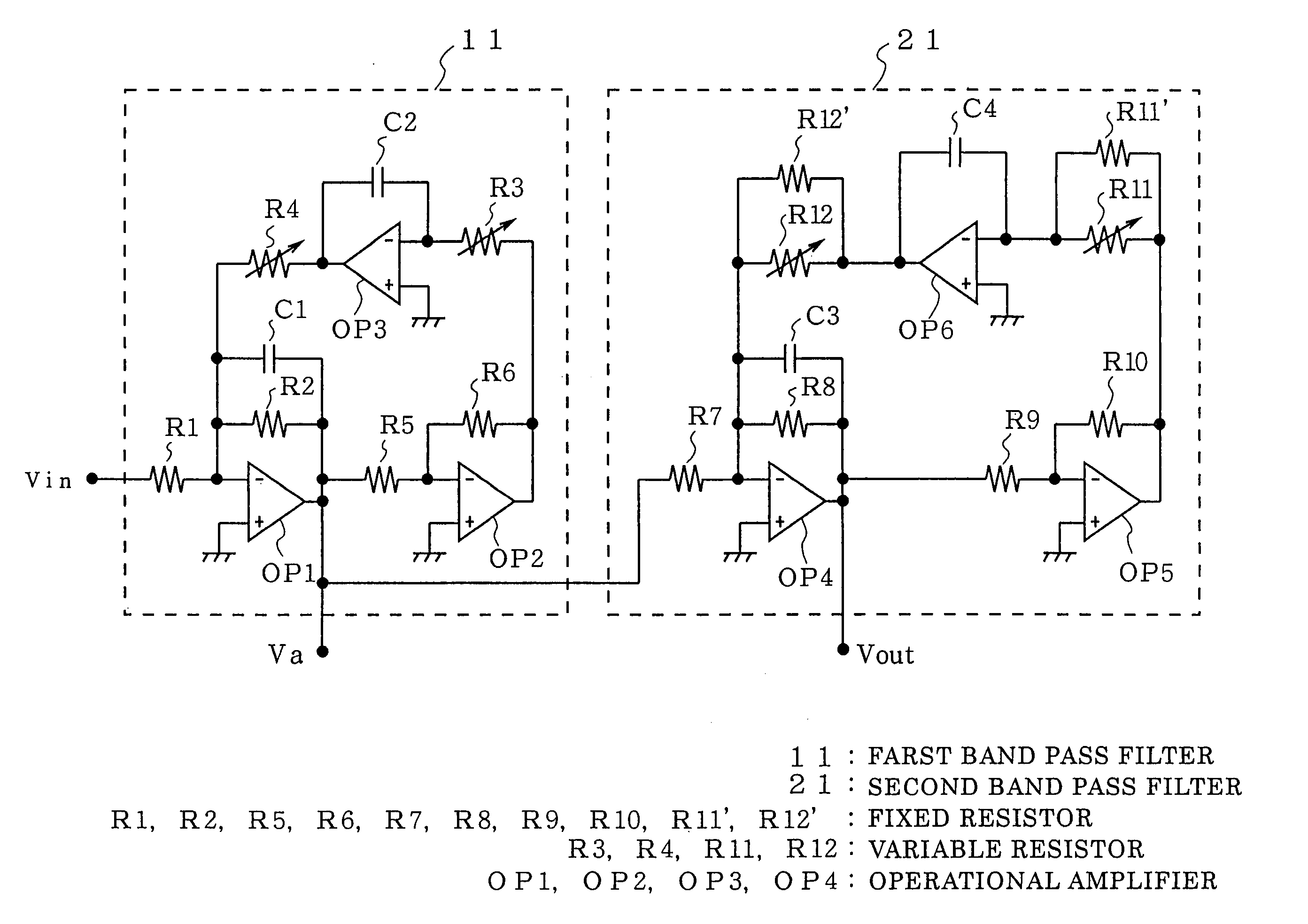
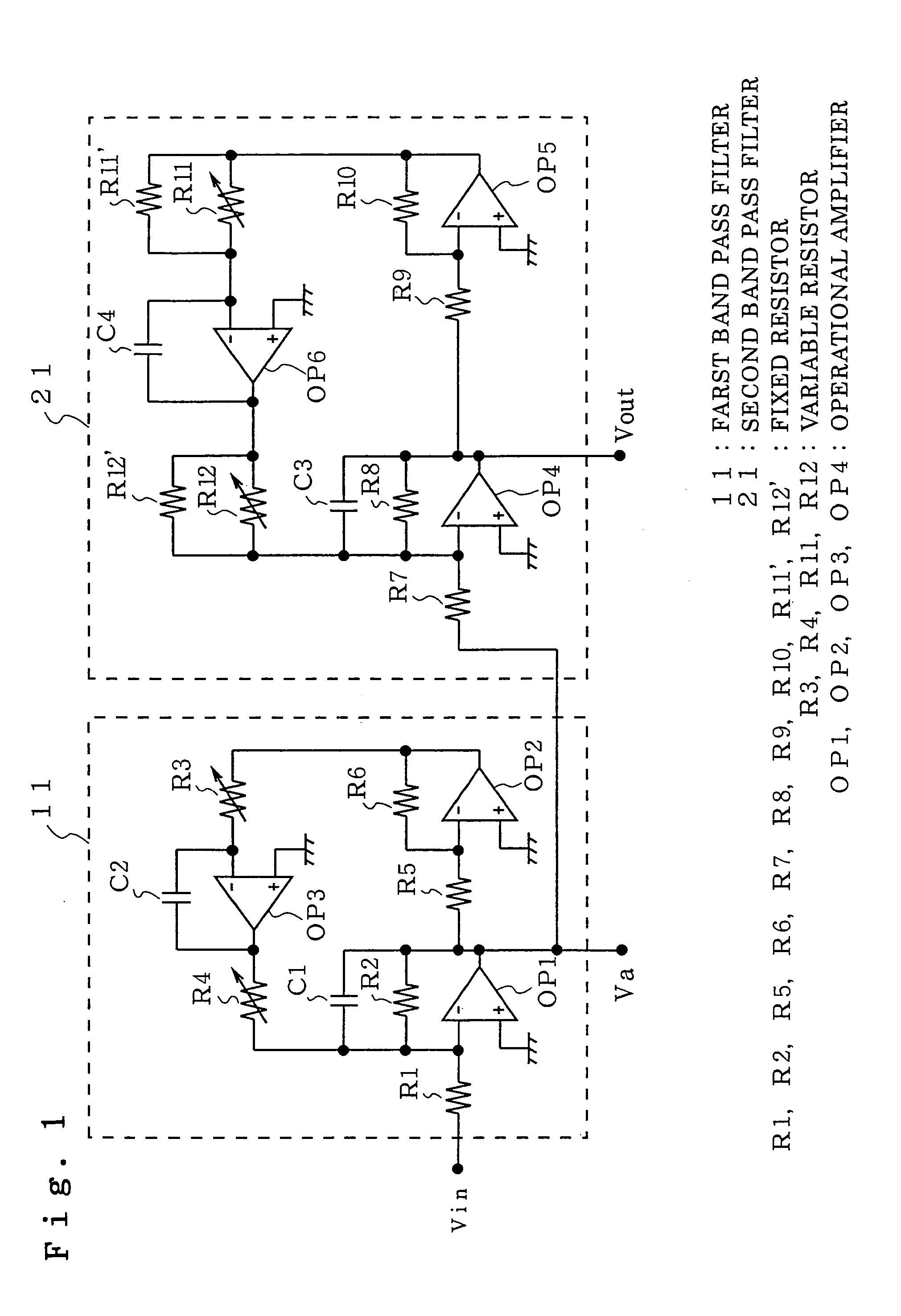
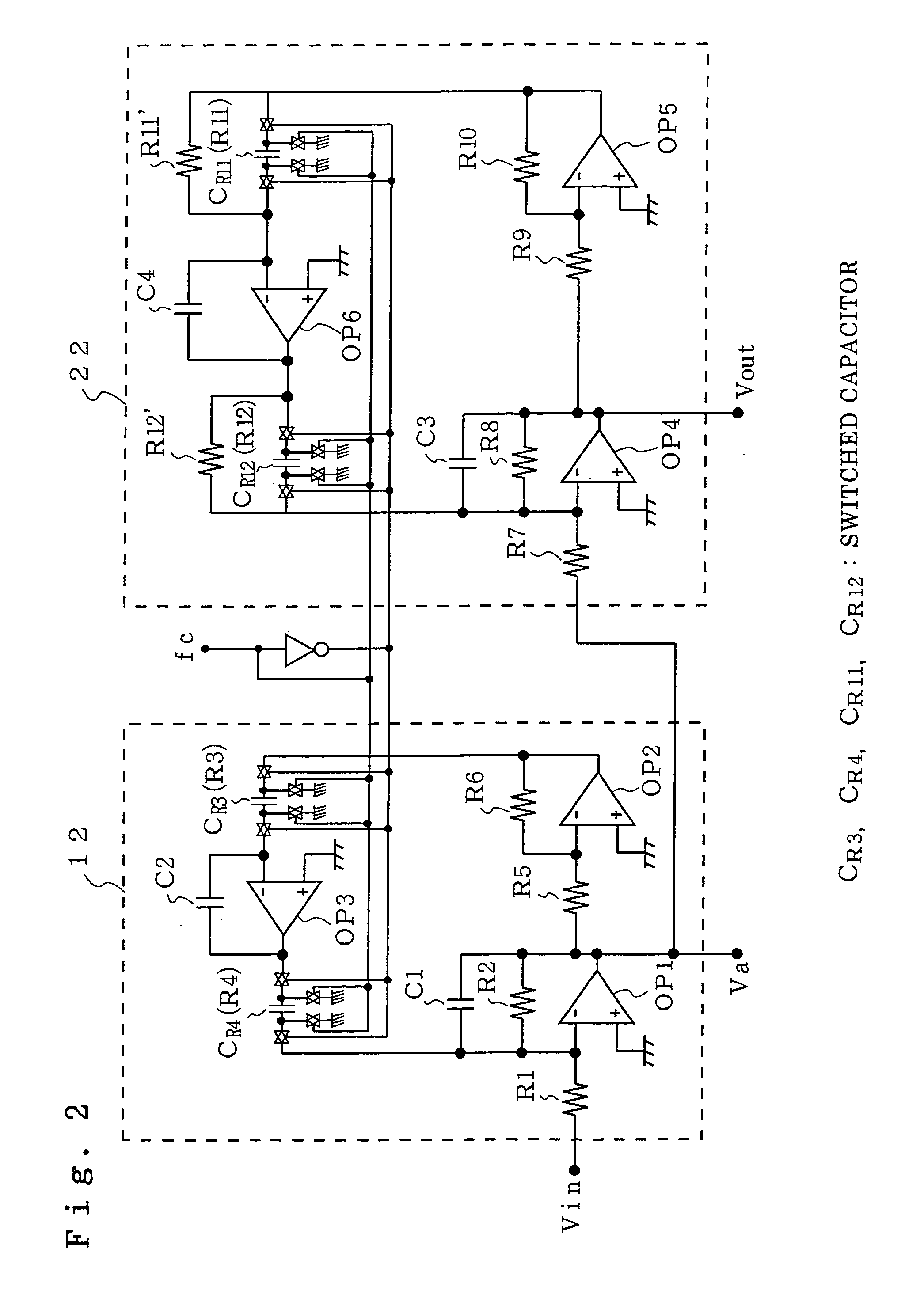
- A band pass filter design that includes a first and second biquad circuit-based band pass filter with center frequency and maximum gain adjusting variable resistors, where a fixed resistor is connected in parallel to the center frequency adjusting variable resistor, allowing for variable center frequency and maximum gain adjustments using switched capacitors or resistors, while keeping the band width fixed.

Performance Trade-offs in Filter Design Optimization
Filter design optimization inherently involves navigating complex performance trade-offs that significantly impact system effectiveness. The fundamental tension between band pass filters and non-causal filters in delay minimization scenarios exemplifies these critical design decisions. Engineers must balance multiple competing objectives including frequency selectivity, phase linearity, computational complexity, and temporal response characteristics.
The most prominent trade-off emerges between filter selectivity and group delay performance. Sharp transition band characteristics in band pass filters typically require higher-order implementations, which inherently introduce increased group delay variations across the passband. Conversely, relaxing selectivity requirements enables flatter group delay responses but compromises frequency discrimination capabilities. This relationship becomes particularly critical in applications where both spectral purity and timing accuracy are essential.
Phase linearity represents another crucial optimization dimension. Non-causal filter implementations can achieve perfect linear phase characteristics through symmetric impulse responses, but this advantage comes at the cost of processing latency. Real-time systems must weigh the benefits of phase linearity against the practical constraints of causal implementation, often leading to compromise solutions using minimum-phase designs or all-pass equalizers.
Computational efficiency introduces additional complexity to the optimization landscape. Non-causal filters often require buffering mechanisms and look-ahead processing, increasing memory requirements and computational overhead. Band pass filters, while potentially offering lower computational complexity per sample, may require cascaded stages or higher-order structures to meet performance specifications, ultimately impacting overall system efficiency.
The stability-performance trade-off becomes particularly evident in aggressive optimization scenarios. Pursuing minimal delay through pole-zero placement near the unit circle can enhance transient response but reduces stability margins. This relationship necessitates careful consideration of manufacturing tolerances, temperature variations, and quantization effects in practical implementations.
Dynamic range and noise performance also factor significantly into optimization decisions. Higher-order filters may provide superior frequency response characteristics but can accumulate quantization noise and reduce dynamic range in fixed-point implementations. The choice between direct-form and cascade realizations further influences these trade-offs, with each topology offering distinct advantages depending on the specific performance priorities and implementation constraints.
The most prominent trade-off emerges between filter selectivity and group delay performance. Sharp transition band characteristics in band pass filters typically require higher-order implementations, which inherently introduce increased group delay variations across the passband. Conversely, relaxing selectivity requirements enables flatter group delay responses but compromises frequency discrimination capabilities. This relationship becomes particularly critical in applications where both spectral purity and timing accuracy are essential.
Phase linearity represents another crucial optimization dimension. Non-causal filter implementations can achieve perfect linear phase characteristics through symmetric impulse responses, but this advantage comes at the cost of processing latency. Real-time systems must weigh the benefits of phase linearity against the practical constraints of causal implementation, often leading to compromise solutions using minimum-phase designs or all-pass equalizers.
Computational efficiency introduces additional complexity to the optimization landscape. Non-causal filters often require buffering mechanisms and look-ahead processing, increasing memory requirements and computational overhead. Band pass filters, while potentially offering lower computational complexity per sample, may require cascaded stages or higher-order structures to meet performance specifications, ultimately impacting overall system efficiency.
The stability-performance trade-off becomes particularly evident in aggressive optimization scenarios. Pursuing minimal delay through pole-zero placement near the unit circle can enhance transient response but reduces stability margins. This relationship necessitates careful consideration of manufacturing tolerances, temperature variations, and quantization effects in practical implementations.
Dynamic range and noise performance also factor significantly into optimization decisions. Higher-order filters may provide superior frequency response characteristics but can accumulate quantization noise and reduce dynamic range in fixed-point implementations. The choice between direct-form and cascade realizations further influences these trade-offs, with each topology offering distinct advantages depending on the specific performance priorities and implementation constraints.
Implementation Complexity and Hardware Constraints
The implementation complexity of band pass filters and non-causal filters varies significantly across different hardware platforms and computational architectures. Band pass filters, particularly those implemented using traditional analog circuits or digital FIR/IIR structures, generally exhibit lower computational overhead and more straightforward hardware realization. These filters can be efficiently implemented using dedicated DSP processors, FPGA fabric, or even simple analog components, making them suitable for resource-constrained environments where power consumption and processing capabilities are limited.
Non-causal filters present substantially greater implementation challenges due to their inherent requirement for future signal samples. This fundamental characteristic necessitates buffering mechanisms and introduces unavoidable processing delays that contradict the primary objective of delay minimization. The computational complexity increases exponentially with the filter order and the extent of non-causality, requiring sophisticated memory management systems and high-performance processing units capable of handling complex mathematical operations in real-time.
Hardware constraints play a crucial role in determining the feasibility of each approach. Memory bandwidth limitations significantly impact non-causal filter implementations, as these systems must continuously store and access large amounts of signal data to simulate future sample availability. Modern FPGA architectures with high-speed block RAM and distributed memory resources can partially mitigate these constraints, but at the cost of increased power consumption and silicon area utilization.
Processing latency requirements impose additional restrictions on both filter types. While band pass filters can achieve near-instantaneous processing with appropriate hardware acceleration, non-causal filters inherently introduce systematic delays that may exceed acceptable thresholds in time-critical applications. The trade-off between filter performance and implementation complexity becomes particularly pronounced in embedded systems where computational resources, power budgets, and thermal constraints severely limit the available processing capabilities.
Real-time processing capabilities represent another critical constraint factor. Band pass filters can be readily implemented in streaming architectures where samples are processed as they arrive, enabling continuous operation with minimal buffering requirements. Conversely, non-causal filters demand batch processing approaches or sophisticated prediction algorithms that significantly complicate the hardware architecture and increase the overall system complexity, making them less suitable for applications requiring immediate response times.
Non-causal filters present substantially greater implementation challenges due to their inherent requirement for future signal samples. This fundamental characteristic necessitates buffering mechanisms and introduces unavoidable processing delays that contradict the primary objective of delay minimization. The computational complexity increases exponentially with the filter order and the extent of non-causality, requiring sophisticated memory management systems and high-performance processing units capable of handling complex mathematical operations in real-time.
Hardware constraints play a crucial role in determining the feasibility of each approach. Memory bandwidth limitations significantly impact non-causal filter implementations, as these systems must continuously store and access large amounts of signal data to simulate future sample availability. Modern FPGA architectures with high-speed block RAM and distributed memory resources can partially mitigate these constraints, but at the cost of increased power consumption and silicon area utilization.
Processing latency requirements impose additional restrictions on both filter types. While band pass filters can achieve near-instantaneous processing with appropriate hardware acceleration, non-causal filters inherently introduce systematic delays that may exceed acceptable thresholds in time-critical applications. The trade-off between filter performance and implementation complexity becomes particularly pronounced in embedded systems where computational resources, power budgets, and thermal constraints severely limit the available processing capabilities.
Real-time processing capabilities represent another critical constraint factor. Band pass filters can be readily implemented in streaming architectures where samples are processed as they arrive, enabling continuous operation with minimal buffering requirements. Conversely, non-causal filters demand batch processing approaches or sophisticated prediction algorithms that significantly complicate the hardware architecture and increase the overall system complexity, making them less suitable for applications requiring immediate response times.
Unlock deeper insights with Patsnap Eureka Quick Research — get a full tech report to explore trends and direct your research. Try now!
Generate Your Research Report Instantly with AI Agent
Supercharge your innovation with Patsnap Eureka AI Agent Platform!