
How to Leverage Band Pass Filter for AI-Driven Predictive Analysis
MAR 25, 20269 MIN READ
Generate Your Research Report Instantly with AI Agent
Patsnap Eureka helps you evaluate technical feasibility & market potential.
Band Pass Filter AI Integration Background and Objectives
Band pass filters have emerged as critical signal processing components in the evolution of AI-driven predictive analysis systems. These filters, which selectively allow frequencies within a specific range to pass while attenuating frequencies outside this range, have traditionally been employed in telecommunications, audio processing, and electronic circuit design. However, their integration with artificial intelligence represents a paradigm shift toward more sophisticated data preprocessing and feature extraction methodologies.
The historical development of band pass filtering technology spans several decades, beginning with analog implementations using resistor-capacitor and inductor-capacitor circuits in the mid-20th century. The transition to digital signal processing in the 1980s and 1990s enabled more precise frequency domain manipulation through algorithms such as Finite Impulse Response and Infinite Impulse Response filters. The convergence of this established filtering technology with modern machine learning frameworks has created unprecedented opportunities for enhanced predictive modeling capabilities.
Contemporary AI systems increasingly require sophisticated preprocessing mechanisms to extract meaningful patterns from complex, multi-dimensional datasets. Band pass filters serve as essential preprocessing tools that can isolate relevant frequency components from noisy signals, thereby improving the quality of input data fed into predictive models. This integration addresses fundamental challenges in signal-to-noise ratio optimization and feature dimensionality reduction that have historically limited the effectiveness of AI-driven analysis systems.
The primary objective of leveraging band pass filters in AI-driven predictive analysis centers on enhancing model accuracy through intelligent frequency domain feature extraction. By selectively filtering input signals to retain only the most informative frequency components, these systems can achieve superior performance in applications ranging from financial market prediction to biomedical signal analysis and industrial equipment monitoring.
Secondary objectives include reducing computational complexity by eliminating irrelevant frequency components before AI processing, improving real-time processing capabilities through efficient signal conditioning, and enabling more robust predictive models that can operate effectively in noisy environments. The integration also aims to establish standardized preprocessing pipelines that can be adapted across diverse application domains while maintaining consistent performance metrics.
The historical development of band pass filtering technology spans several decades, beginning with analog implementations using resistor-capacitor and inductor-capacitor circuits in the mid-20th century. The transition to digital signal processing in the 1980s and 1990s enabled more precise frequency domain manipulation through algorithms such as Finite Impulse Response and Infinite Impulse Response filters. The convergence of this established filtering technology with modern machine learning frameworks has created unprecedented opportunities for enhanced predictive modeling capabilities.
Contemporary AI systems increasingly require sophisticated preprocessing mechanisms to extract meaningful patterns from complex, multi-dimensional datasets. Band pass filters serve as essential preprocessing tools that can isolate relevant frequency components from noisy signals, thereby improving the quality of input data fed into predictive models. This integration addresses fundamental challenges in signal-to-noise ratio optimization and feature dimensionality reduction that have historically limited the effectiveness of AI-driven analysis systems.
The primary objective of leveraging band pass filters in AI-driven predictive analysis centers on enhancing model accuracy through intelligent frequency domain feature extraction. By selectively filtering input signals to retain only the most informative frequency components, these systems can achieve superior performance in applications ranging from financial market prediction to biomedical signal analysis and industrial equipment monitoring.
Secondary objectives include reducing computational complexity by eliminating irrelevant frequency components before AI processing, improving real-time processing capabilities through efficient signal conditioning, and enabling more robust predictive models that can operate effectively in noisy environments. The integration also aims to establish standardized preprocessing pipelines that can be adapted across diverse application domains while maintaining consistent performance metrics.
Market Demand for AI-Enhanced Signal Processing Solutions
The global signal processing market is experiencing unprecedented growth driven by the convergence of artificial intelligence and traditional signal processing technologies. Industries across telecommunications, healthcare, automotive, and industrial automation are increasingly demanding sophisticated solutions that can extract meaningful insights from complex signal data in real-time environments.
Healthcare sector represents one of the most promising markets for AI-enhanced signal processing solutions utilizing band pass filters. Medical device manufacturers are seeking advanced systems capable of processing electrocardiogram, electroencephalogram, and other biomedical signals with superior noise reduction and feature extraction capabilities. The integration of band pass filtering with machine learning algorithms enables more accurate diagnosis and predictive health monitoring, addressing the growing demand for personalized medicine and remote patient monitoring solutions.
Telecommunications infrastructure providers are driving significant demand for AI-powered signal processing technologies that incorporate sophisticated filtering mechanisms. The deployment of 5G networks and the anticipated transition to 6G require advanced signal processing solutions capable of handling massive data throughput while maintaining signal integrity. Band pass filters combined with AI algorithms offer enhanced spectrum efficiency and interference mitigation, critical for next-generation wireless communication systems.
Industrial Internet of Things applications present substantial market opportunities for predictive maintenance solutions leveraging AI-enhanced signal processing. Manufacturing companies are increasingly investing in systems that can analyze vibration, acoustic, and electromagnetic signals from machinery to predict equipment failures before they occur. The combination of band pass filtering and artificial intelligence enables more precise anomaly detection and reduces false positive rates in predictive maintenance applications.
Automotive industry demand is accelerating for AI-driven signal processing solutions that support autonomous vehicle development and advanced driver assistance systems. These applications require real-time processing of radar, lidar, and sensor data with exceptional accuracy and reliability. Band pass filters integrated with AI algorithms provide enhanced object detection, collision avoidance, and environmental perception capabilities essential for autonomous vehicle safety systems.
Financial services sector is emerging as a significant market for AI-enhanced signal processing solutions applied to algorithmic trading and risk management. High-frequency trading firms and investment banks require sophisticated systems capable of processing market data signals with minimal latency while identifying profitable trading patterns and market anomalies through advanced filtering and machine learning techniques.
The convergence of edge computing and AI-enhanced signal processing is creating new market segments focused on distributed intelligence applications. Organizations are seeking solutions that can perform complex signal analysis at the network edge, reducing bandwidth requirements and improving response times for time-critical applications across various industries.
Healthcare sector represents one of the most promising markets for AI-enhanced signal processing solutions utilizing band pass filters. Medical device manufacturers are seeking advanced systems capable of processing electrocardiogram, electroencephalogram, and other biomedical signals with superior noise reduction and feature extraction capabilities. The integration of band pass filtering with machine learning algorithms enables more accurate diagnosis and predictive health monitoring, addressing the growing demand for personalized medicine and remote patient monitoring solutions.
Telecommunications infrastructure providers are driving significant demand for AI-powered signal processing technologies that incorporate sophisticated filtering mechanisms. The deployment of 5G networks and the anticipated transition to 6G require advanced signal processing solutions capable of handling massive data throughput while maintaining signal integrity. Band pass filters combined with AI algorithms offer enhanced spectrum efficiency and interference mitigation, critical for next-generation wireless communication systems.
Industrial Internet of Things applications present substantial market opportunities for predictive maintenance solutions leveraging AI-enhanced signal processing. Manufacturing companies are increasingly investing in systems that can analyze vibration, acoustic, and electromagnetic signals from machinery to predict equipment failures before they occur. The combination of band pass filtering and artificial intelligence enables more precise anomaly detection and reduces false positive rates in predictive maintenance applications.
Automotive industry demand is accelerating for AI-driven signal processing solutions that support autonomous vehicle development and advanced driver assistance systems. These applications require real-time processing of radar, lidar, and sensor data with exceptional accuracy and reliability. Band pass filters integrated with AI algorithms provide enhanced object detection, collision avoidance, and environmental perception capabilities essential for autonomous vehicle safety systems.
Financial services sector is emerging as a significant market for AI-enhanced signal processing solutions applied to algorithmic trading and risk management. High-frequency trading firms and investment banks require sophisticated systems capable of processing market data signals with minimal latency while identifying profitable trading patterns and market anomalies through advanced filtering and machine learning techniques.
The convergence of edge computing and AI-enhanced signal processing is creating new market segments focused on distributed intelligence applications. Organizations are seeking solutions that can perform complex signal analysis at the network edge, reducing bandwidth requirements and improving response times for time-critical applications across various industries.
Current State of Band Pass Filtering in Predictive Analytics
Band pass filtering has emerged as a fundamental signal processing technique in contemporary predictive analytics, serving as a critical preprocessing component for AI-driven systems. The technology operates by selectively allowing signals within specific frequency ranges to pass through while attenuating frequencies outside the designated band, thereby enhancing signal quality and reducing noise interference in predictive models.
Current implementations of band pass filtering in predictive analytics predominantly utilize digital signal processing algorithms, including Butterworth, Chebyshev, and elliptic filter designs. These filters are extensively deployed across financial markets for algorithmic trading systems, where they isolate relevant price movement patterns from market noise. Healthcare applications leverage band pass filtering for biomedical signal analysis, particularly in ECG and EEG data processing for predictive diagnostics.
The integration of band pass filtering with machine learning frameworks has reached significant maturity, with major cloud platforms offering built-in filtering capabilities. TensorFlow and PyTorch now include optimized band pass filter implementations that seamlessly integrate with neural network architectures. Real-time processing capabilities have advanced considerably, enabling sub-millisecond filtering operations for high-frequency trading and industrial IoT applications.
Industrial IoT represents another major application domain where band pass filtering demonstrates substantial impact. Manufacturing systems employ these filters to isolate machinery vibration signatures for predictive maintenance, while energy sector applications focus on power grid stability monitoring. The automotive industry has adopted band pass filtering for sensor fusion in autonomous vehicle systems, where multiple sensor streams require frequency-domain preprocessing.
Despite technological advances, several challenges persist in current implementations. Computational overhead remains significant for real-time applications requiring multiple simultaneous filter operations. Filter design optimization for specific predictive tasks often requires extensive domain expertise, limiting widespread adoption. Additionally, adaptive filtering mechanisms that automatically adjust parameters based on changing signal characteristics are still in early development stages.
Recent developments indicate growing adoption of GPU-accelerated filtering solutions and FPGA-based implementations for ultra-low latency applications. The emergence of quantum computing research in signal processing suggests potential future breakthroughs, though practical applications remain years away from commercial viability.
Current implementations of band pass filtering in predictive analytics predominantly utilize digital signal processing algorithms, including Butterworth, Chebyshev, and elliptic filter designs. These filters are extensively deployed across financial markets for algorithmic trading systems, where they isolate relevant price movement patterns from market noise. Healthcare applications leverage band pass filtering for biomedical signal analysis, particularly in ECG and EEG data processing for predictive diagnostics.
The integration of band pass filtering with machine learning frameworks has reached significant maturity, with major cloud platforms offering built-in filtering capabilities. TensorFlow and PyTorch now include optimized band pass filter implementations that seamlessly integrate with neural network architectures. Real-time processing capabilities have advanced considerably, enabling sub-millisecond filtering operations for high-frequency trading and industrial IoT applications.
Industrial IoT represents another major application domain where band pass filtering demonstrates substantial impact. Manufacturing systems employ these filters to isolate machinery vibration signatures for predictive maintenance, while energy sector applications focus on power grid stability monitoring. The automotive industry has adopted band pass filtering for sensor fusion in autonomous vehicle systems, where multiple sensor streams require frequency-domain preprocessing.
Despite technological advances, several challenges persist in current implementations. Computational overhead remains significant for real-time applications requiring multiple simultaneous filter operations. Filter design optimization for specific predictive tasks often requires extensive domain expertise, limiting widespread adoption. Additionally, adaptive filtering mechanisms that automatically adjust parameters based on changing signal characteristics are still in early development stages.
Recent developments indicate growing adoption of GPU-accelerated filtering solutions and FPGA-based implementations for ultra-low latency applications. The emergence of quantum computing research in signal processing suggests potential future breakthroughs, though practical applications remain years away from commercial viability.
Existing Band Pass Filter Solutions for Predictive Models
01 Adaptive filter coefficient prediction and adjustment
Band pass filters can utilize predictive analysis to adaptively adjust filter coefficients based on signal characteristics. This approach involves analyzing input signal patterns and predicting optimal coefficient values to maintain desired frequency response. The prediction algorithms can employ statistical methods or machine learning techniques to anticipate signal changes and preemptively adjust filter parameters, improving filtering performance in dynamic environments.- Adaptive filter coefficient prediction and adjustment: Band pass filters can utilize predictive analysis to adaptively adjust filter coefficients based on signal characteristics. This approach involves analyzing input signal patterns and predicting optimal coefficient values to maintain desired frequency response. The prediction algorithms can use historical data and real-time measurements to dynamically modify filter parameters, improving filtering performance under varying signal conditions.
- Frequency response prediction using machine learning: Machine learning techniques can be applied to predict the frequency response characteristics of band pass filters. These methods involve training models on filter design parameters and measured responses to predict performance metrics such as center frequency stability, bandwidth variations, and insertion loss. The predictive models enable optimization of filter designs before physical implementation and can forecast filter behavior under different operating conditions.
- Signal quality prediction and interference mitigation: Predictive analysis can be employed to forecast signal quality degradation and interference patterns in band pass filter applications. By analyzing spectral characteristics and environmental factors, these systems can predict when filtering performance may be compromised. This enables proactive adjustment of filter parameters or switching between multiple filter configurations to maintain optimal signal quality and minimize interference effects.
- Filter degradation and maintenance prediction: Predictive maintenance techniques can be applied to band pass filters to forecast component degradation and performance drift over time. These methods monitor filter characteristics such as insertion loss, return loss, and frequency selectivity to predict when maintenance or replacement is needed. The analysis considers factors like temperature effects, aging, and usage patterns to provide early warning of potential filter failures.
- Multi-band filter performance optimization through predictive modeling: Predictive modeling techniques can optimize the performance of multi-band and tunable band pass filters by forecasting the interaction between multiple frequency bands. These approaches analyze cross-coupling effects, harmonic distortion, and inter-band interference to predict overall system performance. The models enable designers to optimize filter architectures and predict the impact of tuning adjustments on adjacent frequency bands.
02 Frequency response prediction using digital signal processing
Predictive analysis techniques can be applied to forecast the frequency response characteristics of band pass filters under varying conditions. This involves mathematical modeling and simulation to predict how the filter will behave across different frequency ranges. The prediction methods enable optimization of filter design parameters before implementation, reducing development time and improving filter performance accuracy.Expand Specific Solutions03 Noise and interference prediction in filtered signals
Predictive analysis can be employed to anticipate noise and interference patterns in signals processed through band pass filters. This approach uses historical data and pattern recognition to predict potential signal degradation and adjust filtering parameters accordingly. The prediction capability allows for proactive compensation strategies, enhancing signal quality and reducing the impact of environmental interference on filtered outputs.Expand Specific Solutions04 Performance degradation prediction and maintenance scheduling
Predictive analysis methods can monitor band pass filter performance over time and forecast potential degradation or failure. This involves tracking key performance indicators and using predictive models to estimate remaining useful life and optimal maintenance intervals. The predictive approach enables preventive maintenance strategies, reducing unexpected failures and extending filter operational lifetime.Expand Specific Solutions05 Real-time signal quality prediction and optimization
Advanced predictive analysis techniques enable real-time forecasting of output signal quality from band pass filters. This involves continuous monitoring of input signals and filter states to predict output characteristics before actual filtering occurs. The prediction capability allows for dynamic optimization of filter settings to maintain desired signal quality under changing operational conditions, improving overall system performance and reliability.Expand Specific Solutions
Key Players in AI Signal Processing and Filter Technology
The competitive landscape for leveraging band pass filters in AI-driven predictive analysis is in its emerging stage, with significant growth potential driven by increasing demand for intelligent signal processing across multiple industries. The market spans diverse sectors including healthcare, telecommunications, automotive, and defense, with estimated multi-billion dollar opportunities in IoT and edge computing applications. Technology maturity varies considerably among key players: established electronics giants like Siemens AG, Toshiba Corp., and Canon Inc. possess advanced hardware capabilities, while companies such as Tencent Technology and ZTE Corp. contribute AI and software expertise. Research institutions like Harbin Engineering University and University College Dublin are advancing theoretical foundations, whereas specialized firms like Rohde & Schwarz and Tektronix focus on precision instrumentation. The convergence of traditional signal processing with modern AI capabilities represents a nascent but rapidly evolving technological frontier.
Koninklijke Philips NV
Technical Solution: Philips integrates band pass filtering with AI-driven predictive analysis in their healthcare monitoring and medical imaging systems. Their approach combines biomedical signal filtering with machine learning algorithms to enable early disease detection and patient monitoring. The company's technology employs multi-stage band pass filters to isolate specific physiological signals from ECG, EEG, and other medical sensors, which are then analyzed by AI models to predict health conditions and treatment outcomes. Their HealthSuite platform incorporates advanced filtering techniques that work with predictive analytics to monitor patient vital signs and predict potential medical emergencies in real-time healthcare applications.
Strengths: Deep healthcare domain expertise, regulatory compliance experience, established medical device infrastructure. Weaknesses: Primarily healthcare-focused, limited applicability to other industries, regulatory constraints may slow innovation.
Tencent Technology (Shenzhen) Co., Ltd.
Technical Solution: Tencent applies band pass filtering in their AI-driven audio and video processing platforms, particularly for content analysis and recommendation systems. Their approach integrates frequency domain filtering with deep learning models to extract meaningful features from multimedia content for predictive analytics. The company's technology utilizes adaptive band pass filters in their speech recognition and audio processing pipelines, where AI algorithms predict optimal frequency ranges for different types of audio content. Their implementation includes real-time filtering systems that work with recommendation engines to analyze user behavior patterns and predict content preferences based on audio-visual signal characteristics.
Strengths: Massive user data for AI training, strong software development capabilities, extensive cloud infrastructure. Weaknesses: Limited hardware expertise, primarily focused on consumer applications rather than industrial solutions.
Core Innovations in Adaptive Filtering for AI Systems
[band pass filter]
PatentInactiveUS20040267849A1
Innovation
- A band pass filter architecture utilizing a shift register and an arithmetic subtracter, where the output is obtained by subtracting the value in the last register from the first register, reducing the number of registers and eliminating the need for coefficients and multipliers, thereby simplifying the design and reducing resource requirements.


Band pass filter
PatentInactiveUS7081788B2
Innovation
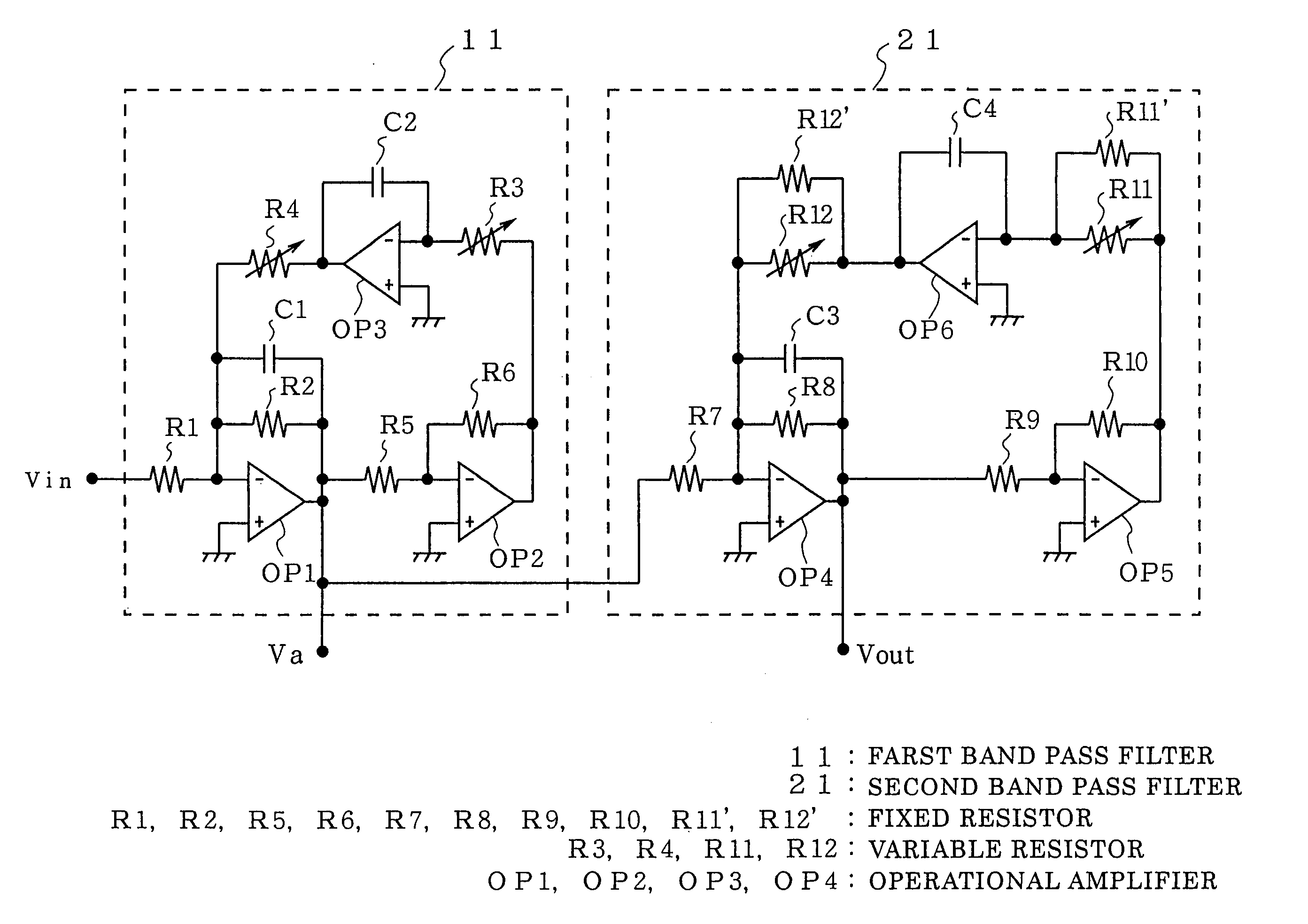
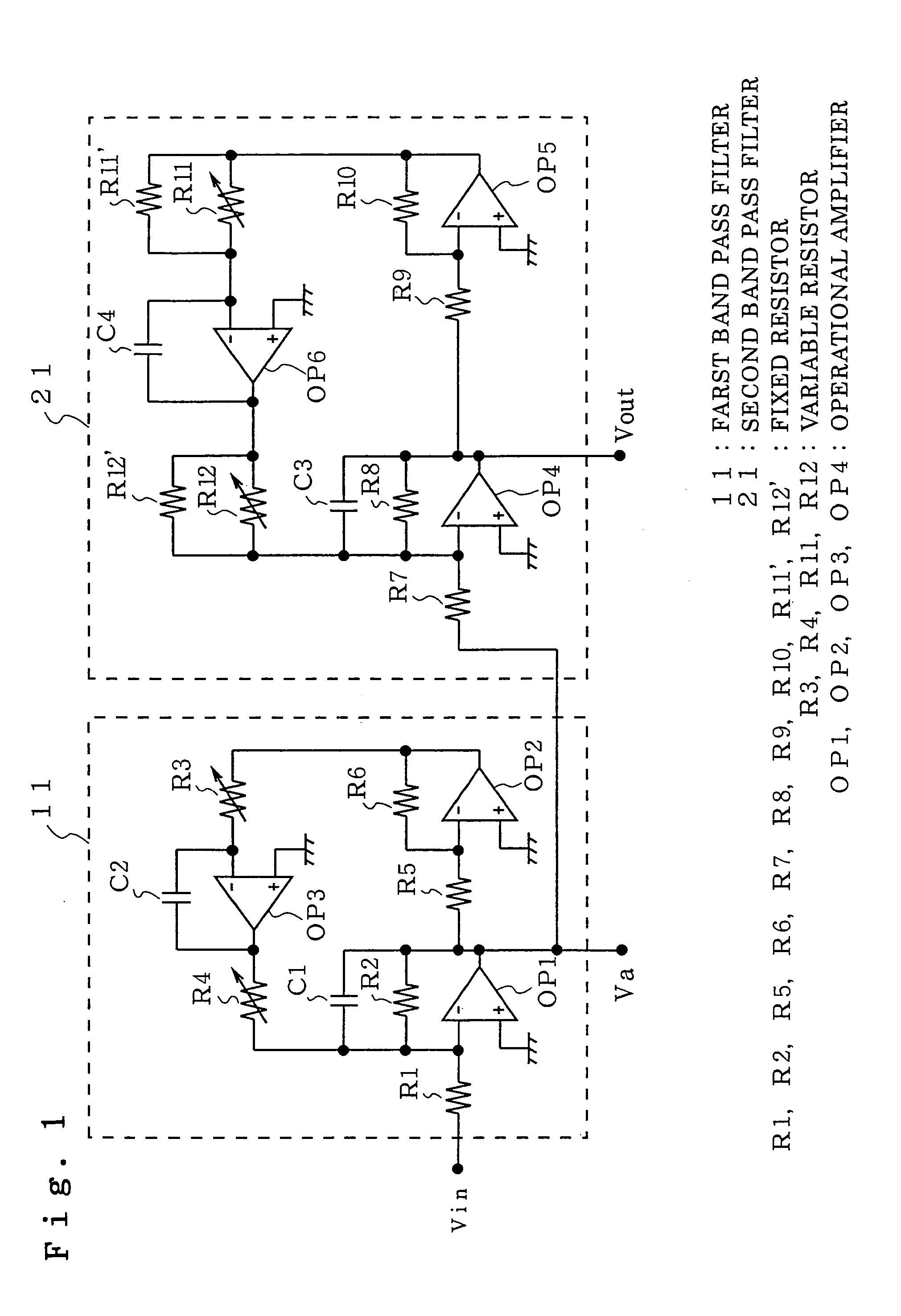
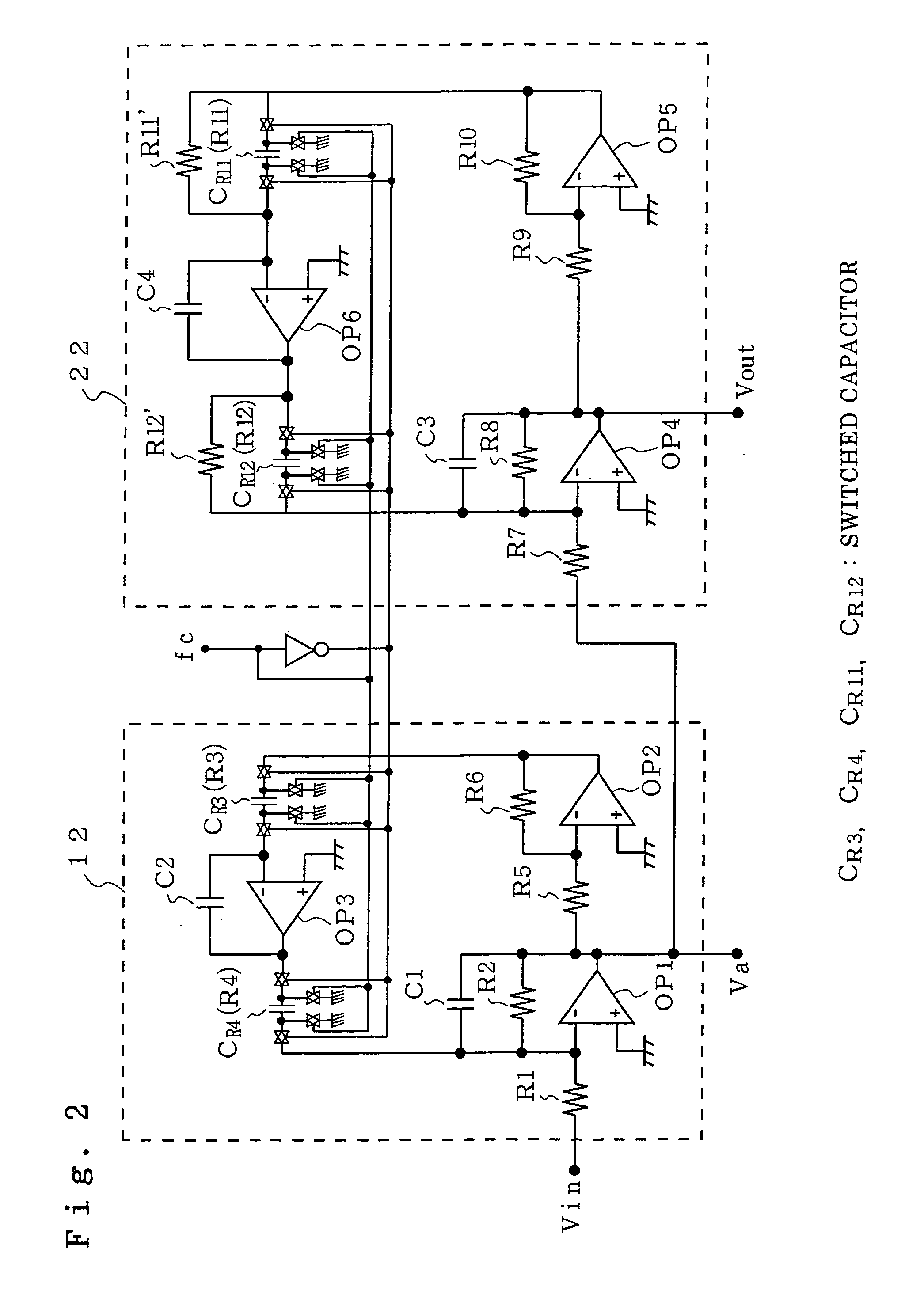
- A band pass filter design that includes a first and second biquad circuit-based band pass filter with center frequency and maximum gain adjusting variable resistors, where a fixed resistor is connected in parallel to the center frequency adjusting variable resistor, allowing for variable center frequency and maximum gain adjustments using switched capacitors or resistors, while keeping the band width fixed.

Data Privacy and Security in AI Signal Processing
The integration of band pass filters in AI-driven predictive analysis systems introduces significant data privacy and security considerations that must be carefully addressed throughout the signal processing pipeline. As these systems handle sensitive signal data across various domains including healthcare, telecommunications, and industrial monitoring, protecting data integrity and user privacy becomes paramount.
Signal data processed through band pass filters often contains personally identifiable information or proprietary business intelligence. In healthcare applications, filtered biomedical signals can reveal patient conditions and medical histories. Similarly, in telecommunications, filtered communication signals may expose user behavior patterns and location data. This necessitates implementing robust encryption mechanisms both at rest and in transit, ensuring that raw and filtered signal data remain protected from unauthorized access.
The distributed nature of AI-driven predictive systems creates additional security vulnerabilities. Band pass filtering operations may occur across multiple processing nodes, edge devices, and cloud infrastructure, expanding the attack surface. Each processing stage requires secure authentication protocols and encrypted communication channels to prevent data interception or manipulation during the filtering and analysis phases.
Privacy-preserving techniques such as differential privacy and federated learning become crucial when implementing band pass filtering for AI predictive models. These approaches allow organizations to extract valuable insights from filtered signals while maintaining individual privacy. Differential privacy adds controlled noise to filtered outputs, while federated learning enables model training on distributed filtered datasets without centralizing sensitive information.
Compliance with data protection regulations including GDPR, HIPAA, and industry-specific standards requires careful consideration of data retention policies and user consent mechanisms. Organizations must implement data minimization principles, ensuring that only necessary frequency components are extracted and retained through band pass filtering operations.
Advanced security measures include homomorphic encryption techniques that enable computation on encrypted filtered signals, allowing AI models to perform predictive analysis without exposing underlying data. Additionally, secure multi-party computation protocols facilitate collaborative analysis of band pass filtered signals across organizations while maintaining data confidentiality.
Regular security audits and vulnerability assessments of the entire signal processing pipeline, from initial filtering to final predictive outputs, ensure ongoing protection against emerging threats and maintain system integrity in AI-driven predictive analysis applications.
Signal data processed through band pass filters often contains personally identifiable information or proprietary business intelligence. In healthcare applications, filtered biomedical signals can reveal patient conditions and medical histories. Similarly, in telecommunications, filtered communication signals may expose user behavior patterns and location data. This necessitates implementing robust encryption mechanisms both at rest and in transit, ensuring that raw and filtered signal data remain protected from unauthorized access.
The distributed nature of AI-driven predictive systems creates additional security vulnerabilities. Band pass filtering operations may occur across multiple processing nodes, edge devices, and cloud infrastructure, expanding the attack surface. Each processing stage requires secure authentication protocols and encrypted communication channels to prevent data interception or manipulation during the filtering and analysis phases.
Privacy-preserving techniques such as differential privacy and federated learning become crucial when implementing band pass filtering for AI predictive models. These approaches allow organizations to extract valuable insights from filtered signals while maintaining individual privacy. Differential privacy adds controlled noise to filtered outputs, while federated learning enables model training on distributed filtered datasets without centralizing sensitive information.
Compliance with data protection regulations including GDPR, HIPAA, and industry-specific standards requires careful consideration of data retention policies and user consent mechanisms. Organizations must implement data minimization principles, ensuring that only necessary frequency components are extracted and retained through band pass filtering operations.
Advanced security measures include homomorphic encryption techniques that enable computation on encrypted filtered signals, allowing AI models to perform predictive analysis without exposing underlying data. Additionally, secure multi-party computation protocols facilitate collaborative analysis of band pass filtered signals across organizations while maintaining data confidentiality.
Regular security audits and vulnerability assessments of the entire signal processing pipeline, from initial filtering to final predictive outputs, ensure ongoing protection against emerging threats and maintain system integrity in AI-driven predictive analysis applications.
Performance Optimization Strategies for Real-time AI Filtering
Real-time AI filtering systems incorporating band pass filters require sophisticated performance optimization strategies to maintain computational efficiency while preserving signal integrity. The primary challenge lies in balancing filter complexity with processing speed, as traditional digital filtering approaches often introduce significant latency that compromises real-time performance requirements.
Memory management optimization represents a critical performance bottleneck in real-time filtering applications. Implementing circular buffer architectures and zero-copy data transfer mechanisms can substantially reduce memory allocation overhead. Advanced memory pooling strategies, combined with cache-aware data structures, enable sustained high-throughput processing while minimizing garbage collection impacts that typically degrade real-time performance.
Parallel processing architectures offer substantial performance gains through strategic workload distribution. Multi-threaded filter implementations utilizing SIMD instructions can achieve significant speedup ratios, particularly when processing multiple frequency bands simultaneously. GPU acceleration through CUDA or OpenCL frameworks enables massive parallel computation of filter coefficients, though careful consideration of memory transfer costs remains essential for optimal performance.
Adaptive filtering techniques provide dynamic performance optimization by adjusting filter parameters based on real-time signal characteristics. Machine learning-driven filter coefficient optimization can reduce computational complexity by up to 40% while maintaining filtering accuracy. These adaptive approaches utilize reinforcement learning algorithms to continuously optimize filter responses based on prediction accuracy feedback.
Hardware-software co-optimization strategies leverage specialized digital signal processing units and field-programmable gate arrays to offload computationally intensive filtering operations. Custom silicon implementations of band pass filtering algorithms can achieve microsecond-level latency while maintaining high precision, enabling real-time processing of high-frequency data streams.
Algorithmic optimizations focus on reducing computational complexity through innovative mathematical approaches. Fast Fourier Transform-based filtering implementations, combined with overlap-add techniques, significantly reduce processing overhead compared to traditional time-domain filtering methods. Additionally, implementing variable-precision arithmetic and dynamic quantization strategies can further enhance performance while preserving essential signal characteristics for accurate predictive analysis.
Memory management optimization represents a critical performance bottleneck in real-time filtering applications. Implementing circular buffer architectures and zero-copy data transfer mechanisms can substantially reduce memory allocation overhead. Advanced memory pooling strategies, combined with cache-aware data structures, enable sustained high-throughput processing while minimizing garbage collection impacts that typically degrade real-time performance.
Parallel processing architectures offer substantial performance gains through strategic workload distribution. Multi-threaded filter implementations utilizing SIMD instructions can achieve significant speedup ratios, particularly when processing multiple frequency bands simultaneously. GPU acceleration through CUDA or OpenCL frameworks enables massive parallel computation of filter coefficients, though careful consideration of memory transfer costs remains essential for optimal performance.
Adaptive filtering techniques provide dynamic performance optimization by adjusting filter parameters based on real-time signal characteristics. Machine learning-driven filter coefficient optimization can reduce computational complexity by up to 40% while maintaining filtering accuracy. These adaptive approaches utilize reinforcement learning algorithms to continuously optimize filter responses based on prediction accuracy feedback.
Hardware-software co-optimization strategies leverage specialized digital signal processing units and field-programmable gate arrays to offload computationally intensive filtering operations. Custom silicon implementations of band pass filtering algorithms can achieve microsecond-level latency while maintaining high precision, enabling real-time processing of high-frequency data streams.
Algorithmic optimizations focus on reducing computational complexity through innovative mathematical approaches. Fast Fourier Transform-based filtering implementations, combined with overlap-add techniques, significantly reduce processing overhead compared to traditional time-domain filtering methods. Additionally, implementing variable-precision arithmetic and dynamic quantization strategies can further enhance performance while preserving essential signal characteristics for accurate predictive analysis.
Unlock deeper insights with Patsnap Eureka Quick Research — get a full tech report to explore trends and direct your research. Try now!
Generate Your Research Report Instantly with AI Agent
Supercharge your innovation with Patsnap Eureka AI Agent Platform!