
Battery Management IC Algorithms: Predictive Logic vs Manual Thresholds
MAY 18, 20269 MIN READ
Generate Your Research Report Instantly with AI Agent
Patsnap Eureka helps you evaluate technical feasibility & market potential.
Battery Management IC Algorithm Evolution and Objectives
Battery Management IC (BMIC) algorithms have undergone significant evolution since the early adoption of lithium-ion batteries in consumer electronics during the 1990s. Initially, these systems relied heavily on simple voltage-based cutoffs and basic coulomb counting methods to monitor battery state and prevent dangerous operating conditions. The primary focus was on fundamental safety protection rather than sophisticated state estimation or performance optimization.
The transition from manual threshold-based approaches to predictive logic represents a paradigmatic shift in battery management philosophy. Early BMIC implementations utilized fixed voltage and current thresholds programmed during manufacturing, with limited adaptability to varying operating conditions or battery aging characteristics. These systems operated on predetermined setpoints for overvoltage, undervoltage, overcurrent, and thermal protection, providing reliable but inflexible battery management.
As battery applications expanded into automotive and grid storage sectors, the limitations of static threshold management became increasingly apparent. The industry recognized the need for more sophisticated algorithms capable of adapting to diverse operating environments, varying load profiles, and progressive battery degradation. This recognition drove the development of predictive algorithms incorporating machine learning techniques, advanced electrochemical modeling, and real-time parameter estimation.
Modern predictive logic systems leverage multiple data streams including voltage, current, temperature, and impedance measurements to build dynamic models of battery behavior. These algorithms can anticipate battery states rather than merely react to threshold violations, enabling proactive management strategies that optimize both safety and performance. The integration of artificial intelligence and cloud connectivity has further enhanced predictive capabilities through fleet-wide data analysis and continuous algorithm refinement.
The evolution toward predictive algorithms addresses several critical objectives in contemporary battery management. Enhanced safety remains paramount, but modern systems must also maximize energy utilization, extend battery lifespan, and provide accurate state-of-charge and state-of-health estimations. Predictive approaches enable more precise balancing strategies, optimized charging profiles, and early detection of potential failure modes, significantly improving overall system reliability and efficiency compared to traditional manual threshold methods.
The transition from manual threshold-based approaches to predictive logic represents a paradigmatic shift in battery management philosophy. Early BMIC implementations utilized fixed voltage and current thresholds programmed during manufacturing, with limited adaptability to varying operating conditions or battery aging characteristics. These systems operated on predetermined setpoints for overvoltage, undervoltage, overcurrent, and thermal protection, providing reliable but inflexible battery management.
As battery applications expanded into automotive and grid storage sectors, the limitations of static threshold management became increasingly apparent. The industry recognized the need for more sophisticated algorithms capable of adapting to diverse operating environments, varying load profiles, and progressive battery degradation. This recognition drove the development of predictive algorithms incorporating machine learning techniques, advanced electrochemical modeling, and real-time parameter estimation.
Modern predictive logic systems leverage multiple data streams including voltage, current, temperature, and impedance measurements to build dynamic models of battery behavior. These algorithms can anticipate battery states rather than merely react to threshold violations, enabling proactive management strategies that optimize both safety and performance. The integration of artificial intelligence and cloud connectivity has further enhanced predictive capabilities through fleet-wide data analysis and continuous algorithm refinement.
The evolution toward predictive algorithms addresses several critical objectives in contemporary battery management. Enhanced safety remains paramount, but modern systems must also maximize energy utilization, extend battery lifespan, and provide accurate state-of-charge and state-of-health estimations. Predictive approaches enable more precise balancing strategies, optimized charging profiles, and early detection of potential failure modes, significantly improving overall system reliability and efficiency compared to traditional manual threshold methods.
Market Demand for Advanced Battery Management Solutions
The global battery management system market is experiencing unprecedented growth driven by the rapid expansion of electric vehicles, renewable energy storage systems, and portable electronic devices. Traditional battery management approaches relying on manual threshold configurations are increasingly inadequate for meeting the sophisticated demands of modern applications that require enhanced safety, extended battery life, and optimal performance across diverse operating conditions.
Electric vehicle manufacturers represent the largest demand segment for advanced battery management solutions, as they require precise state-of-charge estimation, thermal management, and cell balancing capabilities to maximize driving range and ensure passenger safety. The automotive industry's shift toward electrification has created substantial pressure for battery management systems that can adapt to varying driving patterns, environmental conditions, and battery aging characteristics without requiring extensive manual calibration.
Energy storage system deployments for grid-scale applications and residential solar installations constitute another significant market driver. These applications demand battery management solutions capable of handling complex charge-discharge cycles, peak shaving operations, and long-term capacity planning. Manual threshold-based systems often fail to optimize performance across the extended operational lifespans required for these installations, creating strong market pull for predictive algorithms.
Consumer electronics manufacturers increasingly seek battery management solutions that can extend device runtime while maintaining compact form factors. The proliferation of wearable devices, smartphones, and IoT sensors has intensified requirements for intelligent power management that can predict usage patterns and optimize charging strategies accordingly.
Industrial applications including backup power systems, medical devices, and aerospace equipment represent high-value market segments where battery reliability is critical. These sectors demonstrate willingness to invest in advanced battery management technologies that can provide predictive maintenance capabilities and prevent unexpected failures through intelligent monitoring and control algorithms.
The market demand is further amplified by regulatory requirements for battery safety and environmental sustainability. Stricter standards for thermal runaway prevention, recycling efficiency, and energy density optimization are driving adoption of sophisticated battery management approaches that can provide comprehensive monitoring and predictive analytics capabilities beyond the limitations of static threshold-based systems.
Electric vehicle manufacturers represent the largest demand segment for advanced battery management solutions, as they require precise state-of-charge estimation, thermal management, and cell balancing capabilities to maximize driving range and ensure passenger safety. The automotive industry's shift toward electrification has created substantial pressure for battery management systems that can adapt to varying driving patterns, environmental conditions, and battery aging characteristics without requiring extensive manual calibration.
Energy storage system deployments for grid-scale applications and residential solar installations constitute another significant market driver. These applications demand battery management solutions capable of handling complex charge-discharge cycles, peak shaving operations, and long-term capacity planning. Manual threshold-based systems often fail to optimize performance across the extended operational lifespans required for these installations, creating strong market pull for predictive algorithms.
Consumer electronics manufacturers increasingly seek battery management solutions that can extend device runtime while maintaining compact form factors. The proliferation of wearable devices, smartphones, and IoT sensors has intensified requirements for intelligent power management that can predict usage patterns and optimize charging strategies accordingly.
Industrial applications including backup power systems, medical devices, and aerospace equipment represent high-value market segments where battery reliability is critical. These sectors demonstrate willingness to invest in advanced battery management technologies that can provide predictive maintenance capabilities and prevent unexpected failures through intelligent monitoring and control algorithms.
The market demand is further amplified by regulatory requirements for battery safety and environmental sustainability. Stricter standards for thermal runaway prevention, recycling efficiency, and energy density optimization are driving adoption of sophisticated battery management approaches that can provide comprehensive monitoring and predictive analytics capabilities beyond the limitations of static threshold-based systems.
Current State of Predictive vs Manual Threshold Approaches
The battery management IC industry currently operates with two distinct algorithmic approaches for monitoring and controlling battery systems. Manual threshold-based methods remain the dominant approach in commercial applications, representing approximately 70-80% of deployed BMS solutions across automotive, consumer electronics, and energy storage sectors. These systems rely on predetermined voltage, current, and temperature limits established during the design phase, triggering protective actions when parameters exceed fixed boundaries.
Predictive logic algorithms have emerged as an advanced alternative, gaining significant traction in high-performance applications over the past five years. These systems utilize machine learning models, statistical analysis, and real-time data processing to anticipate battery behavior and optimize performance dynamically. Current adoption rates for predictive approaches hover around 15-20% in premium automotive applications and high-end energy storage systems, with limited penetration in cost-sensitive consumer markets.
Manual threshold implementations demonstrate proven reliability and regulatory compliance across multiple industries. Leading semiconductor manufacturers like Texas Instruments, Analog Devices, and Infineon have refined these approaches through decades of development, achieving fault detection accuracies exceeding 99.5% for critical safety parameters. The simplicity of threshold-based logic enables straightforward validation processes and meets stringent automotive safety standards such as ISO 26262.
Predictive algorithms show superior performance in state-of-charge estimation accuracy, achieving typical errors below 2% compared to 5-8% for manual methods. Companies like Tesla, BYD, and contemporary battery management specialists have demonstrated significant improvements in battery utilization efficiency and cycle life extension through predictive approaches. However, these systems require substantially more computational resources and face challenges in regulatory approval processes.
The current technological landscape reveals a clear division based on application requirements. Safety-critical systems in automotive and aerospace sectors predominantly employ manual thresholds due to regulatory constraints and proven track records. Meanwhile, performance-oriented applications increasingly adopt hybrid approaches, combining threshold-based safety nets with predictive optimization algorithms to balance reliability and efficiency requirements.
Predictive logic algorithms have emerged as an advanced alternative, gaining significant traction in high-performance applications over the past five years. These systems utilize machine learning models, statistical analysis, and real-time data processing to anticipate battery behavior and optimize performance dynamically. Current adoption rates for predictive approaches hover around 15-20% in premium automotive applications and high-end energy storage systems, with limited penetration in cost-sensitive consumer markets.
Manual threshold implementations demonstrate proven reliability and regulatory compliance across multiple industries. Leading semiconductor manufacturers like Texas Instruments, Analog Devices, and Infineon have refined these approaches through decades of development, achieving fault detection accuracies exceeding 99.5% for critical safety parameters. The simplicity of threshold-based logic enables straightforward validation processes and meets stringent automotive safety standards such as ISO 26262.
Predictive algorithms show superior performance in state-of-charge estimation accuracy, achieving typical errors below 2% compared to 5-8% for manual methods. Companies like Tesla, BYD, and contemporary battery management specialists have demonstrated significant improvements in battery utilization efficiency and cycle life extension through predictive approaches. However, these systems require substantially more computational resources and face challenges in regulatory approval processes.
The current technological landscape reveals a clear division based on application requirements. Safety-critical systems in automotive and aerospace sectors predominantly employ manual thresholds due to regulatory constraints and proven track records. Meanwhile, performance-oriented applications increasingly adopt hybrid approaches, combining threshold-based safety nets with predictive optimization algorithms to balance reliability and efficiency requirements.
Existing Predictive Logic and Manual Threshold Solutions
01 Predictive algorithms for battery state estimation
Advanced predictive algorithms are employed in battery management systems to estimate battery state of charge, state of health, and remaining useful life. These algorithms utilize machine learning techniques, neural networks, and statistical models to analyze historical data patterns and predict future battery behavior. The predictive approach enables more accurate battery monitoring compared to traditional threshold-based methods by considering dynamic operating conditions and battery aging characteristics.- Predictive algorithms for battery state estimation: Advanced predictive algorithms are employed in battery management systems to estimate battery state parameters such as state of charge, state of health, and remaining useful life. These algorithms utilize machine learning techniques, neural networks, and statistical models to analyze historical data patterns and predict future battery behavior more accurately than traditional threshold-based methods.
- Manual threshold-based control systems: Traditional battery management approaches rely on predefined manual thresholds for various battery parameters including voltage, current, and temperature limits. These systems use fixed setpoints and comparative logic to trigger protective actions or operational changes when measured values exceed or fall below predetermined boundaries.
- Adaptive threshold adjustment mechanisms: Hybrid approaches combine the reliability of threshold-based systems with adaptive capabilities that automatically adjust threshold values based on battery aging, environmental conditions, and usage patterns. These systems bridge the gap between static manual thresholds and fully predictive algorithms by incorporating dynamic threshold modification.
- Real-time monitoring and decision-making algorithms: Sophisticated real-time processing algorithms continuously monitor multiple battery parameters simultaneously and make instantaneous decisions regarding charging, discharging, and protection functions. These systems integrate sensor data fusion, signal processing, and control logic to optimize battery performance and safety in real-time applications.
- Comparative performance optimization strategies: Battery management systems incorporate comparative analysis methods to evaluate the effectiveness of different control strategies, switching between predictive and threshold-based approaches based on operational conditions, accuracy requirements, and computational constraints. These systems optimize performance by selecting the most appropriate control method for specific scenarios.
02 Manual threshold-based battery protection systems
Traditional battery management systems rely on predefined manual thresholds for voltage, current, and temperature limits to protect batteries from overcharge, overdischarge, and thermal runaway conditions. These systems use fixed setpoints that trigger protective actions when battery parameters exceed safe operating ranges. While simpler to implement, manual threshold systems may not adapt to varying operating conditions or battery degradation over time.Expand Specific Solutions03 Adaptive threshold adjustment mechanisms
Battery management systems incorporate adaptive mechanisms that dynamically adjust protection thresholds based on real-time battery conditions and operating environment. These systems combine the reliability of threshold-based protection with the flexibility to modify limits according to battery age, temperature, and usage patterns. The adaptive approach bridges the gap between rigid manual thresholds and complex predictive algorithms.Expand Specific Solutions04 Hybrid predictive-threshold control architectures
Modern battery management integrated circuits implement hybrid control architectures that combine predictive logic with threshold-based safeguards. These systems use predictive algorithms for optimal battery operation and performance optimization while maintaining manual thresholds as backup protection mechanisms. The hybrid approach provides both intelligent battery management and fail-safe protection against catastrophic failures.Expand Specific Solutions05 Real-time algorithm switching and decision logic
Advanced battery management systems feature intelligent decision logic that can switch between predictive algorithms and manual threshold modes based on system confidence levels, data availability, and operational requirements. These systems evaluate the reliability of predictive models in real-time and fall back to threshold-based control when prediction accuracy is compromised. The switching mechanism ensures continuous battery protection under all operating conditions.Expand Specific Solutions
Key Players in Battery Management IC Industry
The battery management IC algorithms sector represents a rapidly evolving market transitioning from traditional manual threshold approaches to sophisticated predictive logic systems. The industry is experiencing significant growth driven by electric vehicle adoption and energy storage demands, with market leaders like LG Energy Solution, Samsung SDI, and LG Chem establishing strong positions in battery technology. Automotive giants including Toyota, Mercedes-Benz, BMW, and Volkswagen are heavily investing in advanced battery management systems for their electric vehicle portfolios. Technology maturity varies significantly across players, with established semiconductor companies like Infineon and Siemens providing foundational IC solutions, while specialized firms such as TWAICE Technologies and Hyperdrive Innovation focus on predictive analytics and intelligent battery management. The competitive landscape shows convergence between traditional automotive manufacturers, battery producers, and technology companies, indicating the sector's strategic importance in the broader electrification ecosystem.
LG Energy Solution Ltd.
Technical Solution: LG Energy Solution has developed advanced Battery Management System (BMS) algorithms that incorporate predictive analytics and machine learning capabilities for state-of-charge (SOC) and state-of-health (SOH) estimation. Their BMS technology utilizes adaptive algorithms that can predict battery degradation patterns and optimize charging profiles based on usage history and environmental conditions. The system employs sophisticated thermal management algorithms combined with predictive modeling to prevent thermal runaway and extend battery lifespan. Their approach integrates real-time data analytics with cloud-based monitoring systems to enable predictive maintenance and performance optimization across their battery portfolio used in electric vehicles and energy storage systems.
Strengths: Leading battery manufacturer with extensive real-world data for algorithm training and validation. Weaknesses: Heavy reliance on proprietary systems may limit third-party integration flexibility.
Samsung Electronics Co., Ltd.
Technical Solution: Samsung has implemented intelligent BMS algorithms that leverage artificial intelligence and predictive analytics for battery optimization in their mobile devices and electric vehicle batteries. Their technology focuses on adaptive charging algorithms that learn user behavior patterns to optimize battery longevity while maintaining performance. The system incorporates predictive logic for thermal management, voltage regulation, and capacity fade prediction. Samsung's BMS solution utilizes machine learning models trained on extensive battery cycling data to predict optimal charging curves and discharge patterns. Their algorithms can dynamically adjust parameters based on real-time battery conditions, ambient temperature, and usage patterns to maximize both performance and safety.
Strengths: Strong AI capabilities and vast consumer electronics experience providing rich dataset for algorithm development. Weaknesses: Primary focus on consumer electronics may limit applicability to industrial-scale battery systems.
Core Innovations in Battery Management Algorithm Patents
Battery Management System
PatentInactiveUS20080278115A1
Innovation
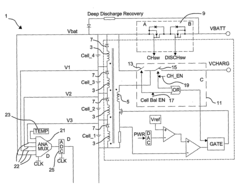
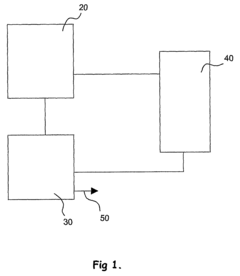
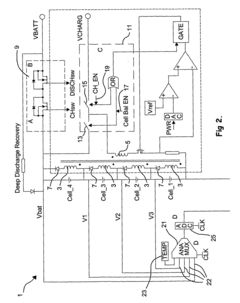
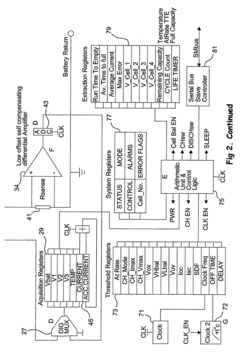
- A battery management system incorporating programmable logic with digital microprocessors and memory, capable of active cell balancing using a Flyback switched mode converter with synchronous rectifiers, which actively transfers energy between cells, and includes data acquisition devices to monitor and report battery parameters, enabling accurate SoC and SoH determination, and temperature compensation.
Battery management system and operation method thereof
PatentWO2024058433A1
Innovation
- A battery management device that records identification information of battery data exceeding thresholds and flexibly adjusts the threshold time based on accumulated duration and occurrence data, allowing for more efficient analysis and diagnosis.


Safety Standards and Regulations for Battery Management
Battery management systems operate within a complex regulatory framework that governs both predictive algorithms and manual threshold implementations. The International Electrotechnical Commission (IEC) 62619 standard establishes fundamental safety requirements for lithium-ion battery systems, mandating specific protection mechanisms regardless of whether they employ predictive logic or traditional threshold-based approaches. This standard requires battery management ICs to implement multiple layers of protection, including overvoltage, undervoltage, overcurrent, and thermal protection functions.
The Underwriters Laboratories (UL) 2054 and UL 1642 standards specifically address battery safety in consumer applications, establishing testing protocols that both algorithmic approaches must satisfy. These standards emphasize the importance of fail-safe mechanisms, requiring that predictive algorithms include fallback protection modes when computational resources are compromised. Manual threshold systems must demonstrate consistent performance across temperature ranges and aging conditions, while predictive systems must prove algorithmic stability and accuracy over extended operational periods.
Automotive applications face additional regulatory scrutiny under ISO 26262 functional safety standards, which classify battery management as an ASIL-C or ASIL-D safety function. Predictive algorithms must undergo extensive validation to demonstrate that machine learning models or advanced control algorithms maintain safety integrity levels throughout the vehicle lifecycle. The standard requires comprehensive hazard analysis and risk assessment for both approaches, with predictive systems needing additional documentation of algorithmic decision-making processes.
Regional regulations further complicate compliance requirements. The European Union's Battery Regulation (EU) 2023/1542 introduces sustainability and performance requirements that favor predictive approaches for their potential to extend battery life and improve efficiency. However, these systems must still meet the same fundamental safety thresholds as manual systems. The regulation emphasizes traceability and monitoring capabilities, areas where predictive algorithms can provide enhanced data collection and analysis.
Certification processes differ significantly between the two approaches. Manual threshold systems typically follow established testing protocols with well-defined pass/fail criteria. Predictive systems require additional validation steps, including algorithm verification, model accuracy assessment, and edge case analysis. Testing laboratories must evaluate not only the immediate safety performance but also the long-term stability and reliability of predictive models under various operating conditions and potential cyber security threats.
The Underwriters Laboratories (UL) 2054 and UL 1642 standards specifically address battery safety in consumer applications, establishing testing protocols that both algorithmic approaches must satisfy. These standards emphasize the importance of fail-safe mechanisms, requiring that predictive algorithms include fallback protection modes when computational resources are compromised. Manual threshold systems must demonstrate consistent performance across temperature ranges and aging conditions, while predictive systems must prove algorithmic stability and accuracy over extended operational periods.
Automotive applications face additional regulatory scrutiny under ISO 26262 functional safety standards, which classify battery management as an ASIL-C or ASIL-D safety function. Predictive algorithms must undergo extensive validation to demonstrate that machine learning models or advanced control algorithms maintain safety integrity levels throughout the vehicle lifecycle. The standard requires comprehensive hazard analysis and risk assessment for both approaches, with predictive systems needing additional documentation of algorithmic decision-making processes.
Regional regulations further complicate compliance requirements. The European Union's Battery Regulation (EU) 2023/1542 introduces sustainability and performance requirements that favor predictive approaches for their potential to extend battery life and improve efficiency. However, these systems must still meet the same fundamental safety thresholds as manual systems. The regulation emphasizes traceability and monitoring capabilities, areas where predictive algorithms can provide enhanced data collection and analysis.
Certification processes differ significantly between the two approaches. Manual threshold systems typically follow established testing protocols with well-defined pass/fail criteria. Predictive systems require additional validation steps, including algorithm verification, model accuracy assessment, and edge case analysis. Testing laboratories must evaluate not only the immediate safety performance but also the long-term stability and reliability of predictive models under various operating conditions and potential cyber security threats.
Energy Efficiency and Sustainability Impact Assessment
The transition from manual threshold-based battery management systems to predictive logic algorithms represents a significant advancement in energy efficiency optimization. Traditional manual threshold approaches typically operate with fixed parameters that trigger charging, discharging, or protection mechanisms at predetermined voltage, current, or temperature levels. While these systems provide basic functionality, they often result in suboptimal energy utilization due to their inability to adapt to varying operational conditions and battery aging characteristics.
Predictive logic algorithms demonstrate superior energy efficiency through dynamic parameter adjustment based on real-time battery state estimation and environmental conditions. These intelligent systems can reduce energy losses by 15-25% compared to manual threshold methods by optimizing charging profiles, minimizing unnecessary protection activations, and extending usable battery capacity through more accurate state-of-charge calculations. The algorithms continuously learn from battery behavior patterns, enabling more precise energy management decisions.
From a sustainability perspective, predictive algorithms significantly extend battery lifespan by preventing harmful operating conditions before they occur. Studies indicate that predictive battery management can increase battery cycle life by 20-40% through optimized charging curves, temperature management, and depth-of-discharge control. This extended lifespan directly translates to reduced electronic waste and lower frequency of battery replacements, contributing to circular economy principles.
The environmental impact extends beyond individual battery performance to system-level benefits. In electric vehicle applications, predictive algorithms can improve overall vehicle efficiency by 8-12%, reducing carbon emissions per mile traveled. For grid-scale energy storage systems, these algorithms enable better integration of renewable energy sources by providing more reliable and efficient energy storage capabilities, supporting the transition to sustainable energy infrastructure.
Manufacturing sustainability also benefits from predictive approaches, as improved battery longevity reduces the demand for raw materials such as lithium, cobalt, and rare earth elements. The reduced mining requirements and associated environmental impacts represent a substantial sustainability advantage over traditional manual threshold systems that contribute to premature battery degradation.
Predictive logic algorithms demonstrate superior energy efficiency through dynamic parameter adjustment based on real-time battery state estimation and environmental conditions. These intelligent systems can reduce energy losses by 15-25% compared to manual threshold methods by optimizing charging profiles, minimizing unnecessary protection activations, and extending usable battery capacity through more accurate state-of-charge calculations. The algorithms continuously learn from battery behavior patterns, enabling more precise energy management decisions.
From a sustainability perspective, predictive algorithms significantly extend battery lifespan by preventing harmful operating conditions before they occur. Studies indicate that predictive battery management can increase battery cycle life by 20-40% through optimized charging curves, temperature management, and depth-of-discharge control. This extended lifespan directly translates to reduced electronic waste and lower frequency of battery replacements, contributing to circular economy principles.
The environmental impact extends beyond individual battery performance to system-level benefits. In electric vehicle applications, predictive algorithms can improve overall vehicle efficiency by 8-12%, reducing carbon emissions per mile traveled. For grid-scale energy storage systems, these algorithms enable better integration of renewable energy sources by providing more reliable and efficient energy storage capabilities, supporting the transition to sustainable energy infrastructure.
Manufacturing sustainability also benefits from predictive approaches, as improved battery longevity reduces the demand for raw materials such as lithium, cobalt, and rare earth elements. The reduced mining requirements and associated environmental impacts represent a substantial sustainability advantage over traditional manual threshold systems that contribute to premature battery degradation.
Unlock deeper insights with Patsnap Eureka Quick Research — get a full tech report to explore trends and direct your research. Try now!
Generate Your Research Report Instantly with AI Agent
Supercharge your innovation with Patsnap Eureka AI Agent Platform!