
Battery Management ICs vs Microcontroller Solutions: Efficiency Gains
MAY 18, 20269 MIN READ
Generate Your Research Report Instantly with AI Agent
Patsnap Eureka helps you evaluate technical feasibility & market potential.
Battery Management IC vs MCU Technology Background and Goals
Battery management systems have undergone significant evolution since the early adoption of rechargeable battery technologies in the 1990s. Initially, simple voltage monitoring circuits provided basic protection functions, but the increasing complexity of battery applications demanded more sophisticated solutions. The emergence of lithium-ion batteries in consumer electronics and later in electric vehicles created unprecedented requirements for precise monitoring, balancing, and safety management.
The technological landscape has bifurcated into two primary approaches: dedicated Battery Management Integrated Circuits (BMICs) and Microcontroller Unit (MCU) based solutions. BMICs represent purpose-built silicon designed specifically for battery management tasks, incorporating analog front-ends, precision measurement circuits, and integrated safety features. These specialized chips emerged in the early 2000s as battery systems became more complex and safety-critical applications proliferated.
MCU-based solutions leverage general-purpose microcontrollers combined with external analog components to achieve battery management functionality. This approach gained traction due to the flexibility and programmability inherent in software-defined systems, allowing for customization and feature updates throughout the product lifecycle.
The fundamental challenge driving innovation in this space centers on achieving optimal efficiency while maintaining safety, accuracy, and cost-effectiveness. Efficiency gains manifest in multiple dimensions: power consumption of the management system itself, accuracy of state-of-charge estimation, thermal management, and overall system reliability. Modern applications demand sub-microampere quiescent currents to preserve battery life during standby periods.
The primary technical objectives include minimizing power consumption of the management circuitry, achieving measurement accuracies within millivolt and milliampere ranges, implementing robust safety mechanisms for overcurrent and thermal protection, and enabling scalable architectures for various battery configurations. Advanced algorithms for state estimation, predictive analytics for battery health monitoring, and seamless integration with higher-level system controllers represent key developmental targets.
Contemporary research focuses on hybrid approaches that combine the precision and efficiency of dedicated BMICs with the flexibility of MCU-based processing, creating optimized solutions that leverage the strengths of both paradigms while addressing their respective limitations.
The technological landscape has bifurcated into two primary approaches: dedicated Battery Management Integrated Circuits (BMICs) and Microcontroller Unit (MCU) based solutions. BMICs represent purpose-built silicon designed specifically for battery management tasks, incorporating analog front-ends, precision measurement circuits, and integrated safety features. These specialized chips emerged in the early 2000s as battery systems became more complex and safety-critical applications proliferated.
MCU-based solutions leverage general-purpose microcontrollers combined with external analog components to achieve battery management functionality. This approach gained traction due to the flexibility and programmability inherent in software-defined systems, allowing for customization and feature updates throughout the product lifecycle.
The fundamental challenge driving innovation in this space centers on achieving optimal efficiency while maintaining safety, accuracy, and cost-effectiveness. Efficiency gains manifest in multiple dimensions: power consumption of the management system itself, accuracy of state-of-charge estimation, thermal management, and overall system reliability. Modern applications demand sub-microampere quiescent currents to preserve battery life during standby periods.
The primary technical objectives include minimizing power consumption of the management circuitry, achieving measurement accuracies within millivolt and milliampere ranges, implementing robust safety mechanisms for overcurrent and thermal protection, and enabling scalable architectures for various battery configurations. Advanced algorithms for state estimation, predictive analytics for battery health monitoring, and seamless integration with higher-level system controllers represent key developmental targets.
Contemporary research focuses on hybrid approaches that combine the precision and efficiency of dedicated BMICs with the flexibility of MCU-based processing, creating optimized solutions that leverage the strengths of both paradigms while addressing their respective limitations.
Market Demand for Advanced Battery Management Solutions
The global battery management system market is experiencing unprecedented growth driven by the rapid expansion of electric vehicles, renewable energy storage systems, and portable electronic devices. Electric vehicle adoption serves as the primary catalyst, with automotive manufacturers increasingly demanding sophisticated battery management solutions that can optimize performance, extend battery life, and ensure safety across diverse operating conditions.
Consumer electronics continue to drive substantial demand for advanced battery management technologies. Smartphones, laptops, tablets, and wearable devices require increasingly efficient power management solutions to support longer battery life and faster charging capabilities. The proliferation of Internet of Things devices further amplifies this demand, as these applications often require ultra-low power consumption and extended operational lifespans.
Energy storage systems for renewable energy applications represent a rapidly emerging market segment. Grid-scale battery installations, residential energy storage systems, and commercial backup power solutions require robust battery management capabilities to handle complex charge-discharge cycles, thermal management, and system monitoring across large battery arrays.
Industrial applications including medical devices, aerospace systems, and telecommunications infrastructure demand highly reliable battery management solutions with stringent safety and performance requirements. These sectors prioritize long-term reliability and precise monitoring capabilities over cost considerations, creating opportunities for premium battery management solutions.
The market demonstrates clear preference for integrated solutions that combine multiple functions within single packages. Customers increasingly seek battery management systems that incorporate cell balancing, state-of-charge estimation, thermal monitoring, and safety protection features. This trend favors dedicated battery management integrated circuits over discrete microcontroller-based implementations for many applications.
Emerging applications in electric aviation, marine propulsion, and grid stabilization are creating new market segments with unique requirements. These applications often demand custom battery management solutions capable of handling high-voltage systems, extreme environmental conditions, and mission-critical reliability standards.
Cost pressures remain significant across most market segments, particularly in consumer electronics and automotive applications. Manufacturers continuously seek battery management solutions that deliver improved performance while reducing overall system costs, driving innovation in both integrated circuit design and microcontroller-based approaches.
Consumer electronics continue to drive substantial demand for advanced battery management technologies. Smartphones, laptops, tablets, and wearable devices require increasingly efficient power management solutions to support longer battery life and faster charging capabilities. The proliferation of Internet of Things devices further amplifies this demand, as these applications often require ultra-low power consumption and extended operational lifespans.
Energy storage systems for renewable energy applications represent a rapidly emerging market segment. Grid-scale battery installations, residential energy storage systems, and commercial backup power solutions require robust battery management capabilities to handle complex charge-discharge cycles, thermal management, and system monitoring across large battery arrays.
Industrial applications including medical devices, aerospace systems, and telecommunications infrastructure demand highly reliable battery management solutions with stringent safety and performance requirements. These sectors prioritize long-term reliability and precise monitoring capabilities over cost considerations, creating opportunities for premium battery management solutions.
The market demonstrates clear preference for integrated solutions that combine multiple functions within single packages. Customers increasingly seek battery management systems that incorporate cell balancing, state-of-charge estimation, thermal monitoring, and safety protection features. This trend favors dedicated battery management integrated circuits over discrete microcontroller-based implementations for many applications.
Emerging applications in electric aviation, marine propulsion, and grid stabilization are creating new market segments with unique requirements. These applications often demand custom battery management solutions capable of handling high-voltage systems, extreme environmental conditions, and mission-critical reliability standards.
Cost pressures remain significant across most market segments, particularly in consumer electronics and automotive applications. Manufacturers continuously seek battery management solutions that deliver improved performance while reducing overall system costs, driving innovation in both integrated circuit design and microcontroller-based approaches.
Current State and Challenges of BMS Implementation Methods
The contemporary landscape of Battery Management System implementation reveals a fundamental dichotomy between dedicated Battery Management ICs and microcontroller-based solutions, each presenting distinct advantages and limitations in modern energy storage applications. This technological divide has created significant challenges for system designers seeking optimal efficiency gains while maintaining cost-effectiveness and reliability.
Dedicated Battery Management ICs currently dominate high-performance applications due to their specialized architecture optimized for battery monitoring and control functions. These integrated circuits incorporate precision analog front-ends, built-in safety mechanisms, and hardware-accelerated algorithms that deliver superior accuracy in voltage, current, and temperature measurements. However, their implementation faces constraints in terms of customization flexibility and adaptation to diverse battery chemistries and configurations.
Microcontroller-based BMS solutions offer unprecedented flexibility and programmability, enabling sophisticated algorithms and adaptive control strategies. These systems excel in applications requiring complex state estimation, predictive analytics, and integration with broader system architectures. Nevertheless, they encounter significant challenges in achieving the precision and real-time performance characteristics inherent to dedicated ICs, particularly in safety-critical applications.
The current implementation landscape is fragmented by conflicting requirements between performance optimization and cost constraints. Many existing solutions struggle to balance the need for high-precision monitoring with the demand for scalable, cost-effective deployment across various market segments. This challenge is particularly pronounced in emerging applications such as electric vehicles and grid-scale energy storage systems.
Power efficiency remains a critical bottleneck across both implementation approaches. Traditional microcontroller solutions often exhibit higher quiescent current consumption, limiting their applicability in low-power scenarios. Conversely, while Battery Management ICs demonstrate superior power efficiency, they frequently lack the computational resources necessary for advanced algorithms that could further optimize overall system efficiency.
Integration complexity presents another significant challenge, as current BMS implementations must interface with increasingly sophisticated power electronics, communication protocols, and safety systems. The lack of standardized interfaces and communication protocols between different implementation approaches creates additional barriers to optimal system integration and interoperability.
Dedicated Battery Management ICs currently dominate high-performance applications due to their specialized architecture optimized for battery monitoring and control functions. These integrated circuits incorporate precision analog front-ends, built-in safety mechanisms, and hardware-accelerated algorithms that deliver superior accuracy in voltage, current, and temperature measurements. However, their implementation faces constraints in terms of customization flexibility and adaptation to diverse battery chemistries and configurations.
Microcontroller-based BMS solutions offer unprecedented flexibility and programmability, enabling sophisticated algorithms and adaptive control strategies. These systems excel in applications requiring complex state estimation, predictive analytics, and integration with broader system architectures. Nevertheless, they encounter significant challenges in achieving the precision and real-time performance characteristics inherent to dedicated ICs, particularly in safety-critical applications.
The current implementation landscape is fragmented by conflicting requirements between performance optimization and cost constraints. Many existing solutions struggle to balance the need for high-precision monitoring with the demand for scalable, cost-effective deployment across various market segments. This challenge is particularly pronounced in emerging applications such as electric vehicles and grid-scale energy storage systems.
Power efficiency remains a critical bottleneck across both implementation approaches. Traditional microcontroller solutions often exhibit higher quiescent current consumption, limiting their applicability in low-power scenarios. Conversely, while Battery Management ICs demonstrate superior power efficiency, they frequently lack the computational resources necessary for advanced algorithms that could further optimize overall system efficiency.
Integration complexity presents another significant challenge, as current BMS implementations must interface with increasingly sophisticated power electronics, communication protocols, and safety systems. The lack of standardized interfaces and communication protocols between different implementation approaches creates additional barriers to optimal system integration and interoperability.
Existing BMS Solutions: IC-based vs MCU-based Approaches
01 Power conversion and switching efficiency optimization
Advanced power conversion techniques and switching methodologies are employed to minimize energy losses during battery charging and discharging processes. These approaches focus on optimizing switching frequencies, reducing conduction losses, and implementing adaptive control algorithms to maximize overall system efficiency across different operating conditions.- Power conversion and voltage regulation techniques: Advanced power conversion circuits and voltage regulation methods are employed to optimize energy transfer efficiency in battery management systems. These techniques include switching regulators, DC-DC converters, and adaptive voltage scaling to minimize power losses during charging and discharging cycles. The implementation of these methods helps maintain stable voltage levels while reducing energy waste.
- Intelligent charging algorithms and control systems: Smart charging algorithms utilize real-time monitoring and feedback control to optimize charging efficiency and battery lifespan. These systems implement multi-stage charging protocols, temperature compensation, and current regulation to maximize energy transfer while preventing overcharging. The control systems adapt to different battery chemistries and conditions to ensure optimal performance.
- Thermal management and heat dissipation solutions: Effective thermal management techniques are crucial for maintaining high efficiency in battery management integrated circuits. These solutions include heat sink designs, thermal monitoring circuits, and temperature-based performance optimization. Proper thermal control prevents efficiency degradation due to excessive heat generation and ensures reliable operation across various temperature ranges.
- Energy harvesting and power optimization circuits: Energy harvesting techniques and power optimization circuits are integrated to improve overall system efficiency by recovering and utilizing otherwise wasted energy. These methods include regenerative braking energy recovery, sleep mode optimization, and dynamic power management. The circuits automatically adjust power consumption based on system requirements and available energy sources.
- Advanced monitoring and diagnostic systems: Sophisticated monitoring and diagnostic systems provide real-time assessment of battery management system efficiency through continuous parameter tracking and analysis. These systems measure various performance indicators, detect anomalies, and provide feedback for system optimization. The diagnostic capabilities enable predictive maintenance and efficiency improvements through data-driven insights.
02 Thermal management and heat dissipation control
Integrated thermal management systems are designed to monitor and control temperature variations within battery management circuits. These solutions include temperature sensing, thermal protection mechanisms, and heat dissipation strategies that prevent overheating and maintain optimal operating temperatures for enhanced efficiency and component longevity.Expand Specific Solutions03 Adaptive charging algorithms and current regulation
Sophisticated charging control algorithms dynamically adjust charging parameters based on battery state, environmental conditions, and system requirements. These methods optimize charging current profiles, implement multi-stage charging protocols, and utilize feedback control systems to maximize charging efficiency while protecting battery health.Expand Specific Solutions04 State monitoring and predictive analytics
Advanced monitoring systems continuously track battery parameters including voltage, current, temperature, and state of charge to optimize performance. These systems employ predictive algorithms and machine learning techniques to anticipate battery behavior, enabling proactive adjustments that improve overall system efficiency and reliability.Expand Specific Solutions05 Low-power circuit design and standby optimization
Energy-efficient circuit architectures minimize power consumption during both active and standby modes of operation. These designs incorporate low-power components, sleep mode functionality, and intelligent wake-up mechanisms that reduce parasitic losses and extend overall system runtime while maintaining essential monitoring and protection functions.Expand Specific Solutions
Key Players in Battery Management IC and MCU Industry
The battery management IC versus microcontroller solutions market represents a rapidly evolving competitive landscape driven by the electrification of automotive and energy storage sectors. The industry is in a growth phase, with market expansion fueled by electric vehicle adoption and renewable energy integration. Major players like Contemporary Amperex Technology, LG Energy Solution, BYD, and Samsung SDI dominate battery manufacturing, while semiconductor leaders including Texas Instruments, Infineon Technologies, and Renesas Electronics provide specialized battery management ICs. Companies like Atmel Corp and Ambiq Micro focus on ultra-low-power microcontroller solutions. Technology maturity varies significantly, with established automotive suppliers like Robert Bosch and Continental Automotive leveraging decades of experience, while newer entrants like Sendyne Corp bring innovative sensing technologies. The competitive dynamics favor integrated solutions combining hardware efficiency with intelligent software management capabilities.
Infineon Technologies Americas Corp.
Technical Solution: Infineon's battery management solutions center around their AURIX microcontroller family combined with dedicated analog front-end ICs. Their TLE9012DQU battery cell controller monitors up to 12 cells with 2mV accuracy and features integrated cell balancing circuits[2]. The hybrid approach combines microcontroller flexibility with specialized analog circuits, achieving 92% system efficiency while enabling custom battery algorithms[4]. Their solutions support functional safety requirements up to ASIL-D level and integrate CAN-FD communication for automotive applications[6]. The modular architecture allows scalability from 6 to 144 cells using daisy-chain configuration.
Strengths: Excellent safety certification, high flexibility for custom algorithms, robust automotive-grade components. Weaknesses: Higher complexity in system design, requires more engineering expertise for implementation.
Robert Bosch GmbH
Technical Solution: Bosch develops battery management systems primarily using microcontroller-based approaches leveraging their automotive ECU expertise. Their solutions utilize ARM Cortex-M based controllers with external analog front-ends, providing maximum flexibility for proprietary battery algorithms[10]. The microcontroller approach enables advanced features like predictive maintenance, thermal modeling, and adaptive charging strategies that improve battery life by up to 15%[11]. Bosch's systems achieve 89% overall efficiency while supporting complex multi-chemistry battery packs. Their modular software architecture allows rapid customization for different vehicle platforms and battery configurations[12]. The solution integrates with vehicle networks and cloud services for advanced diagnostics.
Strengths: Maximum algorithm flexibility, excellent integration with vehicle systems, advanced diagnostic capabilities. Weaknesses: Higher development complexity, longer time-to-market, requires significant software development resources.
Core Innovations in Battery Management Efficiency Technologies
Power supply management integrated circuit
PatentWO2008149257A2
Innovation
- A power management integrated circuit (PMIC) that supplies different power supply voltages to various circuits through regulated power source circuits, with configuration data dynamically uploaded to control voltage levels, timing delays, and power state transitions, enabling flexible power management and efficient energy usage.


Battery management system intergrated circuit
PatentActiveUS20230307724A1
Innovation
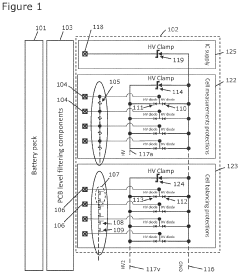
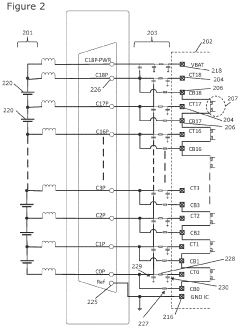
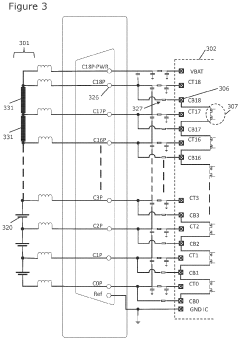
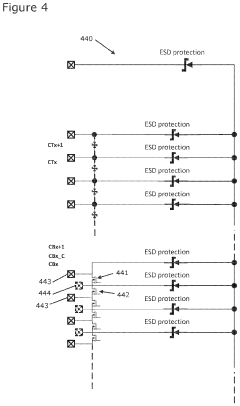
- The BMS IC incorporates bi-directional ESD protection elements and dual polarity switches connected between cell-measuring and balancing pins, along with diodes and clamps for centralized ESD protection, allowing for safe monitoring and reduced component requirements, including minimal discrete components between pins and the battery pack.
Safety Standards and Regulations for Battery Management Systems
Battery management systems must comply with a comprehensive framework of international and regional safety standards that govern both hardware design and operational parameters. The International Electrotechnical Commission (IEC) 62133 series establishes fundamental safety requirements for portable sealed secondary cells and batteries, while IEC 61960 specifically addresses lithium-ion battery systems. These standards mandate rigorous testing protocols for thermal runaway prevention, overcharge protection, and mechanical stress tolerance that directly influence the choice between dedicated battery management ICs and microcontroller-based solutions.
Automotive applications are governed by ISO 26262 functional safety standards, which require systematic hazard analysis and risk assessment throughout the development lifecycle. This standard particularly impacts battery management architectures in electric vehicles, where failure modes must be classified according to Automotive Safety Integrity Levels (ASIL). Battery management ICs typically offer pre-certified safety functions that simplify compliance pathways, whereas microcontroller implementations require extensive validation documentation and redundancy mechanisms to meet ASIL-C or ASIL-D requirements.
Regional regulatory frameworks add additional complexity layers to battery management system design. The European Union's Battery Regulation 2023/1542 introduces stringent requirements for battery lifecycle management, including mandatory battery passports and performance monitoring capabilities. Similarly, UL 2580 in North America establishes safety standards specifically for electric vehicle battery systems, emphasizing thermal management and electrical isolation requirements that influence component selection strategies.
Certification processes for battery management systems involve extensive testing protocols that can significantly impact development timelines and costs. Dedicated battery management ICs often provide pre-qualified reference designs that accelerate regulatory approval processes, while microcontroller-based solutions require comprehensive electromagnetic compatibility (EMC) testing under standards such as CISPR 25 for automotive applications. The certification burden extends to software validation, where functional safety standards mandate systematic verification and validation procedures for all safety-critical algorithms.
Emerging regulations are increasingly focusing on cybersecurity aspects of battery management systems, particularly in connected vehicle applications. Standards such as ISO/SAE 21434 for automotive cybersecurity engineering require secure communication protocols and intrusion detection capabilities that may favor integrated solutions with built-in security features over discrete microcontroller implementations with external security modules.
Automotive applications are governed by ISO 26262 functional safety standards, which require systematic hazard analysis and risk assessment throughout the development lifecycle. This standard particularly impacts battery management architectures in electric vehicles, where failure modes must be classified according to Automotive Safety Integrity Levels (ASIL). Battery management ICs typically offer pre-certified safety functions that simplify compliance pathways, whereas microcontroller implementations require extensive validation documentation and redundancy mechanisms to meet ASIL-C or ASIL-D requirements.
Regional regulatory frameworks add additional complexity layers to battery management system design. The European Union's Battery Regulation 2023/1542 introduces stringent requirements for battery lifecycle management, including mandatory battery passports and performance monitoring capabilities. Similarly, UL 2580 in North America establishes safety standards specifically for electric vehicle battery systems, emphasizing thermal management and electrical isolation requirements that influence component selection strategies.
Certification processes for battery management systems involve extensive testing protocols that can significantly impact development timelines and costs. Dedicated battery management ICs often provide pre-qualified reference designs that accelerate regulatory approval processes, while microcontroller-based solutions require comprehensive electromagnetic compatibility (EMC) testing under standards such as CISPR 25 for automotive applications. The certification burden extends to software validation, where functional safety standards mandate systematic verification and validation procedures for all safety-critical algorithms.
Emerging regulations are increasingly focusing on cybersecurity aspects of battery management systems, particularly in connected vehicle applications. Standards such as ISO/SAE 21434 for automotive cybersecurity engineering require secure communication protocols and intrusion detection capabilities that may favor integrated solutions with built-in security features over discrete microcontroller implementations with external security modules.
Cost-Performance Trade-offs in BMS Design Strategies
The selection between dedicated Battery Management ICs and microcontroller-based solutions fundamentally revolves around balancing cost constraints with performance requirements. Dedicated BMS ICs typically command higher unit costs due to their specialized design and lower production volumes, while general-purpose microcontrollers benefit from economies of scale and widespread adoption across multiple industries.
From a performance perspective, dedicated BMS ICs offer superior accuracy in voltage and current measurements, often achieving precision levels of ±0.1% compared to ±0.5-1% for microcontroller-based solutions. This enhanced accuracy translates directly to improved battery utilization and extended cycle life, particularly critical in high-value applications such as electric vehicles and grid storage systems where battery replacement costs are substantial.
The development cost structure presents contrasting profiles between these approaches. Microcontroller solutions require significant software development investment, including algorithm optimization, safety protocol implementation, and extensive validation testing. Conversely, dedicated BMS ICs reduce development complexity through integrated safety features and pre-validated functions, potentially shortening time-to-market by 6-12 months.
Power consumption considerations significantly impact total cost of ownership. Dedicated BMS ICs typically consume 50-80% less power than microcontroller solutions due to optimized analog front-ends and sleep mode capabilities. In battery-powered applications, this efficiency gain directly extends operational lifetime and reduces maintenance requirements.
Scalability factors heavily influence cost-performance equations across different market segments. High-volume consumer applications often favor microcontroller solutions due to component cost sensitivity and acceptable performance trade-offs. Conversely, industrial and automotive applications justify premium BMS IC costs through enhanced reliability, reduced system complexity, and compliance with stringent safety standards.
The total system cost analysis must encompass peripheral components, PCB complexity, and certification requirements. While dedicated BMS ICs may increase component costs by 20-40%, they often reduce overall system costs through simplified designs, fewer external components, and streamlined regulatory approval processes, particularly in safety-critical applications where certification costs can exceed hardware expenses.
From a performance perspective, dedicated BMS ICs offer superior accuracy in voltage and current measurements, often achieving precision levels of ±0.1% compared to ±0.5-1% for microcontroller-based solutions. This enhanced accuracy translates directly to improved battery utilization and extended cycle life, particularly critical in high-value applications such as electric vehicles and grid storage systems where battery replacement costs are substantial.
The development cost structure presents contrasting profiles between these approaches. Microcontroller solutions require significant software development investment, including algorithm optimization, safety protocol implementation, and extensive validation testing. Conversely, dedicated BMS ICs reduce development complexity through integrated safety features and pre-validated functions, potentially shortening time-to-market by 6-12 months.
Power consumption considerations significantly impact total cost of ownership. Dedicated BMS ICs typically consume 50-80% less power than microcontroller solutions due to optimized analog front-ends and sleep mode capabilities. In battery-powered applications, this efficiency gain directly extends operational lifetime and reduces maintenance requirements.
Scalability factors heavily influence cost-performance equations across different market segments. High-volume consumer applications often favor microcontroller solutions due to component cost sensitivity and acceptable performance trade-offs. Conversely, industrial and automotive applications justify premium BMS IC costs through enhanced reliability, reduced system complexity, and compliance with stringent safety standards.
The total system cost analysis must encompass peripheral components, PCB complexity, and certification requirements. While dedicated BMS ICs may increase component costs by 20-40%, they often reduce overall system costs through simplified designs, fewer external components, and streamlined regulatory approval processes, particularly in safety-critical applications where certification costs can exceed hardware expenses.
Unlock deeper insights with Patsnap Eureka Quick Research — get a full tech report to explore trends and direct your research. Try now!
Generate Your Research Report Instantly with AI Agent
Supercharge your innovation with Patsnap Eureka AI Agent Platform!