

Benchmark Cyclone Separator Efficiency: Dust Load Variability
FEB 24, 20268 MIN READ
Generate Your Research Report Instantly with AI Agent
PatSnap Eureka helps you evaluate technical feasibility & market potential.
Cyclone Separator Technology Background and Efficiency Goals
Cyclone separators have served as fundamental gas-solid separation devices in industrial applications since their introduction in the late 19th century. These mechanical separators utilize centrifugal force to remove particulate matter from gas streams, offering a cost-effective solution without moving parts or complex maintenance requirements. The technology has evolved from simple conical designs to sophisticated multi-cyclone configurations, driven by increasing demands for higher separation efficiency and lower pressure drops across diverse industrial sectors including cement manufacturing, power generation, chemical processing, and mining operations.
The core principle underlying cyclone separator operation involves converting the kinetic energy of inlet gas streams into rotational motion, generating centrifugal forces that propel particles toward the cyclone wall where they lose momentum and fall into collection hoppers. However, the efficiency of this separation process demonstrates significant sensitivity to variations in dust loading conditions, presenting a critical challenge for industrial applications where feed concentrations fluctuate substantially during operational cycles.
Contemporary industrial requirements mandate cyclone separators to achieve collection efficiencies exceeding 90% for particles above 5 micrometers while maintaining pressure drops below 1000 Pa under variable dust load conditions. The challenge intensifies when dust concentrations vary from 10 g/m³ to 100 g/m³ or higher, as such fluctuations fundamentally alter flow patterns, particle-particle interactions, and wall deposition behaviors within the separation chamber.
The primary technical objective centers on establishing reliable benchmarking methodologies to quantify cyclone separator performance across the full spectrum of dust load variability encountered in real-world operations. This encompasses developing standardized testing protocols, identifying critical performance indicators beyond simple collection efficiency, and understanding the mechanisms through which dust concentration variations impact separation effectiveness. Achieving these goals requires integrating computational fluid dynamics modeling, experimental validation, and operational data analysis to create predictive frameworks that enable optimal cyclone design and operation under dynamic loading conditions, ultimately supporting industrial sustainability goals through improved particulate emission control and process efficiency optimization.
The core principle underlying cyclone separator operation involves converting the kinetic energy of inlet gas streams into rotational motion, generating centrifugal forces that propel particles toward the cyclone wall where they lose momentum and fall into collection hoppers. However, the efficiency of this separation process demonstrates significant sensitivity to variations in dust loading conditions, presenting a critical challenge for industrial applications where feed concentrations fluctuate substantially during operational cycles.
Contemporary industrial requirements mandate cyclone separators to achieve collection efficiencies exceeding 90% for particles above 5 micrometers while maintaining pressure drops below 1000 Pa under variable dust load conditions. The challenge intensifies when dust concentrations vary from 10 g/m³ to 100 g/m³ or higher, as such fluctuations fundamentally alter flow patterns, particle-particle interactions, and wall deposition behaviors within the separation chamber.
The primary technical objective centers on establishing reliable benchmarking methodologies to quantify cyclone separator performance across the full spectrum of dust load variability encountered in real-world operations. This encompasses developing standardized testing protocols, identifying critical performance indicators beyond simple collection efficiency, and understanding the mechanisms through which dust concentration variations impact separation effectiveness. Achieving these goals requires integrating computational fluid dynamics modeling, experimental validation, and operational data analysis to create predictive frameworks that enable optimal cyclone design and operation under dynamic loading conditions, ultimately supporting industrial sustainability goals through improved particulate emission control and process efficiency optimization.
Market Demand for Dust Separation Solutions
The global demand for dust separation solutions has experienced sustained growth driven by increasingly stringent environmental regulations and heightened industrial safety awareness across multiple sectors. Manufacturing industries, particularly cement production, power generation, metallurgy, and chemical processing, represent the largest consumer segments where cyclone separators serve as critical components in particulate matter control systems. These industries face mounting pressure to comply with emission standards that have become progressively more restrictive in major economies, creating substantial market pull for efficient dust separation technologies.
Mining and mineral processing operations constitute another significant demand driver, where dust control directly impacts worker health, equipment longevity, and operational efficiency. The pharmaceutical and food processing sectors have emerged as growing markets, requiring dust separation solutions that meet both environmental standards and stringent hygiene requirements. These industries demand systems capable of handling variable dust loads while maintaining consistent separation efficiency to ensure product quality and workplace safety.
The market landscape reveals distinct regional variations in demand patterns. Developed economies prioritize upgrading existing installations to meet enhanced environmental standards, focusing on optimization and efficiency improvements rather than capacity expansion. Emerging industrial economies demonstrate robust demand for new installations as manufacturing capacity expands, though budget constraints often influence technology selection. The Asia-Pacific region shows particularly strong growth momentum, driven by rapid industrialization and evolving regulatory frameworks that increasingly mirror international environmental standards.
End-user requirements have evolved beyond basic particulate capture to encompass energy efficiency, operational flexibility, and adaptability to fluctuating dust loads. Industries operating batch processes or experiencing seasonal production variations specifically seek separation systems that maintain performance across diverse operating conditions. This demand for operational resilience under variable dust loads directly aligns with the technical challenge of benchmarking cyclone separator efficiency across different dust concentration scenarios, highlighting a critical market need for predictable performance characterization and optimization methodologies that address real-world operational variability.
Mining and mineral processing operations constitute another significant demand driver, where dust control directly impacts worker health, equipment longevity, and operational efficiency. The pharmaceutical and food processing sectors have emerged as growing markets, requiring dust separation solutions that meet both environmental standards and stringent hygiene requirements. These industries demand systems capable of handling variable dust loads while maintaining consistent separation efficiency to ensure product quality and workplace safety.
The market landscape reveals distinct regional variations in demand patterns. Developed economies prioritize upgrading existing installations to meet enhanced environmental standards, focusing on optimization and efficiency improvements rather than capacity expansion. Emerging industrial economies demonstrate robust demand for new installations as manufacturing capacity expands, though budget constraints often influence technology selection. The Asia-Pacific region shows particularly strong growth momentum, driven by rapid industrialization and evolving regulatory frameworks that increasingly mirror international environmental standards.
End-user requirements have evolved beyond basic particulate capture to encompass energy efficiency, operational flexibility, and adaptability to fluctuating dust loads. Industries operating batch processes or experiencing seasonal production variations specifically seek separation systems that maintain performance across diverse operating conditions. This demand for operational resilience under variable dust loads directly aligns with the technical challenge of benchmarking cyclone separator efficiency across different dust concentration scenarios, highlighting a critical market need for predictable performance characterization and optimization methodologies that address real-world operational variability.
Current Challenges in Dust Load Variability Management
Cyclone separators face significant operational challenges when managing variable dust loads, which directly impact their separation efficiency and overall performance. The primary difficulty stems from the inherent design optimization of cyclones for specific operating conditions, making them sensitive to fluctuations in particle concentration, size distribution, and flow rates. When dust loads deviate from design parameters, separation efficiency can deteriorate substantially, leading to increased emissions and reduced process reliability.
One critical challenge involves the non-linear relationship between dust concentration and collection efficiency. At extremely low dust loads, particle-particle interactions diminish, reducing agglomeration effects that typically enhance separation. Conversely, excessively high dust loads can cause particle re-entrainment, where collected material is swept back into the gas stream due to turbulent flow patterns and overloading of the collection hopper. This phenomenon becomes particularly problematic in batch processing operations where feed rates fluctuate significantly throughout production cycles.
Particle size distribution variability presents another substantial obstacle. Cyclone efficiency is highly dependent on particle aerodynamic diameter, with fine particles below the cut-point diameter exhibiting poor collection rates. When dust loads contain varying proportions of fine and coarse particles, predicting and maintaining consistent separation performance becomes extremely challenging. Industrial processes often generate polydisperse aerosols with time-varying size distributions, complicating the establishment of reliable performance benchmarks.
Flow rate fluctuations compound these difficulties by altering the cyclone's internal velocity field and residence time distribution. Reduced flow rates decrease centrifugal forces, allowing smaller particles to escape capture, while excessive flow rates can increase pressure drop and promote particle bounce-off from collection surfaces. Many industrial applications experience significant flow variations due to process demands, equipment cycling, or upstream operational changes, making steady-state performance assumptions inadequate for real-world conditions.
Temperature and humidity variations further complicate dust load management by affecting particle properties and gas viscosity. Moisture can cause particle agglomeration or wall adhesion, while temperature changes alter gas density and flow dynamics. These environmental factors interact with dust load variability to create complex, multifaceted challenges that current monitoring and control systems struggle to address effectively, necessitating advanced adaptive strategies for maintaining optimal cyclone performance across diverse operating conditions.
One critical challenge involves the non-linear relationship between dust concentration and collection efficiency. At extremely low dust loads, particle-particle interactions diminish, reducing agglomeration effects that typically enhance separation. Conversely, excessively high dust loads can cause particle re-entrainment, where collected material is swept back into the gas stream due to turbulent flow patterns and overloading of the collection hopper. This phenomenon becomes particularly problematic in batch processing operations where feed rates fluctuate significantly throughout production cycles.
Particle size distribution variability presents another substantial obstacle. Cyclone efficiency is highly dependent on particle aerodynamic diameter, with fine particles below the cut-point diameter exhibiting poor collection rates. When dust loads contain varying proportions of fine and coarse particles, predicting and maintaining consistent separation performance becomes extremely challenging. Industrial processes often generate polydisperse aerosols with time-varying size distributions, complicating the establishment of reliable performance benchmarks.
Flow rate fluctuations compound these difficulties by altering the cyclone's internal velocity field and residence time distribution. Reduced flow rates decrease centrifugal forces, allowing smaller particles to escape capture, while excessive flow rates can increase pressure drop and promote particle bounce-off from collection surfaces. Many industrial applications experience significant flow variations due to process demands, equipment cycling, or upstream operational changes, making steady-state performance assumptions inadequate for real-world conditions.
Temperature and humidity variations further complicate dust load management by affecting particle properties and gas viscosity. Moisture can cause particle agglomeration or wall adhesion, while temperature changes alter gas density and flow dynamics. These environmental factors interact with dust load variability to create complex, multifaceted challenges that current monitoring and control systems struggle to address effectively, necessitating advanced adaptive strategies for maintaining optimal cyclone performance across diverse operating conditions.
Existing Efficiency Benchmarking Methods
01 Optimization of cyclone separator geometric design parameters
The efficiency of cyclone separators can be significantly improved by optimizing geometric design parameters such as the diameter of the cylindrical body, cone angle, inlet dimensions, vortex finder diameter and length, and overall height ratios. These dimensional relationships affect the centrifugal force, residence time, and flow patterns within the separator, directly influencing separation efficiency. Computational fluid dynamics and experimental studies have identified optimal geometric ratios that maximize particle capture while minimizing pressure drop.- Optimization of cyclone separator geometric design parameters: The efficiency of cyclone separators can be significantly improved by optimizing geometric design parameters such as the diameter of the cylindrical body, cone angle, inlet dimensions, vortex finder diameter and length, and overall height ratios. These dimensional relationships affect the flow pattern, residence time, and centrifugal force distribution within the separator, directly impacting separation efficiency. Proper geometric configuration ensures optimal particle trajectory and minimizes short-circuiting of flow.
- Multi-stage and series cyclone separator configurations: Implementing multi-stage cyclone separators or arranging multiple cyclones in series can enhance overall separation efficiency by providing sequential separation of particles of different sizes. The first stage typically removes larger particles while subsequent stages capture finer particles that escaped initial separation. This cascading approach allows for higher total efficiency and better handling of particle size distributions with wide ranges.
- Internal flow guide structures and vortex stabilization devices: The incorporation of internal flow guide structures, such as guide vanes, spiral elements, or vortex stabilizers, can improve cyclone separator efficiency by optimizing the rotational flow pattern and reducing turbulence. These devices help establish more uniform velocity distribution, prevent flow instabilities, reduce pressure drop, and minimize particle re-entrainment. Proper flow guidance ensures particles experience consistent centrifugal forces throughout the separation chamber.
- Inlet design modifications and tangential entry optimization: Modifying the inlet configuration, including the shape, angle, and positioning of the tangential entry, can significantly affect cyclone separator performance. Optimized inlet designs ensure smooth transition of flow into the cyclone body, minimize energy losses, and establish proper rotational velocity. Variations include rectangular, involute, or helical inlet designs that promote better particle distribution and reduce wall wear while maintaining high separation efficiency.
- Dust collection chamber and discharge mechanism improvements: Enhancing the dust collection chamber design and discharge mechanisms at the bottom of cyclone separators prevents re-entrainment of separated particles and maintains consistent separation efficiency. Improvements include optimized cone angles, sealed discharge valves, buffer chambers, and anti-backflow devices. Proper dust removal systems ensure that collected particles are efficiently evacuated without disrupting the internal flow field or allowing particles to be drawn back into the clean gas stream.
02 Multi-stage and tandem cyclone separator configurations
Implementing multi-stage cyclone separators or arranging multiple cyclones in series or parallel configurations can enhance overall separation efficiency. This approach allows for progressive separation of particles of different sizes, with coarser particles removed in the first stage and finer particles captured in subsequent stages. The multi-cyclone arrangement also enables higher throughput while maintaining or improving separation performance compared to single-unit designs.Expand Specific Solutions03 Internal flow guide structures and vortex stabilization devices
The incorporation of internal flow guide structures, such as guide vanes, spiral elements, or vortex stabilizers, can improve cyclone separator efficiency by optimizing the rotational flow pattern and reducing turbulence. These devices help establish a more stable and uniform vortex, minimize short-circuiting of particles, and reduce the formation of secondary flows that can decrease separation performance. The strategic placement of these elements enhances particle trajectory control toward collection zones.Expand Specific Solutions04 Inlet design modifications and tangential entry optimization
Modifying the inlet configuration, including the shape, angle, and velocity profile of the tangential entry, can significantly impact cyclone separator efficiency. Optimized inlet designs ensure proper development of the spiral flow pattern, minimize energy losses, and improve particle distribution within the separation chamber. Innovations include rectangular versus circular inlets, involute entry designs, and multi-inlet configurations that enhance the initial momentum transfer to particles.Expand Specific Solutions05 Dust collection chamber and discharge mechanism improvements
Enhancing the dust collection chamber design and discharge mechanisms can prevent re-entrainment of separated particles and improve overall efficiency. This includes optimizing the cone bottom geometry, implementing sealed discharge systems, adding buffer zones, and incorporating anti-backflow devices. Proper design of the particle collection and removal system ensures that captured material is effectively isolated from the clean gas stream, preventing efficiency losses due to particle re-suspension.Expand Specific Solutions
Core Technologies for Variable Dust Load Handling
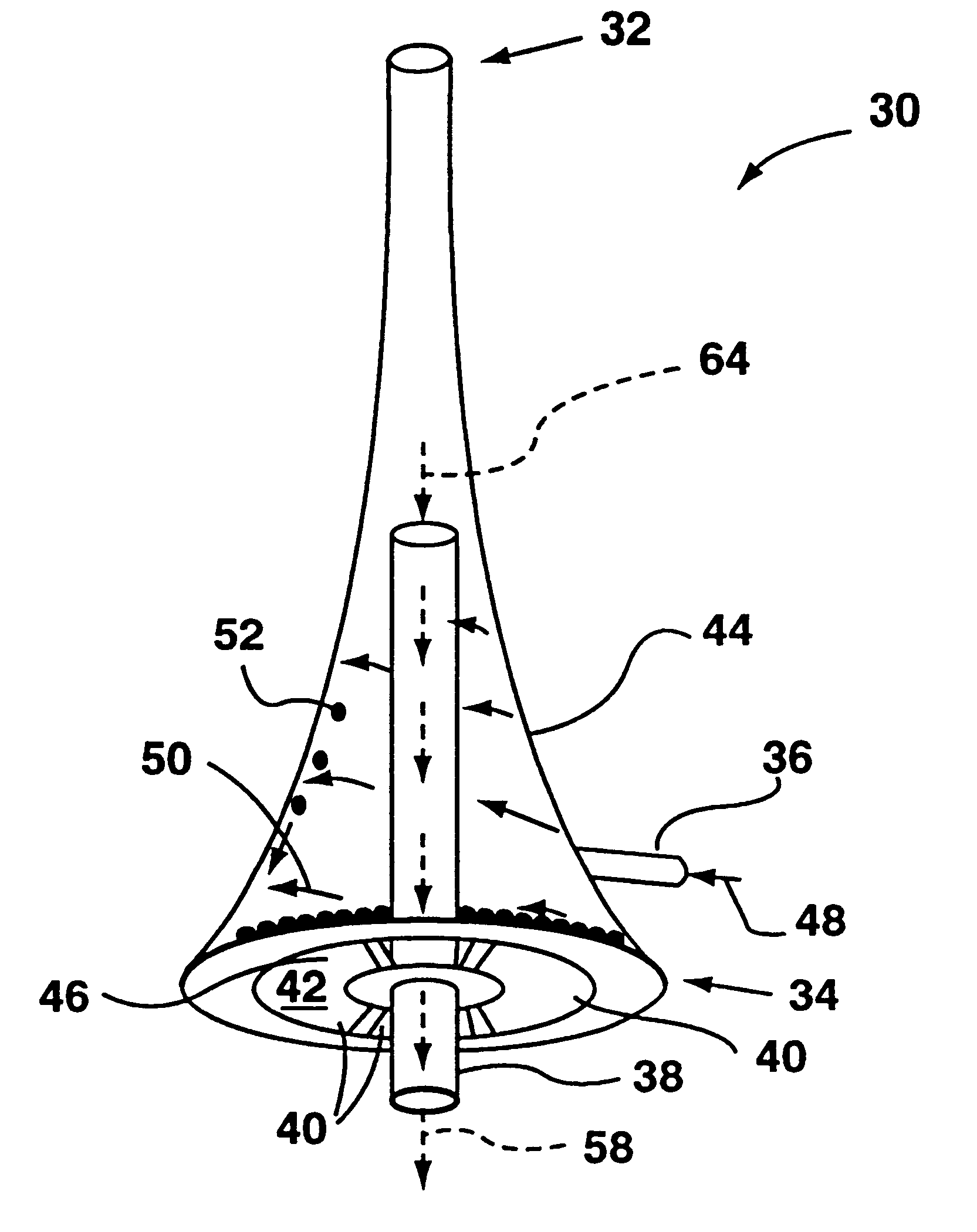
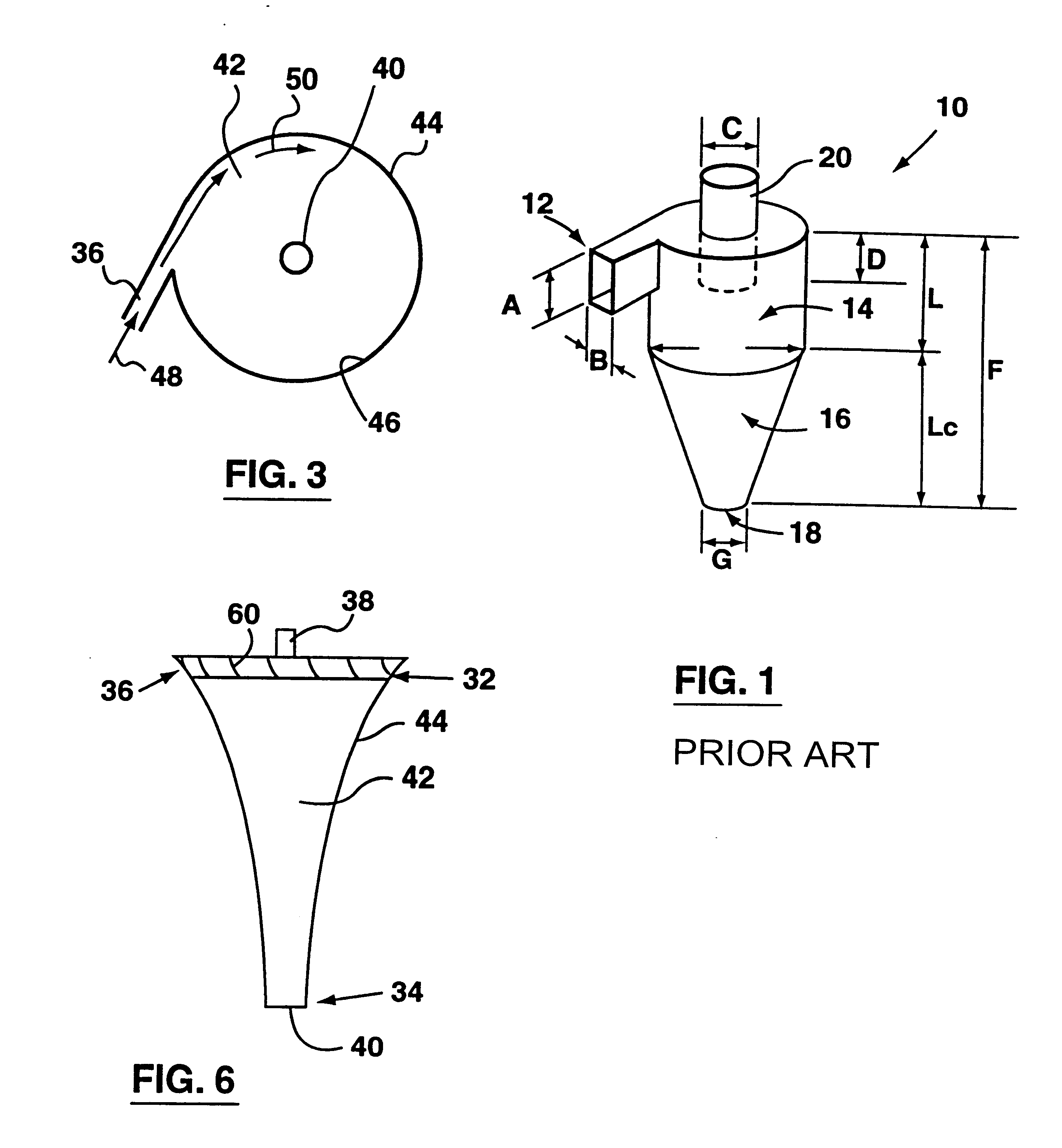
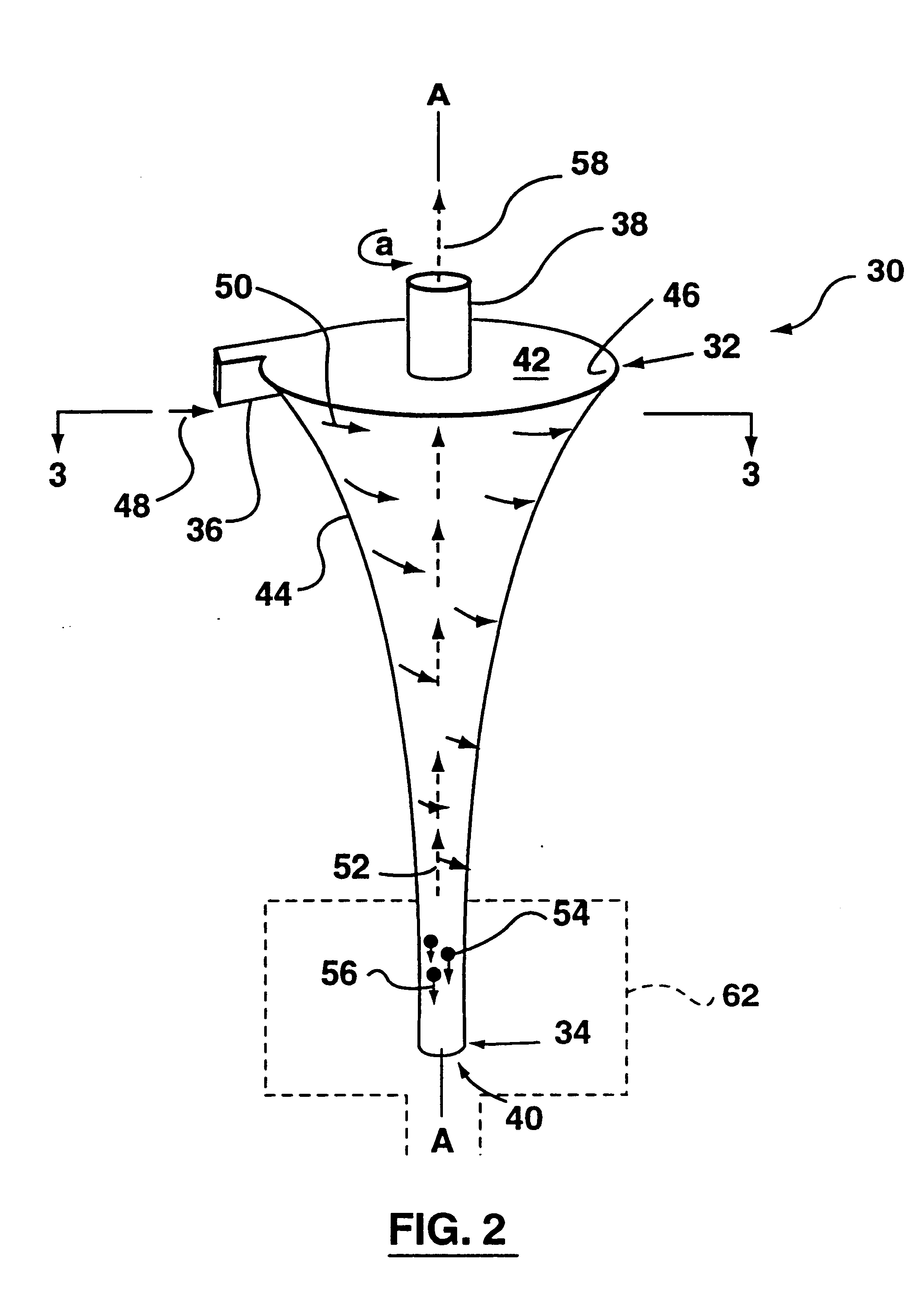
Cyclone separator having a variable longitudinal profile
PatentInactiveUS6596046B2
Innovation
- A non-frusto-conical cyclone separator with a continuously varying inner surface defined by a continuous n-differentiable curve, allowing continuous variation of the L/d and Lc/d parameters along the cyclone axis, enabling efficient separation of a wider range of particle sizes in a single unit.
Dirt and dust cyclonic separating apparatus
PatentWO2006125946A1
Innovation
- A cyclonic separating apparatus comprising three cyclonic units in series, where the second unit has a separation efficiency equal to either the first or third unit, ensuring that the airflow is pre-cleaned before entering the third unit, which operates under favorable conditions to achieve high separation efficiency.


Environmental Standards for Dust Emission Control
Environmental standards for dust emission control have become increasingly stringent worldwide, driven by growing concerns over air quality and public health impacts. Regulatory frameworks such as the U.S. Environmental Protection Agency's National Ambient Air Quality Standards, the European Union's Industrial Emissions Directive, and China's Air Pollution Prevention and Control Law establish maximum permissible concentration limits for particulate matter emissions. These standards typically specify allowable emission rates measured in milligrams per cubic meter, with stricter thresholds applied to fine particulate matter categories including PM10 and PM2.5 due to their enhanced respiratory penetration capabilities.
Cyclone separator performance evaluation under variable dust load conditions must align with these regulatory requirements to ensure compliance across operational scenarios. Most jurisdictions mandate continuous emission monitoring systems or periodic stack testing to verify that industrial facilities maintain emissions below prescribed limits regardless of process fluctuations. The variability in dust loading presents particular challenges for regulatory compliance, as cyclone efficiency degradation during peak loading periods could result in exceedance events that trigger enforcement actions including operational restrictions or financial penalties.
International standards organizations have developed testing protocols specifically addressing cyclone separator performance assessment. ISO 9096 provides standardized methods for determining particulate matter concentration in gas streams, while ASTM D5373 outlines procedures for evaluating dust collector efficiency. These protocols emphasize the importance of testing across representative operating conditions, including variable inlet dust concentrations, to establish reliable performance baselines that reflect real-world operational variability rather than idealized steady-state conditions.
Emerging regulatory trends indicate a shift toward risk-based emission limits that account for both concentration and total mass discharge rates. This evolution requires cyclone separator systems to demonstrate consistent performance not only during nominal operations but also during transient conditions characterized by fluctuating dust loads. Compliance strategies increasingly incorporate predictive modeling and real-time monitoring technologies to anticipate efficiency variations and implement proactive adjustments that maintain emissions within regulatory boundaries throughout the full spectrum of operational scenarios.
Cyclone separator performance evaluation under variable dust load conditions must align with these regulatory requirements to ensure compliance across operational scenarios. Most jurisdictions mandate continuous emission monitoring systems or periodic stack testing to verify that industrial facilities maintain emissions below prescribed limits regardless of process fluctuations. The variability in dust loading presents particular challenges for regulatory compliance, as cyclone efficiency degradation during peak loading periods could result in exceedance events that trigger enforcement actions including operational restrictions or financial penalties.
International standards organizations have developed testing protocols specifically addressing cyclone separator performance assessment. ISO 9096 provides standardized methods for determining particulate matter concentration in gas streams, while ASTM D5373 outlines procedures for evaluating dust collector efficiency. These protocols emphasize the importance of testing across representative operating conditions, including variable inlet dust concentrations, to establish reliable performance baselines that reflect real-world operational variability rather than idealized steady-state conditions.
Emerging regulatory trends indicate a shift toward risk-based emission limits that account for both concentration and total mass discharge rates. This evolution requires cyclone separator systems to demonstrate consistent performance not only during nominal operations but also during transient conditions characterized by fluctuating dust loads. Compliance strategies increasingly incorporate predictive modeling and real-time monitoring technologies to anticipate efficiency variations and implement proactive adjustments that maintain emissions within regulatory boundaries throughout the full spectrum of operational scenarios.
Performance Testing Protocols and Standardization
Establishing robust performance testing protocols for cyclone separators under variable dust load conditions requires systematic approaches that address both measurement accuracy and result reproducibility. Current industry practices reveal significant inconsistencies in testing methodologies, particularly regarding dust concentration variations, particle size distribution control, and flow rate stabilization. The absence of universally accepted standards creates challenges in comparing performance data across different manufacturers and research institutions, ultimately hindering objective efficiency benchmarking.
Standardization efforts must prioritize the development of controlled testing environments that simulate real-world operational variability while maintaining experimental rigor. Key parameters requiring standardization include inlet dust concentration ranges, particle size distribution specifications, gas flow velocity profiles, and temperature-humidity conditions. International organizations such as ISO and ASTM have initiated framework development, yet gaps remain in addressing dynamic dust load scenarios that reflect actual industrial applications rather than steady-state conditions.
Measurement instrumentation standardization presents another critical dimension, encompassing particle sampling techniques, concentration measurement devices, and pressure drop monitoring systems. Calibration protocols for optical particle counters, gravimetric sampling equipment, and differential pressure transducers must be harmonized to ensure data comparability. The integration of real-time monitoring capabilities with standardized data acquisition intervals enables more accurate capture of transient performance variations during dust load fluctuations.
Protocol validation through inter-laboratory testing programs has emerged as essential for establishing credibility and identifying systematic biases in measurement approaches. Round-robin testing initiatives involving multiple facilities using identical cyclone geometries and dust samples can quantify method-related uncertainties and refine procedural specifications. Such collaborative efforts facilitate consensus-building around acceptable tolerance ranges and statistical analysis methods for efficiency calculations under variable loading conditions.
Documentation requirements within standardized protocols must comprehensively specify test setup configurations, operational procedures, data processing algorithms, and uncertainty quantification methods. This includes detailed reporting of cyclone geometric parameters, dust characterization data, environmental conditions, and complete measurement uncertainty budgets. Transparent documentation enables independent verification and supports the development of performance databases that advance understanding of efficiency variability across diverse operational scenarios.
Standardization efforts must prioritize the development of controlled testing environments that simulate real-world operational variability while maintaining experimental rigor. Key parameters requiring standardization include inlet dust concentration ranges, particle size distribution specifications, gas flow velocity profiles, and temperature-humidity conditions. International organizations such as ISO and ASTM have initiated framework development, yet gaps remain in addressing dynamic dust load scenarios that reflect actual industrial applications rather than steady-state conditions.
Measurement instrumentation standardization presents another critical dimension, encompassing particle sampling techniques, concentration measurement devices, and pressure drop monitoring systems. Calibration protocols for optical particle counters, gravimetric sampling equipment, and differential pressure transducers must be harmonized to ensure data comparability. The integration of real-time monitoring capabilities with standardized data acquisition intervals enables more accurate capture of transient performance variations during dust load fluctuations.
Protocol validation through inter-laboratory testing programs has emerged as essential for establishing credibility and identifying systematic biases in measurement approaches. Round-robin testing initiatives involving multiple facilities using identical cyclone geometries and dust samples can quantify method-related uncertainties and refine procedural specifications. Such collaborative efforts facilitate consensus-building around acceptable tolerance ranges and statistical analysis methods for efficiency calculations under variable loading conditions.
Documentation requirements within standardized protocols must comprehensively specify test setup configurations, operational procedures, data processing algorithms, and uncertainty quantification methods. This includes detailed reporting of cyclone geometric parameters, dust characterization data, environmental conditions, and complete measurement uncertainty budgets. Transparent documentation enables independent verification and supports the development of performance databases that advance understanding of efficiency variability across diverse operational scenarios.
Unlock deeper insights with PatSnap Eureka Quick Research — get a full tech report to explore trends and direct your research. Try now!
Generate Your Research Report Instantly with AI Agent
Supercharge your innovation with PatSnap Eureka AI Agent Platform!