Bridge Rectifier vs Diode: Power Efficiency in 5G
MAR 24, 20269 MIN READ
Generate Your Research Report Instantly with AI Agent
Patsnap Eureka helps you evaluate technical feasibility & market potential.
5G Power Rectification Background and Efficiency Goals
The evolution of 5G wireless communication technology has fundamentally transformed the landscape of mobile connectivity, demanding unprecedented levels of power efficiency and performance optimization. As 5G networks proliferate globally, the infrastructure supporting these systems faces mounting pressure to deliver higher data rates, lower latency, and enhanced reliability while maintaining stringent energy consumption standards. This technological paradigm shift has placed power rectification systems at the forefront of critical design considerations.
Power rectification represents a cornerstone technology in 5G infrastructure, serving as the essential bridge between alternating current power sources and the direct current requirements of sophisticated 5G equipment. The efficiency of these rectification systems directly impacts operational costs, thermal management, and overall system reliability. Traditional rectification approaches, primarily centered around single diode configurations, are increasingly challenged by the demanding power requirements of 5G base stations and related infrastructure components.
The emergence of bridge rectifier architectures has introduced new possibilities for addressing the complex power efficiency challenges inherent in 5G deployments. Bridge rectifiers offer distinct advantages in terms of transformer utilization, ripple factor reduction, and overall power conversion efficiency compared to conventional single diode solutions. However, the selection between bridge rectifier and diode configurations requires careful consideration of multiple technical and economic factors specific to 5G applications.
Current industry trends indicate that 5G base stations consume significantly more power than their 4G predecessors, with some estimates suggesting increases of 50-100% in power consumption. This dramatic escalation stems from the deployment of massive MIMO antenna arrays, advanced signal processing requirements, and the need for higher frequency operations. Consequently, even marginal improvements in rectification efficiency can translate to substantial operational savings and reduced environmental impact across large-scale 5G deployments.
The primary efficiency goals driving 5G power rectification development center around achieving conversion efficiencies exceeding 95% while maintaining stable performance across varying load conditions. Additionally, these systems must demonstrate exceptional reliability, minimal electromagnetic interference, and compatibility with existing power infrastructure. The integration of advanced semiconductor materials, such as silicon carbide and gallium nitride, has opened new avenues for achieving these ambitious efficiency targets.
Regulatory frameworks and industry standards continue to evolve, establishing increasingly stringent efficiency requirements for telecommunications infrastructure. These developments have accelerated research into optimized rectification topologies, with bridge rectifier configurations emerging as particularly promising candidates for meeting next-generation efficiency benchmarks while addressing the unique challenges posed by 5G power systems.
Power rectification represents a cornerstone technology in 5G infrastructure, serving as the essential bridge between alternating current power sources and the direct current requirements of sophisticated 5G equipment. The efficiency of these rectification systems directly impacts operational costs, thermal management, and overall system reliability. Traditional rectification approaches, primarily centered around single diode configurations, are increasingly challenged by the demanding power requirements of 5G base stations and related infrastructure components.
The emergence of bridge rectifier architectures has introduced new possibilities for addressing the complex power efficiency challenges inherent in 5G deployments. Bridge rectifiers offer distinct advantages in terms of transformer utilization, ripple factor reduction, and overall power conversion efficiency compared to conventional single diode solutions. However, the selection between bridge rectifier and diode configurations requires careful consideration of multiple technical and economic factors specific to 5G applications.
Current industry trends indicate that 5G base stations consume significantly more power than their 4G predecessors, with some estimates suggesting increases of 50-100% in power consumption. This dramatic escalation stems from the deployment of massive MIMO antenna arrays, advanced signal processing requirements, and the need for higher frequency operations. Consequently, even marginal improvements in rectification efficiency can translate to substantial operational savings and reduced environmental impact across large-scale 5G deployments.
The primary efficiency goals driving 5G power rectification development center around achieving conversion efficiencies exceeding 95% while maintaining stable performance across varying load conditions. Additionally, these systems must demonstrate exceptional reliability, minimal electromagnetic interference, and compatibility with existing power infrastructure. The integration of advanced semiconductor materials, such as silicon carbide and gallium nitride, has opened new avenues for achieving these ambitious efficiency targets.
Regulatory frameworks and industry standards continue to evolve, establishing increasingly stringent efficiency requirements for telecommunications infrastructure. These developments have accelerated research into optimized rectification topologies, with bridge rectifier configurations emerging as particularly promising candidates for meeting next-generation efficiency benchmarks while addressing the unique challenges posed by 5G power systems.
Market Demand for Efficient 5G Power Solutions
The global telecommunications industry is experiencing unprecedented demand for efficient power solutions as 5G networks continue their rapid deployment worldwide. Network operators face mounting pressure to reduce operational expenditures while simultaneously expanding coverage and capacity. Power efficiency has emerged as a critical differentiator, directly impacting both operational costs and environmental sustainability goals that telecommunications companies have committed to achieving.
The proliferation of 5G base stations, which consume significantly more power than their 4G predecessors, has intensified the focus on power conversion efficiency. Each percentage point improvement in power efficiency translates to substantial cost savings across thousands of deployed sites. This economic imperative drives continuous innovation in rectification technologies, where the choice between bridge rectifiers and individual diodes becomes strategically important for equipment manufacturers and network operators.
Market dynamics reveal a clear preference shift toward integrated power solutions that maximize efficiency while minimizing footprint and thermal management requirements. The demand extends beyond traditional telecommunications infrastructure to include edge computing facilities, small cells, and distributed antenna systems that form the backbone of 5G networks. These applications require power solutions that can operate reliably in diverse environmental conditions while maintaining peak efficiency.
Enterprise customers and industrial IoT applications represent another significant demand driver for efficient 5G power solutions. Manufacturing facilities, smart cities, and autonomous vehicle infrastructure depend on reliable, efficient power conversion to support mission-critical 5G connectivity. The stringent uptime requirements in these sectors create premium market opportunities for superior power efficiency technologies.
Regulatory frameworks worldwide increasingly emphasize energy efficiency standards for telecommunications equipment. European Union directives, FCC regulations, and similar policies in Asia-Pacific markets establish minimum efficiency thresholds that influence procurement decisions. These regulatory pressures accelerate market adoption of advanced rectification technologies that exceed baseline requirements.
The competitive landscape shows equipment manufacturers prioritizing power efficiency as a key product differentiation strategy. System integrators seek components that enable them to meet increasingly demanding efficiency specifications while reducing overall system complexity and cost. This market dynamic creates substantial opportunities for innovative rectification solutions that demonstrate measurable performance advantages in real-world 5G deployment scenarios.
The proliferation of 5G base stations, which consume significantly more power than their 4G predecessors, has intensified the focus on power conversion efficiency. Each percentage point improvement in power efficiency translates to substantial cost savings across thousands of deployed sites. This economic imperative drives continuous innovation in rectification technologies, where the choice between bridge rectifiers and individual diodes becomes strategically important for equipment manufacturers and network operators.
Market dynamics reveal a clear preference shift toward integrated power solutions that maximize efficiency while minimizing footprint and thermal management requirements. The demand extends beyond traditional telecommunications infrastructure to include edge computing facilities, small cells, and distributed antenna systems that form the backbone of 5G networks. These applications require power solutions that can operate reliably in diverse environmental conditions while maintaining peak efficiency.
Enterprise customers and industrial IoT applications represent another significant demand driver for efficient 5G power solutions. Manufacturing facilities, smart cities, and autonomous vehicle infrastructure depend on reliable, efficient power conversion to support mission-critical 5G connectivity. The stringent uptime requirements in these sectors create premium market opportunities for superior power efficiency technologies.
Regulatory frameworks worldwide increasingly emphasize energy efficiency standards for telecommunications equipment. European Union directives, FCC regulations, and similar policies in Asia-Pacific markets establish minimum efficiency thresholds that influence procurement decisions. These regulatory pressures accelerate market adoption of advanced rectification technologies that exceed baseline requirements.
The competitive landscape shows equipment manufacturers prioritizing power efficiency as a key product differentiation strategy. System integrators seek components that enable them to meet increasingly demanding efficiency specifications while reducing overall system complexity and cost. This market dynamic creates substantial opportunities for innovative rectification solutions that demonstrate measurable performance advantages in real-world 5G deployment scenarios.
Current Rectifier Performance Challenges in 5G Systems
5G systems face unprecedented power efficiency demands that expose critical limitations in current rectifier technologies. Traditional single-diode rectifiers, while simple and cost-effective, struggle to meet the stringent efficiency requirements of 5G base stations and mobile devices. These systems operate at significantly higher frequencies and power levels compared to previous generations, creating thermal management challenges that directly impact overall system performance and reliability.
The primary challenge stems from the inherent voltage drop characteristics of single-diode rectifiers. At typical 5G operating currents, the forward voltage drop of 0.7V in silicon diodes represents a substantial power loss, particularly in low-voltage applications common in 5G infrastructure. This inefficiency translates to increased heat generation, requiring more sophisticated cooling solutions and ultimately reducing the overall system efficiency below acceptable thresholds for sustainable 5G deployment.
Bridge rectifier configurations, while offering improved voltage utilization, introduce their own set of performance challenges in 5G applications. The dual-diode conduction path inherently doubles the voltage drop losses, creating a 1.4V penalty that becomes increasingly problematic as 5G systems demand higher current densities. This limitation is particularly acute in power-sensitive applications such as massive MIMO arrays and small cell deployments where every percentage point of efficiency directly impacts operational costs.
Thermal management represents another critical challenge affecting rectifier performance in 5G systems. The concentrated heat generation from inefficient rectification creates hotspots that can degrade semiconductor performance and reduce component lifespan. Current rectifier designs often require oversized heat sinks and active cooling systems, adding complexity and cost to 5G infrastructure while consuming additional power that further reduces overall system efficiency.
Switching losses at 5G frequencies present additional complications for rectifier performance. As operating frequencies increase into the millimeter-wave spectrum, parasitic capacitances and inductances in traditional rectifier circuits become more significant, leading to increased switching losses and reduced efficiency. These high-frequency effects are particularly problematic in applications requiring fast switching speeds and precise timing control.
The integration challenges of current rectifier solutions with 5G system architectures also create performance bottlenecks. Many existing rectifier designs were optimized for lower-frequency applications and struggle to maintain efficiency when integrated with the complex power management systems required for 5G base stations and user equipment, necessitating innovative approaches to rectifier design and implementation.
The primary challenge stems from the inherent voltage drop characteristics of single-diode rectifiers. At typical 5G operating currents, the forward voltage drop of 0.7V in silicon diodes represents a substantial power loss, particularly in low-voltage applications common in 5G infrastructure. This inefficiency translates to increased heat generation, requiring more sophisticated cooling solutions and ultimately reducing the overall system efficiency below acceptable thresholds for sustainable 5G deployment.
Bridge rectifier configurations, while offering improved voltage utilization, introduce their own set of performance challenges in 5G applications. The dual-diode conduction path inherently doubles the voltage drop losses, creating a 1.4V penalty that becomes increasingly problematic as 5G systems demand higher current densities. This limitation is particularly acute in power-sensitive applications such as massive MIMO arrays and small cell deployments where every percentage point of efficiency directly impacts operational costs.
Thermal management represents another critical challenge affecting rectifier performance in 5G systems. The concentrated heat generation from inefficient rectification creates hotspots that can degrade semiconductor performance and reduce component lifespan. Current rectifier designs often require oversized heat sinks and active cooling systems, adding complexity and cost to 5G infrastructure while consuming additional power that further reduces overall system efficiency.
Switching losses at 5G frequencies present additional complications for rectifier performance. As operating frequencies increase into the millimeter-wave spectrum, parasitic capacitances and inductances in traditional rectifier circuits become more significant, leading to increased switching losses and reduced efficiency. These high-frequency effects are particularly problematic in applications requiring fast switching speeds and precise timing control.
The integration challenges of current rectifier solutions with 5G system architectures also create performance bottlenecks. Many existing rectifier designs were optimized for lower-frequency applications and struggle to maintain efficiency when integrated with the complex power management systems required for 5G base stations and user equipment, necessitating innovative approaches to rectifier design and implementation.
Existing Bridge vs Diode Rectifier Solutions
01 Bridge rectifier circuits with improved efficiency through optimized diode configuration
Bridge rectifier circuits can achieve improved power efficiency by utilizing optimized diode configurations and arrangements. These designs focus on reducing voltage drops across the rectification path and minimizing power losses during AC to DC conversion. Advanced topologies incorporate specific diode arrangements that reduce conduction losses and improve overall conversion efficiency compared to traditional single-diode rectifiers.- Bridge rectifier circuits with improved efficiency through optimized diode configuration: Bridge rectifier circuits can achieve improved power efficiency by utilizing optimized diode configurations and arrangements. These designs focus on reducing voltage drops across the rectification path and minimizing power losses during the conversion process. Advanced topologies incorporate specific diode arrangements that enhance the overall efficiency of the rectification circuit while maintaining stable output characteristics.
- Synchronous rectification replacing traditional diode bridges: Synchronous rectification technology uses controlled switching devices instead of conventional diodes in bridge rectifier configurations to significantly improve power efficiency. This approach reduces conduction losses by replacing diodes with actively controlled switches that have lower on-resistance. The technique is particularly effective in low-voltage, high-current applications where diode forward voltage drops represent significant power losses.
- Schottky diodes in bridge rectifier applications for reduced power loss: The implementation of Schottky diodes in bridge rectifier circuits provides enhanced power efficiency compared to standard silicon diodes due to their lower forward voltage drop characteristics. These specialized diodes reduce heat generation and improve overall system efficiency, particularly in high-frequency switching applications. The reduced voltage drop directly translates to lower power dissipation and improved energy conversion efficiency.
- Active rectification control circuits for efficiency optimization: Active rectification control systems employ intelligent switching mechanisms and control algorithms to optimize the rectification process and maximize power efficiency. These circuits dynamically adjust the operation of rectifying elements based on load conditions and input parameters. The control systems can detect optimal switching timing and reduce reverse recovery losses, resulting in superior efficiency compared to passive diode-based rectification.
- Hybrid rectifier topologies combining multiple rectification techniques: Hybrid rectifier designs integrate multiple rectification approaches, combining the benefits of different diode types and circuit topologies to achieve optimal power efficiency across varying operating conditions. These configurations may incorporate both passive and active elements, utilizing each component's advantages at appropriate operating points. The hybrid approach allows for improved efficiency over a wider range of input voltages and load conditions compared to single-topology solutions.
02 Synchronous rectification techniques replacing traditional diodes
Synchronous rectification methods replace conventional diodes with actively controlled switching devices to significantly reduce forward voltage drops and conduction losses. This approach uses MOSFETs or other controlled switches that are turned on and off in synchronization with the AC input, eliminating the fixed voltage drop associated with standard diodes and thereby improving power conversion efficiency, particularly in low-voltage high-current applications.Expand Specific Solutions03 Schottky diode implementation for reduced forward voltage drop
The use of Schottky barrier diodes in rectifier circuits provides lower forward voltage drops compared to standard PN junction diodes, resulting in reduced power dissipation and improved efficiency. These diodes exhibit faster switching characteristics and lower conduction losses, making them particularly suitable for high-frequency rectification applications where efficiency is critical.Expand Specific Solutions04 Multi-phase rectification systems for enhanced power efficiency
Multi-phase rectifier configurations utilize multiple rectification stages or phases to distribute current loads and reduce ripple, thereby improving overall power conversion efficiency. These systems can balance thermal loads across multiple diodes, reduce individual component stress, and achieve better power factor correction compared to single-phase bridge rectifiers, resulting in more efficient power delivery.Expand Specific Solutions05 Active power factor correction integrated with rectification
Integration of active power factor correction circuits with bridge rectifiers improves overall system efficiency by reducing harmonic distortion and optimizing input current waveforms. These designs incorporate control circuits that actively shape the input current to follow the input voltage, minimizing reactive power and improving the power factor, which results in more efficient power utilization and reduced losses throughout the rectification process.Expand Specific Solutions
Key Players in 5G Power Management Industry
The bridge rectifier versus diode power efficiency debate in 5G represents a mature technology sector experiencing rapid evolution driven by 5G infrastructure demands. The market, valued in billions globally, is characterized by intense competition among established semiconductor giants and specialized power management companies. Technology maturity varies significantly across players, with STMicroelectronics, Samsung Electronics, and NXP Semiconductors leading advanced power conversion solutions, while companies like Silicon Laboratories and Microchip Technology focus on integrated power management systems. Robert Bosch and automotive suppliers like Vitesco Technologies drive efficiency innovations for 5G-enabled vehicles. The competitive landscape shows consolidation around companies offering comprehensive power solutions, with emerging players like Powermat Technologies and Energous Corp pioneering wireless power alternatives that could disrupt traditional rectifier applications in 5G infrastructure.
STMicroelectronics Asia Pacific Pte Ltd.
Technical Solution: STMicroelectronics develops advanced rectifier solutions optimized for 5G power management, featuring integrated bridge rectifier circuits with Schottky barrier diodes that achieve power efficiency exceeding 95% at high frequencies. Their technology incorporates synchronous rectification techniques combined with low forward voltage drop diodes (typically 0.3-0.4V) to minimize conduction losses. The company's bridge rectifier designs utilize advanced silicon carbide (SiC) and gallium nitride (GaN) materials to handle the demanding power requirements of 5G base stations, which can consume up to 3-4 times more power than 4G equipment. Their solutions integrate smart power management features including adaptive voltage regulation and thermal management systems specifically designed for 5G infrastructure applications.
Strengths: High power efficiency, advanced material technology, integrated smart features. Weaknesses: Higher cost compared to traditional silicon solutions, complex thermal management requirements.
Samsung Electronics Co., Ltd.
Technical Solution: Samsung has developed proprietary power management integrated circuits (PMICs) for 5G applications that incorporate both bridge rectifier and advanced diode technologies. Their solution features a hybrid approach using synchronous bridge rectifiers combined with ultra-low forward voltage Schottky diodes, achieving power conversion efficiency of up to 96% in 5G radio frequency applications. The technology includes adaptive rectification switching that dynamically selects between bridge rectifier mode and diode rectification based on load conditions and frequency requirements. Samsung's design specifically addresses the power density challenges in 5G massive MIMO antenna systems, where space constraints require highly efficient power conversion in compact form factors. Their integrated approach includes on-chip temperature monitoring and power factor correction capabilities.
Strengths: High integration level, adaptive switching technology, optimized for MIMO systems. Weaknesses: Proprietary technology limits third-party integration, higher development costs.
Core Innovations in 5G Power Efficiency Technologies
Power converter with self-driven synchronous rectifier control circuitry
PatentActiveUS20140268956A1
Innovation
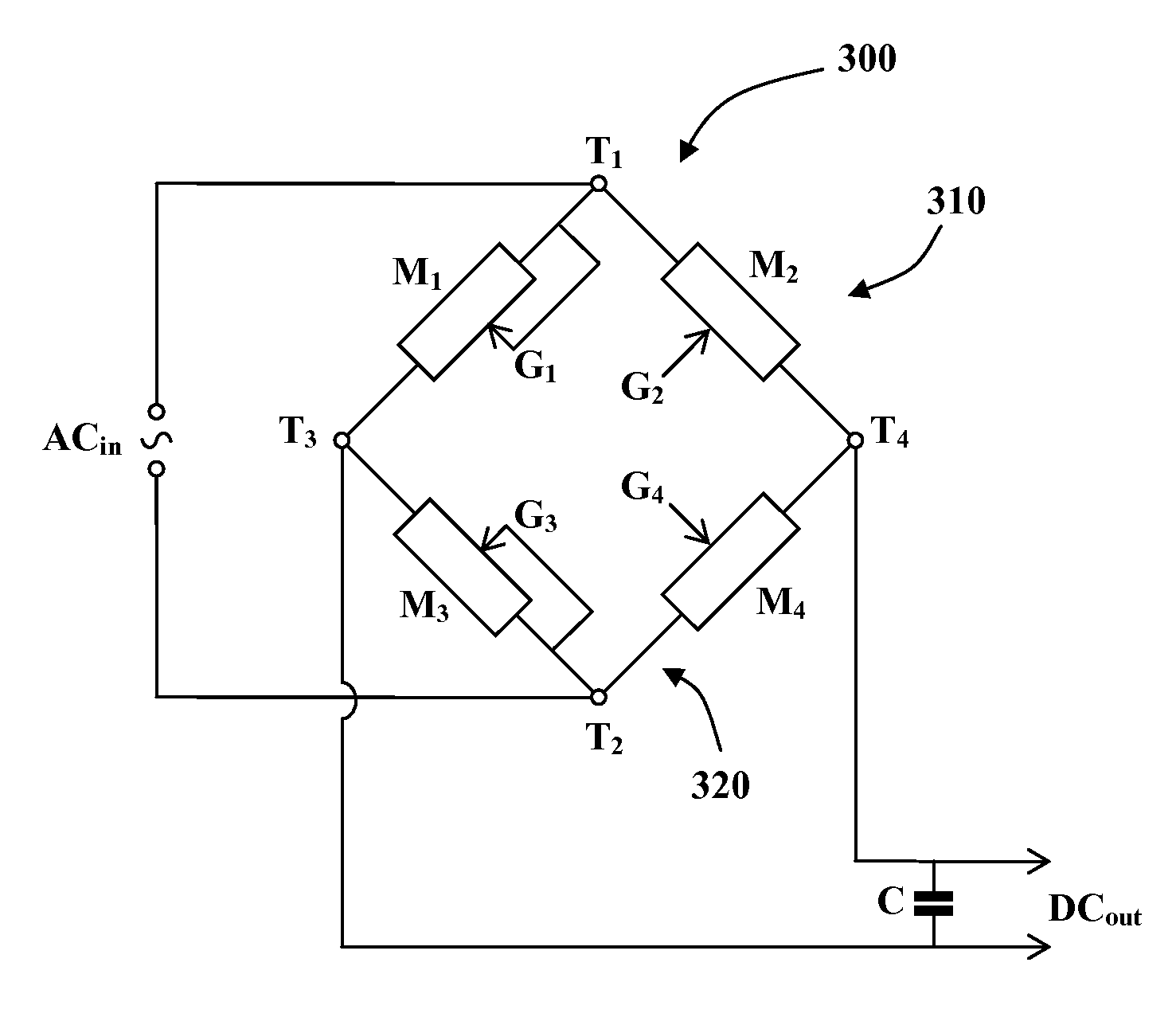
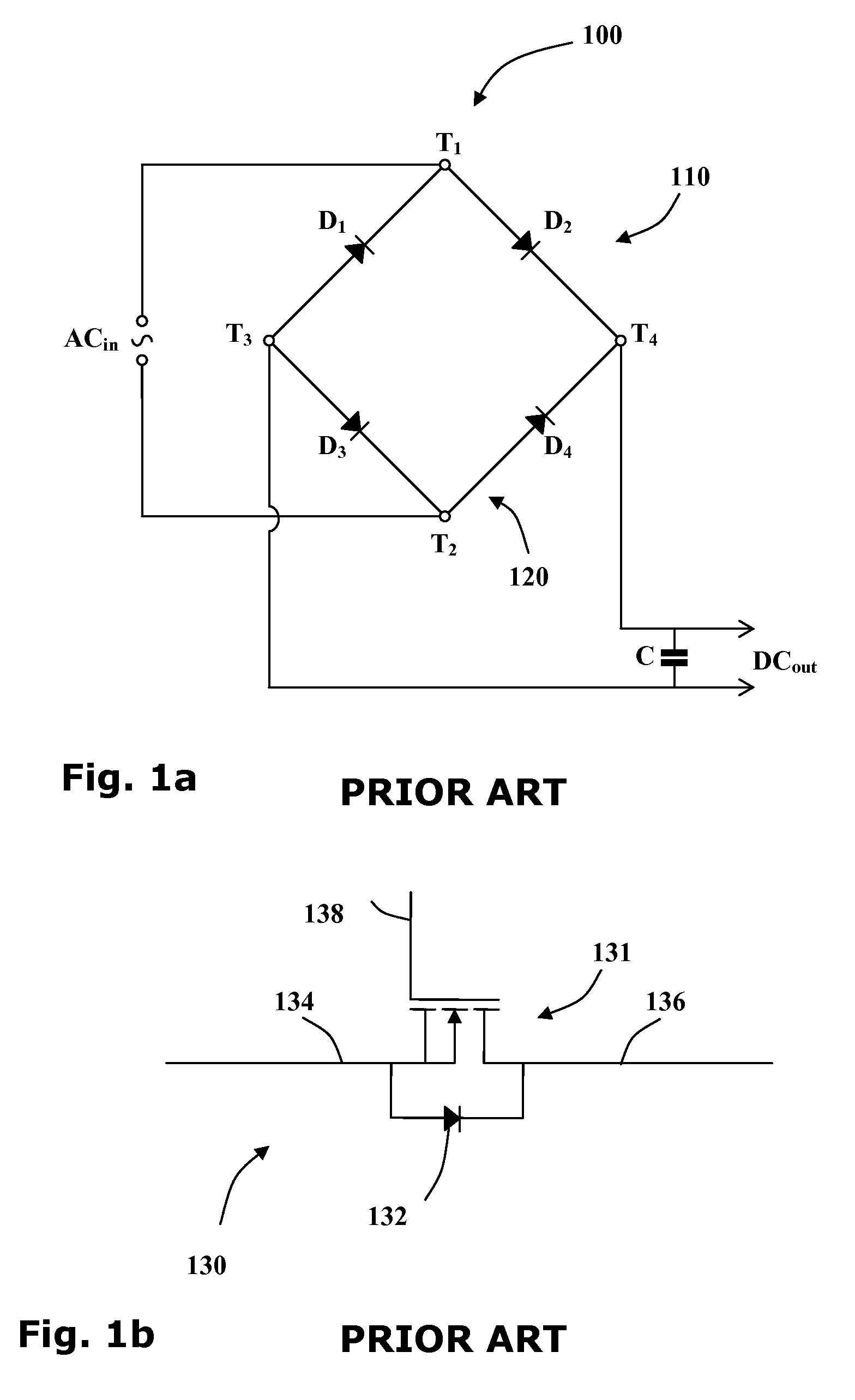
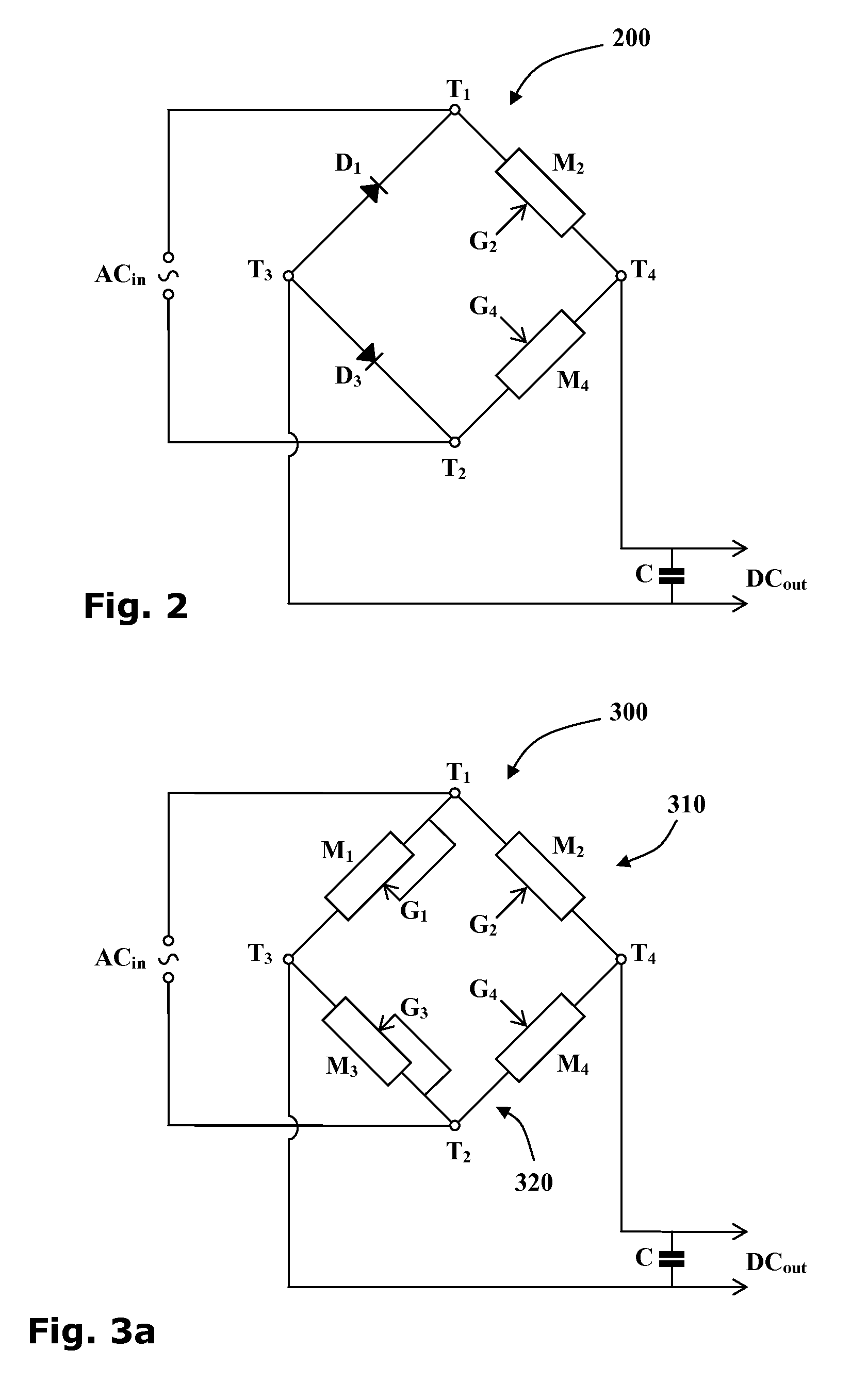
- The integration of MOSFET switching elements with diodes in a bridge rectifier configuration or replacing diodes with MOSFETs, along with control circuitry for driving parallel MOSFET configurations, reduces diode voltage drop losses and enhances overall efficiency.


Bridge synchronous rectifier
PatentActiveUS20090257259A1
Innovation
- A current-triggered synchronous rectifier is introduced, utilizing MOSFET devices with a current monitor to switch between ON and OFF states based on predetermined current thresholds, replacing diodes in a full-wave rectifier configuration to minimize heat loss and prevent short circuits.

Thermal Management in High-Frequency Rectifiers
Thermal management represents one of the most critical challenges in high-frequency rectifier design for 5G applications, where operating frequencies can exceed several gigahertz. The elevated switching frequencies inherent in 5G systems generate substantial heat dissipation, particularly in power conversion circuits where bridge rectifiers and individual diodes must handle rapid current transitions while maintaining efficiency standards.
Heat generation in high-frequency rectifiers primarily stems from switching losses, conduction losses, and reverse recovery phenomena. Bridge rectifiers, with their four-diode configuration, inherently produce more heat than single-diode solutions due to the simultaneous conduction of multiple semiconductor junctions. At 5G frequencies, the reverse recovery time of diodes becomes increasingly significant, creating additional power dissipation during each switching cycle.
Advanced thermal management strategies have emerged to address these challenges, including integrated heat spreaders, micro-channel cooling systems, and thermally optimized package designs. Silicon carbide and gallium nitride semiconductors offer superior thermal conductivity compared to traditional silicon devices, enabling more efficient heat transfer from the junction to the package substrate.
Package-level innovations focus on reducing thermal resistance through direct bonding techniques and enhanced thermal interface materials. Copper lead frames and exposed paddle designs facilitate improved heat conduction pathways, while advanced molding compounds with higher thermal conductivity help distribute heat more uniformly across the device structure.
System-level thermal management incorporates intelligent power cycling, dynamic thermal monitoring, and adaptive frequency scaling to prevent thermal runaway conditions. These approaches become particularly crucial in dense 5G infrastructure deployments where multiple rectifier circuits operate in close proximity, creating localized hot spots that can compromise overall system reliability and performance efficiency.
Heat generation in high-frequency rectifiers primarily stems from switching losses, conduction losses, and reverse recovery phenomena. Bridge rectifiers, with their four-diode configuration, inherently produce more heat than single-diode solutions due to the simultaneous conduction of multiple semiconductor junctions. At 5G frequencies, the reverse recovery time of diodes becomes increasingly significant, creating additional power dissipation during each switching cycle.
Advanced thermal management strategies have emerged to address these challenges, including integrated heat spreaders, micro-channel cooling systems, and thermally optimized package designs. Silicon carbide and gallium nitride semiconductors offer superior thermal conductivity compared to traditional silicon devices, enabling more efficient heat transfer from the junction to the package substrate.
Package-level innovations focus on reducing thermal resistance through direct bonding techniques and enhanced thermal interface materials. Copper lead frames and exposed paddle designs facilitate improved heat conduction pathways, while advanced molding compounds with higher thermal conductivity help distribute heat more uniformly across the device structure.
System-level thermal management incorporates intelligent power cycling, dynamic thermal monitoring, and adaptive frequency scaling to prevent thermal runaway conditions. These approaches become particularly crucial in dense 5G infrastructure deployments where multiple rectifier circuits operate in close proximity, creating localized hot spots that can compromise overall system reliability and performance efficiency.
EMI Compliance Standards for 5G Power Systems
Electromagnetic interference (EMI) compliance represents a critical regulatory framework governing 5G power systems, particularly when evaluating rectification technologies such as bridge rectifiers versus single diodes. The Federal Communications Commission (FCC) Part 15 regulations, European Telecommunications Standards Institute (ETSI) EN 301 489 series, and International Electrotechnical Commission (IEC) 61000 standards establish fundamental EMI limits for telecommunications equipment operating in the sub-6GHz and millimeter-wave frequency bands.
Bridge rectifier configurations inherently generate different EMI signatures compared to single-diode implementations due to their switching characteristics and harmonic content. The four-diode bridge topology creates symmetrical current paths that can reduce common-mode noise generation, while single-diode rectifiers may produce asymmetrical current flows leading to increased differential-mode emissions. These distinctions become particularly significant when meeting CISPR 25 automotive EMC requirements for vehicular 5G applications.
Conducted emissions testing under CISPR 32 Class B limits requires power systems to maintain emissions below 66-56 dBμV across the 150kHz to 30MHz range. Bridge rectifiers typically demonstrate superior performance in this frequency band due to their balanced current distribution, reducing the amplitude of low-frequency harmonics that often challenge single-diode designs. The switching frequency selection becomes crucial, as frequencies near 5G operational bands (3.5GHz, 28GHz, 39GHz) can create interference through harmonic multiplication.
Radiated emissions compliance under ANSI C63.10 standards demands careful consideration of power system layout and filtering approaches. Bridge rectifier implementations often require less aggressive filtering due to their inherently lower EMI generation, potentially reducing system complexity and cost. However, the increased component count introduces additional parasitic elements that must be managed through proper PCB design and shielding techniques.
The emerging 5G-Advanced and 6G standards are driving more stringent EMI requirements, with proposed limits 10-15dB below current thresholds. This regulatory evolution favors power architectures with superior inherent EMI performance, potentially influencing the bridge rectifier versus single-diode selection criteria for next-generation telecommunications infrastructure.
Bridge rectifier configurations inherently generate different EMI signatures compared to single-diode implementations due to their switching characteristics and harmonic content. The four-diode bridge topology creates symmetrical current paths that can reduce common-mode noise generation, while single-diode rectifiers may produce asymmetrical current flows leading to increased differential-mode emissions. These distinctions become particularly significant when meeting CISPR 25 automotive EMC requirements for vehicular 5G applications.
Conducted emissions testing under CISPR 32 Class B limits requires power systems to maintain emissions below 66-56 dBμV across the 150kHz to 30MHz range. Bridge rectifiers typically demonstrate superior performance in this frequency band due to their balanced current distribution, reducing the amplitude of low-frequency harmonics that often challenge single-diode designs. The switching frequency selection becomes crucial, as frequencies near 5G operational bands (3.5GHz, 28GHz, 39GHz) can create interference through harmonic multiplication.
Radiated emissions compliance under ANSI C63.10 standards demands careful consideration of power system layout and filtering approaches. Bridge rectifier implementations often require less aggressive filtering due to their inherently lower EMI generation, potentially reducing system complexity and cost. However, the increased component count introduces additional parasitic elements that must be managed through proper PCB design and shielding techniques.
The emerging 5G-Advanced and 6G standards are driving more stringent EMI requirements, with proposed limits 10-15dB below current thresholds. This regulatory evolution favors power architectures with superior inherent EMI performance, potentially influencing the bridge rectifier versus single-diode selection criteria for next-generation telecommunications infrastructure.
Unlock deeper insights with Patsnap Eureka Quick Research — get a full tech report to explore trends and direct your research. Try now!
Generate Your Research Report Instantly with AI Agent
Supercharge your innovation with Patsnap Eureka AI Agent Platform!