

CDI Performance Boosts with Nanostructured Materials
APR 21, 20269 MIN READ
Generate Your Research Report Instantly with AI Agent
PatSnap Eureka helps you evaluate technical feasibility & market potential.
CDI Nanostructured Materials Background and Objectives
Capacitive deionization (CDI) has emerged as a promising electrochemical water treatment technology that removes ionic contaminants through electrostatic adsorption on porous electrode surfaces. The fundamental principle involves applying a low voltage across two electrodes immersed in saline water, causing ions to migrate and accumulate within the electrical double layer formed at the electrode-electrolyte interface. This process offers significant advantages over conventional desalination methods, including lower energy consumption, minimal chemical usage, and reversible operation through simple polarity switching.
The historical development of CDI technology traces back to the 1960s when researchers first explored electrochemical approaches for water purification. Early implementations utilized activated carbon electrodes, which demonstrated the basic feasibility of capacitive ion removal but suffered from limited salt adsorption capacity and slow kinetics. The technology experienced renewed interest in the 1990s as environmental concerns and water scarcity issues intensified globally, driving research toward more efficient electrode materials and system configurations.
Traditional CDI systems face several performance limitations that restrict their commercial viability and widespread adoption. Conventional activated carbon electrodes typically exhibit salt adsorption capacities below 15 mg/g, insufficient for practical desalination applications. Additionally, these systems suffer from co-ion expulsion effects, where counter-ions are released during the charging process, reducing overall desalination efficiency. Long-term stability issues, including electrode degradation and performance decay, further challenge the technology's economic competitiveness.
The integration of nanostructured materials represents a transformative approach to addressing these fundamental limitations. Nanomaterials offer unprecedented opportunities to engineer electrode properties at the molecular level, enabling precise control over surface area, pore structure, electrical conductivity, and ion selectivity. Advanced nanostructures such as carbon nanotubes, graphene derivatives, metal oxide nanoparticles, and hierarchical porous frameworks demonstrate superior electrochemical properties compared to conventional materials.
The primary objective of incorporating nanostructured materials into CDI systems centers on achieving breakthrough performance improvements across multiple dimensions. Enhanced salt adsorption capacity represents the foremost goal, targeting values exceeding 30-50 mg/g through optimized surface area and pore accessibility. Improved charge efficiency aims to minimize energy losses and co-ion effects through better ion selectivity and faster charge transfer kinetics. Extended operational stability seeks to maintain consistent performance over thousands of charge-discharge cycles while reducing maintenance requirements and operational costs.
The historical development of CDI technology traces back to the 1960s when researchers first explored electrochemical approaches for water purification. Early implementations utilized activated carbon electrodes, which demonstrated the basic feasibility of capacitive ion removal but suffered from limited salt adsorption capacity and slow kinetics. The technology experienced renewed interest in the 1990s as environmental concerns and water scarcity issues intensified globally, driving research toward more efficient electrode materials and system configurations.
Traditional CDI systems face several performance limitations that restrict their commercial viability and widespread adoption. Conventional activated carbon electrodes typically exhibit salt adsorption capacities below 15 mg/g, insufficient for practical desalination applications. Additionally, these systems suffer from co-ion expulsion effects, where counter-ions are released during the charging process, reducing overall desalination efficiency. Long-term stability issues, including electrode degradation and performance decay, further challenge the technology's economic competitiveness.
The integration of nanostructured materials represents a transformative approach to addressing these fundamental limitations. Nanomaterials offer unprecedented opportunities to engineer electrode properties at the molecular level, enabling precise control over surface area, pore structure, electrical conductivity, and ion selectivity. Advanced nanostructures such as carbon nanotubes, graphene derivatives, metal oxide nanoparticles, and hierarchical porous frameworks demonstrate superior electrochemical properties compared to conventional materials.
The primary objective of incorporating nanostructured materials into CDI systems centers on achieving breakthrough performance improvements across multiple dimensions. Enhanced salt adsorption capacity represents the foremost goal, targeting values exceeding 30-50 mg/g through optimized surface area and pore accessibility. Improved charge efficiency aims to minimize energy losses and co-ion effects through better ion selectivity and faster charge transfer kinetics. Extended operational stability seeks to maintain consistent performance over thousands of charge-discharge cycles while reducing maintenance requirements and operational costs.
Market Demand for Advanced CDI Water Treatment Solutions
The global water treatment market is experiencing unprecedented growth driven by escalating water scarcity concerns and increasingly stringent environmental regulations. Traditional desalination technologies face mounting pressure to reduce energy consumption while maintaining high treatment efficiency, creating substantial market opportunities for advanced capacitive deionization solutions enhanced with nanostructured materials.
Industrial sectors represent the largest demand segment for advanced CDI systems, particularly in semiconductor manufacturing, pharmaceutical production, and food processing industries where ultrapure water requirements are critical. These sectors require consistent water quality with minimal operational disruptions, making energy-efficient CDI technology an attractive alternative to conventional reverse osmosis systems that demand higher energy inputs and frequent membrane replacements.
Municipal water treatment facilities are increasingly adopting CDI technology for brackish water desalination and water recycling applications. The technology's modular design and lower maintenance requirements align with municipal budget constraints while addressing growing urban water demands. Coastal cities and water-stressed regions show particularly strong adoption rates as they seek sustainable alternatives to energy-intensive thermal desalination processes.
The agricultural sector presents emerging opportunities for CDI applications, especially in precision irrigation systems where controlled salinity levels enhance crop yields. Nanostructured electrode materials enable more precise ion removal control, making CDI suitable for treating agricultural runoff and producing irrigation water with optimal mineral content for specific crop requirements.
Market drivers include rising energy costs that favor CDI's lower power consumption compared to pressure-driven membrane processes, and increasing focus on circular economy principles that value CDI's ability to recover valuable minerals during the desalination process. Environmental regulations promoting reduced brine discharge further accelerate CDI adoption, as the technology produces concentrated brine streams that are easier to manage than continuous discharge from conventional systems.
Technological convergence with renewable energy systems creates additional market momentum, as CDI's intermittent operation characteristics align well with solar and wind power availability patterns, enabling off-grid water treatment solutions in remote locations.
Industrial sectors represent the largest demand segment for advanced CDI systems, particularly in semiconductor manufacturing, pharmaceutical production, and food processing industries where ultrapure water requirements are critical. These sectors require consistent water quality with minimal operational disruptions, making energy-efficient CDI technology an attractive alternative to conventional reverse osmosis systems that demand higher energy inputs and frequent membrane replacements.
Municipal water treatment facilities are increasingly adopting CDI technology for brackish water desalination and water recycling applications. The technology's modular design and lower maintenance requirements align with municipal budget constraints while addressing growing urban water demands. Coastal cities and water-stressed regions show particularly strong adoption rates as they seek sustainable alternatives to energy-intensive thermal desalination processes.
The agricultural sector presents emerging opportunities for CDI applications, especially in precision irrigation systems where controlled salinity levels enhance crop yields. Nanostructured electrode materials enable more precise ion removal control, making CDI suitable for treating agricultural runoff and producing irrigation water with optimal mineral content for specific crop requirements.
Market drivers include rising energy costs that favor CDI's lower power consumption compared to pressure-driven membrane processes, and increasing focus on circular economy principles that value CDI's ability to recover valuable minerals during the desalination process. Environmental regulations promoting reduced brine discharge further accelerate CDI adoption, as the technology produces concentrated brine streams that are easier to manage than continuous discharge from conventional systems.
Technological convergence with renewable energy systems creates additional market momentum, as CDI's intermittent operation characteristics align well with solar and wind power availability patterns, enabling off-grid water treatment solutions in remote locations.
Current CDI Performance Limitations and Nanomaterial Challenges
Capacitive deionization technology faces several fundamental performance constraints that limit its widespread adoption in water treatment applications. The primary limitation stems from the relatively low salt adsorption capacity of conventional electrode materials, typically ranging from 10-20 mg/g for activated carbon electrodes. This capacity constraint directly impacts the energy efficiency and operational economics of CDI systems, as frequent regeneration cycles are required to maintain desalination performance.
The slow ion transport kinetics within porous electrode structures represents another critical bottleneck. Traditional activated carbon materials exhibit tortuous pore networks that impede rapid ion diffusion, resulting in extended charging times and reduced throughput rates. This kinetic limitation becomes particularly pronounced at higher flow rates, where incomplete ion removal occurs due to insufficient residence time for electrosorption processes.
Electrode stability under cyclic operation presents ongoing challenges, with performance degradation observed after extended use. Conventional materials experience structural changes, surface oxidation, and gradual capacity loss, necessitating frequent electrode replacement and increasing operational costs. The limited voltage window of aqueous systems further constrains the achievable electric field strength, directly impacting ion removal efficiency.
Nanomaterial integration introduces distinct technical challenges despite promising performance enhancements. Synthesis scalability remains a significant hurdle, as laboratory-scale production methods often prove economically unfeasible for industrial applications. Maintaining consistent nanomaterial properties across large-scale manufacturing processes requires sophisticated quality control systems and standardized production protocols.
Nanostructured electrode fabrication presents complex engineering challenges, particularly in achieving uniform nanomaterial distribution within composite electrodes. Agglomeration tendencies of nanoparticles can create performance inconsistencies and reduce the effective surface area available for ion adsorption. The mechanical stability of nanomaterial-based electrodes under hydraulic stress and repeated charge-discharge cycles requires careful optimization of binder systems and electrode architecture.
Cost considerations represent a major barrier to nanomaterial adoption in CDI applications. High-performance nanomaterials often require expensive precursors, specialized synthesis equipment, and energy-intensive processing conditions. The economic viability of nanomaterial-enhanced CDI systems depends on achieving substantial performance improvements that justify the increased material costs and manufacturing complexity.
Environmental and safety concerns associated with nanomaterial handling and disposal add regulatory complexity to technology development. Long-term stability assessments and lifecycle impact evaluations are essential for establishing sustainable nanomaterial-based CDI solutions that meet environmental compliance requirements while delivering superior desalination performance.
The slow ion transport kinetics within porous electrode structures represents another critical bottleneck. Traditional activated carbon materials exhibit tortuous pore networks that impede rapid ion diffusion, resulting in extended charging times and reduced throughput rates. This kinetic limitation becomes particularly pronounced at higher flow rates, where incomplete ion removal occurs due to insufficient residence time for electrosorption processes.
Electrode stability under cyclic operation presents ongoing challenges, with performance degradation observed after extended use. Conventional materials experience structural changes, surface oxidation, and gradual capacity loss, necessitating frequent electrode replacement and increasing operational costs. The limited voltage window of aqueous systems further constrains the achievable electric field strength, directly impacting ion removal efficiency.
Nanomaterial integration introduces distinct technical challenges despite promising performance enhancements. Synthesis scalability remains a significant hurdle, as laboratory-scale production methods often prove economically unfeasible for industrial applications. Maintaining consistent nanomaterial properties across large-scale manufacturing processes requires sophisticated quality control systems and standardized production protocols.
Nanostructured electrode fabrication presents complex engineering challenges, particularly in achieving uniform nanomaterial distribution within composite electrodes. Agglomeration tendencies of nanoparticles can create performance inconsistencies and reduce the effective surface area available for ion adsorption. The mechanical stability of nanomaterial-based electrodes under hydraulic stress and repeated charge-discharge cycles requires careful optimization of binder systems and electrode architecture.
Cost considerations represent a major barrier to nanomaterial adoption in CDI applications. High-performance nanomaterials often require expensive precursors, specialized synthesis equipment, and energy-intensive processing conditions. The economic viability of nanomaterial-enhanced CDI systems depends on achieving substantial performance improvements that justify the increased material costs and manufacturing complexity.
Environmental and safety concerns associated with nanomaterial handling and disposal add regulatory complexity to technology development. Long-term stability assessments and lifecycle impact evaluations are essential for establishing sustainable nanomaterial-based CDI solutions that meet environmental compliance requirements while delivering superior desalination performance.
Existing Nanostructured CDI Enhancement Solutions
01 Electrode material composition for enhanced CDI performance
The performance of capacitive deionization systems can be significantly improved through the development of advanced electrode materials. These materials typically feature high surface area, excellent electrical conductivity, and optimal pore size distribution to maximize ion adsorption capacity. Carbon-based materials, including activated carbon, carbon nanotubes, and graphene derivatives, are commonly employed due to their favorable electrochemical properties. The selection and modification of electrode materials directly impacts the salt removal efficiency, energy consumption, and overall system performance.- Electrode material composition for enhanced CDI performance: The performance of capacitive deionization systems can be significantly improved through the development of advanced electrode materials. These materials typically feature high surface area, excellent electrical conductivity, and optimal pore size distribution to maximize ion adsorption capacity. Carbon-based materials, including activated carbon, carbon nanotubes, and graphene derivatives, are commonly employed due to their favorable electrochemical properties. The selection and modification of electrode materials directly impacts the salt removal efficiency, energy consumption, and overall system performance.
- Electrode structure and architecture optimization: The physical structure and architectural design of electrodes play a crucial role in determining CDI system efficiency. Optimized electrode configurations include hierarchical porous structures, three-dimensional frameworks, and layered architectures that facilitate ion transport and enhance charge storage. The electrode thickness, porosity, and surface morphology are carefully engineered to minimize mass transfer resistance while maximizing the electrochemically active surface area. These structural improvements lead to faster desalination rates and higher salt adsorption capacity.
- System configuration and operational parameters: CDI performance is heavily influenced by system design and operating conditions. Key parameters include applied voltage, flow rate, electrode spacing, and cycle time, which must be optimized for specific water treatment applications. Various system configurations such as flow-through, flow-by, and membrane capacitive deionization architectures offer different advantages in terms of desalination efficiency and energy recovery. The integration of ion-exchange membranes and the implementation of charge-discharge protocols significantly affect the overall system performance and operational stability.
- Surface modification and functionalization techniques: Chemical and physical surface treatments are employed to enhance the electrosorption properties of CDI electrodes. Functionalization methods include heteroatom doping, surface oxidation, polymer coating, and the introduction of functional groups that improve wettability and ion selectivity. These modifications can increase the charge storage capacity, enhance the kinetics of ion adsorption-desorption processes, and improve the long-term stability of the electrodes. Surface engineering also helps to prevent electrode fouling and extends the operational lifetime of CDI systems.
- Composite and hybrid electrode materials: The development of composite and hybrid electrode materials combines the advantages of different components to achieve superior CDI performance. These materials typically integrate carbon-based substrates with metal oxides, conducting polymers, or other functional materials to enhance both capacitance and ion adsorption capabilities. The synergistic effects between different components result in improved electrical conductivity, increased specific surface area, and enhanced electrochemical stability. Hybrid electrodes demonstrate better desalination capacity and energy efficiency compared to single-component systems.
02 System architecture and flow configuration optimization
The design of the CDI system architecture, including flow channel configuration, electrode arrangement, and spacer design, plays a crucial role in determining deionization performance. Optimized flow patterns ensure uniform distribution of feed water across electrode surfaces, minimizing dead zones and maximizing contact time between ions and electrode materials. Various configurations such as flow-through, flow-by, and flow-between designs have been developed to enhance mass transfer efficiency and reduce pressure drop, thereby improving overall system performance and energy efficiency.Expand Specific Solutions03 Operating parameter control and optimization
The operational parameters of CDI systems, including applied voltage, flow rate, cycle time, and regeneration protocols, significantly influence deionization efficiency and energy consumption. Proper control of charging and discharging cycles ensures optimal ion removal while preventing electrode degradation. Advanced control strategies and monitoring systems enable real-time adjustment of operating conditions based on feed water characteristics and desired product water quality, maximizing performance while minimizing operational costs.Expand Specific Solutions04 Surface modification and functionalization techniques
Surface treatment and functionalization of electrode materials enhance CDI performance by improving ion selectivity, increasing adsorption capacity, and preventing fouling. Various modification techniques, including chemical treatment, plasma treatment, and coating with functional groups, can be applied to tailor electrode surface properties. These modifications improve wettability, enhance charge distribution, and create specific binding sites for target ions, resulting in improved salt removal efficiency and extended electrode lifespan.Expand Specific Solutions05 Hybrid and integrated CDI systems
Integration of CDI technology with other water treatment processes or the development of hybrid CDI systems can significantly enhance overall performance and expand application范围. These systems may combine CDI with membrane filtration, ion exchange, or other electrochemical processes to achieve superior water quality, handle complex feed compositions, or enable selective ion removal. Hybrid configurations leverage the advantages of multiple technologies while compensating for individual limitations, resulting in improved efficiency, reduced energy consumption, and enhanced operational flexibility.Expand Specific Solutions
Key Players in CDI and Nanomaterial Industries
The CDI performance enhancement through nanostructured materials represents an emerging technology sector in the early commercialization stage, with significant growth potential driven by increasing demand for advanced energy storage and conversion solutions. The market demonstrates substantial expansion opportunities as industries seek more efficient electrochemical systems. Technology maturity varies considerably across key players, with established semiconductor giants like Samsung Electronics and Taiwan Semiconductor Manufacturing leading in advanced nanomaterial fabrication capabilities, while specialized research institutions including MIT, Kyoto University, and the Chinese Academy of Sciences' Dalian Institute drive fundamental innovation. Academic powerhouses such as Purdue Research Foundation and various Chinese universities contribute to the knowledge base, though commercial applications remain largely in development phases. The competitive landscape shows a clear division between technology developers focused on materials science breakthroughs and potential industrial adopters seeking practical implementation solutions.
Samsung Electronics Co., Ltd.
Technical Solution: Samsung has developed advanced nanostructured materials for CDI applications, focusing on carbon nanotube and graphene-based electrodes. Their technology incorporates hierarchical porous carbon structures with enhanced surface area exceeding 2000 m²/g, enabling improved ion adsorption capacity. The company utilizes chemical vapor deposition techniques to create uniform nanostructured coatings on electrode surfaces, resulting in enhanced desalination efficiency and reduced energy consumption. Their CDI systems demonstrate salt removal rates of over 95% with energy consumption below 1.5 kWh/m³.
Strengths: Large-scale manufacturing capabilities, strong R&D infrastructure, proven track record in semiconductor fabrication techniques applicable to nanostructure creation. Weaknesses: High initial investment costs, complex manufacturing processes requiring specialized equipment.
The Regents of the University of California
Technical Solution: UC system researchers have developed innovative nanostructured materials for CDI performance enhancement, focusing on hybrid carbon-metal oxide composites. Their technology incorporates transition metal oxides such as MnO2 and TiO2 into carbon nanostructure frameworks, creating pseudocapacitive effects that boost ion storage capacity. The research emphasizes scalable synthesis methods using template-assisted approaches to create ordered mesoporous structures with tunable pore sizes ranging from 2-50 nm. Their CDI electrodes demonstrate superior salt adsorption capacity exceeding 30 mg/g and excellent regeneration efficiency. The technology also includes advanced characterization techniques to optimize electrode performance and understand ion transport mechanisms at the nanoscale.
Strengths: Comprehensive research programs across multiple campuses, strong collaboration with industry partners, proven track record in nanomaterial synthesis. Weaknesses: Technology maturity varies across different research groups, potential intellectual property complexities, scaling challenges for commercial applications.
Core Nanomaterial Innovations for CDI Performance
Capacitive deionization electrode
PatentActiveUS20210363015A1
Innovation
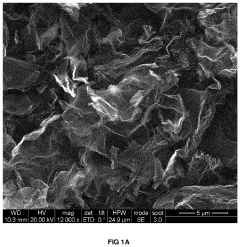
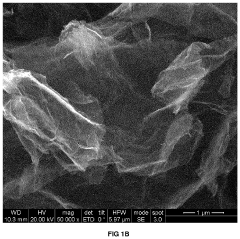
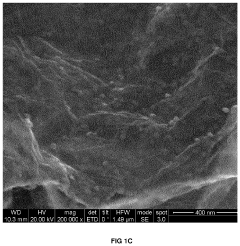
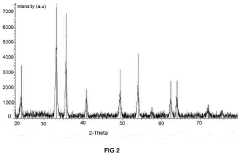
- A 3D reduced graphene oxide/Fe2O3 material is developed through a process involving a graphene oxide water dispersion treated with iron (II) sulfate, followed by hydrothermal treatment, freezing, and lyophilization, resulting in a material with enhanced porosity and specific capacitance for improved ion removal in CDI devices.
Capactive deionization electrode and capactive deionization module including same
PatentWO2025146862A1
Innovation
- The use of activated carbon with a specific surface area exceeding 2000 m²/g and pore volume of 70% with diameters of 2 to 5 nm, combined with crystalline carbon formed on its surface through chemical vapor deposition, enhances desorption and adsorption efficiency while improving electrical conductivity, eliminating the need for environmentally harmful post-treatment processes.


Environmental Impact Assessment of CDI Nanomaterials
The environmental implications of nanostructured materials in capacitive deionization systems present a complex landscape of both opportunities and challenges that require comprehensive evaluation. As CDI technology increasingly relies on engineered nanomaterials to enhance performance, understanding their environmental footprint becomes critical for sustainable implementation and regulatory compliance.
Lifecycle assessment studies indicate that carbon-based nanomaterials, particularly activated carbon nanofibers and graphene derivatives, demonstrate relatively favorable environmental profiles compared to conventional electrode materials. The production energy requirements for these materials, while initially high, are offset by their extended operational lifespan and superior desalination efficiency. However, manufacturing processes involving chemical vapor deposition and high-temperature activation contribute significantly to carbon emissions during the production phase.
Metal oxide nanostructures, including titanium dioxide and manganese oxide nanoparticles, present more complex environmental considerations. While these materials offer exceptional electrochemical performance, their synthesis often involves energy-intensive processes and potentially hazardous precursor chemicals. The environmental burden is further complicated by the need for precise morphological control, which typically requires sophisticated manufacturing techniques with higher resource consumption.
Ecotoxicological assessments reveal varying degrees of environmental risk depending on nanomaterial composition and surface functionalization. Carbon nanotubes and graphene oxide exhibit relatively low acute toxicity in aquatic environments, though long-term bioaccumulation effects remain under investigation. Conversely, certain metal oxide nanoparticles demonstrate potential for ecosystem disruption, particularly in marine environments where CDI systems are commonly deployed.
End-of-life management represents a critical consideration for CDI nanomaterials. Current recycling technologies can effectively recover carbon-based nanomaterials through thermal regeneration processes, maintaining up to 85% of original electrochemical performance. However, composite nanomaterials incorporating multiple phases present separation challenges that limit recycling efficiency and increase disposal costs.
Regulatory frameworks are evolving to address nanomaterial-specific environmental concerns, with emerging guidelines focusing on release prevention and exposure minimization. The development of biodegradable nanocomposites and closed-loop manufacturing processes represents promising approaches to mitigate environmental impact while maintaining CDI performance advantages.
Lifecycle assessment studies indicate that carbon-based nanomaterials, particularly activated carbon nanofibers and graphene derivatives, demonstrate relatively favorable environmental profiles compared to conventional electrode materials. The production energy requirements for these materials, while initially high, are offset by their extended operational lifespan and superior desalination efficiency. However, manufacturing processes involving chemical vapor deposition and high-temperature activation contribute significantly to carbon emissions during the production phase.
Metal oxide nanostructures, including titanium dioxide and manganese oxide nanoparticles, present more complex environmental considerations. While these materials offer exceptional electrochemical performance, their synthesis often involves energy-intensive processes and potentially hazardous precursor chemicals. The environmental burden is further complicated by the need for precise morphological control, which typically requires sophisticated manufacturing techniques with higher resource consumption.
Ecotoxicological assessments reveal varying degrees of environmental risk depending on nanomaterial composition and surface functionalization. Carbon nanotubes and graphene oxide exhibit relatively low acute toxicity in aquatic environments, though long-term bioaccumulation effects remain under investigation. Conversely, certain metal oxide nanoparticles demonstrate potential for ecosystem disruption, particularly in marine environments where CDI systems are commonly deployed.
End-of-life management represents a critical consideration for CDI nanomaterials. Current recycling technologies can effectively recover carbon-based nanomaterials through thermal regeneration processes, maintaining up to 85% of original electrochemical performance. However, composite nanomaterials incorporating multiple phases present separation challenges that limit recycling efficiency and increase disposal costs.
Regulatory frameworks are evolving to address nanomaterial-specific environmental concerns, with emerging guidelines focusing on release prevention and exposure minimization. The development of biodegradable nanocomposites and closed-loop manufacturing processes represents promising approaches to mitigate environmental impact while maintaining CDI performance advantages.
Cost-Benefit Analysis of Nanostructured CDI Systems
The economic viability of nanostructured CDI systems requires comprehensive evaluation of capital expenditures, operational costs, and long-term benefits compared to conventional desalination technologies. Initial investment costs for nanostructured CDI systems are typically 15-25% higher than traditional CDI due to specialized electrode materials and manufacturing processes. However, the enhanced performance characteristics of nanostructured materials significantly improve the overall economic proposition through reduced energy consumption and extended operational lifespan.
Energy efficiency represents the primary cost advantage of nanostructured CDI systems. Advanced carbon nanotube and graphene-based electrodes demonstrate 30-40% lower energy consumption per cubic meter of treated water compared to conventional activated carbon electrodes. This translates to operational savings of $0.08-0.12 per cubic meter in energy costs alone, assuming industrial electricity rates of $0.10-0.15 per kWh. The improved salt adsorption capacity and faster regeneration cycles further reduce processing time and associated labor costs.
Maintenance and replacement costs favor nanostructured systems due to enhanced durability and chemical stability. Traditional CDI electrodes typically require replacement every 18-24 months, while nanostructured alternatives maintain performance for 36-48 months under similar operating conditions. This extended lifespan reduces maintenance downtime and replacement material costs by approximately 40-50%, contributing significantly to total cost of ownership reduction.
The scalability factor presents both opportunities and challenges for cost optimization. Large-scale production of nanostructured materials benefits from economies of scale, potentially reducing material costs by 20-30% as manufacturing volumes increase. However, current production capacity limitations may create supply chain bottlenecks that temporarily inflate costs during market expansion phases.
Return on investment analysis indicates that nanostructured CDI systems typically achieve payback periods of 3.5-4.5 years in industrial applications, compared to 4.5-6 years for conventional systems. The accelerated payback results from combined energy savings, reduced maintenance requirements, and improved water recovery rates. For high-volume applications processing over 1000 cubic meters daily, the economic advantages become particularly pronounced, with total cost savings reaching 25-35% over a ten-year operational period.
Energy efficiency represents the primary cost advantage of nanostructured CDI systems. Advanced carbon nanotube and graphene-based electrodes demonstrate 30-40% lower energy consumption per cubic meter of treated water compared to conventional activated carbon electrodes. This translates to operational savings of $0.08-0.12 per cubic meter in energy costs alone, assuming industrial electricity rates of $0.10-0.15 per kWh. The improved salt adsorption capacity and faster regeneration cycles further reduce processing time and associated labor costs.
Maintenance and replacement costs favor nanostructured systems due to enhanced durability and chemical stability. Traditional CDI electrodes typically require replacement every 18-24 months, while nanostructured alternatives maintain performance for 36-48 months under similar operating conditions. This extended lifespan reduces maintenance downtime and replacement material costs by approximately 40-50%, contributing significantly to total cost of ownership reduction.
The scalability factor presents both opportunities and challenges for cost optimization. Large-scale production of nanostructured materials benefits from economies of scale, potentially reducing material costs by 20-30% as manufacturing volumes increase. However, current production capacity limitations may create supply chain bottlenecks that temporarily inflate costs during market expansion phases.
Return on investment analysis indicates that nanostructured CDI systems typically achieve payback periods of 3.5-4.5 years in industrial applications, compared to 4.5-6 years for conventional systems. The accelerated payback results from combined energy savings, reduced maintenance requirements, and improved water recovery rates. For high-volume applications processing over 1000 cubic meters daily, the economic advantages become particularly pronounced, with total cost savings reaching 25-35% over a ten-year operational period.
Unlock deeper insights with PatSnap Eureka Quick Research — get a full tech report to explore trends and direct your research. Try now!
Generate Your Research Report Instantly with AI Agent
Supercharge your innovation with PatSnap Eureka AI Agent Platform!