

Comparing Cathode Performance: Prussian Blue vs Mixed Transition-Metal Batteries
MAY 15, 20269 MIN READ
Generate Your Research Report Instantly with AI Agent
PatSnap Eureka helps you evaluate technical feasibility & market potential.
Cathode Material Development Background and Objectives
The development of advanced cathode materials represents a critical frontier in next-generation energy storage systems, driven by the exponential growth in demand for high-performance batteries across multiple sectors. Traditional lithium-ion battery cathodes, while commercially successful, face inherent limitations in energy density, cycling stability, and resource sustainability that necessitate exploration of alternative chemistries.
Prussian Blue analogs have emerged as promising cathode candidates due to their unique three-dimensional framework structure, which provides large ionic channels for facile ion transport. These materials offer theoretical advantages including high voltage platforms, excellent structural stability during cycling, and the ability to accommodate various working ions beyond lithium, making them attractive for diverse battery applications.
Mixed transition-metal cathodes represent another evolutionary pathway, leveraging synergistic effects between different metal centers to optimize electrochemical performance. These materials aim to combine the high capacity of nickel-rich compositions with the thermal stability of manganese-based systems and the structural integrity provided by cobalt or aluminum incorporation.
The primary objective of comparing these two cathode technologies centers on establishing comprehensive performance benchmarks across multiple critical parameters. Energy density evaluation remains paramount, as it directly impacts the practical viability of battery systems in weight and volume-constrained applications such as electric vehicles and portable electronics.
Cycling stability assessment forms another crucial objective, particularly understanding degradation mechanisms and capacity retention over extended charge-discharge cycles. The structural evolution of both cathode types under operational conditions requires detailed investigation to predict long-term performance and identify optimization strategies.
Rate capability comparison aims to determine the power delivery characteristics of each technology, essential for applications requiring rapid charging or high-power discharge profiles. This involves analyzing ionic and electronic conductivity limitations, interface kinetics, and mass transport phenomena within each cathode architecture.
Cost-effectiveness evaluation encompasses raw material availability, synthesis complexity, and scalability considerations. Prussian Blue materials potentially offer advantages in terms of abundant precursor availability, while mixed transition-metal cathodes may benefit from established manufacturing infrastructure and supply chains.
Environmental impact assessment represents an increasingly important objective, examining the sustainability profiles of both technologies throughout their lifecycle. This includes resource extraction implications, manufacturing energy requirements, and end-of-life recycling potential, aligning with global sustainability initiatives in the battery industry.
Prussian Blue analogs have emerged as promising cathode candidates due to their unique three-dimensional framework structure, which provides large ionic channels for facile ion transport. These materials offer theoretical advantages including high voltage platforms, excellent structural stability during cycling, and the ability to accommodate various working ions beyond lithium, making them attractive for diverse battery applications.
Mixed transition-metal cathodes represent another evolutionary pathway, leveraging synergistic effects between different metal centers to optimize electrochemical performance. These materials aim to combine the high capacity of nickel-rich compositions with the thermal stability of manganese-based systems and the structural integrity provided by cobalt or aluminum incorporation.
The primary objective of comparing these two cathode technologies centers on establishing comprehensive performance benchmarks across multiple critical parameters. Energy density evaluation remains paramount, as it directly impacts the practical viability of battery systems in weight and volume-constrained applications such as electric vehicles and portable electronics.
Cycling stability assessment forms another crucial objective, particularly understanding degradation mechanisms and capacity retention over extended charge-discharge cycles. The structural evolution of both cathode types under operational conditions requires detailed investigation to predict long-term performance and identify optimization strategies.
Rate capability comparison aims to determine the power delivery characteristics of each technology, essential for applications requiring rapid charging or high-power discharge profiles. This involves analyzing ionic and electronic conductivity limitations, interface kinetics, and mass transport phenomena within each cathode architecture.
Cost-effectiveness evaluation encompasses raw material availability, synthesis complexity, and scalability considerations. Prussian Blue materials potentially offer advantages in terms of abundant precursor availability, while mixed transition-metal cathodes may benefit from established manufacturing infrastructure and supply chains.
Environmental impact assessment represents an increasingly important objective, examining the sustainability profiles of both technologies throughout their lifecycle. This includes resource extraction implications, manufacturing energy requirements, and end-of-life recycling potential, aligning with global sustainability initiatives in the battery industry.
Market Demand for Advanced Battery Cathode Technologies
The global battery market is experiencing unprecedented growth driven by the rapid expansion of electric vehicles, renewable energy storage systems, and portable electronics. This surge has created substantial demand for advanced cathode technologies that can deliver superior performance, safety, and cost-effectiveness compared to conventional lithium-ion battery materials.
Electric vehicle manufacturers are particularly driving demand for next-generation cathode materials as they seek to overcome range anxiety and reduce charging times. Current lithium-ion batteries face limitations in energy density, cycle life, and thermal stability, creating market opportunities for alternative cathode chemistries. The automotive sector's transition toward electrification has intensified the search for cathode materials that can provide higher capacity retention, improved safety profiles, and reduced reliance on scarce materials like cobalt and nickel.
Grid-scale energy storage applications represent another significant market driver for advanced cathode technologies. As renewable energy deployment accelerates globally, utilities and energy companies require large-scale battery systems capable of storing intermittent solar and wind power. These applications demand cathode materials with exceptional cycle stability, long calendar life, and cost-effective manufacturing processes to ensure economic viability over decades of operation.
Prussian blue cathodes have garnered attention due to their unique structural properties and potential for sodium-ion battery applications. The market interest stems from sodium's abundance and lower cost compared to lithium, making it attractive for stationary storage applications where weight is less critical. The open framework structure of Prussian blue compounds enables rapid ion transport, addressing market demands for fast-charging capabilities.
Mixed transition-metal cathodes continue to dominate commercial applications but face increasing pressure to improve performance metrics. Market demand focuses on enhancing energy density while maintaining safety standards and reducing material costs. The industry seeks cathode formulations that can operate effectively across wider temperature ranges and deliver consistent performance throughout extended cycling.
The consumer electronics sector maintains steady demand for cathode innovations that enable thinner, lighter devices with longer battery life. Manufacturers require cathode materials that can support high-rate charging while maintaining compact form factors, driving research into advanced material compositions and processing techniques.
Supply chain considerations significantly influence market demand patterns for cathode technologies. Recent disruptions have highlighted the importance of material security and geographic diversification, creating opportunities for cathode chemistries based on more abundant elements. This trend particularly benefits Prussian blue and certain mixed transition-metal formulations that utilize readily available raw materials.
Regulatory frameworks and environmental considerations increasingly shape market demand for sustainable cathode technologies. Battery manufacturers face growing pressure to develop recyclable materials and reduce environmental impact throughout the product lifecycle, influencing the selection criteria for next-generation cathode materials.
Electric vehicle manufacturers are particularly driving demand for next-generation cathode materials as they seek to overcome range anxiety and reduce charging times. Current lithium-ion batteries face limitations in energy density, cycle life, and thermal stability, creating market opportunities for alternative cathode chemistries. The automotive sector's transition toward electrification has intensified the search for cathode materials that can provide higher capacity retention, improved safety profiles, and reduced reliance on scarce materials like cobalt and nickel.
Grid-scale energy storage applications represent another significant market driver for advanced cathode technologies. As renewable energy deployment accelerates globally, utilities and energy companies require large-scale battery systems capable of storing intermittent solar and wind power. These applications demand cathode materials with exceptional cycle stability, long calendar life, and cost-effective manufacturing processes to ensure economic viability over decades of operation.
Prussian blue cathodes have garnered attention due to their unique structural properties and potential for sodium-ion battery applications. The market interest stems from sodium's abundance and lower cost compared to lithium, making it attractive for stationary storage applications where weight is less critical. The open framework structure of Prussian blue compounds enables rapid ion transport, addressing market demands for fast-charging capabilities.
Mixed transition-metal cathodes continue to dominate commercial applications but face increasing pressure to improve performance metrics. Market demand focuses on enhancing energy density while maintaining safety standards and reducing material costs. The industry seeks cathode formulations that can operate effectively across wider temperature ranges and deliver consistent performance throughout extended cycling.
The consumer electronics sector maintains steady demand for cathode innovations that enable thinner, lighter devices with longer battery life. Manufacturers require cathode materials that can support high-rate charging while maintaining compact form factors, driving research into advanced material compositions and processing techniques.
Supply chain considerations significantly influence market demand patterns for cathode technologies. Recent disruptions have highlighted the importance of material security and geographic diversification, creating opportunities for cathode chemistries based on more abundant elements. This trend particularly benefits Prussian blue and certain mixed transition-metal formulations that utilize readily available raw materials.
Regulatory frameworks and environmental considerations increasingly shape market demand for sustainable cathode technologies. Battery manufacturers face growing pressure to develop recyclable materials and reduce environmental impact throughout the product lifecycle, influencing the selection criteria for next-generation cathode materials.
Current Status of Prussian Blue and Mixed Transition-Metal Cathodes
Prussian Blue cathodes have emerged as a promising alternative for sodium-ion batteries, demonstrating significant commercial viability in recent years. These materials exhibit excellent structural stability due to their open framework structure, which accommodates sodium ion insertion and extraction with minimal volume changes. Current Prussian Blue cathodes achieve energy densities of approximately 150-200 Wh/kg with good cycling stability exceeding 2000 cycles. Major manufacturers like CATL and Natron Energy have successfully scaled production, with CATL announcing commercial sodium-ion batteries incorporating Prussian Blue analogs in 2021.
The primary challenge facing Prussian Blue cathodes lies in their relatively low operating voltage of around 3.2V versus sodium, which limits energy density compared to lithium-ion alternatives. Additionally, the presence of crystal water and vacancies in the structure can lead to capacity fade over extended cycling. Manufacturing complexities arise from the need to control particle size and crystallinity to optimize electrochemical performance.
Mixed transition-metal cathodes, particularly layered oxides like NaNi1/3Fe1/3Mn1/3O2 and polyanionic compounds such as Na3V2(PO4)2F3, represent the current state-of-the-art for high-performance sodium-ion batteries. These materials leverage synergistic effects between different transition metals to achieve higher operating voltages of 3.5-4.0V and improved structural stability. Recent developments have demonstrated energy densities approaching 160-180 Wh/kg with enhanced thermal stability.
Contemporary mixed transition-metal cathodes face challenges related to air sensitivity, particularly for layered oxide structures that can undergo phase transitions upon moisture exposure. The complex synthesis requirements and precise stoichiometric control necessary for optimal performance present manufacturing scalability concerns. Additionally, the higher cost of certain transition metals like vanadium and cobalt impacts economic viability.
Both cathode technologies currently exhibit geographic concentration in development, with Asian manufacturers leading in Prussian Blue commercialization while European and North American research institutions focus heavily on mixed transition-metal optimization. The technology readiness levels differ significantly, with Prussian Blue cathodes reaching commercial deployment while advanced mixed transition-metal formulations remain primarily in pilot-scale development phases.
The primary challenge facing Prussian Blue cathodes lies in their relatively low operating voltage of around 3.2V versus sodium, which limits energy density compared to lithium-ion alternatives. Additionally, the presence of crystal water and vacancies in the structure can lead to capacity fade over extended cycling. Manufacturing complexities arise from the need to control particle size and crystallinity to optimize electrochemical performance.
Mixed transition-metal cathodes, particularly layered oxides like NaNi1/3Fe1/3Mn1/3O2 and polyanionic compounds such as Na3V2(PO4)2F3, represent the current state-of-the-art for high-performance sodium-ion batteries. These materials leverage synergistic effects between different transition metals to achieve higher operating voltages of 3.5-4.0V and improved structural stability. Recent developments have demonstrated energy densities approaching 160-180 Wh/kg with enhanced thermal stability.
Contemporary mixed transition-metal cathodes face challenges related to air sensitivity, particularly for layered oxide structures that can undergo phase transitions upon moisture exposure. The complex synthesis requirements and precise stoichiometric control necessary for optimal performance present manufacturing scalability concerns. Additionally, the higher cost of certain transition metals like vanadium and cobalt impacts economic viability.
Both cathode technologies currently exhibit geographic concentration in development, with Asian manufacturers leading in Prussian Blue commercialization while European and North American research institutions focus heavily on mixed transition-metal optimization. The technology readiness levels differ significantly, with Prussian Blue cathodes reaching commercial deployment while advanced mixed transition-metal formulations remain primarily in pilot-scale development phases.
Existing Cathode Performance Comparison Solutions
01 Cathode material composition and structure optimization
Advanced cathode materials with optimized composition and crystal structure are developed to enhance electrochemical performance. These materials focus on improving the active material properties through specific elemental combinations and structural modifications that increase capacity, stability, and conductivity. The optimization includes controlling particle size, morphology, and surface characteristics to achieve better ion transport and electron conduction.- Cathode material composition and structure optimization: Advanced cathode materials with optimized composition and crystal structure are developed to enhance electrochemical performance. These materials focus on improving ionic conductivity, structural stability, and energy density through careful selection of active materials and dopants. The optimization includes modifications to particle morphology and surface properties to achieve better performance characteristics.
- Cathode coating and surface treatment technologies: Surface modification techniques are employed to improve cathode performance through protective coatings and surface treatments. These methods enhance the interface stability between cathode and electrolyte, reduce side reactions, and improve cycling stability. The treatments help maintain structural integrity during charge-discharge cycles and prevent capacity degradation.
- Cathode manufacturing processes and fabrication methods: Specialized manufacturing processes are developed to produce high-performance cathodes with controlled microstructure and properties. These processes include advanced synthesis methods, thermal treatment procedures, and fabrication techniques that ensure uniform distribution of active materials and optimal electrode architecture for enhanced performance.
- Cathode electrolyte interface optimization: Interface engineering between cathode and electrolyte is crucial for improving overall battery performance. This involves developing compatible electrolyte systems, interface stabilization techniques, and methods to reduce interfacial resistance. The optimization focuses on maintaining stable ion transport and minimizing unwanted reactions at the interface.
- Cathode performance testing and characterization methods: Comprehensive testing methodologies and characterization techniques are developed to evaluate cathode performance under various conditions. These methods include electrochemical testing protocols, structural analysis techniques, and performance evaluation standards that help optimize cathode design and predict long-term behavior in practical applications.
02 Cathode coating and surface modification techniques
Surface treatment and coating technologies are applied to cathode materials to improve their electrochemical properties and stability. These modifications help protect the cathode from degradation, enhance ion conductivity at the interface, and reduce unwanted side reactions. The techniques involve applying thin protective layers or functional coatings that maintain the structural integrity of the cathode during cycling.Expand Specific Solutions03 Cathode manufacturing processes and fabrication methods
Specialized manufacturing techniques and processing methods are employed to produce high-performance cathodes with consistent quality and properties. These processes focus on optimizing synthesis conditions, controlling reaction parameters, and implementing quality control measures to ensure reproducible cathode performance. The methods include various thermal treatments, mixing procedures, and forming techniques.Expand Specific Solutions04 Cathode electrolyte interface optimization
The interface between cathode and electrolyte is engineered to minimize resistance and improve ion transfer efficiency. This involves developing compatible electrolyte formulations and cathode surface treatments that promote stable interface formation. The optimization addresses issues such as interface impedance, chemical compatibility, and long-term stability under operating conditions.Expand Specific Solutions05 Cathode performance testing and characterization methods
Comprehensive testing protocols and characterization techniques are developed to evaluate cathode performance under various operating conditions. These methods assess key performance metrics including capacity retention, cycle life, rate capability, and thermal stability. The testing approaches provide insights into degradation mechanisms and help optimize cathode design for specific applications.Expand Specific Solutions
Key Players in Advanced Cathode Material Industry
The cathode performance comparison between Prussian Blue and mixed transition-metal batteries represents an emerging competitive landscape within the broader energy storage industry. The market is currently in an early development stage, with significant growth potential driven by increasing demand for sustainable energy storage solutions. Market size remains relatively niche compared to established lithium-ion technologies, but shows promising expansion prospects. Technology maturity varies significantly among key players: Contemporary Amperex Technology Co., Ltd. leads with advanced lithium battery expertise, while specialized companies like Zhejiang Sodium Innovation Energy Co., Ltd. and Liaoning XingKong Sodium Battery Co., Ltd. focus specifically on alternative cathode chemistries. Research institutions including Zhejiang University and Shanghai Jiao Tong University contribute fundamental research, while companies like Hunan Changyuan Lico New Energy Co., Ltd. and Jinchi Energy Materials Co. Ltd. develop practical applications, indicating a competitive ecosystem spanning from basic research to commercial implementation.
Contemporary Amperex Technology Co., Ltd.
Technical Solution: CATL has developed advanced cathode materials including both Prussian Blue analogs and mixed transition-metal compounds for sodium-ion batteries. Their Prussian Blue-based cathodes demonstrate excellent structural stability with minimal volume change during cycling, achieving over 4000 cycles at 80% capacity retention. For mixed transition-metal systems, CATL utilizes layered oxide materials with optimized Ni-Co-Mn ratios, delivering energy densities of 160 Wh/kg at cell level. The company has implemented surface coating technologies and electrolyte optimization to enhance the electrochemical performance of both cathode types, with particular focus on improving the air stability of Prussian Blue materials through controlled synthesis environments.
Strengths: Market-leading manufacturing scale, proven commercialization capabilities, strong R&D investment. Weaknesses: Higher production costs for Prussian Blue materials, limited energy density compared to lithium-ion alternatives.
Zhejiang Sodium Innovation Energy Co., Ltd.
Technical Solution: Zhejiang Sodium Innovation specializes in sodium-ion battery cathode development with focus on both Prussian Blue and layered transition-metal oxides. Their Prussian Blue cathodes feature improved crystal structure through controlled vacancy engineering, achieving 120 mAh/g capacity with excellent rate capability. The company's mixed transition-metal approach utilizes P2-type layered oxides with optimized Na content, delivering superior cycling stability over 2000 cycles. They have developed proprietary synthesis methods for reducing water content in Prussian Blue materials to below 1%, significantly improving electrochemical performance. Their cathode materials demonstrate operating voltages of 3.1V for Prussian Blue and 3.3V for mixed transition-metal systems, with customized particle size distribution for enhanced electrode processing.
Strengths: Specialized focus on sodium-ion technology, innovative synthesis methods, strong technical partnerships. Weaknesses: Limited production scale, relatively new market presence, dependency on raw material supply chains.
Core Innovations in Prussian Blue vs Mixed Metal Cathodes
Prussian Blue Analogue Anodes for Aqueous Electrolyte Batteries
PatentInactiveUS20140220392A1
Innovation
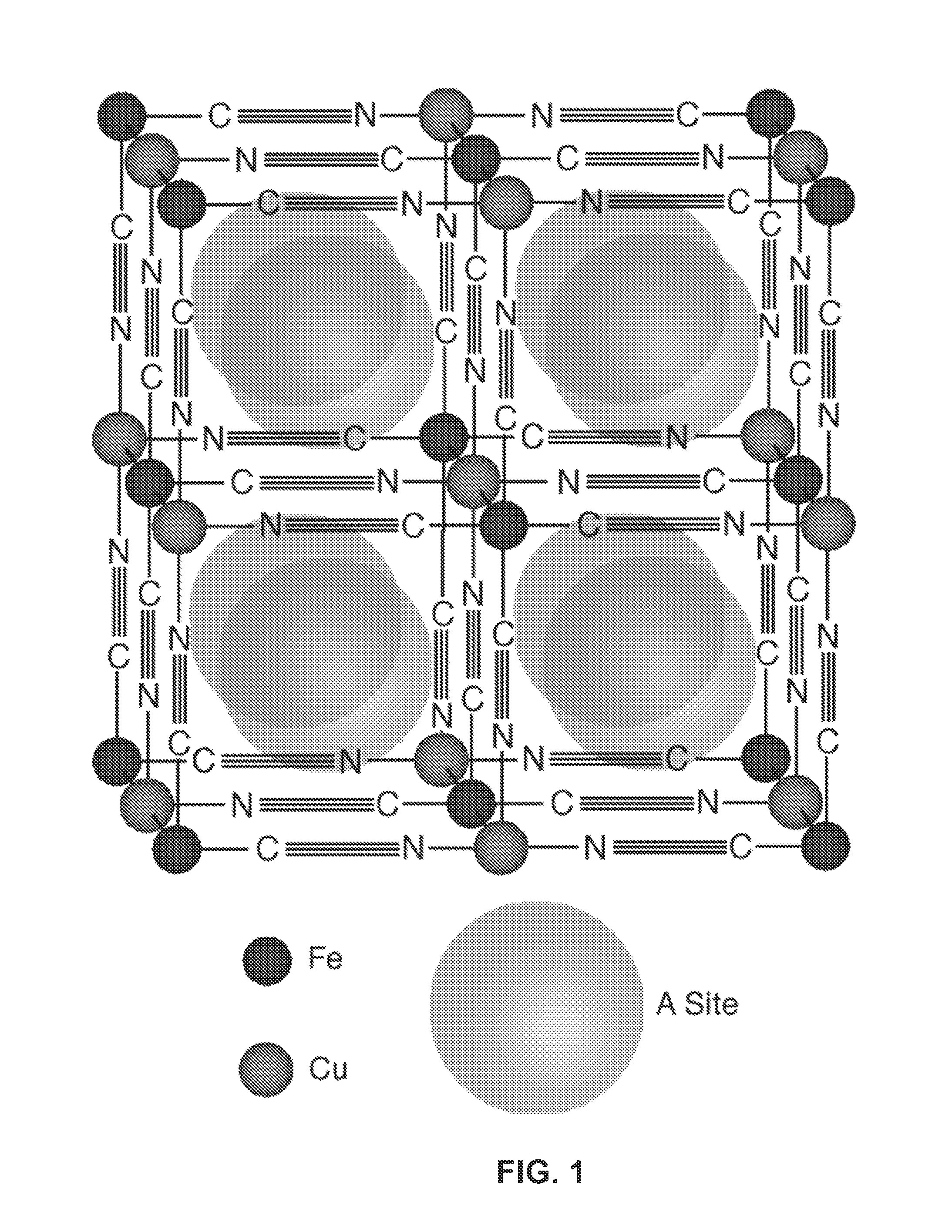
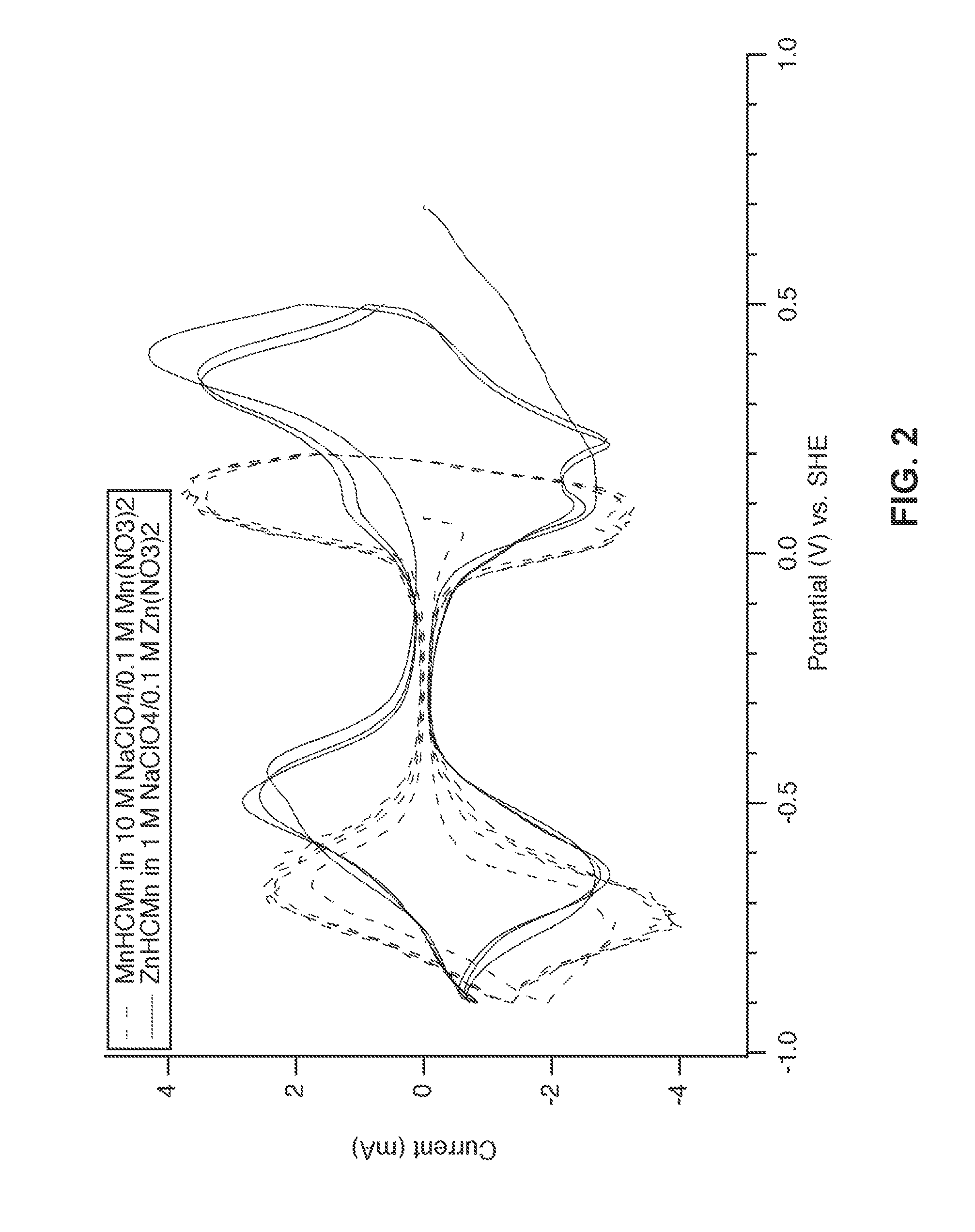
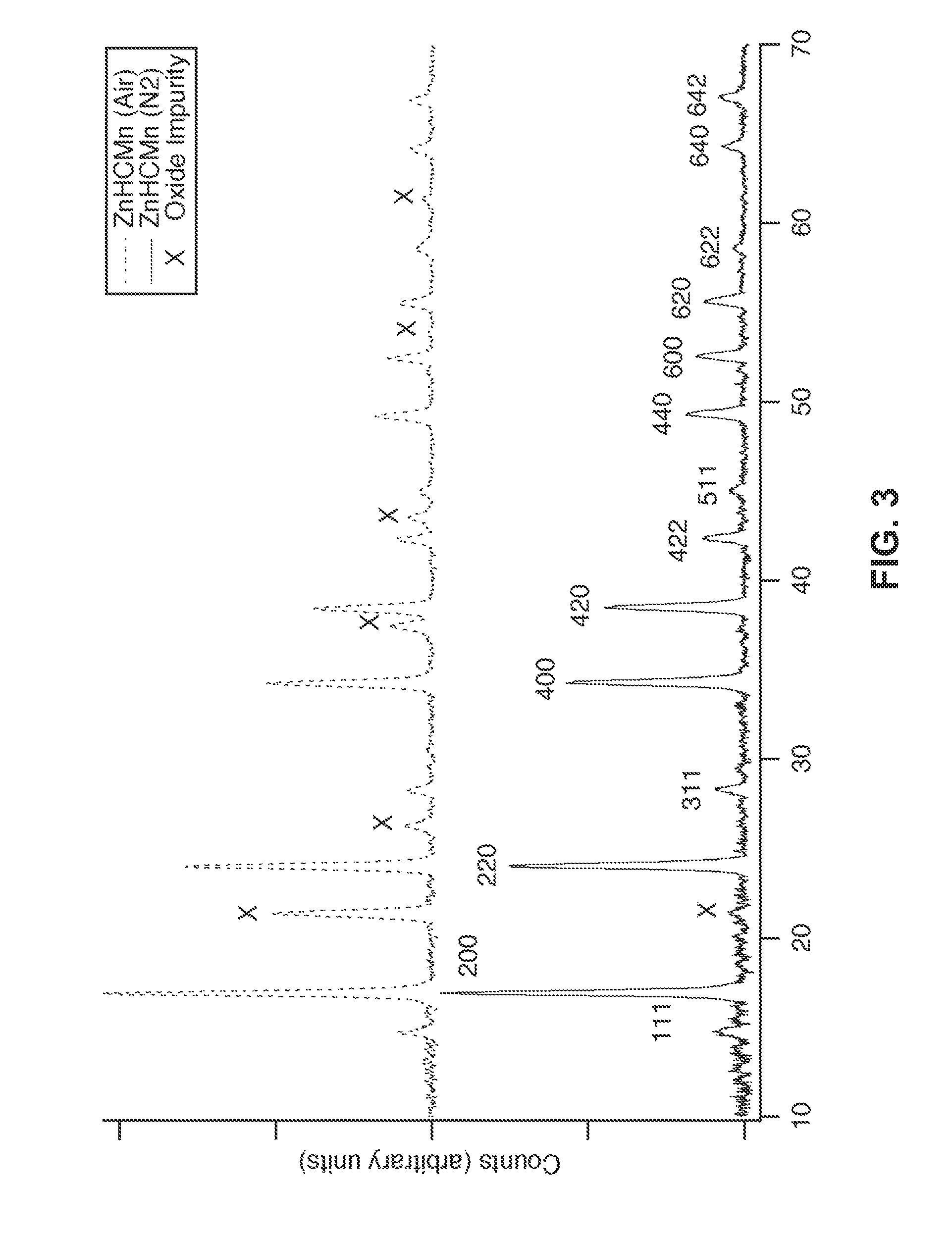
- Development of Prussian Blue analogue anodes with electrochemically active species having lower reaction potentials, allowing for the construction of symmetric batteries with tuned reaction potentials and the use of hexacyanomanganate-based materials in aqueous electrolytes, enabling longer cycle life and higher rate capability by utilizing both the upper and lower electrochemical reactions.

Cathode for proton batteries and method of manufacture
PatentWO2024119235A1
Innovation
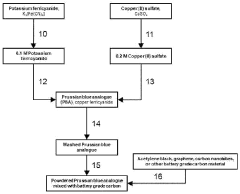
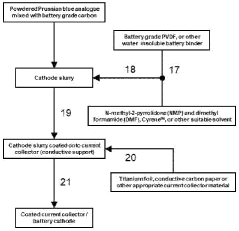
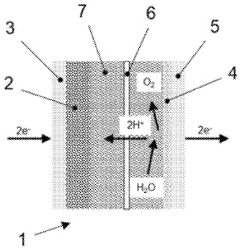
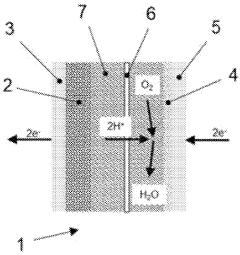
- A cathode for proton batteries comprising a Prussian blue analogue (PBA) coated on a current collector, combined with battery-grade carbon nanoparticles and a non-water-soluble binder, utilizing a copper hexacyanoferrate or manganese hexacyanoferrate structure for enhanced proton intercalation and storage capabilities, along with a suitable current collector and electrolyte system.
Environmental Impact of Cathode Material Production
The environmental implications of cathode material production represent a critical consideration in the comparative assessment of Prussian Blue and mixed transition-metal battery technologies. Manufacturing processes for these cathode materials exhibit distinct environmental footprints that significantly influence their overall sustainability profiles and long-term viability in energy storage applications.
Prussian Blue cathode production demonstrates relatively favorable environmental characteristics due to its simplified synthesis pathways and abundant raw material availability. The manufacturing process typically involves aqueous precipitation methods at ambient temperatures, requiring minimal energy input compared to high-temperature ceramic processing routes. Iron and cyanide precursors, while requiring careful handling protocols, are generally more accessible and less environmentally intensive to extract than many transition metals used in alternative cathode chemistries.
Mixed transition-metal cathode production presents more complex environmental challenges, particularly regarding resource extraction and processing. Nickel, cobalt, and manganese mining operations often involve significant ecological disruption, water consumption, and potential soil contamination. Cobalt extraction, specifically, raises substantial environmental and ethical concerns due to mining practices in primary source regions. The high-temperature calcination processes required for layered oxide cathode synthesis contribute additional carbon emissions and energy consumption.
Water usage patterns differ markedly between these production pathways. Prussian Blue synthesis generally occurs in aqueous environments with manageable wastewater treatment requirements, though cyanide handling necessitates specialized treatment protocols. Mixed transition-metal cathode production involves extensive hydrometallurgical processing, generating substantial volumes of process water requiring comprehensive treatment before discharge.
Carbon footprint analysis reveals significant disparities in lifecycle emissions. Prussian Blue production benefits from lower processing temperatures and reduced transportation requirements for raw materials. Conversely, mixed transition-metal cathodes incur higher carbon costs through energy-intensive pyrometallurgical processing, long-distance transportation of mined materials, and complex purification sequences.
Waste generation and recyclability considerations further differentiate these technologies. Prussian Blue materials demonstrate promising recyclability potential through relatively straightforward chemical processing, while mixed transition-metal cathodes require sophisticated recycling infrastructure to recover valuable metals effectively. End-of-life processing complexity significantly impacts the overall environmental assessment of each technology pathway.
Prussian Blue cathode production demonstrates relatively favorable environmental characteristics due to its simplified synthesis pathways and abundant raw material availability. The manufacturing process typically involves aqueous precipitation methods at ambient temperatures, requiring minimal energy input compared to high-temperature ceramic processing routes. Iron and cyanide precursors, while requiring careful handling protocols, are generally more accessible and less environmentally intensive to extract than many transition metals used in alternative cathode chemistries.
Mixed transition-metal cathode production presents more complex environmental challenges, particularly regarding resource extraction and processing. Nickel, cobalt, and manganese mining operations often involve significant ecological disruption, water consumption, and potential soil contamination. Cobalt extraction, specifically, raises substantial environmental and ethical concerns due to mining practices in primary source regions. The high-temperature calcination processes required for layered oxide cathode synthesis contribute additional carbon emissions and energy consumption.
Water usage patterns differ markedly between these production pathways. Prussian Blue synthesis generally occurs in aqueous environments with manageable wastewater treatment requirements, though cyanide handling necessitates specialized treatment protocols. Mixed transition-metal cathode production involves extensive hydrometallurgical processing, generating substantial volumes of process water requiring comprehensive treatment before discharge.
Carbon footprint analysis reveals significant disparities in lifecycle emissions. Prussian Blue production benefits from lower processing temperatures and reduced transportation requirements for raw materials. Conversely, mixed transition-metal cathodes incur higher carbon costs through energy-intensive pyrometallurgical processing, long-distance transportation of mined materials, and complex purification sequences.
Waste generation and recyclability considerations further differentiate these technologies. Prussian Blue materials demonstrate promising recyclability potential through relatively straightforward chemical processing, while mixed transition-metal cathodes require sophisticated recycling infrastructure to recover valuable metals effectively. End-of-life processing complexity significantly impacts the overall environmental assessment of each technology pathway.
Safety Standards for Advanced Battery Cathode Systems
The development of comprehensive safety standards for advanced battery cathode systems has become increasingly critical as Prussian Blue and mixed transition-metal cathode technologies advance toward commercial deployment. Current regulatory frameworks primarily address conventional lithium-ion systems, creating significant gaps in safety protocols specifically tailored to these emerging cathode chemistries.
Thermal stability requirements represent a fundamental pillar of cathode safety standards. Prussian Blue cathodes demonstrate exceptional thermal stability with decomposition temperatures exceeding 300°C, necessitating specific testing protocols that differ from conventional cathode materials. Mixed transition-metal systems, particularly those incorporating nickel-rich compositions, require more stringent thermal runaway prevention measures due to their increased reactivity at elevated temperatures.
Electrochemical safety parameters must address the unique voltage profiles and cycling behaviors of these advanced cathode systems. Standards should establish maximum operating voltages, charge/discharge rate limitations, and depth-of-discharge boundaries specific to each cathode chemistry. Prussian Blue systems typically operate within safer voltage windows, while mixed transition-metal cathodes may require more restrictive operational envelopes to prevent safety incidents.
Material handling and manufacturing safety protocols need comprehensive updates to address the specific hazards associated with transition metal compounds and cyanide-containing precursors used in Prussian Blue synthesis. Occupational exposure limits, containment requirements, and emergency response procedures must be established for each material class.
Testing methodologies require standardization across multiple safety domains including nail penetration tests, overcharge protection validation, and gas evolution analysis. These tests must account for the distinct failure modes of each cathode type, as Prussian Blue systems may exhibit different gas generation patterns compared to traditional oxide cathodes.
Environmental safety considerations encompass end-of-life disposal protocols and recycling procedures specific to these advanced cathode materials. Standards must address the safe handling of spent cathode materials and establish guidelines for material recovery processes that minimize environmental impact while ensuring worker safety throughout the battery lifecycle.
Thermal stability requirements represent a fundamental pillar of cathode safety standards. Prussian Blue cathodes demonstrate exceptional thermal stability with decomposition temperatures exceeding 300°C, necessitating specific testing protocols that differ from conventional cathode materials. Mixed transition-metal systems, particularly those incorporating nickel-rich compositions, require more stringent thermal runaway prevention measures due to their increased reactivity at elevated temperatures.
Electrochemical safety parameters must address the unique voltage profiles and cycling behaviors of these advanced cathode systems. Standards should establish maximum operating voltages, charge/discharge rate limitations, and depth-of-discharge boundaries specific to each cathode chemistry. Prussian Blue systems typically operate within safer voltage windows, while mixed transition-metal cathodes may require more restrictive operational envelopes to prevent safety incidents.
Material handling and manufacturing safety protocols need comprehensive updates to address the specific hazards associated with transition metal compounds and cyanide-containing precursors used in Prussian Blue synthesis. Occupational exposure limits, containment requirements, and emergency response procedures must be established for each material class.
Testing methodologies require standardization across multiple safety domains including nail penetration tests, overcharge protection validation, and gas evolution analysis. These tests must account for the distinct failure modes of each cathode type, as Prussian Blue systems may exhibit different gas generation patterns compared to traditional oxide cathodes.
Environmental safety considerations encompass end-of-life disposal protocols and recycling procedures specific to these advanced cathode materials. Standards must address the safe handling of spent cathode materials and establish guidelines for material recovery processes that minimize environmental impact while ensuring worker safety throughout the battery lifecycle.
Unlock deeper insights with PatSnap Eureka Quick Research — get a full tech report to explore trends and direct your research. Try now!
Generate Your Research Report Instantly with AI Agent
Supercharge your innovation with PatSnap Eureka AI Agent Platform!