

How to Prevent Surface Layer Breakdown in Prussian Blue Cathodes
MAY 15, 20269 MIN READ
Generate Your Research Report Instantly with AI Agent
Patsnap Eureka helps you evaluate technical feasibility & market potential.
Prussian Blue Cathode Surface Degradation Background and Goals
Prussian blue (PB) cathodes have emerged as promising candidates for next-generation energy storage systems, particularly in sodium-ion and potassium-ion batteries, due to their unique three-dimensional framework structure and abundant availability of raw materials. These materials offer theoretical advantages including high voltage platforms, excellent structural stability, and cost-effectiveness compared to conventional lithium-based cathodes. However, the practical implementation of PB cathodes faces significant challenges, with surface layer degradation representing one of the most critical obstacles limiting their commercial viability.
The surface degradation phenomenon in PB cathodes manifests through multiple pathways, including structural decomposition, electrolyte-induced corrosion, and mechanical stress-related fracturing during charge-discharge cycles. Surface layer breakdown typically initiates at the cathode-electrolyte interface, where chemical and electrochemical reactions lead to the formation of resistive layers, loss of active material, and deterioration of ionic conductivity. This degradation process significantly impacts battery performance metrics, including capacity retention, cycling stability, and rate capability.
Historical research efforts have documented that PB cathodes experience rapid capacity fade, often losing 20-30% of their initial capacity within the first 100 cycles. The surface instability stems from the inherent structural characteristics of PB materials, including their high surface area, presence of coordinated water molecules, and sensitivity to pH variations in the electrolyte environment. Additionally, the formation of inactive phases and the dissolution of transition metal ions contribute to progressive performance deterioration.
The primary objective of addressing surface layer breakdown in PB cathodes centers on developing comprehensive strategies to enhance interfacial stability while maintaining the inherent advantages of the PB framework. Key goals include extending cycle life beyond 1000 cycles with minimal capacity degradation, improving rate performance through optimized surface conductivity, and establishing robust cathode-electrolyte interfaces resistant to chemical attack.
Technical targets encompass achieving capacity retention rates exceeding 90% after 500 cycles, reducing interfacial resistance by at least 50% compared to unmodified PB cathodes, and developing scalable surface modification techniques compatible with industrial manufacturing processes. These objectives align with broader industry requirements for next-generation battery technologies that can compete with established lithium-ion systems in terms of performance, durability, and cost-effectiveness.
The surface degradation phenomenon in PB cathodes manifests through multiple pathways, including structural decomposition, electrolyte-induced corrosion, and mechanical stress-related fracturing during charge-discharge cycles. Surface layer breakdown typically initiates at the cathode-electrolyte interface, where chemical and electrochemical reactions lead to the formation of resistive layers, loss of active material, and deterioration of ionic conductivity. This degradation process significantly impacts battery performance metrics, including capacity retention, cycling stability, and rate capability.
Historical research efforts have documented that PB cathodes experience rapid capacity fade, often losing 20-30% of their initial capacity within the first 100 cycles. The surface instability stems from the inherent structural characteristics of PB materials, including their high surface area, presence of coordinated water molecules, and sensitivity to pH variations in the electrolyte environment. Additionally, the formation of inactive phases and the dissolution of transition metal ions contribute to progressive performance deterioration.
The primary objective of addressing surface layer breakdown in PB cathodes centers on developing comprehensive strategies to enhance interfacial stability while maintaining the inherent advantages of the PB framework. Key goals include extending cycle life beyond 1000 cycles with minimal capacity degradation, improving rate performance through optimized surface conductivity, and establishing robust cathode-electrolyte interfaces resistant to chemical attack.
Technical targets encompass achieving capacity retention rates exceeding 90% after 500 cycles, reducing interfacial resistance by at least 50% compared to unmodified PB cathodes, and developing scalable surface modification techniques compatible with industrial manufacturing processes. These objectives align with broader industry requirements for next-generation battery technologies that can compete with established lithium-ion systems in terms of performance, durability, and cost-effectiveness.
Market Demand for Stable Prussian Blue Battery Systems
The global energy storage market is experiencing unprecedented growth driven by the urgent need for reliable, sustainable battery technologies. Prussian blue cathodes have emerged as a promising alternative to conventional lithium-ion systems, particularly for large-scale stationary storage applications. However, the persistent challenge of surface layer breakdown significantly limits their commercial viability and market penetration.
Grid-scale energy storage systems represent the primary market opportunity for stable Prussian blue batteries. Utility companies and renewable energy developers require battery systems capable of thousands of charge-discharge cycles without significant capacity degradation. Current Prussian blue cathodes suffer from surface structural instability, leading to rapid performance decline that fails to meet the demanding requirements of these applications.
The electric vehicle market presents another substantial demand driver for enhanced Prussian blue battery systems. Automotive manufacturers are actively seeking cost-effective alternatives to traditional lithium-ion batteries, particularly for entry-level electric vehicles and commercial fleets. Surface layer stability directly impacts battery lifespan and safety, making breakthrough solutions in preventing breakdown essential for market acceptance.
Consumer electronics manufacturers are increasingly interested in Prussian blue-based systems for portable devices requiring extended operational life. The unique properties of Prussian blue, including excellent thermal stability and environmental friendliness, align with growing consumer preferences for sustainable technology products. However, surface degradation issues currently prevent widespread adoption in this competitive market segment.
Industrial energy storage applications, including backup power systems and load leveling installations, represent a rapidly expanding market segment. These applications demand batteries with exceptional cycle life and minimal maintenance requirements. Stable Prussian blue cathodes that resist surface breakdown could capture significant market share by offering superior longevity compared to existing technologies.
The market demand is further intensified by regulatory pressures and environmental considerations. Governments worldwide are implementing stricter regulations on battery recycling and material sourcing, creating opportunities for Prussian blue systems that utilize abundant, non-toxic materials. Solving surface stability challenges would position these batteries as environmentally superior alternatives in multiple market segments.
Research institutions and battery manufacturers are investing heavily in developing solutions to surface layer breakdown, recognizing the substantial market potential. The convergence of environmental regulations, cost pressures, and performance requirements creates a compelling market opportunity for stable Prussian blue battery systems across diverse applications.
Grid-scale energy storage systems represent the primary market opportunity for stable Prussian blue batteries. Utility companies and renewable energy developers require battery systems capable of thousands of charge-discharge cycles without significant capacity degradation. Current Prussian blue cathodes suffer from surface structural instability, leading to rapid performance decline that fails to meet the demanding requirements of these applications.
The electric vehicle market presents another substantial demand driver for enhanced Prussian blue battery systems. Automotive manufacturers are actively seeking cost-effective alternatives to traditional lithium-ion batteries, particularly for entry-level electric vehicles and commercial fleets. Surface layer stability directly impacts battery lifespan and safety, making breakthrough solutions in preventing breakdown essential for market acceptance.
Consumer electronics manufacturers are increasingly interested in Prussian blue-based systems for portable devices requiring extended operational life. The unique properties of Prussian blue, including excellent thermal stability and environmental friendliness, align with growing consumer preferences for sustainable technology products. However, surface degradation issues currently prevent widespread adoption in this competitive market segment.
Industrial energy storage applications, including backup power systems and load leveling installations, represent a rapidly expanding market segment. These applications demand batteries with exceptional cycle life and minimal maintenance requirements. Stable Prussian blue cathodes that resist surface breakdown could capture significant market share by offering superior longevity compared to existing technologies.
The market demand is further intensified by regulatory pressures and environmental considerations. Governments worldwide are implementing stricter regulations on battery recycling and material sourcing, creating opportunities for Prussian blue systems that utilize abundant, non-toxic materials. Solving surface stability challenges would position these batteries as environmentally superior alternatives in multiple market segments.
Research institutions and battery manufacturers are investing heavily in developing solutions to surface layer breakdown, recognizing the substantial market potential. The convergence of environmental regulations, cost pressures, and performance requirements creates a compelling market opportunity for stable Prussian blue battery systems across diverse applications.
Current Surface Layer Breakdown Issues in PB Cathodes
Prussian Blue (PB) cathodes face significant surface layer degradation challenges that fundamentally limit their electrochemical performance and cycle stability in battery applications. The primary manifestation of surface breakdown occurs through the formation of an insulating layer that impedes ion transport and electron conduction at the electrode-electrolyte interface. This degradation mechanism is particularly pronounced during repeated charge-discharge cycles, where the surface undergoes continuous structural and chemical modifications.
The most critical issue stems from the inherent instability of the PB framework structure when exposed to aqueous electrolytes. Water molecules can penetrate the crystal lattice, leading to hydrolysis reactions that decompose the iron-cyanide bonds. This process results in the formation of iron hydroxides and other decomposition products that accumulate on the cathode surface, creating a passivating layer with poor ionic and electronic conductivity.
Structural collapse represents another major concern, where the repeated insertion and extraction of charge carriers causes mechanical stress within the PB lattice. The volume changes associated with ion intercalation and deintercalation lead to particle cracking and surface roughening. These physical changes expose fresh surfaces to further degradation while simultaneously reducing the effective contact area between active material and current collector.
Iron dissolution constitutes a particularly detrimental process where Fe ions leach from the PB structure into the electrolyte solution. This phenomenon is accelerated under acidic conditions and high operating potentials, resulting in the gradual loss of electrochemically active sites. The dissolved iron species can subsequently precipitate as inactive compounds on the cathode surface, further contributing to capacity fade and impedance increase.
Surface oxidation of the cyanide ligands presents additional complications, especially in oxygen-containing environments. The oxidation process can break the critical Fe-CN-Fe bridges that maintain the PB framework integrity, leading to localized structural degradation that propagates throughout the electrode material. This degradation pathway is particularly problematic in air-exposed systems where atmospheric oxygen can interact with the cathode surface.
The formation of surface films through side reactions with electrolyte components creates another layer of complexity. These films, while sometimes providing temporary protection, often exhibit poor stability and can undergo further decomposition, creating a cycle of continuous surface modification that progressively degrades electrode performance and reliability.
The most critical issue stems from the inherent instability of the PB framework structure when exposed to aqueous electrolytes. Water molecules can penetrate the crystal lattice, leading to hydrolysis reactions that decompose the iron-cyanide bonds. This process results in the formation of iron hydroxides and other decomposition products that accumulate on the cathode surface, creating a passivating layer with poor ionic and electronic conductivity.
Structural collapse represents another major concern, where the repeated insertion and extraction of charge carriers causes mechanical stress within the PB lattice. The volume changes associated with ion intercalation and deintercalation lead to particle cracking and surface roughening. These physical changes expose fresh surfaces to further degradation while simultaneously reducing the effective contact area between active material and current collector.
Iron dissolution constitutes a particularly detrimental process where Fe ions leach from the PB structure into the electrolyte solution. This phenomenon is accelerated under acidic conditions and high operating potentials, resulting in the gradual loss of electrochemically active sites. The dissolved iron species can subsequently precipitate as inactive compounds on the cathode surface, further contributing to capacity fade and impedance increase.
Surface oxidation of the cyanide ligands presents additional complications, especially in oxygen-containing environments. The oxidation process can break the critical Fe-CN-Fe bridges that maintain the PB framework integrity, leading to localized structural degradation that propagates throughout the electrode material. This degradation pathway is particularly problematic in air-exposed systems where atmospheric oxygen can interact with the cathode surface.
The formation of surface films through side reactions with electrolyte components creates another layer of complexity. These films, while sometimes providing temporary protection, often exhibit poor stability and can undergo further decomposition, creating a cycle of continuous surface modification that progressively degrades electrode performance and reliability.
Existing Surface Protection Solutions for PB Cathodes
01 Surface modification and coating techniques for Prussian blue cathodes
Various surface modification and coating methods are employed to prevent surface layer breakdown in Prussian blue cathodes. These techniques involve applying protective layers or modifying the surface chemistry to enhance structural stability and prevent degradation during electrochemical cycling. The modifications help maintain the integrity of the cathode material and improve its long-term performance.- Surface modification and coating techniques for Prussian blue cathodes: Various surface modification and coating methods are employed to prevent surface layer breakdown in Prussian blue cathodes. These techniques involve applying protective layers or modifying the surface chemistry to enhance structural stability and prevent degradation during electrochemical cycling. The modifications help maintain the integrity of the cathode material and improve its long-term performance.
- Structural stabilization through doping and substitution: Doping with various elements and ionic substitution strategies are used to stabilize the crystal structure of Prussian blue cathodes and prevent surface layer breakdown. These approaches involve introducing foreign atoms into the lattice structure to enhance mechanical stability and reduce structural changes during charge-discharge cycles. The doping elements help maintain the framework integrity and minimize surface degradation.
- Electrolyte optimization and interface engineering: Optimization of electrolyte composition and engineering of the electrode-electrolyte interface play crucial roles in preventing surface layer breakdown. These methods focus on reducing side reactions at the cathode surface and improving ionic conductivity. Interface modifications help create stable solid electrolyte interphase layers that protect the cathode from degradation and maintain electrochemical performance.
- Synthesis methods for enhanced surface stability: Advanced synthesis techniques are developed to create Prussian blue cathodes with improved surface stability and resistance to breakdown. These methods control particle morphology, crystal orientation, and surface properties during the formation process. The optimized synthesis approaches result in cathode materials with better structural integrity and reduced susceptibility to surface layer degradation.
- Composite materials and hybrid structures: Development of composite materials and hybrid structures incorporating Prussian blue with other materials to prevent surface layer breakdown. These approaches combine the advantages of different materials to create cathodes with enhanced mechanical properties and improved resistance to structural degradation. The composite structures provide additional support and protection to maintain cathode integrity during operation.
02 Structural stabilization through doping and substitution
Doping with various elements or ionic substitution in the Prussian blue framework helps stabilize the crystal structure and reduce surface layer breakdown. These approaches involve introducing foreign atoms or ions into the lattice structure to strengthen the framework and minimize structural collapse during charge-discharge cycles. The stabilization methods focus on maintaining the cubic structure and preventing phase transitions.Expand Specific Solutions03 Electrolyte optimization and interface engineering
Optimizing the electrolyte composition and engineering the electrode-electrolyte interface plays a crucial role in preventing surface layer breakdown. This involves selecting appropriate electrolyte additives, controlling pH levels, and managing ion transport at the interface. The optimization helps reduce side reactions and maintains stable electrochemical performance while preventing surface degradation.Expand Specific Solutions04 Synthesis methods for enhanced structural integrity
Advanced synthesis techniques are developed to create Prussian blue cathodes with improved structural integrity and resistance to surface breakdown. These methods focus on controlling particle size, morphology, and crystallinity during the synthesis process. The optimized synthesis approaches result in materials with better mechanical stability and reduced susceptibility to surface layer degradation.Expand Specific Solutions05 Characterization and monitoring of surface degradation mechanisms
Various analytical techniques and monitoring methods are employed to understand and characterize the surface layer breakdown mechanisms in Prussian blue cathodes. These approaches involve studying the degradation pathways, identifying failure modes, and developing diagnostic tools to assess cathode health. The characterization methods help in developing strategies to mitigate surface breakdown and improve cathode longevity.Expand Specific Solutions
Key Players in Prussian Blue Battery Technology
The Prussian Blue cathode surface layer breakdown prevention technology represents an emerging yet rapidly evolving sector within the advanced battery materials industry. The market is currently in its early commercialization phase, with significant growth potential driven by increasing demand for sustainable energy storage solutions. Key players demonstrate varying levels of technological maturity, with Altris AB leading in specialized Prussian White cathode development and commercialization, while established battery manufacturers like Contemporary Amperex Technology (CATL) and Northvolt AB are integrating these materials into broader product portfolios. Research institutions including Harbin Institute of Technology and University of Shanghai for Science & Technology contribute fundamental research, while industrial giants such as Toyota Motor Corp. and Mercedes-Benz Group AG drive application-focused development. The competitive landscape shows a mix of specialized startups, established battery manufacturers, and automotive companies, indicating strong cross-industry interest and investment in overcoming technical challenges related to structural stability and cycling performance of Prussian Blue cathodes.
Altris AB
Technical Solution: Altris AB has developed a proprietary cathode technology based on Prussian Blue analogs that addresses surface layer breakdown through controlled synthesis and surface modification techniques. Their approach involves optimizing the crystal structure and implementing protective coatings to prevent water intercalation and structural degradation. The company focuses on maintaining the open framework structure while minimizing defects that lead to surface instability. Their technology includes advanced electrolyte formulations and electrode processing methods specifically designed to enhance the cycling stability of Prussian Blue cathodes in sodium-ion batteries.
Strengths: Specialized focus on Prussian Blue technology with proven commercial applications. Weaknesses: Limited scale compared to larger battery manufacturers and relatively new market presence.
Ningbo Ronbay New Energy Technology Co., Ltd.
Technical Solution: Ronbay has developed specialized cathode materials including Prussian Blue compounds with enhanced surface stability through proprietary synthesis methods. Their technology focuses on controlling particle morphology and implementing surface functionalization techniques to prevent degradation. The company utilizes advanced precursor chemistry and thermal treatment processes to create uniform crystal structures with reduced surface reactivity. Their approach includes the development of specialized binders and conductive additives that work synergistically with Prussian Blue cathodes to maintain structural integrity during cycling.
Strengths: Strong expertise in cathode material production with established supply chain capabilities. Weaknesses: Smaller scale compared to industry giants and limited global market presence.
Core Innovations in PB Surface Layer Preservation
Process for preparing a cathode comprising a prussian blue analogue
PatentWO2025109072A1
Innovation
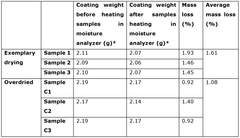
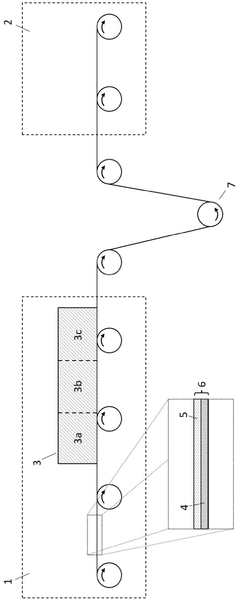
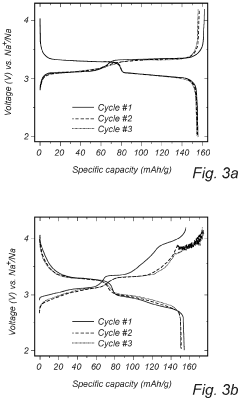
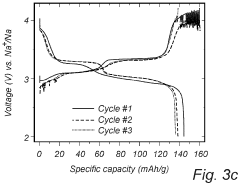
- A process involving the controlled drying of the cathode active layer to achieve an adsorbed water content between 12,000 ppm and 50,000 ppm, allowing the layer to withstand mechanical stress without flaking or cracking, while using an aqueous-based slurry to maintain environmental sustainability.
A method for manufacturing a sodium or potassium ion battery cell
PatentActiveEP4376110A1
Innovation
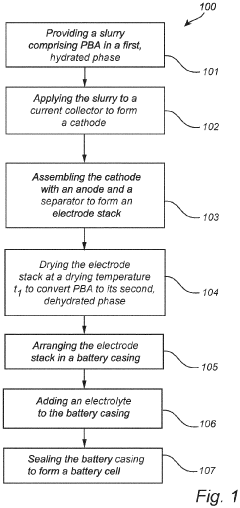
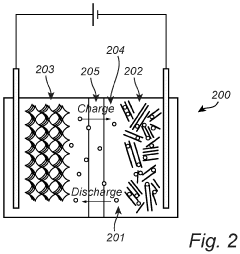
- A method involving a slurry of Prussian Blue analogue in a hydrated phase, applied to a current collector, dried under controlled conditions (150-300°C for 1 minute to 4 hours) to convert to a dehydrated phase, maintaining the material in this phase throughout the battery assembly process under inert conditions to prevent rehydration, allowing for large-scale, cost-effective production without the need for dry rooms.
Environmental Impact of Prussian Blue Battery Materials
The environmental implications of Prussian blue battery materials present a complex landscape of both opportunities and challenges that directly influence surface layer stability and overall cathode performance. Unlike conventional lithium-ion battery materials that often rely on scarce and environmentally problematic elements such as cobalt and nickel, Prussian blue compounds primarily consist of abundant elements including iron, carbon, and nitrogen, significantly reducing the environmental burden associated with raw material extraction and processing.
The synthesis pathways for Prussian blue cathodes typically involve aqueous precipitation methods that operate under mild conditions, eliminating the need for high-temperature calcination processes commonly required for oxide-based cathode materials. This low-energy manufacturing approach substantially reduces carbon emissions during production while minimizing the generation of toxic byproducts that could compromise material purity and surface integrity.
Water usage represents a critical environmental consideration in Prussian blue cathode production, as the aqueous synthesis routes require careful management of process water and waste streams. The presence of residual water molecules and ionic impurities from synthesis can directly contribute to surface layer degradation mechanisms, creating a direct link between environmental processing considerations and electrochemical performance. Proper water treatment and purification protocols not only reduce environmental impact but also enhance cathode surface stability.
End-of-life recyclability of Prussian blue materials offers significant environmental advantages compared to traditional cathode chemistries. The iron-based framework can be efficiently recovered through simple acid leaching processes, avoiding the complex pyrometallurgical treatments required for conventional cathodes. This simplified recycling pathway reduces energy consumption and toxic emissions while enabling circular material flows that support sustainable battery manufacturing.
The absence of heavy metals and toxic elements in Prussian blue structures eliminates many environmental hazards associated with battery disposal and recycling. However, the cyanide groups within the crystal framework require careful handling during processing and end-of-life management to prevent potential environmental release, necessitating specialized protocols that ensure both worker safety and environmental protection throughout the material lifecycle.
The synthesis pathways for Prussian blue cathodes typically involve aqueous precipitation methods that operate under mild conditions, eliminating the need for high-temperature calcination processes commonly required for oxide-based cathode materials. This low-energy manufacturing approach substantially reduces carbon emissions during production while minimizing the generation of toxic byproducts that could compromise material purity and surface integrity.
Water usage represents a critical environmental consideration in Prussian blue cathode production, as the aqueous synthesis routes require careful management of process water and waste streams. The presence of residual water molecules and ionic impurities from synthesis can directly contribute to surface layer degradation mechanisms, creating a direct link between environmental processing considerations and electrochemical performance. Proper water treatment and purification protocols not only reduce environmental impact but also enhance cathode surface stability.
End-of-life recyclability of Prussian blue materials offers significant environmental advantages compared to traditional cathode chemistries. The iron-based framework can be efficiently recovered through simple acid leaching processes, avoiding the complex pyrometallurgical treatments required for conventional cathodes. This simplified recycling pathway reduces energy consumption and toxic emissions while enabling circular material flows that support sustainable battery manufacturing.
The absence of heavy metals and toxic elements in Prussian blue structures eliminates many environmental hazards associated with battery disposal and recycling. However, the cyanide groups within the crystal framework require careful handling during processing and end-of-life management to prevent potential environmental release, necessitating specialized protocols that ensure both worker safety and environmental protection throughout the material lifecycle.
Safety Standards for Prussian Blue Energy Storage Systems
The development of comprehensive safety standards for Prussian Blue energy storage systems represents a critical milestone in the commercialization of this promising cathode technology. As these systems transition from laboratory research to industrial applications, establishing robust safety frameworks becomes essential to address the unique characteristics and potential risks associated with Prussian Blue-based batteries.
Current safety standard development focuses on addressing the specific failure modes inherent to Prussian Blue cathodes, particularly surface layer breakdown phenomena. International standardization bodies, including IEC and IEEE, are actively working to incorporate Prussian Blue-specific testing protocols into existing battery safety frameworks. These standards emphasize thermal stability assessment, structural integrity monitoring, and electrochemical performance degradation limits.
Key safety parameters being standardized include maximum operating temperature ranges, typically 60-80°C for commercial applications, and voltage window specifications to prevent irreversible structural changes. Standards also define acceptable capacity fade rates, generally limiting degradation to less than 20% over 2000 cycles to ensure long-term safety and performance reliability.
Testing methodologies outlined in emerging standards require comprehensive evaluation of surface layer stability under various stress conditions. These include accelerated aging tests, thermal cycling protocols, and mechanical stress assessments specifically designed to identify early indicators of surface layer breakdown. Standards mandate continuous monitoring of key performance indicators such as impedance growth, capacity retention, and structural integrity markers.
Certification requirements for Prussian Blue energy storage systems encompass both component-level and system-level safety validation. Manufacturing quality control standards specify acceptable levels of crystal defects, surface uniformity, and electrochemical consistency to minimize breakdown risks. Additionally, standards define mandatory safety features including thermal management systems, voltage monitoring circuits, and emergency shutdown protocols.
Regulatory compliance frameworks are being established to ensure consistent implementation across different markets and applications. These frameworks address installation requirements, operational monitoring protocols, and maintenance procedures specific to Prussian Blue technology, creating a comprehensive safety ecosystem that supports widespread commercial adoption while maintaining high safety standards.
Current safety standard development focuses on addressing the specific failure modes inherent to Prussian Blue cathodes, particularly surface layer breakdown phenomena. International standardization bodies, including IEC and IEEE, are actively working to incorporate Prussian Blue-specific testing protocols into existing battery safety frameworks. These standards emphasize thermal stability assessment, structural integrity monitoring, and electrochemical performance degradation limits.
Key safety parameters being standardized include maximum operating temperature ranges, typically 60-80°C for commercial applications, and voltage window specifications to prevent irreversible structural changes. Standards also define acceptable capacity fade rates, generally limiting degradation to less than 20% over 2000 cycles to ensure long-term safety and performance reliability.
Testing methodologies outlined in emerging standards require comprehensive evaluation of surface layer stability under various stress conditions. These include accelerated aging tests, thermal cycling protocols, and mechanical stress assessments specifically designed to identify early indicators of surface layer breakdown. Standards mandate continuous monitoring of key performance indicators such as impedance growth, capacity retention, and structural integrity markers.
Certification requirements for Prussian Blue energy storage systems encompass both component-level and system-level safety validation. Manufacturing quality control standards specify acceptable levels of crystal defects, surface uniformity, and electrochemical consistency to minimize breakdown risks. Additionally, standards define mandatory safety features including thermal management systems, voltage monitoring circuits, and emergency shutdown protocols.
Regulatory compliance frameworks are being established to ensure consistent implementation across different markets and applications. These frameworks address installation requirements, operational monitoring protocols, and maintenance procedures specific to Prussian Blue technology, creating a comprehensive safety ecosystem that supports widespread commercial adoption while maintaining high safety standards.
Unlock deeper insights with Patsnap Eureka Quick Research — get a full tech report to explore trends and direct your research. Try now!
Generate Your Research Report Instantly with AI Agent
Supercharge your innovation with Patsnap Eureka AI Agent Platform!