

Validate Cathode Microstructure Optimization for Prussian Blue Materials
MAY 15, 20268 MIN READ
Generate Your Research Report Instantly with AI Agent
Patsnap Eureka helps you evaluate technical feasibility & market potential.
Prussian Blue Cathode Development Background and Objectives
Prussian Blue (PB) materials have emerged as promising cathode candidates for next-generation energy storage systems, particularly sodium-ion batteries, due to their unique three-dimensional framework structure and abundant availability of constituent elements. The historical development of PB materials dates back to their initial discovery as pigments, but their electrochemical properties were not fully recognized until recent decades when researchers began exploring alternative battery chemistries beyond lithium-ion systems.
The evolution of PB cathode materials has been driven by the growing demand for sustainable and cost-effective energy storage solutions. As lithium resources face supply constraints and price volatility, sodium-ion batteries utilizing PB cathodes present an attractive alternative due to sodium's abundance and the iron-based composition of PB materials. This technological shift represents a significant paradigm change in battery chemistry, moving from scarce materials to earth-abundant alternatives.
Current research trends in PB cathode development focus heavily on microstructure optimization to address inherent challenges such as structural water content, vacancy defects, and cycling stability. The microstructural characteristics of PB materials directly influence their electrochemical performance, including capacity retention, rate capability, and long-term durability. Understanding and controlling these microstructural features has become paramount for commercial viability.
The primary technical objectives for PB cathode microstructure optimization encompass several critical areas. First, minimizing interstitial and coordinated water content while maintaining structural integrity represents a fundamental challenge. Second, controlling vacancy concentrations and distribution within the crystal lattice to optimize sodium-ion diffusion pathways. Third, achieving uniform particle size distribution and morphology to enhance electrode-electrolyte interface stability.
Advanced characterization techniques and computational modeling approaches are being integrated to validate microstructural improvements systematically. These methodologies enable precise correlation between structural modifications and electrochemical performance metrics, facilitating data-driven optimization strategies.
The ultimate goal involves developing PB cathode materials with enhanced energy density, extended cycle life, and improved rate performance through systematic microstructure engineering, positioning these materials as viable alternatives for large-scale energy storage applications.
The evolution of PB cathode materials has been driven by the growing demand for sustainable and cost-effective energy storage solutions. As lithium resources face supply constraints and price volatility, sodium-ion batteries utilizing PB cathodes present an attractive alternative due to sodium's abundance and the iron-based composition of PB materials. This technological shift represents a significant paradigm change in battery chemistry, moving from scarce materials to earth-abundant alternatives.
Current research trends in PB cathode development focus heavily on microstructure optimization to address inherent challenges such as structural water content, vacancy defects, and cycling stability. The microstructural characteristics of PB materials directly influence their electrochemical performance, including capacity retention, rate capability, and long-term durability. Understanding and controlling these microstructural features has become paramount for commercial viability.
The primary technical objectives for PB cathode microstructure optimization encompass several critical areas. First, minimizing interstitial and coordinated water content while maintaining structural integrity represents a fundamental challenge. Second, controlling vacancy concentrations and distribution within the crystal lattice to optimize sodium-ion diffusion pathways. Third, achieving uniform particle size distribution and morphology to enhance electrode-electrolyte interface stability.
Advanced characterization techniques and computational modeling approaches are being integrated to validate microstructural improvements systematically. These methodologies enable precise correlation between structural modifications and electrochemical performance metrics, facilitating data-driven optimization strategies.
The ultimate goal involves developing PB cathode materials with enhanced energy density, extended cycle life, and improved rate performance through systematic microstructure engineering, positioning these materials as viable alternatives for large-scale energy storage applications.
Market Demand for Advanced Battery Cathode Materials
The global battery market is experiencing unprecedented growth driven by the rapid expansion of electric vehicles, renewable energy storage systems, and portable electronics. This surge in demand has created substantial market opportunities for advanced cathode materials that can deliver superior performance characteristics compared to conventional lithium-ion battery technologies.
Electric vehicle adoption represents the primary growth driver for advanced cathode materials. Major automotive manufacturers are transitioning their production lines toward electrification, creating massive demand for battery systems that offer extended range, faster charging capabilities, and enhanced safety profiles. The automotive sector requires cathode materials that can withstand thousands of charge-discharge cycles while maintaining capacity retention and thermal stability.
Energy storage systems for grid-scale applications constitute another significant market segment demanding advanced cathode materials. As renewable energy sources like solar and wind become more prevalent, utilities and energy companies require large-scale battery installations capable of storing and dispatching electricity efficiently. These applications prioritize cost-effectiveness, longevity, and safety over energy density, creating distinct requirements for cathode material optimization.
Prussian blue cathode materials are positioned to address several critical market needs that existing technologies struggle to fulfill. The abundance and low cost of iron and sodium-based precursors make Prussian blue materials particularly attractive for large-scale energy storage applications where cost per kilowatt-hour is paramount. Additionally, these materials demonstrate excellent structural stability during cycling, addressing durability concerns that plague many alternative cathode chemistries.
The market demand for sustainable and environmentally friendly battery technologies is intensifying as regulatory frameworks become more stringent. Prussian blue materials offer advantages in terms of resource availability and reduced environmental impact compared to cobalt-intensive cathode materials. This sustainability aspect aligns with corporate environmental goals and government initiatives promoting cleaner energy technologies.
Manufacturing scalability represents a crucial market requirement that Prussian blue cathode materials can potentially satisfy. The relatively simple synthesis processes and abundant raw materials enable cost-effective large-scale production, which is essential for meeting the projected demand growth across multiple application sectors.
Electric vehicle adoption represents the primary growth driver for advanced cathode materials. Major automotive manufacturers are transitioning their production lines toward electrification, creating massive demand for battery systems that offer extended range, faster charging capabilities, and enhanced safety profiles. The automotive sector requires cathode materials that can withstand thousands of charge-discharge cycles while maintaining capacity retention and thermal stability.
Energy storage systems for grid-scale applications constitute another significant market segment demanding advanced cathode materials. As renewable energy sources like solar and wind become more prevalent, utilities and energy companies require large-scale battery installations capable of storing and dispatching electricity efficiently. These applications prioritize cost-effectiveness, longevity, and safety over energy density, creating distinct requirements for cathode material optimization.
Prussian blue cathode materials are positioned to address several critical market needs that existing technologies struggle to fulfill. The abundance and low cost of iron and sodium-based precursors make Prussian blue materials particularly attractive for large-scale energy storage applications where cost per kilowatt-hour is paramount. Additionally, these materials demonstrate excellent structural stability during cycling, addressing durability concerns that plague many alternative cathode chemistries.
The market demand for sustainable and environmentally friendly battery technologies is intensifying as regulatory frameworks become more stringent. Prussian blue materials offer advantages in terms of resource availability and reduced environmental impact compared to cobalt-intensive cathode materials. This sustainability aspect aligns with corporate environmental goals and government initiatives promoting cleaner energy technologies.
Manufacturing scalability represents a crucial market requirement that Prussian blue cathode materials can potentially satisfy. The relatively simple synthesis processes and abundant raw materials enable cost-effective large-scale production, which is essential for meeting the projected demand growth across multiple application sectors.
Current Microstructure Challenges in Prussian Blue Cathodes
Prussian blue cathode materials face significant microstructural challenges that directly impact their electrochemical performance and commercial viability in energy storage applications. The inherent crystal structure of Prussian blue analogues, characterized by an open framework with large interstitial sites, presents both opportunities and obstacles for ion transport and structural stability.
One of the primary microstructural challenges lies in the presence of structural water and crystal defects within the Prussian blue framework. These materials typically contain coordinated water molecules and crystal vacancies that can lead to uneven ion distribution and create preferential pathways for degradation. The zeolitic water content varies significantly depending on synthesis conditions, resulting in inconsistent electrochemical behavior and capacity retention across different batches.
Particle size distribution and morphology control represent another critical challenge in Prussian blue cathode optimization. Conventional synthesis methods often produce irregular particle shapes with wide size distributions, leading to non-uniform current density distribution during cycling. Large particles suffer from poor ion diffusion kinetics, while excessively small particles tend to agglomerate and exhibit high surface reactivity that accelerates electrolyte decomposition.
The crystallographic orientation and phase purity of Prussian blue materials significantly influence their electrochemical properties. Mixed phases and random crystallographic orientations can create internal stress concentrations during ion insertion and extraction processes. This leads to mechanical degradation, capacity fading, and reduced cycle life, particularly under high-rate charging conditions.
Surface chemistry and interface stability pose additional microstructural challenges. The high surface area of Prussian blue particles makes them susceptible to side reactions with electrolyte components, forming resistive surface films that impede ion transport. The transition metal centers at particle surfaces are particularly vulnerable to oxidation and dissolution, creating compositional gradients that affect overall performance.
Structural stability during repeated cycling remains a fundamental challenge, as the Prussian blue framework undergoes volume changes during ion intercalation and deintercalation. These volume fluctuations can cause particle cracking, active material isolation, and progressive loss of electrical connectivity within the electrode matrix.
One of the primary microstructural challenges lies in the presence of structural water and crystal defects within the Prussian blue framework. These materials typically contain coordinated water molecules and crystal vacancies that can lead to uneven ion distribution and create preferential pathways for degradation. The zeolitic water content varies significantly depending on synthesis conditions, resulting in inconsistent electrochemical behavior and capacity retention across different batches.
Particle size distribution and morphology control represent another critical challenge in Prussian blue cathode optimization. Conventional synthesis methods often produce irregular particle shapes with wide size distributions, leading to non-uniform current density distribution during cycling. Large particles suffer from poor ion diffusion kinetics, while excessively small particles tend to agglomerate and exhibit high surface reactivity that accelerates electrolyte decomposition.
The crystallographic orientation and phase purity of Prussian blue materials significantly influence their electrochemical properties. Mixed phases and random crystallographic orientations can create internal stress concentrations during ion insertion and extraction processes. This leads to mechanical degradation, capacity fading, and reduced cycle life, particularly under high-rate charging conditions.
Surface chemistry and interface stability pose additional microstructural challenges. The high surface area of Prussian blue particles makes them susceptible to side reactions with electrolyte components, forming resistive surface films that impede ion transport. The transition metal centers at particle surfaces are particularly vulnerable to oxidation and dissolution, creating compositional gradients that affect overall performance.
Structural stability during repeated cycling remains a fundamental challenge, as the Prussian blue framework undergoes volume changes during ion intercalation and deintercalation. These volume fluctuations can cause particle cracking, active material isolation, and progressive loss of electrical connectivity within the electrode matrix.
Existing Microstructure Optimization Approaches
01 Prussian blue cathode material synthesis and preparation methods
Various synthesis approaches have been developed to prepare Prussian blue materials for cathode applications, including precipitation methods, hydrothermal synthesis, and controlled crystallization processes. These methods focus on optimizing the formation of the cubic framework structure and controlling particle size distribution to enhance electrochemical performance.- Prussian blue cathode material synthesis and preparation methods: Various synthesis approaches have been developed to prepare Prussian blue materials for cathode applications, including precipitation methods, hydrothermal synthesis, and controlled crystallization processes. These methods focus on optimizing the formation of the cubic framework structure and controlling particle size distribution to enhance electrochemical performance.
- Microstructural modification and doping strategies: Enhancement of Prussian blue cathode materials through structural modifications, including metal ion substitution, defect engineering, and composite formation. These approaches aim to improve ionic conductivity, structural stability, and cycling performance by modifying the crystal lattice and introducing beneficial dopants or additives.
- Nanostructure engineering and morphology control: Development of nanostructured Prussian blue materials with controlled morphologies such as nanoparticles, nanowires, and hierarchical structures. These approaches focus on optimizing surface area, ion diffusion pathways, and electrode-electrolyte interfaces to enhance rate capability and capacity retention.
- Composite cathode materials and hybrid structures: Integration of Prussian blue materials with other active materials, conductive additives, or support matrices to create composite cathode systems. These hybrid approaches combine the advantages of different materials to achieve improved electrochemical properties, mechanical stability, and overall battery performance.
- Electrochemical performance optimization and characterization: Comprehensive studies on the electrochemical behavior of Prussian blue cathode materials, including capacity evaluation, cycling stability, rate performance, and mechanistic understanding. These investigations provide insights into structure-property relationships and guide further material optimization for practical battery applications.
02 Microstructural modification and doping strategies
Enhancement of Prussian blue cathode materials through structural modifications, including metal ion substitution, defect engineering, and composite formation. These approaches aim to improve ionic conductivity, structural stability, and cycling performance by modifying the crystal lattice and introducing beneficial dopants or additives.Expand Specific Solutions03 Morphology control and nanostructure engineering
Development of controlled morphologies such as nanocubes, hollow structures, and hierarchical architectures to optimize the electrochemical properties of Prussian blue cathodes. The focus is on creating specific surface areas and pore structures that facilitate ion transport and improve battery performance.Expand Specific Solutions04 Composite cathode materials and hybrid structures
Integration of Prussian blue with other materials to form composite cathode systems that combine the advantages of different components. These hybrid approaches include carbon composites, conductive polymer matrices, and multi-component systems designed to enhance overall electrochemical performance and stability.Expand Specific Solutions05 Surface treatment and interface optimization
Surface modification techniques and interface engineering strategies to improve the electrochemical properties of Prussian blue cathodes. These methods include surface coating, functionalization, and interface stabilization approaches that enhance ion diffusion kinetics and prevent structural degradation during cycling.Expand Specific Solutions
Key Players in Prussian Blue and Battery Industry
The Prussian Blue cathode microstructure optimization field represents an emerging segment within the broader sodium-ion battery industry, currently in its early commercialization phase. The market remains relatively niche compared to lithium-ion technologies, with estimated global sodium-ion battery market reaching $1.2 billion by 2025. Technology maturity varies significantly across players, with Altris AB leading in specialized Prussian White cathode development and commercialization capabilities. Chinese companies like CATL, CNGR Advanced Material, and Zhejiang Sodium Innovation Energy demonstrate strong manufacturing scale and integration potential. Research institutions including Tongji University, IIT Bombay, and City University of Hong Kong contribute fundamental research advances. Industrial giants such as Sharp Corp. and established battery material suppliers like Hubei Wanrun provide manufacturing infrastructure. The competitive landscape shows a mix of specialized startups, established battery manufacturers, and academic institutions, indicating technology transition from laboratory to industrial scale production.
Envision Ruitai Dynamics Technology (Shanghai) Co., Ltd.
Technical Solution: Envision has developed comprehensive cathode microstructure validation protocols for Prussian Blue materials, incorporating advanced imaging techniques and electrochemical testing methodologies. Their approach focuses on optimizing particle morphology through controlled synthesis parameters, including temperature, pH, and precursor concentration. The validation process includes detailed analysis of crystal defects, surface area measurements, and pore structure characterization to ensure optimal ion transport pathways and structural integrity during cycling operations.
Strengths: Strong integration with renewable energy systems and advanced battery management technologies. Weaknesses: Relatively newer player in Prussian Blue material development compared to established battery manufacturers.
Contemporary Amperex Technology Co., Ltd.
Technical Solution: CATL has developed advanced cathode microstructure optimization techniques for Prussian Blue materials, focusing on controlled synthesis methods to enhance structural stability and electrochemical performance. Their approach involves precise control of particle size distribution, surface morphology, and crystal structure through optimized precipitation conditions and post-treatment processes. The company employs advanced characterization techniques including high-resolution electron microscopy and X-ray diffraction to validate microstructural improvements, achieving enhanced cycling stability and capacity retention in sodium-ion battery applications.
Strengths: Leading market position in battery technology with extensive R&D capabilities and manufacturing scale. Weaknesses: High development costs and complex manufacturing processes requiring precise control parameters.
Core Patents in Prussian Blue Cathode Design
Cathode for proton batteries and method of manufacture
PatentWO2024119235A1
Innovation
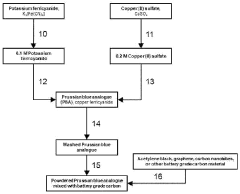
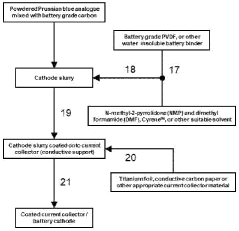
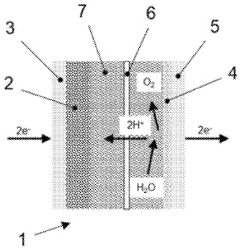
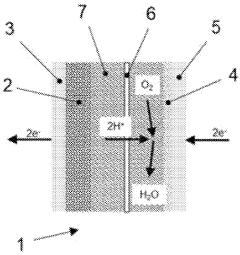
- A cathode for proton batteries comprising a Prussian blue analogue (PBA) coated on a current collector, combined with battery-grade carbon nanoparticles and a non-water-soluble binder, utilizing a copper hexacyanoferrate or manganese hexacyanoferrate structure for enhanced proton intercalation and storage capabilities, along with a suitable current collector and electrolyte system.
Environmental Impact of Prussian Blue Materials
The environmental implications of Prussian Blue materials in energy storage applications present both promising opportunities and critical considerations for sustainable technology development. As cathode materials for sodium-ion and potassium-ion batteries, Prussian Blue analogues offer significant environmental advantages compared to conventional lithium-ion battery materials, particularly in terms of resource availability and extraction impact.
The primary environmental benefit stems from the abundant availability of iron and sodium/potassium precursors, which eliminates dependency on scarce lithium resources and reduces mining pressure on environmentally sensitive regions. Unlike lithium extraction that often requires extensive water consumption in arid regions, the raw materials for Prussian Blue synthesis are widely distributed and can be sourced with minimal ecological disruption.
Manufacturing processes for Prussian Blue materials typically operate under mild conditions using aqueous synthesis routes, resulting in lower energy consumption and reduced carbon footprint compared to high-temperature ceramic processing required for traditional cathode materials. The water-based synthesis eliminates the need for toxic organic solvents, significantly reducing hazardous waste generation during production.
However, environmental challenges exist in the optimization of cathode microstructures. The synthesis often involves transition metal precursors that require careful waste management protocols. Defect engineering and structural modifications may introduce additional chemical treatments that could generate secondary waste streams requiring proper disposal or recycling strategies.
End-of-life considerations reveal mixed environmental impacts. While Prussian Blue materials demonstrate good recyclability due to their simple chemical composition, the current lack of established recycling infrastructure poses challenges. The materials show relatively low toxicity profiles, but comprehensive lifecycle assessments are still needed to fully understand long-term environmental implications.
Water stability issues in some Prussian Blue variants may lead to performance degradation, potentially shortening battery lifespans and increasing replacement frequency. This could offset some environmental benefits if not properly addressed through microstructural optimization strategies that enhance material durability and cycling stability.
The primary environmental benefit stems from the abundant availability of iron and sodium/potassium precursors, which eliminates dependency on scarce lithium resources and reduces mining pressure on environmentally sensitive regions. Unlike lithium extraction that often requires extensive water consumption in arid regions, the raw materials for Prussian Blue synthesis are widely distributed and can be sourced with minimal ecological disruption.
Manufacturing processes for Prussian Blue materials typically operate under mild conditions using aqueous synthesis routes, resulting in lower energy consumption and reduced carbon footprint compared to high-temperature ceramic processing required for traditional cathode materials. The water-based synthesis eliminates the need for toxic organic solvents, significantly reducing hazardous waste generation during production.
However, environmental challenges exist in the optimization of cathode microstructures. The synthesis often involves transition metal precursors that require careful waste management protocols. Defect engineering and structural modifications may introduce additional chemical treatments that could generate secondary waste streams requiring proper disposal or recycling strategies.
End-of-life considerations reveal mixed environmental impacts. While Prussian Blue materials demonstrate good recyclability due to their simple chemical composition, the current lack of established recycling infrastructure poses challenges. The materials show relatively low toxicity profiles, but comprehensive lifecycle assessments are still needed to fully understand long-term environmental implications.
Water stability issues in some Prussian Blue variants may lead to performance degradation, potentially shortening battery lifespans and increasing replacement frequency. This could offset some environmental benefits if not properly addressed through microstructural optimization strategies that enhance material durability and cycling stability.
Validation Methods for Cathode Performance Assessment
Validation of cathode performance in Prussian Blue materials requires a comprehensive suite of analytical methods to assess microstructural optimization effectiveness. Electrochemical characterization forms the foundation of performance validation, utilizing cyclic voltammetry to evaluate redox behavior and identify optimal potential windows. Galvanostatic charge-discharge testing provides critical insights into capacity retention, rate capability, and cycling stability under various current densities.
Advanced microscopy techniques serve as essential tools for microstructural validation. Scanning electron microscopy enables detailed examination of particle morphology, size distribution, and surface characteristics following optimization treatments. Transmission electron microscopy offers higher resolution analysis of crystalline structure and defect identification at the nanoscale level.
X-ray diffraction analysis validates crystallographic changes resulting from microstructural optimization processes. This technique confirms phase purity, lattice parameter modifications, and structural integrity of the Prussian Blue framework. Rietveld refinement of diffraction patterns provides quantitative assessment of structural parameters and phase composition changes.
Spectroscopic validation methods complement structural characterization approaches. X-ray photoelectron spectroscopy determines surface chemical composition and oxidation states of iron and other metal centers. Fourier-transform infrared spectroscopy identifies functional group modifications and coordination environment changes within the Prussian Blue lattice structure.
Electrochemical impedance spectroscopy provides crucial information about charge transfer kinetics and ionic conductivity improvements achieved through microstructural optimization. This technique separates contributions from bulk resistance, charge transfer resistance, and diffusion limitations, enabling targeted assessment of optimization effectiveness.
Physical property validation encompasses surface area analysis through nitrogen adsorption isotherms, revealing porosity changes and accessible surface modifications. Thermal analysis techniques, including differential scanning calorimetry and thermogravimetric analysis, assess thermal stability improvements and decomposition behavior of optimized cathode materials.
Operando characterization methods enable real-time monitoring of structural and electrochemical changes during battery operation. These techniques provide dynamic validation of microstructural stability and performance correlation under actual operating conditions, ensuring optimization strategies translate to practical applications.
Advanced microscopy techniques serve as essential tools for microstructural validation. Scanning electron microscopy enables detailed examination of particle morphology, size distribution, and surface characteristics following optimization treatments. Transmission electron microscopy offers higher resolution analysis of crystalline structure and defect identification at the nanoscale level.
X-ray diffraction analysis validates crystallographic changes resulting from microstructural optimization processes. This technique confirms phase purity, lattice parameter modifications, and structural integrity of the Prussian Blue framework. Rietveld refinement of diffraction patterns provides quantitative assessment of structural parameters and phase composition changes.
Spectroscopic validation methods complement structural characterization approaches. X-ray photoelectron spectroscopy determines surface chemical composition and oxidation states of iron and other metal centers. Fourier-transform infrared spectroscopy identifies functional group modifications and coordination environment changes within the Prussian Blue lattice structure.
Electrochemical impedance spectroscopy provides crucial information about charge transfer kinetics and ionic conductivity improvements achieved through microstructural optimization. This technique separates contributions from bulk resistance, charge transfer resistance, and diffusion limitations, enabling targeted assessment of optimization effectiveness.
Physical property validation encompasses surface area analysis through nitrogen adsorption isotherms, revealing porosity changes and accessible surface modifications. Thermal analysis techniques, including differential scanning calorimetry and thermogravimetric analysis, assess thermal stability improvements and decomposition behavior of optimized cathode materials.
Operando characterization methods enable real-time monitoring of structural and electrochemical changes during battery operation. These techniques provide dynamic validation of microstructural stability and performance correlation under actual operating conditions, ensuring optimization strategies translate to practical applications.
Unlock deeper insights with Patsnap Eureka Quick Research — get a full tech report to explore trends and direct your research. Try now!
Generate Your Research Report Instantly with AI Agent
Supercharge your innovation with Patsnap Eureka AI Agent Platform!