

Comparing Fire Suppression Systems for Thermal Runaway
FEB 26, 20269 MIN READ
Generate Your Research Report Instantly with AI Agent
PatSnap Eureka helps you evaluate technical feasibility & market potential.
Fire Suppression Tech Background and Safety Goals
Fire suppression technology has evolved significantly over the past century, driven by the increasing complexity of industrial applications and the emergence of new fire hazards. Traditional fire suppression systems were primarily designed for conventional combustible materials, but the advent of advanced energy storage systems, particularly lithium-ion batteries, has introduced unprecedented challenges in fire safety management.
The phenomenon of thermal runaway represents a critical safety concern in modern energy storage applications. This process occurs when a battery cell experiences an uncontrolled temperature rise, leading to a cascade of exothermic reactions that can propagate to adjacent cells. The unique characteristics of thermal runaway fires, including extreme temperatures exceeding 1000°C, toxic gas emissions, and potential for re-ignition, have necessitated a fundamental reevaluation of fire suppression strategies.
Historical development of fire suppression technologies began with water-based systems in the early 20th century, progressing through chemical suppressants like halon in the 1960s, and evolving to modern clean agents and specialized suppression media. Each technological advancement addressed specific limitations of previous systems while introducing new capabilities for emerging fire risks.
The primary safety goals for thermal runaway suppression encompass multiple critical objectives. Temperature control stands as the foremost priority, requiring rapid heat absorption and cooling to prevent fire propagation between battery cells. Suppression systems must achieve immediate flame knockdown while maintaining sustained cooling effects to prevent re-ignition, which is particularly challenging given the stored energy within battery systems.
Toxic gas mitigation represents another essential safety objective. Thermal runaway events generate hazardous compounds including hydrogen fluoride, carbon monoxide, and various organic vapors. Effective suppression systems must not only extinguish flames but also minimize toxic gas production and facilitate safe evacuation procedures for personnel.
Environmental protection and asset preservation constitute additional safety goals. Modern suppression systems must minimize collateral damage to sensitive electronic equipment while providing effective fire control. This requirement has driven development of clean agents and specialized suppression media that leave minimal residue and cause reduced secondary damage.
The integration of detection and suppression technologies has become increasingly sophisticated, with safety goals extending beyond mere fire extinction to encompass early warning capabilities, automated response systems, and integration with broader facility safety management systems. These comprehensive safety objectives continue to drive innovation in fire suppression technology development.
The phenomenon of thermal runaway represents a critical safety concern in modern energy storage applications. This process occurs when a battery cell experiences an uncontrolled temperature rise, leading to a cascade of exothermic reactions that can propagate to adjacent cells. The unique characteristics of thermal runaway fires, including extreme temperatures exceeding 1000°C, toxic gas emissions, and potential for re-ignition, have necessitated a fundamental reevaluation of fire suppression strategies.
Historical development of fire suppression technologies began with water-based systems in the early 20th century, progressing through chemical suppressants like halon in the 1960s, and evolving to modern clean agents and specialized suppression media. Each technological advancement addressed specific limitations of previous systems while introducing new capabilities for emerging fire risks.
The primary safety goals for thermal runaway suppression encompass multiple critical objectives. Temperature control stands as the foremost priority, requiring rapid heat absorption and cooling to prevent fire propagation between battery cells. Suppression systems must achieve immediate flame knockdown while maintaining sustained cooling effects to prevent re-ignition, which is particularly challenging given the stored energy within battery systems.
Toxic gas mitigation represents another essential safety objective. Thermal runaway events generate hazardous compounds including hydrogen fluoride, carbon monoxide, and various organic vapors. Effective suppression systems must not only extinguish flames but also minimize toxic gas production and facilitate safe evacuation procedures for personnel.
Environmental protection and asset preservation constitute additional safety goals. Modern suppression systems must minimize collateral damage to sensitive electronic equipment while providing effective fire control. This requirement has driven development of clean agents and specialized suppression media that leave minimal residue and cause reduced secondary damage.
The integration of detection and suppression technologies has become increasingly sophisticated, with safety goals extending beyond mere fire extinction to encompass early warning capabilities, automated response systems, and integration with broader facility safety management systems. These comprehensive safety objectives continue to drive innovation in fire suppression technology development.
Market Demand for Thermal Runaway Fire Solutions
The global market for thermal runaway fire suppression solutions is experiencing unprecedented growth driven by the rapid expansion of lithium-ion battery applications across multiple industries. Electric vehicle adoption continues to accelerate worldwide, with automotive manufacturers increasingly prioritizing battery safety systems to protect both vehicle occupants and infrastructure. This surge in EV production has created substantial demand for specialized fire suppression technologies capable of addressing the unique challenges posed by thermal runaway incidents.
Energy storage systems represent another critical market segment fueling demand for advanced fire suppression solutions. As renewable energy integration expands and grid-scale battery installations proliferate, utilities and energy companies require robust safety measures to protect substantial capital investments and ensure operational continuity. The high energy density and potential for cascading failures in large battery arrays make effective fire suppression systems essential rather than optional.
Consumer electronics manufacturers face mounting pressure to implement comprehensive thermal runaway protection as device energy densities increase and safety regulations tighten. Smartphones, laptops, and portable devices require compact yet effective suppression systems that can operate within space-constrained environments while maintaining product aesthetics and functionality.
Industrial applications including material handling equipment, backup power systems, and stationary energy storage installations drive significant market demand. These sectors prioritize reliability and proven performance, creating opportunities for established suppression technologies while simultaneously pushing innovation boundaries for next-generation solutions.
Regulatory frameworks across major markets are evolving to mandate enhanced battery safety measures, particularly in transportation and energy storage applications. These regulatory developments create both compliance-driven demand and standardization requirements that influence technology selection and implementation strategies.
Geographic market dynamics reveal concentrated demand in regions with strong electric vehicle manufacturing bases and renewable energy deployment programs. Asia-Pacific markets lead in volume demand, while North American and European markets emphasize premium solutions with advanced monitoring and integration capabilities.
The market exhibits distinct segmentation based on application requirements, with automotive applications demanding lightweight and cost-effective solutions, while stationary installations prioritize comprehensive protection and system integration capabilities. This segmentation drives diverse technology development paths and creates multiple market entry opportunities for specialized suppression system providers.
Energy storage systems represent another critical market segment fueling demand for advanced fire suppression solutions. As renewable energy integration expands and grid-scale battery installations proliferate, utilities and energy companies require robust safety measures to protect substantial capital investments and ensure operational continuity. The high energy density and potential for cascading failures in large battery arrays make effective fire suppression systems essential rather than optional.
Consumer electronics manufacturers face mounting pressure to implement comprehensive thermal runaway protection as device energy densities increase and safety regulations tighten. Smartphones, laptops, and portable devices require compact yet effective suppression systems that can operate within space-constrained environments while maintaining product aesthetics and functionality.
Industrial applications including material handling equipment, backup power systems, and stationary energy storage installations drive significant market demand. These sectors prioritize reliability and proven performance, creating opportunities for established suppression technologies while simultaneously pushing innovation boundaries for next-generation solutions.
Regulatory frameworks across major markets are evolving to mandate enhanced battery safety measures, particularly in transportation and energy storage applications. These regulatory developments create both compliance-driven demand and standardization requirements that influence technology selection and implementation strategies.
Geographic market dynamics reveal concentrated demand in regions with strong electric vehicle manufacturing bases and renewable energy deployment programs. Asia-Pacific markets lead in volume demand, while North American and European markets emphasize premium solutions with advanced monitoring and integration capabilities.
The market exhibits distinct segmentation based on application requirements, with automotive applications demanding lightweight and cost-effective solutions, while stationary installations prioritize comprehensive protection and system integration capabilities. This segmentation drives diverse technology development paths and creates multiple market entry opportunities for specialized suppression system providers.
Current Fire Suppression Challenges in Battery Systems
Battery thermal runaway presents unprecedented challenges for conventional fire suppression systems, fundamentally altering the landscape of fire safety engineering. Traditional suppression methods, originally designed for conventional combustible materials, encounter significant limitations when confronting the unique characteristics of lithium-ion battery fires. The electrochemical nature of thermal runaway creates a self-sustaining reaction that continues even in oxygen-depleted environments, rendering standard oxygen displacement techniques largely ineffective.
Water-based suppression systems face critical operational challenges in battery applications. While water demonstrates superior cooling capacity essential for temperature reduction, its electrical conductivity poses severe safety risks in energized battery systems. The interaction between water and lithium compounds can generate toxic hydrogen fluoride gas, creating additional hazardous conditions. Furthermore, water's limited penetration into tightly packed battery modules restricts its ability to reach the thermal runaway source effectively.
Gaseous suppression agents encounter distinct obstacles in battery fire scenarios. Carbon dioxide and inert gas systems, while electrically safe, provide insufficient cooling capacity to interrupt the thermal chain reaction. The sealed nature of many battery enclosures prevents adequate gas concentration maintenance, while the continuous heat generation from thermal runaway can quickly overwhelm the suppression agent's cooling effect. Additionally, the potential for re-ignition remains high once the suppression agent dissipates.
Foam-based systems struggle with application challenges specific to battery configurations. Traditional foam formulations lack the thermal stability required for sustained contact with high-temperature battery surfaces. The foam's inability to penetrate between closely spaced cells limits its cooling effectiveness, while its organic composition may contribute additional fuel to the fire scenario.
Detection and timing present critical challenges across all suppression technologies. Battery thermal runaway can propagate rapidly between cells, requiring suppression systems to respond within extremely narrow time windows. Conventional fire detection methods often fail to provide adequate early warning, as thermal runaway can occur without visible flames or significant smoke production in initial stages.
The integration of suppression systems with battery management systems creates additional complexity. Coordination between fire suppression activation and electrical isolation requires sophisticated control algorithms to ensure personnel safety while maximizing suppression effectiveness. The challenge intensifies in large-scale installations where partial system shutdown may be necessary to facilitate safe suppression operations.
Water-based suppression systems face critical operational challenges in battery applications. While water demonstrates superior cooling capacity essential for temperature reduction, its electrical conductivity poses severe safety risks in energized battery systems. The interaction between water and lithium compounds can generate toxic hydrogen fluoride gas, creating additional hazardous conditions. Furthermore, water's limited penetration into tightly packed battery modules restricts its ability to reach the thermal runaway source effectively.
Gaseous suppression agents encounter distinct obstacles in battery fire scenarios. Carbon dioxide and inert gas systems, while electrically safe, provide insufficient cooling capacity to interrupt the thermal chain reaction. The sealed nature of many battery enclosures prevents adequate gas concentration maintenance, while the continuous heat generation from thermal runaway can quickly overwhelm the suppression agent's cooling effect. Additionally, the potential for re-ignition remains high once the suppression agent dissipates.
Foam-based systems struggle with application challenges specific to battery configurations. Traditional foam formulations lack the thermal stability required for sustained contact with high-temperature battery surfaces. The foam's inability to penetrate between closely spaced cells limits its cooling effectiveness, while its organic composition may contribute additional fuel to the fire scenario.
Detection and timing present critical challenges across all suppression technologies. Battery thermal runaway can propagate rapidly between cells, requiring suppression systems to respond within extremely narrow time windows. Conventional fire detection methods often fail to provide adequate early warning, as thermal runaway can occur without visible flames or significant smoke production in initial stages.
The integration of suppression systems with battery management systems creates additional complexity. Coordination between fire suppression activation and electrical isolation requires sophisticated control algorithms to ensure personnel safety while maximizing suppression effectiveness. The challenge intensifies in large-scale installations where partial system shutdown may be necessary to facilitate safe suppression operations.
Existing Fire Suppression Solutions Comparison
01 Advanced detection and activation systems for fire suppression
Fire suppression systems incorporate sophisticated detection mechanisms including thermal sensors, smoke detectors, and flame detection technologies that enable rapid identification of fire conditions. These systems utilize automated activation protocols that trigger suppression mechanisms based on predefined parameters such as temperature thresholds, smoke density, or flame presence. The integration of intelligent control systems allows for optimized response times and targeted suppression deployment, significantly enhancing overall fire suppression effectiveness through early intervention and precise activation timing.- Advanced detection and activation systems for fire suppression: Fire suppression systems incorporate sophisticated detection mechanisms including thermal sensors, smoke detectors, and flame detection technologies that enable rapid identification of fire conditions. These systems utilize automated activation protocols that trigger suppression mechanisms based on predefined parameters such as temperature thresholds, smoke density, or flame presence. The integration of intelligent control systems allows for precise timing and deployment of suppression agents, significantly improving response times and overall effectiveness in containing fires before they spread.
- Specialized suppression agents and delivery mechanisms: Modern fire suppression systems employ various specialized agents including water mist, foam concentrates, inert gases, and chemical suppressants tailored to specific fire classes and environments. The delivery mechanisms are engineered to optimize agent distribution through nozzle design, pressure regulation, and spray patterns that ensure comprehensive coverage of protected areas. These systems are designed to maximize fire extinguishing capability while minimizing collateral damage to equipment and structures, with particular attention to agent concentration, dispersion velocity, and coverage uniformity.
- Performance testing and effectiveness evaluation methods: Comprehensive testing protocols have been developed to assess fire suppression system effectiveness under various conditions and scenarios. These evaluation methods include standardized fire tests, computational modeling, and real-scale demonstrations that measure key performance indicators such as extinguishment time, fire growth rate reduction, and temperature control. Testing procedures also evaluate system reliability, agent discharge characteristics, and the ability to suppress different fire types, providing quantitative data to validate system design and installation requirements.
- Integration with building management and safety systems: Fire suppression systems are increasingly integrated with broader building management systems to enhance overall safety and operational efficiency. This integration enables coordinated responses including automatic shutdown of ventilation systems, activation of emergency lighting, unlocking of exit doors, and notification of emergency services. The interconnected approach allows for centralized monitoring, remote diagnostics, and data logging that supports maintenance scheduling and compliance documentation while ensuring that suppression actions are synchronized with other safety measures.
- Environmental considerations and sustainability in suppression systems: Contemporary fire suppression system design emphasizes environmental responsibility through the use of eco-friendly suppression agents with low global warming potential and zero ozone depletion characteristics. Systems are engineered to minimize water usage, reduce chemical discharge, and incorporate recyclable components where possible. Design innovations focus on achieving effective fire suppression while meeting environmental regulations and sustainability goals, including the development of clean agent systems and water-efficient technologies that maintain high suppression effectiveness with reduced environmental impact.
02 Water-based suppression agent delivery and distribution optimization
Enhanced fire suppression effectiveness is achieved through optimized delivery systems for water-based suppression agents, including specialized nozzle designs, spray patterns, and pressure regulation mechanisms. These systems employ strategic placement of discharge points and controlled flow rates to ensure comprehensive coverage of protected areas. Advanced distribution networks incorporate features such as variable spray characteristics, atomization technologies, and targeted delivery methods that maximize agent-to-fire contact while minimizing water damage and ensuring efficient use of suppression resources.Expand Specific Solutions03 Gaseous and chemical suppression agent technologies
Fire suppression systems utilize specialized gaseous and chemical agents designed for rapid fire extinguishment through oxygen displacement, chemical reaction, or heat absorption mechanisms. These systems are particularly effective in enclosed spaces and for protecting sensitive equipment where water-based systems may cause damage. The effectiveness is enhanced through proper agent selection based on fire classification, optimized concentration levels, and controlled discharge rates that ensure adequate suppression while maintaining safety for occupants and protected assets.Expand Specific Solutions04 Monitoring and performance evaluation systems
Modern fire suppression systems incorporate comprehensive monitoring capabilities that continuously assess system readiness and performance during activation. These systems utilize sensors and feedback mechanisms to verify proper operation, measure suppression effectiveness in real-time, and provide diagnostic information for maintenance purposes. Performance evaluation features include pressure monitoring, flow rate verification, agent concentration measurement, and post-discharge assessment capabilities that ensure the system operates within design parameters and achieves intended suppression objectives.Expand Specific Solutions05 Integrated multi-zone and scalable suppression architectures
Fire suppression effectiveness is enhanced through integrated system architectures that provide zone-based protection with scalable deployment capabilities. These systems feature modular designs allowing customization for different facility layouts and risk profiles, with capability to isolate and protect specific areas independently. The architecture incorporates centralized control with distributed suppression resources, enabling coordinated response across multiple zones while maintaining independent operation capability. This approach optimizes resource allocation and ensures comprehensive protection coverage adapted to specific facility requirements and fire risk characteristics.Expand Specific Solutions
Key Players in Fire Suppression Industry
The fire suppression systems for thermal runaway market is in a rapidly evolving growth stage, driven by the expanding electric vehicle and energy storage sectors. The market demonstrates significant scale potential as major battery manufacturers like Contemporary Amperex Technology Co., Ltd., LG Energy Solution Ltd., and SK On Co., Ltd. increasingly prioritize thermal safety solutions. Technology maturity varies considerably across the competitive landscape, with established fire protection specialists such as Nippon Dry-Chemical Co., Ltd. and 3M Innovative Properties Co. offering proven suppression technologies, while emerging players like Nanjing Nengqineng Electronic Technology Co., Ltd. focus on innovative early warning systems. Traditional automotive giants including Hyundai Mobis Co., Ltd., DENSO Corp., and GM Global Technology Operations LLC are integrating advanced thermal management solutions into their vehicle platforms. The convergence of chemical companies like The Chemours Co., research institutions such as Huaneng Clean Energy Research Institute, and technology leaders creates a dynamic ecosystem where conventional fire suppression methods compete with next-generation materials and intelligent detection systems, indicating a market transitioning from reactive to predictive thermal runaway management approaches.
Contemporary Amperex Technology Co., Ltd.
Technical Solution: CATL has developed comprehensive thermal runaway suppression systems including advanced battery management systems with real-time temperature monitoring, thermal barriers between cells, and integrated fire suppression mechanisms. Their CTP (Cell-to-Pack) technology incorporates flame-retardant materials and aerogel thermal insulation to prevent thermal propagation. The company utilizes water-based suppression systems combined with inert gas flooding for effective thermal runaway mitigation in energy storage applications.
Strengths: Leading battery manufacturer with extensive R&D capabilities and proven thermal management solutions. Weaknesses: Solutions primarily focused on their own battery systems, limited compatibility with other manufacturers' products.
LG Energy Solution Ltd.
Technical Solution: LG Energy Solution employs multi-layered fire suppression approach combining passive and active systems. Their thermal runaway mitigation includes ceramic-coated separators, flame-retardant electrolytes, and integrated cooling systems with phase-change materials. The company has developed proprietary fire suppression agents specifically designed for lithium-ion battery fires, including specialized foam systems and encapsulation techniques that prevent oxygen access while cooling the affected cells.
Strengths: Advanced materials science expertise and comprehensive testing facilities for fire suppression validation. Weaknesses: Higher cost implementation compared to conventional suppression systems, complex integration requirements.
Core Innovations in Thermal Runaway Suppression
Battery management systems with thermally integrated fire suppression
PatentInactiveUS20130316198A1
Innovation
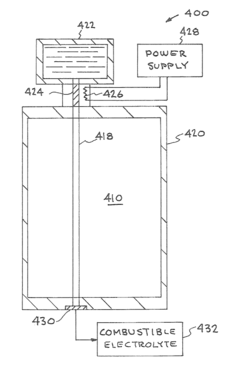
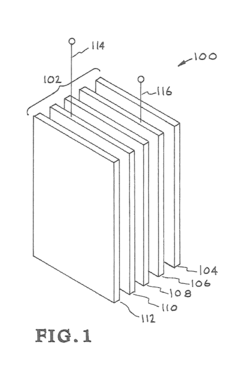
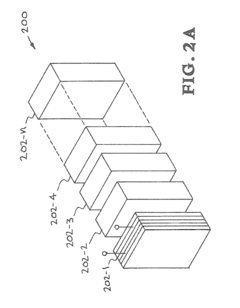
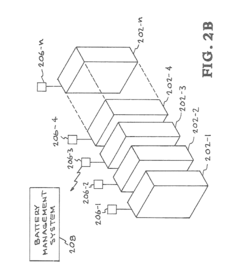
- A thermally integrated fire suppression system with distributed sensors monitoring cell parameters and a liquid-vapor phase change heat removal system using an inert high-pressure refrigerant, such as R125, for rapid quenching during abnormal events, integrated within the battery pack to mitigate thermal runaway and prevent explosions.


Li-ion battery thermal runaway suppression system using microchannel coolers and refrigerant injections
PatentInactiveUS9490507B2
Innovation
- A battery management system with thermally integrated fire suppression, featuring cooling passages between cells, sensors to detect thermal runaway, and a mechanism to inject coolant into these passages to rapidly quench the event, preventing cell-to-cell propagation and mitigating thermal runaway.
Safety Standards and Fire Regulations Compliance
Fire suppression systems designed for thermal runaway mitigation must comply with a complex framework of international and regional safety standards. The International Electrotechnical Commission (IEC) 62619 standard provides fundamental requirements for lithium-ion battery safety, while IEC 62133 addresses cell-level safety considerations. These standards establish baseline requirements for thermal management and fire prevention that directly influence suppression system design parameters.
The National Fire Protection Association (NFPA) has developed several critical standards governing fire suppression in energy storage applications. NFPA 855 specifically addresses stationary energy storage system installations, mandating specific detection and suppression requirements. NFPA 2001 governs clean agent fire extinguishing systems, establishing performance criteria for gaseous suppression agents commonly used in battery applications. These standards require suppression systems to demonstrate effectiveness against Class A fires while maintaining electrical non-conductivity.
Underwriters Laboratories (UL) standards play a crucial role in system certification and market acceptance. UL 9540 provides comprehensive safety requirements for energy storage systems, including fire suppression integration requirements. UL 9540A establishes test methods for evaluating thermal runaway fire propagation, directly impacting suppression system design specifications. Compliance with these standards is often mandatory for insurance coverage and regulatory approval.
Regional regulatory frameworks add additional complexity to compliance requirements. European EN standards, including EN 54 series for fire detection and alarm systems, establish specific performance criteria for suppression system components. The European Battery Regulation introduces new safety requirements that affect suppression system integration approaches. Asian markets follow distinct regulatory pathways, with Chinese GB standards and Japanese JIS requirements creating unique compliance challenges.
Certification processes require extensive testing and documentation to demonstrate compliance across multiple standard frameworks. Third-party testing laboratories must validate suppression system performance under standardized thermal runaway scenarios. Documentation requirements include detailed technical specifications, installation guidelines, and maintenance protocols that ensure continued compliance throughout system lifecycle.
The evolving regulatory landscape presents ongoing challenges for suppression system manufacturers and users. Emerging standards are incorporating lessons learned from real-world thermal runaway incidents, leading to more stringent performance requirements. Harmonization efforts between international standards organizations aim to reduce compliance complexity while maintaining safety effectiveness across global markets.
The National Fire Protection Association (NFPA) has developed several critical standards governing fire suppression in energy storage applications. NFPA 855 specifically addresses stationary energy storage system installations, mandating specific detection and suppression requirements. NFPA 2001 governs clean agent fire extinguishing systems, establishing performance criteria for gaseous suppression agents commonly used in battery applications. These standards require suppression systems to demonstrate effectiveness against Class A fires while maintaining electrical non-conductivity.
Underwriters Laboratories (UL) standards play a crucial role in system certification and market acceptance. UL 9540 provides comprehensive safety requirements for energy storage systems, including fire suppression integration requirements. UL 9540A establishes test methods for evaluating thermal runaway fire propagation, directly impacting suppression system design specifications. Compliance with these standards is often mandatory for insurance coverage and regulatory approval.
Regional regulatory frameworks add additional complexity to compliance requirements. European EN standards, including EN 54 series for fire detection and alarm systems, establish specific performance criteria for suppression system components. The European Battery Regulation introduces new safety requirements that affect suppression system integration approaches. Asian markets follow distinct regulatory pathways, with Chinese GB standards and Japanese JIS requirements creating unique compliance challenges.
Certification processes require extensive testing and documentation to demonstrate compliance across multiple standard frameworks. Third-party testing laboratories must validate suppression system performance under standardized thermal runaway scenarios. Documentation requirements include detailed technical specifications, installation guidelines, and maintenance protocols that ensure continued compliance throughout system lifecycle.
The evolving regulatory landscape presents ongoing challenges for suppression system manufacturers and users. Emerging standards are incorporating lessons learned from real-world thermal runaway incidents, leading to more stringent performance requirements. Harmonization efforts between international standards organizations aim to reduce compliance complexity while maintaining safety effectiveness across global markets.
Environmental Impact of Fire Suppression Agents
The environmental impact of fire suppression agents used in thermal runaway scenarios varies significantly across different chemical compositions and deployment methods. Traditional halogenated agents, while highly effective in suppressing lithium-ion battery fires, present substantial environmental concerns due to their high global warming potential and ozone depletion characteristics. These agents can persist in the atmosphere for decades, contributing to long-term climate change effects that extend far beyond their immediate fire suppression benefits.
Water-based suppression systems demonstrate the most favorable environmental profile, producing minimal direct atmospheric impact and utilizing readily available natural resources. However, the environmental considerations extend beyond the agent itself to include potential contamination of water systems through runoff containing dissolved electrolytes and toxic combustion byproducts from thermal runaway events. The large volumes of water required for effective suppression also raise concerns about resource consumption in water-scarce regions.
Inert gas systems, particularly nitrogen and argon-based solutions, offer environmentally neutral suppression capabilities with no direct atmospheric pollution or chemical residue formation. These systems present minimal ecological risk during deployment and require no specialized disposal procedures post-incident. The primary environmental consideration involves the energy-intensive production and storage processes required for compressed gas systems.
Emerging bio-based and environmentally engineered suppression agents represent a growing focus on sustainable fire protection solutions. These agents incorporate biodegradable components and reduced atmospheric lifetime characteristics while maintaining suppression effectiveness. However, their environmental impact assessment remains limited due to relatively recent market introduction and insufficient long-term ecological studies.
The disposal and cleanup requirements following suppression system activation create additional environmental implications. Chemical suppression agents often require specialized hazardous waste handling procedures, while water-based systems may necessitate extensive contaminated water treatment processes. The cumulative environmental cost includes not only the immediate suppression impact but also the entire lifecycle from production through disposal, making comprehensive environmental assessment essential for informed system selection in thermal runaway applications.
Water-based suppression systems demonstrate the most favorable environmental profile, producing minimal direct atmospheric impact and utilizing readily available natural resources. However, the environmental considerations extend beyond the agent itself to include potential contamination of water systems through runoff containing dissolved electrolytes and toxic combustion byproducts from thermal runaway events. The large volumes of water required for effective suppression also raise concerns about resource consumption in water-scarce regions.
Inert gas systems, particularly nitrogen and argon-based solutions, offer environmentally neutral suppression capabilities with no direct atmospheric pollution or chemical residue formation. These systems present minimal ecological risk during deployment and require no specialized disposal procedures post-incident. The primary environmental consideration involves the energy-intensive production and storage processes required for compressed gas systems.
Emerging bio-based and environmentally engineered suppression agents represent a growing focus on sustainable fire protection solutions. These agents incorporate biodegradable components and reduced atmospheric lifetime characteristics while maintaining suppression effectiveness. However, their environmental impact assessment remains limited due to relatively recent market introduction and insufficient long-term ecological studies.
The disposal and cleanup requirements following suppression system activation create additional environmental implications. Chemical suppression agents often require specialized hazardous waste handling procedures, while water-based systems may necessitate extensive contaminated water treatment processes. The cumulative environmental cost includes not only the immediate suppression impact but also the entire lifecycle from production through disposal, making comprehensive environmental assessment essential for informed system selection in thermal runaway applications.
Unlock deeper insights with PatSnap Eureka Quick Research — get a full tech report to explore trends and direct your research. Try now!
Generate Your Research Report Instantly with AI Agent
Supercharge your innovation with PatSnap Eureka AI Agent Platform!