Comparing Jet Impingement Cooling vs Phase-Change Cooling: Efficiency Breakdown
MAY 5, 20269 MIN READ
Generate Your Research Report Instantly with AI Agent
PatSnap Eureka helps you evaluate technical feasibility & market potential.
Jet Impingement vs Phase-Change Cooling Background and Objectives
The evolution of thermal management technologies has been driven by the relentless pursuit of higher performance in electronic systems, aerospace applications, and industrial processes. As power densities continue to escalate across various sectors, traditional air cooling methods have reached their fundamental limitations, necessitating the development of more sophisticated cooling solutions. This technological imperative has led to the emergence of advanced cooling methodologies, with jet impingement cooling and phase-change cooling representing two distinct yet promising approaches to address contemporary thermal challenges.
Jet impingement cooling technology traces its origins to the mid-20th century, initially developed for gas turbine blade cooling applications in aerospace engines. The fundamental principle involves directing high-velocity fluid jets onto heated surfaces, creating localized regions of enhanced heat transfer through forced convection. Over the decades, this technology has evolved from simple single-jet configurations to complex multi-jet arrays with sophisticated flow control mechanisms, finding applications in electronics cooling, steel processing, and food industry applications.
Phase-change cooling, conversely, leverages the latent heat absorption characteristics of working fluids during phase transitions. This approach encompasses various implementations including heat pipes, vapor chambers, thermosiphons, and immersion cooling systems. The technology gained significant momentum in the 1960s with the development of heat pipes for spacecraft thermal management, subsequently expanding into terrestrial applications as miniaturization demands intensified.
The primary objective of comparing these two cooling paradigms centers on establishing a comprehensive efficiency framework that encompasses thermal performance, energy consumption, system complexity, and operational reliability. This comparative analysis aims to identify the optimal application domains for each technology, considering factors such as heat flux requirements, spatial constraints, maintenance considerations, and economic viability.
Contemporary research objectives focus on quantifying the heat transfer coefficients, pressure drop characteristics, and overall system efficiency under various operating conditions. Understanding the thermal-hydraulic performance trade-offs becomes crucial for system designers seeking to optimize cooling solutions for specific applications. Additionally, the investigation seeks to establish performance boundaries where one technology demonstrates clear advantages over the other.
The comparative study also aims to address scalability considerations, examining how each technology performs across different size scales and power levels. This includes evaluating the potential for hybrid implementations that combine both approaches to maximize thermal management effectiveness while minimizing system complexity and operational costs.
Jet impingement cooling technology traces its origins to the mid-20th century, initially developed for gas turbine blade cooling applications in aerospace engines. The fundamental principle involves directing high-velocity fluid jets onto heated surfaces, creating localized regions of enhanced heat transfer through forced convection. Over the decades, this technology has evolved from simple single-jet configurations to complex multi-jet arrays with sophisticated flow control mechanisms, finding applications in electronics cooling, steel processing, and food industry applications.
Phase-change cooling, conversely, leverages the latent heat absorption characteristics of working fluids during phase transitions. This approach encompasses various implementations including heat pipes, vapor chambers, thermosiphons, and immersion cooling systems. The technology gained significant momentum in the 1960s with the development of heat pipes for spacecraft thermal management, subsequently expanding into terrestrial applications as miniaturization demands intensified.
The primary objective of comparing these two cooling paradigms centers on establishing a comprehensive efficiency framework that encompasses thermal performance, energy consumption, system complexity, and operational reliability. This comparative analysis aims to identify the optimal application domains for each technology, considering factors such as heat flux requirements, spatial constraints, maintenance considerations, and economic viability.
Contemporary research objectives focus on quantifying the heat transfer coefficients, pressure drop characteristics, and overall system efficiency under various operating conditions. Understanding the thermal-hydraulic performance trade-offs becomes crucial for system designers seeking to optimize cooling solutions for specific applications. Additionally, the investigation seeks to establish performance boundaries where one technology demonstrates clear advantages over the other.
The comparative study also aims to address scalability considerations, examining how each technology performs across different size scales and power levels. This includes evaluating the potential for hybrid implementations that combine both approaches to maximize thermal management effectiveness while minimizing system complexity and operational costs.
Market Demand Analysis for Advanced Thermal Management Solutions
The global thermal management market is experiencing unprecedented growth driven by the exponential increase in heat generation across multiple industries. Data centers, which consume substantial energy for cooling operations, represent one of the most significant demand drivers. The proliferation of artificial intelligence, cloud computing, and edge computing has intensified the need for efficient cooling solutions that can handle higher heat flux densities while maintaining operational reliability.
Electric vehicle adoption is creating substantial demand for advanced thermal management systems. Battery thermal management directly impacts vehicle performance, safety, and longevity, making efficient cooling technologies critical for automotive manufacturers. The transition from traditional air cooling to liquid cooling systems in EVs has opened new opportunities for both jet impingement and phase-change cooling technologies.
The electronics industry continues to push miniaturization boundaries while increasing power densities, particularly in high-performance computing, gaming systems, and mobile devices. Traditional cooling methods are reaching their thermal limits, creating market pull for innovative solutions that can deliver superior heat removal capabilities in compact form factors.
Industrial manufacturing sectors, including aerospace, defense, and power generation, require robust thermal management solutions capable of operating under extreme conditions. These applications often demand precise temperature control and high reliability, driving preference for proven cooling technologies with predictable performance characteristics.
Market segmentation analysis reveals distinct preferences across applications. High-performance computing and data centers show growing interest in phase-change cooling due to its superior heat transfer coefficients and ability to maintain uniform temperatures. Conversely, applications requiring precise thermal control and rapid response times demonstrate stronger demand for jet impingement systems.
Geographic demand patterns indicate concentrated growth in regions with significant technology manufacturing and data center development. Asia-Pacific markets show particularly strong demand driven by semiconductor manufacturing expansion and increasing digitalization initiatives.
The market is also responding to sustainability pressures, with organizations seeking cooling solutions that reduce energy consumption and environmental impact. This trend favors technologies that can deliver higher cooling efficiency while minimizing power requirements and refrigerant usage.
Electric vehicle adoption is creating substantial demand for advanced thermal management systems. Battery thermal management directly impacts vehicle performance, safety, and longevity, making efficient cooling technologies critical for automotive manufacturers. The transition from traditional air cooling to liquid cooling systems in EVs has opened new opportunities for both jet impingement and phase-change cooling technologies.
The electronics industry continues to push miniaturization boundaries while increasing power densities, particularly in high-performance computing, gaming systems, and mobile devices. Traditional cooling methods are reaching their thermal limits, creating market pull for innovative solutions that can deliver superior heat removal capabilities in compact form factors.
Industrial manufacturing sectors, including aerospace, defense, and power generation, require robust thermal management solutions capable of operating under extreme conditions. These applications often demand precise temperature control and high reliability, driving preference for proven cooling technologies with predictable performance characteristics.
Market segmentation analysis reveals distinct preferences across applications. High-performance computing and data centers show growing interest in phase-change cooling due to its superior heat transfer coefficients and ability to maintain uniform temperatures. Conversely, applications requiring precise thermal control and rapid response times demonstrate stronger demand for jet impingement systems.
Geographic demand patterns indicate concentrated growth in regions with significant technology manufacturing and data center development. Asia-Pacific markets show particularly strong demand driven by semiconductor manufacturing expansion and increasing digitalization initiatives.
The market is also responding to sustainability pressures, with organizations seeking cooling solutions that reduce energy consumption and environmental impact. This trend favors technologies that can deliver higher cooling efficiency while minimizing power requirements and refrigerant usage.
Current Status and Challenges in High-Performance Cooling Technologies
High-performance cooling technologies have reached a critical juncture where traditional air-cooling solutions are increasingly inadequate for modern thermal management demands. The exponential growth in power densities across electronics, data centers, and industrial applications has created an urgent need for more efficient cooling methodologies. Current market leaders are gravitating toward two primary advanced cooling approaches: jet impingement cooling and phase-change cooling systems.
Jet impingement cooling technology has matured significantly over the past decade, with commercial implementations achieving heat transfer coefficients ranging from 10,000 to 50,000 W/m²K. Major technology providers including IBM, Intel, and specialized thermal management companies have developed sophisticated jet array configurations optimized for specific applications. However, the technology faces substantial challenges in pump power consumption, which can account for 15-25% of total system energy usage, and complex fluid distribution requirements that increase manufacturing costs.
Phase-change cooling represents a paradigm shift toward leveraging latent heat properties for thermal management. Current implementations span from traditional heat pipes to advanced two-phase immersion cooling systems. Companies like 3M, Novec, and emerging startups have developed dielectric fluids specifically engineered for electronics cooling applications. The technology demonstrates exceptional heat transfer capabilities, with some configurations achieving effective thermal conductivities exceeding 100,000 W/m²K equivalent performance.
The primary technical challenges constraining widespread adoption include fluid compatibility issues, long-term reliability concerns, and complex system integration requirements. Phase-change systems struggle with vapor management, condensation control, and maintaining optimal fluid inventory across varying thermal loads. Additionally, the initial capital investment for phase-change infrastructure typically exceeds conventional cooling solutions by 200-400%.
Geographical distribution of cooling technology development shows concentrated innovation clusters in North America, particularly Silicon Valley and Research Triangle, alongside significant European contributions from Germany and Switzerland. Asian markets, led by Taiwan, South Korea, and Japan, focus primarily on manufacturing optimization and cost reduction strategies.
Current market penetration remains limited, with jet impingement cooling capturing approximately 8% of high-performance cooling applications, while phase-change cooling holds roughly 12% market share. The remaining market continues relying on traditional air and liquid cooling solutions, indicating substantial growth potential for advanced cooling technologies as thermal requirements continue escalating across multiple industries.
Jet impingement cooling technology has matured significantly over the past decade, with commercial implementations achieving heat transfer coefficients ranging from 10,000 to 50,000 W/m²K. Major technology providers including IBM, Intel, and specialized thermal management companies have developed sophisticated jet array configurations optimized for specific applications. However, the technology faces substantial challenges in pump power consumption, which can account for 15-25% of total system energy usage, and complex fluid distribution requirements that increase manufacturing costs.
Phase-change cooling represents a paradigm shift toward leveraging latent heat properties for thermal management. Current implementations span from traditional heat pipes to advanced two-phase immersion cooling systems. Companies like 3M, Novec, and emerging startups have developed dielectric fluids specifically engineered for electronics cooling applications. The technology demonstrates exceptional heat transfer capabilities, with some configurations achieving effective thermal conductivities exceeding 100,000 W/m²K equivalent performance.
The primary technical challenges constraining widespread adoption include fluid compatibility issues, long-term reliability concerns, and complex system integration requirements. Phase-change systems struggle with vapor management, condensation control, and maintaining optimal fluid inventory across varying thermal loads. Additionally, the initial capital investment for phase-change infrastructure typically exceeds conventional cooling solutions by 200-400%.
Geographical distribution of cooling technology development shows concentrated innovation clusters in North America, particularly Silicon Valley and Research Triangle, alongside significant European contributions from Germany and Switzerland. Asian markets, led by Taiwan, South Korea, and Japan, focus primarily on manufacturing optimization and cost reduction strategies.
Current market penetration remains limited, with jet impingement cooling capturing approximately 8% of high-performance cooling applications, while phase-change cooling holds roughly 12% market share. The remaining market continues relying on traditional air and liquid cooling solutions, indicating substantial growth potential for advanced cooling technologies as thermal requirements continue escalating across multiple industries.
Current Technical Solutions for Jet and Phase-Change Cooling
01 Jet impingement cooling systems for electronic components
Jet impingement cooling utilizes directed fluid jets to enhance heat transfer from electronic components and high-power devices. This method provides efficient thermal management by creating high convective heat transfer coefficients through direct fluid contact with heated surfaces. The technique is particularly effective for cooling processors, power electronics, and other components that generate significant heat loads.- Jet impingement cooling systems with enhanced heat transfer mechanisms: Advanced jet impingement cooling systems utilize optimized nozzle configurations and flow patterns to maximize heat transfer efficiency. These systems employ strategic jet positioning, variable flow rates, and specialized surface treatments to enhance convective heat transfer. The cooling effectiveness is improved through controlled jet velocity, optimal spacing between jets, and targeted impingement angles that create turbulent flow patterns for superior thermal management.
- Phase-change cooling with integrated heat sink designs: Phase-change cooling systems incorporate specialized heat sink architectures that leverage latent heat absorption during liquid-to-vapor transitions. These designs feature optimized vapor chambers, micro-channel structures, and enhanced surface area configurations to facilitate efficient phase transitions. The cooling efficiency is maximized through controlled evaporation and condensation processes, enabling superior thermal dissipation compared to traditional single-phase cooling methods.
- Hybrid cooling systems combining jet impingement and phase-change technologies: Integrated cooling solutions combine jet impingement and phase-change mechanisms to achieve enhanced thermal performance. These hybrid systems utilize liquid jet impingement to initiate rapid heat removal while simultaneously employing phase-change materials for sustained cooling capacity. The synergistic effect of both technologies provides improved temperature control, reduced thermal resistance, and enhanced cooling uniformity across heated surfaces.
- Micro-scale cooling structures for enhanced heat transfer efficiency: Micro-scale cooling architectures feature miniaturized jet arrays and micro-channel networks designed for high-density heat removal applications. These systems incorporate precision-engineered micro-nozzles, micro-fins, and structured surfaces that maximize heat transfer coefficients through increased surface area and enhanced fluid mixing. The compact designs enable efficient cooling in space-constrained applications while maintaining superior thermal performance.
- Advanced cooling fluid management and optimization techniques: Sophisticated fluid management systems optimize coolant flow distribution, pressure regulation, and thermal properties to maximize cooling efficiency. These techniques include dynamic flow control, multi-phase fluid optimization, and advanced coolant formulations that enhance heat transfer capabilities. The systems feature intelligent flow routing, pressure drop minimization, and thermal property enhancement to achieve optimal cooling performance across varying operational conditions.
02 Phase-change materials for thermal management
Phase-change cooling systems leverage the latent heat of vaporization or melting to absorb large amounts of thermal energy during phase transitions. These systems provide highly efficient heat removal by utilizing the energy required for phase changes, offering superior cooling performance compared to single-phase systems. The approach is commonly implemented in heat pipes, vapor chambers, and immersion cooling applications.Expand Specific Solutions03 Hybrid cooling systems combining jet impingement and phase-change
Advanced cooling architectures integrate both jet impingement and phase-change mechanisms to maximize heat transfer efficiency. These hybrid systems combine the high local heat transfer rates of impinging jets with the high heat capacity of phase-change processes. The integration allows for optimized thermal management across varying heat loads and operating conditions.Expand Specific Solutions04 Microchannel and microjet cooling technologies
Microscale jet impingement and phase-change cooling systems utilize miniaturized channels and nozzles to enhance heat transfer in compact spaces. These technologies enable precise thermal control in applications with space constraints while maintaining high cooling efficiency. The microscale approach allows for integration into semiconductor devices and miniaturized electronic systems.Expand Specific Solutions05 Optimization of cooling system design and performance
Advanced design methodologies focus on optimizing jet configurations, flow patterns, and phase-change material selection to maximize cooling efficiency. These approaches involve computational modeling, experimental validation, and performance enhancement techniques to achieve optimal heat transfer rates. Design considerations include nozzle geometry, fluid properties, surface modifications, and system integration aspects.Expand Specific Solutions
Major Players in Advanced Cooling Technology Market
The jet impingement versus phase-change cooling technology landscape represents a mature but rapidly evolving market driven by increasing thermal management demands in high-performance electronics and automotive applications. The industry is experiencing significant growth, with market expansion fueled by semiconductor miniaturization and electric vehicle adoption. Technology maturity varies considerably across players, with established corporations like Intel Corp., NEC Corp., and Sony Group Corp. leveraging advanced manufacturing capabilities, while specialized firms like JETCOOL Technologies focus on innovative microjet solutions. Automotive leaders including Toyota Motor Corp., BMW, and Hyundai Motor Co. are integrating these cooling technologies for electric powertrains. Research institutions such as Purdue Research Foundation, Shanghai Jiao Tong University, and Colorado State University continue advancing fundamental cooling mechanisms. The competitive landscape shows a convergence of semiconductor manufacturers, automotive OEMs, and specialized cooling technology developers, indicating strong cross-industry collaboration and technology transfer opportunities in this high-growth thermal management sector.
JETCOOL Technologies, Inc.
Technical Solution: JETCOOL specializes in direct liquid cooling solutions using microjet impingement technology for high-performance computing and data center applications. Their patented microconvective cooling technology creates thousands of microscale jets that directly impinge on hot surfaces, achieving thermal resistance as low as 0.01°C/W. The system operates with dielectric fluids and can handle heat fluxes exceeding 1000 W/cm². Their technology enables significant reduction in cooling energy consumption compared to traditional air cooling while maintaining precise temperature control across chip surfaces.
Strengths: Extremely high heat transfer coefficients, direct cooling capability, low thermal resistance. Weaknesses: Complex fluid management systems, potential for clogging in microchannels, higher initial investment costs.
Intel Corp.
Technical Solution: Intel has developed advanced thermal management solutions combining both jet impingement and phase-change cooling technologies for their high-performance processors. Their approach includes integrated vapor chambers with microjet arrays that provide localized cooling for hotspots while utilizing phase-change materials for thermal buffering. The system achieves junction-to-ambient thermal resistance below 0.1°C/W and can manage power densities up to 500 W/cm². Intel's solution integrates seamlessly with their packaging technology and provides real-time thermal monitoring and control capabilities for optimal performance under varying workloads.
Strengths: Integrated design with processors, proven reliability, scalable architecture. Weaknesses: Limited to specific Intel platforms, complex manufacturing requirements, higher cost per unit.
Core Technologies in Jet Impingement and Phase-Change Systems
Two-phase jet impingement cooling devices and electronic device assemblies incorporating the same
PatentActiveUS20170094837A1
Innovation
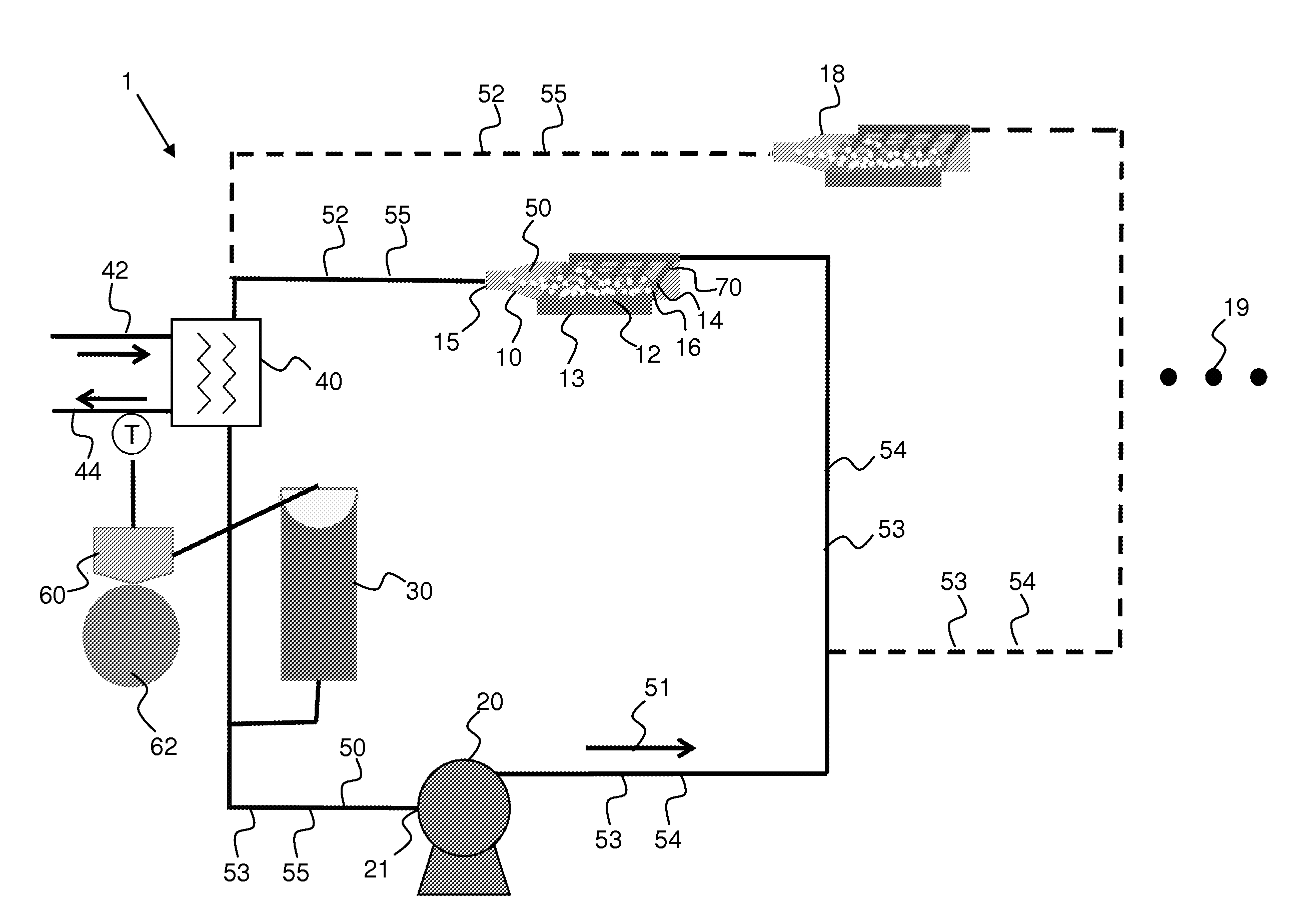
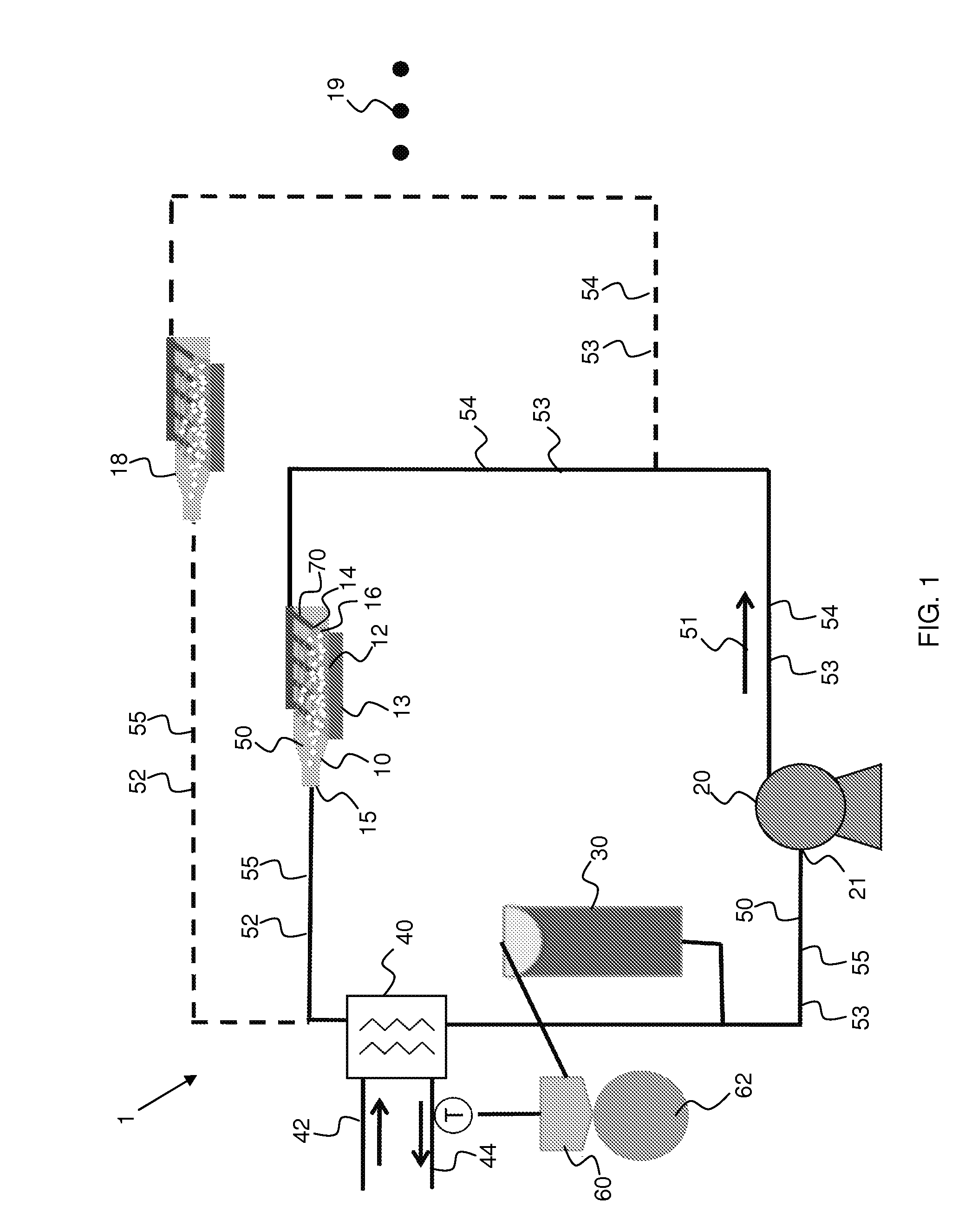
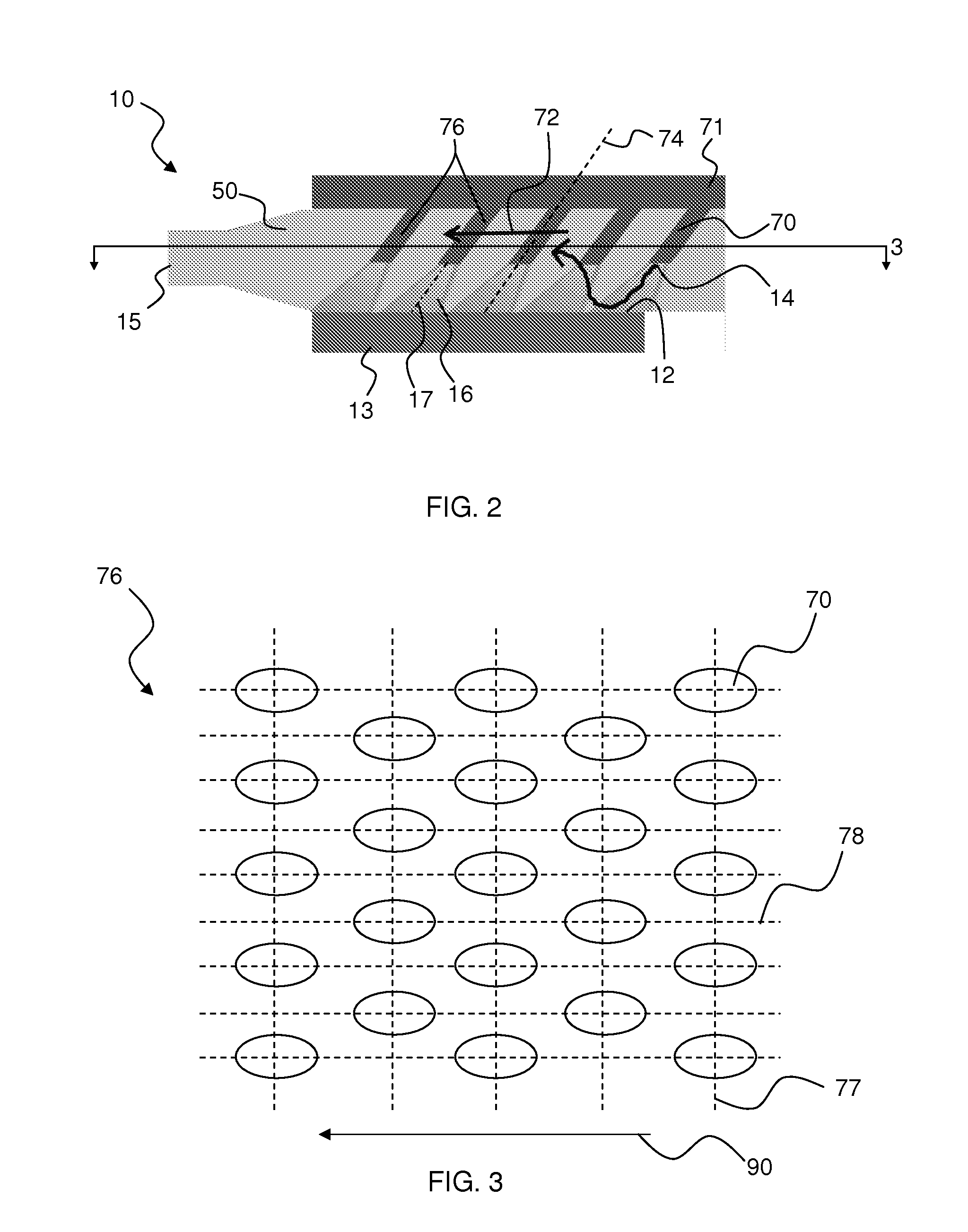
- The cooling device features a manifold with symmetrical jet regions and surface features that optimize fluid flow through jet orifices, combined with heat sinks that promote phase change of the cooling fluid from liquid to vapor, including porous surfaces to enhance nucleation, ensuring uniform fluid distribution and efficient heat transfer.


High efficiency thermal management system
PatentInactiveUS20120325436A1
Innovation
- A two-phase, direct impingement cooling system using a chamber with non-perpendicularly angled tubular nozzles to project coolant streams against the surface, allowing for efficient heat transfer and phase change without the need for thermal interface materials, and automatically managing hot spots through evaporation.

Energy Efficiency Standards and Environmental Regulations
The regulatory landscape for thermal management systems is increasingly shaped by stringent energy efficiency standards that directly impact the adoption of jet impingement and phase-change cooling technologies. The European Union's Ecodesign Directive sets mandatory efficiency thresholds for industrial cooling systems, requiring minimum coefficient of performance (COP) values that favor advanced cooling solutions. Similarly, the U.S. Department of Energy's Federal Energy Management Program establishes baseline efficiency requirements that push organizations toward more sophisticated thermal management approaches.
Energy efficiency standards typically evaluate cooling systems based on their power usage effectiveness (PUE) and total energy consumption per unit of heat removal. Phase-change cooling systems often demonstrate superior performance under these metrics due to their inherent thermodynamic advantages, achieving PUE ratios as low as 1.05 compared to traditional systems. Jet impingement cooling, while highly effective for localized applications, faces challenges meeting broad efficiency mandates when scaled to facility-level implementations.
Environmental regulations are becoming increasingly restrictive regarding refrigerant usage and greenhouse gas emissions from cooling systems. The Montreal Protocol's Kigali Amendment phases down hydrofluorocarbon (HFC) refrigerants, creating pressure for cooling technologies to adopt natural refrigerants or eliminate them entirely. Phase-change cooling systems using water or other environmentally benign working fluids align well with these regulatory trends, while jet impingement systems may require additional compliance measures depending on their implementation.
Carbon footprint regulations, particularly in jurisdictions with carbon pricing mechanisms, create economic incentives for deploying the most energy-efficient cooling solutions. The European Union Emissions Trading System and similar programs in California and other regions effectively penalize energy-intensive cooling approaches. This regulatory framework increasingly favors phase-change cooling systems that can demonstrate lower lifetime carbon emissions, even when initial capital costs may be higher than conventional jet impingement solutions.
Emerging regulations also address noise pollution and workplace safety standards, areas where both cooling technologies must demonstrate compliance. Phase-change systems typically operate with lower noise levels due to reduced fan requirements, while jet impingement systems may require additional acoustic mitigation measures to meet occupational health standards in industrial environments.
Energy efficiency standards typically evaluate cooling systems based on their power usage effectiveness (PUE) and total energy consumption per unit of heat removal. Phase-change cooling systems often demonstrate superior performance under these metrics due to their inherent thermodynamic advantages, achieving PUE ratios as low as 1.05 compared to traditional systems. Jet impingement cooling, while highly effective for localized applications, faces challenges meeting broad efficiency mandates when scaled to facility-level implementations.
Environmental regulations are becoming increasingly restrictive regarding refrigerant usage and greenhouse gas emissions from cooling systems. The Montreal Protocol's Kigali Amendment phases down hydrofluorocarbon (HFC) refrigerants, creating pressure for cooling technologies to adopt natural refrigerants or eliminate them entirely. Phase-change cooling systems using water or other environmentally benign working fluids align well with these regulatory trends, while jet impingement systems may require additional compliance measures depending on their implementation.
Carbon footprint regulations, particularly in jurisdictions with carbon pricing mechanisms, create economic incentives for deploying the most energy-efficient cooling solutions. The European Union Emissions Trading System and similar programs in California and other regions effectively penalize energy-intensive cooling approaches. This regulatory framework increasingly favors phase-change cooling systems that can demonstrate lower lifetime carbon emissions, even when initial capital costs may be higher than conventional jet impingement solutions.
Emerging regulations also address noise pollution and workplace safety standards, areas where both cooling technologies must demonstrate compliance. Phase-change systems typically operate with lower noise levels due to reduced fan requirements, while jet impingement systems may require additional acoustic mitigation measures to meet occupational health standards in industrial environments.
Cost-Performance Trade-offs in Cooling System Selection
The selection of cooling systems involves a complex balance between initial capital expenditure and long-term operational efficiency. Jet impingement cooling systems typically require lower upfront investment due to their simpler mechanical design and established manufacturing processes. The primary components include pumps, nozzles, and distribution manifolds, which are readily available and cost-effective to produce. However, the operational costs can be substantial due to continuous pumping power requirements and potential pressure losses across the system.
Phase-change cooling systems present a contrasting cost structure with higher initial capital requirements. The sophisticated heat exchangers, specialized working fluids, and precise control systems contribute to elevated procurement costs. Advanced materials capable of withstanding thermal cycling and corrosion resistance further increase the initial investment. Despite these higher upfront costs, phase-change systems often demonstrate superior long-term economic viability through reduced energy consumption and maintenance requirements.
Performance metrics reveal significant disparities in cooling effectiveness per unit cost. Jet impingement systems achieve heat transfer coefficients ranging from 500 to 2000 W/m²K, depending on jet velocity and spacing configuration. The cost per unit of heat removal typically ranges from $0.15 to $0.25 per watt of cooling capacity. Maintenance costs remain moderate due to the absence of complex phase-change mechanisms, though nozzle cleaning and pump servicing are recurring expenses.
Phase-change cooling systems demonstrate exceptional performance density, achieving heat transfer rates exceeding 10,000 W/m²K in optimized configurations. The cost per unit of cooling capacity ranges from $0.30 to $0.50 initially, but operational efficiency gains can reduce the effective cost to $0.10 to $0.20 per watt over the system lifecycle. The enhanced thermal management capability enables higher power density applications, potentially reducing overall system footprint and associated infrastructure costs.
Total cost of ownership analysis reveals that phase-change systems become economically advantageous in high-performance applications where cooling efficiency directly impacts operational revenue. For moderate cooling requirements with budget constraints, jet impingement systems offer acceptable performance at lower investment thresholds.
Phase-change cooling systems present a contrasting cost structure with higher initial capital requirements. The sophisticated heat exchangers, specialized working fluids, and precise control systems contribute to elevated procurement costs. Advanced materials capable of withstanding thermal cycling and corrosion resistance further increase the initial investment. Despite these higher upfront costs, phase-change systems often demonstrate superior long-term economic viability through reduced energy consumption and maintenance requirements.
Performance metrics reveal significant disparities in cooling effectiveness per unit cost. Jet impingement systems achieve heat transfer coefficients ranging from 500 to 2000 W/m²K, depending on jet velocity and spacing configuration. The cost per unit of heat removal typically ranges from $0.15 to $0.25 per watt of cooling capacity. Maintenance costs remain moderate due to the absence of complex phase-change mechanisms, though nozzle cleaning and pump servicing are recurring expenses.
Phase-change cooling systems demonstrate exceptional performance density, achieving heat transfer rates exceeding 10,000 W/m²K in optimized configurations. The cost per unit of cooling capacity ranges from $0.30 to $0.50 initially, but operational efficiency gains can reduce the effective cost to $0.10 to $0.20 per watt over the system lifecycle. The enhanced thermal management capability enables higher power density applications, potentially reducing overall system footprint and associated infrastructure costs.
Total cost of ownership analysis reveals that phase-change systems become economically advantageous in high-performance applications where cooling efficiency directly impacts operational revenue. For moderate cooling requirements with budget constraints, jet impingement systems offer acceptable performance at lower investment thresholds.
Unlock deeper insights with PatSnap Eureka Quick Research — get a full tech report to explore trends and direct your research. Try now!
Generate Your Research Report Instantly with AI Agent
Supercharge your innovation with PatSnap Eureka AI Agent Platform!