Comparing Polymer Vs Glass-Based Thermal Metamaterials
APR 29, 20269 MIN READ
Generate Your Research Report Instantly with AI Agent
PatSnap Eureka helps you evaluate technical feasibility & market potential.
Thermal Metamaterials Background and Research Objectives
Thermal metamaterials represent a revolutionary class of artificially engineered materials designed to manipulate heat flow in ways that exceed the capabilities of conventional materials. These structures derive their extraordinary thermal properties not from their constituent materials alone, but from their precisely designed geometric architectures at scales smaller than the characteristic thermal diffusion length. The field emerged from the broader metamaterials concept, initially developed for electromagnetic applications, and has rapidly evolved to address critical thermal management challenges across multiple industries.
The fundamental principle underlying thermal metamaterials lies in their ability to control phonon transport through structural design rather than relying solely on material composition. By creating periodic or aperiodic arrangements of different materials with contrasting thermal properties, these metamaterials can achieve unprecedented thermal functionalities including thermal cloaking, focusing, and negative thermal expansion. This approach opens new possibilities for thermal management that were previously considered impossible within the constraints of natural materials.
Among the various material platforms available for thermal metamaterial construction, polymers and glass-based systems have emerged as two dominant approaches, each offering distinct advantages and limitations. Polymer-based thermal metamaterials leverage the inherently low thermal conductivity of most polymeric materials, excellent processability, and design flexibility. These materials can be easily fabricated using additive manufacturing techniques, allowing for complex three-dimensional architectures with precise control over feature sizes and material distribution.
Glass-based thermal metamaterials, conversely, exploit the unique thermal properties of various glass compositions and their ability to be processed into intricate structures through advanced manufacturing techniques. Glass materials offer superior thermal stability, chemical inertness, and the potential for achieving extreme thermal property contrasts when combined with other materials. The optical transparency of many glass systems also enables additional functionalities in applications requiring both thermal and optical management.
The primary research objectives in comparing these two material platforms focus on establishing comprehensive performance benchmarks across multiple criteria. Key objectives include quantifying the thermal manipulation efficiency of polymer versus glass-based designs under identical geometric configurations, evaluating the manufacturing scalability and cost-effectiveness of each approach, and assessing long-term stability under various environmental conditions.
Additionally, research aims to identify optimal application domains for each material system, considering factors such as operating temperature ranges, mechanical requirements, and integration constraints. Understanding the fundamental limits and trade-offs inherent to each platform will enable informed material selection for specific thermal metamaterial applications and guide future development efforts toward hybrid approaches that combine the strengths of both systems.
The fundamental principle underlying thermal metamaterials lies in their ability to control phonon transport through structural design rather than relying solely on material composition. By creating periodic or aperiodic arrangements of different materials with contrasting thermal properties, these metamaterials can achieve unprecedented thermal functionalities including thermal cloaking, focusing, and negative thermal expansion. This approach opens new possibilities for thermal management that were previously considered impossible within the constraints of natural materials.
Among the various material platforms available for thermal metamaterial construction, polymers and glass-based systems have emerged as two dominant approaches, each offering distinct advantages and limitations. Polymer-based thermal metamaterials leverage the inherently low thermal conductivity of most polymeric materials, excellent processability, and design flexibility. These materials can be easily fabricated using additive manufacturing techniques, allowing for complex three-dimensional architectures with precise control over feature sizes and material distribution.
Glass-based thermal metamaterials, conversely, exploit the unique thermal properties of various glass compositions and their ability to be processed into intricate structures through advanced manufacturing techniques. Glass materials offer superior thermal stability, chemical inertness, and the potential for achieving extreme thermal property contrasts when combined with other materials. The optical transparency of many glass systems also enables additional functionalities in applications requiring both thermal and optical management.
The primary research objectives in comparing these two material platforms focus on establishing comprehensive performance benchmarks across multiple criteria. Key objectives include quantifying the thermal manipulation efficiency of polymer versus glass-based designs under identical geometric configurations, evaluating the manufacturing scalability and cost-effectiveness of each approach, and assessing long-term stability under various environmental conditions.
Additionally, research aims to identify optimal application domains for each material system, considering factors such as operating temperature ranges, mechanical requirements, and integration constraints. Understanding the fundamental limits and trade-offs inherent to each platform will enable informed material selection for specific thermal metamaterial applications and guide future development efforts toward hybrid approaches that combine the strengths of both systems.
Market Demand for Advanced Thermal Management Solutions
The global thermal management market is experiencing unprecedented growth driven by the increasing demand for efficient heat dissipation solutions across multiple industries. Electronic devices are becoming more compact and powerful, generating higher heat densities that require advanced thermal management technologies. Traditional cooling methods are reaching their performance limits, creating substantial market opportunities for innovative thermal metamaterials.
Data centers represent one of the most significant market segments, as they consume enormous amounts of energy for cooling operations. The proliferation of cloud computing, artificial intelligence, and big data analytics has intensified the need for more efficient thermal management solutions. Polymer-based thermal metamaterials offer lightweight and flexible alternatives, while glass-based solutions provide superior thermal conductivity and durability for high-temperature applications.
The automotive industry is undergoing a transformation with the rapid adoption of electric vehicles and advanced driver assistance systems. These technologies generate substantial heat loads that must be managed effectively to ensure optimal performance and safety. Battery thermal management systems particularly require materials that can provide both thermal conductivity and electrical isolation, making both polymer and glass-based metamaterials attractive options for different applications.
Consumer electronics manufacturers face constant pressure to develop thinner, lighter, and more powerful devices while maintaining acceptable operating temperatures. Smartphones, laptops, and wearable devices require thermal management solutions that can be integrated seamlessly into compact form factors. The flexibility of polymer-based metamaterials makes them particularly suitable for curved surfaces and flexible electronics, while glass-based materials excel in applications requiring high thermal performance.
Industrial applications including aerospace, defense, and manufacturing equipment present additional market opportunities. These sectors often require thermal management solutions that can operate under extreme conditions while maintaining long-term reliability. Glass-based thermal metamaterials typically offer superior performance in high-temperature environments, while polymer-based solutions provide advantages in weight-sensitive applications.
The renewable energy sector, particularly solar panel manufacturing and energy storage systems, represents an emerging market segment. Efficient thermal management is crucial for maximizing energy conversion efficiency and extending equipment lifespan, driving demand for advanced metamaterial solutions tailored to specific operating conditions and performance requirements.
Data centers represent one of the most significant market segments, as they consume enormous amounts of energy for cooling operations. The proliferation of cloud computing, artificial intelligence, and big data analytics has intensified the need for more efficient thermal management solutions. Polymer-based thermal metamaterials offer lightweight and flexible alternatives, while glass-based solutions provide superior thermal conductivity and durability for high-temperature applications.
The automotive industry is undergoing a transformation with the rapid adoption of electric vehicles and advanced driver assistance systems. These technologies generate substantial heat loads that must be managed effectively to ensure optimal performance and safety. Battery thermal management systems particularly require materials that can provide both thermal conductivity and electrical isolation, making both polymer and glass-based metamaterials attractive options for different applications.
Consumer electronics manufacturers face constant pressure to develop thinner, lighter, and more powerful devices while maintaining acceptable operating temperatures. Smartphones, laptops, and wearable devices require thermal management solutions that can be integrated seamlessly into compact form factors. The flexibility of polymer-based metamaterials makes them particularly suitable for curved surfaces and flexible electronics, while glass-based materials excel in applications requiring high thermal performance.
Industrial applications including aerospace, defense, and manufacturing equipment present additional market opportunities. These sectors often require thermal management solutions that can operate under extreme conditions while maintaining long-term reliability. Glass-based thermal metamaterials typically offer superior performance in high-temperature environments, while polymer-based solutions provide advantages in weight-sensitive applications.
The renewable energy sector, particularly solar panel manufacturing and energy storage systems, represents an emerging market segment. Efficient thermal management is crucial for maximizing energy conversion efficiency and extending equipment lifespan, driving demand for advanced metamaterial solutions tailored to specific operating conditions and performance requirements.
Current State of Polymer vs Glass Thermal Metamaterials
Polymer-based thermal metamaterials have emerged as a promising alternative to traditional glass-based systems, driven by advances in additive manufacturing and polymer chemistry. Current polymer solutions primarily utilize thermoplastics such as polylactic acid (PLA), acrylonitrile butadiene styrene (ABS), and specialized engineering polymers like polyetherimide (PEI). These materials enable complex geometric structures with thermal conductivities ranging from 0.1 to 0.5 W/mK, significantly lower than conventional materials.
Glass-based thermal metamaterials continue to dominate high-temperature applications, leveraging silicate glass compositions with thermal conductivities between 1.0 to 1.4 W/mK. Recent developments in glass processing have enabled the creation of micro-structured glass arrays and photonic crystal configurations that demonstrate superior thermal management capabilities at temperatures exceeding 500°C.
Manufacturing scalability represents a critical differentiator between these approaches. Polymer-based systems benefit from established injection molding and 3D printing technologies, enabling rapid prototyping and cost-effective mass production. Current production costs for polymer thermal metamaterials range from $50-200 per cubic meter, depending on complexity and material specifications.
Glass-based manufacturing relies on precision molding, etching, and laser processing techniques that require specialized equipment and controlled environments. Production costs typically range from $300-800 per cubic meter, reflecting the higher processing temperatures and precision requirements inherent in glass fabrication.
Performance characteristics reveal distinct operational domains for each material class. Polymer systems excel in low-to-moderate temperature applications below 200°C, offering excellent design flexibility and mechanical durability. Their lower thermal conductivity enables effective thermal insulation and controlled heat distribution in electronic cooling applications.
Glass-based metamaterials demonstrate superior performance in high-temperature environments, maintaining structural integrity and thermal properties at temperatures up to 800°C. Their higher thermal conductivity and optical transparency make them particularly suitable for concentrated solar power systems and high-performance heat exchangers.
Current research focuses on hybrid approaches that combine polymer and glass components to optimize performance across broader temperature ranges. These composite structures leverage polymer flexibility for mechanical compliance while utilizing glass components for high-temperature stability, representing a significant advancement in thermal metamaterial design philosophy.
Glass-based thermal metamaterials continue to dominate high-temperature applications, leveraging silicate glass compositions with thermal conductivities between 1.0 to 1.4 W/mK. Recent developments in glass processing have enabled the creation of micro-structured glass arrays and photonic crystal configurations that demonstrate superior thermal management capabilities at temperatures exceeding 500°C.
Manufacturing scalability represents a critical differentiator between these approaches. Polymer-based systems benefit from established injection molding and 3D printing technologies, enabling rapid prototyping and cost-effective mass production. Current production costs for polymer thermal metamaterials range from $50-200 per cubic meter, depending on complexity and material specifications.
Glass-based manufacturing relies on precision molding, etching, and laser processing techniques that require specialized equipment and controlled environments. Production costs typically range from $300-800 per cubic meter, reflecting the higher processing temperatures and precision requirements inherent in glass fabrication.
Performance characteristics reveal distinct operational domains for each material class. Polymer systems excel in low-to-moderate temperature applications below 200°C, offering excellent design flexibility and mechanical durability. Their lower thermal conductivity enables effective thermal insulation and controlled heat distribution in electronic cooling applications.
Glass-based metamaterials demonstrate superior performance in high-temperature environments, maintaining structural integrity and thermal properties at temperatures up to 800°C. Their higher thermal conductivity and optical transparency make them particularly suitable for concentrated solar power systems and high-performance heat exchangers.
Current research focuses on hybrid approaches that combine polymer and glass components to optimize performance across broader temperature ranges. These composite structures leverage polymer flexibility for mechanical compliance while utilizing glass components for high-temperature stability, representing a significant advancement in thermal metamaterial design philosophy.
Existing Polymer and Glass-Based Thermal Solutions
01 Thermal cloaking and invisibility structures
Metamaterials designed to manipulate thermal fields by creating regions that are thermally invisible or cloaked from detection. These structures use engineered material properties to redirect heat flow around objects, making them undetectable in thermal imaging or creating thermal camouflage effects. The metamaterials achieve this through carefully designed geometric patterns and material compositions that control thermal conductivity paths.- Thermal cloaking and invisibility structures: Metamaterial structures designed to manipulate thermal fields and create thermal cloaking effects. These structures can redirect heat flow around objects, making them thermally invisible or creating regions with controlled temperature distributions. The designs typically involve carefully engineered geometric patterns and material arrangements that control thermal conductivity paths.
- Thermal management and heat dissipation systems: Metamaterial-based thermal management solutions for electronic devices and systems requiring efficient heat dissipation. These structures utilize engineered thermal properties to enhance heat transfer, improve cooling efficiency, and manage thermal gradients in various applications including electronics packaging and thermal interface materials.
- Thermal insulation and barrier applications: Metamaterial designs focused on thermal insulation and creating thermal barriers with enhanced performance compared to conventional materials. These structures can provide superior insulation properties, selective thermal transmission, or adaptive thermal resistance based on environmental conditions.
- Thermal energy harvesting and conversion: Metamaterial structures designed for thermal energy harvesting, conversion, and management applications. These systems can enhance thermoelectric effects, improve thermal-to-electrical energy conversion efficiency, or create structures that manipulate thermal radiation for energy applications.
- Thermal sensing and measurement devices: Metamaterial-enhanced thermal sensing systems and measurement devices with improved sensitivity, selectivity, or response characteristics. These structures can amplify thermal signals, provide enhanced thermal detection capabilities, or create thermal sensors with novel functionalities for various monitoring and measurement applications.
02 Thermal conductivity control and management
Metamaterial structures that enable precise control over thermal conductivity properties, allowing for enhanced heat dissipation or thermal insulation. These materials can be engineered to have anisotropic thermal properties, directing heat flow in specific directions or creating thermal barriers. Applications include thermal management in electronic devices and building materials with superior insulation properties.Expand Specific Solutions03 Phononic thermal metamaterials
Metamaterials that manipulate phonon propagation to control thermal transport at the microscale. These structures create phononic bandgaps or modify phonon scattering mechanisms to achieve desired thermal properties. The designs often incorporate periodic structures or engineered interfaces that interact with phonons responsible for heat conduction in materials.Expand Specific Solutions04 Thermal energy harvesting and conversion
Metamaterial designs focused on capturing and converting thermal energy into other forms of energy or enhancing thermoelectric effects. These structures optimize thermal gradients and heat flow patterns to improve energy conversion efficiency. The metamaterials may incorporate thermoelectric materials or create enhanced thermal interfaces for better energy harvesting performance.Expand Specific Solutions05 Thermal wave manipulation and focusing
Metamaterials capable of controlling thermal wave propagation, including focusing, steering, or amplifying thermal signals. These structures can create thermal lenses, concentrators, or waveguides that direct heat flow in predetermined patterns. The technology enables applications in thermal imaging enhancement, heat concentration for industrial processes, and thermal signal processing.Expand Specific Solutions
Key Players in Thermal Metamaterial Industry
The thermal metamaterials sector comparing polymer versus glass-based approaches represents an emerging technology field in its early development stage, characterized by significant research activity but limited commercial deployment. The market remains nascent with substantial growth potential as applications in thermal management, energy efficiency, and advanced manufacturing expand. Technology maturity varies considerably across the competitive landscape, with established chemical giants like Dow Global Technologies, Wacker Chemie AG, and SABIC Global Technologies leveraging their polymer expertise, while specialty materials companies such as Victrex Manufacturing and Arkema France focus on high-performance applications. Research institutions including University of Nottingham, Shanghai Jiao Tong University, and Sichuan University drive fundamental innovations, particularly in glass-based metamaterial structures. Industrial players like 3M Innovative Properties and Henkel AG contribute manufacturing scalability, while emerging companies like Carbodeon explore nanomaterial integration. The competitive dynamics suggest a fragmented ecosystem where polymer-based solutions currently demonstrate greater manufacturing readiness, though glass-based approaches show superior thermal properties, indicating parallel development trajectories serving different application segments.
Dow Global Technologies LLC
Technical Solution: Dow has pioneered silicone-based thermal metamaterials that bridge polymer and glass characteristics. Their SYLGARD series incorporates thermally conductive fillers within silicone matrices, achieving thermal conductivities up to 3.0 W/mK while maintaining polymer-like flexibility. The company's approach utilizes controlled cross-linking chemistry to create three-dimensional thermal networks. Their materials exhibit excellent thermal stability up to 250°C and demonstrate superior adhesion properties for thermal interface applications. Dow's metamaterials feature engineered phonon transport pathways that optimize heat dissipation in confined geometries, particularly beneficial for electronic packaging applications.
Advantages: High thermal stability, excellent adhesion properties, chemical resistance, good electrical insulation. Disadvantages: Higher cost than conventional polymers, limited mechanical strength, processing complexity for large-scale applications.
Arkema France SA
Technical Solution: Arkema has developed fluoropolymer-based thermal metamaterials that combine exceptional chemical resistance with controlled thermal properties. Their KYNAR and RILSAN-based formulations incorporate thermally conductive nanofillers to achieve thermal conductivities up to 5 W/mK while maintaining polymer processing advantages. The company's approach utilizes surface-modified carbon nanotubes and graphene platelets to create percolating thermal networks within the polymer matrix. Their metamaterials exhibit outstanding thermal cycling stability and maintain properties across wide temperature ranges (-40°C to 200°C). Arkema's solutions offer superior environmental resistance compared to glass-based alternatives, particularly in corrosive or high-humidity applications where glass degradation becomes problematic.
Advantages: Excellent chemical resistance, wide operating temperature range, superior environmental durability, good electrical insulation. Disadvantages: High material costs, specialized processing requirements, limited availability of grades, potential health considerations during processing.
Core Innovations in Thermal Metamaterial Design
System for measuring glass transition temperature of a polymer
PatentInactiveUS20160153921A1
Innovation
- A system comprising a high-pressure cell with a three-point flexural bending assembly, temperature probes, and a data acquisition system that allows for measuring the glass transition temperature of polymers under varying temperatures and pressures in a gaseous environment, including the use of CO2, enabling precise determination of Tg values up to 200 bar and 300°C.
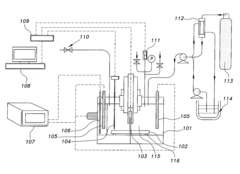
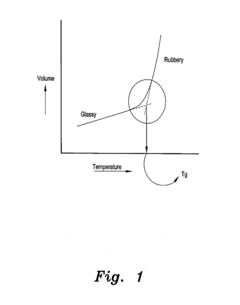
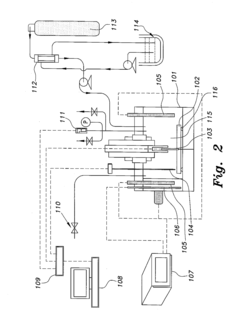
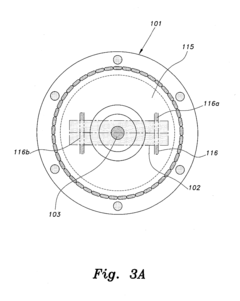
Ce-Base Amorphous Metallic Plastic
PatentActiveUS20080105338A1
Innovation
- Development of Ce-based amorphous metallic plastics with extremely low Tg, wide supercooled liquid region, and low cost, using compositions like CeaAlbMc, CedAleCufZg, and CehAliCujNi, where Ce, Al, and other elements are used with high purity, and processed through methods such as arc melting and suction casting to achieve a stable amorphous phase with high glass forming ability.


Manufacturing Scalability of Thermal Metamaterials
The manufacturing scalability of thermal metamaterials represents a critical bottleneck in transitioning from laboratory demonstrations to commercial applications. Current production methods for both polymer and glass-based thermal metamaterials face distinct challenges that significantly impact their potential for large-scale deployment.
Polymer-based thermal metamaterials demonstrate superior scalability advantages through established manufacturing processes. Injection molding, 3D printing, and roll-to-roll processing enable high-volume production with relatively low capital investment. These techniques can achieve feature sizes down to micrometers while maintaining dimensional accuracy across large substrate areas. The inherent flexibility of polymer processing allows for continuous manufacturing workflows, with production rates potentially reaching thousands of units per hour for simpler geometries.
Glass-based thermal metamaterials encounter more substantial scalability constraints due to their reliance on precision fabrication techniques. Traditional glass processing methods such as photolithography, etching, and thermal forming require specialized cleanroom facilities and expensive equipment. The brittle nature of glass materials necessitates careful handling protocols, increasing manufacturing complexity and reducing yield rates. Current glass metamaterial production is largely limited to batch processing, restricting throughput to hundreds of units per production cycle.
Cost considerations further differentiate the scalability potential between these material systems. Polymer metamaterials benefit from mature supply chains and commodity-grade raw materials, resulting in material costs typically ranging from $0.10 to $5.00 per square centimeter depending on complexity. Glass-based systems require high-purity substrates and specialized processing chemicals, driving material costs to $2.00 to $20.00 per square centimeter for equivalent structures.
Quality control and reproducibility present ongoing challenges for both material platforms at scale. Polymer systems must address thermal stability variations and dimensional drift during processing, while glass-based manufacturing requires precise control of surface roughness and internal stress distributions. Advanced process monitoring and feedback control systems are essential for maintaining consistent metamaterial performance across large production volumes.
Emerging manufacturing approaches show promise for addressing current scalability limitations. Nanoimprint lithography and soft lithography techniques offer potential pathways for high-throughput polymer metamaterial production. For glass systems, laser-based processing and advanced molding techniques may enable more efficient manufacturing workflows while maintaining the superior thermal properties inherent to glass materials.
Polymer-based thermal metamaterials demonstrate superior scalability advantages through established manufacturing processes. Injection molding, 3D printing, and roll-to-roll processing enable high-volume production with relatively low capital investment. These techniques can achieve feature sizes down to micrometers while maintaining dimensional accuracy across large substrate areas. The inherent flexibility of polymer processing allows for continuous manufacturing workflows, with production rates potentially reaching thousands of units per hour for simpler geometries.
Glass-based thermal metamaterials encounter more substantial scalability constraints due to their reliance on precision fabrication techniques. Traditional glass processing methods such as photolithography, etching, and thermal forming require specialized cleanroom facilities and expensive equipment. The brittle nature of glass materials necessitates careful handling protocols, increasing manufacturing complexity and reducing yield rates. Current glass metamaterial production is largely limited to batch processing, restricting throughput to hundreds of units per production cycle.
Cost considerations further differentiate the scalability potential between these material systems. Polymer metamaterials benefit from mature supply chains and commodity-grade raw materials, resulting in material costs typically ranging from $0.10 to $5.00 per square centimeter depending on complexity. Glass-based systems require high-purity substrates and specialized processing chemicals, driving material costs to $2.00 to $20.00 per square centimeter for equivalent structures.
Quality control and reproducibility present ongoing challenges for both material platforms at scale. Polymer systems must address thermal stability variations and dimensional drift during processing, while glass-based manufacturing requires precise control of surface roughness and internal stress distributions. Advanced process monitoring and feedback control systems are essential for maintaining consistent metamaterial performance across large production volumes.
Emerging manufacturing approaches show promise for addressing current scalability limitations. Nanoimprint lithography and soft lithography techniques offer potential pathways for high-throughput polymer metamaterial production. For glass systems, laser-based processing and advanced molding techniques may enable more efficient manufacturing workflows while maintaining the superior thermal properties inherent to glass materials.
Performance Benchmarking Standards for Thermal Control
Establishing standardized performance benchmarking protocols for thermal metamaterials represents a critical need in advancing both polymer and glass-based systems toward practical applications. Current evaluation frameworks lack consistency across research institutions and industrial laboratories, creating significant barriers to meaningful comparison between different material platforms and hindering technology transfer from laboratory to commercial deployment.
The fundamental challenge lies in developing metrics that accurately capture the multifaceted nature of thermal control performance. Traditional thermal conductivity measurements, while essential, provide insufficient insight into the dynamic behavior and directional properties that define metamaterial functionality. Effective benchmarking standards must encompass thermal anisotropy ratios, response time characteristics, temperature-dependent stability, and spatial resolution capabilities across relevant operating temperature ranges.
Standardization efforts should prioritize measurement protocols that address the unique properties of engineered thermal structures. This includes establishing consistent methodologies for evaluating thermal cloaking efficiency, heat flux manipulation accuracy, and thermal focusing performance. The standards must also account for the significant differences in measurement approaches required for polymer versus glass-based systems, given their distinct thermal response characteristics and operational temperature ranges.
Industry adoption requires benchmarking frameworks that translate laboratory measurements into application-relevant performance indicators. This necessitates developing composite metrics that combine thermal performance with mechanical stability, environmental durability, and manufacturing scalability factors. Such integrated assessment approaches enable more informed material selection decisions for specific thermal management applications.
International collaboration among standards organizations, research institutions, and industry stakeholders is essential for establishing globally accepted benchmarking protocols. These standards should incorporate both steady-state and transient thermal measurement techniques, ensuring comprehensive evaluation of metamaterial performance across diverse operating conditions and application scenarios.
The development of automated testing platforms and standardized sample preparation procedures will further enhance measurement reproducibility and accelerate the validation process for emerging thermal metamaterial technologies, ultimately facilitating their transition from research concepts to commercial thermal management solutions.
The fundamental challenge lies in developing metrics that accurately capture the multifaceted nature of thermal control performance. Traditional thermal conductivity measurements, while essential, provide insufficient insight into the dynamic behavior and directional properties that define metamaterial functionality. Effective benchmarking standards must encompass thermal anisotropy ratios, response time characteristics, temperature-dependent stability, and spatial resolution capabilities across relevant operating temperature ranges.
Standardization efforts should prioritize measurement protocols that address the unique properties of engineered thermal structures. This includes establishing consistent methodologies for evaluating thermal cloaking efficiency, heat flux manipulation accuracy, and thermal focusing performance. The standards must also account for the significant differences in measurement approaches required for polymer versus glass-based systems, given their distinct thermal response characteristics and operational temperature ranges.
Industry adoption requires benchmarking frameworks that translate laboratory measurements into application-relevant performance indicators. This necessitates developing composite metrics that combine thermal performance with mechanical stability, environmental durability, and manufacturing scalability factors. Such integrated assessment approaches enable more informed material selection decisions for specific thermal management applications.
International collaboration among standards organizations, research institutions, and industry stakeholders is essential for establishing globally accepted benchmarking protocols. These standards should incorporate both steady-state and transient thermal measurement techniques, ensuring comprehensive evaluation of metamaterial performance across diverse operating conditions and application scenarios.
The development of automated testing platforms and standardized sample preparation procedures will further enhance measurement reproducibility and accelerate the validation process for emerging thermal metamaterial technologies, ultimately facilitating their transition from research concepts to commercial thermal management solutions.
Unlock deeper insights with PatSnap Eureka Quick Research — get a full tech report to explore trends and direct your research. Try now!
Generate Your Research Report Instantly with AI Agent
Supercharge your innovation with PatSnap Eureka AI Agent Platform!