

How Material Composition Impacts Thermal Stability in Metamaterials
APR 29, 20269 MIN READ
Generate Your Research Report Instantly with AI Agent
PatSnap Eureka helps you evaluate technical feasibility & market potential.
Metamaterial Thermal Stability Background and Objectives
Metamaterials represent a revolutionary class of artificially engineered materials whose electromagnetic, acoustic, or thermal properties are primarily determined by their structural design rather than their constituent materials. These materials derive their unique characteristics from periodic or quasi-periodic arrangements of subwavelength structural elements, enabling properties not found in naturally occurring materials. The field has evolved from theoretical concepts in the 1960s to practical applications spanning telecommunications, aerospace, energy harvesting, and thermal management systems.
The thermal behavior of metamaterials has emerged as a critical research frontier, particularly as applications demand materials that maintain structural integrity and functional performance under extreme temperature conditions. Unlike conventional materials where thermal properties are intrinsic to the base material composition, metamaterials exhibit thermal characteristics that arise from complex interactions between constituent materials, geometric configurations, and interfacial phenomena. This unique relationship creates both opportunities and challenges in predicting and controlling thermal stability.
Material composition plays a fundamental role in determining thermal stability through multiple mechanisms. The thermal expansion coefficients of different constituent materials create internal stresses during temperature fluctuations, potentially leading to structural failure or performance degradation. Additionally, the thermal conductivity mismatch between components affects heat distribution patterns, creating localized hot spots that can compromise material integrity. Chemical compatibility between different materials becomes crucial at elevated temperatures, where interdiffusion or chemical reactions can alter the intended structural properties.
The primary objective of investigating material composition impacts on thermal stability is to establish predictive frameworks that enable the design of thermally robust metamaterials. This involves developing comprehensive understanding of how different material combinations respond to thermal cycling, identifying critical temperature thresholds for various applications, and establishing design guidelines that optimize both functional performance and thermal resilience.
Current research aims to address several key challenges including the development of multi-physics modeling approaches that accurately capture thermal-mechanical-electromagnetic coupling effects, the identification of material selection criteria that balance performance requirements with thermal constraints, and the establishment of standardized testing protocols for evaluating thermal stability across different metamaterial architectures.
The ultimate goal is to enable the deployment of metamaterials in high-temperature environments such as aerospace applications, automotive systems, and industrial processes where thermal stability is paramount for reliable long-term operation.
The thermal behavior of metamaterials has emerged as a critical research frontier, particularly as applications demand materials that maintain structural integrity and functional performance under extreme temperature conditions. Unlike conventional materials where thermal properties are intrinsic to the base material composition, metamaterials exhibit thermal characteristics that arise from complex interactions between constituent materials, geometric configurations, and interfacial phenomena. This unique relationship creates both opportunities and challenges in predicting and controlling thermal stability.
Material composition plays a fundamental role in determining thermal stability through multiple mechanisms. The thermal expansion coefficients of different constituent materials create internal stresses during temperature fluctuations, potentially leading to structural failure or performance degradation. Additionally, the thermal conductivity mismatch between components affects heat distribution patterns, creating localized hot spots that can compromise material integrity. Chemical compatibility between different materials becomes crucial at elevated temperatures, where interdiffusion or chemical reactions can alter the intended structural properties.
The primary objective of investigating material composition impacts on thermal stability is to establish predictive frameworks that enable the design of thermally robust metamaterials. This involves developing comprehensive understanding of how different material combinations respond to thermal cycling, identifying critical temperature thresholds for various applications, and establishing design guidelines that optimize both functional performance and thermal resilience.
Current research aims to address several key challenges including the development of multi-physics modeling approaches that accurately capture thermal-mechanical-electromagnetic coupling effects, the identification of material selection criteria that balance performance requirements with thermal constraints, and the establishment of standardized testing protocols for evaluating thermal stability across different metamaterial architectures.
The ultimate goal is to enable the deployment of metamaterials in high-temperature environments such as aerospace applications, automotive systems, and industrial processes where thermal stability is paramount for reliable long-term operation.
Market Demand for Thermally Stable Metamaterials
The aerospace and defense sectors represent the most significant market drivers for thermally stable metamaterials, where extreme temperature variations and mission-critical performance requirements create substantial demand. Aircraft engines, spacecraft thermal management systems, and hypersonic vehicle components require materials that maintain their electromagnetic properties across temperature ranges exceeding 1000°C. The increasing deployment of satellite constellations and space exploration missions has intensified the need for metamaterial-based antennas and sensors that can withstand the harsh thermal cycling of space environments.
Telecommunications infrastructure presents another major market opportunity, particularly in 5G and beyond wireless networks. Base station components, radar systems, and millimeter-wave communication devices require metamaterials that preserve their frequency-selective properties under varying environmental conditions. The global expansion of wireless networks in diverse climatic regions has created demand for thermally robust metamaterial solutions that can operate reliably from arctic to desert conditions.
The automotive industry's transition toward autonomous vehicles and advanced driver assistance systems has generated growing demand for thermally stable metamaterial-based sensors and communication components. Engine compartments and exterior-mounted radar systems experience significant temperature fluctuations, necessitating materials that maintain consistent electromagnetic performance across operational temperature ranges.
Energy sector applications, including solar concentrators, thermal management systems, and wireless power transfer devices, require metamaterials with exceptional thermal stability. The integration of metamaterial-enhanced components in renewable energy systems demands materials that can withstand prolonged exposure to elevated temperatures while maintaining their designed electromagnetic characteristics.
Medical device manufacturers increasingly seek thermally stable metamaterials for implantable devices, diagnostic equipment, and therapeutic systems. Biomedical applications require materials that remain stable at body temperature and during sterilization processes, while maintaining biocompatibility and electromagnetic functionality.
The market demand is further driven by the miniaturization trend across electronic devices, where thermal management becomes increasingly challenging. Consumer electronics, wearable devices, and Internet of Things applications require compact metamaterial components that can operate reliably despite heat generation from densely packed electronic circuits.
Industrial applications in harsh environments, including oil and gas exploration, mining operations, and manufacturing processes, create additional demand for thermally robust metamaterials. These sectors require sensing and communication systems that can function reliably in high-temperature industrial environments while maintaining their metamaterial-enhanced capabilities.
Telecommunications infrastructure presents another major market opportunity, particularly in 5G and beyond wireless networks. Base station components, radar systems, and millimeter-wave communication devices require metamaterials that preserve their frequency-selective properties under varying environmental conditions. The global expansion of wireless networks in diverse climatic regions has created demand for thermally robust metamaterial solutions that can operate reliably from arctic to desert conditions.
The automotive industry's transition toward autonomous vehicles and advanced driver assistance systems has generated growing demand for thermally stable metamaterial-based sensors and communication components. Engine compartments and exterior-mounted radar systems experience significant temperature fluctuations, necessitating materials that maintain consistent electromagnetic performance across operational temperature ranges.
Energy sector applications, including solar concentrators, thermal management systems, and wireless power transfer devices, require metamaterials with exceptional thermal stability. The integration of metamaterial-enhanced components in renewable energy systems demands materials that can withstand prolonged exposure to elevated temperatures while maintaining their designed electromagnetic characteristics.
Medical device manufacturers increasingly seek thermally stable metamaterials for implantable devices, diagnostic equipment, and therapeutic systems. Biomedical applications require materials that remain stable at body temperature and during sterilization processes, while maintaining biocompatibility and electromagnetic functionality.
The market demand is further driven by the miniaturization trend across electronic devices, where thermal management becomes increasingly challenging. Consumer electronics, wearable devices, and Internet of Things applications require compact metamaterial components that can operate reliably despite heat generation from densely packed electronic circuits.
Industrial applications in harsh environments, including oil and gas exploration, mining operations, and manufacturing processes, create additional demand for thermally robust metamaterials. These sectors require sensing and communication systems that can function reliably in high-temperature industrial environments while maintaining their metamaterial-enhanced capabilities.
Current Thermal Challenges in Metamaterial Design
Metamaterial design faces significant thermal challenges that fundamentally limit their practical applications across various industries. The primary thermal constraint stems from the inherent mismatch between constituent materials' thermal expansion coefficients, which creates internal stresses during temperature fluctuations. These stresses can lead to structural deformation, cracking, or complete failure of the metamaterial's engineered properties.
Temperature-induced dimensional changes represent another critical challenge in metamaterial systems. As operating temperatures vary, the precise geometric relationships between structural elements become distorted, directly affecting the metamaterial's electromagnetic, acoustic, or mechanical responses. This dimensional instability is particularly problematic in applications requiring consistent performance across wide temperature ranges, such as aerospace components or outdoor communication systems.
Thermal conductivity mismatches between different material phases create localized hot spots and thermal gradients within metamaterial structures. These non-uniform temperature distributions can cause preferential thermal expansion in specific regions, leading to warping, delamination, or catastrophic failure. The complex three-dimensional architectures typical of metamaterials exacerbate these issues by creating intricate heat transfer pathways that are difficult to predict and control.
Interface degradation emerges as a persistent thermal challenge, particularly in composite metamaterials combining metals, polymers, and ceramics. Repeated thermal cycling weakens interfacial bonds, reducing mechanical integrity and altering electromagnetic properties. The different thermal expansion rates of bonded materials create shear stresses at interfaces, promoting crack initiation and propagation.
High-temperature applications reveal additional constraints related to material degradation and phase transitions. Polymer-based metamaterials suffer from thermal decomposition, oxidation, and glass transition effects that fundamentally alter their properties. Metal components may experience grain growth, oxidation, or phase transformations that compromise the carefully engineered microstructure essential for metamaterial functionality.
Thermal hysteresis effects introduce unpredictable behavior in metamaterial responses, where properties depend not only on current temperature but also on thermal history. This memory effect complicates system design and control, particularly in applications requiring precise, repeatable performance characteristics across multiple thermal cycles.
Temperature-induced dimensional changes represent another critical challenge in metamaterial systems. As operating temperatures vary, the precise geometric relationships between structural elements become distorted, directly affecting the metamaterial's electromagnetic, acoustic, or mechanical responses. This dimensional instability is particularly problematic in applications requiring consistent performance across wide temperature ranges, such as aerospace components or outdoor communication systems.
Thermal conductivity mismatches between different material phases create localized hot spots and thermal gradients within metamaterial structures. These non-uniform temperature distributions can cause preferential thermal expansion in specific regions, leading to warping, delamination, or catastrophic failure. The complex three-dimensional architectures typical of metamaterials exacerbate these issues by creating intricate heat transfer pathways that are difficult to predict and control.
Interface degradation emerges as a persistent thermal challenge, particularly in composite metamaterials combining metals, polymers, and ceramics. Repeated thermal cycling weakens interfacial bonds, reducing mechanical integrity and altering electromagnetic properties. The different thermal expansion rates of bonded materials create shear stresses at interfaces, promoting crack initiation and propagation.
High-temperature applications reveal additional constraints related to material degradation and phase transitions. Polymer-based metamaterials suffer from thermal decomposition, oxidation, and glass transition effects that fundamentally alter their properties. Metal components may experience grain growth, oxidation, or phase transformations that compromise the carefully engineered microstructure essential for metamaterial functionality.
Thermal hysteresis effects introduce unpredictable behavior in metamaterial responses, where properties depend not only on current temperature but also on thermal history. This memory effect complicates system design and control, particularly in applications requiring precise, repeatable performance characteristics across multiple thermal cycles.
Existing Material Composition Solutions for Thermal Stability
01 High-temperature resistant metamaterial structures
Development of metamaterial designs that maintain their electromagnetic properties at elevated temperatures through specialized structural configurations and geometric arrangements. These structures are engineered to withstand thermal expansion and maintain dimensional stability under high-temperature conditions while preserving their unique electromagnetic characteristics.- High-temperature resistant metamaterial structures: Development of metamaterial designs that maintain their electromagnetic properties at elevated temperatures through specialized structural configurations and geometric arrangements. These structures are engineered to withstand thermal expansion and maintain dimensional stability under high-temperature conditions while preserving their unique electromagnetic characteristics.
- Thermally stable metamaterial compositions and materials: Formulation of metamaterials using thermally stable base materials and composites that resist degradation at high temperatures. These compositions incorporate materials with high melting points, low thermal expansion coefficients, and excellent thermal conductivity to ensure metamaterial functionality is preserved across wide temperature ranges.
- Thermal management and heat dissipation in metamaterials: Integration of thermal management systems and heat dissipation mechanisms within metamaterial structures to prevent overheating and maintain operational stability. These approaches include thermal interface materials, heat sinks, and cooling channels designed specifically for metamaterial applications.
- Temperature compensation mechanisms in metamaterials: Implementation of active and passive temperature compensation techniques to counteract thermal effects on metamaterial performance. These mechanisms automatically adjust metamaterial properties in response to temperature changes, ensuring consistent electromagnetic behavior across varying thermal conditions.
- Thermal testing and characterization methods for metamaterials: Development of specialized testing protocols and characterization techniques to evaluate metamaterial thermal stability and performance under various temperature conditions. These methods include thermal cycling tests, high-temperature electromagnetic measurements, and thermal imaging analysis to assess metamaterial reliability and durability.
02 Thermally stable metamaterial compositions and materials
Formulation of metamaterials using thermally stable base materials and composites that resist degradation at high temperatures. These compositions incorporate materials with high melting points, low thermal expansion coefficients, and excellent thermal conductivity to ensure metamaterial functionality is preserved across wide temperature ranges.Expand Specific Solutions03 Thermal management and heat dissipation in metamaterials
Integration of thermal management systems and heat dissipation mechanisms within metamaterial structures to prevent overheating and maintain operational stability. These approaches include thermal interface materials, heat sinks, and active cooling systems specifically designed for metamaterial applications.Expand Specific Solutions04 Temperature-compensated metamaterial designs
Development of metamaterial architectures that automatically compensate for temperature-induced changes through adaptive mechanisms or temperature-invariant designs. These systems maintain consistent electromagnetic performance despite thermal fluctuations by incorporating compensation elements or self-adjusting structures.Expand Specific Solutions05 Fabrication methods for thermally robust metamaterials
Manufacturing techniques and processes specifically developed to create metamaterials with enhanced thermal stability. These methods include specialized deposition techniques, annealing processes, and multi-layer fabrication approaches that improve the thermal resilience of the final metamaterial structures.Expand Specific Solutions
Key Players in Metamaterial and Thermal Engineering
The metamaterial thermal stability field represents an emerging technology sector in its early-to-mid development stage, with significant growth potential driven by applications in aerospace, electronics, and advanced manufacturing. The market remains relatively nascent but shows promising expansion as thermal management becomes increasingly critical in high-performance applications. Technology maturity varies considerably across different players, with established research institutions like National University of Defense Technology, Northwestern Polytechnical University, and Centre National de la Recherche Scientifique leading fundamental research, while specialized companies such as Kuang-Chi Innovative Technology and Multiscale Systems focus on commercial applications. Industrial giants including BASF Corp., Henkel AG, and FUJIFILM Corp. leverage their materials expertise to develop thermally stable metamaterial solutions, indicating growing mainstream adoption. The competitive landscape features a diverse ecosystem spanning academic research, government initiatives, and private sector innovation, suggesting the technology is transitioning from laboratory research toward practical implementation phases.
Kuang-Chi Institute of Advanced Technology
Technical Solution: Develops metamaterial structures with engineered material compositions focusing on thermal management applications. Their approach involves creating periodic structures with specific dielectric and metallic components arranged to achieve desired thermal properties while maintaining electromagnetic functionality. The institute has developed metamaterials using temperature-stable polymers combined with metallic resonators that maintain structural integrity at elevated temperatures up to 200°C. Their research emphasizes the relationship between unit cell geometry, material selection, and thermal expansion coefficients to minimize performance degradation under thermal stress. They utilize computational modeling to predict thermal behavior and optimize material combinations for specific operating temperature ranges.
Strengths: Strong research foundation in metamaterial design and thermal analysis. Weaknesses: Limited commercial scalability and manufacturing capabilities for mass production applications.
FUJIFILM Corp.
Technical Solution: Applies advanced materials science expertise from imaging and electronics industries to develop thermally stable metamaterial components. FUJIFILM's approach leverages their experience with high-performance polymers and precision manufacturing to create metamaterials with enhanced thermal properties. Their research focuses on fluoropolymer-based substrates and coatings that provide exceptional thermal stability while maintaining low dielectric loss characteristics essential for metamaterial applications. The company has developed proprietary material formulations that resist thermal degradation up to 280°C and maintain dimensional stability under thermal cycling conditions. Their work emphasizes the integration of thermal barrier coatings and heat-dissipating additives to manage thermal stress in metamaterial structures while preserving electromagnetic functionality.
Strengths: Advanced materials processing capabilities and experience with precision manufacturing for demanding applications. Weaknesses: Limited specific expertise in electromagnetic metamaterial design compared to specialized research institutions.
Core Material Science Innovations for Thermal Metamaterials
High-thermal-emissivity metamaterial
PatentWO2024261313A1
Innovation
- A nanostructured metamaterial composed of a porous inorganic support with alternating layers of dielectric and conductive oxides, such as Al2O3 and ZnO, which are inert to each other at high temperatures, allowing for adjustable thermal emissivity and enhanced mechanical and chemical resistance.

Lattice metamaterial having programed thermal expansion
PatentInactiveUS20210020263A1
Innovation
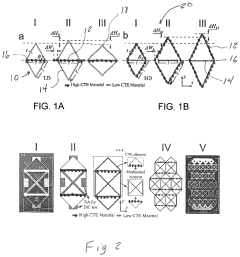
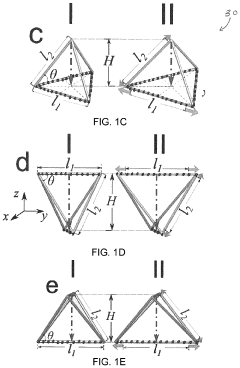
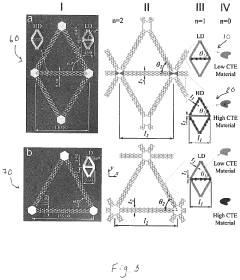
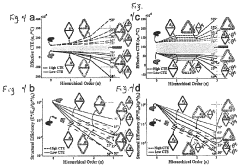
- Development of lattice metamaterials with pre-programmed thermal expansions, utilizing bi-material unit cells with different coefficients of thermal expansion to achieve tunable thermal expansion properties, allowing for control of thermal expansion without compromising structural performance, through the use of stretch-dominated diamond or tetrahedron-shaped building blocks and hierarchical lattices.
Manufacturing Standards for Thermally Stable Metamaterials
The establishment of comprehensive manufacturing standards for thermally stable metamaterials represents a critical milestone in transitioning these advanced materials from laboratory prototypes to industrial applications. Current standardization efforts focus on defining precise material composition requirements, structural tolerances, and thermal performance benchmarks that ensure consistent quality across different manufacturing facilities and production scales.
International standards organizations, including ISO and ASTM, are actively developing frameworks that address the unique challenges posed by metamaterial fabrication. These standards encompass material purity specifications, with particular emphasis on controlling impurity levels that can significantly impact thermal stability. For instance, metallic inclusions in dielectric metamaterials must be limited to parts-per-million levels to prevent localized heating and structural degradation under thermal cycling conditions.
Manufacturing process standardization extends beyond material composition to include fabrication techniques such as electron beam lithography, nanoimprint lithography, and additive manufacturing protocols. Each method requires specific parameter controls, including exposure doses, temperature profiles, and environmental conditions that directly influence the thermal stability of the final metamaterial structure. Quality control standards mandate real-time monitoring of these parameters with documented traceability throughout the production process.
Testing protocols constitute another fundamental aspect of manufacturing standards, requiring standardized thermal cycling procedures that simulate real-world operating conditions. These protocols specify temperature ranges, heating and cooling rates, and duration requirements that metamaterials must withstand without performance degradation. Acceptance criteria include maximum allowable changes in electromagnetic properties, structural dimensions, and material integrity after thermal exposure.
Certification processes are being developed to validate manufacturing facilities' compliance with thermal stability standards. These processes involve third-party audits, batch testing requirements, and continuous monitoring systems that ensure consistent adherence to established protocols. The certification framework also addresses supply chain management, requiring documentation of raw material sources and their thermal stability characteristics to maintain end-product reliability.
International standards organizations, including ISO and ASTM, are actively developing frameworks that address the unique challenges posed by metamaterial fabrication. These standards encompass material purity specifications, with particular emphasis on controlling impurity levels that can significantly impact thermal stability. For instance, metallic inclusions in dielectric metamaterials must be limited to parts-per-million levels to prevent localized heating and structural degradation under thermal cycling conditions.
Manufacturing process standardization extends beyond material composition to include fabrication techniques such as electron beam lithography, nanoimprint lithography, and additive manufacturing protocols. Each method requires specific parameter controls, including exposure doses, temperature profiles, and environmental conditions that directly influence the thermal stability of the final metamaterial structure. Quality control standards mandate real-time monitoring of these parameters with documented traceability throughout the production process.
Testing protocols constitute another fundamental aspect of manufacturing standards, requiring standardized thermal cycling procedures that simulate real-world operating conditions. These protocols specify temperature ranges, heating and cooling rates, and duration requirements that metamaterials must withstand without performance degradation. Acceptance criteria include maximum allowable changes in electromagnetic properties, structural dimensions, and material integrity after thermal exposure.
Certification processes are being developed to validate manufacturing facilities' compliance with thermal stability standards. These processes involve third-party audits, batch testing requirements, and continuous monitoring systems that ensure consistent adherence to established protocols. The certification framework also addresses supply chain management, requiring documentation of raw material sources and their thermal stability characteristics to maintain end-product reliability.
Environmental Impact of Metamaterial Thermal Performance
The environmental implications of metamaterial thermal performance represent a critical consideration in the development and deployment of these advanced engineered structures. As metamaterials increasingly find applications in thermal management systems, building materials, and energy harvesting devices, their environmental footprint becomes a paramount concern for sustainable technology advancement.
The manufacturing processes of metamaterials often involve energy-intensive fabrication techniques, including electron beam lithography, focused ion beam milling, and chemical vapor deposition. These processes typically consume significant amounts of energy and may generate hazardous waste products, particularly when working with metallic nanostructures or exotic dielectric materials. The carbon footprint associated with producing metamaterials with specific thermal properties can be substantially higher than conventional materials, raising questions about their long-term environmental viability.
Material selection for thermal metamaterials directly influences environmental impact through resource extraction and processing requirements. Noble metals like gold and silver, commonly used for their excellent thermal and optical properties, involve environmentally destructive mining practices and limited recyclability. Alternative materials such as graphene-based composites or bio-inspired structures offer potentially lower environmental impact while maintaining desired thermal characteristics.
The operational environmental benefits of metamaterials often offset their manufacturing impact through enhanced energy efficiency. Thermal metamaterials enable more effective heat management in electronic devices, reducing cooling energy requirements and extending device lifespans. In building applications, metamaterial-based thermal regulators can significantly reduce HVAC energy consumption, contributing to lower greenhouse gas emissions over their operational lifetime.
End-of-life considerations present both challenges and opportunities for metamaterial thermal systems. The complex nanostructured nature of these materials complicates traditional recycling processes, potentially leading to electronic waste accumulation. However, emerging research into biodegradable metamaterials and design-for-disassembly approaches offers promising pathways for sustainable lifecycle management.
Life cycle assessment studies indicate that the environmental impact of metamaterial thermal systems varies significantly based on application context, with energy-saving applications in buildings and electronics showing favorable environmental profiles despite higher initial manufacturing impacts.
The manufacturing processes of metamaterials often involve energy-intensive fabrication techniques, including electron beam lithography, focused ion beam milling, and chemical vapor deposition. These processes typically consume significant amounts of energy and may generate hazardous waste products, particularly when working with metallic nanostructures or exotic dielectric materials. The carbon footprint associated with producing metamaterials with specific thermal properties can be substantially higher than conventional materials, raising questions about their long-term environmental viability.
Material selection for thermal metamaterials directly influences environmental impact through resource extraction and processing requirements. Noble metals like gold and silver, commonly used for their excellent thermal and optical properties, involve environmentally destructive mining practices and limited recyclability. Alternative materials such as graphene-based composites or bio-inspired structures offer potentially lower environmental impact while maintaining desired thermal characteristics.
The operational environmental benefits of metamaterials often offset their manufacturing impact through enhanced energy efficiency. Thermal metamaterials enable more effective heat management in electronic devices, reducing cooling energy requirements and extending device lifespans. In building applications, metamaterial-based thermal regulators can significantly reduce HVAC energy consumption, contributing to lower greenhouse gas emissions over their operational lifetime.
End-of-life considerations present both challenges and opportunities for metamaterial thermal systems. The complex nanostructured nature of these materials complicates traditional recycling processes, potentially leading to electronic waste accumulation. However, emerging research into biodegradable metamaterials and design-for-disassembly approaches offers promising pathways for sustainable lifecycle management.
Life cycle assessment studies indicate that the environmental impact of metamaterial thermal systems varies significantly based on application context, with energy-saving applications in buildings and electronics showing favorable environmental profiles despite higher initial manufacturing impacts.
Unlock deeper insights with PatSnap Eureka Quick Research — get a full tech report to explore trends and direct your research. Try now!
Generate Your Research Report Instantly with AI Agent
Supercharge your innovation with PatSnap Eureka AI Agent Platform!