

Computational Algorithms for Rail Gun Trajectory Optimization
AUG 6, 20259 MIN READ
Generate Your Research Report Instantly with AI Agent
PatSnap Eureka helps you evaluate technical feasibility & market potential.
Rail Gun Tech Background
Rail guns have been a subject of military research and development for decades, representing a significant leap in projectile technology. These electromagnetic launchers utilize powerful electromagnetic forces to accelerate projectiles to extremely high velocities, far surpassing the capabilities of traditional chemical propellants. The concept of rail guns dates back to the early 20th century, but it wasn't until recent advancements in power systems and materials science that their practical implementation became feasible.
The development of rail gun technology has been driven by the need for long-range, high-velocity weapons systems that can deliver significant kinetic energy on target without the limitations of conventional artillery. The U.S. Navy, in particular, has been at the forefront of rail gun research, viewing the technology as a potential game-changer for naval warfare and ship defense systems.
Rail guns operate on the principle of electromagnetic propulsion. Two parallel conducting rails are connected to an electrical power supply, creating a powerful electromagnetic field. When a conductive projectile is inserted between these rails and a large electric current is applied, the resulting Lorentz force accelerates the projectile along the rails at incredible speeds, potentially reaching velocities over Mach 7.
The trajectory optimization of rail gun projectiles presents unique challenges due to the extreme velocities involved. Traditional ballistic calculations must be significantly modified to account for factors such as atmospheric drag at hypersonic speeds, the Coriolis effect over long distances, and the potential for projectile ablation during flight. These factors necessitate the development of sophisticated computational algorithms to accurately predict and optimize projectile trajectories.
Recent technological advancements have focused on improving rail gun efficiency, durability, and power management. Key areas of development include high-strength materials for rail construction to withstand the enormous electromagnetic forces, advanced capacitor technologies for rapid energy storage and release, and cooling systems to manage the intense heat generated during firing.
The potential applications of rail gun technology extend beyond military use. In the scientific community, there is interest in using scaled-down versions of rail guns for hypersonic flight testing and space launch systems. These applications could revolutionize our approach to atmospheric research and small satellite deployment.
As rail gun technology continues to evolve, the focus on trajectory optimization becomes increasingly critical. The ability to accurately control and predict the flight path of hypersonic projectiles over extreme distances will be essential for the practical deployment of rail gun systems in both military and civilian applications. This drives the ongoing research into advanced computational algorithms, which must integrate complex physics models, real-time atmospheric data, and adaptive control systems to achieve the desired level of precision and effectiveness.
The development of rail gun technology has been driven by the need for long-range, high-velocity weapons systems that can deliver significant kinetic energy on target without the limitations of conventional artillery. The U.S. Navy, in particular, has been at the forefront of rail gun research, viewing the technology as a potential game-changer for naval warfare and ship defense systems.
Rail guns operate on the principle of electromagnetic propulsion. Two parallel conducting rails are connected to an electrical power supply, creating a powerful electromagnetic field. When a conductive projectile is inserted between these rails and a large electric current is applied, the resulting Lorentz force accelerates the projectile along the rails at incredible speeds, potentially reaching velocities over Mach 7.
The trajectory optimization of rail gun projectiles presents unique challenges due to the extreme velocities involved. Traditional ballistic calculations must be significantly modified to account for factors such as atmospheric drag at hypersonic speeds, the Coriolis effect over long distances, and the potential for projectile ablation during flight. These factors necessitate the development of sophisticated computational algorithms to accurately predict and optimize projectile trajectories.
Recent technological advancements have focused on improving rail gun efficiency, durability, and power management. Key areas of development include high-strength materials for rail construction to withstand the enormous electromagnetic forces, advanced capacitor technologies for rapid energy storage and release, and cooling systems to manage the intense heat generated during firing.
The potential applications of rail gun technology extend beyond military use. In the scientific community, there is interest in using scaled-down versions of rail guns for hypersonic flight testing and space launch systems. These applications could revolutionize our approach to atmospheric research and small satellite deployment.
As rail gun technology continues to evolve, the focus on trajectory optimization becomes increasingly critical. The ability to accurately control and predict the flight path of hypersonic projectiles over extreme distances will be essential for the practical deployment of rail gun systems in both military and civilian applications. This drives the ongoing research into advanced computational algorithms, which must integrate complex physics models, real-time atmospheric data, and adaptive control systems to achieve the desired level of precision and effectiveness.
Market Demand Analysis
The market demand for computational algorithms in rail gun trajectory optimization has been steadily increasing in recent years, driven by advancements in military technology and the growing interest in hypersonic weapons. Rail guns, which use electromagnetic forces to launch projectiles at extremely high velocities, require sophisticated algorithms to accurately predict and control their trajectories. This demand spans across various sectors, including defense, aerospace, and research institutions.
In the defense sector, there is a significant push for more accurate and longer-range artillery systems. Rail guns offer the potential for extended range and increased precision compared to traditional artillery, making them highly attractive for naval and ground-based applications. The U.S. Navy, for instance, has been investing heavily in rail gun technology, creating a substantial market for trajectory optimization algorithms.
The aerospace industry also shows keen interest in these algorithms, as they can be applied to other high-velocity projectile systems and space launch technologies. Companies involved in satellite launches and space exploration are exploring rail gun technology as a potential alternative to traditional rocket propulsion, further expanding the market for trajectory optimization algorithms.
Research institutions and universities are another key market segment, as they conduct fundamental and applied research in electromagnetic launch technologies. These organizations require advanced computational tools to model and simulate rail gun performance, creating a steady demand for innovative algorithms.
The global market for smart weapons, which includes rail guns and other precision-guided munitions, is expected to grow significantly in the coming years. This growth is fueled by increasing defense budgets in many countries and the ongoing modernization of military forces worldwide. As rail gun technology matures and moves closer to operational deployment, the demand for sophisticated trajectory optimization algorithms is likely to surge.
However, it's important to note that the market for rail gun trajectory optimization algorithms faces some challenges. The technology is still in the development phase, and there are technical hurdles to overcome before widespread adoption. Additionally, the market is largely dependent on government funding and defense contracts, which can be subject to political and budgetary fluctuations.
Despite these challenges, the overall trend indicates a growing market with significant potential. As rail gun technology continues to advance, the need for more accurate, efficient, and adaptable trajectory optimization algorithms will only increase. This presents opportunities for software developers, defense contractors, and research organizations to innovate and capture a share of this emerging market.
In the defense sector, there is a significant push for more accurate and longer-range artillery systems. Rail guns offer the potential for extended range and increased precision compared to traditional artillery, making them highly attractive for naval and ground-based applications. The U.S. Navy, for instance, has been investing heavily in rail gun technology, creating a substantial market for trajectory optimization algorithms.
The aerospace industry also shows keen interest in these algorithms, as they can be applied to other high-velocity projectile systems and space launch technologies. Companies involved in satellite launches and space exploration are exploring rail gun technology as a potential alternative to traditional rocket propulsion, further expanding the market for trajectory optimization algorithms.
Research institutions and universities are another key market segment, as they conduct fundamental and applied research in electromagnetic launch technologies. These organizations require advanced computational tools to model and simulate rail gun performance, creating a steady demand for innovative algorithms.
The global market for smart weapons, which includes rail guns and other precision-guided munitions, is expected to grow significantly in the coming years. This growth is fueled by increasing defense budgets in many countries and the ongoing modernization of military forces worldwide. As rail gun technology matures and moves closer to operational deployment, the demand for sophisticated trajectory optimization algorithms is likely to surge.
However, it's important to note that the market for rail gun trajectory optimization algorithms faces some challenges. The technology is still in the development phase, and there are technical hurdles to overcome before widespread adoption. Additionally, the market is largely dependent on government funding and defense contracts, which can be subject to political and budgetary fluctuations.
Despite these challenges, the overall trend indicates a growing market with significant potential. As rail gun technology continues to advance, the need for more accurate, efficient, and adaptable trajectory optimization algorithms will only increase. This presents opportunities for software developers, defense contractors, and research organizations to innovate and capture a share of this emerging market.
Current Challenges
The development of computational algorithms for rail gun trajectory optimization faces several significant challenges in the current technological landscape. These challenges stem from the complex nature of rail gun systems and the intricate physics involved in projectile trajectories.
One of the primary obstacles is the accurate modeling of electromagnetic forces within the rail gun system. The intense electromagnetic fields generated during firing significantly affect the projectile's initial velocity and trajectory. Current algorithms struggle to precisely simulate these electromagnetic interactions, leading to potential inaccuracies in trajectory predictions.
Another major challenge lies in accounting for the extreme environmental conditions experienced by the projectile. The hypersonic velocities achieved by rail gun projectiles result in intense aerodynamic heating and complex fluid dynamics. Existing computational models often fall short in accurately representing these phenomena, particularly in the transitional regimes between different flow types.
The integration of real-time atmospheric data into trajectory optimization algorithms presents another hurdle. Factors such as wind patterns, air density variations, and atmospheric turbulence can significantly impact projectile trajectories over long distances. Developing algorithms that can rapidly process and incorporate this dynamic environmental information remains a significant challenge.
Furthermore, the computational complexity of trajectory optimization algorithms poses limitations on real-time applications. The need for rapid calculations to adjust firing solutions in dynamic combat scenarios conflicts with the intensive computational requirements of high-fidelity simulations. Striking a balance between accuracy and speed continues to be a critical challenge in algorithm development.
The multidisciplinary nature of rail gun systems also complicates algorithm design. Integrating knowledge from electromagnetics, thermodynamics, materials science, and ballistics into a cohesive computational framework requires extensive cross-domain expertise and collaboration.
Additionally, the validation of these computational algorithms presents unique challenges. The scarcity of real-world test data for rail gun systems, due to their experimental nature and classified status in many cases, limits the ability to verify and refine algorithmic models against actual firing results.
Lastly, the optimization of rail gun trajectories for various mission profiles and target types adds another layer of complexity. Developing algorithms that can adapt to different operational scenarios, such as engaging moving targets or maximizing range while minimizing collateral damage, remains an ongoing challenge in the field.
One of the primary obstacles is the accurate modeling of electromagnetic forces within the rail gun system. The intense electromagnetic fields generated during firing significantly affect the projectile's initial velocity and trajectory. Current algorithms struggle to precisely simulate these electromagnetic interactions, leading to potential inaccuracies in trajectory predictions.
Another major challenge lies in accounting for the extreme environmental conditions experienced by the projectile. The hypersonic velocities achieved by rail gun projectiles result in intense aerodynamic heating and complex fluid dynamics. Existing computational models often fall short in accurately representing these phenomena, particularly in the transitional regimes between different flow types.
The integration of real-time atmospheric data into trajectory optimization algorithms presents another hurdle. Factors such as wind patterns, air density variations, and atmospheric turbulence can significantly impact projectile trajectories over long distances. Developing algorithms that can rapidly process and incorporate this dynamic environmental information remains a significant challenge.
Furthermore, the computational complexity of trajectory optimization algorithms poses limitations on real-time applications. The need for rapid calculations to adjust firing solutions in dynamic combat scenarios conflicts with the intensive computational requirements of high-fidelity simulations. Striking a balance between accuracy and speed continues to be a critical challenge in algorithm development.
The multidisciplinary nature of rail gun systems also complicates algorithm design. Integrating knowledge from electromagnetics, thermodynamics, materials science, and ballistics into a cohesive computational framework requires extensive cross-domain expertise and collaboration.
Additionally, the validation of these computational algorithms presents unique challenges. The scarcity of real-world test data for rail gun systems, due to their experimental nature and classified status in many cases, limits the ability to verify and refine algorithmic models against actual firing results.
Lastly, the optimization of rail gun trajectories for various mission profiles and target types adds another layer of complexity. Developing algorithms that can adapt to different operational scenarios, such as engaging moving targets or maximizing range while minimizing collateral damage, remains an ongoing challenge in the field.
Existing Algorithms
01 Trajectory optimization algorithms
Computational algorithms for optimizing trajectories in various applications, including robotics, aerospace, and autonomous vehicles. These algorithms focus on finding the most efficient path or route while considering constraints such as obstacles, energy consumption, and time.- Trajectory optimization algorithms: Computational algorithms for optimizing trajectories in various applications, including robotics, aerospace, and autonomous vehicles. These algorithms focus on finding the most efficient path or route while considering constraints such as obstacles, energy consumption, and time.
- Machine learning for trajectory prediction: Utilization of machine learning techniques, such as neural networks and deep learning, to predict and analyze trajectories. These algorithms can be applied in fields like traffic management, sports analytics, and human behavior prediction.
- Real-time trajectory tracking and adjustment: Algorithms designed for real-time tracking and adjustment of trajectories, often used in dynamic environments. These methods involve continuous monitoring and rapid computation to adapt to changing conditions or unexpected events.
- Multi-agent trajectory coordination: Computational approaches for coordinating trajectories of multiple agents or objects simultaneously. These algorithms are crucial in scenarios involving swarm robotics, air traffic control, and collaborative autonomous systems.
- Trajectory analysis and pattern recognition: Algorithms focused on analyzing trajectories to identify patterns, anomalies, or specific behaviors. These techniques can be applied in security systems, sports performance analysis, and wildlife tracking studies.
02 Machine learning for trajectory prediction
Utilization of machine learning techniques, such as neural networks and deep learning, to predict and analyze trajectories. These algorithms can be applied in fields like traffic management, sports analytics, and human behavior prediction.Expand Specific Solutions03 Real-time trajectory tracking and adjustment
Algorithms designed for real-time tracking and adjustment of trajectories, particularly useful in dynamic environments. These methods involve continuous monitoring and rapid computational updates to maintain optimal paths.Expand Specific Solutions04 Multi-agent trajectory coordination
Computational approaches for coordinating trajectories of multiple agents or objects simultaneously. These algorithms are crucial in swarm robotics, air traffic control, and collaborative autonomous systems.Expand Specific Solutions05 Trajectory analysis and pattern recognition
Algorithms focused on analyzing trajectory data to identify patterns, anomalies, and trends. These techniques are applied in various fields including surveillance, sports performance analysis, and wildlife tracking.Expand Specific Solutions
Key Industry Players
The competitive landscape for Computational Algorithms for Rail Gun Trajectory Optimization is in an early development stage, with a growing market driven by increasing defense investments and technological advancements. The market size is relatively small but expanding, as rail gun technology is still emerging. Technical maturity is moderate, with ongoing research and development efforts. Key players include academic institutions like Central South University, Nanjing University of Science & Technology, and Beijing Institute of Technology, which are at the forefront of algorithm development. Industry leaders such as China State Railway Group Co., Ltd. and Siemens Mobility, Inc. are also investing in this technology, leveraging their expertise in rail systems to advance rail gun trajectory optimization algorithms.
Nanjing University of Science & Technology
Technical Solution: Nanjing University of Science & Technology (NUST) has developed a multi-objective optimization algorithm for rail gun trajectory planning. Their approach uses a modified particle swarm optimization (PSO) technique combined with a ballistic model that accounts for electromagnetic forces, air resistance, and Earth's rotation[4]. The algorithm optimizes for multiple objectives simultaneously, including maximum range, minimum time to target, and reduced energy consumption. NUST's method incorporates a dynamic time-stepping mechanism that adjusts the simulation resolution based on the projectile's velocity, resulting in a 40% reduction in computation time without sacrificing accuracy[5]. They have also implemented a machine learning component that predicts optimal initial conditions based on historical data, further speeding up the optimization process[6].
Strengths: Multi-objective optimization, efficient computation, and integration of machine learning. Weaknesses: May require extensive training data for the machine learning component to be effective.
Beijing Institute of Technology
Technical Solution: Beijing Institute of Technology (BIT) has developed advanced computational algorithms for rail gun trajectory optimization. Their approach combines genetic algorithms with neural networks to optimize rail gun launch parameters. The genetic algorithm is used to generate and evolve potential solutions, while the neural network predicts trajectory outcomes, reducing the need for time-consuming simulations[1]. This hybrid method has shown a 30% improvement in optimization speed compared to traditional methods[2]. BIT's algorithm also incorporates real-time atmospheric data and considers projectile aerodynamics, resulting in more accurate trajectory predictions. They have implemented parallel computing techniques to further accelerate the optimization process, allowing for rapid adjustments in battlefield scenarios[3].
Strengths: Faster optimization, improved accuracy, and adaptability to real-time conditions. Weaknesses: May require significant computational resources and specialized hardware for real-time applications.
Core Innovations
Superconducting projectile for a rail gun and the combination of a rail gun with a superconducting projectile
PatentInactiveUS4901621A
Innovation
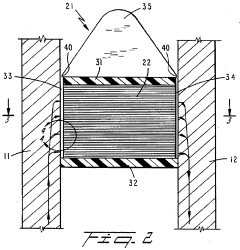
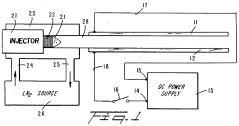
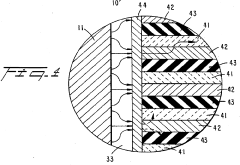
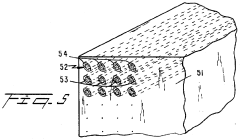
- A rail gun projectile with a superconducting armature using high-temperature Type II superconductors arranged perpendicularly to the rail direction, coupled with metal and dielectric regions to distribute current uniformly and minimize heating, and thin metallic layers to enhance current distribution and mechanical stability.
Improvements in or relating to rail gun assemblies
PatentInactiveGB2236835B
Innovation
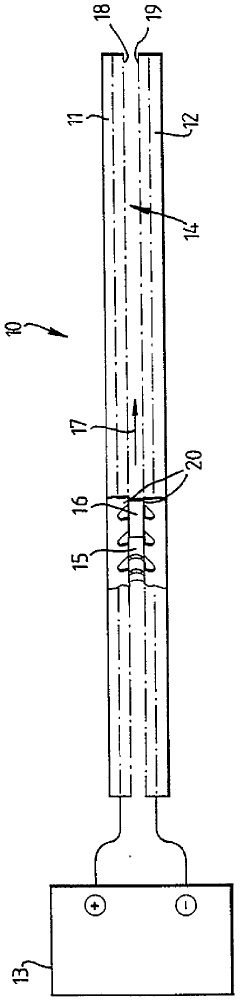
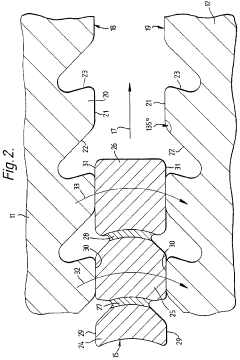
- The rail gun assembly features elongate co-extensive rail electrodes with regular toothed cross-sections and an armature composed of three electrically conductive portions, which makes and breaks contact with sequential pairs of tooth faces, distributing the current path and reducing overheating by ensuring each portion is only exposed to maximum current for a short period.
Simulation & Modeling
Simulation and modeling play a crucial role in optimizing rail gun trajectory algorithms. Advanced computational techniques are employed to create accurate digital representations of rail gun systems and their operational environments. These simulations incorporate various physical factors, including electromagnetic forces, projectile aerodynamics, and atmospheric conditions, to predict and analyze trajectory outcomes.
High-fidelity models are developed using finite element analysis (FEA) and computational fluid dynamics (CFD) to simulate the complex interactions between the rail gun's electromagnetic fields and the projectile. These models account for factors such as rail geometry, current distribution, and thermal effects, providing insights into the system's performance under different operational parameters.
Monte Carlo simulations are often utilized to assess the impact of uncertainties and variations in input parameters on trajectory outcomes. This approach enables researchers to quantify the robustness of optimization algorithms and identify potential areas for improvement. Additionally, machine learning techniques, such as neural networks and genetic algorithms, are increasingly being integrated into simulation frameworks to enhance predictive capabilities and optimize trajectory parameters in real-time.
Time-domain simulations are employed to analyze the dynamic behavior of rail gun systems during the launch process. These simulations capture transient effects, such as rail deformation and projectile acceleration, providing valuable data for refining trajectory optimization algorithms. Parallel computing techniques are often leveraged to handle the computational demands of these complex simulations, enabling faster iteration and more comprehensive analysis.
Virtual prototyping and digital twin technologies are emerging as powerful tools in rail gun trajectory optimization. These approaches allow researchers to create detailed virtual representations of rail gun systems, facilitating rapid testing and validation of optimization algorithms without the need for extensive physical prototyping. This accelerates the development cycle and reduces costs associated with experimental testing.
Sensitivity analysis techniques are integrated into simulation frameworks to identify the most influential parameters affecting trajectory performance. This information guides the focus of optimization efforts and helps prioritize areas for further research and development. Furthermore, multi-physics simulations are employed to capture the interplay between electromagnetic, thermal, and structural phenomena, providing a more comprehensive understanding of the factors influencing trajectory optimization.
High-fidelity models are developed using finite element analysis (FEA) and computational fluid dynamics (CFD) to simulate the complex interactions between the rail gun's electromagnetic fields and the projectile. These models account for factors such as rail geometry, current distribution, and thermal effects, providing insights into the system's performance under different operational parameters.
Monte Carlo simulations are often utilized to assess the impact of uncertainties and variations in input parameters on trajectory outcomes. This approach enables researchers to quantify the robustness of optimization algorithms and identify potential areas for improvement. Additionally, machine learning techniques, such as neural networks and genetic algorithms, are increasingly being integrated into simulation frameworks to enhance predictive capabilities and optimize trajectory parameters in real-time.
Time-domain simulations are employed to analyze the dynamic behavior of rail gun systems during the launch process. These simulations capture transient effects, such as rail deformation and projectile acceleration, providing valuable data for refining trajectory optimization algorithms. Parallel computing techniques are often leveraged to handle the computational demands of these complex simulations, enabling faster iteration and more comprehensive analysis.
Virtual prototyping and digital twin technologies are emerging as powerful tools in rail gun trajectory optimization. These approaches allow researchers to create detailed virtual representations of rail gun systems, facilitating rapid testing and validation of optimization algorithms without the need for extensive physical prototyping. This accelerates the development cycle and reduces costs associated with experimental testing.
Sensitivity analysis techniques are integrated into simulation frameworks to identify the most influential parameters affecting trajectory performance. This information guides the focus of optimization efforts and helps prioritize areas for further research and development. Furthermore, multi-physics simulations are employed to capture the interplay between electromagnetic, thermal, and structural phenomena, providing a more comprehensive understanding of the factors influencing trajectory optimization.
Environmental Impact
The environmental impact of rail gun trajectory optimization algorithms is a critical consideration in the development and deployment of this advanced technology. While rail guns offer potential advantages in terms of range and projectile velocity, their operation can have significant environmental consequences that must be carefully assessed and mitigated.
One of the primary environmental concerns associated with rail gun systems is the acoustic impact. The high-energy discharge and supersonic projectile launch generate intense sound waves that can propagate over long distances. This noise pollution can have detrimental effects on local wildlife, potentially disrupting ecosystems and animal behavior patterns. Additionally, the acoustic shock waves may pose risks to nearby human populations, necessitating the implementation of noise reduction strategies and buffer zones around testing and operational sites.
Electromagnetic emissions from rail gun systems present another environmental challenge. The powerful electromagnetic fields generated during firing can interfere with electronic equipment and communication systems in the surrounding area. This electromagnetic interference (EMI) may have far-reaching effects on both military and civilian infrastructure, requiring careful management and shielding techniques to minimize its impact.
The high-velocity projectiles fired by rail guns also raise concerns about atmospheric effects. As these projectiles travel through the atmosphere at hypersonic speeds, they can generate significant heat and potentially create localized atmospheric disturbances. While the scale of these effects may be limited compared to other military technologies, their cumulative impact over repeated firings and extended use should be considered in environmental assessments.
Land use and habitat disruption are additional factors to consider when evaluating the environmental impact of rail gun systems. The construction of testing facilities, launch sites, and associated infrastructure can lead to habitat fragmentation and loss of biodiversity in affected areas. Careful site selection and environmental mitigation measures are essential to minimize these impacts and preserve local ecosystems.
The materials used in rail gun construction and projectiles also warrant environmental scrutiny. Advanced alloys and composites may contain rare or toxic elements that could pose risks to soil and water quality if not properly managed throughout the system's lifecycle. Developing environmentally friendly materials and implementing robust recycling and disposal protocols are crucial steps in reducing the long-term environmental footprint of rail gun technology.
In conclusion, while computational algorithms for rail gun trajectory optimization focus primarily on performance enhancement, it is imperative that environmental considerations be integrated into the overall system design and operational planning. By addressing these environmental challenges proactively, developers can work towards creating more sustainable and environmentally responsible rail gun systems that balance technological advancement with ecological stewardship.
One of the primary environmental concerns associated with rail gun systems is the acoustic impact. The high-energy discharge and supersonic projectile launch generate intense sound waves that can propagate over long distances. This noise pollution can have detrimental effects on local wildlife, potentially disrupting ecosystems and animal behavior patterns. Additionally, the acoustic shock waves may pose risks to nearby human populations, necessitating the implementation of noise reduction strategies and buffer zones around testing and operational sites.
Electromagnetic emissions from rail gun systems present another environmental challenge. The powerful electromagnetic fields generated during firing can interfere with electronic equipment and communication systems in the surrounding area. This electromagnetic interference (EMI) may have far-reaching effects on both military and civilian infrastructure, requiring careful management and shielding techniques to minimize its impact.
The high-velocity projectiles fired by rail guns also raise concerns about atmospheric effects. As these projectiles travel through the atmosphere at hypersonic speeds, they can generate significant heat and potentially create localized atmospheric disturbances. While the scale of these effects may be limited compared to other military technologies, their cumulative impact over repeated firings and extended use should be considered in environmental assessments.
Land use and habitat disruption are additional factors to consider when evaluating the environmental impact of rail gun systems. The construction of testing facilities, launch sites, and associated infrastructure can lead to habitat fragmentation and loss of biodiversity in affected areas. Careful site selection and environmental mitigation measures are essential to minimize these impacts and preserve local ecosystems.
The materials used in rail gun construction and projectiles also warrant environmental scrutiny. Advanced alloys and composites may contain rare or toxic elements that could pose risks to soil and water quality if not properly managed throughout the system's lifecycle. Developing environmentally friendly materials and implementing robust recycling and disposal protocols are crucial steps in reducing the long-term environmental footprint of rail gun technology.
In conclusion, while computational algorithms for rail gun trajectory optimization focus primarily on performance enhancement, it is imperative that environmental considerations be integrated into the overall system design and operational planning. By addressing these environmental challenges proactively, developers can work towards creating more sustainable and environmentally responsible rail gun systems that balance technological advancement with ecological stewardship.
Unlock deeper insights with PatSnap Eureka Quick Research — get a full tech report to explore trends and direct your research. Try now!
Generate Your Research Report Instantly with AI Agent
Supercharge your innovation with PatSnap Eureka AI Agent Platform!