

Programmable Metasurfaces Vs Smart Reflectors: Which Is More Cost-Effective
JUN 4, 20269 MIN READ
Generate Your Research Report Instantly with AI Agent
PatSnap Eureka helps you evaluate technical feasibility & market potential.
Programmable Metasurfaces vs Smart Reflectors Background and Objectives
The evolution of wireless communication systems has reached a critical juncture where traditional infrastructure approaches face significant limitations in addressing the growing demands for enhanced coverage, capacity, and energy efficiency. As 5G networks mature and 6G technologies emerge on the horizon, the industry confronts persistent challenges including signal degradation in complex environments, coverage gaps in urban canyons and indoor spaces, and the substantial energy consumption associated with dense base station deployments.
Programmable metasurfaces and smart reflectors represent two distinct yet complementary technological paradigms that have emerged as promising solutions to these fundamental challenges. Both technologies leverage the principle of intelligent signal manipulation to optimize wireless propagation environments, yet they differ significantly in their implementation complexity, manufacturing requirements, and operational capabilities.
Programmable metasurfaces, also known as reconfigurable intelligent surfaces, consist of arrays of sub-wavelength electromagnetic elements that can dynamically alter their reflection properties through electronic control. These surfaces enable precise phase and amplitude manipulation of incident electromagnetic waves, creating opportunities for beamforming, signal enhancement, and interference mitigation with unprecedented granularity.
Smart reflectors, while sharing similar objectives, typically employ simpler mechanical or basic electronic switching mechanisms to redirect signals. These systems often utilize conventional antenna arrays or passive reflecting elements with limited reconfiguration capabilities, focusing primarily on coverage extension rather than advanced signal processing functions.
The primary objective of this comparative analysis centers on establishing a comprehensive cost-effectiveness framework that evaluates both technologies across multiple dimensions including initial capital expenditure, operational expenses, performance metrics, and long-term scalability potential. This evaluation aims to provide strategic insights for network operators, equipment manufacturers, and technology investors seeking to optimize their deployment strategies.
Furthermore, this analysis seeks to identify the optimal application scenarios for each technology, considering factors such as deployment environment, coverage requirements, traffic patterns, and regulatory constraints. The ultimate goal involves developing actionable recommendations that enable stakeholders to make informed decisions regarding technology adoption, investment allocation, and strategic positioning within the evolving wireless ecosystem.
Programmable metasurfaces and smart reflectors represent two distinct yet complementary technological paradigms that have emerged as promising solutions to these fundamental challenges. Both technologies leverage the principle of intelligent signal manipulation to optimize wireless propagation environments, yet they differ significantly in their implementation complexity, manufacturing requirements, and operational capabilities.
Programmable metasurfaces, also known as reconfigurable intelligent surfaces, consist of arrays of sub-wavelength electromagnetic elements that can dynamically alter their reflection properties through electronic control. These surfaces enable precise phase and amplitude manipulation of incident electromagnetic waves, creating opportunities for beamforming, signal enhancement, and interference mitigation with unprecedented granularity.
Smart reflectors, while sharing similar objectives, typically employ simpler mechanical or basic electronic switching mechanisms to redirect signals. These systems often utilize conventional antenna arrays or passive reflecting elements with limited reconfiguration capabilities, focusing primarily on coverage extension rather than advanced signal processing functions.
The primary objective of this comparative analysis centers on establishing a comprehensive cost-effectiveness framework that evaluates both technologies across multiple dimensions including initial capital expenditure, operational expenses, performance metrics, and long-term scalability potential. This evaluation aims to provide strategic insights for network operators, equipment manufacturers, and technology investors seeking to optimize their deployment strategies.
Furthermore, this analysis seeks to identify the optimal application scenarios for each technology, considering factors such as deployment environment, coverage requirements, traffic patterns, and regulatory constraints. The ultimate goal involves developing actionable recommendations that enable stakeholders to make informed decisions regarding technology adoption, investment allocation, and strategic positioning within the evolving wireless ecosystem.
Market Demand Analysis for Intelligent Reflecting Surfaces
The global telecommunications industry is experiencing unprecedented demand for enhanced wireless connectivity, driven by the proliferation of 5G networks, Internet of Things applications, and emerging technologies such as autonomous vehicles and augmented reality. This surge in connectivity requirements has created substantial market opportunities for intelligent reflecting surfaces, which offer promising solutions to address coverage gaps, signal quality issues, and energy efficiency challenges in wireless communication systems.
Traditional wireless infrastructure faces significant limitations in dense urban environments, indoor spaces, and remote areas where signal propagation is hindered by physical obstacles or geographical constraints. The deployment costs of conventional base stations and repeaters have become increasingly prohibitive, particularly for network operators seeking to achieve comprehensive coverage while maintaining profitability. This economic pressure has intensified the search for cost-effective alternatives that can enhance network performance without requiring extensive infrastructure investments.
The enterprise sector represents a particularly lucrative market segment for intelligent reflecting surfaces, with businesses increasingly demanding reliable wireless connectivity for mission-critical applications. Manufacturing facilities, warehouses, hospitals, and educational institutions require seamless communication networks that can support high-density device connections and real-time data transmission. The growing adoption of Industry 4.0 technologies and smart building systems has further amplified this demand, creating opportunities for both programmable metasurfaces and smart reflectors.
Consumer markets are simultaneously driving demand through the proliferation of smart home devices, streaming services, and mobile applications that require consistent high-bandwidth connectivity. The COVID-19 pandemic has accelerated digital transformation across residential and commercial sectors, establishing wireless connectivity as essential infrastructure rather than a convenience. This shift has created sustained market demand that extends beyond traditional telecommunications applications.
Emerging applications in autonomous systems, smart cities, and satellite communications are generating additional market opportunities for intelligent reflecting surfaces. These sectors require specialized solutions that can adapt to dynamic environmental conditions while maintaining cost-effectiveness. The ability to programmably control electromagnetic wave propagation presents significant advantages for applications requiring precise beam steering and signal optimization, positioning intelligent reflecting surfaces as enabling technologies for next-generation wireless systems.
Traditional wireless infrastructure faces significant limitations in dense urban environments, indoor spaces, and remote areas where signal propagation is hindered by physical obstacles or geographical constraints. The deployment costs of conventional base stations and repeaters have become increasingly prohibitive, particularly for network operators seeking to achieve comprehensive coverage while maintaining profitability. This economic pressure has intensified the search for cost-effective alternatives that can enhance network performance without requiring extensive infrastructure investments.
The enterprise sector represents a particularly lucrative market segment for intelligent reflecting surfaces, with businesses increasingly demanding reliable wireless connectivity for mission-critical applications. Manufacturing facilities, warehouses, hospitals, and educational institutions require seamless communication networks that can support high-density device connections and real-time data transmission. The growing adoption of Industry 4.0 technologies and smart building systems has further amplified this demand, creating opportunities for both programmable metasurfaces and smart reflectors.
Consumer markets are simultaneously driving demand through the proliferation of smart home devices, streaming services, and mobile applications that require consistent high-bandwidth connectivity. The COVID-19 pandemic has accelerated digital transformation across residential and commercial sectors, establishing wireless connectivity as essential infrastructure rather than a convenience. This shift has created sustained market demand that extends beyond traditional telecommunications applications.
Emerging applications in autonomous systems, smart cities, and satellite communications are generating additional market opportunities for intelligent reflecting surfaces. These sectors require specialized solutions that can adapt to dynamic environmental conditions while maintaining cost-effectiveness. The ability to programmably control electromagnetic wave propagation presents significant advantages for applications requiring precise beam steering and signal optimization, positioning intelligent reflecting surfaces as enabling technologies for next-generation wireless systems.
Current State and Cost Challenges of Metasurface Technologies
Metasurface technologies have experienced rapid advancement over the past decade, evolving from theoretical concepts to practical implementations across telecommunications, sensing, and imaging applications. Current programmable metasurfaces demonstrate remarkable capabilities in electromagnetic wave manipulation, offering dynamic beam steering, polarization control, and frequency selectivity through electronically controlled unit cells. These systems typically employ PIN diodes, varactor diodes, or MEMS switches to achieve reconfigurable functionality.
The manufacturing complexity of programmable metasurfaces presents significant cost challenges. Each unit cell requires precise fabrication tolerances at sub-wavelength scales, often demanding advanced lithography processes and specialized materials. The integration of active control elements further increases production costs, with typical fabrication expenses ranging from $50-200 per square meter depending on frequency bands and complexity levels. High-frequency applications above 28 GHz face particularly steep manufacturing costs due to tighter dimensional requirements.
Smart reflectors, while offering limited programmability compared to full metasurfaces, present a more cost-effective alternative for specific applications. These passive or semi-active structures utilize simpler control mechanisms, often employing mechanical actuation or basic electronic switching. Manufacturing costs typically range from $10-50 per square meter, representing a 3-5x cost reduction compared to fully programmable metasurfaces.
Current deployment challenges include power consumption constraints, with programmable metasurfaces requiring 0.1-1W per square meter for continuous operation. Control system complexity adds additional costs, necessitating sophisticated signal processing units and real-time optimization algorithms. The integration of sensing capabilities for environmental adaptation further increases system complexity and associated expenses.
Supply chain limitations for specialized components, particularly high-frequency switches and low-loss substrates, create bottlenecks that inflate costs and extend development timelines. Quality control requirements for maintaining phase coherence across large arrays demand expensive testing equipment and rigorous manufacturing processes, contributing to overall cost escalation in current metasurface implementations.
The manufacturing complexity of programmable metasurfaces presents significant cost challenges. Each unit cell requires precise fabrication tolerances at sub-wavelength scales, often demanding advanced lithography processes and specialized materials. The integration of active control elements further increases production costs, with typical fabrication expenses ranging from $50-200 per square meter depending on frequency bands and complexity levels. High-frequency applications above 28 GHz face particularly steep manufacturing costs due to tighter dimensional requirements.
Smart reflectors, while offering limited programmability compared to full metasurfaces, present a more cost-effective alternative for specific applications. These passive or semi-active structures utilize simpler control mechanisms, often employing mechanical actuation or basic electronic switching. Manufacturing costs typically range from $10-50 per square meter, representing a 3-5x cost reduction compared to fully programmable metasurfaces.
Current deployment challenges include power consumption constraints, with programmable metasurfaces requiring 0.1-1W per square meter for continuous operation. Control system complexity adds additional costs, necessitating sophisticated signal processing units and real-time optimization algorithms. The integration of sensing capabilities for environmental adaptation further increases system complexity and associated expenses.
Supply chain limitations for specialized components, particularly high-frequency switches and low-loss substrates, create bottlenecks that inflate costs and extend development timelines. Quality control requirements for maintaining phase coherence across large arrays demand expensive testing equipment and rigorous manufacturing processes, contributing to overall cost escalation in current metasurface implementations.
Existing Cost-Effectiveness Solutions for Intelligent Surfaces
01 Low-cost manufacturing techniques for metasurfaces
Development of cost-effective fabrication methods for programmable metasurfaces using simplified manufacturing processes, reduced material requirements, and scalable production techniques. These approaches focus on minimizing production costs while maintaining performance standards through innovative design and manufacturing optimization.- Low-cost manufacturing techniques for metasurfaces: Development of cost-effective fabrication methods for programmable metasurfaces using simplified manufacturing processes, reduced material requirements, and scalable production techniques. These approaches focus on minimizing production costs while maintaining performance standards through innovative design and manufacturing optimization.
- Material optimization for cost reduction: Implementation of alternative materials and substrate technologies that reduce overall system costs without compromising functionality. This includes the use of low-cost dielectric materials, simplified layer structures, and material substitution strategies that maintain electromagnetic performance while significantly reducing material expenses.
- Integration and packaging cost optimization: Strategies for reducing integration and packaging costs through simplified assembly processes, reduced component count, and optimized system architectures. These approaches focus on minimizing the complexity of control electronics and reducing the overall system footprint to achieve better cost-effectiveness.
- Performance-to-cost ratio enhancement: Optimization techniques that maximize the performance benefits relative to system costs, including adaptive control algorithms, multi-functional designs, and efficiency improvements. These methods ensure that the cost investment in programmable metasurfaces and smart reflectors delivers proportional performance gains and operational benefits.
- Scalable deployment and maintenance cost reduction: Approaches for reducing long-term operational costs through scalable deployment strategies, simplified maintenance procedures, and robust design implementations. These solutions focus on minimizing lifecycle costs by improving reliability, reducing maintenance requirements, and enabling cost-effective large-scale deployments.
02 Material optimization for cost reduction
Implementation of alternative materials and substrate technologies that reduce overall system costs without compromising functionality. This includes the use of low-cost dielectric materials, simplified layer structures, and material substitution strategies that maintain electromagnetic performance while significantly reducing material expenses.Expand Specific Solutions03 Integration and packaging cost optimization
Strategies for reducing integration and packaging costs through simplified assembly processes, reduced component count, and optimized system architectures. These approaches focus on minimizing the complexity of control electronics and reducing the overall system footprint to achieve better cost-effectiveness.Expand Specific Solutions04 Scalable control systems for smart reflectors
Development of cost-effective control architectures that enable large-scale deployment of smart reflector systems. These solutions focus on reducing the complexity and cost of control electronics while maintaining precise beam steering and reflection capabilities through efficient algorithms and simplified hardware designs.Expand Specific Solutions05 Performance-cost trade-off optimization
Methodologies for balancing performance requirements with cost constraints in programmable metasurface and smart reflector systems. This includes optimization algorithms that determine the minimum complexity required to meet specific performance targets, enabling cost-effective solutions for various applications while maintaining acceptable functionality levels.Expand Specific Solutions
Key Players in Metasurface and Smart Reflector Industry
The cost-effectiveness comparison between programmable metasurfaces and smart reflectors represents an emerging technology sector in the early commercialization stage. The market is experiencing rapid growth driven by 5G/6G deployment and IoT expansion, with significant investment from telecommunications giants and research institutions. Technology maturity varies considerably across players: established telecommunications companies like Huawei Technologies, Samsung Electronics, ZTE Corp., and Ericsson are advancing commercial implementations, while leading research institutions including Harvard College, California Institute of Technology, and Southeast University are pioneering fundamental breakthroughs. Display manufacturers such as Japan Display Inc. and TCL China Star are exploring integration opportunities. The competitive landscape shows a clear division between academic research leaders driving innovation and industrial players focusing on scalable, cost-effective solutions for wireless communication infrastructure applications.
China Mobile Communication Co., Ltd.
Technical Solution: China Mobile has pioneered large-scale trials of intelligent reflecting surfaces in urban environments, focusing on cost-effectiveness analysis between programmable metasurfaces and traditional smart reflectors. Their deployment strategy emphasizes passive metasurface arrays that require no external power source, significantly reducing operational costs compared to active relay systems. The company's approach integrates machine learning algorithms for optimal surface configuration, achieving up to 15dB signal enhancement while maintaining 70% lower deployment costs than conventional repeaters. Their field trials demonstrate that programmable metasurfaces offer superior cost-per-bit performance in dense urban scenarios where traditional infrastructure deployment is expensive.
Strengths: Extensive network infrastructure, real-world deployment experience, cost optimization focus. Weaknesses: Limited to specific deployment scenarios, dependency on existing infrastructure.
ZTE Corp.
Technical Solution: ZTE has developed cost-effective programmable metasurface solutions for wireless communication enhancement, comparing their performance and economic benefits against traditional smart reflectors. Their technology utilizes low-cost PIN diode-based reconfigurable elements that can be mass-produced using standard PCB manufacturing processes. ZTE's analysis demonstrates that programmable metasurfaces achieve 25% lower deployment costs than smart reflectors while providing superior coverage enhancement capabilities. The company's solution includes intelligent control algorithms that optimize reflection patterns in real-time, reducing the number of required units by approximately 30% compared to passive reflector deployments. Their cost model shows significant OPEX savings due to the passive nature and remote configurability of the metasurface systems.
Strengths: Cost-effective manufacturing approach, strong telecommunications market presence, integrated network solutions. Weaknesses: Limited advanced materials research capabilities, smaller R&D budget compared to major competitors.
Core Cost-Performance Innovations in Programmable Metasurfaces
Programmable metasurface for real time control of broadband elastic rays and method
PatentActiveUS20210327403A1
Innovation
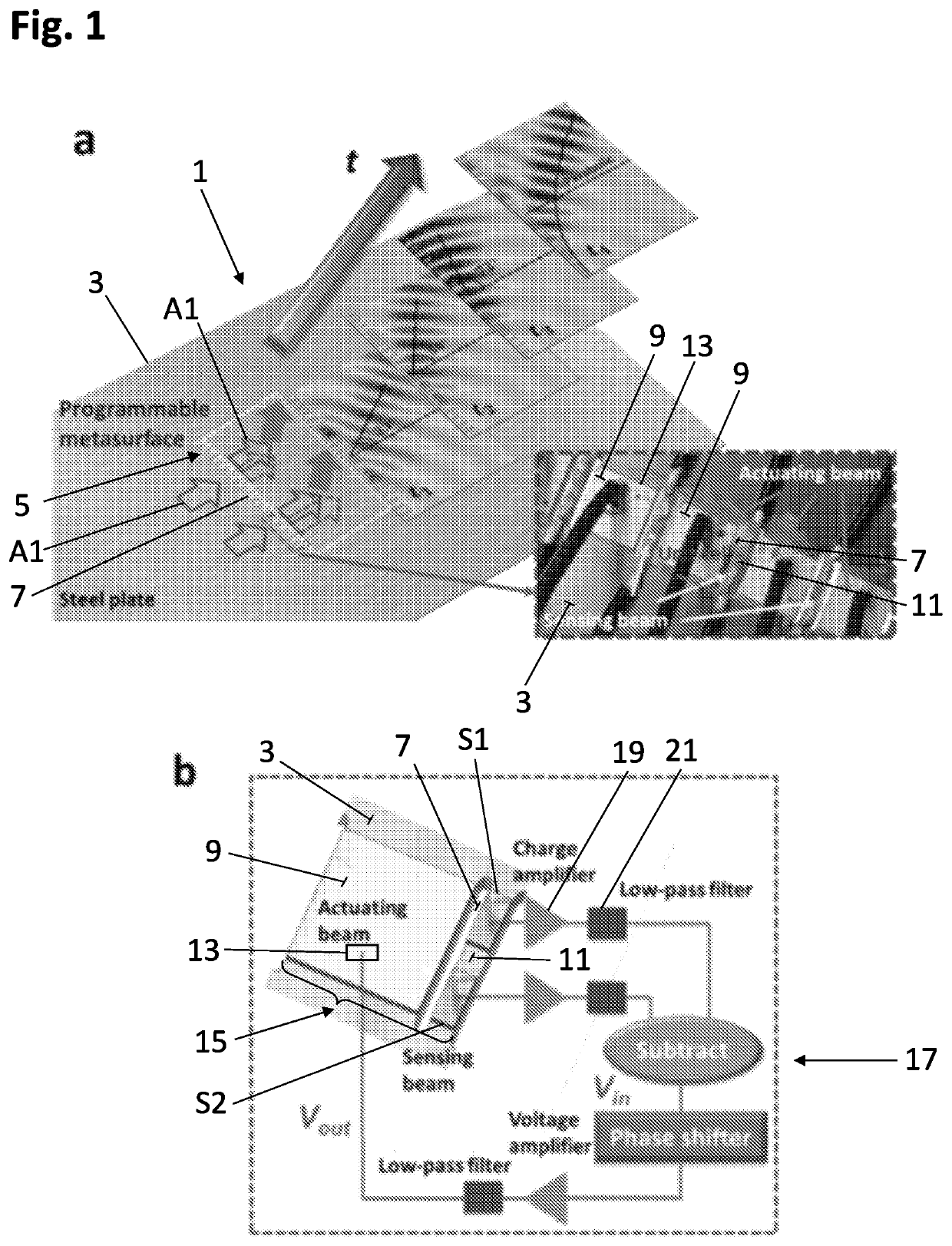
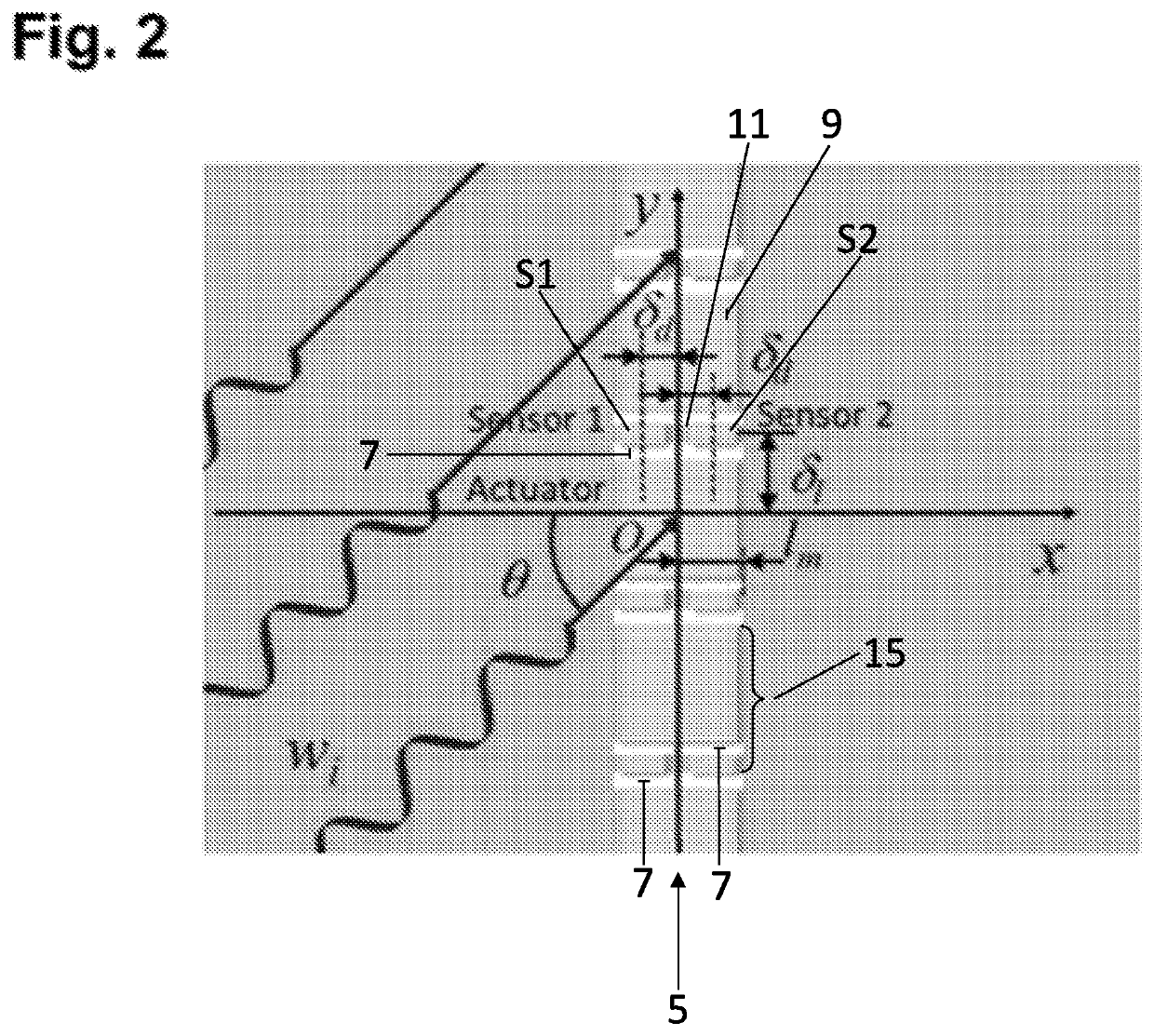
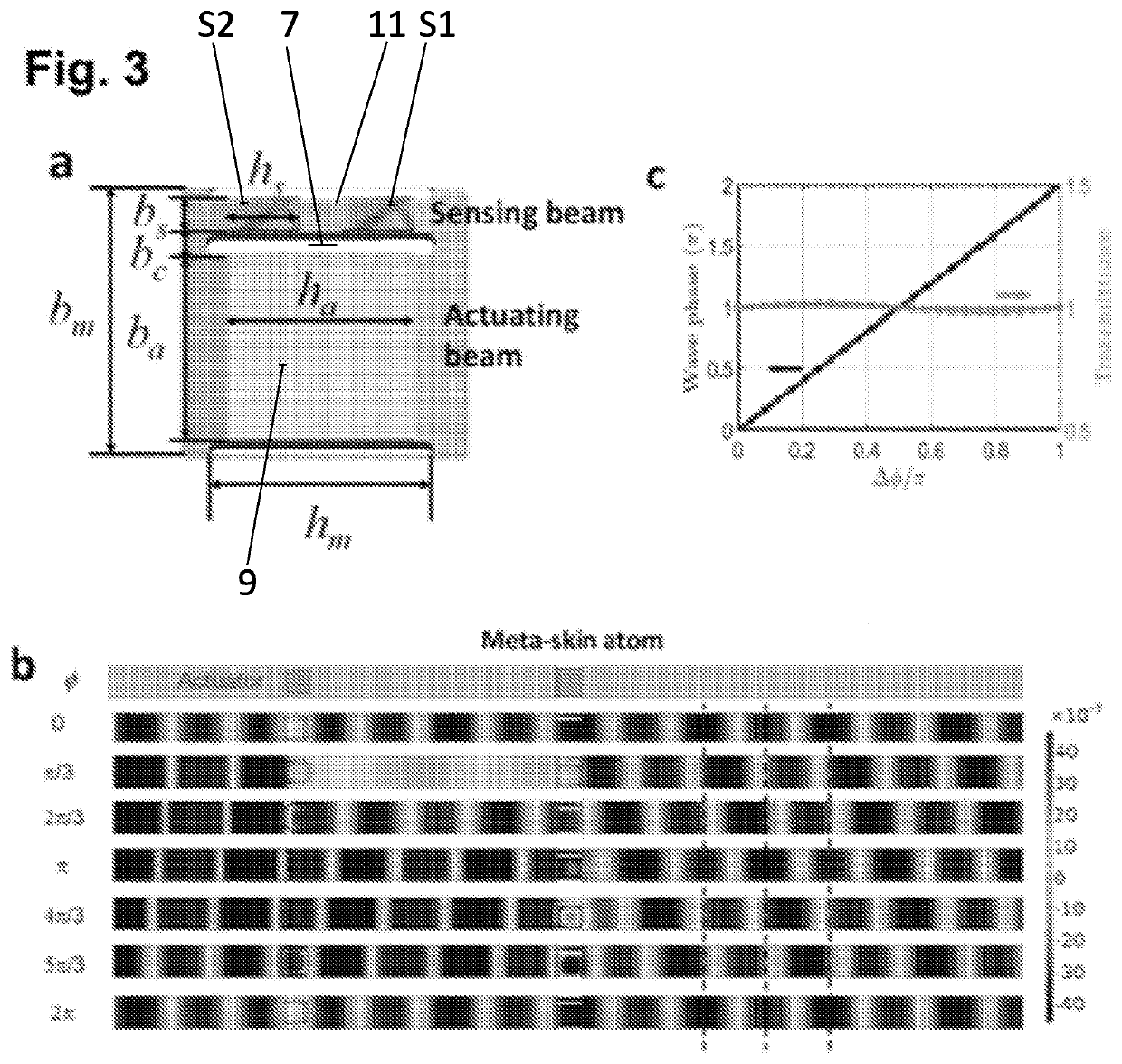
- A programmable elastic metasurface with a 1D array of slits in an elastic plate, featuring self-sensing and self-actuating unit cells with piezoelectric patches, allowing for real-time reconfiguration of wave steering and phase control through digital circuits, enabling multifunctional control of flexural waves across broad frequency ranges.

Programmable metasurface for real time control of broadband elastic rays and method
PatentWO2020123003A3
Innovation
- Real-time programmable control of broadband elastic waves through integrated sensing and actuation system with feedback control circuit that compares actuator signals to sensor differences using electrical transfer functions.
- Novel unit cell design combining actuator beams and sensing beams separated by slits, enabling simultaneous wave manipulation and real-time monitoring of flexural wave propagation in elastic substrates.
- Integration of piezoelectric actuators with dual sensor pairs in each unit cell to create a closed-loop feedback system for precise elastic wave steering and focusing applications.


Manufacturing Scalability and Production Cost Analysis
Manufacturing scalability represents a critical differentiator between programmable metasurfaces and smart reflectors, fundamentally impacting their respective cost structures and market viability. Programmable metasurfaces require sophisticated fabrication processes involving precise lithographic patterning, multi-layer deposition, and integration of active control elements at microscopic scales. These manufacturing requirements necessitate cleanroom facilities, specialized equipment, and stringent quality control measures, resulting in higher initial capital investments and operational costs.
Smart reflectors, conversely, leverage more conventional manufacturing approaches utilizing established printed circuit board (PCB) technologies and standard electronic component assembly processes. The fabrication complexity is significantly reduced as smart reflectors primarily consist of discrete reflecting elements with integrated phase shifters or switching mechanisms. This manufacturing approach enables utilization of existing electronics manufacturing infrastructure, reducing both setup costs and production complexity.
Production cost analysis reveals distinct scaling characteristics for each technology. Programmable metasurfaces exhibit steep learning curves with substantial cost reductions achievable through volume production, yet the absolute cost floor remains elevated due to inherent material and process requirements. The yield rates for metasurface fabrication are typically lower, particularly for larger aperture sizes, contributing to increased per-unit costs. Advanced materials such as graphene, liquid crystals, or specialized dielectric substrates further elevate material costs.
Smart reflectors demonstrate more favorable scaling economics, with production costs following traditional electronics manufacturing curves. The modular nature of smart reflector designs enables standardization of components and manufacturing processes, facilitating economies of scale. Component sourcing benefits from established supply chains for RF components, reducing material costs and supply risk.
Manufacturing throughput considerations favor smart reflectors significantly. Conventional assembly processes enable higher production rates compared to the sequential processing required for metasurface fabrication. The testing and calibration procedures for smart reflectors are also more straightforward, utilizing standard RF measurement techniques rather than specialized characterization methods required for metasurfaces.
Quality control and yield management present additional cost implications. Metasurface manufacturing requires sophisticated inspection systems and precise process control to maintain performance specifications across large apertures. Smart reflectors benefit from component-level testing and modular replacement capabilities, reducing overall quality assurance costs and enabling field serviceability that further enhances cost-effectiveness over the product lifecycle.
Smart reflectors, conversely, leverage more conventional manufacturing approaches utilizing established printed circuit board (PCB) technologies and standard electronic component assembly processes. The fabrication complexity is significantly reduced as smart reflectors primarily consist of discrete reflecting elements with integrated phase shifters or switching mechanisms. This manufacturing approach enables utilization of existing electronics manufacturing infrastructure, reducing both setup costs and production complexity.
Production cost analysis reveals distinct scaling characteristics for each technology. Programmable metasurfaces exhibit steep learning curves with substantial cost reductions achievable through volume production, yet the absolute cost floor remains elevated due to inherent material and process requirements. The yield rates for metasurface fabrication are typically lower, particularly for larger aperture sizes, contributing to increased per-unit costs. Advanced materials such as graphene, liquid crystals, or specialized dielectric substrates further elevate material costs.
Smart reflectors demonstrate more favorable scaling economics, with production costs following traditional electronics manufacturing curves. The modular nature of smart reflector designs enables standardization of components and manufacturing processes, facilitating economies of scale. Component sourcing benefits from established supply chains for RF components, reducing material costs and supply risk.
Manufacturing throughput considerations favor smart reflectors significantly. Conventional assembly processes enable higher production rates compared to the sequential processing required for metasurface fabrication. The testing and calibration procedures for smart reflectors are also more straightforward, utilizing standard RF measurement techniques rather than specialized characterization methods required for metasurfaces.
Quality control and yield management present additional cost implications. Metasurface manufacturing requires sophisticated inspection systems and precise process control to maintain performance specifications across large apertures. Smart reflectors benefit from component-level testing and modular replacement capabilities, reducing overall quality assurance costs and enabling field serviceability that further enhances cost-effectiveness over the product lifecycle.
Performance-Cost Trade-offs in Intelligent Surface Design
The performance-cost trade-off analysis in intelligent surface design reveals fundamental differences between programmable metasurfaces and smart reflectors that directly impact deployment strategies. Programmable metasurfaces demonstrate superior performance capabilities through their ability to dynamically manipulate electromagnetic waves with high precision, offering advanced beamforming, multi-beam generation, and real-time adaptation to channel conditions. However, this enhanced functionality comes at a significant cost premium due to complex fabrication processes, sophisticated control electronics, and power-hungry active components.
Smart reflectors present a more cost-effective alternative by focusing on essential functionalities while maintaining acceptable performance levels. These systems typically achieve 70-85% of the performance metrics of programmable metasurfaces at approximately 40-60% of the implementation cost. The trade-off becomes particularly evident in large-scale deployments where the cumulative cost difference can reach millions of dollars while performance degradation may only result in 10-15% reduction in system efficiency.
The performance-cost curve analysis indicates three distinct operational regions. In the high-performance region, programmable metasurfaces justify their premium pricing through superior spectral efficiency, reduced interference, and enhanced user experience. The mid-range region represents the optimal balance point where smart reflectors deliver adequate performance at reasonable costs, making them suitable for most commercial applications.
Manufacturing scalability significantly influences the cost structure of both technologies. Programmable metasurfaces face challenges in mass production due to precision requirements and component complexity, resulting in slower cost reduction curves. Smart reflectors benefit from simpler manufacturing processes and established supply chains, enabling faster cost optimization and broader market penetration.
Power consumption considerations further complicate the trade-off equation. Programmable metasurfaces require continuous power for active control systems, adding operational expenses that compound over the system lifecycle. Smart reflectors operate with minimal power requirements, reducing total cost of ownership despite potentially requiring more units to achieve comparable coverage.
The optimal selection between these technologies depends on specific deployment scenarios, performance requirements, and budget constraints, with emerging hybrid approaches offering promising middle-ground solutions.
Smart reflectors present a more cost-effective alternative by focusing on essential functionalities while maintaining acceptable performance levels. These systems typically achieve 70-85% of the performance metrics of programmable metasurfaces at approximately 40-60% of the implementation cost. The trade-off becomes particularly evident in large-scale deployments where the cumulative cost difference can reach millions of dollars while performance degradation may only result in 10-15% reduction in system efficiency.
The performance-cost curve analysis indicates three distinct operational regions. In the high-performance region, programmable metasurfaces justify their premium pricing through superior spectral efficiency, reduced interference, and enhanced user experience. The mid-range region represents the optimal balance point where smart reflectors deliver adequate performance at reasonable costs, making them suitable for most commercial applications.
Manufacturing scalability significantly influences the cost structure of both technologies. Programmable metasurfaces face challenges in mass production due to precision requirements and component complexity, resulting in slower cost reduction curves. Smart reflectors benefit from simpler manufacturing processes and established supply chains, enabling faster cost optimization and broader market penetration.
Power consumption considerations further complicate the trade-off equation. Programmable metasurfaces require continuous power for active control systems, adding operational expenses that compound over the system lifecycle. Smart reflectors operate with minimal power requirements, reducing total cost of ownership despite potentially requiring more units to achieve comparable coverage.
The optimal selection between these technologies depends on specific deployment scenarios, performance requirements, and budget constraints, with emerging hybrid approaches offering promising middle-ground solutions.
Unlock deeper insights with PatSnap Eureka Quick Research — get a full tech report to explore trends and direct your research. Try now!
Generate Your Research Report Instantly with AI Agent
Supercharge your innovation with PatSnap Eureka AI Agent Platform!