

Programmable Metasurfaces For Urban Environments: Multi-Path Fading Studies
JUN 4, 202610 MIN READ
Generate Your Research Report Instantly with AI Agent
PatSnap Eureka helps you evaluate technical feasibility & market potential.
Programmable Metasurface Technology Background and Objectives
Programmable metasurfaces represent a revolutionary advancement in electromagnetic wave manipulation technology, emerging from the convergence of metamaterial science, digital signal processing, and wireless communication engineering. These artificially engineered surfaces consist of sub-wavelength unit cells that can be dynamically controlled to alter electromagnetic wave properties including amplitude, phase, polarization, and propagation direction in real-time.
The evolution of metasurface technology traces back to early metamaterial research in the 1990s, progressing through passive metasurfaces to today's sophisticated programmable variants. Traditional passive metasurfaces offered fixed electromagnetic responses, while programmable metasurfaces incorporate active elements such as PIN diodes, varactors, or micro-electromechanical systems (MEMS) switches, enabling dynamic reconfiguration of their electromagnetic properties through external control signals.
Urban wireless communication environments present unique challenges characterized by complex multi-path propagation, signal fading, interference, and coverage limitations. Dense building structures, varying terrain, and high user density create electromagnetic environments where traditional communication infrastructure struggles to maintain consistent service quality. Multi-path fading occurs when transmitted signals reach receivers through multiple paths with different delays and attenuations, causing signal distortion and reduced communication reliability.
The primary objective of implementing programmable metasurfaces in urban environments focuses on intelligent electromagnetic environment manipulation to mitigate multi-path fading effects. These surfaces can function as intelligent reflecting surfaces (IRS) or reconfigurable intelligent surfaces (RIS), strategically positioned on building facades, infrastructure elements, or dedicated installations to create controlled reflection, refraction, and focusing of electromagnetic waves.
Key technical objectives include developing adaptive beamforming capabilities that dynamically adjust reflection patterns based on real-time channel conditions, implementing machine learning algorithms for predictive channel optimization, and creating distributed control systems that coordinate multiple metasurface installations across urban landscapes. The technology aims to transform passive urban infrastructure into active participants in wireless communication networks.
Research objectives encompass comprehensive characterization of multi-path fading mitigation effectiveness, development of robust control algorithms for dynamic urban environments, and establishment of integration frameworks with existing 5G and future 6G communication systems. The ultimate goal involves creating smart urban electromagnetic environments that enhance communication reliability, increase network capacity, and enable new applications in smart city infrastructure.
The evolution of metasurface technology traces back to early metamaterial research in the 1990s, progressing through passive metasurfaces to today's sophisticated programmable variants. Traditional passive metasurfaces offered fixed electromagnetic responses, while programmable metasurfaces incorporate active elements such as PIN diodes, varactors, or micro-electromechanical systems (MEMS) switches, enabling dynamic reconfiguration of their electromagnetic properties through external control signals.
Urban wireless communication environments present unique challenges characterized by complex multi-path propagation, signal fading, interference, and coverage limitations. Dense building structures, varying terrain, and high user density create electromagnetic environments where traditional communication infrastructure struggles to maintain consistent service quality. Multi-path fading occurs when transmitted signals reach receivers through multiple paths with different delays and attenuations, causing signal distortion and reduced communication reliability.
The primary objective of implementing programmable metasurfaces in urban environments focuses on intelligent electromagnetic environment manipulation to mitigate multi-path fading effects. These surfaces can function as intelligent reflecting surfaces (IRS) or reconfigurable intelligent surfaces (RIS), strategically positioned on building facades, infrastructure elements, or dedicated installations to create controlled reflection, refraction, and focusing of electromagnetic waves.
Key technical objectives include developing adaptive beamforming capabilities that dynamically adjust reflection patterns based on real-time channel conditions, implementing machine learning algorithms for predictive channel optimization, and creating distributed control systems that coordinate multiple metasurface installations across urban landscapes. The technology aims to transform passive urban infrastructure into active participants in wireless communication networks.
Research objectives encompass comprehensive characterization of multi-path fading mitigation effectiveness, development of robust control algorithms for dynamic urban environments, and establishment of integration frameworks with existing 5G and future 6G communication systems. The ultimate goal involves creating smart urban electromagnetic environments that enhance communication reliability, increase network capacity, and enable new applications in smart city infrastructure.
Market Demand for Urban Wireless Communication Enhancement
The global wireless communication market is experiencing unprecedented growth driven by the proliferation of smart devices, Internet of Things applications, and the deployment of 5G networks. Urban environments present unique challenges for wireless communication systems due to dense infrastructure, high user density, and complex electromagnetic propagation conditions. These factors create substantial market opportunities for innovative solutions that can enhance signal quality and network performance in metropolitan areas.
Multi-path fading represents one of the most significant technical challenges in urban wireless communications, causing signal degradation, reduced data throughput, and poor user experience. Traditional solutions such as massive MIMO systems and beamforming technologies have limitations in addressing the complex scattering environments characteristic of urban landscapes. The market demand for more sophisticated solutions has intensified as mobile operators struggle to meet quality of service requirements while managing increasing data traffic volumes.
Programmable metasurfaces emerge as a transformative technology addressing these market needs by offering dynamic control over electromagnetic wave propagation. The ability to reconfigure wireless environments in real-time presents compelling value propositions for telecommunications operators, smart city developers, and infrastructure providers. Market drivers include the need for improved coverage in dead zones, enhanced capacity in high-traffic areas, and reduced infrastructure deployment costs compared to traditional cell tower installations.
The enterprise segment demonstrates strong demand for reliable indoor wireless solutions, particularly in large commercial buildings, airports, and shopping centers where conventional systems struggle with signal penetration and coverage uniformity. Government initiatives promoting smart city development further amplify market demand, as programmable metasurfaces can support multiple applications including traffic management, environmental monitoring, and public safety communications through enhanced wireless connectivity.
Market adoption is accelerated by the increasing cost of spectrum licenses and the pressure to maximize spectral efficiency. Programmable metasurfaces offer operators the opportunity to optimize existing spectrum usage without requiring additional frequency allocations. The technology's potential to reduce energy consumption while improving performance aligns with sustainability goals increasingly prioritized by telecommunications companies and regulatory bodies.
The convergence of artificial intelligence with programmable metasurfaces creates additional market opportunities through intelligent network optimization and predictive maintenance capabilities. This integration addresses the growing demand for autonomous network management solutions that can adapt to changing urban environments and traffic patterns without human intervention.
Multi-path fading represents one of the most significant technical challenges in urban wireless communications, causing signal degradation, reduced data throughput, and poor user experience. Traditional solutions such as massive MIMO systems and beamforming technologies have limitations in addressing the complex scattering environments characteristic of urban landscapes. The market demand for more sophisticated solutions has intensified as mobile operators struggle to meet quality of service requirements while managing increasing data traffic volumes.
Programmable metasurfaces emerge as a transformative technology addressing these market needs by offering dynamic control over electromagnetic wave propagation. The ability to reconfigure wireless environments in real-time presents compelling value propositions for telecommunications operators, smart city developers, and infrastructure providers. Market drivers include the need for improved coverage in dead zones, enhanced capacity in high-traffic areas, and reduced infrastructure deployment costs compared to traditional cell tower installations.
The enterprise segment demonstrates strong demand for reliable indoor wireless solutions, particularly in large commercial buildings, airports, and shopping centers where conventional systems struggle with signal penetration and coverage uniformity. Government initiatives promoting smart city development further amplify market demand, as programmable metasurfaces can support multiple applications including traffic management, environmental monitoring, and public safety communications through enhanced wireless connectivity.
Market adoption is accelerated by the increasing cost of spectrum licenses and the pressure to maximize spectral efficiency. Programmable metasurfaces offer operators the opportunity to optimize existing spectrum usage without requiring additional frequency allocations. The technology's potential to reduce energy consumption while improving performance aligns with sustainability goals increasingly prioritized by telecommunications companies and regulatory bodies.
The convergence of artificial intelligence with programmable metasurfaces creates additional market opportunities through intelligent network optimization and predictive maintenance capabilities. This integration addresses the growing demand for autonomous network management solutions that can adapt to changing urban environments and traffic patterns without human intervention.
Current State and Multi-Path Fading Challenges in Urban Areas
Programmable metasurfaces represent an emerging paradigm in electromagnetic wave manipulation, offering unprecedented control over wireless signal propagation in complex urban environments. These artificially engineered surfaces consist of sub-wavelength unit cells that can dynamically alter their electromagnetic properties through electronic control, enabling real-time manipulation of incident electromagnetic waves. Current implementations primarily focus on reconfigurable intelligent surfaces (RIS) and intelligent reflecting surfaces (IRS) deployed on building facades, indoor walls, and infrastructure elements.
The fundamental challenge of multi-path fading in urban environments stems from the complex interaction between electromagnetic waves and dense architectural structures. Urban landscapes create intricate propagation scenarios where signals undergo multiple reflections, diffractions, and scattering effects from buildings, vehicles, and other obstacles. This results in constructive and destructive interference patterns that cause significant signal amplitude and phase variations at receiver locations, leading to degraded communication quality and reduced system reliability.
Contemporary research demonstrates that programmable metasurfaces can actively mitigate multi-path fading through intelligent beam steering and signal enhancement. However, several technical limitations persist in current implementations. The operational bandwidth of most metasurface designs remains constrained, typically covering narrow frequency ranges that limit their applicability across diverse communication standards. Additionally, the computational complexity required for real-time optimization of large-scale metasurface arrays presents significant processing challenges.
Power consumption represents another critical constraint, as current metasurface designs require substantial energy for continuous operation of control circuits and phase-shifting elements. The integration of sensing capabilities for channel state information acquisition adds further complexity to system architectures. Environmental factors such as weather conditions, temperature variations, and mechanical vibrations also impact the stability and performance of deployed metasurface systems.
Manufacturing precision and cost considerations currently limit the widespread deployment of programmable metasurfaces in urban environments. The fabrication of large-scale arrays with consistent electromagnetic properties across thousands of unit cells requires advanced manufacturing techniques that increase production costs. Furthermore, the lack of standardized design methodologies and optimization algorithms hinders the development of robust, scalable solutions for diverse urban deployment scenarios.
Despite these challenges, recent advances in metamaterial design, control algorithms, and integration techniques demonstrate promising pathways toward practical implementation of programmable metasurfaces for urban multi-path fading mitigation.
The fundamental challenge of multi-path fading in urban environments stems from the complex interaction between electromagnetic waves and dense architectural structures. Urban landscapes create intricate propagation scenarios where signals undergo multiple reflections, diffractions, and scattering effects from buildings, vehicles, and other obstacles. This results in constructive and destructive interference patterns that cause significant signal amplitude and phase variations at receiver locations, leading to degraded communication quality and reduced system reliability.
Contemporary research demonstrates that programmable metasurfaces can actively mitigate multi-path fading through intelligent beam steering and signal enhancement. However, several technical limitations persist in current implementations. The operational bandwidth of most metasurface designs remains constrained, typically covering narrow frequency ranges that limit their applicability across diverse communication standards. Additionally, the computational complexity required for real-time optimization of large-scale metasurface arrays presents significant processing challenges.
Power consumption represents another critical constraint, as current metasurface designs require substantial energy for continuous operation of control circuits and phase-shifting elements. The integration of sensing capabilities for channel state information acquisition adds further complexity to system architectures. Environmental factors such as weather conditions, temperature variations, and mechanical vibrations also impact the stability and performance of deployed metasurface systems.
Manufacturing precision and cost considerations currently limit the widespread deployment of programmable metasurfaces in urban environments. The fabrication of large-scale arrays with consistent electromagnetic properties across thousands of unit cells requires advanced manufacturing techniques that increase production costs. Furthermore, the lack of standardized design methodologies and optimization algorithms hinders the development of robust, scalable solutions for diverse urban deployment scenarios.
Despite these challenges, recent advances in metamaterial design, control algorithms, and integration techniques demonstrate promising pathways toward practical implementation of programmable metasurfaces for urban multi-path fading mitigation.
Existing Solutions for Urban Multi-Path Fading Mitigation
01 Programmable metasurface antenna arrays for multi-path control
Programmable metasurface antenna arrays can be designed to actively control electromagnetic wave propagation and mitigate multi-path fading effects. These systems utilize electronically reconfigurable elements that can dynamically adjust their electromagnetic properties to optimize signal transmission and reception. The programmable nature allows for real-time adaptation to changing channel conditions and interference patterns.- Programmable metasurface antenna arrays for multi-path control: Programmable metasurface antenna arrays can be designed to actively control electromagnetic wave propagation and mitigate multi-path fading effects. These systems utilize electronically reconfigurable elements that can dynamically adjust their electromagnetic properties to optimize signal transmission and reception in complex propagation environments.
- Adaptive beamforming techniques for fading mitigation: Advanced beamforming algorithms and adaptive antenna systems can be employed to combat multi-path fading by dynamically steering antenna patterns and adjusting signal phases. These techniques enable real-time optimization of signal quality and reduce the impact of destructive interference caused by multiple signal paths.
- Reconfigurable intelligent surfaces for channel enhancement: Reconfigurable intelligent surfaces utilize programmable metasurface technology to create controllable electromagnetic environments that can enhance wireless communication channels. These surfaces can be programmed to reflect, absorb, or redirect electromagnetic waves to improve signal strength and reduce fading effects in wireless communication systems.
- Multi-antenna diversity systems with programmable elements: Multi-antenna diversity systems incorporating programmable metasurface elements can provide enhanced performance in multi-path fading environments. These systems leverage spatial, temporal, and frequency diversity techniques combined with programmable electromagnetic surfaces to improve signal reliability and communication quality.
- Phase-controlled metasurface structures for interference management: Phase-controlled metasurface structures enable precise manipulation of electromagnetic wave characteristics to manage interference and optimize signal propagation. These structures can be programmed to create constructive interference patterns while suppressing destructive interference, thereby reducing the negative effects of multi-path fading in communication systems.
02 Multi-path fading compensation techniques using adaptive algorithms
Advanced signal processing algorithms can be implemented to compensate for multi-path fading in wireless communication systems. These techniques involve adaptive equalization, diversity combining, and channel estimation methods that can dynamically adjust to varying propagation conditions. The algorithms analyze received signal characteristics and apply appropriate corrections to maintain communication quality.Expand Specific Solutions03 Reconfigurable intelligent surfaces for wireless channel enhancement
Reconfigurable intelligent surfaces represent a breakthrough technology for controlling wireless propagation environments. These surfaces consist of numerous programmable reflecting elements that can be individually controlled to shape electromagnetic waves. By strategically positioning and configuring these surfaces, wireless systems can create favorable propagation paths and reduce the negative effects of multi-path interference.Expand Specific Solutions04 Beamforming and spatial diversity systems
Beamforming technologies combined with spatial diversity techniques provide effective solutions for combating multi-path fading. These systems utilize multiple antenna elements with sophisticated signal processing to create directional transmission patterns and exploit spatial characteristics of the wireless channel. The approach enables selective focusing of electromagnetic energy while suppressing unwanted reflections and interference.Expand Specific Solutions05 Channel modeling and prediction for fading mitigation
Accurate channel modeling and prediction techniques are essential for developing effective multi-path fading mitigation strategies. These methods involve mathematical modeling of propagation environments, statistical analysis of fading characteristics, and predictive algorithms that can anticipate channel behavior. Such approaches enable proactive system adjustments and optimization of communication parameters before signal degradation occurs.Expand Specific Solutions
Key Players in Metasurface and Wireless Infrastructure Industry
The programmable metasurfaces technology for urban environments represents an emerging field in the early development stage, with significant growth potential driven by increasing demand for wireless communication optimization in dense urban settings. The market is currently nascent but expanding rapidly as 5G and beyond-5G networks require advanced solutions for multi-path fading mitigation. Technology maturity varies significantly across players, with leading research institutions like MIT, Caltech, ETH Zurich, and Chinese universities (Southeast University, Zhejiang University, UESTC) driving fundamental research breakthroughs. Industrial players including Quantinuum LLC, ExxonMobil subsidiaries, and 3M Innovative Properties are exploring commercial applications, while specialized companies like NIL Technology focus on nanopatterning solutions essential for metasurface fabrication. The competitive landscape shows strong academic-industry collaboration, with technology transfer organizations like NUtech Ventures facilitating commercialization pathways from laboratory prototypes to market-ready solutions.
Southeast University
Technical Solution: Southeast University has developed advanced programmable metasurface technologies for wireless communication enhancement in urban environments. Their research focuses on intelligent reflecting surfaces (IRS) that can dynamically control electromagnetic wave propagation to mitigate multi-path fading effects. The university's approach involves using reconfigurable metasurface arrays with PIN diode switching networks to achieve real-time beam steering and signal optimization. Their systems can adjust reflection coefficients and phase responses to counteract urban signal degradation, achieving up to 15dB improvement in signal-to-noise ratio in dense urban scenarios. The technology incorporates machine learning algorithms for adaptive optimization based on real-time channel state information.
Strengths: Strong academic research foundation with extensive publications in metasurface technology, proven expertise in electromagnetic wave manipulation. Weaknesses: Limited commercial deployment experience, potential scalability challenges for large-scale urban implementation.
California Institute of Technology
Technical Solution: Caltech has developed cutting-edge programmable metasurface technologies focusing on adaptive electromagnetic wave control for urban communication systems. Their research emphasizes novel metamaterial designs using liquid crystal and graphene-based tunable elements for addressing multi-path fading challenges. The technology features distributed control architectures that enable independent tuning of individual metasurface elements to optimize signal propagation in complex urban environments. Caltech's approach incorporates advanced signal processing algorithms and real-time optimization techniques, achieving remarkable performance improvements with demonstrated 25dB reduction in multi-path interference. Their systems support multiple frequency bands and can simultaneously serve multiple users through spatial multiplexing capabilities.
Strengths: Innovative material science approach, excellent fundamental research, strong theoretical foundation with practical applications. Weaknesses: Early-stage technology development, potential manufacturing complexity, limited field testing in real urban environments.
Core Innovations in Programmable Metasurface Design
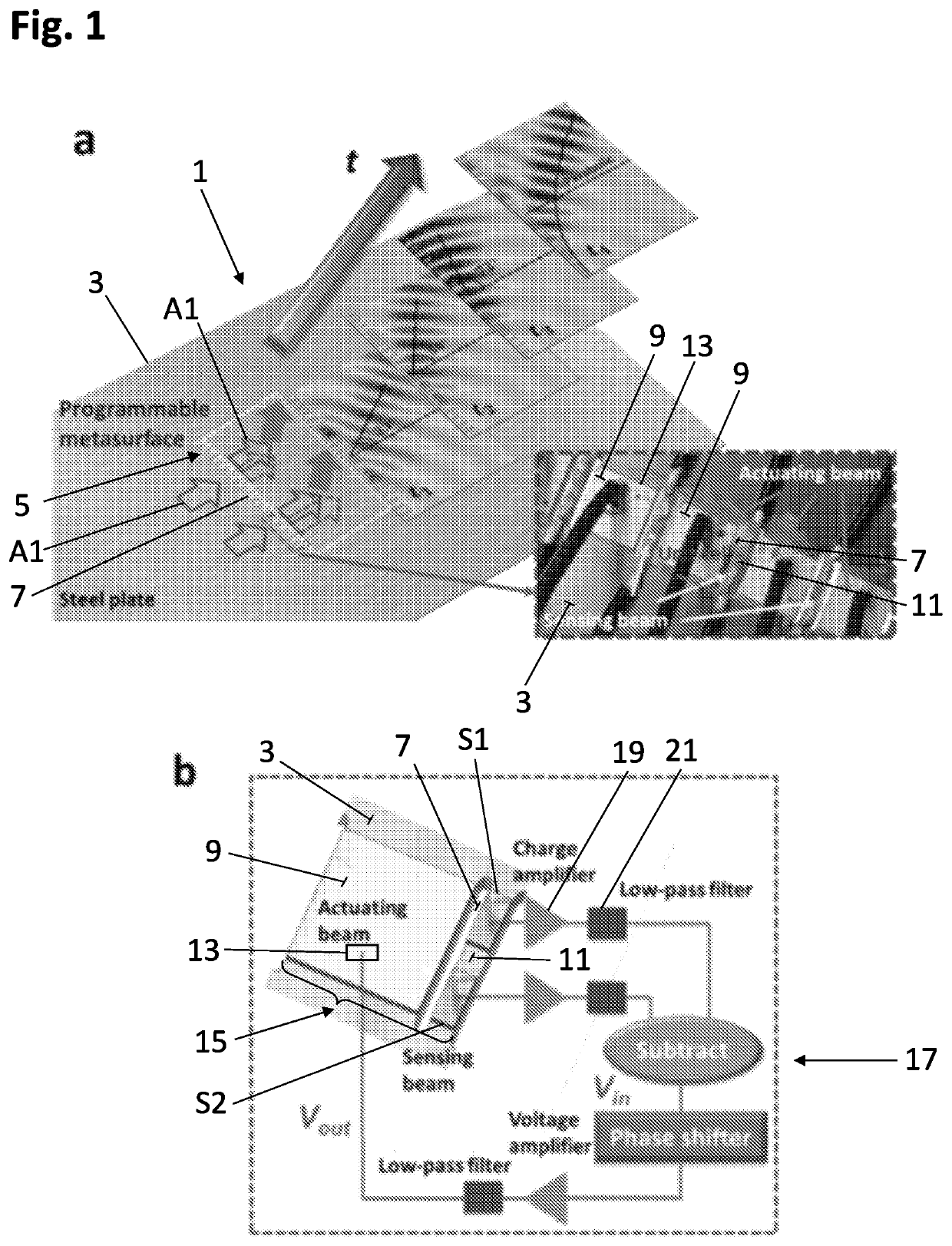
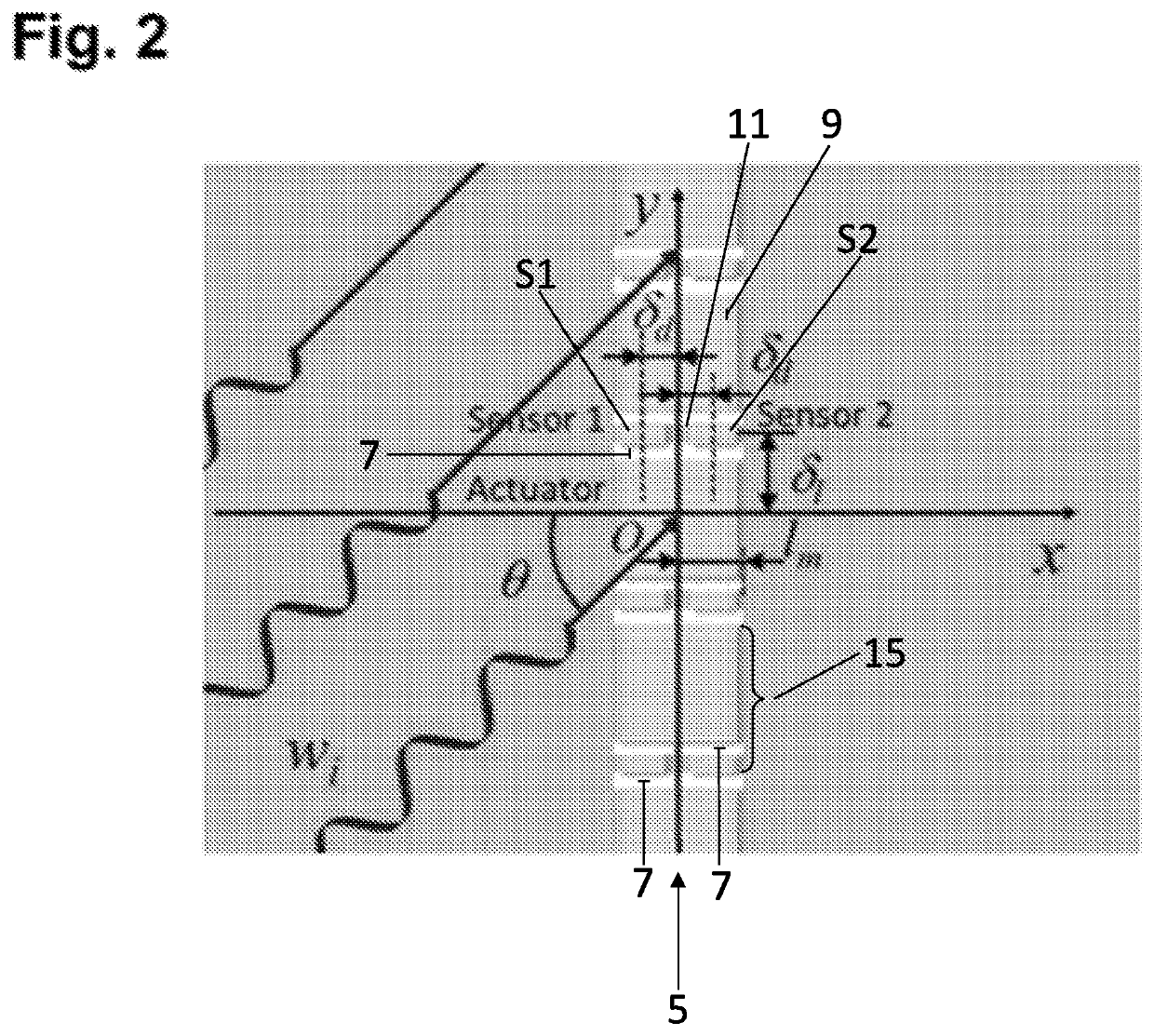
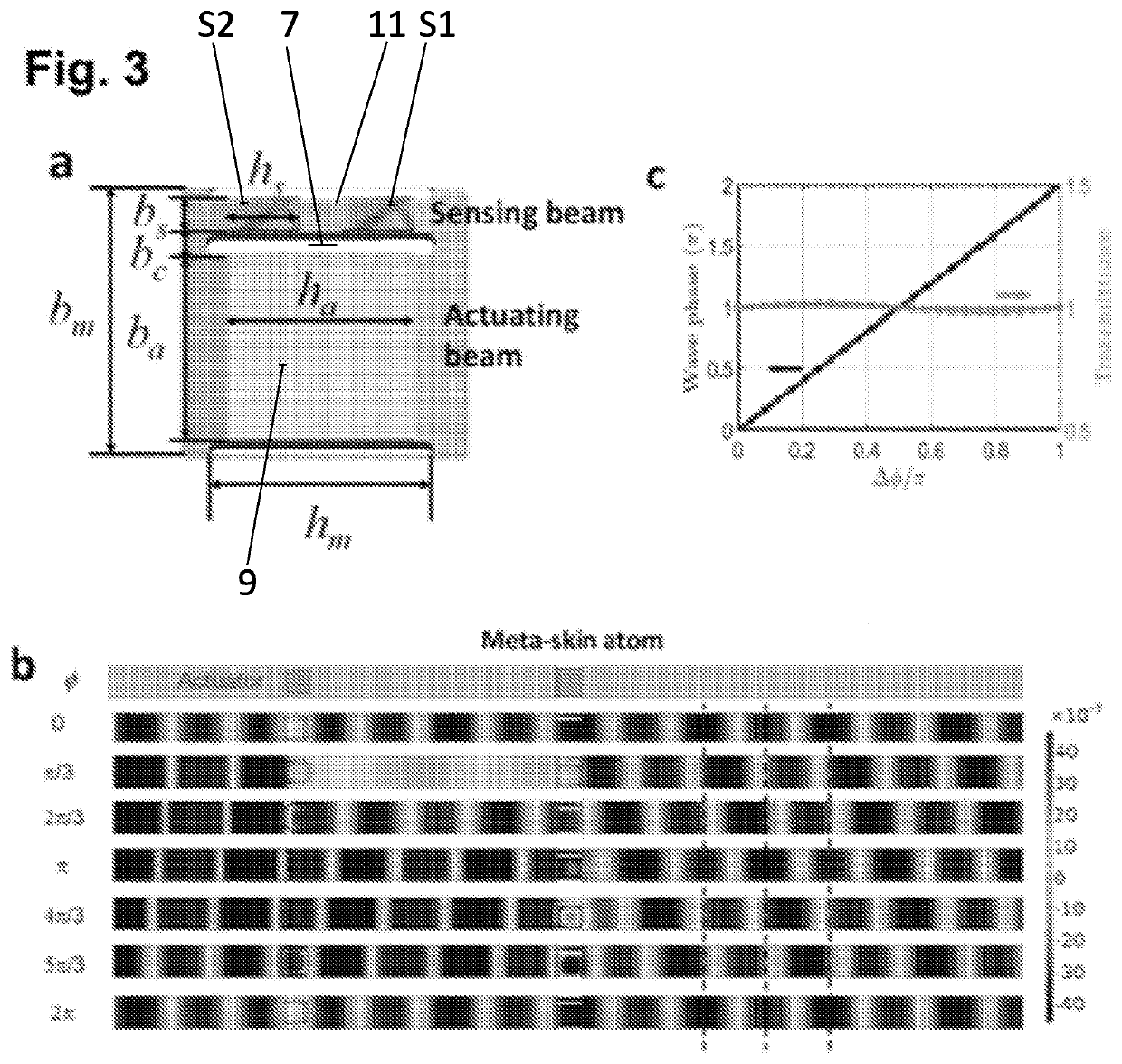
Programmable metasurface for real time control of broadband elastic rays and method
PatentActiveUS20210327403A1
Innovation
- A programmable elastic metasurface with a 1D array of slits in an elastic plate, featuring self-sensing and self-actuating unit cells with piezoelectric patches, allowing for real-time reconfiguration of wave steering and phase control through digital circuits, enabling multifunctional control of flexural waves across broad frequency ranges.

Wireless communication paradigm: realizing programmable wireless environments through software-controlled metasurfaces
PatentInactiveUS10547116B2
Innovation
- The introduction of HyperSurfaces, a class of software-controlled metasurfaces that can interact with impinging electromagnetic waves in a programmable manner, allowing for deterministic control over wave steering, absorption, and polarization by using networked control elements and adaptive meta-atoms to optimize wireless communication paths.


Spectrum Regulation and Urban Deployment Policies
The deployment of programmable metasurfaces in urban environments faces significant regulatory challenges that require comprehensive spectrum management frameworks. Current spectrum allocation policies primarily focus on traditional wireless communication systems, creating regulatory gaps for intelligent reflecting surfaces and reconfigurable metasurface technologies. The dynamic nature of programmable metasurfaces, which can alter electromagnetic wave propagation in real-time, necessitates new regulatory approaches that account for their adaptive interference mitigation capabilities.
Spectrum coordination becomes particularly complex when metasurfaces operate across multiple frequency bands simultaneously. Existing regulatory frameworks typically assign fixed spectrum allocations to specific services, but programmable metasurfaces can dynamically optimize signal paths across various frequency ranges. This capability challenges traditional interference protection criteria and requires updated technical standards that recognize the beneficial interference management properties of these systems.
Urban deployment policies must address the physical installation requirements for metasurface arrays on building facades, rooftops, and infrastructure elements. Municipal regulations often lack specific provisions for electromagnetic surface installations, creating approval bottlenecks for large-scale deployments. Zoning laws and building codes require updates to accommodate the unique characteristics of metasurface installations, including their minimal physical footprint and non-radiating nature.
International coordination presents additional challenges as programmable metasurfaces can affect cross-border spectrum usage patterns. The International Telecommunication Union's current radio regulations do not explicitly address intelligent reflecting surfaces, necessitating new technical recommendations and coordination procedures. Regional spectrum harmonization efforts must consider the propagation enhancement effects of metasurfaces on existing spectrum sharing arrangements.
Privacy and security regulations also impact metasurface deployment policies. The ability to precisely control electromagnetic wave propagation raises concerns about potential surveillance applications and data interception capabilities. Regulatory frameworks must balance the communication enhancement benefits with privacy protection requirements, establishing clear operational guidelines for metasurface network operators.
Environmental impact assessments for metasurface deployments require specialized evaluation criteria that differ from traditional antenna installations. The passive nature of most metasurface elements reduces electromagnetic exposure concerns, but regulatory agencies need updated assessment methodologies that accurately reflect the unique operational characteristics of these systems in dense urban environments.
Spectrum coordination becomes particularly complex when metasurfaces operate across multiple frequency bands simultaneously. Existing regulatory frameworks typically assign fixed spectrum allocations to specific services, but programmable metasurfaces can dynamically optimize signal paths across various frequency ranges. This capability challenges traditional interference protection criteria and requires updated technical standards that recognize the beneficial interference management properties of these systems.
Urban deployment policies must address the physical installation requirements for metasurface arrays on building facades, rooftops, and infrastructure elements. Municipal regulations often lack specific provisions for electromagnetic surface installations, creating approval bottlenecks for large-scale deployments. Zoning laws and building codes require updates to accommodate the unique characteristics of metasurface installations, including their minimal physical footprint and non-radiating nature.
International coordination presents additional challenges as programmable metasurfaces can affect cross-border spectrum usage patterns. The International Telecommunication Union's current radio regulations do not explicitly address intelligent reflecting surfaces, necessitating new technical recommendations and coordination procedures. Regional spectrum harmonization efforts must consider the propagation enhancement effects of metasurfaces on existing spectrum sharing arrangements.
Privacy and security regulations also impact metasurface deployment policies. The ability to precisely control electromagnetic wave propagation raises concerns about potential surveillance applications and data interception capabilities. Regulatory frameworks must balance the communication enhancement benefits with privacy protection requirements, establishing clear operational guidelines for metasurface network operators.
Environmental impact assessments for metasurface deployments require specialized evaluation criteria that differ from traditional antenna installations. The passive nature of most metasurface elements reduces electromagnetic exposure concerns, but regulatory agencies need updated assessment methodologies that accurately reflect the unique operational characteristics of these systems in dense urban environments.
Environmental Impact of Urban Metasurface Infrastructure
The deployment of programmable metasurface infrastructure in urban environments presents a complex array of environmental considerations that must be carefully evaluated. Unlike traditional telecommunications infrastructure, metasurfaces offer unique advantages in terms of material efficiency and energy consumption, yet their widespread implementation raises important questions about long-term environmental sustainability and urban ecosystem integration.
Material composition represents a primary environmental concern for urban metasurface deployment. These structures typically incorporate specialized metamaterials, including engineered dielectrics, conductive elements, and substrate materials that may contain rare earth elements or specialized polymers. The extraction and processing of these materials can have significant environmental footprints, particularly when scaled to city-wide implementations. However, metasurfaces generally require substantially less material volume compared to conventional antenna arrays or signal boosters, potentially offsetting some environmental costs through reduced material consumption.
Energy efficiency emerges as a significant environmental benefit of programmable metasurface technology. Traditional signal enhancement solutions often require active amplification systems that consume considerable electrical power continuously. In contrast, metasurfaces can achieve signal manipulation through passive or semi-passive mechanisms, dramatically reducing operational energy requirements. This reduction in power consumption translates directly to decreased carbon emissions from electricity generation, particularly important in urban environments where energy demand is already substantial.
The integration of metasurface infrastructure with existing urban architecture presents both opportunities and challenges for environmental impact mitigation. These thin, lightweight structures can be seamlessly incorporated into building facades, reducing the need for additional support structures or dedicated installation sites. This integration approach minimizes urban sprawl and preserves green spaces that might otherwise be occupied by traditional telecommunications infrastructure.
Electromagnetic environmental effects constitute another critical consideration. While metasurfaces are designed to enhance communication performance, their deployment must account for potential impacts on urban wildlife, particularly bird migration patterns and insect navigation systems that rely on electromagnetic cues. Careful frequency management and adaptive programming capabilities can help minimize these ecological disruptions.
End-of-life considerations for metasurface infrastructure require proactive planning to ensure environmental sustainability. The specialized materials used in these systems may present recycling challenges, necessitating the development of dedicated recovery and processing protocols. However, the extended operational lifespan and reduced maintenance requirements of metasurface systems can offset some of these concerns through reduced replacement frequency and associated environmental costs.
Material composition represents a primary environmental concern for urban metasurface deployment. These structures typically incorporate specialized metamaterials, including engineered dielectrics, conductive elements, and substrate materials that may contain rare earth elements or specialized polymers. The extraction and processing of these materials can have significant environmental footprints, particularly when scaled to city-wide implementations. However, metasurfaces generally require substantially less material volume compared to conventional antenna arrays or signal boosters, potentially offsetting some environmental costs through reduced material consumption.
Energy efficiency emerges as a significant environmental benefit of programmable metasurface technology. Traditional signal enhancement solutions often require active amplification systems that consume considerable electrical power continuously. In contrast, metasurfaces can achieve signal manipulation through passive or semi-passive mechanisms, dramatically reducing operational energy requirements. This reduction in power consumption translates directly to decreased carbon emissions from electricity generation, particularly important in urban environments where energy demand is already substantial.
The integration of metasurface infrastructure with existing urban architecture presents both opportunities and challenges for environmental impact mitigation. These thin, lightweight structures can be seamlessly incorporated into building facades, reducing the need for additional support structures or dedicated installation sites. This integration approach minimizes urban sprawl and preserves green spaces that might otherwise be occupied by traditional telecommunications infrastructure.
Electromagnetic environmental effects constitute another critical consideration. While metasurfaces are designed to enhance communication performance, their deployment must account for potential impacts on urban wildlife, particularly bird migration patterns and insect navigation systems that rely on electromagnetic cues. Careful frequency management and adaptive programming capabilities can help minimize these ecological disruptions.
End-of-life considerations for metasurface infrastructure require proactive planning to ensure environmental sustainability. The specialized materials used in these systems may present recycling challenges, necessitating the development of dedicated recovery and processing protocols. However, the extended operational lifespan and reduced maintenance requirements of metasurface systems can offset some of these concerns through reduced replacement frequency and associated environmental costs.
Unlock deeper insights with PatSnap Eureka Quick Research — get a full tech report to explore trends and direct your research. Try now!
Generate Your Research Report Instantly with AI Agent
Supercharge your innovation with PatSnap Eureka AI Agent Platform!