
Data Augmentation Techniques for Dynamic Weather Prediction
FEB 27, 20269 MIN READ
Generate Your Research Report Instantly with AI Agent
Patsnap Eureka helps you evaluate technical feasibility & market potential.
Weather Data Augmentation Background and Objectives
Weather prediction has evolved from simple observational methods to sophisticated numerical modeling systems over the past century. The integration of satellite imagery, radar networks, and ground-based sensors has created unprecedented volumes of meteorological data. However, the inherent complexity and chaotic nature of atmospheric systems continue to challenge traditional forecasting approaches, particularly in capturing rapid weather transitions and extreme events.
The emergence of machine learning and deep learning techniques has revolutionized weather prediction capabilities, enabling more accurate short-term forecasts and improved pattern recognition. These data-driven approaches have demonstrated superior performance in handling non-linear atmospheric dynamics compared to conventional statistical methods. The transition from physics-based models to hybrid AI-enhanced systems represents a fundamental shift in meteorological science.
Data augmentation has emerged as a critical enabler for advancing weather prediction accuracy, particularly in addressing the scarcity of extreme weather events in historical datasets. Traditional meteorological databases often lack sufficient representation of rare but impactful phenomena such as hurricanes, tornadoes, and severe thunderstorms. This data imbalance significantly limits the ability of machine learning models to accurately predict and characterize these critical weather events.
The primary objective of implementing data augmentation techniques in dynamic weather prediction is to enhance model robustness and generalization capabilities across diverse meteorological conditions. By artificially expanding training datasets through sophisticated augmentation methods, researchers aim to improve prediction accuracy for both common weather patterns and rare extreme events. This approach seeks to bridge the gap between limited historical observations and the comprehensive data requirements of modern AI-driven forecasting systems.
Current research focuses on developing domain-specific augmentation strategies that preserve the physical consistency and temporal coherence inherent in atmospheric processes. The goal extends beyond simple data multiplication to creating synthetic weather scenarios that maintain realistic spatial-temporal relationships and thermodynamic constraints. These efforts aim to establish a new paradigm where augmented datasets can significantly enhance the predictive power of weather forecasting models while reducing computational requirements and improving real-time operational capabilities.
The emergence of machine learning and deep learning techniques has revolutionized weather prediction capabilities, enabling more accurate short-term forecasts and improved pattern recognition. These data-driven approaches have demonstrated superior performance in handling non-linear atmospheric dynamics compared to conventional statistical methods. The transition from physics-based models to hybrid AI-enhanced systems represents a fundamental shift in meteorological science.
Data augmentation has emerged as a critical enabler for advancing weather prediction accuracy, particularly in addressing the scarcity of extreme weather events in historical datasets. Traditional meteorological databases often lack sufficient representation of rare but impactful phenomena such as hurricanes, tornadoes, and severe thunderstorms. This data imbalance significantly limits the ability of machine learning models to accurately predict and characterize these critical weather events.
The primary objective of implementing data augmentation techniques in dynamic weather prediction is to enhance model robustness and generalization capabilities across diverse meteorological conditions. By artificially expanding training datasets through sophisticated augmentation methods, researchers aim to improve prediction accuracy for both common weather patterns and rare extreme events. This approach seeks to bridge the gap between limited historical observations and the comprehensive data requirements of modern AI-driven forecasting systems.
Current research focuses on developing domain-specific augmentation strategies that preserve the physical consistency and temporal coherence inherent in atmospheric processes. The goal extends beyond simple data multiplication to creating synthetic weather scenarios that maintain realistic spatial-temporal relationships and thermodynamic constraints. These efforts aim to establish a new paradigm where augmented datasets can significantly enhance the predictive power of weather forecasting models while reducing computational requirements and improving real-time operational capabilities.
Market Demand for Enhanced Weather Forecasting Systems
The global weather forecasting market has experienced substantial growth driven by increasing demand for accurate and timely meteorological information across multiple sectors. Traditional weather prediction systems face significant limitations in handling dynamic atmospheric conditions, creating substantial market opportunities for enhanced forecasting technologies that incorporate advanced data augmentation techniques.
Aviation industry represents one of the largest market segments demanding improved weather forecasting capabilities. Airlines require precise short-term and medium-term weather predictions to optimize flight routes, reduce fuel consumption, and enhance passenger safety. Current forecasting limitations result in substantial operational costs due to flight delays, cancellations, and inefficient routing decisions. Enhanced weather prediction systems utilizing data augmentation techniques can significantly reduce these operational disruptions.
Agricultural sector demonstrates growing demand for sophisticated weather forecasting solutions to support precision farming initiatives. Modern agricultural operations require detailed microclimatic predictions to optimize irrigation scheduling, crop protection measures, and harvest timing. Traditional forecasting models often lack the granular spatial and temporal resolution needed for effective agricultural decision-making, creating market demand for enhanced prediction systems.
Energy sector, particularly renewable energy operations, requires advanced weather forecasting for wind and solar power generation optimization. Wind farms and solar installations depend heavily on accurate weather predictions to forecast energy output and manage grid integration effectively. Enhanced forecasting systems can improve energy production efficiency and reduce operational uncertainties in renewable energy markets.
Emergency management and disaster preparedness sectors represent critical market segments requiring enhanced weather prediction capabilities. Government agencies and emergency response organizations need accurate extreme weather event predictions to implement timely evacuation procedures and resource allocation strategies. Current forecasting limitations in predicting severe weather events create substantial demand for improved prediction systems.
Maritime industry requires enhanced weather forecasting for shipping route optimization and offshore operations safety. Commercial shipping companies and offshore energy operations depend on accurate marine weather predictions to ensure operational safety and efficiency. Enhanced forecasting systems can reduce maritime accidents and optimize shipping schedules.
The insurance industry increasingly demands sophisticated weather prediction capabilities for risk assessment and catastrophe modeling. Insurance companies require accurate long-term weather trend predictions and extreme event forecasting to develop appropriate pricing models and risk management strategies.
Aviation industry represents one of the largest market segments demanding improved weather forecasting capabilities. Airlines require precise short-term and medium-term weather predictions to optimize flight routes, reduce fuel consumption, and enhance passenger safety. Current forecasting limitations result in substantial operational costs due to flight delays, cancellations, and inefficient routing decisions. Enhanced weather prediction systems utilizing data augmentation techniques can significantly reduce these operational disruptions.
Agricultural sector demonstrates growing demand for sophisticated weather forecasting solutions to support precision farming initiatives. Modern agricultural operations require detailed microclimatic predictions to optimize irrigation scheduling, crop protection measures, and harvest timing. Traditional forecasting models often lack the granular spatial and temporal resolution needed for effective agricultural decision-making, creating market demand for enhanced prediction systems.
Energy sector, particularly renewable energy operations, requires advanced weather forecasting for wind and solar power generation optimization. Wind farms and solar installations depend heavily on accurate weather predictions to forecast energy output and manage grid integration effectively. Enhanced forecasting systems can improve energy production efficiency and reduce operational uncertainties in renewable energy markets.
Emergency management and disaster preparedness sectors represent critical market segments requiring enhanced weather prediction capabilities. Government agencies and emergency response organizations need accurate extreme weather event predictions to implement timely evacuation procedures and resource allocation strategies. Current forecasting limitations in predicting severe weather events create substantial demand for improved prediction systems.
Maritime industry requires enhanced weather forecasting for shipping route optimization and offshore operations safety. Commercial shipping companies and offshore energy operations depend on accurate marine weather predictions to ensure operational safety and efficiency. Enhanced forecasting systems can reduce maritime accidents and optimize shipping schedules.
The insurance industry increasingly demands sophisticated weather prediction capabilities for risk assessment and catastrophe modeling. Insurance companies require accurate long-term weather trend predictions and extreme event forecasting to develop appropriate pricing models and risk management strategies.
Current Limitations in Dynamic Weather Prediction Models
Dynamic weather prediction models face significant computational constraints that limit their ability to process vast amounts of meteorological data in real-time. Current numerical weather prediction systems require enormous computational resources to solve complex atmospheric equations, often resulting in trade-offs between spatial resolution, temporal coverage, and forecast accuracy. These computational bottlenecks become particularly pronounced when attempting to model extreme weather events or long-term climate patterns.
Data sparsity represents another critical limitation, especially in oceanic regions, polar areas, and developing countries where meteorological observation networks are inadequate. Traditional weather stations provide point measurements that may not capture the full complexity of atmospheric phenomena across large geographical areas. This spatial discontinuity creates gaps in model initialization data, leading to reduced forecast reliability in data-sparse regions.
Temporal resolution challenges persist in capturing rapidly evolving weather systems such as thunderstorms, tornadoes, and flash floods. Many existing models operate on hourly or sub-hourly time steps, which may be insufficient to accurately represent the dynamics of fast-moving meteorological events. This temporal limitation often results in delayed warnings for severe weather conditions, potentially compromising public safety and emergency response effectiveness.
Model uncertainty quantification remains inadequately addressed in most operational weather prediction systems. Current models struggle to provide reliable confidence intervals for their predictions, making it difficult for decision-makers to assess forecast reliability. This uncertainty propagation becomes more pronounced in ensemble forecasting systems, where multiple model runs may produce divergent results without clear guidance on which scenarios are most probable.
Integration of multi-scale atmospheric processes presents ongoing challenges, as weather systems operate across vastly different spatial and temporal scales. Current models often fail to adequately couple microscale processes with mesoscale and synoptic-scale phenomena, leading to systematic biases in precipitation forecasting, cloud formation prediction, and boundary layer representation.
Physical parameterization schemes in existing models rely on simplified representations of complex atmospheric processes such as convection, radiation, and surface interactions. These approximations introduce systematic errors that accumulate over time, particularly affecting medium-range and extended-range forecasts. The challenge becomes more acute when models encounter atmospheric conditions outside their training or calibration domains.
Data sparsity represents another critical limitation, especially in oceanic regions, polar areas, and developing countries where meteorological observation networks are inadequate. Traditional weather stations provide point measurements that may not capture the full complexity of atmospheric phenomena across large geographical areas. This spatial discontinuity creates gaps in model initialization data, leading to reduced forecast reliability in data-sparse regions.
Temporal resolution challenges persist in capturing rapidly evolving weather systems such as thunderstorms, tornadoes, and flash floods. Many existing models operate on hourly or sub-hourly time steps, which may be insufficient to accurately represent the dynamics of fast-moving meteorological events. This temporal limitation often results in delayed warnings for severe weather conditions, potentially compromising public safety and emergency response effectiveness.
Model uncertainty quantification remains inadequately addressed in most operational weather prediction systems. Current models struggle to provide reliable confidence intervals for their predictions, making it difficult for decision-makers to assess forecast reliability. This uncertainty propagation becomes more pronounced in ensemble forecasting systems, where multiple model runs may produce divergent results without clear guidance on which scenarios are most probable.
Integration of multi-scale atmospheric processes presents ongoing challenges, as weather systems operate across vastly different spatial and temporal scales. Current models often fail to adequately couple microscale processes with mesoscale and synoptic-scale phenomena, leading to systematic biases in precipitation forecasting, cloud formation prediction, and boundary layer representation.
Physical parameterization schemes in existing models rely on simplified representations of complex atmospheric processes such as convection, radiation, and surface interactions. These approximations introduce systematic errors that accumulate over time, particularly affecting medium-range and extended-range forecasts. The challenge becomes more acute when models encounter atmospheric conditions outside their training or calibration domains.
Existing Data Augmentation Methods for Weather Models
01 Synthetic data generation for training dataset expansion
Data augmentation techniques involve generating synthetic training data through various transformation methods to expand the original dataset. This approach helps improve model generalization by creating diverse variations of existing data samples, including geometric transformations, color space adjustments, and noise injection. The expanded dataset enables models to learn more robust features and reduces overfitting, thereby enhancing prediction accuracy across different scenarios.- Synthetic data generation for training dataset expansion: Data augmentation techniques involve generating synthetic training data through various transformation methods to expand the original dataset. This approach helps improve model generalization by creating diverse variations of existing data samples, including geometric transformations, color space adjustments, and noise injection. The expanded dataset enables models to learn more robust features and reduces overfitting, thereby enhancing prediction accuracy across different scenarios.
- Domain-specific augmentation strategies for specialized applications: Specialized data augmentation methods are designed for specific domains such as medical imaging, natural language processing, or computer vision tasks. These techniques apply domain knowledge to create meaningful variations that preserve semantic information while increasing data diversity. The approach includes context-aware transformations and feature-preserving modifications that maintain the integrity of domain-specific characteristics, leading to improved prediction performance in specialized applications.
- Adaptive augmentation based on model performance feedback: Advanced augmentation techniques dynamically adjust transformation parameters based on real-time model performance metrics and learning progress. This adaptive approach monitors prediction accuracy during training and automatically modifies augmentation strategies to address specific weaknesses or biases in the model. The feedback-driven methodology optimizes the augmentation process to maximize learning efficiency and improve overall prediction accuracy.
- Multi-modal data fusion and cross-domain augmentation: Data augmentation techniques that combine information from multiple data modalities or transfer knowledge across different domains to enhance prediction capabilities. This approach leverages complementary information from various sources and applies cross-domain transformation strategies to create enriched training samples. The integration of diverse data types and domain adaptation methods results in more comprehensive feature learning and improved prediction accuracy.
- Automated augmentation policy learning and optimization: Machine learning-based approaches for automatically discovering and optimizing data augmentation policies without manual intervention. These methods employ reinforcement learning, neural architecture search, or evolutionary algorithms to identify the most effective combination of augmentation operations and their parameters. The automated optimization process systematically explores the augmentation strategy space to find configurations that maximize prediction accuracy for specific tasks and datasets.
02 Domain-specific augmentation strategies for specialized applications
Specialized data augmentation methods are designed for specific domains such as medical imaging, natural language processing, or computer vision tasks. These techniques apply domain knowledge to create meaningful variations that preserve semantic information while increasing data diversity. The approach includes context-aware transformations and feature-preserving modifications that maintain the integrity of domain-specific characteristics, leading to improved prediction performance in specialized applications.Expand Specific Solutions03 Adaptive augmentation based on model performance feedback
Advanced augmentation techniques dynamically adjust transformation parameters based on real-time model performance metrics and learning progress. This adaptive approach monitors prediction accuracy during training and automatically modifies augmentation strategies to address specific weaknesses or biases in the model. The feedback-driven methodology optimizes the augmentation process to maximize learning efficiency and improve overall prediction accuracy.Expand Specific Solutions04 Multi-modal data fusion and cross-domain augmentation
Data augmentation techniques that combine information from multiple data modalities or transfer knowledge across different domains to enhance prediction capabilities. This approach leverages complementary information from various sources and applies cross-domain transformation strategies to create enriched training samples. The integration of multi-modal features and domain adaptation methods significantly improves model robustness and prediction accuracy in complex scenarios.Expand Specific Solutions05 Automated augmentation policy learning and optimization
Machine learning-based approaches for automatically discovering and optimizing data augmentation policies without manual intervention. These methods employ reinforcement learning, neural architecture search, or evolutionary algorithms to identify the most effective augmentation strategies for specific tasks. The automated optimization process systematically explores the augmentation parameter space to find optimal configurations that maximize prediction accuracy while minimizing computational overhead.Expand Specific Solutions
Leading Companies in Weather AI and Data Enhancement
The data augmentation techniques for dynamic weather prediction field represents an emerging technological domain experiencing rapid growth, driven by increasing demand for accurate meteorological forecasting and climate modeling. The market demonstrates significant expansion potential as weather prediction becomes critical for various industries including aviation, agriculture, and renewable energy. Technology maturity varies considerably across different approaches, with traditional statistical methods being well-established while advanced machine learning and AI-driven augmentation techniques remain in developmental stages. Key players span diverse sectors, with academic institutions like Nanjing University of Information Science & Technology, Fudan University, and Wuhan University leading fundamental research, while state-owned enterprises such as State Grid Corp. of China and China Three Gorges Corp. drive practical applications. Technology companies including Aostar Information Technologies and Hefei Zhongke Leinao Intelligence Technology focus on AI-powered solutions, indicating a collaborative ecosystem where research institutions provide theoretical foundations and commercial entities accelerate practical implementation and deployment.
Fudan University
Technical Solution: Fudan University has established research programs in artificial intelligence applications for meteorological data processing, including data augmentation techniques for weather prediction models. Their research focuses on developing novel neural network architectures that can effectively utilize augmented weather data for improved prediction accuracy. The university has worked on time-series augmentation methods specifically designed for meteorological applications, incorporating domain knowledge about atmospheric physics into the augmentation process. Their approach includes developing metrics and evaluation frameworks to assess the quality and effectiveness of augmented weather data in prediction models.
Strengths: Strong AI and machine learning research capabilities, interdisciplinary approach combining computer science with atmospheric sciences. Weaknesses: General AI focus may lack specialized meteorological domain expertise, academic research may have limited real-world validation, resource constraints for large-scale weather data processing.
Nanjing University of Information Science & Technology
Technical Solution: NUIST has developed advanced data augmentation techniques specifically for meteorological applications, including synthetic weather pattern generation using generative adversarial networks (GANs) and variational autoencoders. Their approach incorporates temporal consistency constraints to maintain realistic weather evolution patterns across time series data. The university has implemented multi-scale data augmentation methods that combine satellite imagery, radar data, and ground station measurements to create comprehensive training datasets for dynamic weather prediction models. Their research focuses on physics-informed data augmentation that preserves atmospheric dynamics while generating diverse weather scenarios for improved model robustness.
Strengths: Strong meteorological domain expertise, physics-informed approaches ensure realistic weather patterns. Weaknesses: Limited computational resources compared to commercial entities, research may lack immediate practical deployment capabilities.
Core Innovations in Synthetic Weather Data Generation
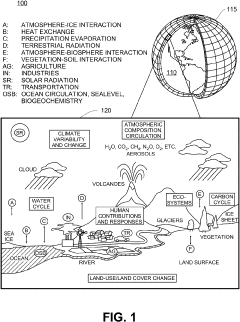
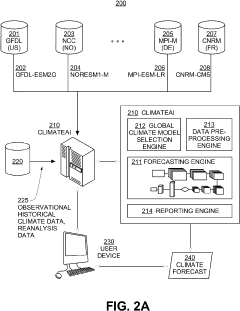
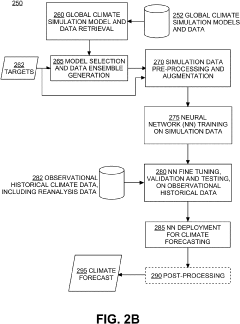
Systems and methods of data preprocessing and augmentation for neural network climate forecasting models
PatentActiveUS20230128989A1
Innovation
- A neural network-based climate forecasting model is developed, trained on pre-processed multi-model ensemble global climate simulation data, using techniques like spatial and temporal homogenization, augmentation with synthetic data, and fine-tuned with observational historical data to enhance forecasting accuracy and efficiency.
Wind and solar power prediction method for extreme weather scenarios
PatentActiveCN118630757B
Innovation
- By obtaining original data from multiple data sources, selecting data at extreme weather moments for storage, using data enhancement technology to generate new training data, training machine learning models for extreme weather identification and wind and solar power prediction, combining meteorological data, historical power generation data and Satellite remote sensing data is predicted using the Transformer model and attention mechanism.


Climate Data Standards and Meteorological Regulations
The standardization of climate data represents a fundamental pillar for advancing data augmentation techniques in dynamic weather prediction systems. International organizations such as the World Meteorological Organization (WMO) have established comprehensive frameworks including the WMO Information System (WIS) and Climate Data Modernization Program (CDMP), which define essential parameters for meteorological data collection, processing, and exchange. These standards ensure consistency in temporal resolution, spatial coverage, and measurement accuracy across global weather monitoring networks.
Current regulatory frameworks mandate specific data quality protocols that directly impact augmentation methodologies. The Global Climate Observing System (GCOS) Essential Climate Variables (ECVs) establish minimum requirements for atmospheric, oceanic, and terrestrial observations. These regulations specify acceptable uncertainty ranges, calibration procedures, and metadata requirements that constrain how synthetic data can be generated and validated within augmentation pipelines.
Data format standardization through protocols like Network Common Data Form (NetCDF) and Climate Forecast (CF) conventions creates structured environments for implementing augmentation algorithms. These standards define variable naming conventions, coordinate systems, and attribute specifications that enable seamless integration of augmented datasets with existing meteorological databases. Compliance with these formats ensures interoperability between different prediction models and research institutions.
Quality assurance regulations impose strict validation requirements on augmented climate datasets. International standards such as ISO 19115 for geographic metadata and WMO Quality Management Framework establish benchmarks for data integrity, traceability, and uncertainty quantification. These regulations require comprehensive documentation of augmentation processes, including algorithm parameters, training datasets, and validation metrics, ensuring that synthetic data meets scientific rigor standards.
Emerging regulatory considerations address the integration of machine learning-generated climate data within operational forecasting systems. Recent guidelines from meteorological agencies emphasize the need for transparent augmentation methodologies, bias assessment protocols, and uncertainty propagation analysis. These evolving standards recognize the growing importance of artificial data generation while maintaining the reliability and accuracy essential for weather prediction applications.
Current regulatory frameworks mandate specific data quality protocols that directly impact augmentation methodologies. The Global Climate Observing System (GCOS) Essential Climate Variables (ECVs) establish minimum requirements for atmospheric, oceanic, and terrestrial observations. These regulations specify acceptable uncertainty ranges, calibration procedures, and metadata requirements that constrain how synthetic data can be generated and validated within augmentation pipelines.
Data format standardization through protocols like Network Common Data Form (NetCDF) and Climate Forecast (CF) conventions creates structured environments for implementing augmentation algorithms. These standards define variable naming conventions, coordinate systems, and attribute specifications that enable seamless integration of augmented datasets with existing meteorological databases. Compliance with these formats ensures interoperability between different prediction models and research institutions.
Quality assurance regulations impose strict validation requirements on augmented climate datasets. International standards such as ISO 19115 for geographic metadata and WMO Quality Management Framework establish benchmarks for data integrity, traceability, and uncertainty quantification. These regulations require comprehensive documentation of augmentation processes, including algorithm parameters, training datasets, and validation metrics, ensuring that synthetic data meets scientific rigor standards.
Emerging regulatory considerations address the integration of machine learning-generated climate data within operational forecasting systems. Recent guidelines from meteorological agencies emphasize the need for transparent augmentation methodologies, bias assessment protocols, and uncertainty propagation analysis. These evolving standards recognize the growing importance of artificial data generation while maintaining the reliability and accuracy essential for weather prediction applications.
Computational Infrastructure for Large-Scale Weather Data
The computational infrastructure supporting large-scale weather data processing represents a critical foundation for implementing effective data augmentation techniques in dynamic weather prediction systems. Modern meteorological organizations and research institutions rely on sophisticated high-performance computing architectures that can handle the massive volumes of observational data, satellite imagery, and numerical model outputs required for comprehensive weather analysis.
Contemporary weather data processing systems typically employ distributed computing frameworks built on cloud-native architectures and hybrid infrastructure models. These systems integrate traditional supercomputing clusters with elastic cloud resources, enabling dynamic scaling based on computational demands. The infrastructure must accommodate data ingestion rates exceeding several terabytes per hour from global observation networks, including weather stations, radiosondes, aircraft sensors, and satellite platforms.
Storage architectures for weather data utilize hierarchical storage management systems that balance performance requirements with cost considerations. High-frequency access data resides on solid-state storage arrays, while historical datasets are archived on tape libraries or cold storage systems. Object storage solutions have become increasingly prevalent, offering scalable capacity and geographic distribution capabilities essential for global weather monitoring networks.
Data processing pipelines leverage containerized microservices architectures that facilitate parallel processing of multiple data streams. These systems employ message queuing technologies and event-driven architectures to ensure reliable data flow and processing coordination. Real-time data assimilation processes require low-latency computing capabilities, often implemented through specialized hardware accelerators including GPUs and field-programmable gate arrays.
Network infrastructure considerations include high-bandwidth connections to international meteorological data exchange networks and content delivery networks for distributing processed weather products. Edge computing deployments at observation sites enable preliminary data processing and quality control before transmission to central facilities.
The infrastructure must also support advanced analytics workloads for machine learning model training and inference, requiring specialized hardware configurations optimized for tensor operations and large-scale matrix computations essential for modern weather prediction algorithms.
Contemporary weather data processing systems typically employ distributed computing frameworks built on cloud-native architectures and hybrid infrastructure models. These systems integrate traditional supercomputing clusters with elastic cloud resources, enabling dynamic scaling based on computational demands. The infrastructure must accommodate data ingestion rates exceeding several terabytes per hour from global observation networks, including weather stations, radiosondes, aircraft sensors, and satellite platforms.
Storage architectures for weather data utilize hierarchical storage management systems that balance performance requirements with cost considerations. High-frequency access data resides on solid-state storage arrays, while historical datasets are archived on tape libraries or cold storage systems. Object storage solutions have become increasingly prevalent, offering scalable capacity and geographic distribution capabilities essential for global weather monitoring networks.
Data processing pipelines leverage containerized microservices architectures that facilitate parallel processing of multiple data streams. These systems employ message queuing technologies and event-driven architectures to ensure reliable data flow and processing coordination. Real-time data assimilation processes require low-latency computing capabilities, often implemented through specialized hardware accelerators including GPUs and field-programmable gate arrays.
Network infrastructure considerations include high-bandwidth connections to international meteorological data exchange networks and content delivery networks for distributing processed weather products. Edge computing deployments at observation sites enable preliminary data processing and quality control before transmission to central facilities.
The infrastructure must also support advanced analytics workloads for machine learning model training and inference, requiring specialized hardware configurations optimized for tensor operations and large-scale matrix computations essential for modern weather prediction algorithms.
Unlock deeper insights with Patsnap Eureka Quick Research — get a full tech report to explore trends and direct your research. Try now!
Generate Your Research Report Instantly with AI Agent
Supercharge your innovation with Patsnap Eureka AI Agent Platform!