

Digital LDOs for Sub-Threshold Circuits: Key Design Considerations
MAY 9, 20269 MIN READ
Generate Your Research Report Instantly with AI Agent
PatSnap Eureka helps you evaluate technical feasibility & market potential.
Digital LDO Sub-Threshold Design Background and Objectives
The evolution of digital low-dropout regulators (LDOs) for sub-threshold circuits represents a critical convergence of two transformative technologies in modern semiconductor design. Sub-threshold operation, where circuits function below the transistor threshold voltage, has emerged as a fundamental approach for ultra-low-power applications, enabling devices to operate with power consumption in the nanowatt to microwatt range. This operational regime has become increasingly vital as the Internet of Things (IoT), wearable devices, and energy-harvesting systems demand unprecedented power efficiency.
Digital LDOs have simultaneously evolved as sophisticated power management solutions that leverage digital control mechanisms to achieve superior performance compared to their analog counterparts. Unlike traditional analog LDOs that rely on continuous feedback loops, digital LDOs employ discrete-time control algorithms, offering enhanced programmability, improved process scalability, and better integration with digital systems. The marriage of these two technologies addresses the unique challenges posed by sub-threshold circuit operation, where conventional power management approaches often fall short.
The historical development of sub-threshold circuits traces back to early research in the 1970s, but practical implementations gained momentum in the 2000s as mobile computing and sensor networks demanded extreme energy efficiency. Concurrently, digital LDO technology emerged from the need for more flexible and scalable power management solutions in advanced process nodes. The intersection of these fields became apparent as designers recognized that sub-threshold circuits require specialized power delivery networks capable of maintaining stable operation under highly variable load conditions and process variations.
The primary objective of developing digital LDOs for sub-threshold circuits centers on achieving stable voltage regulation while maintaining the ultra-low power characteristics essential for sub-threshold operation. This involves creating control systems that can respond effectively to load transients despite the inherently slow response times characteristic of sub-threshold circuits. Additionally, the design must accommodate the significant process, voltage, and temperature variations that disproportionately affect sub-threshold operation.
Another critical objective involves optimizing the trade-off between regulation accuracy and power consumption. Sub-threshold circuits often exhibit high sensitivity to supply voltage variations, necessitating tight regulation, yet the power overhead of the regulation system itself must remain minimal to preserve the overall power benefits. This challenge drives the need for innovative digital control algorithms and circuit architectures specifically tailored for sub-threshold environments.
The technological goals extend to achieving seamless integration between the digital LDO and the sub-threshold load circuits, ensuring compatibility across different process technologies and enabling scalable implementation across various application domains. These objectives collectively aim to unlock the full potential of sub-threshold computing while maintaining robust and reliable power delivery.
Digital LDOs have simultaneously evolved as sophisticated power management solutions that leverage digital control mechanisms to achieve superior performance compared to their analog counterparts. Unlike traditional analog LDOs that rely on continuous feedback loops, digital LDOs employ discrete-time control algorithms, offering enhanced programmability, improved process scalability, and better integration with digital systems. The marriage of these two technologies addresses the unique challenges posed by sub-threshold circuit operation, where conventional power management approaches often fall short.
The historical development of sub-threshold circuits traces back to early research in the 1970s, but practical implementations gained momentum in the 2000s as mobile computing and sensor networks demanded extreme energy efficiency. Concurrently, digital LDO technology emerged from the need for more flexible and scalable power management solutions in advanced process nodes. The intersection of these fields became apparent as designers recognized that sub-threshold circuits require specialized power delivery networks capable of maintaining stable operation under highly variable load conditions and process variations.
The primary objective of developing digital LDOs for sub-threshold circuits centers on achieving stable voltage regulation while maintaining the ultra-low power characteristics essential for sub-threshold operation. This involves creating control systems that can respond effectively to load transients despite the inherently slow response times characteristic of sub-threshold circuits. Additionally, the design must accommodate the significant process, voltage, and temperature variations that disproportionately affect sub-threshold operation.
Another critical objective involves optimizing the trade-off between regulation accuracy and power consumption. Sub-threshold circuits often exhibit high sensitivity to supply voltage variations, necessitating tight regulation, yet the power overhead of the regulation system itself must remain minimal to preserve the overall power benefits. This challenge drives the need for innovative digital control algorithms and circuit architectures specifically tailored for sub-threshold environments.
The technological goals extend to achieving seamless integration between the digital LDO and the sub-threshold load circuits, ensuring compatibility across different process technologies and enabling scalable implementation across various application domains. These objectives collectively aim to unlock the full potential of sub-threshold computing while maintaining robust and reliable power delivery.
Market Demand for Ultra-Low Power Digital LDO Solutions
The global semiconductor industry is experiencing unprecedented demand for ultra-low power solutions, driven by the explosive growth of Internet of Things devices, wearable electronics, and battery-powered systems. Digital Low-Dropout regulators operating in sub-threshold regions have emerged as critical components for extending battery life and enabling energy-harvesting applications. This market segment represents a rapidly expanding niche within the broader power management integrated circuit market.
Edge computing devices and wireless sensor networks constitute the primary demand drivers for digital LDO solutions optimized for sub-threshold operation. These applications require power management circuits capable of maintaining stable voltage regulation while consuming minimal quiescent current, often in the nanoampere range. The proliferation of smart home devices, industrial IoT sensors, and medical implants has created substantial market pull for such specialized power management solutions.
Battery-powered consumer electronics represent another significant demand segment, particularly in smartwatches, fitness trackers, and hearing aids where extended operational lifetime directly translates to enhanced user experience. Manufacturers in these sectors increasingly prioritize power efficiency over raw performance, creating favorable market conditions for sub-threshold digital LDO adoption.
The automotive industry presents emerging opportunities as vehicles integrate more low-power sensing systems for autonomous driving and connectivity features. These applications often require power management solutions that can operate reliably across wide temperature ranges while maintaining ultra-low power consumption during standby modes.
Healthcare and biomedical device markets demonstrate strong demand for digital LDOs capable of sub-threshold operation, particularly in implantable devices and continuous monitoring systems. Regulatory requirements for extended device longevity and patient safety drive the need for highly reliable, low-power voltage regulation solutions.
Market adoption faces challenges related to design complexity and the specialized expertise required for sub-threshold circuit implementation. However, growing awareness of energy efficiency benefits and improving design tool availability are accelerating market acceptance across multiple application domains.
Edge computing devices and wireless sensor networks constitute the primary demand drivers for digital LDO solutions optimized for sub-threshold operation. These applications require power management circuits capable of maintaining stable voltage regulation while consuming minimal quiescent current, often in the nanoampere range. The proliferation of smart home devices, industrial IoT sensors, and medical implants has created substantial market pull for such specialized power management solutions.
Battery-powered consumer electronics represent another significant demand segment, particularly in smartwatches, fitness trackers, and hearing aids where extended operational lifetime directly translates to enhanced user experience. Manufacturers in these sectors increasingly prioritize power efficiency over raw performance, creating favorable market conditions for sub-threshold digital LDO adoption.
The automotive industry presents emerging opportunities as vehicles integrate more low-power sensing systems for autonomous driving and connectivity features. These applications often require power management solutions that can operate reliably across wide temperature ranges while maintaining ultra-low power consumption during standby modes.
Healthcare and biomedical device markets demonstrate strong demand for digital LDOs capable of sub-threshold operation, particularly in implantable devices and continuous monitoring systems. Regulatory requirements for extended device longevity and patient safety drive the need for highly reliable, low-power voltage regulation solutions.
Market adoption faces challenges related to design complexity and the specialized expertise required for sub-threshold circuit implementation. However, growing awareness of energy efficiency benefits and improving design tool availability are accelerating market acceptance across multiple application domains.
Current Challenges in Sub-Threshold Digital LDO Design
Digital LDOs operating in sub-threshold regimes face fundamental challenges that stem from the inherently low current levels and reduced voltage headroom characteristic of these operating conditions. The primary obstacle lies in achieving adequate regulation accuracy while maintaining stability across process, voltage, and temperature variations. Traditional analog control loops become increasingly unreliable at sub-threshold voltages, where device matching deteriorates and parasitic effects become more pronounced relative to the desired signal levels.
Power efficiency optimization presents another critical challenge, as the overhead current consumption of the LDO control circuitry can easily exceed the load current in sub-threshold applications. This creates a paradoxical situation where the regulator consumes more power than the circuit it is designed to supply. The challenge intensifies when considering that digital control mechanisms typically require higher switching frequencies to maintain regulation quality, potentially increasing dynamic power consumption.
Transient response performance becomes severely compromised in sub-threshold digital LDOs due to the limited current sourcing capability of the pass transistor and the reduced transconductance of control devices. The combination of low drive strength and increased parasitic capacitances results in sluggish response to load current variations, making it difficult to maintain stable output voltages during dynamic operating conditions.
Process variation sensitivity represents a significant design constraint, as sub-threshold circuits exhibit exponential sensitivity to threshold voltage variations. Digital LDOs must accommodate wide ranges of process-induced parameter shifts while maintaining consistent performance across different manufacturing lots. This challenge is compounded by the need to ensure functionality across multiple voltage domains within the same system.
Temperature coefficient management poses additional complexity, as sub-threshold operation amplifies the temperature dependence of device characteristics. Digital control algorithms must compensate for temperature-induced variations in reference voltages, switching thresholds, and device performance parameters. The challenge extends to maintaining consistent regulation performance across the entire specified temperature range while minimizing temperature-dependent offset errors.
Finally, noise immunity and signal integrity become critical concerns in sub-threshold digital LDO implementations. The reduced noise margins inherent in low-voltage operation make the control circuitry susceptible to supply noise, substrate coupling, and electromagnetic interference. Digital switching activities within the LDO controller can introduce additional noise sources that compromise the quality of the regulated output voltage.
Power efficiency optimization presents another critical challenge, as the overhead current consumption of the LDO control circuitry can easily exceed the load current in sub-threshold applications. This creates a paradoxical situation where the regulator consumes more power than the circuit it is designed to supply. The challenge intensifies when considering that digital control mechanisms typically require higher switching frequencies to maintain regulation quality, potentially increasing dynamic power consumption.
Transient response performance becomes severely compromised in sub-threshold digital LDOs due to the limited current sourcing capability of the pass transistor and the reduced transconductance of control devices. The combination of low drive strength and increased parasitic capacitances results in sluggish response to load current variations, making it difficult to maintain stable output voltages during dynamic operating conditions.
Process variation sensitivity represents a significant design constraint, as sub-threshold circuits exhibit exponential sensitivity to threshold voltage variations. Digital LDOs must accommodate wide ranges of process-induced parameter shifts while maintaining consistent performance across different manufacturing lots. This challenge is compounded by the need to ensure functionality across multiple voltage domains within the same system.
Temperature coefficient management poses additional complexity, as sub-threshold operation amplifies the temperature dependence of device characteristics. Digital control algorithms must compensate for temperature-induced variations in reference voltages, switching thresholds, and device performance parameters. The challenge extends to maintaining consistent regulation performance across the entire specified temperature range while minimizing temperature-dependent offset errors.
Finally, noise immunity and signal integrity become critical concerns in sub-threshold digital LDO implementations. The reduced noise margins inherent in low-voltage operation make the control circuitry susceptible to supply noise, substrate coupling, and electromagnetic interference. Digital switching activities within the LDO controller can introduce additional noise sources that compromise the quality of the regulated output voltage.
Existing Digital LDO Architectures for Sub-Threshold Operation
01 Digital LDO circuit architecture and design
Digital low-dropout regulators utilize digital control mechanisms instead of traditional analog feedback loops. These architectures incorporate digital signal processing techniques to achieve voltage regulation with improved accuracy and faster response times. The digital approach allows for better integration with modern digital systems and provides enhanced controllability through programmable parameters.- Digital LDO circuit topology and architecture design: Digital low-dropout regulators employ various circuit topologies and architectural approaches to achieve voltage regulation through digital control mechanisms. These designs focus on optimizing the overall structure and configuration of the digital LDO to improve performance characteristics such as transient response, stability, and power efficiency. The architectures typically incorporate digital feedback loops and control systems that differ significantly from traditional analog LDO designs.
- Digital control algorithms and feedback mechanisms: Advanced control algorithms are implemented in digital LDOs to manage voltage regulation through sophisticated feedback mechanisms. These systems utilize digital signal processing techniques to monitor output voltage and adjust the regulation accordingly. The control methods often include predictive algorithms, adaptive control schemes, and digital compensation techniques that enhance the regulator's ability to respond to load changes and maintain stable output voltage under varying conditions.
- Power management and efficiency optimization techniques: Digital LDOs incorporate various power management strategies and efficiency optimization techniques to minimize power consumption and improve overall energy efficiency. These approaches include dynamic voltage scaling, power gating mechanisms, and intelligent load detection systems. The optimization techniques focus on reducing quiescent current, improving load regulation, and enhancing the power conversion efficiency across different operating conditions.
- Transient response and stability enhancement methods: Specialized techniques are employed in digital LDOs to improve transient response characteristics and ensure system stability under dynamic load conditions. These methods include fast transient detection circuits, adaptive bandwidth control, and digital compensation networks. The enhancement techniques focus on minimizing voltage overshoot and undershoot during load transitions while maintaining stable operation across the entire operating range.
- Integration and implementation in system-on-chip applications: Digital LDOs are designed for seamless integration into system-on-chip applications and complex integrated circuit environments. These implementations focus on area optimization, process compatibility, and integration with other on-chip power management units. The designs consider factors such as substrate noise immunity, thermal management, and compatibility with digital processing cores, enabling efficient power delivery in modern semiconductor systems.
02 Control algorithms and feedback mechanisms
Advanced control algorithms are implemented in digital LDOs to optimize performance characteristics such as transient response, stability, and power efficiency. These systems employ sophisticated feedback mechanisms that can adapt to varying load conditions and provide real-time adjustments to maintain optimal voltage regulation across different operating scenarios.Expand Specific Solutions03 Power management and efficiency optimization
Digital LDOs incorporate intelligent power management techniques to maximize efficiency while maintaining regulation accuracy. These implementations focus on reducing power consumption during different operating modes and optimizing the overall energy efficiency of the voltage regulation system through dynamic adjustment capabilities.Expand Specific Solutions04 Integration and system-on-chip applications
Digital LDOs are designed for seamless integration into complex system-on-chip architectures, providing localized voltage regulation for specific circuit blocks. These implementations address the challenges of integrating multiple voltage domains within a single chip while maintaining isolation and providing independent control over different power rails.Expand Specific Solutions05 Performance enhancement and stability techniques
Various techniques are employed to enhance the performance and stability of digital LDOs, including compensation methods, noise reduction strategies, and improved transient response characteristics. These approaches focus on maintaining stable operation across wide ranges of load conditions while minimizing output voltage variations and improving overall system reliability.Expand Specific Solutions
Key Players in Digital LDO and Low-Power IC Industry
The digital LDO market for sub-threshold circuits represents an emerging segment within the broader power management semiconductor industry, currently in its early development stage with significant growth potential driven by increasing demand for ultra-low-power applications in IoT and wearable devices. The market remains relatively niche but is expanding as energy efficiency becomes critical across consumer electronics, automotive, and industrial applications. Technology maturity varies significantly among key players, with established semiconductor giants like Intel Corp., Texas Instruments, Qualcomm, and Infineon Technologies leading in advanced power management solutions and manufacturing capabilities. Chinese companies including Institute of Microelectronics of Chinese Academy of Sciences, Mindmotion Microelectronics, and Dosilicon are rapidly developing competitive technologies, while academic institutions such as Southeast University, Huazhong University of Science & Technology, and Georgia Tech Research Corp. contribute fundamental research innovations that drive next-generation digital LDO architectures for sub-threshold operation.
Intel Corp.
Technical Solution: Intel has developed advanced digital LDO architectures specifically optimized for sub-threshold operation, featuring adaptive voltage scaling and dynamic power management capabilities. Their digital LDOs incorporate sophisticated feedback control systems with multi-bit quantization to achieve precise voltage regulation even at ultra-low supply voltages below 0.5V. The design utilizes clock-based control mechanisms with programmable switching frequencies to optimize transient response while minimizing power consumption in sub-threshold circuits.
Strengths: Industry-leading process technology and extensive R&D resources enable highly optimized designs. Weaknesses: High development costs and complex integration requirements may limit accessibility for smaller applications.
Texas Instruments Incorporated
Technical Solution: TI has pioneered digital LDO solutions for ultra-low power applications, implementing innovative switched-capacitor architectures combined with digital control loops for sub-threshold voltage regulation. Their approach features adaptive dead-time control and dynamic voltage scaling capabilities that maintain regulation accuracy across wide load variations. The digital LDOs incorporate advanced power management algorithms with real-time load detection to optimize efficiency in sub-threshold operating conditions.
Strengths: Proven track record in power management ICs and strong analog/mixed-signal expertise. Weaknesses: Traditional focus on higher voltage applications may require significant adaptation for sub-threshold requirements.
Core Design Innovations in Sub-Threshold Digital LDOs
Digital low dropout regulator
PatentActiveCN111208858A
Innovation
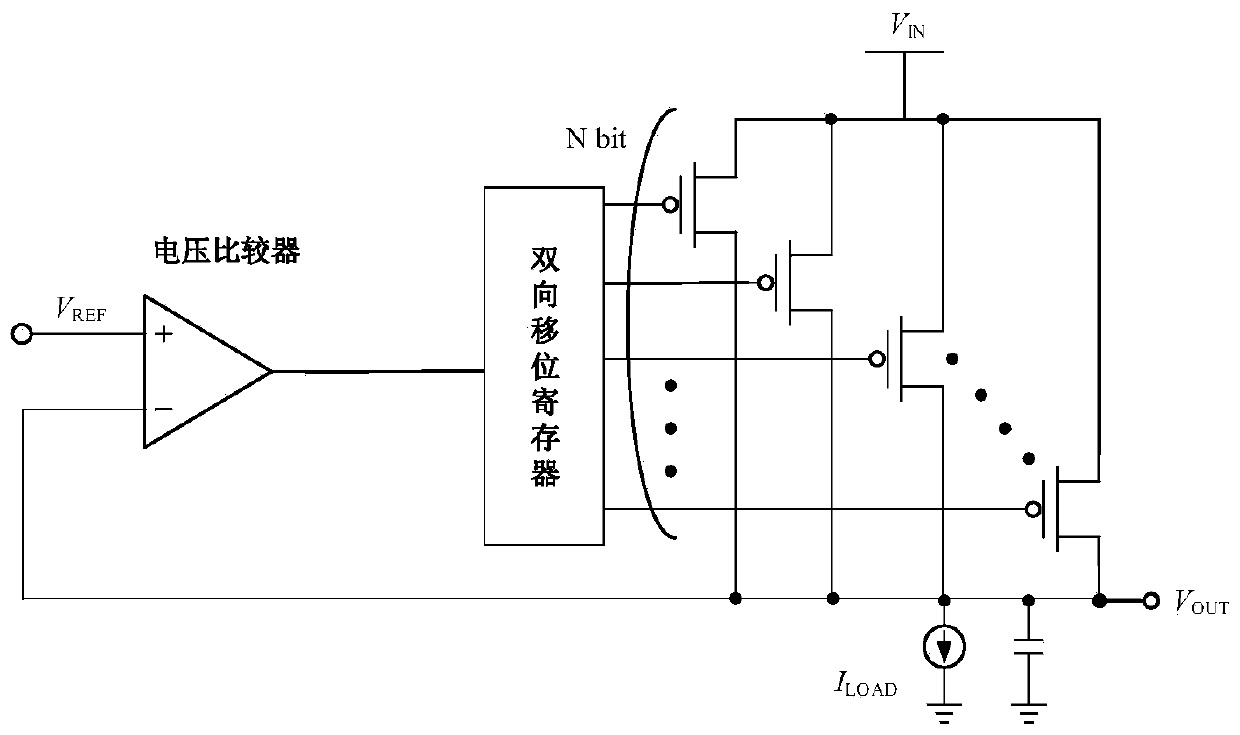
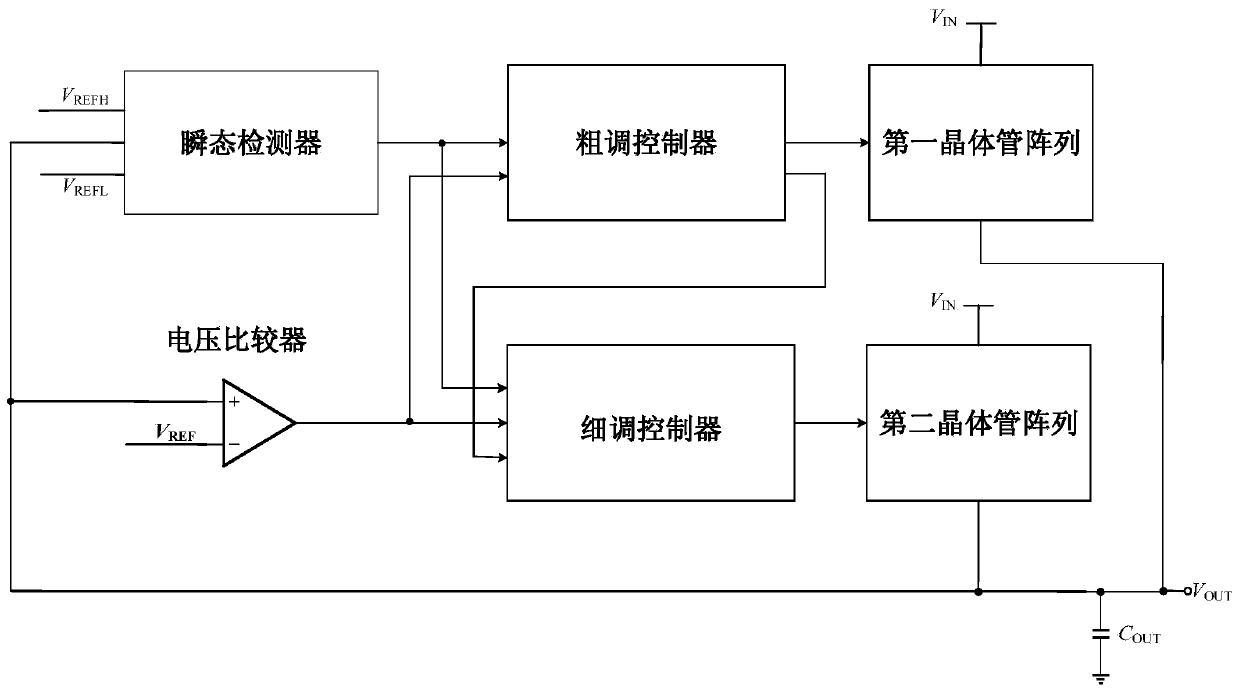
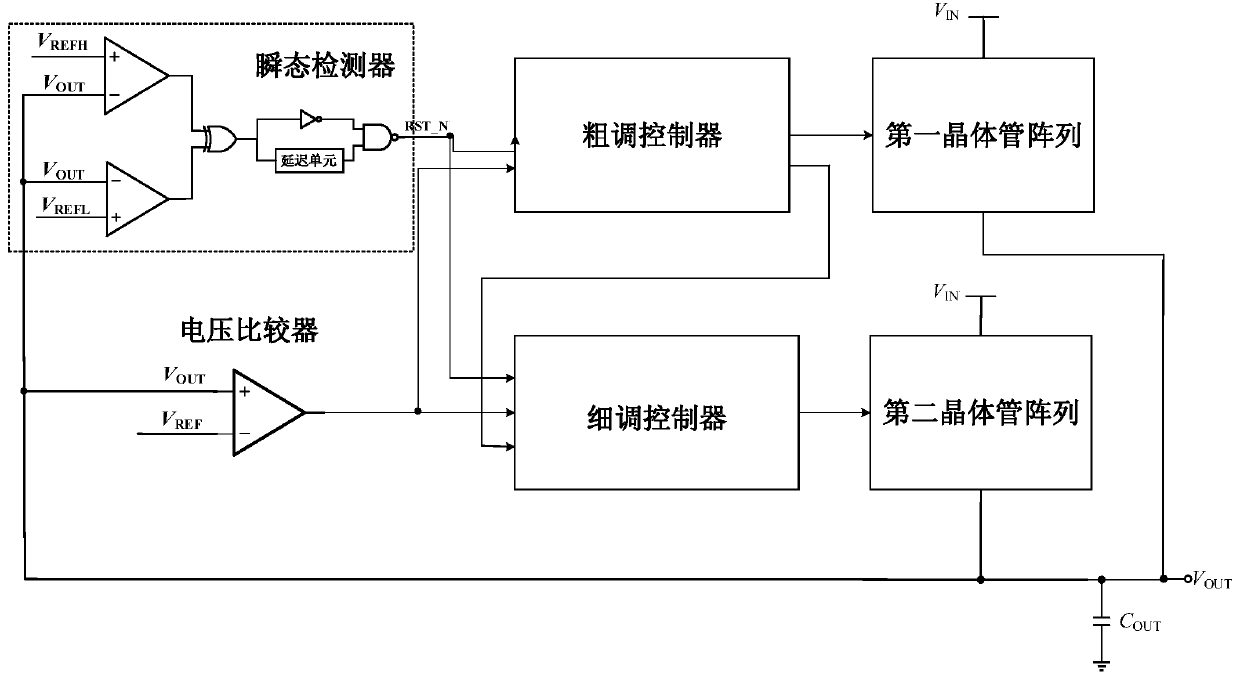
- Using a method of combining coarse adjustment and fine adjustment, through the collaborative work of the transient detector, coarse adjustment controller and fine adjustment controller, asynchronous dynamic comparator and binary/linear search algorithm are used to achieve voltage regulation and eliminate external clock signals , reduce power consumption.

Sub-threshold region based low dropout regulator
PatentActiveTW202118201A
Innovation
- Incorporating resistors with large resistance values between components operating in the sub-threshold region and the power supply line, which act as current mirrors, reducing sensitivity to current disturbances and thus mitigating current mismatch.


Process Variation Impact on Sub-Threshold Digital LDOs
Process variations in semiconductor manufacturing pose significant challenges for digital low-dropout regulators (LDOs) operating in sub-threshold circuits, where the impact becomes exponentially more pronounced due to the inherently low operating voltages and currents. These variations manifest across multiple dimensions including threshold voltage (Vth), channel length, oxide thickness, and doping concentration, creating substantial deviations from nominal design parameters that can severely compromise circuit performance and reliability.
Threshold voltage variations represent the most critical concern for sub-threshold digital LDOs, as the exponential relationship between drain current and gate-source voltage in the sub-threshold region amplifies even minor Vth fluctuations into significant current variations. Statistical analysis reveals that Vth variations can reach ±30mV in advanced process nodes, translating to current variations exceeding 300% in sub-threshold operation. This variability directly affects the LDO's reference voltage generation, feedback loop stability, and output regulation accuracy.
Geometric variations, particularly in channel length and width, introduce additional complexity to sub-threshold digital LDO design. Random dopant fluctuations become increasingly dominant in smaller transistors, creating local threshold voltage variations that can cause significant mismatch between nominally identical devices. This mismatch is particularly problematic in current mirror configurations and differential pairs commonly used in LDO control circuits, where device matching is crucial for proper operation.
Temperature-dependent process variations further exacerbate the challenges in sub-threshold digital LDOs. The temperature coefficient of threshold voltage interacts with process-induced Vth variations, creating a complex dependency that varies across different die locations and manufacturing lots. This interaction can cause the LDO's temperature stability to vary significantly from the designed specifications, potentially leading to regulation failures under extreme operating conditions.
Monte Carlo simulations demonstrate that process variations can shift the LDO's dropout voltage by up to 50% from nominal values, while line and load regulation can degrade by factors of 2-3x. The power supply rejection ratio (PSRR) shows particular sensitivity to process corners, with worst-case scenarios exhibiting 15-20dB degradation compared to typical conditions. These variations necessitate robust design methodologies incorporating statistical optimization, corner analysis, and adaptive compensation techniques to ensure reliable operation across all process, voltage, and temperature conditions.
Threshold voltage variations represent the most critical concern for sub-threshold digital LDOs, as the exponential relationship between drain current and gate-source voltage in the sub-threshold region amplifies even minor Vth fluctuations into significant current variations. Statistical analysis reveals that Vth variations can reach ±30mV in advanced process nodes, translating to current variations exceeding 300% in sub-threshold operation. This variability directly affects the LDO's reference voltage generation, feedback loop stability, and output regulation accuracy.
Geometric variations, particularly in channel length and width, introduce additional complexity to sub-threshold digital LDO design. Random dopant fluctuations become increasingly dominant in smaller transistors, creating local threshold voltage variations that can cause significant mismatch between nominally identical devices. This mismatch is particularly problematic in current mirror configurations and differential pairs commonly used in LDO control circuits, where device matching is crucial for proper operation.
Temperature-dependent process variations further exacerbate the challenges in sub-threshold digital LDOs. The temperature coefficient of threshold voltage interacts with process-induced Vth variations, creating a complex dependency that varies across different die locations and manufacturing lots. This interaction can cause the LDO's temperature stability to vary significantly from the designed specifications, potentially leading to regulation failures under extreme operating conditions.
Monte Carlo simulations demonstrate that process variations can shift the LDO's dropout voltage by up to 50% from nominal values, while line and load regulation can degrade by factors of 2-3x. The power supply rejection ratio (PSRR) shows particular sensitivity to process corners, with worst-case scenarios exhibiting 15-20dB degradation compared to typical conditions. These variations necessitate robust design methodologies incorporating statistical optimization, corner analysis, and adaptive compensation techniques to ensure reliable operation across all process, voltage, and temperature conditions.
Temperature Sensitivity in Sub-Threshold Digital LDO Design
Temperature sensitivity represents one of the most critical design challenges in sub-threshold digital LDO implementations, fundamentally affecting circuit reliability and performance across operational environments. Sub-threshold circuits inherently exhibit exponential sensitivity to temperature variations due to their dependence on weak inversion current mechanisms, where drain current follows an exponential relationship with gate-source voltage and temperature coefficients.
The primary concern stems from the temperature coefficient of threshold voltage, which typically ranges from -1.5mV/°C to -2.5mV/°C in modern CMOS processes. In sub-threshold operation, where gate voltages are deliberately maintained below the threshold voltage, this temperature dependency creates significant variations in reference currents and bias conditions. Digital LDO controllers must compensate for these variations to maintain stable output regulation across the specified temperature range.
Reference voltage generation becomes particularly challenging in temperature-sensitive environments. Traditional bandgap references may consume excessive power for sub-threshold applications, necessitating alternative approaches such as proportional-to-absolute-temperature (PTAT) and complementary-to-absolute-temperature (CTAT) current sources. These circuits must be carefully balanced to achieve near-zero temperature coefficients while operating within sub-threshold power budgets.
The digital control loop itself experiences temperature-induced variations in switching thresholds and propagation delays. Comparator offset voltages and switching points drift with temperature, potentially causing regulation accuracy degradation or oscillatory behavior. Advanced digital LDO designs incorporate temperature compensation through adaptive threshold adjustment or temperature-aware control algorithms.
Process variation interactions with temperature sensitivity compound the design complexity. Corner analysis must consider worst-case scenarios where process variations and temperature extremes combine to create maximum deviation from nominal performance. Monte Carlo simulations across temperature ranges become essential for robust design verification.
Mitigation strategies include implementing temperature-compensated reference circuits, utilizing process-insensitive current sources, and employing digital calibration techniques that can adapt to temperature variations during operation. Some designs incorporate on-chip temperature sensors to enable real-time compensation algorithms, though this approach must balance accuracy improvements against additional power consumption and circuit complexity.
The primary concern stems from the temperature coefficient of threshold voltage, which typically ranges from -1.5mV/°C to -2.5mV/°C in modern CMOS processes. In sub-threshold operation, where gate voltages are deliberately maintained below the threshold voltage, this temperature dependency creates significant variations in reference currents and bias conditions. Digital LDO controllers must compensate for these variations to maintain stable output regulation across the specified temperature range.
Reference voltage generation becomes particularly challenging in temperature-sensitive environments. Traditional bandgap references may consume excessive power for sub-threshold applications, necessitating alternative approaches such as proportional-to-absolute-temperature (PTAT) and complementary-to-absolute-temperature (CTAT) current sources. These circuits must be carefully balanced to achieve near-zero temperature coefficients while operating within sub-threshold power budgets.
The digital control loop itself experiences temperature-induced variations in switching thresholds and propagation delays. Comparator offset voltages and switching points drift with temperature, potentially causing regulation accuracy degradation or oscillatory behavior. Advanced digital LDO designs incorporate temperature compensation through adaptive threshold adjustment or temperature-aware control algorithms.
Process variation interactions with temperature sensitivity compound the design complexity. Corner analysis must consider worst-case scenarios where process variations and temperature extremes combine to create maximum deviation from nominal performance. Monte Carlo simulations across temperature ranges become essential for robust design verification.
Mitigation strategies include implementing temperature-compensated reference circuits, utilizing process-insensitive current sources, and employing digital calibration techniques that can adapt to temperature variations during operation. Some designs incorporate on-chip temperature sensors to enable real-time compensation algorithms, though this approach must balance accuracy improvements against additional power consumption and circuit complexity.
Unlock deeper insights with PatSnap Eureka Quick Research — get a full tech report to explore trends and direct your research. Try now!
Generate Your Research Report Instantly with AI Agent
Supercharge your innovation with PatSnap Eureka AI Agent Platform!