
Enhance Compression Wave Signal Processing Algorithms
MAR 9, 20269 MIN READ
Generate Your Research Report Instantly with AI Agent
Patsnap Eureka helps you evaluate technical feasibility & market potential.
Compression Wave Signal Processing Background and Objectives
Compression wave signal processing has emerged as a critical technology domain spanning multiple industries, from seismic exploration and medical imaging to non-destructive testing and underwater acoustics. The fundamental principle involves analyzing mechanical waves that propagate through various media, where particle displacement occurs parallel to the wave propagation direction. These waves carry valuable information about subsurface structures, material properties, and environmental conditions.
The evolution of compression wave signal processing began in the early 20th century with basic seismographic applications for earthquake detection. The technology gained significant momentum during the 1950s with the advent of digital computing, enabling more sophisticated signal analysis techniques. The oil and gas industry drove substantial advancements in the 1970s and 1980s, developing complex algorithms for hydrocarbon exploration. Recent decades have witnessed exponential growth in processing capabilities, incorporating machine learning, artificial intelligence, and advanced mathematical transforms.
Current technological trends indicate a shift toward real-time processing capabilities, enhanced resolution algorithms, and multi-dimensional signal analysis. The integration of cloud computing and edge processing has revolutionized data handling capacities, while advanced filtering techniques have significantly improved signal-to-noise ratios. Modern systems now incorporate adaptive algorithms that can automatically adjust processing parameters based on environmental conditions and signal characteristics.
The primary technical objectives center on achieving superior signal clarity, enhanced penetration depth analysis, and improved computational efficiency. Key goals include developing algorithms capable of processing larger datasets with reduced computational overhead, implementing real-time analysis capabilities for time-critical applications, and creating robust noise suppression techniques for challenging environmental conditions.
Future development targets encompass the integration of artificial intelligence for predictive signal analysis, development of quantum-enhanced processing algorithms, and creation of standardized protocols for cross-platform compatibility. The ultimate objective involves establishing comprehensive signal processing frameworks that can adapt to diverse applications while maintaining high accuracy and reliability standards across varying operational environments.
The evolution of compression wave signal processing began in the early 20th century with basic seismographic applications for earthquake detection. The technology gained significant momentum during the 1950s with the advent of digital computing, enabling more sophisticated signal analysis techniques. The oil and gas industry drove substantial advancements in the 1970s and 1980s, developing complex algorithms for hydrocarbon exploration. Recent decades have witnessed exponential growth in processing capabilities, incorporating machine learning, artificial intelligence, and advanced mathematical transforms.
Current technological trends indicate a shift toward real-time processing capabilities, enhanced resolution algorithms, and multi-dimensional signal analysis. The integration of cloud computing and edge processing has revolutionized data handling capacities, while advanced filtering techniques have significantly improved signal-to-noise ratios. Modern systems now incorporate adaptive algorithms that can automatically adjust processing parameters based on environmental conditions and signal characteristics.
The primary technical objectives center on achieving superior signal clarity, enhanced penetration depth analysis, and improved computational efficiency. Key goals include developing algorithms capable of processing larger datasets with reduced computational overhead, implementing real-time analysis capabilities for time-critical applications, and creating robust noise suppression techniques for challenging environmental conditions.
Future development targets encompass the integration of artificial intelligence for predictive signal analysis, development of quantum-enhanced processing algorithms, and creation of standardized protocols for cross-platform compatibility. The ultimate objective involves establishing comprehensive signal processing frameworks that can adapt to diverse applications while maintaining high accuracy and reliability standards across varying operational environments.
Market Demand for Advanced Compression Wave Applications
The global market for advanced compression wave applications is experiencing unprecedented growth driven by diverse industrial sectors requiring sophisticated signal processing capabilities. Medical ultrasound imaging represents the largest market segment, with healthcare providers increasingly demanding higher resolution diagnostic equipment and real-time imaging systems. The aging global population and rising healthcare expenditure are fueling continuous investment in advanced ultrasonic medical devices, creating substantial demand for enhanced signal processing algorithms.
Industrial non-destructive testing applications constitute another significant market driver, particularly in aerospace, automotive, and energy sectors. Manufacturing companies require precise defect detection and material characterization capabilities to ensure product quality and safety compliance. The growing emphasis on predictive maintenance and quality assurance in critical infrastructure has intensified the need for more accurate and efficient compression wave signal processing solutions.
The oil and gas exploration industry presents substantial market opportunities for advanced seismic signal processing technologies. Enhanced algorithms capable of processing complex geological data with improved accuracy and speed are essential for optimizing exploration activities and reducing operational costs. The transition toward unconventional energy sources and deep-water exploration further amplifies the demand for sophisticated compression wave processing capabilities.
Emerging applications in structural health monitoring and smart infrastructure are creating new market segments. Urban development projects and aging infrastructure require continuous monitoring systems that can detect structural anomalies and predict maintenance needs. These applications demand robust signal processing algorithms capable of operating in challenging environmental conditions while maintaining high accuracy levels.
The automotive industry's shift toward autonomous vehicles and advanced driver assistance systems is generating increasing demand for ultrasonic sensor technologies. Enhanced compression wave signal processing algorithms are crucial for improving object detection, distance measurement, and collision avoidance systems. The integration of multiple sensor technologies requires sophisticated signal fusion and processing capabilities.
Research institutions and academic organizations represent a growing market segment, driving demand for advanced signal processing tools and methodologies. The increasing focus on materials science research, biomedical engineering, and geophysical studies requires cutting-edge compression wave processing capabilities for experimental and analytical applications.
Industrial non-destructive testing applications constitute another significant market driver, particularly in aerospace, automotive, and energy sectors. Manufacturing companies require precise defect detection and material characterization capabilities to ensure product quality and safety compliance. The growing emphasis on predictive maintenance and quality assurance in critical infrastructure has intensified the need for more accurate and efficient compression wave signal processing solutions.
The oil and gas exploration industry presents substantial market opportunities for advanced seismic signal processing technologies. Enhanced algorithms capable of processing complex geological data with improved accuracy and speed are essential for optimizing exploration activities and reducing operational costs. The transition toward unconventional energy sources and deep-water exploration further amplifies the demand for sophisticated compression wave processing capabilities.
Emerging applications in structural health monitoring and smart infrastructure are creating new market segments. Urban development projects and aging infrastructure require continuous monitoring systems that can detect structural anomalies and predict maintenance needs. These applications demand robust signal processing algorithms capable of operating in challenging environmental conditions while maintaining high accuracy levels.
The automotive industry's shift toward autonomous vehicles and advanced driver assistance systems is generating increasing demand for ultrasonic sensor technologies. Enhanced compression wave signal processing algorithms are crucial for improving object detection, distance measurement, and collision avoidance systems. The integration of multiple sensor technologies requires sophisticated signal fusion and processing capabilities.
Research institutions and academic organizations represent a growing market segment, driving demand for advanced signal processing tools and methodologies. The increasing focus on materials science research, biomedical engineering, and geophysical studies requires cutting-edge compression wave processing capabilities for experimental and analytical applications.
Current State and Challenges in Wave Signal Processing
Compression wave signal processing has reached a mature stage in several fundamental areas, with established algorithms for basic signal detection, filtering, and analysis widely deployed across industries. Current systems effectively handle standard compression wave scenarios in seismic exploration, non-destructive testing, and acoustic monitoring applications. Digital signal processing techniques, including Fast Fourier Transform (FFT) and wavelet analysis, form the backbone of most contemporary solutions.
However, significant performance limitations persist in high-noise environments where signal-to-noise ratios drop below critical thresholds. Existing algorithms struggle with real-time processing requirements when dealing with massive datasets generated by modern sensor arrays. The computational complexity of advanced filtering techniques often creates bottlenecks in time-sensitive applications, particularly in industrial monitoring systems requiring immediate response capabilities.
Adaptive filtering mechanisms represent another area of concern, as current solutions lack sufficient intelligence to automatically adjust parameters based on changing environmental conditions. Traditional algorithms often require manual calibration and fail to maintain optimal performance across varying operational scenarios. This limitation becomes particularly pronounced in applications involving multiple wave propagation media or complex geometric configurations.
The integration of machine learning approaches with conventional signal processing methods remains fragmented and inconsistent across different platforms. While some progress has been made in applying neural networks to pattern recognition within compression wave data, the lack of standardized frameworks hinders widespread adoption and limits cross-platform compatibility.
Geographic distribution of advanced compression wave processing capabilities shows significant concentration in developed regions, with North America and Europe leading in both research institutions and commercial implementations. Asia-Pacific markets demonstrate rapid growth but face challenges in accessing cutting-edge algorithms and specialized expertise. This uneven distribution creates disparities in technological advancement and limits global collaboration opportunities.
Emerging challenges include the need for enhanced resolution in subsurface imaging applications and improved accuracy in defect detection systems. The increasing demand for portable, low-power processing solutions adds complexity to algorithm design requirements, necessitating optimization strategies that balance computational efficiency with processing accuracy.
However, significant performance limitations persist in high-noise environments where signal-to-noise ratios drop below critical thresholds. Existing algorithms struggle with real-time processing requirements when dealing with massive datasets generated by modern sensor arrays. The computational complexity of advanced filtering techniques often creates bottlenecks in time-sensitive applications, particularly in industrial monitoring systems requiring immediate response capabilities.
Adaptive filtering mechanisms represent another area of concern, as current solutions lack sufficient intelligence to automatically adjust parameters based on changing environmental conditions. Traditional algorithms often require manual calibration and fail to maintain optimal performance across varying operational scenarios. This limitation becomes particularly pronounced in applications involving multiple wave propagation media or complex geometric configurations.
The integration of machine learning approaches with conventional signal processing methods remains fragmented and inconsistent across different platforms. While some progress has been made in applying neural networks to pattern recognition within compression wave data, the lack of standardized frameworks hinders widespread adoption and limits cross-platform compatibility.
Geographic distribution of advanced compression wave processing capabilities shows significant concentration in developed regions, with North America and Europe leading in both research institutions and commercial implementations. Asia-Pacific markets demonstrate rapid growth but face challenges in accessing cutting-edge algorithms and specialized expertise. This uneven distribution creates disparities in technological advancement and limits global collaboration opportunities.
Emerging challenges include the need for enhanced resolution in subsurface imaging applications and improved accuracy in defect detection systems. The increasing demand for portable, low-power processing solutions adds complexity to algorithm design requirements, necessitating optimization strategies that balance computational efficiency with processing accuracy.
Existing Compression Wave Signal Processing Solutions
01 Compression wave detection and filtering algorithms
Signal processing algorithms designed to detect and filter compression waves from raw sensor data. These algorithms employ various filtering techniques such as bandpass filters, adaptive filters, and wavelet transforms to isolate compression wave signals from noise and other interference. The methods enable accurate identification of compression wave characteristics including amplitude, frequency, and phase information for further analysis.- Compression wave detection and filtering algorithms: Signal processing algorithms designed to detect and filter compression waves from raw sensor data. These algorithms employ various filtering techniques such as bandpass filters, adaptive filters, and wavelet transforms to isolate compression wave signals from noise and other interference. The methods enable accurate identification of compression wave characteristics including amplitude, frequency, and phase information for further analysis.
- Time-frequency domain analysis for compression waves: Advanced signal processing techniques that analyze compression wave signals in both time and frequency domains simultaneously. These algorithms utilize methods such as short-time Fourier transform, continuous wavelet transform, and Wigner-Ville distribution to extract temporal and spectral features of compression waves. This dual-domain analysis provides comprehensive characterization of transient compression wave events and their evolution over time.
- Compression wave signal enhancement and reconstruction: Signal processing algorithms focused on enhancing weak compression wave signals and reconstructing degraded waveforms. These techniques employ methods including signal averaging, correlation analysis, and machine learning-based reconstruction to improve signal-to-noise ratio and recover original compression wave characteristics. The algorithms are particularly useful for processing signals acquired in challenging environments with high noise levels.
- Real-time compression wave signal processing systems: Hardware and software architectures designed for real-time processing of compression wave signals. These systems implement optimized algorithms using parallel processing, digital signal processors, and field-programmable gate arrays to achieve low-latency signal analysis. The implementations enable immediate detection, classification, and response to compression wave events in time-critical applications.
- Compression wave pattern recognition and classification: Algorithms that identify and classify different types of compression wave patterns using pattern recognition techniques. These methods employ feature extraction, statistical analysis, neural networks, and support vector machines to categorize compression waves based on their characteristics. The classification enables automated identification of wave sources, prediction of wave behavior, and differentiation between normal and anomalous compression wave events.
02 Time-frequency domain analysis for compression waves
Advanced signal processing techniques that analyze compression wave signals in both time and frequency domains simultaneously. These algorithms utilize methods such as short-time Fourier transform, continuous wavelet transform, and Hilbert-Huang transform to extract temporal and spectral features of compression waves. The approach enables better characterization of transient and non-stationary compression wave phenomena.Expand Specific Solutions03 Compression wave signal enhancement and reconstruction
Algorithms focused on enhancing weak compression wave signals and reconstructing degraded waveforms. These techniques employ methods including signal averaging, correlation analysis, and machine learning-based reconstruction to improve signal quality and recover missing or corrupted data. The algorithms are particularly useful for processing signals with low signal-to-noise ratios or incomplete data acquisition.Expand Specific Solutions04 Real-time compression wave processing systems
Hardware and software architectures designed for real-time processing of compression wave signals. These systems implement efficient algorithms optimized for low-latency processing, utilizing parallel processing, pipelining, and dedicated signal processing units. The implementations enable immediate analysis and response to compression wave events in time-critical applications.Expand Specific Solutions05 Multi-channel compression wave signal fusion
Signal processing algorithms that combine and analyze compression wave data from multiple sensors or channels simultaneously. These methods employ sensor fusion techniques, beamforming algorithms, and multi-dimensional signal processing to improve detection accuracy and spatial resolution. The algorithms enable comprehensive analysis of compression wave propagation patterns and source localization.Expand Specific Solutions
Key Players in Signal Processing and Wave Analysis Industry
The compression wave signal processing algorithm enhancement field represents a mature technology domain experiencing steady growth, driven by applications in telecommunications, defense, and industrial automation. The market demonstrates significant scale with established players spanning telecommunications infrastructure, semiconductor design, and research institutions. Technology maturity varies across segments, with companies like Huawei Technologies and Mitsubishi Electric leading in commercial implementations, while Altera Corp. provides foundational FPGA solutions for signal processing acceleration. Academic institutions including Zhejiang University, Harbin Institute of Technology, and Columbia University contribute advanced algorithmic research, bridging theoretical developments with practical applications. Defense contractors such as Leidos and TKMS ATLAS ELEKTRONIK focus on specialized military applications, while consumer electronics companies like Sony Semiconductor Solutions and Harman International drive mass-market adoption. The competitive landscape reflects a balanced ecosystem where established technology giants, specialized defense contractors, and leading research universities collaborate to advance compression wave signal processing capabilities across diverse application domains.
Huawei Technologies Co., Ltd.
Technical Solution: Huawei has developed advanced compression wave signal processing algorithms primarily for telecommunications and audio applications. Their approach integrates adaptive filtering techniques with machine learning-based optimization to enhance signal compression efficiency. The company's algorithms utilize wavelet transform combined with perceptual coding models to achieve up to 40% better compression ratios while maintaining signal quality. Their implementation includes real-time processing capabilities for 5G networks and IoT devices, featuring dynamic bit allocation and noise reduction algorithms. The technology supports multiple compression standards and includes proprietary error correction mechanisms for robust signal transmission in challenging environments.
Strengths: Strong integration with telecommunications infrastructure, excellent real-time processing capabilities. Weaknesses: Limited availability due to geopolitical restrictions, primarily focused on telecom applications.
Mitsubishi Electric Corp.
Technical Solution: Mitsubishi Electric has developed sophisticated compression wave signal processing algorithms for industrial automation and power systems applications. Their technology employs multi-resolution analysis combined with adaptive quantization techniques to process high-frequency electrical signals in power grids and manufacturing equipment. The algorithms feature advanced noise suppression capabilities and can handle signals with frequencies up to 100 MHz while maintaining compression ratios of 8:1. Their implementation includes specialized hardware acceleration and real-time monitoring capabilities for critical infrastructure applications, with particular emphasis on fault detection and system diagnostics through compressed signal analysis.
Strengths: Excellent industrial reliability, specialized hardware integration, strong power systems expertise. Weaknesses: Limited consumer market presence, higher cost for specialized applications.
Core Innovations in Advanced Wave Processing Algorithms
Compression of sampled data in a data acquisition system
PatentInactiveUS7876252B1
Innovation
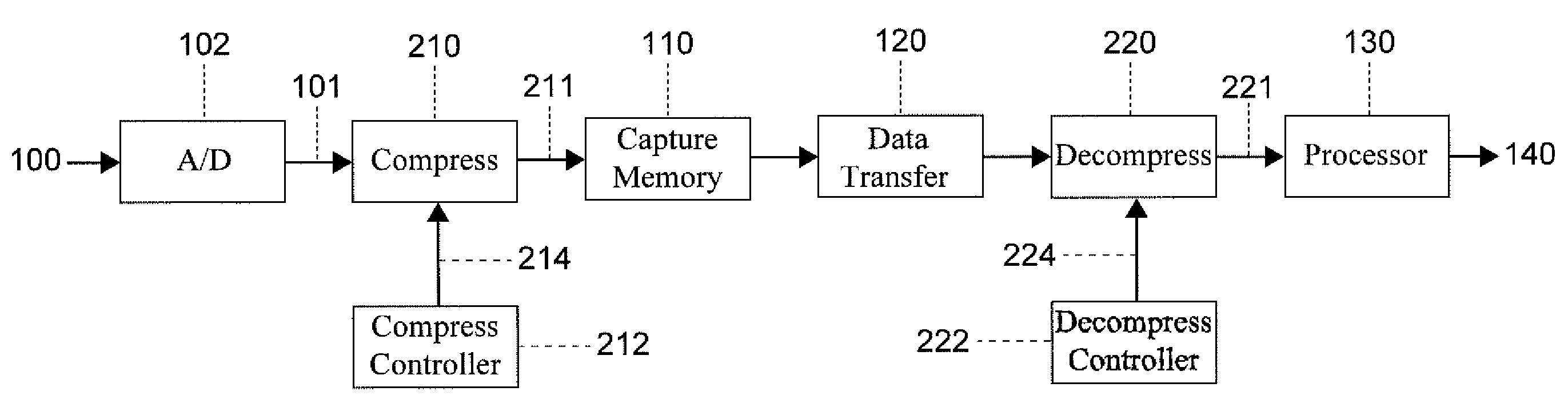
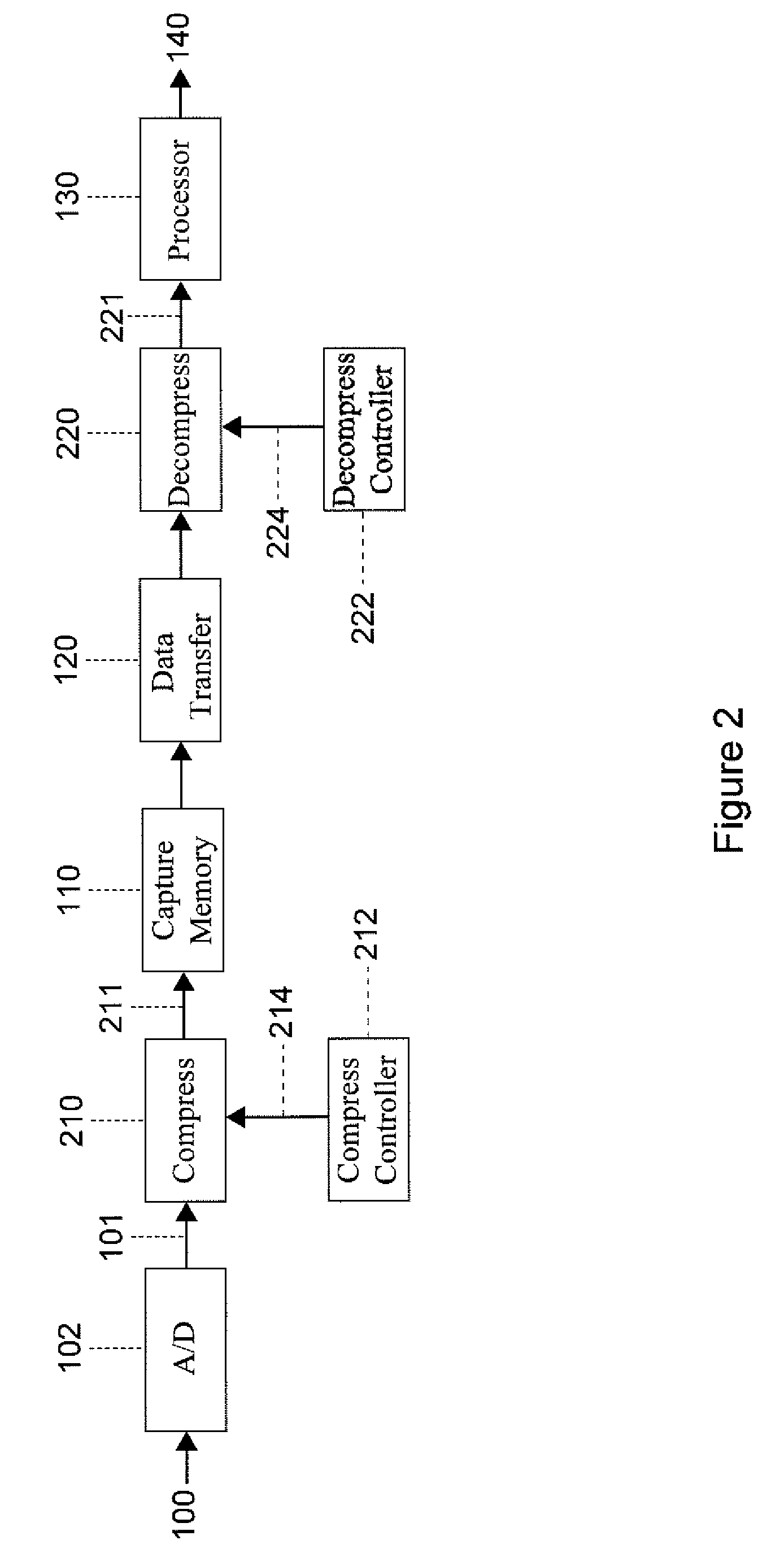
- A system that uses preprocessors to adjust signal parameters like noise floor, center frequency, and bandwidth, allowing for real-time compression and decompression of high-speed analog signals with scalable processing resources, enabling both lossless and lossy compression modes and adaptable to varying signal conditions.


Frequency resolution using compression
PatentInactiveUS20080123731A1
Innovation
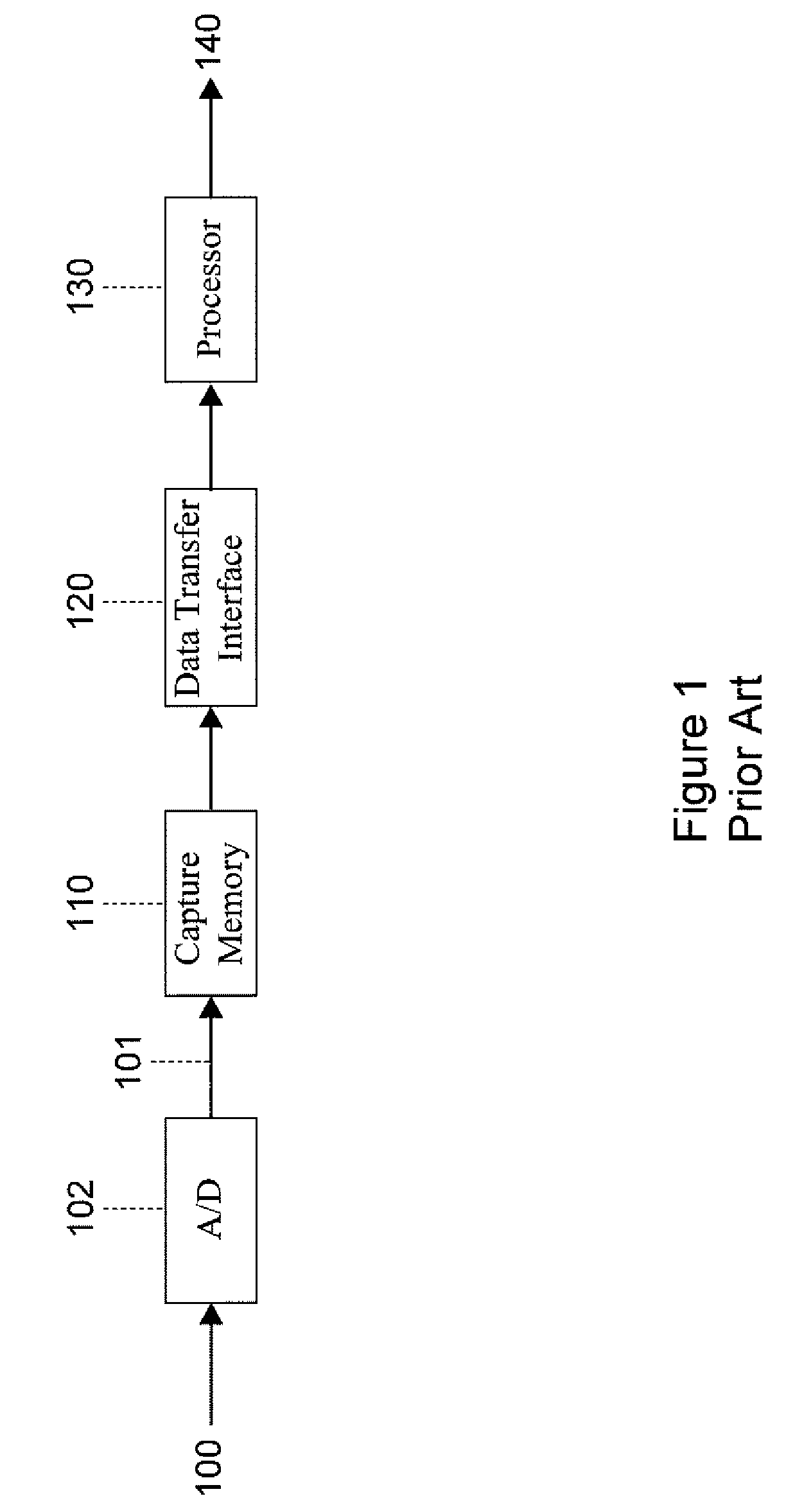
- Signal compression before storage or transfer allows for improved frequency domain resolution by increasing the number of samples available for processing, using lossless or lossy compression techniques that reduce memory and data transfer requirements, enabling the use of lower-speed memory architectures and reducing bandwidth needs.

Standards and Protocols for Wave Signal Processing
The standardization landscape for compression wave signal processing algorithms encompasses multiple international and regional frameworks that govern implementation, interoperability, and performance benchmarks. The International Organization for Standardization (ISO) provides foundational guidelines through ISO/IEC 23008 series for advanced audio coding and ISO/IEC 23003 for unified speech and audio coding, establishing baseline requirements for compression efficiency and signal fidelity preservation.
IEEE standards play a crucial role in defining technical specifications for wave signal processing implementations. IEEE 1857 series addresses video coding standards with compression wave applications, while IEEE 754 floating-point arithmetic standards ensure numerical precision consistency across different processing platforms. These standards establish mandatory compliance requirements for algorithm developers seeking market adoption and cross-platform compatibility.
The International Telecommunication Union (ITU) contributes significantly through ITU-T recommendations, particularly G.711, G.722, and G.729 series for audio compression, and H.264/H.265 for video applications involving compression wave processing. These protocols define encoding parameters, bit rate specifications, and quality metrics that directly impact algorithm design choices and performance optimization strategies.
Regional standards organizations have developed complementary frameworks addressing specific market requirements. The European Telecommunications Standards Institute (ETSI) provides guidelines for compression wave processing in telecommunications applications, while the Audio Engineering Society (AES) establishes professional audio processing standards that influence algorithm development for high-fidelity applications.
Protocol frameworks for real-time compression wave processing include Real-time Transport Protocol (RTP) specifications that define packet structure, timing requirements, and error handling mechanisms. These protocols establish latency constraints and buffering strategies that significantly influence algorithm architecture and computational resource allocation decisions.
Emerging standardization efforts focus on machine learning-enhanced compression algorithms, with organizations developing new compliance frameworks for AI-driven wave signal processing. These evolving standards address algorithm transparency, computational complexity limits, and performance validation methodologies specific to neural network-based compression approaches.
IEEE standards play a crucial role in defining technical specifications for wave signal processing implementations. IEEE 1857 series addresses video coding standards with compression wave applications, while IEEE 754 floating-point arithmetic standards ensure numerical precision consistency across different processing platforms. These standards establish mandatory compliance requirements for algorithm developers seeking market adoption and cross-platform compatibility.
The International Telecommunication Union (ITU) contributes significantly through ITU-T recommendations, particularly G.711, G.722, and G.729 series for audio compression, and H.264/H.265 for video applications involving compression wave processing. These protocols define encoding parameters, bit rate specifications, and quality metrics that directly impact algorithm design choices and performance optimization strategies.
Regional standards organizations have developed complementary frameworks addressing specific market requirements. The European Telecommunications Standards Institute (ETSI) provides guidelines for compression wave processing in telecommunications applications, while the Audio Engineering Society (AES) establishes professional audio processing standards that influence algorithm development for high-fidelity applications.
Protocol frameworks for real-time compression wave processing include Real-time Transport Protocol (RTP) specifications that define packet structure, timing requirements, and error handling mechanisms. These protocols establish latency constraints and buffering strategies that significantly influence algorithm architecture and computational resource allocation decisions.
Emerging standardization efforts focus on machine learning-enhanced compression algorithms, with organizations developing new compliance frameworks for AI-driven wave signal processing. These evolving standards address algorithm transparency, computational complexity limits, and performance validation methodologies specific to neural network-based compression approaches.
Real-time Processing Requirements and Computational Constraints
Real-time processing of compression wave signals demands stringent temporal constraints that fundamentally shape algorithm design and implementation strategies. Modern applications require processing latencies typically ranging from microseconds to milliseconds, depending on the specific use case. Seismic monitoring systems must process compression wave data within 10-50 milliseconds to enable effective early warning capabilities, while industrial non-destructive testing applications often require sub-millisecond response times for quality control processes.
The computational architecture presents significant constraints that directly impact algorithm selection and optimization approaches. Traditional sequential processing methods prove inadequate for meeting these temporal requirements, necessitating parallel processing architectures and specialized hardware implementations. Graphics Processing Units (GPUs) have emerged as viable solutions, offering thousands of parallel cores capable of simultaneous signal processing operations, though they introduce additional complexity in memory management and data transfer protocols.
Memory bandwidth limitations constitute another critical constraint, particularly when processing high-frequency compression wave signals with sampling rates exceeding several megahertz. The continuous data streams generate substantial memory access demands that can create bottlenecks in real-time systems. Efficient memory allocation strategies and cache optimization techniques become essential for maintaining processing throughput while minimizing latency variations.
Power consumption constraints significantly influence algorithm design choices, especially in portable and embedded applications. Energy-efficient processing algorithms must balance computational complexity with power requirements, often necessitating trade-offs between processing accuracy and battery life. Low-power digital signal processors and field-programmable gate arrays (FPGAs) offer promising solutions for power-constrained environments.
Scalability requirements add another layer of complexity, as systems must accommodate varying signal complexities and multiple simultaneous channels without compromising real-time performance. Adaptive algorithms that can dynamically adjust computational load based on signal characteristics and available processing resources represent a crucial development direction for addressing these scalability challenges while maintaining consistent real-time performance standards.
The computational architecture presents significant constraints that directly impact algorithm selection and optimization approaches. Traditional sequential processing methods prove inadequate for meeting these temporal requirements, necessitating parallel processing architectures and specialized hardware implementations. Graphics Processing Units (GPUs) have emerged as viable solutions, offering thousands of parallel cores capable of simultaneous signal processing operations, though they introduce additional complexity in memory management and data transfer protocols.
Memory bandwidth limitations constitute another critical constraint, particularly when processing high-frequency compression wave signals with sampling rates exceeding several megahertz. The continuous data streams generate substantial memory access demands that can create bottlenecks in real-time systems. Efficient memory allocation strategies and cache optimization techniques become essential for maintaining processing throughput while minimizing latency variations.
Power consumption constraints significantly influence algorithm design choices, especially in portable and embedded applications. Energy-efficient processing algorithms must balance computational complexity with power requirements, often necessitating trade-offs between processing accuracy and battery life. Low-power digital signal processors and field-programmable gate arrays (FPGAs) offer promising solutions for power-constrained environments.
Scalability requirements add another layer of complexity, as systems must accommodate varying signal complexities and multiple simultaneous channels without compromising real-time performance. Adaptive algorithms that can dynamically adjust computational load based on signal characteristics and available processing resources represent a crucial development direction for addressing these scalability challenges while maintaining consistent real-time performance standards.
Unlock deeper insights with Patsnap Eureka Quick Research — get a full tech report to explore trends and direct your research. Try now!
Generate Your Research Report Instantly with AI Agent
Supercharge your innovation with Patsnap Eureka AI Agent Platform!