Enhancing competitive edge in racing through KERS analytics
AUG 15, 20258 MIN READ
Generate Your Research Report Instantly with AI Agent
PatSnap Eureka helps you evaluate technical feasibility & market potential.
KERS Evolution & Goals
The Kinetic Energy Recovery System (KERS) has undergone significant evolution since its inception in motorsports, particularly in Formula 1 racing. Initially introduced in 2009, KERS was designed to harness the energy typically lost during braking and convert it into additional power for acceleration. This technology marked a pivotal shift in racing strategy and vehicle design, aligning with broader automotive industry trends towards energy efficiency and sustainability.
The primary goal of KERS has consistently been to enhance competitive edge by providing drivers with additional bursts of power at critical moments during a race. As the technology matured, teams aimed to optimize the system's weight, efficiency, and integration with other vehicle systems. This evolution has seen KERS progress from a supplementary feature to an integral component of modern racing vehicles, significantly influencing race outcomes and driving techniques.
Over time, the objectives of KERS development expanded beyond mere performance enhancement. Teams and manufacturers began to view KERS as a platform for innovation that could potentially transfer to road-going vehicles. This broader perspective led to increased investment in research and development, with goals shifting towards creating more compact, lightweight, and efficient energy recovery systems.
The evolution of KERS has also been shaped by regulatory changes in motorsports. Governing bodies have adjusted rules to promote the technology's development while maintaining competitive balance. These regulations have driven teams to push the boundaries of KERS capabilities, resulting in systems that can store and deploy increasingly larger amounts of energy with greater precision.
As analytics capabilities have advanced, a new frontier in KERS evolution has emerged. The goal has shifted towards not just developing more powerful systems, but also optimizing their usage through data-driven strategies. Teams now aim to leverage real-time analytics to make split-second decisions on when and how to deploy KERS energy for maximum competitive advantage.
Looking forward, the goals for KERS technology continue to evolve. There is a growing focus on integrating KERS with other advanced technologies such as artificial intelligence and machine learning. The objective is to create intelligent energy recovery systems that can adapt to changing race conditions, driver behaviors, and track characteristics in real-time. Additionally, there is an increasing emphasis on developing more sustainable KERS solutions, aligning with the broader push towards environmentally friendly technologies in motorsports.
The primary goal of KERS has consistently been to enhance competitive edge by providing drivers with additional bursts of power at critical moments during a race. As the technology matured, teams aimed to optimize the system's weight, efficiency, and integration with other vehicle systems. This evolution has seen KERS progress from a supplementary feature to an integral component of modern racing vehicles, significantly influencing race outcomes and driving techniques.
Over time, the objectives of KERS development expanded beyond mere performance enhancement. Teams and manufacturers began to view KERS as a platform for innovation that could potentially transfer to road-going vehicles. This broader perspective led to increased investment in research and development, with goals shifting towards creating more compact, lightweight, and efficient energy recovery systems.
The evolution of KERS has also been shaped by regulatory changes in motorsports. Governing bodies have adjusted rules to promote the technology's development while maintaining competitive balance. These regulations have driven teams to push the boundaries of KERS capabilities, resulting in systems that can store and deploy increasingly larger amounts of energy with greater precision.
As analytics capabilities have advanced, a new frontier in KERS evolution has emerged. The goal has shifted towards not just developing more powerful systems, but also optimizing their usage through data-driven strategies. Teams now aim to leverage real-time analytics to make split-second decisions on when and how to deploy KERS energy for maximum competitive advantage.
Looking forward, the goals for KERS technology continue to evolve. There is a growing focus on integrating KERS with other advanced technologies such as artificial intelligence and machine learning. The objective is to create intelligent energy recovery systems that can adapt to changing race conditions, driver behaviors, and track characteristics in real-time. Additionally, there is an increasing emphasis on developing more sustainable KERS solutions, aligning with the broader push towards environmentally friendly technologies in motorsports.
KERS Market Analysis
The KERS (Kinetic Energy Recovery System) market has experienced significant growth in recent years, driven by the increasing demand for energy-efficient technologies in motorsports and the automotive industry. The global KERS market is expected to continue its upward trajectory, with a compound annual growth rate (CAGR) projected to be in the double digits over the next five years.
In the motorsports sector, Formula 1 has been at the forefront of KERS adoption, with the technology becoming mandatory for all teams since 2014. This has led to a surge in demand for KERS components and systems, creating a niche market for specialized manufacturers and suppliers. The technology has also found applications in other racing series, such as endurance racing and electric vehicle racing, further expanding its market potential.
The automotive industry has shown increasing interest in KERS technology as a means to improve fuel efficiency and reduce emissions in passenger vehicles. Major automakers have been investing in research and development to integrate KERS into their hybrid and electric vehicle platforms. This trend is expected to drive substantial growth in the KERS market over the coming years, as stricter emissions regulations and consumer demand for eco-friendly vehicles continue to shape the industry.
The market for KERS analytics is emerging as a crucial segment within the broader KERS ecosystem. As teams and manufacturers seek to optimize the performance of their KERS systems, there is a growing need for sophisticated data analysis tools and services. This includes real-time monitoring of energy recovery and deployment, predictive maintenance algorithms, and performance optimization software.
Key players in the KERS market include established automotive suppliers, specialized racing technology firms, and emerging startups focused on energy recovery systems. These companies are competing to develop more efficient, lightweight, and cost-effective KERS solutions, driving innovation in the field.
Geographically, Europe remains the largest market for KERS technology, primarily due to its strong presence in motorsports and the automotive industry. However, North America and Asia-Pacific regions are showing rapid growth, fueled by increasing adoption of hybrid and electric vehicles in these markets.
The market analysis reveals several trends shaping the future of KERS technology. These include the integration of artificial intelligence and machine learning algorithms to optimize energy recovery and deployment, the development of more compact and efficient energy storage systems, and the exploration of new materials to reduce weight and improve performance.
In the motorsports sector, Formula 1 has been at the forefront of KERS adoption, with the technology becoming mandatory for all teams since 2014. This has led to a surge in demand for KERS components and systems, creating a niche market for specialized manufacturers and suppliers. The technology has also found applications in other racing series, such as endurance racing and electric vehicle racing, further expanding its market potential.
The automotive industry has shown increasing interest in KERS technology as a means to improve fuel efficiency and reduce emissions in passenger vehicles. Major automakers have been investing in research and development to integrate KERS into their hybrid and electric vehicle platforms. This trend is expected to drive substantial growth in the KERS market over the coming years, as stricter emissions regulations and consumer demand for eco-friendly vehicles continue to shape the industry.
The market for KERS analytics is emerging as a crucial segment within the broader KERS ecosystem. As teams and manufacturers seek to optimize the performance of their KERS systems, there is a growing need for sophisticated data analysis tools and services. This includes real-time monitoring of energy recovery and deployment, predictive maintenance algorithms, and performance optimization software.
Key players in the KERS market include established automotive suppliers, specialized racing technology firms, and emerging startups focused on energy recovery systems. These companies are competing to develop more efficient, lightweight, and cost-effective KERS solutions, driving innovation in the field.
Geographically, Europe remains the largest market for KERS technology, primarily due to its strong presence in motorsports and the automotive industry. However, North America and Asia-Pacific regions are showing rapid growth, fueled by increasing adoption of hybrid and electric vehicles in these markets.
The market analysis reveals several trends shaping the future of KERS technology. These include the integration of artificial intelligence and machine learning algorithms to optimize energy recovery and deployment, the development of more compact and efficient energy storage systems, and the exploration of new materials to reduce weight and improve performance.
KERS Tech Challenges
The implementation of Kinetic Energy Recovery Systems (KERS) in racing has revolutionized the sport, but it also presents significant technical challenges. One of the primary hurdles is the integration of KERS with existing powertrain systems. Engineers must design a seamless interface between the energy recovery mechanism and the conventional engine, ensuring optimal power distribution without compromising vehicle balance or performance.
Weight management is another critical challenge in KERS implementation. The addition of energy storage systems, such as batteries or flywheels, increases the overall mass of the vehicle. This extra weight can negatively impact acceleration, handling, and fuel efficiency. Racing teams must constantly innovate to develop lighter, more compact KERS components without sacrificing energy storage capacity or power output.
Thermal management poses a substantial technical obstacle for KERS. The energy recovery and deployment processes generate significant heat, which can affect the performance and longevity of both the KERS components and surrounding systems. Developing efficient cooling solutions that do not add excessive weight or aerodynamic drag is a constant challenge for racing engineers.
The control systems for KERS present another layer of complexity. Precise algorithms are required to determine the optimal timing for energy recovery and deployment, taking into account factors such as track conditions, race strategy, and driver input. These control systems must be robust enough to handle the high-stress environment of competitive racing while remaining adaptable to different scenarios.
Reliability and durability of KERS components are ongoing concerns. The high-performance nature of racing puts extreme stress on all vehicle systems, and KERS is no exception. Engineers must design components that can withstand the rigors of racing while maintaining consistent performance throughout the race duration.
Energy storage technology is a critical area of focus for KERS development. Current systems primarily use either batteries or flywheels, each with its own set of advantages and limitations. Improving energy density, charge/discharge rates, and cycle life of these storage systems is crucial for enhancing KERS performance and reliability.
Finally, the analytics aspect of KERS presents its own set of challenges. Collecting, processing, and interpreting vast amounts of data in real-time requires sophisticated hardware and software solutions. Teams must develop robust data acquisition systems and advanced analytics tools to extract meaningful insights that can inform race strategy and system optimization.
Weight management is another critical challenge in KERS implementation. The addition of energy storage systems, such as batteries or flywheels, increases the overall mass of the vehicle. This extra weight can negatively impact acceleration, handling, and fuel efficiency. Racing teams must constantly innovate to develop lighter, more compact KERS components without sacrificing energy storage capacity or power output.
Thermal management poses a substantial technical obstacle for KERS. The energy recovery and deployment processes generate significant heat, which can affect the performance and longevity of both the KERS components and surrounding systems. Developing efficient cooling solutions that do not add excessive weight or aerodynamic drag is a constant challenge for racing engineers.
The control systems for KERS present another layer of complexity. Precise algorithms are required to determine the optimal timing for energy recovery and deployment, taking into account factors such as track conditions, race strategy, and driver input. These control systems must be robust enough to handle the high-stress environment of competitive racing while remaining adaptable to different scenarios.
Reliability and durability of KERS components are ongoing concerns. The high-performance nature of racing puts extreme stress on all vehicle systems, and KERS is no exception. Engineers must design components that can withstand the rigors of racing while maintaining consistent performance throughout the race duration.
Energy storage technology is a critical area of focus for KERS development. Current systems primarily use either batteries or flywheels, each with its own set of advantages and limitations. Improving energy density, charge/discharge rates, and cycle life of these storage systems is crucial for enhancing KERS performance and reliability.
Finally, the analytics aspect of KERS presents its own set of challenges. Collecting, processing, and interpreting vast amounts of data in real-time requires sophisticated hardware and software solutions. Teams must develop robust data acquisition systems and advanced analytics tools to extract meaningful insights that can inform race strategy and system optimization.
Current KERS Solutions
01 Improved energy efficiency and performance
KERS enhances vehicle efficiency by capturing and reusing kinetic energy during braking. This recovered energy can be used for acceleration, reducing fuel consumption and improving overall performance. The system provides a competitive edge by offering better fuel economy and increased power output when needed.- Enhanced energy efficiency and performance: KERS provides a competitive edge by improving overall energy efficiency and vehicle performance. It captures and stores kinetic energy during braking, which can then be redeployed to boost acceleration or power auxiliary systems. This results in improved fuel economy, reduced emissions, and enhanced performance, particularly in racing applications.
- Advanced control systems and integration: Sophisticated control systems and seamless integration with existing vehicle systems give KERS a competitive advantage. These systems optimize energy recovery, storage, and deployment, ensuring maximum efficiency and performance gains. Advanced algorithms and sensors allow for real-time adjustments based on driving conditions and vehicle status.
- Innovative energy storage technologies: KERS systems gain a competitive edge through the use of advanced energy storage technologies. These may include high-performance flywheels, advanced batteries, or supercapacitors, which offer rapid charge and discharge capabilities. Improved energy density and power output of these storage systems contribute to overall system effectiveness.
- Lightweight and compact designs: Competitive KERS designs focus on minimizing weight and size while maximizing energy recovery potential. This is achieved through the use of advanced materials, optimized component layouts, and innovative mechanical or electrical designs. Lightweight systems contribute to overall vehicle efficiency and performance, particularly in racing applications.
- Versatility and adaptability across vehicle types: KERS systems that offer versatility and adaptability across different vehicle types and applications provide a significant competitive edge. This includes scalability for use in various vehicle sizes, from small passenger cars to large commercial vehicles, as well as adaptability to different powertrain configurations, including hybrid and fully electric vehicles.
02 Advanced control systems for KERS
Sophisticated control systems optimize the operation of KERS, ensuring seamless integration with the vehicle's powertrain. These systems manage energy recovery, storage, and deployment, adapting to various driving conditions and user preferences. Advanced control algorithms contribute to improved efficiency and responsiveness, providing a competitive advantage.Expand Specific Solutions03 Innovative energy storage solutions
Development of high-performance energy storage systems for KERS, including advanced flywheels, supercapacitors, and hybrid battery technologies. These solutions offer rapid charge and discharge capabilities, high power density, and improved durability, enhancing the overall effectiveness of the KERS and providing a competitive edge in energy management.Expand Specific Solutions04 Integration with hybrid and electric powertrains
KERS technology is being integrated with hybrid and electric vehicle powertrains to maximize energy recovery and utilization. This integration allows for more efficient power distribution, extended electric driving range, and reduced emissions, offering a significant competitive advantage in the evolving automotive market.Expand Specific Solutions05 Application in non-automotive sectors
Expansion of KERS technology beyond automotive applications, including use in industrial machinery, renewable energy systems, and public transportation. This diversification provides competitive advantages in multiple sectors by improving energy efficiency and reducing operational costs across various industries.Expand Specific Solutions
KERS Industry Players
The competitive landscape for enhancing racing performance through KERS (Kinetic Energy Recovery System) analytics is in a growth phase, with increasing market size and evolving technological maturity. The industry is transitioning from early adoption to more widespread implementation, driven by the potential for significant performance gains. Key players like Marelli Europe SpA, Volvo, and Brembo SpA are investing heavily in R&D to develop advanced KERS solutions. The market is characterized by a mix of established automotive companies and specialized racing technology firms, such as MyPitboard, Inc., focusing on data-driven performance optimization. As the technology matures, we're seeing increased integration of AI and machine learning capabilities to enhance KERS efficiency and effectiveness in racing applications.
Volvo Personvagnar AB
Technical Solution: Volvo has developed a KERS analytics solution that builds on their expertise in automotive engineering and safety systems. Their approach focuses on integrating KERS analytics with overall vehicle dynamics and safety systems. Volvo's solution utilizes a network of sensors throughout the vehicle, collecting data on KERS performance, vehicle dynamics, and driver inputs. This data is processed using advanced algorithms that optimize energy recovery and deployment while maintaining vehicle stability and safety. The system features adaptive control strategies that can adjust KERS performance based on road conditions, driving style, and race situations. Volvo has also implemented a machine learning model that continuously improves the system's performance based on accumulated race data[9]. The solution includes a simulation environment for strategy testing and driver training.
Strengths: Strong integration with vehicle dynamics and safety systems, adaptive control strategies, and focus on overall vehicle performance. Weaknesses: May be more conservative in energy deployment strategies due to emphasis on safety, potentially limited experience in high-performance racing environments.
International Business Machines Corp.
Technical Solution: IBM has developed a comprehensive KERS analytics solution leveraging its expertise in AI and big data. Their system utilizes IBM Watson for advanced predictive analytics, processing vast amounts of telemetry data in real-time. The solution incorporates machine learning models that analyze driver behavior, track conditions, and vehicle performance to optimize energy recovery and deployment. IBM's KERS analytics also features a digital twin simulation environment, allowing teams to test various scenarios and strategies virtually[2]. The system integrates with IBM's cloud infrastructure for scalable processing and storage, enabling teams to access insights from anywhere[4].
Strengths: Advanced AI capabilities, scalable cloud infrastructure, and digital twin simulation for strategy testing. Weaknesses: Potentially complex implementation and high cost, may require significant customization for specific racing teams.
KERS Core Innovations
Automatic control braking system for vehicles
PatentWO2017115244A1
Innovation
- A braking system with a master cylinder having two output circuits and an automatic hydraulic actuation unit, where a first float is connected to a manual actuation device and a second float is operated by the hydraulic actuation circuit, ensuring high power and reduced actuation times with smaller components, and featuring a processing and control unit to manage fluid flow and actuation strokes for reliable braking.


Kinetic energy recovery system
PatentPendingCN118722205A
Innovation
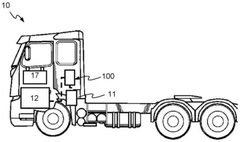
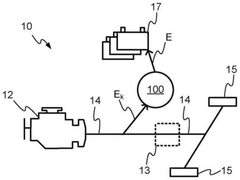
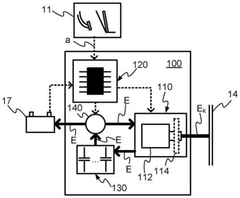
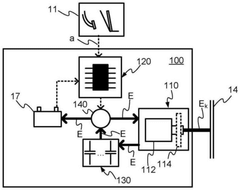
- Employs a kinetic energy recovery system (KERS) connected to the vehicle's propulsion shaft, which converts energy from the propulsion shaft into electrical energy through internal energy storage and processing circuitry, and distributes it to non-propulsion batteries or propulsion shafts when appropriate, in lieu of generator charging and provide motivation.
KERS Data Analytics
KERS (Kinetic Energy Recovery System) data analytics plays a crucial role in enhancing competitive edge in racing. This advanced technology utilizes sophisticated sensors and data collection systems to capture and analyze vast amounts of information during races and practice sessions. The data collected includes energy recovery rates, deployment strategies, and overall system performance metrics.
One of the primary focuses of KERS data analytics is optimizing energy recovery and deployment. By analyzing braking patterns, track characteristics, and driver behavior, teams can fine-tune their KERS settings to maximize energy recuperation during deceleration. This data-driven approach allows for more efficient use of stored energy during acceleration phases, potentially providing a significant advantage on straights and out of corners.
Real-time data analysis during races enables teams to make informed decisions on KERS usage strategies. By monitoring factors such as battery charge levels, thermal management, and energy deployment patterns, race engineers can advise drivers on the most effective times to utilize the stored energy. This dynamic approach to energy management can be particularly beneficial in overtaking scenarios or defending positions.
Historical data analysis is another critical aspect of KERS analytics. By examining data from previous races and testing sessions, teams can identify trends and patterns in system performance across different track layouts and racing conditions. This information is invaluable for pre-race setup optimization and long-term development of KERS technology.
Machine learning algorithms are increasingly being applied to KERS data analytics. These advanced computational methods can process vast amounts of data to identify subtle correlations and predict optimal KERS strategies for specific race scenarios. As the technology evolves, the potential for AI-driven KERS management systems becomes a realistic prospect for future racing applications.
The integration of KERS data with other vehicle telemetry systems provides a holistic view of car performance. By correlating KERS data with information on tire wear, fuel consumption, and aerodynamic performance, teams can develop comprehensive race strategies that balance energy recovery and deployment with overall vehicle dynamics.
As regulations in various racing series continue to emphasize energy efficiency and sustainability, the importance of KERS data analytics is likely to grow. Teams that can effectively harness this data to optimize their energy recovery and deployment strategies will gain a significant competitive advantage in the evolving landscape of motorsport technology.
One of the primary focuses of KERS data analytics is optimizing energy recovery and deployment. By analyzing braking patterns, track characteristics, and driver behavior, teams can fine-tune their KERS settings to maximize energy recuperation during deceleration. This data-driven approach allows for more efficient use of stored energy during acceleration phases, potentially providing a significant advantage on straights and out of corners.
Real-time data analysis during races enables teams to make informed decisions on KERS usage strategies. By monitoring factors such as battery charge levels, thermal management, and energy deployment patterns, race engineers can advise drivers on the most effective times to utilize the stored energy. This dynamic approach to energy management can be particularly beneficial in overtaking scenarios or defending positions.
Historical data analysis is another critical aspect of KERS analytics. By examining data from previous races and testing sessions, teams can identify trends and patterns in system performance across different track layouts and racing conditions. This information is invaluable for pre-race setup optimization and long-term development of KERS technology.
Machine learning algorithms are increasingly being applied to KERS data analytics. These advanced computational methods can process vast amounts of data to identify subtle correlations and predict optimal KERS strategies for specific race scenarios. As the technology evolves, the potential for AI-driven KERS management systems becomes a realistic prospect for future racing applications.
The integration of KERS data with other vehicle telemetry systems provides a holistic view of car performance. By correlating KERS data with information on tire wear, fuel consumption, and aerodynamic performance, teams can develop comprehensive race strategies that balance energy recovery and deployment with overall vehicle dynamics.
As regulations in various racing series continue to emphasize energy efficiency and sustainability, the importance of KERS data analytics is likely to grow. Teams that can effectively harness this data to optimize their energy recovery and deployment strategies will gain a significant competitive advantage in the evolving landscape of motorsport technology.
KERS Regulations
The Kinetic Energy Recovery System (KERS) has been subject to evolving regulations since its introduction in Formula One racing. These regulations have played a crucial role in shaping the development and implementation of KERS technology, influencing both the competitive landscape and the overall racing experience.
Initially, KERS was introduced in 2009 with relatively loose regulations, allowing teams to experiment with different approaches. However, concerns about safety and cost led to more stringent rules in subsequent years. The FIA (Fédération Internationale de l'Automobile) has since implemented specific guidelines governing the use of KERS in racing.
Current regulations stipulate that KERS can deliver a maximum power output of 120 kW (approximately 160 bhp) for up to 6.67 seconds per lap. This limitation ensures a balance between performance enhancement and maintaining the core essence of racing skill. Teams are required to adhere to strict safety standards in the design and installation of KERS units, including robust containment systems and fail-safe mechanisms.
Weight restrictions have also been a key aspect of KERS regulations. The system's weight is included in the overall minimum weight of the car, encouraging teams to develop lighter and more efficient KERS units. This has led to significant advancements in energy storage technologies and power electronics.
The regulations also address the strategic use of KERS during races. Drivers are allowed to deploy the stored energy at their discretion, adding an extra layer of tactical decision-making to race strategy. This aspect has become particularly important in overtaking maneuvers and defending positions on the track.
In recent years, there has been a shift towards more sustainable and environmentally friendly racing practices. As a result, KERS regulations have evolved to promote energy efficiency and reduce overall fuel consumption. This aligns with broader efforts to make motorsports more eco-friendly and technologically relevant to road car development.
The FIA continues to refine KERS regulations, balancing the need for technological innovation with fair competition and cost control. These ongoing adjustments reflect the dynamic nature of motorsport technology and the constant pursuit of performance gains within a regulated framework.
Initially, KERS was introduced in 2009 with relatively loose regulations, allowing teams to experiment with different approaches. However, concerns about safety and cost led to more stringent rules in subsequent years. The FIA (Fédération Internationale de l'Automobile) has since implemented specific guidelines governing the use of KERS in racing.
Current regulations stipulate that KERS can deliver a maximum power output of 120 kW (approximately 160 bhp) for up to 6.67 seconds per lap. This limitation ensures a balance between performance enhancement and maintaining the core essence of racing skill. Teams are required to adhere to strict safety standards in the design and installation of KERS units, including robust containment systems and fail-safe mechanisms.
Weight restrictions have also been a key aspect of KERS regulations. The system's weight is included in the overall minimum weight of the car, encouraging teams to develop lighter and more efficient KERS units. This has led to significant advancements in energy storage technologies and power electronics.
The regulations also address the strategic use of KERS during races. Drivers are allowed to deploy the stored energy at their discretion, adding an extra layer of tactical decision-making to race strategy. This aspect has become particularly important in overtaking maneuvers and defending positions on the track.
In recent years, there has been a shift towards more sustainable and environmentally friendly racing practices. As a result, KERS regulations have evolved to promote energy efficiency and reduce overall fuel consumption. This aligns with broader efforts to make motorsports more eco-friendly and technologically relevant to road car development.
The FIA continues to refine KERS regulations, balancing the need for technological innovation with fair competition and cost control. These ongoing adjustments reflect the dynamic nature of motorsport technology and the constant pursuit of performance gains within a regulated framework.
Unlock deeper insights with PatSnap Eureka Quick Research — get a full tech report to explore trends and direct your research. Try now!
Generate Your Research Report Instantly with AI Agent
Supercharge your innovation with PatSnap Eureka AI Agent Platform!