

Evaluating Additives for Improved BMS Integration
APR 15, 20269 MIN READ
Generate Your Research Report Instantly with AI Agent
PatSnap Eureka helps you evaluate technical feasibility & market potential.
BMS Additive Technology Background and Integration Goals
Battery Management Systems have evolved significantly since their inception in the early 1990s, transitioning from basic voltage monitoring circuits to sophisticated multi-layered control architectures. The integration of chemical and physical additives into BMS design represents a paradigm shift from purely electronic solutions to hybrid electro-chemical approaches that enhance system performance at the cellular level.
The historical development of BMS technology can be traced through three distinct phases: passive balancing systems (1990s-2000s), active management protocols (2000s-2010s), and the current era of intelligent adaptive systems with additive integration capabilities. Each evolutionary stage has addressed specific limitations while introducing new opportunities for performance optimization through material science innovations.
Contemporary BMS additive integration focuses on incorporating specialized compounds that can improve thermal management, enhance ionic conductivity, and provide real-time electrochemical feedback. These additives range from thermally conductive polymers and phase-change materials to electroactive compounds that can modify local electrochemical environments within battery cells.
The primary technical objectives driving additive integration include achieving superior thermal regulation across diverse operating conditions, extending operational lifespan through reduced degradation mechanisms, and enabling more precise state-of-charge and state-of-health monitoring capabilities. Advanced integration targets also encompass self-healing functionalities and adaptive performance characteristics that respond dynamically to usage patterns.
Current integration goals emphasize seamless compatibility between additive materials and existing BMS hardware architectures, ensuring that enhanced performance does not compromise system reliability or safety protocols. The development trajectory aims toward creating modular additive systems that can be customized for specific applications while maintaining standardized integration interfaces.
Future objectives include establishing predictive maintenance capabilities through additive-enabled sensing networks, developing reversible performance enhancement mechanisms, and creating adaptive systems that can optimize their own additive deployment based on real-time operational data and machine learning algorithms.
The historical development of BMS technology can be traced through three distinct phases: passive balancing systems (1990s-2000s), active management protocols (2000s-2010s), and the current era of intelligent adaptive systems with additive integration capabilities. Each evolutionary stage has addressed specific limitations while introducing new opportunities for performance optimization through material science innovations.
Contemporary BMS additive integration focuses on incorporating specialized compounds that can improve thermal management, enhance ionic conductivity, and provide real-time electrochemical feedback. These additives range from thermally conductive polymers and phase-change materials to electroactive compounds that can modify local electrochemical environments within battery cells.
The primary technical objectives driving additive integration include achieving superior thermal regulation across diverse operating conditions, extending operational lifespan through reduced degradation mechanisms, and enabling more precise state-of-charge and state-of-health monitoring capabilities. Advanced integration targets also encompass self-healing functionalities and adaptive performance characteristics that respond dynamically to usage patterns.
Current integration goals emphasize seamless compatibility between additive materials and existing BMS hardware architectures, ensuring that enhanced performance does not compromise system reliability or safety protocols. The development trajectory aims toward creating modular additive systems that can be customized for specific applications while maintaining standardized integration interfaces.
Future objectives include establishing predictive maintenance capabilities through additive-enabled sensing networks, developing reversible performance enhancement mechanisms, and creating adaptive systems that can optimize their own additive deployment based on real-time operational data and machine learning algorithms.
Market Demand Analysis for Enhanced BMS Performance
The global battery management system market is experiencing unprecedented growth driven by the rapid expansion of electric vehicles, energy storage systems, and portable electronics. This surge in demand has created substantial opportunities for enhanced BMS performance through innovative additive technologies that can improve system integration, reliability, and operational efficiency.
Electric vehicle manufacturers represent the largest and most demanding segment for advanced BMS solutions. These companies require systems that can seamlessly integrate with complex vehicle architectures while maintaining precise monitoring and control capabilities. The push toward longer driving ranges and faster charging times has intensified the need for BMS technologies that can handle higher power densities and thermal management challenges through specialized additives.
Energy storage system operators, particularly in grid-scale applications, constitute another critical market segment. These stakeholders demand BMS solutions that can operate reliably over extended periods while managing large battery arrays. The integration of renewable energy sources has created specific requirements for BMS systems that can adapt to variable charging and discharging patterns, making additive-enhanced performance characteristics increasingly valuable.
Consumer electronics manufacturers continue to drive demand for compact, efficient BMS solutions that can be seamlessly integrated into increasingly sophisticated devices. The trend toward wireless charging, fast charging capabilities, and extended battery life has created market pressure for BMS technologies that can deliver enhanced performance without compromising device form factors.
Industrial equipment manufacturers represent an emerging market segment with unique requirements for rugged, long-lasting BMS solutions. These applications often involve harsh operating environments where traditional BMS integration approaches may prove inadequate, creating opportunities for additive technologies that enhance system robustness and environmental tolerance.
The aerospace and defense sectors present specialized market opportunities where BMS performance and integration reliability are critical safety factors. These applications typically involve stringent certification requirements and performance standards that can justify premium pricing for advanced additive-enhanced BMS technologies.
Market research indicates strong growth trajectories across all major application segments, with particular emphasis on solutions that can demonstrate measurable improvements in integration efficiency, thermal management, and long-term reliability through innovative additive approaches.
Electric vehicle manufacturers represent the largest and most demanding segment for advanced BMS solutions. These companies require systems that can seamlessly integrate with complex vehicle architectures while maintaining precise monitoring and control capabilities. The push toward longer driving ranges and faster charging times has intensified the need for BMS technologies that can handle higher power densities and thermal management challenges through specialized additives.
Energy storage system operators, particularly in grid-scale applications, constitute another critical market segment. These stakeholders demand BMS solutions that can operate reliably over extended periods while managing large battery arrays. The integration of renewable energy sources has created specific requirements for BMS systems that can adapt to variable charging and discharging patterns, making additive-enhanced performance characteristics increasingly valuable.
Consumer electronics manufacturers continue to drive demand for compact, efficient BMS solutions that can be seamlessly integrated into increasingly sophisticated devices. The trend toward wireless charging, fast charging capabilities, and extended battery life has created market pressure for BMS technologies that can deliver enhanced performance without compromising device form factors.
Industrial equipment manufacturers represent an emerging market segment with unique requirements for rugged, long-lasting BMS solutions. These applications often involve harsh operating environments where traditional BMS integration approaches may prove inadequate, creating opportunities for additive technologies that enhance system robustness and environmental tolerance.
The aerospace and defense sectors present specialized market opportunities where BMS performance and integration reliability are critical safety factors. These applications typically involve stringent certification requirements and performance standards that can justify premium pricing for advanced additive-enhanced BMS technologies.
Market research indicates strong growth trajectories across all major application segments, with particular emphasis on solutions that can demonstrate measurable improvements in integration efficiency, thermal management, and long-term reliability through innovative additive approaches.
Current BMS Integration Challenges and Additive Limitations
Battery Management System integration faces significant technical barriers that limit optimal performance and safety in modern energy storage applications. Traditional BMS architectures struggle with thermal management inconsistencies, where temperature gradients across battery packs create monitoring blind spots and reduce overall system reliability. Communication latency between individual cell monitoring units and central processing systems introduces delays that can compromise real-time safety responses during critical events.
Electrochemical impedance variations among battery cells present another fundamental challenge. Standard BMS designs often fail to account for the dynamic nature of internal resistance changes over operational cycles, leading to inaccurate state-of-charge estimations and suboptimal charging protocols. This limitation becomes particularly pronounced in large-scale installations where cell-to-cell variations compound system-level inefficiencies.
Current additive technologies demonstrate notable performance constraints in BMS integration scenarios. Conductive additives, while improving electrical connectivity, often introduce unwanted parasitic reactions that interfere with accurate voltage measurements. Carbon-based additives can create electromagnetic interference that disrupts communication protocols between BMS components, particularly in high-frequency switching environments.
Thermal interface materials used as additives frequently exhibit degradation under cycling conditions, compromising long-term thermal management effectiveness. These materials may initially provide adequate heat dissipation but lose thermal conductivity over time, creating unpredictable thermal profiles that challenge BMS calibration algorithms.
Electrolyte additives designed to enhance battery performance sometimes conflict with BMS sensor accuracy requirements. Flame retardant additives can alter ionic conductivity in ways that affect impedance-based diagnostic capabilities, while SEI-forming additives may create surface films that interfere with direct electrical contact measurements.
Manufacturing integration presents additional complexity, as many promising additives require specialized processing conditions that are incompatible with standard BMS component assembly procedures. Temperature-sensitive additives may degrade during typical soldering processes, while particle-based additives can create contamination risks for sensitive electronic components.
The scalability challenge emerges when laboratory-proven additive solutions fail to maintain consistent performance across different battery chemistries and form factors that modern BMS systems must accommodate. This limitation restricts the development of universal additive solutions that could simplify BMS design and reduce integration costs across diverse applications.
Electrochemical impedance variations among battery cells present another fundamental challenge. Standard BMS designs often fail to account for the dynamic nature of internal resistance changes over operational cycles, leading to inaccurate state-of-charge estimations and suboptimal charging protocols. This limitation becomes particularly pronounced in large-scale installations where cell-to-cell variations compound system-level inefficiencies.
Current additive technologies demonstrate notable performance constraints in BMS integration scenarios. Conductive additives, while improving electrical connectivity, often introduce unwanted parasitic reactions that interfere with accurate voltage measurements. Carbon-based additives can create electromagnetic interference that disrupts communication protocols between BMS components, particularly in high-frequency switching environments.
Thermal interface materials used as additives frequently exhibit degradation under cycling conditions, compromising long-term thermal management effectiveness. These materials may initially provide adequate heat dissipation but lose thermal conductivity over time, creating unpredictable thermal profiles that challenge BMS calibration algorithms.
Electrolyte additives designed to enhance battery performance sometimes conflict with BMS sensor accuracy requirements. Flame retardant additives can alter ionic conductivity in ways that affect impedance-based diagnostic capabilities, while SEI-forming additives may create surface films that interfere with direct electrical contact measurements.
Manufacturing integration presents additional complexity, as many promising additives require specialized processing conditions that are incompatible with standard BMS component assembly procedures. Temperature-sensitive additives may degrade during typical soldering processes, while particle-based additives can create contamination risks for sensitive electronic components.
The scalability challenge emerges when laboratory-proven additive solutions fail to maintain consistent performance across different battery chemistries and form factors that modern BMS systems must accommodate. This limitation restricts the development of universal additive solutions that could simplify BMS design and reduce integration costs across diverse applications.
Current Additive Solutions for BMS Enhancement
01 BMS hardware integration architecture
Battery Management System integration involves designing hardware architectures that enable seamless communication between battery cells, monitoring circuits, and control units. This includes the development of integrated circuit boards, sensor networks, and communication interfaces that allow real-time data exchange. The architecture typically incorporates modular designs to facilitate scalability and maintenance while ensuring reliable power distribution and thermal management across the system.- BMS hardware integration architecture: Battery Management System integration involves designing hardware architectures that enable seamless communication between battery cells, monitoring circuits, and control units. The integration architecture typically includes sensor interfaces, data acquisition modules, and communication protocols that allow real-time monitoring of battery parameters such as voltage, current, and temperature. Advanced integration designs incorporate modular components that can be scaled for different battery pack configurations.
- Software and communication protocol integration: Integration of BMS software systems requires implementation of standardized communication protocols to enable data exchange between battery management units and external systems. This includes developing middleware solutions, API interfaces, and data processing algorithms that facilitate integration with vehicle control units, energy management systems, or grid infrastructure. The software integration ensures compatibility across different platforms and enables remote monitoring and diagnostics capabilities.
- Thermal management system integration: Effective BMS integration incorporates thermal management solutions that work in conjunction with battery monitoring systems. This involves integrating temperature sensors, cooling systems, and heating elements with the battery management controller to maintain optimal operating temperatures. The integrated thermal management approach helps prevent thermal runaway, extends battery life, and ensures safe operation under various environmental conditions.
- Safety and protection circuit integration: BMS integration includes comprehensive safety mechanisms through integrated protection circuits that monitor and respond to abnormal conditions. These systems incorporate overcurrent protection, overvoltage protection, short circuit detection, and cell balancing circuits. The integrated safety features work together to prevent damage to battery cells and ensure system reliability through coordinated monitoring and control actions.
- Multi-level system integration and scalability: Advanced BMS integration solutions support multi-level architectures that can be scaled from individual cell monitoring to complete battery pack management. This includes hierarchical integration approaches where cell-level controllers communicate with pack-level management systems, which in turn interface with system-level energy management platforms. The scalable integration design allows for flexible deployment across different applications ranging from small portable devices to large-scale energy storage systems.
02 Software and communication protocol integration
Integration of Battery Management Systems requires standardized communication protocols and software frameworks to enable interoperability between different components and external systems. This involves implementing protocols for data transmission, developing middleware for system coordination, and creating application programming interfaces that allow third-party integration. The software layer manages data processing, state estimation algorithms, and provides interfaces for remote monitoring and control capabilities.Expand Specific Solutions03 Additive manufacturing for BMS components
Advanced manufacturing techniques are employed to produce customized Battery Management System components with enhanced performance characteristics. This approach enables the creation of complex geometries, optimized thermal management structures, and lightweight housings that improve overall system efficiency. The manufacturing process allows for rapid prototyping and customization of components to meet specific application requirements while reducing production costs and material waste.Expand Specific Solutions04 Functional additives for battery performance enhancement
Chemical additives and functional materials are integrated into Battery Management Systems to improve battery performance, longevity, and safety. These materials include electrolyte additives, coating materials for electrodes, and thermal interface materials that enhance heat dissipation. The integration of these additives requires careful consideration of compatibility, stability, and their effects on overall system performance under various operating conditions.Expand Specific Solutions05 System-level integration and testing methodologies
Comprehensive integration approaches encompass testing protocols, validation procedures, and quality assurance methods for Battery Management Systems. This includes the development of diagnostic tools, simulation environments, and standardized testing procedures to ensure system reliability and compliance with safety standards. The methodology addresses integration challenges such as electromagnetic compatibility, thermal cycling, and long-term stability assessment across different operating scenarios.Expand Specific Solutions
Key Players in BMS and Battery Additive Industry
The BMS integration additives market represents a rapidly evolving sector within the broader energy storage industry, currently in its growth phase as electric vehicle adoption accelerates and grid-scale storage demands increase. Market expansion is driven by the critical need for enhanced battery performance, safety, and longevity. The competitive landscape features established chemical giants like BASF Corp., Evonik Operations GmbH, and The Lubrizol Corp. leveraging their extensive additive expertise, while technology leaders such as Siemens AG, General Electric Company, and Honeywell International Technologies Ltd. contribute advanced integration solutions. Companies like Afton Chemical Corp., Infineum International Ltd., and Shell Internationale Research Maatschappij BV bring specialized fuel and lubricant additive knowledge to battery applications. The technology maturity varies significantly across different additive categories, with thermal management and electrolyte additives showing higher development levels compared to emerging smart additives for predictive maintenance and performance optimization.
BASF Corp.
Technical Solution: BASF provides comprehensive chemical additive solutions specifically formulated for BMS component enhancement and integration. Their portfolio includes specialized plastic additives such as flame retardants, heat stabilizers, and impact modifiers that improve the performance and safety of BMS housings and electronic components. The company develops conductive carbon black additives and polymer compounds that enhance electromagnetic shielding while maintaining mechanical properties. BASF's additive systems also include moisture barrier coatings, thermal interface materials, and specialized adhesives that ensure reliable electrical connections and thermal management in battery management applications.
Strengths: Extensive chemical expertise, comprehensive additive portfolio for multiple BMS components. Weaknesses: Requires significant technical support for proper implementation, longer development cycles for custom formulations.
General Electric Company
Technical Solution: GE's BMS integration approach centers on industrial-grade monitoring and control systems with advanced additive technologies. Their solution incorporates proprietary flame-retardant additives, corrosion-resistant coatings, and thermal management compounds designed for large-scale energy storage applications. GE develops specialized polymer additives that enhance the durability of BMS components in extreme operating conditions, including UV stabilizers, antioxidants, and conductive fillers for improved electromagnetic compatibility. Their integrated platform combines hardware protection with predictive analytics software for comprehensive battery system management and performance optimization.
Strengths: Proven industrial reliability, comprehensive system integration capabilities. Weaknesses: Solutions primarily focused on large-scale applications, potentially over-engineered for smaller systems.
Core Additive Patents for BMS Integration
Module typed Battery Management System apparatus for integrating various voltage product and Data control method thereof
PatentInactiveKR1020140122776A
Innovation
- A modular BMS device is introduced, comprising a master BMS connected to slave BMS modules, an electronic controller, and a switching unit, allowing integration of various voltage products by dividing the BMS into modules, with a data control method to manage cells across different voltage ranges.


Battery management system intergrated circuit
PatentActiveUS20230307724A1
Innovation
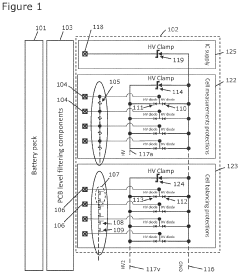
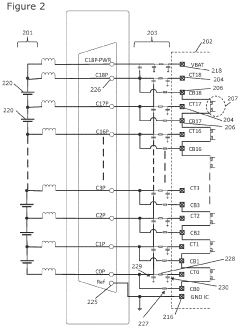
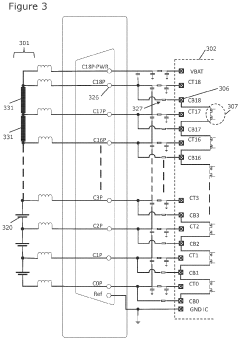
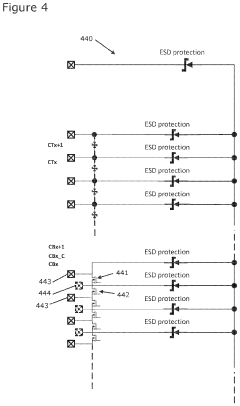
- The BMS IC incorporates bi-directional ESD protection elements and dual polarity switches connected between cell-measuring and balancing pins, along with diodes and clamps for centralized ESD protection, allowing for safe monitoring and reduced component requirements, including minimal discrete components between pins and the battery pack.
Battery Safety Standards and Regulatory Framework
The regulatory landscape for battery management systems (BMS) and their associated additives is governed by a complex framework of international, national, and industry-specific standards. These regulations establish fundamental safety requirements that directly impact the selection and evaluation of additives for enhanced BMS integration. Key regulatory bodies including the International Electrotechnical Commission (IEC), Underwriters Laboratories (UL), and the Society of Automotive Engineers (SAE) have developed comprehensive standards that address battery safety across various applications.
IEC 62619 and IEC 62133 series standards provide essential guidelines for lithium-ion battery safety, establishing requirements for thermal stability, electrical safety, and mechanical integrity that influence additive selection criteria. These standards mandate specific testing protocols for materials used in battery systems, including additives that may affect electrochemical performance or thermal behavior. Compliance with these standards requires thorough documentation of additive properties and their impact on overall system safety.
Automotive applications are subject to additional regulatory frameworks, particularly ISO 26262 for functional safety and UN ECE R100 for electric vehicle safety requirements. These standards impose stringent requirements on BMS components and any additives that could influence system reliability or safety performance. The automotive sector's emphasis on fail-safe operation necessitates comprehensive validation of additive effects on BMS functionality under various operating conditions.
Regional regulatory variations significantly impact additive evaluation processes. The European Union's Battery Regulation and REACH requirements mandate extensive chemical safety assessments for battery additives, while North American standards focus primarily on performance and safety testing. Asian markets, particularly China and Japan, have developed their own regulatory frameworks that emphasize both safety and environmental considerations.
Emerging regulations addressing battery sustainability and circular economy principles are increasingly influencing additive selection criteria. These evolving standards require consideration of additive lifecycle impacts, recyclability, and environmental safety throughout the battery's operational life. Compliance strategies must therefore incorporate long-term regulatory trends alongside current safety requirements to ensure sustainable BMS integration solutions.
IEC 62619 and IEC 62133 series standards provide essential guidelines for lithium-ion battery safety, establishing requirements for thermal stability, electrical safety, and mechanical integrity that influence additive selection criteria. These standards mandate specific testing protocols for materials used in battery systems, including additives that may affect electrochemical performance or thermal behavior. Compliance with these standards requires thorough documentation of additive properties and their impact on overall system safety.
Automotive applications are subject to additional regulatory frameworks, particularly ISO 26262 for functional safety and UN ECE R100 for electric vehicle safety requirements. These standards impose stringent requirements on BMS components and any additives that could influence system reliability or safety performance. The automotive sector's emphasis on fail-safe operation necessitates comprehensive validation of additive effects on BMS functionality under various operating conditions.
Regional regulatory variations significantly impact additive evaluation processes. The European Union's Battery Regulation and REACH requirements mandate extensive chemical safety assessments for battery additives, while North American standards focus primarily on performance and safety testing. Asian markets, particularly China and Japan, have developed their own regulatory frameworks that emphasize both safety and environmental considerations.
Emerging regulations addressing battery sustainability and circular economy principles are increasingly influencing additive selection criteria. These evolving standards require consideration of additive lifecycle impacts, recyclability, and environmental safety throughout the battery's operational life. Compliance strategies must therefore incorporate long-term regulatory trends alongside current safety requirements to ensure sustainable BMS integration solutions.
Environmental Impact Assessment of BMS Additives
The environmental impact assessment of BMS additives has become increasingly critical as the battery industry faces mounting pressure to adopt sustainable practices throughout the product lifecycle. Traditional BMS additives, including flame retardants, thermal interface materials, and protective coatings, often contain substances that pose significant environmental challenges during manufacturing, operation, and end-of-life disposal phases.
Manufacturing processes for conventional BMS additives frequently involve the use of halogenated compounds and heavy metals, which generate toxic byproducts and require energy-intensive production methods. These substances contribute to air and water pollution, while their carbon footprint remains substantially higher compared to bio-based alternatives. The extraction and processing of raw materials for synthetic additives also result in habitat disruption and resource depletion.
During the operational phase, certain additives may release volatile organic compounds or microparticles that affect indoor air quality and worker safety. Thermal degradation of polymer-based additives under high-temperature conditions can produce harmful emissions, particularly in poorly ventilated environments. Long-term exposure to these substances raises concerns about occupational health and environmental contamination.
End-of-life management presents the most significant environmental challenge for BMS additives. Many current formulations are not biodegradable and require specialized recycling processes to prevent soil and groundwater contamination. The presence of persistent organic pollutants in some additives complicates battery recycling efforts and limits material recovery rates.
Recent regulatory frameworks, including RoHS and REACH directives, have accelerated the development of environmentally friendly alternatives. Bio-based additives derived from renewable sources show promising results in reducing environmental impact while maintaining performance standards. These alternatives typically exhibit lower toxicity profiles, improved biodegradability, and reduced carbon footprints throughout their lifecycle.
Life cycle assessment studies indicate that transitioning to sustainable BMS additives could reduce overall environmental impact by 30-45% compared to conventional formulations. However, comprehensive evaluation must consider factors such as performance trade-offs, cost implications, and supply chain sustainability to ensure successful implementation of environmentally responsible solutions.
Manufacturing processes for conventional BMS additives frequently involve the use of halogenated compounds and heavy metals, which generate toxic byproducts and require energy-intensive production methods. These substances contribute to air and water pollution, while their carbon footprint remains substantially higher compared to bio-based alternatives. The extraction and processing of raw materials for synthetic additives also result in habitat disruption and resource depletion.
During the operational phase, certain additives may release volatile organic compounds or microparticles that affect indoor air quality and worker safety. Thermal degradation of polymer-based additives under high-temperature conditions can produce harmful emissions, particularly in poorly ventilated environments. Long-term exposure to these substances raises concerns about occupational health and environmental contamination.
End-of-life management presents the most significant environmental challenge for BMS additives. Many current formulations are not biodegradable and require specialized recycling processes to prevent soil and groundwater contamination. The presence of persistent organic pollutants in some additives complicates battery recycling efforts and limits material recovery rates.
Recent regulatory frameworks, including RoHS and REACH directives, have accelerated the development of environmentally friendly alternatives. Bio-based additives derived from renewable sources show promising results in reducing environmental impact while maintaining performance standards. These alternatives typically exhibit lower toxicity profiles, improved biodegradability, and reduced carbon footprints throughout their lifecycle.
Life cycle assessment studies indicate that transitioning to sustainable BMS additives could reduce overall environmental impact by 30-45% compared to conventional formulations. However, comprehensive evaluation must consider factors such as performance trade-offs, cost implications, and supply chain sustainability to ensure successful implementation of environmentally responsible solutions.
Unlock deeper insights with PatSnap Eureka Quick Research — get a full tech report to explore trends and direct your research. Try now!
Generate Your Research Report Instantly with AI Agent
Supercharge your innovation with PatSnap Eureka AI Agent Platform!