Evaluating Technological Advancements in Carbon Capture
MAR 23, 20268 MIN READ
Generate Your Research Report Instantly with AI Agent
Patsnap Eureka helps you evaluate technical feasibility & market potential.
Carbon Capture Technology Background and Objectives
Carbon capture technology has emerged as a critical component in global climate mitigation strategies, representing one of the most promising approaches to address industrial carbon dioxide emissions. The technology encompasses various methods designed to capture CO2 from emission sources or directly from the atmosphere, preventing its release into the environment and enabling subsequent utilization or permanent storage.
The historical development of carbon capture can be traced back to the 1930s when chemical absorption processes were first employed in industrial applications for gas purification. However, the modern focus on carbon capture as a climate solution gained momentum in the 1990s, driven by increasing awareness of anthropogenic climate change and the need for large-scale emission reduction technologies.
Current carbon capture technologies operate through three primary mechanisms: post-combustion capture, pre-combustion capture, and oxy-fuel combustion. Post-combustion systems extract CO2 from flue gases after fuel combustion, typically using chemical solvents or solid sorbents. Pre-combustion approaches convert fuel into hydrogen and CO2 before combustion, allowing for easier CO2 separation. Oxy-fuel combustion burns fuel in pure oxygen, producing a concentrated CO2 stream suitable for capture.
The evolution of carbon capture has been marked by significant technological milestones, including the development of advanced solvent systems, novel solid sorbents, and membrane-based separation technologies. Recent innovations have focused on reducing energy penalties associated with capture processes, which historically consumed 20-30% of power plant output, and improving capture efficiency rates.
Contemporary objectives for carbon capture technology center on achieving commercial viability through cost reduction, energy efficiency improvements, and scalability enhancement. The target cost for CO2 capture has been established at approximately $50-100 per ton of CO2, representing a significant reduction from current levels. Additionally, the technology aims to achieve capture rates exceeding 95% while minimizing parasitic energy consumption to below 15% of total plant capacity.
Integration with carbon utilization and storage infrastructure represents another key objective, requiring seamless coordination between capture facilities, transportation networks, and permanent storage sites. The technology must also demonstrate long-term reliability and environmental safety to gain widespread acceptance and regulatory approval for large-scale deployment across various industrial sectors.
The historical development of carbon capture can be traced back to the 1930s when chemical absorption processes were first employed in industrial applications for gas purification. However, the modern focus on carbon capture as a climate solution gained momentum in the 1990s, driven by increasing awareness of anthropogenic climate change and the need for large-scale emission reduction technologies.
Current carbon capture technologies operate through three primary mechanisms: post-combustion capture, pre-combustion capture, and oxy-fuel combustion. Post-combustion systems extract CO2 from flue gases after fuel combustion, typically using chemical solvents or solid sorbents. Pre-combustion approaches convert fuel into hydrogen and CO2 before combustion, allowing for easier CO2 separation. Oxy-fuel combustion burns fuel in pure oxygen, producing a concentrated CO2 stream suitable for capture.
The evolution of carbon capture has been marked by significant technological milestones, including the development of advanced solvent systems, novel solid sorbents, and membrane-based separation technologies. Recent innovations have focused on reducing energy penalties associated with capture processes, which historically consumed 20-30% of power plant output, and improving capture efficiency rates.
Contemporary objectives for carbon capture technology center on achieving commercial viability through cost reduction, energy efficiency improvements, and scalability enhancement. The target cost for CO2 capture has been established at approximately $50-100 per ton of CO2, representing a significant reduction from current levels. Additionally, the technology aims to achieve capture rates exceeding 95% while minimizing parasitic energy consumption to below 15% of total plant capacity.
Integration with carbon utilization and storage infrastructure represents another key objective, requiring seamless coordination between capture facilities, transportation networks, and permanent storage sites. The technology must also demonstrate long-term reliability and environmental safety to gain widespread acceptance and regulatory approval for large-scale deployment across various industrial sectors.
Market Demand Analysis for Carbon Capture Solutions
The global carbon capture market is experiencing unprecedented growth driven by escalating climate commitments and regulatory pressures. Governments worldwide have implemented increasingly stringent carbon emission targets, with many nations committing to net-zero emissions by 2050. This regulatory landscape creates substantial demand for carbon capture, utilization, and storage (CCUS) technologies across multiple industrial sectors.
Power generation represents the largest market segment for carbon capture solutions, particularly for coal and natural gas-fired power plants seeking to reduce their carbon footprint while maintaining operational capacity. The cement, steel, and petrochemical industries constitute additional high-demand sectors, as these energy-intensive manufacturing processes generate significant CO2 emissions that are difficult to eliminate through alternative means.
The market exhibits strong geographic concentration in regions with heavy industrial bases and supportive policy frameworks. North America leads in deployment due to favorable tax incentives and established regulatory structures, while Europe demonstrates growing demand driven by the European Green Deal and carbon pricing mechanisms. Asia-Pacific markets, particularly China and Japan, show increasing interest as these nations balance industrial growth with decarbonization objectives.
Corporate sustainability initiatives are creating additional market pull beyond regulatory compliance. Major corporations across various industries are voluntarily adopting carbon capture technologies to meet internal sustainability goals and respond to stakeholder pressure. This trend is particularly pronounced among multinational companies with public commitments to carbon neutrality.
Market capacity projections indicate substantial growth potential, with demand expected to scale significantly as technology costs decline and deployment experience increases. The direct air capture segment represents an emerging high-growth area, driven by the need for negative emissions to achieve global climate targets.
Current market barriers include high capital costs, limited commercial-scale deployment experience, and uncertain long-term policy support. However, increasing carbon pricing, technological improvements, and growing climate urgency are progressively addressing these constraints, creating a more favorable demand environment for carbon capture solutions across industrial applications.
Power generation represents the largest market segment for carbon capture solutions, particularly for coal and natural gas-fired power plants seeking to reduce their carbon footprint while maintaining operational capacity. The cement, steel, and petrochemical industries constitute additional high-demand sectors, as these energy-intensive manufacturing processes generate significant CO2 emissions that are difficult to eliminate through alternative means.
The market exhibits strong geographic concentration in regions with heavy industrial bases and supportive policy frameworks. North America leads in deployment due to favorable tax incentives and established regulatory structures, while Europe demonstrates growing demand driven by the European Green Deal and carbon pricing mechanisms. Asia-Pacific markets, particularly China and Japan, show increasing interest as these nations balance industrial growth with decarbonization objectives.
Corporate sustainability initiatives are creating additional market pull beyond regulatory compliance. Major corporations across various industries are voluntarily adopting carbon capture technologies to meet internal sustainability goals and respond to stakeholder pressure. This trend is particularly pronounced among multinational companies with public commitments to carbon neutrality.
Market capacity projections indicate substantial growth potential, with demand expected to scale significantly as technology costs decline and deployment experience increases. The direct air capture segment represents an emerging high-growth area, driven by the need for negative emissions to achieve global climate targets.
Current market barriers include high capital costs, limited commercial-scale deployment experience, and uncertain long-term policy support. However, increasing carbon pricing, technological improvements, and growing climate urgency are progressively addressing these constraints, creating a more favorable demand environment for carbon capture solutions across industrial applications.
Current Status and Challenges in Carbon Capture Tech
Carbon capture technology has reached a critical juncture in its development trajectory, with multiple technological pathways demonstrating varying degrees of commercial viability. Post-combustion capture systems, primarily utilizing amine-based solvents, represent the most mature approach and have been successfully deployed in several large-scale pilot projects. However, these systems face significant energy penalties, typically requiring 15-30% of a power plant's output for operation, which substantially impacts overall efficiency and economic feasibility.
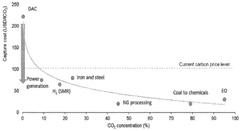
Pre-combustion capture technologies, integrated with gasification processes, offer higher capture rates but demand extensive infrastructure modifications. Oxyfuel combustion presents another viable pathway, though it requires substantial capital investment for air separation units and flue gas recycling systems. Direct air capture (DAC) technologies have emerged as promising solutions for atmospheric CO2 removal, with companies like Climeworks and Carbon Engineering demonstrating operational facilities, albeit at high costs ranging from $400-600 per ton of CO2.
The geographical distribution of carbon capture development reveals distinct regional strengths. North America leads in large-scale demonstration projects, with over 20 operational facilities primarily focused on enhanced oil recovery applications. Europe emphasizes industrial integration and storage solutions, particularly in the North Sea region. Asia-Pacific countries, led by China and Japan, are rapidly advancing in both research and deployment, with China operating the world's largest DAC facility.
Current technological constraints center on energy efficiency, cost reduction, and scalability challenges. Solvent degradation in chemical absorption processes requires frequent replacement, increasing operational costs. Material durability under harsh operating conditions remains problematic, particularly for solid sorbents exposed to high temperatures and corrosive environments. Integration complexities with existing industrial infrastructure pose additional hurdles, often requiring comprehensive system redesigns.
Economic viability represents the most significant barrier to widespread adoption. Without substantial carbon pricing mechanisms or government incentives, most carbon capture technologies struggle to achieve cost competitiveness. Storage and transportation infrastructure limitations further compound deployment challenges, particularly in regions lacking suitable geological formations or pipeline networks. Regulatory frameworks remain fragmented across jurisdictions, creating uncertainty for long-term investment planning and technology standardization efforts.
Pre-combustion capture technologies, integrated with gasification processes, offer higher capture rates but demand extensive infrastructure modifications. Oxyfuel combustion presents another viable pathway, though it requires substantial capital investment for air separation units and flue gas recycling systems. Direct air capture (DAC) technologies have emerged as promising solutions for atmospheric CO2 removal, with companies like Climeworks and Carbon Engineering demonstrating operational facilities, albeit at high costs ranging from $400-600 per ton of CO2.
The geographical distribution of carbon capture development reveals distinct regional strengths. North America leads in large-scale demonstration projects, with over 20 operational facilities primarily focused on enhanced oil recovery applications. Europe emphasizes industrial integration and storage solutions, particularly in the North Sea region. Asia-Pacific countries, led by China and Japan, are rapidly advancing in both research and deployment, with China operating the world's largest DAC facility.
Current technological constraints center on energy efficiency, cost reduction, and scalability challenges. Solvent degradation in chemical absorption processes requires frequent replacement, increasing operational costs. Material durability under harsh operating conditions remains problematic, particularly for solid sorbents exposed to high temperatures and corrosive environments. Integration complexities with existing industrial infrastructure pose additional hurdles, often requiring comprehensive system redesigns.
Economic viability represents the most significant barrier to widespread adoption. Without substantial carbon pricing mechanisms or government incentives, most carbon capture technologies struggle to achieve cost competitiveness. Storage and transportation infrastructure limitations further compound deployment challenges, particularly in regions lacking suitable geological formations or pipeline networks. Regulatory frameworks remain fragmented across jurisdictions, creating uncertainty for long-term investment planning and technology standardization efforts.
Current Carbon Capture Technology Solutions
01 Chemical absorption methods using solvents
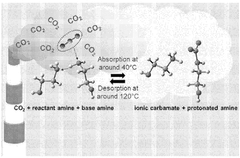
Carbon capture can be achieved through chemical absorption processes utilizing various solvents that selectively bind with carbon dioxide from gas streams. These methods typically involve amine-based solutions or other chemical absorbents that react with CO2, allowing for its separation from industrial emissions or atmospheric air. The captured carbon can then be released through regeneration processes for storage or utilization.- Chemical absorption methods for carbon capture: Chemical absorption techniques utilize solvents and reactive compounds to capture carbon dioxide from gas streams. These methods involve the use of amine-based solutions or other chemical absorbents that selectively bind with CO2 molecules. The captured carbon can then be released through temperature or pressure changes, allowing for regeneration of the absorbent material. This approach is particularly effective for post-combustion capture in industrial facilities and power plants.
- Physical adsorption using solid sorbents: Solid sorbent materials provide a physical adsorption approach for capturing carbon dioxide. These materials include metal-organic frameworks, zeolites, and activated carbons that have high surface areas and selective binding properties. The adsorption process occurs at the molecular level where CO2 molecules attach to the surface of the sorbent material. This method offers advantages in terms of energy efficiency and can be applied in various temperature and pressure conditions.
- Membrane separation technology: Membrane-based separation systems employ selective permeable barriers to separate carbon dioxide from mixed gas streams. These membranes are designed with specific pore sizes and chemical properties that allow CO2 to pass through while blocking other gases. The technology can be implemented in modular systems and offers continuous operation capabilities. Various membrane materials including polymeric and ceramic compositions are utilized to achieve optimal separation efficiency.
- Biological and enzymatic carbon capture: Biological approaches leverage natural processes and enzymatic reactions to capture and convert carbon dioxide. These methods may involve microorganisms, algae, or isolated enzymes that facilitate CO2 fixation through metabolic pathways. The captured carbon can be converted into useful products such as biomass or biofuels. This approach offers potential for sustainable and environmentally friendly carbon capture solutions with lower energy requirements compared to traditional methods.
- Integrated carbon capture and utilization systems: Integrated systems combine carbon capture with subsequent utilization or storage processes. These comprehensive approaches include capture mechanisms coupled with conversion technologies that transform CO2 into valuable products or prepare it for geological storage. The systems may incorporate multiple capture methods and downstream processing units to maximize efficiency and economic viability. Such integrated solutions address both the capture and disposition of carbon dioxide in a coordinated manner.
02 Membrane-based separation technologies
Membrane separation systems provide a physical barrier that selectively allows carbon dioxide to pass through while blocking other gases. These technologies utilize specialized membrane materials with specific permeability characteristics to efficiently separate CO2 from mixed gas streams. The process offers advantages in terms of energy efficiency and compact design compared to traditional separation methods.Expand Specific Solutions03 Adsorption-based capture systems
Solid adsorbent materials can be employed to capture carbon dioxide through physical or chemical adsorption processes. These systems use porous materials with high surface areas that preferentially adsorb CO2 molecules from gas mixtures. The adsorbents can be regenerated through pressure or temperature swing processes, making the capture process cyclical and reusable.Expand Specific Solutions04 Biological and enzymatic carbon capture
Biological approaches utilize living organisms or enzymatic processes to capture and convert carbon dioxide. These methods may involve algae cultivation, microbial systems, or enzyme-catalyzed reactions that naturally sequester CO2. Such bio-based technologies offer sustainable alternatives that can integrate carbon capture with biomass production or biofuel generation.Expand Specific Solutions05 Integrated capture and utilization systems
Advanced systems combine carbon capture with direct utilization pathways, converting captured CO2 into valuable products or fuels. These integrated approaches may include mineralization processes, conversion to chemicals, or incorporation into building materials. The technology aims to create economic value from captured carbon while achieving emission reduction goals.Expand Specific Solutions
Key Innovations in Advanced Carbon Capture Methods
Using computer simulation for ranking materials for post combustion carbon capture
PatentPendingUS20240071575A1
Innovation
- A computer-implemented method and system that characterizes sorbent materials using a molecular model workflow to generate microscopic figures of merit, evaluates these materials with a process model workflow to generate macroscopic figures of merit, and ranks them for applicability as sorbent materials using a combined microscopic performance and macroscopic process feasibility generator.


Systems and methods for combined carbon capture and thermal energy storage
PatentWO2025095856A1
Innovation
- A method and system for combined carbon capture and thermal energy storage, where CO2 is captured using a carbon capture medium that generates heat through an exothermic reaction, and this heat is utilized for thermal energy storage, with cooling applied to maintain the capture medium at a temperature below the CO2 regeneration temperature.

Policy and Regulatory Framework for Carbon Capture
The policy and regulatory framework for carbon capture technologies represents a complex ecosystem of international agreements, national legislation, and regional initiatives that collectively shape the development and deployment of carbon capture, utilization, and storage (CCUS) solutions. At the international level, the Paris Agreement serves as the foundational framework, establishing legally binding commitments for countries to reduce greenhouse gas emissions and creating the policy imperative for carbon capture technologies as essential tools for achieving net-zero targets.
National governments have responded with varying degrees of regulatory support and financial incentives. The United States has implemented significant tax credits through Section 45Q of the Internal Revenue Code, providing up to $85 per ton of CO2 permanently stored and $60 per ton for utilization applications. The European Union has established the Innovation Fund and Emissions Trading System (ETS) to support large-scale CCUS projects, while the UK has committed £1 billion in funding for CCUS clusters through its Net Zero Strategy.
Regulatory frameworks address critical aspects including environmental permitting, storage site selection and monitoring, transport infrastructure development, and long-term liability management. The EPA's Underground Injection Control program in the US provides the regulatory foundation for CO2 storage, while similar frameworks exist in Norway, Canada, and Australia. These regulations establish stringent requirements for geological characterization, injection well construction, monitoring protocols, and post-injection site care.
Financial mechanisms and market-based instruments play crucial roles in making carbon capture economically viable. Carbon pricing mechanisms, whether through carbon taxes or cap-and-trade systems, create economic incentives for CCUS deployment. Additionally, renewable energy standards and clean fuel standards in various jurisdictions provide indirect support for carbon capture technologies by creating markets for low-carbon products.
However, regulatory gaps and inconsistencies across jurisdictions present significant challenges. Issues such as cross-border CO2 transport, international storage agreements, and standardized measurement and verification protocols require enhanced international coordination. The development of comprehensive regulatory frameworks that balance environmental protection with technological innovation remains an ongoing priority for policymakers worldwide.
National governments have responded with varying degrees of regulatory support and financial incentives. The United States has implemented significant tax credits through Section 45Q of the Internal Revenue Code, providing up to $85 per ton of CO2 permanently stored and $60 per ton for utilization applications. The European Union has established the Innovation Fund and Emissions Trading System (ETS) to support large-scale CCUS projects, while the UK has committed £1 billion in funding for CCUS clusters through its Net Zero Strategy.
Regulatory frameworks address critical aspects including environmental permitting, storage site selection and monitoring, transport infrastructure development, and long-term liability management. The EPA's Underground Injection Control program in the US provides the regulatory foundation for CO2 storage, while similar frameworks exist in Norway, Canada, and Australia. These regulations establish stringent requirements for geological characterization, injection well construction, monitoring protocols, and post-injection site care.
Financial mechanisms and market-based instruments play crucial roles in making carbon capture economically viable. Carbon pricing mechanisms, whether through carbon taxes or cap-and-trade systems, create economic incentives for CCUS deployment. Additionally, renewable energy standards and clean fuel standards in various jurisdictions provide indirect support for carbon capture technologies by creating markets for low-carbon products.
However, regulatory gaps and inconsistencies across jurisdictions present significant challenges. Issues such as cross-border CO2 transport, international storage agreements, and standardized measurement and verification protocols require enhanced international coordination. The development of comprehensive regulatory frameworks that balance environmental protection with technological innovation remains an ongoing priority for policymakers worldwide.
Environmental Impact Assessment of Carbon Capture
The environmental impact assessment of carbon capture technologies reveals a complex landscape of both positive and negative ecological consequences that must be carefully evaluated alongside technological advancement metrics. While carbon capture systems demonstrate significant potential for atmospheric CO2 reduction, their implementation introduces various environmental considerations that extend beyond their primary carbon mitigation objectives.
Energy consumption represents the most significant environmental concern associated with current carbon capture technologies. Direct air capture systems typically require 1,500-2,000 kWh per ton of CO2 captured, while post-combustion capture from industrial sources demands 300-400 kWh per ton. This substantial energy requirement often translates to increased fossil fuel consumption if renewable energy sources are not utilized, potentially offsetting 15-25% of the captured carbon benefits through indirect emissions.
Water resource utilization presents another critical environmental dimension, particularly for solvent-based capture systems. These technologies can consume 1.5-3.0 cubic meters of water per ton of CO2 captured for cooling and solvent regeneration processes. In water-stressed regions, this consumption pattern raises concerns about competing demands with agricultural and municipal water supplies, necessitating careful site selection and water management strategies.
Land use implications vary significantly across different carbon capture approaches. Direct air capture facilities require approximately 0.1-0.3 hectares per thousand tons of annual CO2 capacity, while industrial point-source capture systems typically utilize existing industrial infrastructure. However, the associated renewable energy infrastructure needed to power these systems sustainably can require substantial additional land allocation, particularly for solar and wind installations.
Chemical waste generation and management constitute emerging environmental challenges as carbon capture technologies scale. Solvent degradation products, filter replacements, and sorbent materials create waste streams requiring specialized treatment and disposal protocols. Advanced amine-based solvents, while more efficient, often produce more complex degradation byproducts that demand sophisticated waste management approaches.
Ecosystem impact assessments indicate that large-scale deployment could affect local air quality patterns and atmospheric chemistry. While reducing CO2 concentrations, some capture processes may release trace amounts of volatile organic compounds or ammonia, requiring continuous monitoring and emission control systems to prevent unintended ecological consequences in surrounding environments.
Energy consumption represents the most significant environmental concern associated with current carbon capture technologies. Direct air capture systems typically require 1,500-2,000 kWh per ton of CO2 captured, while post-combustion capture from industrial sources demands 300-400 kWh per ton. This substantial energy requirement often translates to increased fossil fuel consumption if renewable energy sources are not utilized, potentially offsetting 15-25% of the captured carbon benefits through indirect emissions.
Water resource utilization presents another critical environmental dimension, particularly for solvent-based capture systems. These technologies can consume 1.5-3.0 cubic meters of water per ton of CO2 captured for cooling and solvent regeneration processes. In water-stressed regions, this consumption pattern raises concerns about competing demands with agricultural and municipal water supplies, necessitating careful site selection and water management strategies.
Land use implications vary significantly across different carbon capture approaches. Direct air capture facilities require approximately 0.1-0.3 hectares per thousand tons of annual CO2 capacity, while industrial point-source capture systems typically utilize existing industrial infrastructure. However, the associated renewable energy infrastructure needed to power these systems sustainably can require substantial additional land allocation, particularly for solar and wind installations.
Chemical waste generation and management constitute emerging environmental challenges as carbon capture technologies scale. Solvent degradation products, filter replacements, and sorbent materials create waste streams requiring specialized treatment and disposal protocols. Advanced amine-based solvents, while more efficient, often produce more complex degradation byproducts that demand sophisticated waste management approaches.
Ecosystem impact assessments indicate that large-scale deployment could affect local air quality patterns and atmospheric chemistry. While reducing CO2 concentrations, some capture processes may release trace amounts of volatile organic compounds or ammonia, requiring continuous monitoring and emission control systems to prevent unintended ecological consequences in surrounding environments.
Unlock deeper insights with Patsnap Eureka Quick Research — get a full tech report to explore trends and direct your research. Try now!
Generate Your Research Report Instantly with AI Agent
Supercharge your innovation with Patsnap Eureka AI Agent Platform!