

Frequency Shift Keying vs Direct Sequence Spread Spectrum: Coverage Area
MAR 19, 20269 MIN READ
Generate Your Research Report Instantly with AI Agent
PatSnap Eureka helps you evaluate technical feasibility & market potential.
FSK vs DSSS Coverage Challenges and Goals
The evolution of wireless communication technologies has been fundamentally driven by the need to achieve optimal coverage while maintaining reliable data transmission. Frequency Shift Keying (FSK) and Direct Sequence Spread Spectrum (DSSS) represent two distinct modulation approaches that have shaped modern communication systems, each addressing coverage challenges through different technical philosophies. The historical development of these technologies reflects the industry's continuous pursuit of enhanced range, interference resistance, and spectral efficiency.
FSK emerged as one of the earliest digital modulation techniques, gaining prominence in applications requiring robust long-range communication with relatively simple implementation requirements. Its development trajectory focused on maximizing coverage through power-efficient transmission and excellent noise immunity characteristics. The technology found widespread adoption in industrial IoT applications, smart metering systems, and low-power wide-area networks where extended coverage areas are paramount.
DSSS technology evolved from military communication requirements, where secure and interference-resistant transmission was essential. The spread spectrum approach addressed coverage challenges by trading bandwidth for processing gain, enabling reliable communication in hostile RF environments. This technology became foundational for modern wireless standards including Wi-Fi and early cellular systems, demonstrating superior performance in dense deployment scenarios.
The primary technical objective driving both technologies centers on achieving maximum effective coverage while maintaining acceptable quality of service parameters. For FSK implementations, the goal involves optimizing transmission power efficiency and receiver sensitivity to extend communication range. The narrow bandwidth characteristics of FSK enable concentrated power density, facilitating long-distance propagation with minimal infrastructure requirements.
DSSS technology pursues coverage optimization through different mechanisms, focusing on interference mitigation and multipath resilience. The spreading process provides inherent diversity benefits, enabling reliable communication in challenging propagation environments where traditional narrowband approaches fail. The processing gain achieved through despreading operations allows for operation below noise floor levels, effectively extending coverage in interference-limited scenarios.
Contemporary coverage challenges for both technologies involve balancing regulatory constraints, power consumption limitations, and deployment complexity. FSK systems must address frequency planning issues and adjacent channel interference in increasingly crowded spectrum environments. DSSS implementations face challenges related to near-far effects, synchronization requirements, and computational complexity in resource-constrained devices.
The convergence of IoT applications and 5G network evolution has redefined coverage objectives for both modulation schemes. Modern implementations target seamless integration with existing infrastructure while supporting diverse application requirements ranging from ultra-low-power sensor networks to high-reliability industrial automation systems.
FSK emerged as one of the earliest digital modulation techniques, gaining prominence in applications requiring robust long-range communication with relatively simple implementation requirements. Its development trajectory focused on maximizing coverage through power-efficient transmission and excellent noise immunity characteristics. The technology found widespread adoption in industrial IoT applications, smart metering systems, and low-power wide-area networks where extended coverage areas are paramount.
DSSS technology evolved from military communication requirements, where secure and interference-resistant transmission was essential. The spread spectrum approach addressed coverage challenges by trading bandwidth for processing gain, enabling reliable communication in hostile RF environments. This technology became foundational for modern wireless standards including Wi-Fi and early cellular systems, demonstrating superior performance in dense deployment scenarios.
The primary technical objective driving both technologies centers on achieving maximum effective coverage while maintaining acceptable quality of service parameters. For FSK implementations, the goal involves optimizing transmission power efficiency and receiver sensitivity to extend communication range. The narrow bandwidth characteristics of FSK enable concentrated power density, facilitating long-distance propagation with minimal infrastructure requirements.
DSSS technology pursues coverage optimization through different mechanisms, focusing on interference mitigation and multipath resilience. The spreading process provides inherent diversity benefits, enabling reliable communication in challenging propagation environments where traditional narrowband approaches fail. The processing gain achieved through despreading operations allows for operation below noise floor levels, effectively extending coverage in interference-limited scenarios.
Contemporary coverage challenges for both technologies involve balancing regulatory constraints, power consumption limitations, and deployment complexity. FSK systems must address frequency planning issues and adjacent channel interference in increasingly crowded spectrum environments. DSSS implementations face challenges related to near-far effects, synchronization requirements, and computational complexity in resource-constrained devices.
The convergence of IoT applications and 5G network evolution has redefined coverage objectives for both modulation schemes. Modern implementations target seamless integration with existing infrastructure while supporting diverse application requirements ranging from ultra-low-power sensor networks to high-reliability industrial automation systems.
Market Demand for Extended Range Wireless Communication
The global wireless communication market is experiencing unprecedented demand for extended range capabilities, driven by the proliferation of Internet of Things (IoT) applications, smart city initiatives, and industrial automation systems. Traditional short-range communication technologies are proving inadequate for emerging applications that require reliable connectivity across vast geographical areas, creating substantial market opportunities for advanced modulation techniques like Frequency Shift Keying (FSK) and Direct Sequence Spread Spectrum (DSSS).
Agricultural technology represents one of the most significant growth sectors demanding extended range wireless solutions. Modern precision farming requires continuous monitoring of soil conditions, weather patterns, and crop health across thousands of acres. Current market requirements call for communication systems capable of maintaining reliable data transmission over distances exceeding several kilometers while operating under challenging environmental conditions including electromagnetic interference from agricultural machinery and varying terrain topography.
Industrial IoT applications are generating substantial demand for robust long-range communication systems. Manufacturing facilities, oil and gas operations, and mining sites require wireless networks that can span large industrial complexes while maintaining data integrity in electromagnetically noisy environments. The market increasingly favors solutions that can provide both extended coverage and resistance to interference, making the choice between FSK and DSSS technologies critical for system designers.
Smart city infrastructure development is creating new market segments requiring extended range wireless communication. Traffic management systems, environmental monitoring networks, and public safety applications demand reliable connectivity across urban areas where traditional cellular networks may be insufficient or cost-prohibitive. Municipal governments are actively seeking communication technologies that can provide comprehensive coverage while minimizing infrastructure deployment costs.
The logistics and transportation sector presents growing demand for extended range tracking and monitoring systems. Fleet management, cargo tracking, and supply chain visibility applications require communication technologies capable of maintaining connectivity across diverse geographical regions. Market requirements emphasize the need for power-efficient solutions that can operate reliably in mobile environments while providing adequate coverage for real-time data transmission.
Emergency response and disaster management applications are driving demand for resilient extended range communication systems. These critical applications require technologies that can maintain operational capability when traditional communication infrastructure fails, creating market opportunities for robust modulation schemes that can provide reliable coverage under adverse conditions.
Agricultural technology represents one of the most significant growth sectors demanding extended range wireless solutions. Modern precision farming requires continuous monitoring of soil conditions, weather patterns, and crop health across thousands of acres. Current market requirements call for communication systems capable of maintaining reliable data transmission over distances exceeding several kilometers while operating under challenging environmental conditions including electromagnetic interference from agricultural machinery and varying terrain topography.
Industrial IoT applications are generating substantial demand for robust long-range communication systems. Manufacturing facilities, oil and gas operations, and mining sites require wireless networks that can span large industrial complexes while maintaining data integrity in electromagnetically noisy environments. The market increasingly favors solutions that can provide both extended coverage and resistance to interference, making the choice between FSK and DSSS technologies critical for system designers.
Smart city infrastructure development is creating new market segments requiring extended range wireless communication. Traffic management systems, environmental monitoring networks, and public safety applications demand reliable connectivity across urban areas where traditional cellular networks may be insufficient or cost-prohibitive. Municipal governments are actively seeking communication technologies that can provide comprehensive coverage while minimizing infrastructure deployment costs.
The logistics and transportation sector presents growing demand for extended range tracking and monitoring systems. Fleet management, cargo tracking, and supply chain visibility applications require communication technologies capable of maintaining connectivity across diverse geographical regions. Market requirements emphasize the need for power-efficient solutions that can operate reliably in mobile environments while providing adequate coverage for real-time data transmission.
Emergency response and disaster management applications are driving demand for resilient extended range communication systems. These critical applications require technologies that can maintain operational capability when traditional communication infrastructure fails, creating market opportunities for robust modulation schemes that can provide reliable coverage under adverse conditions.
Current Coverage Limitations of FSK and DSSS Technologies
Frequency Shift Keying (FSK) technology faces significant coverage limitations primarily due to its susceptibility to interference and relatively low spectral efficiency. In urban environments, FSK signals experience substantial degradation when encountering multipath propagation, where signals reflect off buildings and other structures, creating multiple signal paths that can cause destructive interference. This phenomenon severely limits the effective range in dense metropolitan areas, typically reducing coverage to 2-5 kilometers under optimal conditions.
The power requirements for FSK systems present another critical limitation. To achieve adequate coverage in challenging environments, FSK transmitters must operate at higher power levels, which increases energy consumption and creates regulatory compliance issues. The technology's binary nature also constrains its ability to adapt to varying channel conditions, resulting in fixed coverage patterns that cannot dynamically adjust to environmental changes or interference sources.
Direct Sequence Spread Spectrum (DSSS) technology encounters distinct coverage challenges despite its inherent resistance to interference. The primary limitation stems from the processing gain requirements, where maintaining adequate signal-to-noise ratios over extended distances necessitates either increased transmission power or reduced data rates. This trade-off significantly impacts the practical deployment scenarios, particularly in applications requiring both long-range coverage and high-speed data transmission.
DSSS systems also face limitations related to code synchronization over large coverage areas. As the distance between transmitter and receiver increases, maintaining precise timing synchronization becomes increasingly difficult, leading to degraded performance at the coverage periphery. The technology's reliance on complex correlation processes introduces latency issues that compound with distance, creating practical limitations for real-time applications requiring extensive coverage.
Both technologies struggle with near-far problems in multi-user environments, where strong signals from nearby transmitters can overwhelm weaker signals from distant sources. This issue becomes particularly pronounced in cellular or network deployments where coverage optimization must balance signal strength across varying distances. Environmental factors such as atmospheric conditions, terrain variations, and seasonal changes further constrain the reliable coverage area for both FSK and DSSS implementations.
The frequency-dependent propagation characteristics also impose fundamental limitations on coverage area. Higher frequency implementations of both technologies experience greater path loss and reduced penetration through obstacles, while lower frequency variants face spectrum availability constraints and increased antenna size requirements. These physical limitations create inherent trade-offs between coverage area, system complexity, and deployment feasibility that continue to challenge practical implementations in diverse operational environments.
The power requirements for FSK systems present another critical limitation. To achieve adequate coverage in challenging environments, FSK transmitters must operate at higher power levels, which increases energy consumption and creates regulatory compliance issues. The technology's binary nature also constrains its ability to adapt to varying channel conditions, resulting in fixed coverage patterns that cannot dynamically adjust to environmental changes or interference sources.
Direct Sequence Spread Spectrum (DSSS) technology encounters distinct coverage challenges despite its inherent resistance to interference. The primary limitation stems from the processing gain requirements, where maintaining adequate signal-to-noise ratios over extended distances necessitates either increased transmission power or reduced data rates. This trade-off significantly impacts the practical deployment scenarios, particularly in applications requiring both long-range coverage and high-speed data transmission.
DSSS systems also face limitations related to code synchronization over large coverage areas. As the distance between transmitter and receiver increases, maintaining precise timing synchronization becomes increasingly difficult, leading to degraded performance at the coverage periphery. The technology's reliance on complex correlation processes introduces latency issues that compound with distance, creating practical limitations for real-time applications requiring extensive coverage.
Both technologies struggle with near-far problems in multi-user environments, where strong signals from nearby transmitters can overwhelm weaker signals from distant sources. This issue becomes particularly pronounced in cellular or network deployments where coverage optimization must balance signal strength across varying distances. Environmental factors such as atmospheric conditions, terrain variations, and seasonal changes further constrain the reliable coverage area for both FSK and DSSS implementations.
The frequency-dependent propagation characteristics also impose fundamental limitations on coverage area. Higher frequency implementations of both technologies experience greater path loss and reduced penetration through obstacles, while lower frequency variants face spectrum availability constraints and increased antenna size requirements. These physical limitations create inherent trade-offs between coverage area, system complexity, and deployment feasibility that continue to challenge practical implementations in diverse operational environments.
Existing Solutions for Coverage Area Optimization
01 Hybrid modulation combining FSK and DSSS techniques
Systems that integrate Frequency Shift Keying with Direct Sequence Spread Spectrum modulation to enhance coverage area and signal robustness. This hybrid approach leverages the frequency diversity of FSK and the processing gain of DSSS to improve communication range and interference resistance in wireless systems.- Hybrid modulation combining FSK and DSSS techniques: Systems that integrate Frequency Shift Keying with Direct Sequence Spread Spectrum modulation to enhance coverage area and signal robustness. This hybrid approach leverages the frequency diversity of FSK and the processing gain of DSSS to improve communication range and interference resistance in wireless systems.
- Adaptive spreading code allocation for coverage optimization: Methods for dynamically adjusting spreading codes and chip rates in DSSS systems to optimize coverage area based on channel conditions and user distribution. These techniques enable flexible resource allocation to extend effective communication range while maintaining signal quality and reducing interference between users.
- Multi-carrier FSK-DSSS for extended range: Implementation of multiple carrier frequencies with spread spectrum techniques to achieve broader coverage areas. This approach distributes transmitted power across multiple frequency bands while applying spreading codes, resulting in improved propagation characteristics and enhanced ability to penetrate obstacles in the coverage area.
- Power control mechanisms for coverage area management: Techniques for adjusting transmission power levels in FSK and DSSS systems to balance coverage area with interference mitigation and energy efficiency. These methods employ feedback mechanisms and predictive algorithms to maintain optimal signal strength throughout the intended coverage zone while minimizing power consumption.
- Antenna diversity and beamforming for coverage enhancement: Systems utilizing multiple antenna configurations and directional transmission techniques to extend and shape coverage areas in FSK-DSSS networks. These implementations employ spatial processing to focus signal energy toward intended receivers, improving effective range and capacity within the coverage zone.
02 Adaptive spreading code allocation for coverage optimization
Methods for dynamically adjusting spreading codes and chip rates in DSSS systems to optimize coverage area based on channel conditions and user distribution. These techniques enable flexible resource allocation to extend effective communication range while maintaining signal quality and reducing interference between users.Expand Specific Solutions03 Multi-carrier FSK-DSSS systems for extended range
Communication systems employing multiple carrier frequencies with spread spectrum techniques to achieve broader coverage areas. By distributing signals across multiple frequency channels with spreading codes, these systems can overcome path loss and fading effects to extend operational range in various propagation environments.Expand Specific Solutions04 Power control mechanisms for coverage area management
Techniques for controlling transmission power in FSK and DSSS systems to balance coverage area with interference mitigation and energy efficiency. These methods adjust power levels based on distance, channel quality, and network density to maintain optimal coverage while minimizing co-channel interference and extending battery life in mobile devices.Expand Specific Solutions05 Receiver sensitivity enhancement for improved coverage
Advanced receiver architectures and signal processing algorithms designed to improve detection sensitivity in FSK-DSSS systems, thereby extending effective coverage range. These innovations include correlation techniques, noise reduction methods, and adaptive filtering to extract weak signals from noise and interference, enabling communication over greater distances.Expand Specific Solutions
Key Players in Wireless Communication and RF Technology
The competitive landscape for Frequency Shift Keying versus Direct Sequence Spread Spectrum coverage area technologies reflects a mature industry in the growth-to-consolidation phase. The global market, valued in billions, is driven by 5G deployment and IoT expansion. Technology maturity varies significantly across players: established telecommunications giants like Ericsson, Huawei, and Qualcomm demonstrate advanced implementation capabilities, while Intel, MediaTek, and Apple focus on integration optimization. Chinese entities including China Mobile and Datang Mobile represent strong regional competition. Defense contractors like Boeing, General Dynamics, and Aerospace Corp. drive specialized applications. Academic institutions such as Peking University and Beijing Institute of Technology contribute foundational research. The landscape shows clear segmentation between commercial telecommunications leaders and defense-focused specialists, with technology maturity highest among tier-one equipment manufacturers.
Telefonaktiebolaget LM Ericsson
Technical Solution: Ericsson employs hybrid modulation schemes combining FSK and DSSS technologies in their cellular infrastructure solutions to optimize coverage area performance. Their approach utilizes adaptive switching between FSK for long-range, low-data-rate applications and DSSS for high-capacity scenarios. The company's radio access network solutions incorporate intelligent coverage optimization algorithms that dynamically select the most appropriate modulation scheme based on propagation conditions, user density, and quality of service requirements, ensuring maximum coverage efficiency across diverse deployment scenarios.
Strengths: Comprehensive network infrastructure expertise with adaptive modulation capabilities and global deployment experience. Weaknesses: Complex system integration requirements and higher operational costs for hybrid implementations.
Intel Corp.
Technical Solution: Intel develops specialized chipsets and processors optimized for both FSK and DSSS implementations, focusing on coverage area enhancement through advanced signal processing capabilities. Their solutions include dedicated DSP units and hardware accelerators that enable efficient implementation of complex spreading algorithms and adaptive modulation schemes. The company's approach emphasizes low-power, high-performance processing architectures that support extended coverage applications in IoT and edge computing scenarios, with particular focus on optimizing the trade-offs between coverage range, data rate, and power consumption.
Strengths: Advanced semiconductor technology with optimized hardware acceleration and strong ecosystem support. Weaknesses: Limited direct RF expertise compared to specialized communication companies and dependency on partner implementations.
Core Innovations in FSK and DSSS Coverage Enhancement
Time and frequency diversity in FH/TDD systems
PatentInactiveUS6850740B1
Innovation
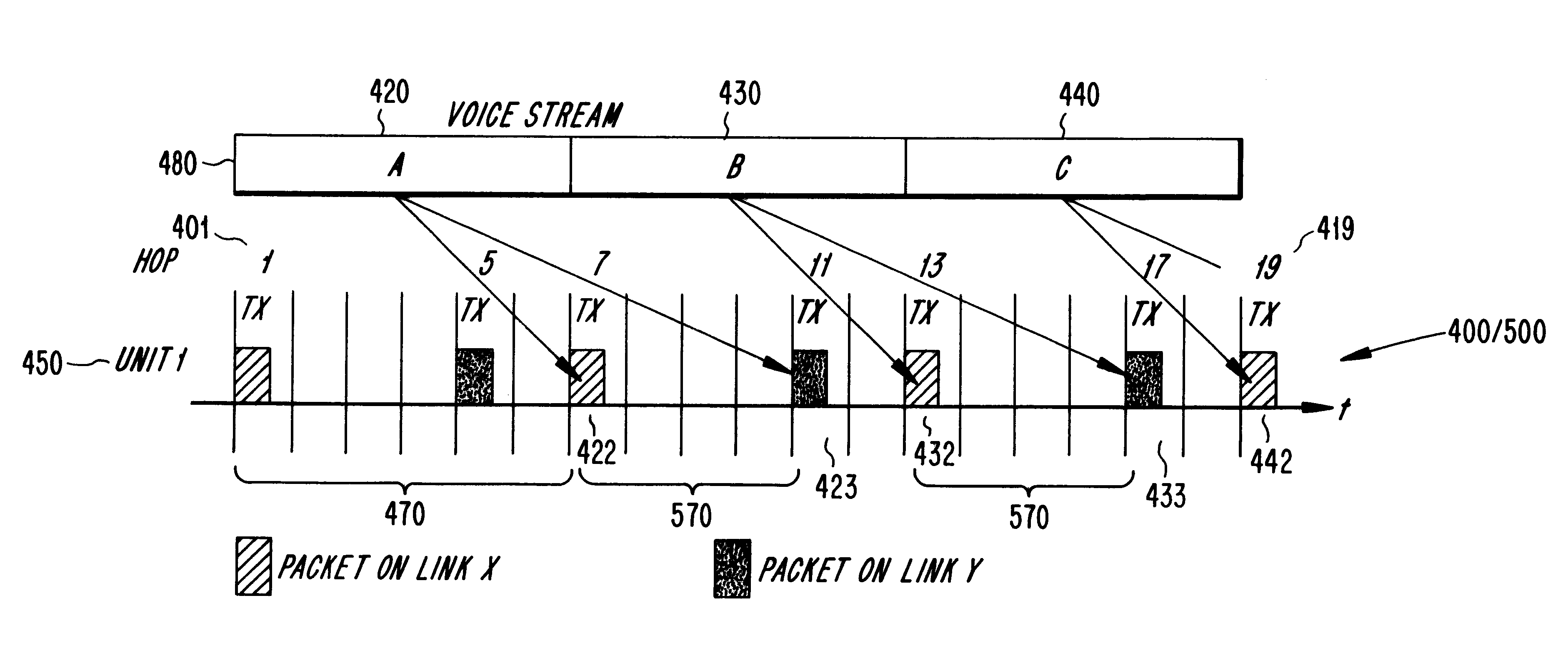
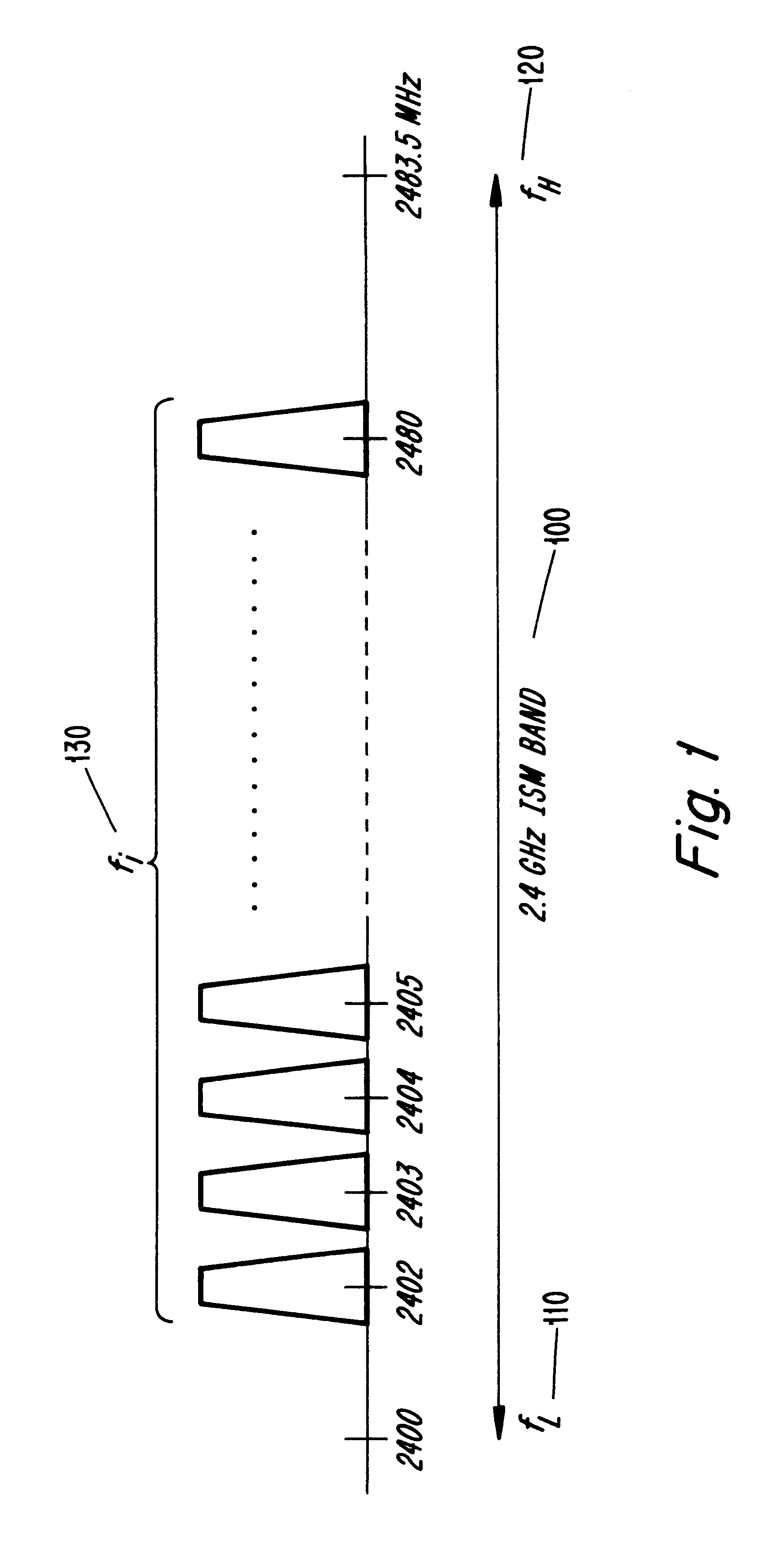
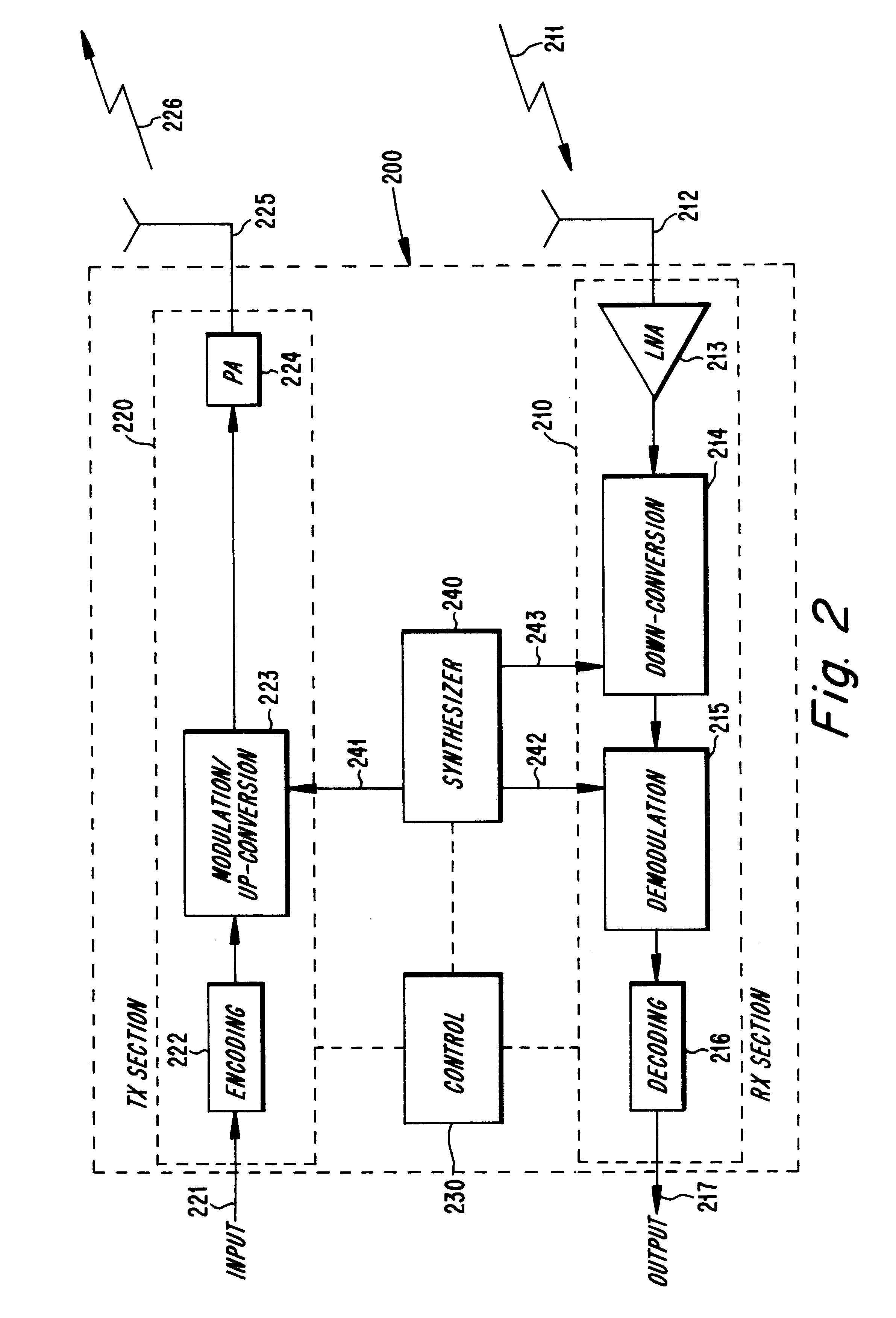
- The implementation of a method and apparatus that uses frequency and time diversity oriented spread spectrum modulation, where additional links are established based on interference characteristics, with each link using a different frequency hop sequence and potentially delayed to provide redundancy and immunity against interference, allowing for the combination of packets to maintain data integrity.

Orthogonal spread-spectrum waveform generation with non-contiguous spectral occupancy for use in CDMA communications
PatentInactiveUS20110080936A1
Innovation
- The technology enables CDMA transmission in non-contiguous spectrum by spreading signals over available discontinuous spectrum, ensuring minimal energy in unused portions and using orthogonal codes to distinguish overlapping signals, thereby minimizing interference and allowing for efficient use of fragmented spectrum.


Spectrum Regulation and Licensing Requirements
The regulatory landscape for FSK and DSSS technologies varies significantly across global jurisdictions, with each modulation scheme subject to distinct licensing frameworks and spectrum allocation policies. FSK systems typically operate within narrowband allocations and are governed by traditional frequency coordination mechanisms, while DSSS implementations fall under spread spectrum regulations that often provide more flexible deployment options.
In the United States, the Federal Communications Commission regulates both technologies under Part 15 and Part 90 rules, depending on application context. FSK systems in industrial applications require specific frequency coordination and may need individual licenses for higher power operations. DSSS technologies benefit from unlicensed operation in ISM bands, particularly the 2.4 GHz and 5.8 GHz ranges, enabling broader deployment without extensive licensing procedures.
European regulatory frameworks under ETSI standards present different compliance requirements for each technology. FSK implementations must adhere to stringent spectral mask requirements and power limitations, particularly in the sub-GHz bands commonly used for IoT applications. DSSS systems enjoy more lenient regulations in designated spread spectrum bands, with relaxed power spectral density limits that facilitate extended coverage areas.
The licensing complexity directly impacts deployment strategies and operational costs. FSK systems often require detailed interference analysis and coordination studies, particularly when seeking coverage area expansion through increased transmit power. These regulatory hurdles can significantly delay deployment timelines and increase operational expenses through ongoing license maintenance fees.
DSSS technologies generally face fewer regulatory barriers for coverage enhancement, as spread spectrum characteristics inherently provide interference mitigation. However, power limitations in unlicensed bands may constrain maximum achievable coverage, necessitating alternative approaches such as mesh networking or repeater deployment to extend operational range.
International harmonization efforts through ITU recommendations are gradually standardizing spectrum access for both technologies, though regional variations persist. These regulatory differences significantly influence technology selection decisions, particularly for applications requiring multi-national deployment or cross-border coverage areas.
In the United States, the Federal Communications Commission regulates both technologies under Part 15 and Part 90 rules, depending on application context. FSK systems in industrial applications require specific frequency coordination and may need individual licenses for higher power operations. DSSS technologies benefit from unlicensed operation in ISM bands, particularly the 2.4 GHz and 5.8 GHz ranges, enabling broader deployment without extensive licensing procedures.
European regulatory frameworks under ETSI standards present different compliance requirements for each technology. FSK implementations must adhere to stringent spectral mask requirements and power limitations, particularly in the sub-GHz bands commonly used for IoT applications. DSSS systems enjoy more lenient regulations in designated spread spectrum bands, with relaxed power spectral density limits that facilitate extended coverage areas.
The licensing complexity directly impacts deployment strategies and operational costs. FSK systems often require detailed interference analysis and coordination studies, particularly when seeking coverage area expansion through increased transmit power. These regulatory hurdles can significantly delay deployment timelines and increase operational expenses through ongoing license maintenance fees.
DSSS technologies generally face fewer regulatory barriers for coverage enhancement, as spread spectrum characteristics inherently provide interference mitigation. However, power limitations in unlicensed bands may constrain maximum achievable coverage, necessitating alternative approaches such as mesh networking or repeater deployment to extend operational range.
International harmonization efforts through ITU recommendations are gradually standardizing spectrum access for both technologies, though regional variations persist. These regulatory differences significantly influence technology selection decisions, particularly for applications requiring multi-national deployment or cross-border coverage areas.
Power Consumption vs Coverage Trade-offs Analysis
The power consumption versus coverage trade-off represents a fundamental design challenge when comparing Frequency Shift Keying (FSK) and Direct Sequence Spread Spectrum (DSSS) technologies. This analysis becomes particularly critical in battery-powered IoT devices and remote sensing applications where energy efficiency directly impacts operational longevity and deployment feasibility.
FSK systems typically demonstrate superior power efficiency due to their simpler modulation scheme and reduced computational requirements. The constant envelope nature of FSK signals allows for the use of non-linear power amplifiers operating near saturation, achieving power amplifier efficiencies of 70-85%. However, this efficiency advantage comes at the cost of limited coverage area, as FSK systems require higher signal-to-noise ratios for reliable demodulation, particularly in interference-heavy environments.
DSSS technology presents a contrasting profile with higher power consumption but significantly enhanced coverage capabilities. The spreading process inherent in DSSS requires additional computational overhead for chip sequence generation and correlation processing, increasing baseline power consumption by 15-30% compared to FSK implementations. The processing gain achieved through spreading, typically ranging from 10-20 dB, enables reliable communication at much lower received signal levels.
The coverage extension capabilities of DSSS create interesting power trade-off scenarios. While individual transmission power requirements may be reduced due to processing gain, the overall system power consumption often increases due to digital signal processing demands. Modern DSSS implementations utilizing low-power DSP architectures can partially mitigate this disadvantage through optimized correlation algorithms and duty-cycling techniques.
Geographic deployment considerations further complicate the power-coverage equation. In dense urban environments where interference levels are high, DSSS systems may achieve better energy efficiency per successfully transmitted bit despite higher baseline consumption. Conversely, in rural deployments with minimal interference, FSK systems often provide optimal power efficiency for required coverage areas.
Battery life projections reveal that FSK systems typically achieve 20-40% longer operational periods in ideal conditions, while DSSS systems maintain more consistent performance across varying environmental conditions, potentially offering better long-term reliability despite higher power consumption.
FSK systems typically demonstrate superior power efficiency due to their simpler modulation scheme and reduced computational requirements. The constant envelope nature of FSK signals allows for the use of non-linear power amplifiers operating near saturation, achieving power amplifier efficiencies of 70-85%. However, this efficiency advantage comes at the cost of limited coverage area, as FSK systems require higher signal-to-noise ratios for reliable demodulation, particularly in interference-heavy environments.
DSSS technology presents a contrasting profile with higher power consumption but significantly enhanced coverage capabilities. The spreading process inherent in DSSS requires additional computational overhead for chip sequence generation and correlation processing, increasing baseline power consumption by 15-30% compared to FSK implementations. The processing gain achieved through spreading, typically ranging from 10-20 dB, enables reliable communication at much lower received signal levels.
The coverage extension capabilities of DSSS create interesting power trade-off scenarios. While individual transmission power requirements may be reduced due to processing gain, the overall system power consumption often increases due to digital signal processing demands. Modern DSSS implementations utilizing low-power DSP architectures can partially mitigate this disadvantage through optimized correlation algorithms and duty-cycling techniques.
Geographic deployment considerations further complicate the power-coverage equation. In dense urban environments where interference levels are high, DSSS systems may achieve better energy efficiency per successfully transmitted bit despite higher baseline consumption. Conversely, in rural deployments with minimal interference, FSK systems often provide optimal power efficiency for required coverage areas.
Battery life projections reveal that FSK systems typically achieve 20-40% longer operational periods in ideal conditions, while DSSS systems maintain more consistent performance across varying environmental conditions, potentially offering better long-term reliability despite higher power consumption.
Unlock deeper insights with PatSnap Eureka Quick Research — get a full tech report to explore trends and direct your research. Try now!
Generate Your Research Report Instantly with AI Agent
Supercharge your innovation with PatSnap Eureka AI Agent Platform!