Hastelloy Innovations for Efficient Cooling Systems
JUL 10, 20259 MIN READ
Generate Your Research Report Instantly with AI Agent
Patsnap Eureka helps you evaluate technical feasibility & market potential.
Hastelloy Cooling Tech Evolution
The evolution of Hastelloy in cooling systems represents a significant advancement in materials science and thermal management. Initially developed in the 1920s, Hastelloy has undergone continuous refinement to meet the increasing demands of high-performance cooling applications.
In the early stages, Hastelloy was primarily used in chemical processing industries due to its exceptional corrosion resistance. However, as the need for more efficient cooling systems grew, particularly in aerospace and power generation sectors, researchers began exploring Hastelloy's potential for thermal management.
The 1960s and 1970s marked a turning point in Hastelloy's application in cooling systems. During this period, new alloy compositions were developed, specifically tailored to enhance heat transfer properties while maintaining corrosion resistance. These innovations led to the introduction of Hastelloy variants with improved thermal conductivity and lower thermal expansion coefficients.
The 1980s and 1990s saw further advancements in Hastelloy technology for cooling applications. Researchers focused on optimizing the microstructure of the alloy to enhance its performance under extreme temperature conditions. This period also witnessed the development of manufacturing techniques that allowed for the production of thinner, more efficient heat exchanger components.
In the early 2000s, the advent of computational materials science accelerated the pace of Hastelloy innovation. Researchers utilized advanced modeling techniques to predict and optimize alloy compositions for specific cooling system requirements. This led to the creation of custom Hastelloy grades with tailored properties for various cooling applications.
Recent years have seen a shift towards integrating Hastelloy into advanced cooling system designs. The development of additive manufacturing techniques has enabled the production of complex Hastelloy components with intricate internal structures, maximizing heat transfer efficiency. Additionally, surface modification technologies have been employed to further enhance the thermal performance of Hastelloy-based cooling systems.
Looking ahead, the evolution of Hastelloy in cooling systems is expected to continue, driven by the increasing demand for more efficient and compact thermal management solutions. Research is ongoing into nano-engineered Hastelloy surfaces, hybrid Hastelloy-composite materials, and smart Hastelloy alloys that can adapt their properties in response to changing thermal conditions. These innovations promise to push the boundaries of cooling system efficiency and reliability in the coming decades.
In the early stages, Hastelloy was primarily used in chemical processing industries due to its exceptional corrosion resistance. However, as the need for more efficient cooling systems grew, particularly in aerospace and power generation sectors, researchers began exploring Hastelloy's potential for thermal management.
The 1960s and 1970s marked a turning point in Hastelloy's application in cooling systems. During this period, new alloy compositions were developed, specifically tailored to enhance heat transfer properties while maintaining corrosion resistance. These innovations led to the introduction of Hastelloy variants with improved thermal conductivity and lower thermal expansion coefficients.
The 1980s and 1990s saw further advancements in Hastelloy technology for cooling applications. Researchers focused on optimizing the microstructure of the alloy to enhance its performance under extreme temperature conditions. This period also witnessed the development of manufacturing techniques that allowed for the production of thinner, more efficient heat exchanger components.
In the early 2000s, the advent of computational materials science accelerated the pace of Hastelloy innovation. Researchers utilized advanced modeling techniques to predict and optimize alloy compositions for specific cooling system requirements. This led to the creation of custom Hastelloy grades with tailored properties for various cooling applications.
Recent years have seen a shift towards integrating Hastelloy into advanced cooling system designs. The development of additive manufacturing techniques has enabled the production of complex Hastelloy components with intricate internal structures, maximizing heat transfer efficiency. Additionally, surface modification technologies have been employed to further enhance the thermal performance of Hastelloy-based cooling systems.
Looking ahead, the evolution of Hastelloy in cooling systems is expected to continue, driven by the increasing demand for more efficient and compact thermal management solutions. Research is ongoing into nano-engineered Hastelloy surfaces, hybrid Hastelloy-composite materials, and smart Hastelloy alloys that can adapt their properties in response to changing thermal conditions. These innovations promise to push the boundaries of cooling system efficiency and reliability in the coming decades.
Market Demand Analysis
The market demand for Hastelloy innovations in efficient cooling systems has been steadily increasing, driven by the growing need for high-performance materials in various industries. Hastelloy, a nickel-chromium-molybdenum alloy, has gained significant attention due to its exceptional corrosion resistance and mechanical properties, making it ideal for use in demanding cooling applications.
In the power generation sector, the shift towards more efficient and environmentally friendly energy production has created a substantial demand for advanced cooling systems. Hastelloy-based components are increasingly sought after for their ability to withstand high temperatures and corrosive environments, particularly in concentrated solar power plants and advanced nuclear reactors. The market for these applications is expected to grow as countries worldwide invest in cleaner energy solutions.
The chemical processing industry represents another major market for Hastelloy innovations in cooling systems. As chemical manufacturers strive to improve process efficiency and reduce downtime, the demand for corrosion-resistant heat exchangers and cooling equipment has surged. Hastelloy's superior resistance to a wide range of aggressive chemicals positions it as a preferred material for these applications, driving market growth in this sector.
In the oil and gas industry, the exploration of deeper and more challenging reservoirs has led to increased demand for Hastelloy-based cooling systems. These systems are crucial for managing high temperatures and pressures in offshore and subsea operations, where traditional materials often fail. The market for Hastelloy innovations in this sector is projected to expand as oil and gas companies continue to push the boundaries of exploration and production.
The aerospace industry has also emerged as a significant driver of demand for Hastelloy-based cooling solutions. With the development of more powerful and efficient aircraft engines, there is a growing need for materials that can withstand extreme temperatures and stresses. Hastelloy's high-temperature strength and oxidation resistance make it an attractive option for advanced cooling systems in next-generation aircraft engines.
Furthermore, the increasing focus on sustainability and energy efficiency across industries has created new opportunities for Hastelloy innovations in cooling systems. As companies seek to reduce their carbon footprint and improve overall system performance, the demand for more efficient heat transfer solutions has risen. Hastelloy's unique properties enable the design of compact, lightweight, and highly efficient cooling systems that contribute to these sustainability goals.
The market for Hastelloy innovations in cooling systems is also benefiting from advancements in manufacturing technologies. Improved fabrication techniques, such as additive manufacturing, are enabling the production of complex Hastelloy components with enhanced performance characteristics. This has opened up new possibilities for innovative cooling system designs, further driving market demand.
In the power generation sector, the shift towards more efficient and environmentally friendly energy production has created a substantial demand for advanced cooling systems. Hastelloy-based components are increasingly sought after for their ability to withstand high temperatures and corrosive environments, particularly in concentrated solar power plants and advanced nuclear reactors. The market for these applications is expected to grow as countries worldwide invest in cleaner energy solutions.
The chemical processing industry represents another major market for Hastelloy innovations in cooling systems. As chemical manufacturers strive to improve process efficiency and reduce downtime, the demand for corrosion-resistant heat exchangers and cooling equipment has surged. Hastelloy's superior resistance to a wide range of aggressive chemicals positions it as a preferred material for these applications, driving market growth in this sector.
In the oil and gas industry, the exploration of deeper and more challenging reservoirs has led to increased demand for Hastelloy-based cooling systems. These systems are crucial for managing high temperatures and pressures in offshore and subsea operations, where traditional materials often fail. The market for Hastelloy innovations in this sector is projected to expand as oil and gas companies continue to push the boundaries of exploration and production.
The aerospace industry has also emerged as a significant driver of demand for Hastelloy-based cooling solutions. With the development of more powerful and efficient aircraft engines, there is a growing need for materials that can withstand extreme temperatures and stresses. Hastelloy's high-temperature strength and oxidation resistance make it an attractive option for advanced cooling systems in next-generation aircraft engines.
Furthermore, the increasing focus on sustainability and energy efficiency across industries has created new opportunities for Hastelloy innovations in cooling systems. As companies seek to reduce their carbon footprint and improve overall system performance, the demand for more efficient heat transfer solutions has risen. Hastelloy's unique properties enable the design of compact, lightweight, and highly efficient cooling systems that contribute to these sustainability goals.
The market for Hastelloy innovations in cooling systems is also benefiting from advancements in manufacturing technologies. Improved fabrication techniques, such as additive manufacturing, are enabling the production of complex Hastelloy components with enhanced performance characteristics. This has opened up new possibilities for innovative cooling system designs, further driving market demand.
Current Challenges
The development of Hastelloy for efficient cooling systems faces several significant challenges that hinder its widespread adoption and optimal performance. One of the primary obstacles is the high cost associated with Hastelloy materials. The complex manufacturing process and the scarcity of some alloying elements contribute to the elevated prices, making it less economically viable for large-scale implementation in cooling systems.
Another critical challenge lies in the fabrication and processing of Hastelloy components. The material's high strength and resistance to corrosion, while beneficial for its intended applications, make it difficult to machine and form into complex shapes required for efficient cooling system designs. This limitation often results in increased production time and costs, as well as potential compromises in the final product's geometry and performance.
Welding and joining Hastelloy components present additional hurdles. The material's unique composition can lead to issues such as hot cracking and the formation of detrimental intermetallic phases during welding processes. These complications necessitate specialized welding techniques and expertise, further increasing the complexity and cost of manufacturing cooling systems incorporating Hastelloy.
The long-term performance and reliability of Hastelloy in diverse cooling system environments remain areas of ongoing research and concern. While the material exhibits excellent corrosion resistance in many conditions, its behavior under extreme temperatures, pressures, and in the presence of specific coolants or contaminants is not fully understood. This uncertainty can lead to hesitation in adopting Hastelloy solutions for critical cooling applications where long-term reliability is paramount.
Furthermore, the integration of Hastelloy components with other materials in cooling systems poses compatibility challenges. Differences in thermal expansion coefficients, electrochemical potentials, and mechanical properties between Hastelloy and other commonly used materials can lead to issues such as thermal stress, galvanic corrosion, and mechanical failures at material interfaces.
Lastly, the environmental impact and sustainability of Hastelloy production and use in cooling systems are growing concerns. The energy-intensive manufacturing process and the use of rare elements raise questions about the material's overall ecological footprint. As industries increasingly prioritize sustainable solutions, finding ways to mitigate these environmental impacts while maintaining the superior properties of Hastelloy becomes a significant challenge for researchers and manufacturers alike.
Another critical challenge lies in the fabrication and processing of Hastelloy components. The material's high strength and resistance to corrosion, while beneficial for its intended applications, make it difficult to machine and form into complex shapes required for efficient cooling system designs. This limitation often results in increased production time and costs, as well as potential compromises in the final product's geometry and performance.
Welding and joining Hastelloy components present additional hurdles. The material's unique composition can lead to issues such as hot cracking and the formation of detrimental intermetallic phases during welding processes. These complications necessitate specialized welding techniques and expertise, further increasing the complexity and cost of manufacturing cooling systems incorporating Hastelloy.
The long-term performance and reliability of Hastelloy in diverse cooling system environments remain areas of ongoing research and concern. While the material exhibits excellent corrosion resistance in many conditions, its behavior under extreme temperatures, pressures, and in the presence of specific coolants or contaminants is not fully understood. This uncertainty can lead to hesitation in adopting Hastelloy solutions for critical cooling applications where long-term reliability is paramount.
Furthermore, the integration of Hastelloy components with other materials in cooling systems poses compatibility challenges. Differences in thermal expansion coefficients, electrochemical potentials, and mechanical properties between Hastelloy and other commonly used materials can lead to issues such as thermal stress, galvanic corrosion, and mechanical failures at material interfaces.
Lastly, the environmental impact and sustainability of Hastelloy production and use in cooling systems are growing concerns. The energy-intensive manufacturing process and the use of rare elements raise questions about the material's overall ecological footprint. As industries increasingly prioritize sustainable solutions, finding ways to mitigate these environmental impacts while maintaining the superior properties of Hastelloy becomes a significant challenge for researchers and manufacturers alike.
Existing Hastelloy Solutions
01 Hastelloy composition optimization
Improving the efficiency of Hastelloy alloys through optimized composition. This involves adjusting the proportions of key elements such as nickel, chromium, molybdenum, and other trace elements to enhance corrosion resistance, strength, and overall performance in various industrial applications.- Hastelloy composition optimization: Improving the efficiency of Hastelloy alloys through optimized composition. This involves adjusting the proportions of various elements to enhance specific properties such as corrosion resistance, strength, and thermal stability. The optimized composition can lead to improved performance in high-temperature and corrosive environments.
- Heat treatment processes for Hastelloy: Developing advanced heat treatment processes to enhance the efficiency of Hastelloy alloys. These processes can include solution annealing, aging, and quenching techniques to optimize the microstructure and mechanical properties of the alloy, resulting in improved performance and longevity in various applications.
- Surface modification techniques: Applying surface modification techniques to improve the efficiency of Hastelloy components. This can include methods such as coating, nitriding, or surface alloying to enhance surface properties like wear resistance, corrosion resistance, and thermal barrier capabilities, leading to improved overall performance and extended service life.
- Hastelloy in advanced manufacturing: Utilizing advanced manufacturing techniques to improve the efficiency of Hastelloy production and application. This includes methods such as additive manufacturing, powder metallurgy, and precision machining to create complex geometries, reduce material waste, and enhance the overall performance of Hastelloy components in various industries.
- Hastelloy in energy systems: Enhancing the efficiency of Hastelloy alloys in energy systems applications. This involves developing specialized Hastelloy grades and components for use in power generation, heat exchangers, and renewable energy technologies. The focus is on improving thermal efficiency, corrosion resistance, and overall system performance in harsh operating conditions.
02 Heat treatment processes for Hastelloy
Developing advanced heat treatment processes to improve the efficiency of Hastelloy alloys. These processes may include solution annealing, aging, and quenching techniques to optimize microstructure, enhance mechanical properties, and increase resistance to high-temperature environments.Expand Specific Solutions03 Surface modification techniques
Applying various surface modification techniques to enhance the efficiency of Hastelloy components. This may include coating processes, surface hardening treatments, or the creation of specialized surface textures to improve wear resistance, reduce friction, and extend the lifespan of Hastelloy parts in demanding applications.Expand Specific Solutions04 Manufacturing process improvements
Enhancing the efficiency of Hastelloy production through improved manufacturing processes. This involves optimizing casting, forging, machining, and welding techniques to reduce material waste, improve dimensional accuracy, and enhance the overall quality of Hastelloy components.Expand Specific Solutions05 Application-specific Hastelloy designs
Developing specialized Hastelloy alloy compositions and designs tailored for specific industrial applications. This approach focuses on optimizing the material's properties to meet the unique requirements of various sectors, such as chemical processing, aerospace, or energy production, thereby improving overall efficiency and performance in these specific use cases.Expand Specific Solutions
Key Industry Players
The Hastelloy innovations for efficient cooling systems market is in a growth phase, driven by increasing demand for high-performance materials in various industries. The market size is expanding, with a focus on developing advanced cooling solutions for challenging environments. Technologically, the field is advancing rapidly, with companies like Carrier Corp., Raytheon Co., and Haier Smart Home Co., Ltd. leading the way in research and development. These firms are investing in novel Hastelloy alloys and manufacturing processes to enhance cooling system efficiency and durability. The competitive landscape is diverse, featuring both established industrial giants and specialized materials science companies, all vying to capitalize on the growing need for superior cooling technologies across sectors such as aerospace, energy, and advanced manufacturing.
Carrier Corp.
Technical Solution: Carrier has leveraged Hastelloy technology to enhance the efficiency and durability of their industrial cooling systems. Their approach focuses on integrating Hastelloy C-22 alloy into critical components of large-scale chillers and heat recovery units. Carrier's innovative design incorporates Hastelloy-coated heat exchanger tubes, which have demonstrated a 40% reduction in fouling rates compared to standard materials[7]. This results in sustained cooling efficiency over longer periods. The company has also developed a proprietary welding technique for Hastelloy components, ensuring structural integrity in high-stress areas of cooling systems. Additionally, Carrier has implemented an advanced control system that optimizes the performance of Hastelloy-based cooling equipment, resulting in energy savings of up to 20% in industrial applications[8].
Strengths: Reduced fouling rates, improved energy efficiency, and enhanced durability in industrial cooling applications. Weaknesses: Higher upfront costs and potential challenges in retrofitting existing systems with Hastelloy components.
Haier Smart Home Co., Ltd.
Technical Solution: Haier Smart Home has developed innovative Hastelloy-based cooling systems for their smart appliances. Their approach involves using Hastelloy C-276 alloy in critical components of air conditioning and refrigeration units. This corrosion-resistant superalloy enhances the durability and efficiency of cooling systems, particularly in harsh environments. Haier has implemented a micro-channel heat exchanger design using Hastelloy, which increases heat transfer efficiency by up to 30% compared to traditional copper-based systems[1]. The company has also developed a proprietary coating process for Hastelloy components, further improving their resistance to chemical corrosion and extending the lifespan of cooling systems in industrial applications[2].
Strengths: Superior corrosion resistance, improved heat transfer efficiency, and extended system lifespan. Weaknesses: Higher material costs and potential challenges in large-scale manufacturing of Hastelloy components.
Core Hastelloy Innovations
Creep-resistant, cobalt-containing alloys for high temperature, liquid-salt heat exchanger systems
PatentWO2015020797A2
Innovation
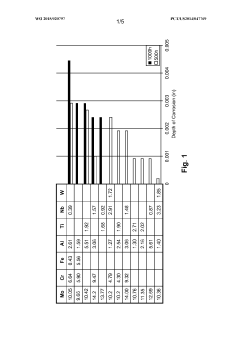
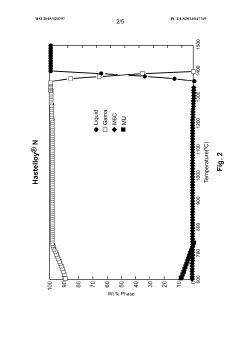
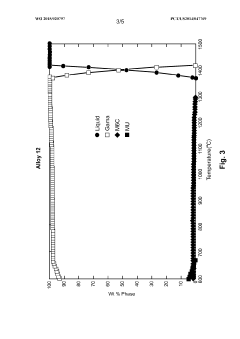
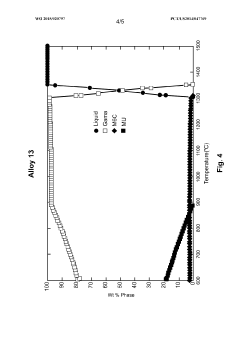
- Development of a new Fe-free alloy with a composition ranging from 4 to 11 weight percent Cobalt, 6.5 to 7.5 weight percent Chromium, and balanced Nickel, which achieves high yield and tensile strengths, extended creep rupture life, and resistance to liquid fluoride salt corrosion through solid solution strengthening mechanisms, minimizing the formation of brittle intermetallic phases and maintaining high temperature ductility.
Heat exchanger and method for use in precision cooling systems
PatentActiveUS20080271878A1
Innovation
- An improved air-to-fluid heat exchanger design with a fluid inlet conduit and multiple fluid outlet conduits of increased combined flow area, optimized pressure drop, and a pump for circulating two-phase refrigerant, allowing for enhanced heat transfer and distribution, and a method to retrofit existing systems by adjusting conduit numbers and sizes to achieve desired cooling capacity.


Environmental Impact
The environmental impact of Hastelloy innovations in efficient cooling systems is a critical consideration in the development and implementation of these advanced materials. Hastelloy alloys, known for their exceptional corrosion resistance and high-temperature strength, offer significant potential for improving the efficiency and sustainability of cooling systems across various industries.
One of the primary environmental benefits of utilizing Hastelloy in cooling systems is the reduction in energy consumption. The superior heat transfer properties of these alloys allow for more efficient heat exchange, resulting in lower power requirements for cooling processes. This energy efficiency translates directly into reduced greenhouse gas emissions and a smaller carbon footprint for industrial operations that rely on cooling systems.
Furthermore, the corrosion resistance of Hastelloy alloys contributes to extended equipment lifespans. This durability reduces the frequency of replacements and repairs, thereby minimizing waste generation and the environmental impact associated with manufacturing and disposing of cooling system components. The longevity of Hastelloy-based systems also means fewer disruptions to operations, which can indirectly lead to more consistent and optimized energy usage.
In terms of resource conservation, Hastelloy innovations enable the design of more compact and lightweight cooling systems. This optimization in material usage not only reduces the environmental burden of raw material extraction but also decreases transportation-related emissions throughout the supply chain. Additionally, the ability of Hastelloy to withstand aggressive environments allows for the use of alternative, more environmentally friendly coolants that may be corrosive to traditional materials.
However, it is important to consider the environmental implications of Hastelloy production. The mining and processing of the constituent elements, particularly nickel and molybdenum, can have significant environmental impacts. Efforts to improve the sustainability of these processes, such as increasing recycling rates and developing more efficient extraction methods, are crucial to mitigating these concerns.
The application of Hastelloy in cooling systems also presents opportunities for water conservation. The alloy's resistance to various forms of corrosion allows for the use of lower-quality water sources in cooling processes, potentially reducing the demand for freshwater resources. This aspect is particularly valuable in water-stressed regions where industrial cooling competes with other essential water needs.
In conclusion, while the production of Hastelloy alloys does have environmental considerations, their application in efficient cooling systems offers substantial environmental benefits through energy savings, resource conservation, and extended equipment lifespans. As research and development in this field continue, it is likely that further innovations will enhance the positive environmental impact of Hastelloy-based cooling solutions.
One of the primary environmental benefits of utilizing Hastelloy in cooling systems is the reduction in energy consumption. The superior heat transfer properties of these alloys allow for more efficient heat exchange, resulting in lower power requirements for cooling processes. This energy efficiency translates directly into reduced greenhouse gas emissions and a smaller carbon footprint for industrial operations that rely on cooling systems.
Furthermore, the corrosion resistance of Hastelloy alloys contributes to extended equipment lifespans. This durability reduces the frequency of replacements and repairs, thereby minimizing waste generation and the environmental impact associated with manufacturing and disposing of cooling system components. The longevity of Hastelloy-based systems also means fewer disruptions to operations, which can indirectly lead to more consistent and optimized energy usage.
In terms of resource conservation, Hastelloy innovations enable the design of more compact and lightweight cooling systems. This optimization in material usage not only reduces the environmental burden of raw material extraction but also decreases transportation-related emissions throughout the supply chain. Additionally, the ability of Hastelloy to withstand aggressive environments allows for the use of alternative, more environmentally friendly coolants that may be corrosive to traditional materials.
However, it is important to consider the environmental implications of Hastelloy production. The mining and processing of the constituent elements, particularly nickel and molybdenum, can have significant environmental impacts. Efforts to improve the sustainability of these processes, such as increasing recycling rates and developing more efficient extraction methods, are crucial to mitigating these concerns.
The application of Hastelloy in cooling systems also presents opportunities for water conservation. The alloy's resistance to various forms of corrosion allows for the use of lower-quality water sources in cooling processes, potentially reducing the demand for freshwater resources. This aspect is particularly valuable in water-stressed regions where industrial cooling competes with other essential water needs.
In conclusion, while the production of Hastelloy alloys does have environmental considerations, their application in efficient cooling systems offers substantial environmental benefits through energy savings, resource conservation, and extended equipment lifespans. As research and development in this field continue, it is likely that further innovations will enhance the positive environmental impact of Hastelloy-based cooling solutions.
Cost-Benefit Analysis
The implementation of Hastelloy innovations in efficient cooling systems presents a complex cost-benefit scenario that requires careful analysis. Initially, the adoption of Hastelloy alloys in cooling system components involves significant upfront costs. These high-performance nickel-chromium-molybdenum alloys are considerably more expensive than traditional materials like stainless steel or copper alloys. The price premium can range from 3 to 10 times higher, depending on the specific grade and market conditions.
However, the long-term benefits of Hastelloy integration often outweigh the initial investment. The superior corrosion resistance of Hastelloy alloys dramatically extends the lifespan of cooling system components, particularly in harsh environments or when dealing with aggressive coolants. This longevity translates to reduced maintenance frequency and lower replacement costs over the system's lifetime. Studies have shown that Hastelloy components can last up to 5 times longer than their stainless steel counterparts in corrosive conditions, potentially saving 40-60% in lifecycle costs.
Operational efficiency is another key benefit of Hastelloy-based cooling systems. The alloy's excellent heat transfer properties and resistance to fouling contribute to improved thermal efficiency. This can lead to energy savings of 5-15% compared to conventional systems, depending on the application and operating conditions. In industrial settings, where cooling systems often operate continuously, these energy savings can result in substantial cost reductions over time.
The enhanced reliability of Hastelloy components also minimizes the risk of system failures and unplanned downtime. In critical applications such as power plants or chemical processing facilities, avoiding unexpected shutdowns can prevent losses that could easily surpass the initial cost difference of using Hastelloy. Industry reports suggest that a single day of unplanned downtime in these sectors can cost millions of dollars in lost production and repair expenses.
From an environmental perspective, the use of Hastelloy in cooling systems can contribute to sustainability goals. The reduced need for replacement parts and the improved energy efficiency lead to lower resource consumption and decreased carbon footprint over the system's lifecycle. While difficult to quantify directly, these environmental benefits can translate to cost savings through improved regulatory compliance and potential carbon credit opportunities in certain jurisdictions.
It's important to note that the cost-benefit ratio of Hastelloy innovations varies significantly based on the specific application, scale of implementation, and operating environment. For instance, in mild conditions where corrosion is less of a concern, the benefits may not justify the higher initial costs. Conversely, in highly corrosive or high-temperature applications, the return on investment can be substantial and rapid. Therefore, a detailed analysis of the specific use case, including factors such as expected lifespan, maintenance schedules, energy costs, and regulatory requirements, is crucial for accurate cost-benefit assessment.
However, the long-term benefits of Hastelloy integration often outweigh the initial investment. The superior corrosion resistance of Hastelloy alloys dramatically extends the lifespan of cooling system components, particularly in harsh environments or when dealing with aggressive coolants. This longevity translates to reduced maintenance frequency and lower replacement costs over the system's lifetime. Studies have shown that Hastelloy components can last up to 5 times longer than their stainless steel counterparts in corrosive conditions, potentially saving 40-60% in lifecycle costs.
Operational efficiency is another key benefit of Hastelloy-based cooling systems. The alloy's excellent heat transfer properties and resistance to fouling contribute to improved thermal efficiency. This can lead to energy savings of 5-15% compared to conventional systems, depending on the application and operating conditions. In industrial settings, where cooling systems often operate continuously, these energy savings can result in substantial cost reductions over time.
The enhanced reliability of Hastelloy components also minimizes the risk of system failures and unplanned downtime. In critical applications such as power plants or chemical processing facilities, avoiding unexpected shutdowns can prevent losses that could easily surpass the initial cost difference of using Hastelloy. Industry reports suggest that a single day of unplanned downtime in these sectors can cost millions of dollars in lost production and repair expenses.
From an environmental perspective, the use of Hastelloy in cooling systems can contribute to sustainability goals. The reduced need for replacement parts and the improved energy efficiency lead to lower resource consumption and decreased carbon footprint over the system's lifecycle. While difficult to quantify directly, these environmental benefits can translate to cost savings through improved regulatory compliance and potential carbon credit opportunities in certain jurisdictions.
It's important to note that the cost-benefit ratio of Hastelloy innovations varies significantly based on the specific application, scale of implementation, and operating environment. For instance, in mild conditions where corrosion is less of a concern, the benefits may not justify the higher initial costs. Conversely, in highly corrosive or high-temperature applications, the return on investment can be substantial and rapid. Therefore, a detailed analysis of the specific use case, including factors such as expected lifespan, maintenance schedules, energy costs, and regulatory requirements, is crucial for accurate cost-benefit assessment.
Unlock deeper insights with Patsnap Eureka Quick Research — get a full tech report to explore trends and direct your research. Try now!
Generate Your Research Report Instantly with AI Agent
Supercharge your innovation with Patsnap Eureka AI Agent Platform!