High Pass Filter Techniques in Acoustic Environment Sensing
JUL 28, 202510 MIN READ
Generate Your Research Report Instantly with AI Agent
PatSnap Eureka helps you evaluate technical feasibility & market potential.
Acoustic Sensing Background and Objectives
Acoustic environment sensing has emerged as a critical field in the realm of environmental monitoring and smart technologies. The evolution of this technology can be traced back to the mid-20th century when basic sound level meters were first introduced. Over the decades, the field has witnessed significant advancements, moving from simple decibel measurements to sophisticated spectral analysis and pattern recognition techniques.
The current trend in acoustic sensing is towards more intelligent and context-aware systems. These systems are capable of not only detecting sound levels but also identifying specific acoustic events and patterns within complex auditory landscapes. This progression has been driven by the increasing demand for smart city applications, environmental monitoring, and industrial process control.
High-pass filter techniques play a crucial role in this technological evolution. These filters are designed to attenuate low-frequency signals while allowing higher frequencies to pass through, which is particularly useful in acoustic sensing applications. By effectively removing low-frequency noise and focusing on higher frequency components, high-pass filters enable more accurate detection and analysis of relevant acoustic events.
The primary objectives of implementing high-pass filter techniques in acoustic environment sensing are multifaceted. Firstly, they aim to enhance the signal-to-noise ratio by eliminating low-frequency background noise, which is often prevalent in urban and industrial environments. This improvement in signal quality leads to more reliable and precise acoustic measurements.
Secondly, high-pass filters contribute to the development of more energy-efficient sensing systems. By focusing on specific frequency ranges of interest, these techniques can reduce the computational load and power consumption of acoustic sensors, making them more suitable for long-term deployment in various environmental monitoring scenarios.
Another key objective is to improve the discrimination capabilities of acoustic sensing systems. High-pass filtering allows for better isolation of high-frequency acoustic signatures associated with specific events or sources, such as machinery faults, wildlife vocalizations, or urban traffic patterns. This enhanced discrimination is crucial for developing more sophisticated and context-aware acoustic monitoring solutions.
Furthermore, the integration of high-pass filter techniques aims to expand the application scope of acoustic sensing. By refining the ability to capture and analyze specific frequency components, these methods open up new possibilities in fields such as predictive maintenance, environmental conservation, and public safety monitoring.
As we look towards the future, the continued development of high-pass filter techniques in acoustic sensing is expected to play a vital role in addressing emerging challenges. These include the need for real-time processing of vast amounts of acoustic data, adaptation to dynamic and complex sound environments, and integration with other sensing modalities for more comprehensive environmental monitoring solutions.
The current trend in acoustic sensing is towards more intelligent and context-aware systems. These systems are capable of not only detecting sound levels but also identifying specific acoustic events and patterns within complex auditory landscapes. This progression has been driven by the increasing demand for smart city applications, environmental monitoring, and industrial process control.
High-pass filter techniques play a crucial role in this technological evolution. These filters are designed to attenuate low-frequency signals while allowing higher frequencies to pass through, which is particularly useful in acoustic sensing applications. By effectively removing low-frequency noise and focusing on higher frequency components, high-pass filters enable more accurate detection and analysis of relevant acoustic events.
The primary objectives of implementing high-pass filter techniques in acoustic environment sensing are multifaceted. Firstly, they aim to enhance the signal-to-noise ratio by eliminating low-frequency background noise, which is often prevalent in urban and industrial environments. This improvement in signal quality leads to more reliable and precise acoustic measurements.
Secondly, high-pass filters contribute to the development of more energy-efficient sensing systems. By focusing on specific frequency ranges of interest, these techniques can reduce the computational load and power consumption of acoustic sensors, making them more suitable for long-term deployment in various environmental monitoring scenarios.
Another key objective is to improve the discrimination capabilities of acoustic sensing systems. High-pass filtering allows for better isolation of high-frequency acoustic signatures associated with specific events or sources, such as machinery faults, wildlife vocalizations, or urban traffic patterns. This enhanced discrimination is crucial for developing more sophisticated and context-aware acoustic monitoring solutions.
Furthermore, the integration of high-pass filter techniques aims to expand the application scope of acoustic sensing. By refining the ability to capture and analyze specific frequency components, these methods open up new possibilities in fields such as predictive maintenance, environmental conservation, and public safety monitoring.
As we look towards the future, the continued development of high-pass filter techniques in acoustic sensing is expected to play a vital role in addressing emerging challenges. These include the need for real-time processing of vast amounts of acoustic data, adaptation to dynamic and complex sound environments, and integration with other sensing modalities for more comprehensive environmental monitoring solutions.
Market Analysis for Acoustic Environment Sensing
The market for acoustic environment sensing technologies, particularly those utilizing high pass filter techniques, has been experiencing significant growth in recent years. This expansion is driven by the increasing demand for noise reduction solutions in various industries, including automotive, consumer electronics, and industrial applications.
In the automotive sector, the push for quieter and more comfortable vehicle interiors has led to a surge in the adoption of acoustic sensing technologies. High pass filters play a crucial role in isolating and mitigating low-frequency noise, enhancing the overall driving experience. As electric vehicles gain popularity, the need for advanced acoustic sensing becomes even more pronounced due to the absence of engine noise masking other sounds.
The consumer electronics market has also become a major driver for acoustic environment sensing. With the proliferation of smart home devices, voice-controlled assistants, and high-fidelity audio systems, there is a growing need for accurate sound detection and processing. High pass filter techniques are essential in improving the performance of these devices by eliminating unwanted low-frequency interference and enhancing voice recognition capabilities.
Industrial applications represent another significant market segment for acoustic environment sensing. In manufacturing environments, precise noise monitoring and control are critical for worker safety and regulatory compliance. High pass filters are employed in industrial acoustic sensors to focus on specific frequency ranges of interest, enabling more accurate detection of machinery faults or potential hazards.
The healthcare sector is emerging as a promising market for acoustic sensing technologies. Applications such as sleep apnea detection, respiratory monitoring, and non-invasive diagnostic tools rely on sophisticated acoustic sensing capabilities. High pass filter techniques are instrumental in isolating relevant respiratory sounds from background noise, improving the accuracy of these medical devices.
Environmental monitoring and urban planning represent growing niches within the acoustic sensing market. Cities are increasingly deploying sensor networks to measure noise pollution and its impact on residents. High pass filters are utilized in these systems to differentiate between various types of urban noise and provide more meaningful data for policymakers and urban planners.
As the Internet of Things (IoT) continues to expand, the integration of acoustic sensors into connected devices is expected to drive further market growth. This trend is likely to create new opportunities for high pass filter technologies in areas such as smart buildings, predictive maintenance, and security systems.
The global market for acoustic sensors, including those incorporating high pass filter techniques, is projected to grow steadily over the next five years. Factors such as technological advancements, increasing awareness of noise pollution, and stringent regulatory standards are expected to fuel this growth across various industries and applications.
In the automotive sector, the push for quieter and more comfortable vehicle interiors has led to a surge in the adoption of acoustic sensing technologies. High pass filters play a crucial role in isolating and mitigating low-frequency noise, enhancing the overall driving experience. As electric vehicles gain popularity, the need for advanced acoustic sensing becomes even more pronounced due to the absence of engine noise masking other sounds.
The consumer electronics market has also become a major driver for acoustic environment sensing. With the proliferation of smart home devices, voice-controlled assistants, and high-fidelity audio systems, there is a growing need for accurate sound detection and processing. High pass filter techniques are essential in improving the performance of these devices by eliminating unwanted low-frequency interference and enhancing voice recognition capabilities.
Industrial applications represent another significant market segment for acoustic environment sensing. In manufacturing environments, precise noise monitoring and control are critical for worker safety and regulatory compliance. High pass filters are employed in industrial acoustic sensors to focus on specific frequency ranges of interest, enabling more accurate detection of machinery faults or potential hazards.
The healthcare sector is emerging as a promising market for acoustic sensing technologies. Applications such as sleep apnea detection, respiratory monitoring, and non-invasive diagnostic tools rely on sophisticated acoustic sensing capabilities. High pass filter techniques are instrumental in isolating relevant respiratory sounds from background noise, improving the accuracy of these medical devices.
Environmental monitoring and urban planning represent growing niches within the acoustic sensing market. Cities are increasingly deploying sensor networks to measure noise pollution and its impact on residents. High pass filters are utilized in these systems to differentiate between various types of urban noise and provide more meaningful data for policymakers and urban planners.
As the Internet of Things (IoT) continues to expand, the integration of acoustic sensors into connected devices is expected to drive further market growth. This trend is likely to create new opportunities for high pass filter technologies in areas such as smart buildings, predictive maintenance, and security systems.
The global market for acoustic sensors, including those incorporating high pass filter techniques, is projected to grow steadily over the next five years. Factors such as technological advancements, increasing awareness of noise pollution, and stringent regulatory standards are expected to fuel this growth across various industries and applications.
High Pass Filter State-of-the-Art and Challenges
High pass filtering techniques have seen significant advancements in acoustic environment sensing applications. Currently, these filters are widely implemented in both analog and digital domains, each with its own set of advantages and challenges. In the analog realm, passive RC circuits remain popular due to their simplicity and low cost. However, they suffer from limited flexibility and potential signal degradation. Active high pass filters using operational amplifiers offer improved performance and adjustability but come at the expense of increased power consumption and complexity.
Digital high pass filters have gained prominence with the proliferation of digital signal processing (DSP) technologies. Finite Impulse Response (FIR) and Infinite Impulse Response (IIR) filters are commonly employed, with FIR filters providing linear phase response and stability at the cost of higher computational requirements. IIR filters offer more efficient implementation but may introduce phase distortion.
One of the primary challenges in high pass filter design for acoustic sensing is achieving an optimal balance between noise reduction and preservation of relevant signal information. Environmental acoustics often contain low-frequency components that can mask or interfere with the signals of interest. Determining the appropriate cutoff frequency and filter order to effectively attenuate unwanted low-frequency noise while maintaining the integrity of the desired acoustic information remains a critical challenge.
Another significant hurdle is the need for adaptive filtering techniques to cope with dynamic acoustic environments. Traditional fixed-parameter filters may not perform adequately in scenarios where the noise characteristics or signal of interest vary over time. Developing robust adaptive algorithms that can automatically adjust filter parameters in real-time without introducing artifacts or instability is an ongoing area of research.
The miniaturization of acoustic sensing devices presents additional challenges for high pass filter implementation. As sensors become smaller and more energy-efficient, there is a growing demand for compact, low-power filtering solutions that can maintain high performance. This has led to increased interest in mixed-signal approaches and the integration of analog and digital filtering techniques on a single chip.
Furthermore, the rise of edge computing in IoT applications has created a need for computationally efficient high pass filtering algorithms that can be executed on resource-constrained devices. Balancing filter complexity with the limited processing power and memory available on these platforms remains a significant challenge in the field.
Digital high pass filters have gained prominence with the proliferation of digital signal processing (DSP) technologies. Finite Impulse Response (FIR) and Infinite Impulse Response (IIR) filters are commonly employed, with FIR filters providing linear phase response and stability at the cost of higher computational requirements. IIR filters offer more efficient implementation but may introduce phase distortion.
One of the primary challenges in high pass filter design for acoustic sensing is achieving an optimal balance between noise reduction and preservation of relevant signal information. Environmental acoustics often contain low-frequency components that can mask or interfere with the signals of interest. Determining the appropriate cutoff frequency and filter order to effectively attenuate unwanted low-frequency noise while maintaining the integrity of the desired acoustic information remains a critical challenge.
Another significant hurdle is the need for adaptive filtering techniques to cope with dynamic acoustic environments. Traditional fixed-parameter filters may not perform adequately in scenarios where the noise characteristics or signal of interest vary over time. Developing robust adaptive algorithms that can automatically adjust filter parameters in real-time without introducing artifacts or instability is an ongoing area of research.
The miniaturization of acoustic sensing devices presents additional challenges for high pass filter implementation. As sensors become smaller and more energy-efficient, there is a growing demand for compact, low-power filtering solutions that can maintain high performance. This has led to increased interest in mixed-signal approaches and the integration of analog and digital filtering techniques on a single chip.
Furthermore, the rise of edge computing in IoT applications has created a need for computationally efficient high pass filtering algorithms that can be executed on resource-constrained devices. Balancing filter complexity with the limited processing power and memory available on these platforms remains a significant challenge in the field.
Current High Pass Filter Solutions
01 Digital signal processing for high-pass filtering
High-pass filtering techniques in digital signal processing involve the use of algorithms and circuits to attenuate low-frequency components while allowing high-frequency components to pass through. These methods are applied in various applications such as audio processing, image enhancement, and noise reduction in electronic systems.- Circuit design for high-pass filters: High-pass filters can be implemented using various circuit designs, including RC circuits, active filters with operational amplifiers, and digital filter implementations. These designs allow for the attenuation of low-frequency signals while passing high-frequency components, which is crucial in many signal processing applications.
- Digital signal processing techniques for high-pass filtering: Digital signal processing (DSP) techniques are employed to implement high-pass filters in software or firmware. These methods involve algorithms for frequency domain analysis, coefficient calculation, and real-time signal processing. DSP-based high-pass filters offer flexibility and can be easily adjusted for different cutoff frequencies and filter characteristics.
- Application of high-pass filters in image and video processing: High-pass filters play a crucial role in image and video processing applications. They are used for edge detection, sharpening, and noise reduction in visual data. These filters help enhance high-frequency details in images and videos, improving overall quality and facilitating further analysis or compression.
- High-pass filtering in communication systems: High-pass filters are essential components in communication systems for signal conditioning and noise reduction. They are used in receivers to remove low-frequency interference, improve signal-to-noise ratio, and separate desired high-frequency components from unwanted low-frequency signals. This application is particularly important in wireless and wired communication technologies.
- Adaptive and tunable high-pass filtering techniques: Advanced high-pass filtering techniques incorporate adaptive and tunable features. These methods allow for dynamic adjustment of filter parameters based on input signal characteristics or system requirements. Adaptive high-pass filters can automatically optimize their performance in changing environments, making them suitable for applications with varying signal conditions.
02 High-pass filter design in analog circuits
Analog high-pass filter designs utilize passive and active components to achieve the desired frequency response. These filters can be implemented using capacitors, inductors, and operational amplifiers to create various topologies such as RC, LC, or active filters. The design considerations include cutoff frequency, roll-off rate, and component selection for optimal performance.Expand Specific Solutions03 Application of high-pass filters in medical imaging
High-pass filtering techniques are employed in medical imaging systems to enhance image quality and extract relevant diagnostic information. These filters can be used to remove low-frequency background noise, improve edge detection, and highlight specific features in various imaging modalities such as ultrasound, MRI, and CT scans.Expand Specific Solutions04 High-pass filtering in communication systems
Communication systems utilize high-pass filtering to remove unwanted low-frequency components and improve signal quality. These filters are applied in various stages of signal processing, including baseband processing, modulation, and demodulation. High-pass filters help reduce interference, minimize DC offset, and optimize the overall system performance in wireless and wired communication networks.Expand Specific Solutions05 Implementation of high-pass filters in image and video processing
High-pass filtering techniques are widely used in image and video processing applications to enhance visual quality and extract relevant features. These filters can be applied to sharpen edges, remove low-frequency noise, and improve contrast in digital images and video streams. Various algorithms and hardware implementations are employed to achieve efficient high-pass filtering in real-time processing scenarios.Expand Specific Solutions
Key Players in Acoustic Sensing Industry
The high pass filter techniques in acoustic environment sensing market is in a growth phase, driven by increasing demand for noise reduction and sound quality enhancement in various applications. The market size is expanding, with projections indicating significant growth in the coming years. Technologically, the field is advancing rapidly, with companies like Murata Manufacturing, Koninklijke Philips, and NXP Semiconductors leading innovation. These firms are developing sophisticated algorithms and hardware solutions to improve filter performance and efficiency. Other key players such as Fujitsu, Siemens, and STMicroelectronics are also contributing to the technological maturity of the sector, focusing on miniaturization and integration of high pass filters in diverse acoustic sensing systems.
Siemens AG
Technical Solution: Siemens AG has developed sophisticated high-pass filter techniques for acoustic environment sensing, particularly focusing on industrial and automotive applications. Their approach combines robust hardware filtering with advanced digital signal processing algorithms. Siemens' solution incorporates a multi-stage filtering process, starting with high-quality analog high-pass filters in their sensor designs, followed by powerful digital filtering implemented in their proprietary signal processing units. The company's technique also includes adaptive filter algorithms that can adjust to different acoustic environments in real-time, improving performance across various industrial settings[9]. Siemens' high-pass filters are designed to operate effectively in the range of 50 Hz to 20 kHz, with the ability to attenuate low-frequency noise by up to 24 dB/octave in harsh industrial environments[10].
Strengths: Robust design suitable for harsh industrial environments, high precision in noise reduction. Weaknesses: May be over-engineered for consumer applications, potentially higher cost.
STMicroelectronics International NV
Technical Solution: STMicroelectronics has developed a comprehensive high-pass filter solution for acoustic environment sensing, integrating it into their MEMS microphone product line. Their approach utilizes a combination of analog and digital filtering techniques, with a focus on low power consumption and high signal-to-noise ratio. The company's MEMS microphones feature built-in high-pass filters with customizable cut-off frequencies, typically ranging from 20 Hz to 100 Hz[2]. Additionally, STMicroelectronics has implemented advanced DSP algorithms that allow for dynamic adjustment of filter parameters based on the detected acoustic environment, enhancing performance in varying noise conditions[4].
Strengths: Low power consumption, high integration level suitable for portable devices. Weaknesses: May have limitations in extremely low-frequency noise environments.
Core Innovations in High Pass Filter Design
Systems and methods for high pass filtering with smart saturation
PatentActiveUS20120224724A1
Innovation
- Incorporating a saturation detector and switch mechanism in high pass filters, allowing for the controlled dissipation of energy stored in elements like capacitors or inductors when saturation is detected, thereby preventing excessive output levels and maintaining spectral integrity of the signal.


Signal interconnect with high pass filter
PatentInactiveUS9673773B2
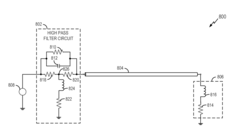
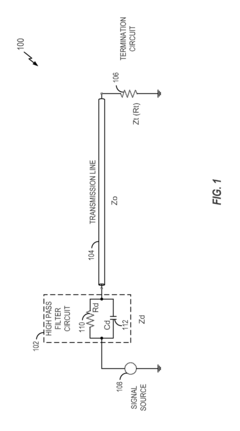
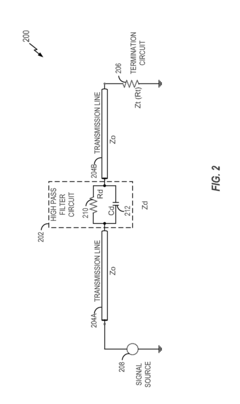
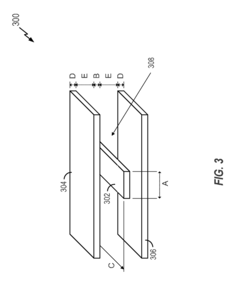
Innovation
- A passive compensation scheme using a signal interconnect with a high pass filter circuit comprising a resistive and capacitive circuit in parallel, where the resistance and capacitance are selected based on the frequency-dependent wire resistance and bit period to compensate for low pass effects and maximize the eye diagram quality.
Noise Reduction Standards and Regulations
Noise reduction standards and regulations play a crucial role in the development and implementation of high pass filter techniques for acoustic environment sensing. These standards establish the minimum requirements for noise control and mitigation, ensuring that acoustic sensing systems operate within acceptable limits and provide accurate data.
International organizations, such as the International Organization for Standardization (ISO) and the International Electrotechnical Commission (IEC), have developed comprehensive standards for noise measurement and control. ISO 1996-1:2016 and ISO 1996-2:2017 provide guidelines for the description, measurement, and assessment of environmental noise. These standards are particularly relevant to acoustic environment sensing applications, as they define methods for quantifying and characterizing noise levels in various settings.
In the context of high pass filter techniques, the IEC 61672-1:2013 standard is particularly significant. This standard specifies performance requirements for sound level meters, including frequency weighting and time weighting characteristics. High pass filters used in acoustic sensing systems must comply with these specifications to ensure accurate noise measurements across different frequency ranges.
National regulatory bodies also play a vital role in establishing noise reduction standards. In the United States, the Occupational Safety and Health Administration (OSHA) sets permissible noise exposure limits in workplace environments. These regulations directly impact the design and implementation of acoustic sensing systems, as they must be capable of detecting and monitoring noise levels within the specified limits.
The European Union's Environmental Noise Directive (2002/49/EC) mandates the assessment and management of environmental noise. This directive has led to the development of noise mapping techniques and action plans for noise reduction, which rely heavily on accurate acoustic sensing technologies. High pass filter techniques must be designed to meet the requirements set forth in this directive, ensuring compatibility with noise mapping and monitoring systems across EU member states.
In the automotive industry, the UN/ECE Regulation No. 51 specifies noise emission standards for vehicles. This regulation has implications for acoustic environment sensing in urban areas and along transportation corridors. High pass filter techniques used in these applications must be capable of isolating and analyzing vehicle noise within the specified frequency ranges and sound pressure levels.
As emerging technologies such as smart cities and Internet of Things (IoT) devices incorporate acoustic sensing capabilities, new standards and regulations are being developed to address the unique challenges posed by these applications. For instance, the IEEE P2413 standard for an architectural framework for the IoT includes considerations for acoustic sensors and their data processing requirements.
International organizations, such as the International Organization for Standardization (ISO) and the International Electrotechnical Commission (IEC), have developed comprehensive standards for noise measurement and control. ISO 1996-1:2016 and ISO 1996-2:2017 provide guidelines for the description, measurement, and assessment of environmental noise. These standards are particularly relevant to acoustic environment sensing applications, as they define methods for quantifying and characterizing noise levels in various settings.
In the context of high pass filter techniques, the IEC 61672-1:2013 standard is particularly significant. This standard specifies performance requirements for sound level meters, including frequency weighting and time weighting characteristics. High pass filters used in acoustic sensing systems must comply with these specifications to ensure accurate noise measurements across different frequency ranges.
National regulatory bodies also play a vital role in establishing noise reduction standards. In the United States, the Occupational Safety and Health Administration (OSHA) sets permissible noise exposure limits in workplace environments. These regulations directly impact the design and implementation of acoustic sensing systems, as they must be capable of detecting and monitoring noise levels within the specified limits.
The European Union's Environmental Noise Directive (2002/49/EC) mandates the assessment and management of environmental noise. This directive has led to the development of noise mapping techniques and action plans for noise reduction, which rely heavily on accurate acoustic sensing technologies. High pass filter techniques must be designed to meet the requirements set forth in this directive, ensuring compatibility with noise mapping and monitoring systems across EU member states.
In the automotive industry, the UN/ECE Regulation No. 51 specifies noise emission standards for vehicles. This regulation has implications for acoustic environment sensing in urban areas and along transportation corridors. High pass filter techniques used in these applications must be capable of isolating and analyzing vehicle noise within the specified frequency ranges and sound pressure levels.
As emerging technologies such as smart cities and Internet of Things (IoT) devices incorporate acoustic sensing capabilities, new standards and regulations are being developed to address the unique challenges posed by these applications. For instance, the IEEE P2413 standard for an architectural framework for the IoT includes considerations for acoustic sensors and their data processing requirements.
Environmental Impact of Acoustic Sensing Technologies
Acoustic sensing technologies, while offering significant benefits in environmental monitoring and analysis, also pose potential environmental impacts that warrant careful consideration. The deployment of high-pass filter techniques in acoustic environment sensing systems can have both positive and negative effects on the surrounding ecosystem.
One of the primary environmental concerns associated with acoustic sensing technologies is noise pollution. High-pass filters, designed to attenuate low-frequency signals, can help mitigate some of the low-frequency noise generated by sensing equipment. This reduction in low-frequency emissions can be particularly beneficial for marine environments, where many species are sensitive to low-frequency sounds. By minimizing the acoustic footprint of sensing devices, high-pass filter techniques contribute to the preservation of natural soundscapes and reduce disturbances to wildlife.
However, the increased focus on higher frequency ranges may lead to unintended consequences. Some species rely on low-frequency communication, and the widespread use of high-pass filtered acoustic sensors could potentially mask important ecological signals. This alteration of the acoustic environment may impact animal behavior, breeding patterns, and overall ecosystem dynamics.
The physical presence of acoustic sensing equipment in natural habitats is another environmental consideration. While high-pass filter techniques may allow for more compact and energy-efficient devices, the installation and maintenance of these systems can still lead to habitat disruption. Careful placement and minimally invasive deployment methods are essential to reduce the physical impact on sensitive ecosystems.
Energy consumption is a critical factor in the environmental impact of acoustic sensing technologies. High-pass filter techniques can contribute to improved energy efficiency by focusing processing power on relevant frequency ranges. This optimization may lead to reduced power requirements, potentially allowing for smaller batteries or solar panels, thus minimizing the overall environmental footprint of sensing stations.
The materials used in acoustic sensing devices also play a role in their environmental impact. As high-pass filter techniques evolve, there may be opportunities to develop more eco-friendly components and manufacturing processes. The use of biodegradable materials or recyclable electronics could significantly reduce the long-term environmental impact of these technologies.
Data collection and transmission associated with acoustic sensing can have indirect environmental effects. While high-pass filtering may reduce the volume of data transmitted, the infrastructure required for data processing and storage still has an environmental cost. Cloud computing centers and network systems supporting these technologies contribute to energy consumption and carbon emissions.
In conclusion, the environmental impact of acoustic sensing technologies incorporating high-pass filter techniques is multifaceted. While these techniques offer potential benefits in terms of noise reduction and energy efficiency, careful consideration must be given to their broader ecological effects. Ongoing research and development should focus on optimizing these technologies to minimize negative environmental impacts while maximizing their potential for environmental monitoring and conservation efforts.
One of the primary environmental concerns associated with acoustic sensing technologies is noise pollution. High-pass filters, designed to attenuate low-frequency signals, can help mitigate some of the low-frequency noise generated by sensing equipment. This reduction in low-frequency emissions can be particularly beneficial for marine environments, where many species are sensitive to low-frequency sounds. By minimizing the acoustic footprint of sensing devices, high-pass filter techniques contribute to the preservation of natural soundscapes and reduce disturbances to wildlife.
However, the increased focus on higher frequency ranges may lead to unintended consequences. Some species rely on low-frequency communication, and the widespread use of high-pass filtered acoustic sensors could potentially mask important ecological signals. This alteration of the acoustic environment may impact animal behavior, breeding patterns, and overall ecosystem dynamics.
The physical presence of acoustic sensing equipment in natural habitats is another environmental consideration. While high-pass filter techniques may allow for more compact and energy-efficient devices, the installation and maintenance of these systems can still lead to habitat disruption. Careful placement and minimally invasive deployment methods are essential to reduce the physical impact on sensitive ecosystems.
Energy consumption is a critical factor in the environmental impact of acoustic sensing technologies. High-pass filter techniques can contribute to improved energy efficiency by focusing processing power on relevant frequency ranges. This optimization may lead to reduced power requirements, potentially allowing for smaller batteries or solar panels, thus minimizing the overall environmental footprint of sensing stations.
The materials used in acoustic sensing devices also play a role in their environmental impact. As high-pass filter techniques evolve, there may be opportunities to develop more eco-friendly components and manufacturing processes. The use of biodegradable materials or recyclable electronics could significantly reduce the long-term environmental impact of these technologies.
Data collection and transmission associated with acoustic sensing can have indirect environmental effects. While high-pass filtering may reduce the volume of data transmitted, the infrastructure required for data processing and storage still has an environmental cost. Cloud computing centers and network systems supporting these technologies contribute to energy consumption and carbon emissions.
In conclusion, the environmental impact of acoustic sensing technologies incorporating high-pass filter techniques is multifaceted. While these techniques offer potential benefits in terms of noise reduction and energy efficiency, careful consideration must be given to their broader ecological effects. Ongoing research and development should focus on optimizing these technologies to minimize negative environmental impacts while maximizing their potential for environmental monitoring and conservation efforts.
Unlock deeper insights with PatSnap Eureka Quick Research — get a full tech report to explore trends and direct your research. Try now!
Generate Your Research Report Instantly with AI Agent
Supercharge your innovation with PatSnap Eureka AI Agent Platform!