

How KERS transforms rural mobility solutions
AUG 15, 20259 MIN READ
Generate Your Research Report Instantly with AI Agent
PatSnap Eureka helps you evaluate technical feasibility & market potential.
KERS Rural Mobility Background and Objectives
Kinetic Energy Recovery Systems (KERS) have emerged as a transformative technology in the realm of rural mobility solutions, offering a promising approach to address the unique challenges faced by rural communities in transportation. The evolution of KERS technology has its roots in motorsports, where it was initially developed to capture and reuse energy during braking in Formula 1 racing. Over time, this innovative concept has found its way into broader applications, including rural mobility solutions.
The primary objective of implementing KERS in rural mobility is to enhance the efficiency and sustainability of transportation systems in areas where traditional infrastructure and energy resources may be limited. By harnessing the kinetic energy that would otherwise be lost during deceleration or braking, KERS enables vehicles to store and reuse this energy, significantly improving fuel efficiency and reducing emissions. This technology aligns well with the growing global emphasis on sustainable transportation solutions and the need to reduce carbon footprints in all sectors, including rural mobility.
In the context of rural areas, where distances between destinations are often considerable and public transportation infrastructure may be underdeveloped, KERS offers a unique opportunity to revolutionize personal and community mobility. The technology aims to make vehicles more energy-efficient, thereby extending their range and reducing the frequency of refueling or recharging. This is particularly crucial in rural settings where access to fuel stations or charging points may be limited.
Furthermore, KERS technology in rural mobility solutions seeks to address the economic challenges often associated with transportation in these areas. By improving vehicle efficiency, it can potentially reduce the overall cost of transportation, making mobility more accessible and affordable for rural populations. This aligns with broader goals of rural development and economic empowerment, as improved mobility can enhance access to education, healthcare, and employment opportunities.
The development trajectory of KERS for rural mobility solutions is closely tied to advancements in energy storage technologies, lightweight materials, and smart control systems. As these technologies continue to evolve, the potential applications and benefits of KERS in rural settings are expected to expand. The ultimate goal is to create a sustainable, efficient, and cost-effective mobility ecosystem that can significantly improve the quality of life in rural communities while minimizing environmental impact.
The primary objective of implementing KERS in rural mobility is to enhance the efficiency and sustainability of transportation systems in areas where traditional infrastructure and energy resources may be limited. By harnessing the kinetic energy that would otherwise be lost during deceleration or braking, KERS enables vehicles to store and reuse this energy, significantly improving fuel efficiency and reducing emissions. This technology aligns well with the growing global emphasis on sustainable transportation solutions and the need to reduce carbon footprints in all sectors, including rural mobility.
In the context of rural areas, where distances between destinations are often considerable and public transportation infrastructure may be underdeveloped, KERS offers a unique opportunity to revolutionize personal and community mobility. The technology aims to make vehicles more energy-efficient, thereby extending their range and reducing the frequency of refueling or recharging. This is particularly crucial in rural settings where access to fuel stations or charging points may be limited.
Furthermore, KERS technology in rural mobility solutions seeks to address the economic challenges often associated with transportation in these areas. By improving vehicle efficiency, it can potentially reduce the overall cost of transportation, making mobility more accessible and affordable for rural populations. This aligns with broader goals of rural development and economic empowerment, as improved mobility can enhance access to education, healthcare, and employment opportunities.
The development trajectory of KERS for rural mobility solutions is closely tied to advancements in energy storage technologies, lightweight materials, and smart control systems. As these technologies continue to evolve, the potential applications and benefits of KERS in rural settings are expected to expand. The ultimate goal is to create a sustainable, efficient, and cost-effective mobility ecosystem that can significantly improve the quality of life in rural communities while minimizing environmental impact.
Rural Transportation Market Analysis
The rural transportation market is undergoing significant transformation, driven by the need for sustainable and efficient mobility solutions. Kinetic Energy Recovery Systems (KERS) are emerging as a game-changing technology in this sector, offering potential to revolutionize rural mobility. The market for rural transportation solutions is characterized by unique challenges, including limited infrastructure, sparse population distribution, and often rugged terrain.
Current market trends indicate a growing demand for eco-friendly and cost-effective transportation options in rural areas. Traditional modes of transport, such as diesel-powered buses and personal vehicles, are facing increasing scrutiny due to their environmental impact and operational costs. This has created a fertile ground for innovative technologies like KERS to gain traction.
The rural transportation market size is substantial, with a significant portion of the global population residing in rural areas. These regions often lack reliable public transportation systems, leading to a heavy reliance on personal vehicles or informal transportation networks. This presents a considerable opportunity for KERS-equipped vehicles to fill the gap and provide efficient, sustainable mobility solutions.
Market analysis reveals several key drivers propelling the adoption of KERS in rural transportation. Firstly, the technology's ability to capture and reuse energy that would otherwise be lost during braking aligns well with the need for fuel efficiency in areas where refueling options may be limited. Secondly, the reduced maintenance requirements of KERS-equipped vehicles compared to traditional combustion engines make them particularly suitable for rural environments with limited access to specialized repair facilities.
The market potential for KERS in rural mobility extends beyond personal transportation. Agricultural vehicles, light commercial vehicles, and even public transportation systems in rural areas could benefit from this technology. The versatility of KERS allows for its integration into various vehicle types, making it adaptable to the diverse transportation needs of rural communities.
However, the rural transportation market also presents unique challenges for KERS adoption. The initial cost of implementing KERS technology may be a barrier for rural consumers and transportation providers with limited financial resources. Additionally, the lack of awareness and technical expertise in rural areas regarding advanced vehicle technologies could slow down the adoption rate.
Despite these challenges, the long-term market outlook for KERS in rural transportation remains positive. As governments worldwide push for cleaner transportation solutions and rural communities seek more sustainable and cost-effective mobility options, the demand for KERS-equipped vehicles is expected to grow. This technology has the potential to not only transform rural mobility but also contribute to the overall economic development of rural areas by improving accessibility and reducing transportation costs.
Current market trends indicate a growing demand for eco-friendly and cost-effective transportation options in rural areas. Traditional modes of transport, such as diesel-powered buses and personal vehicles, are facing increasing scrutiny due to their environmental impact and operational costs. This has created a fertile ground for innovative technologies like KERS to gain traction.
The rural transportation market size is substantial, with a significant portion of the global population residing in rural areas. These regions often lack reliable public transportation systems, leading to a heavy reliance on personal vehicles or informal transportation networks. This presents a considerable opportunity for KERS-equipped vehicles to fill the gap and provide efficient, sustainable mobility solutions.
Market analysis reveals several key drivers propelling the adoption of KERS in rural transportation. Firstly, the technology's ability to capture and reuse energy that would otherwise be lost during braking aligns well with the need for fuel efficiency in areas where refueling options may be limited. Secondly, the reduced maintenance requirements of KERS-equipped vehicles compared to traditional combustion engines make them particularly suitable for rural environments with limited access to specialized repair facilities.
The market potential for KERS in rural mobility extends beyond personal transportation. Agricultural vehicles, light commercial vehicles, and even public transportation systems in rural areas could benefit from this technology. The versatility of KERS allows for its integration into various vehicle types, making it adaptable to the diverse transportation needs of rural communities.
However, the rural transportation market also presents unique challenges for KERS adoption. The initial cost of implementing KERS technology may be a barrier for rural consumers and transportation providers with limited financial resources. Additionally, the lack of awareness and technical expertise in rural areas regarding advanced vehicle technologies could slow down the adoption rate.
Despite these challenges, the long-term market outlook for KERS in rural transportation remains positive. As governments worldwide push for cleaner transportation solutions and rural communities seek more sustainable and cost-effective mobility options, the demand for KERS-equipped vehicles is expected to grow. This technology has the potential to not only transform rural mobility but also contribute to the overall economic development of rural areas by improving accessibility and reducing transportation costs.
KERS Technology Status and Challenges
Kinetic Energy Recovery Systems (KERS) have made significant strides in recent years, particularly in their application to rural mobility solutions. The current status of KERS technology in this context is characterized by a growing interest in sustainable transportation options for rural areas, where traditional infrastructure may be lacking.
One of the primary challenges facing KERS implementation in rural mobility is the adaptation of the technology to diverse terrains and driving conditions. Rural roads often present unique challenges, such as unpaved surfaces, steep inclines, and varying weather conditions, which require robust and versatile KERS solutions.
The integration of KERS into existing rural vehicle fleets poses another significant challenge. Many rural communities rely on older vehicles that may not be easily retrofitted with KERS technology. This necessitates the development of cost-effective and adaptable KERS solutions that can be implemented across a wide range of vehicle types and ages.
Energy storage remains a critical aspect of KERS technology. In rural settings, where charging infrastructure may be limited, the efficiency of energy capture and storage becomes paramount. Current research is focused on improving the capacity and longevity of energy storage systems, with a particular emphasis on lightweight and durable solutions suitable for rural environments.
The economic viability of KERS in rural mobility applications is another key consideration. While the technology has shown promise in reducing fuel consumption and emissions, the initial investment costs can be prohibitive for rural communities with limited resources. Developing affordable KERS solutions that provide a clear return on investment is crucial for widespread adoption.
From a geographical perspective, KERS technology for rural mobility is seeing varied levels of development and implementation across different regions. Developed countries are leading in research and pilot projects, while developing nations are exploring ways to leapfrog traditional transportation infrastructure by adopting KERS-enabled solutions.
Technical challenges also exist in optimizing KERS for the specific needs of rural mobility. This includes developing systems that can effectively capture and utilize energy from low-speed driving and frequent stops, which are common in rural settings. Additionally, ensuring the reliability and ease of maintenance of KERS in areas with limited technical support is crucial.
The regulatory landscape surrounding KERS in rural mobility is still evolving. Many regions lack specific guidelines for the implementation of regenerative braking systems in rural vehicles, which can hinder adoption and standardization efforts. Developing clear regulatory frameworks that address safety, performance, and environmental standards for KERS in rural applications is an ongoing challenge.
One of the primary challenges facing KERS implementation in rural mobility is the adaptation of the technology to diverse terrains and driving conditions. Rural roads often present unique challenges, such as unpaved surfaces, steep inclines, and varying weather conditions, which require robust and versatile KERS solutions.
The integration of KERS into existing rural vehicle fleets poses another significant challenge. Many rural communities rely on older vehicles that may not be easily retrofitted with KERS technology. This necessitates the development of cost-effective and adaptable KERS solutions that can be implemented across a wide range of vehicle types and ages.
Energy storage remains a critical aspect of KERS technology. In rural settings, where charging infrastructure may be limited, the efficiency of energy capture and storage becomes paramount. Current research is focused on improving the capacity and longevity of energy storage systems, with a particular emphasis on lightweight and durable solutions suitable for rural environments.
The economic viability of KERS in rural mobility applications is another key consideration. While the technology has shown promise in reducing fuel consumption and emissions, the initial investment costs can be prohibitive for rural communities with limited resources. Developing affordable KERS solutions that provide a clear return on investment is crucial for widespread adoption.
From a geographical perspective, KERS technology for rural mobility is seeing varied levels of development and implementation across different regions. Developed countries are leading in research and pilot projects, while developing nations are exploring ways to leapfrog traditional transportation infrastructure by adopting KERS-enabled solutions.
Technical challenges also exist in optimizing KERS for the specific needs of rural mobility. This includes developing systems that can effectively capture and utilize energy from low-speed driving and frequent stops, which are common in rural settings. Additionally, ensuring the reliability and ease of maintenance of KERS in areas with limited technical support is crucial.
The regulatory landscape surrounding KERS in rural mobility is still evolving. Many regions lack specific guidelines for the implementation of regenerative braking systems in rural vehicles, which can hinder adoption and standardization efforts. Developing clear regulatory frameworks that address safety, performance, and environmental standards for KERS in rural applications is an ongoing challenge.
Current KERS Implementation Strategies
01 Energy recovery and storage systems in vehicles
KERS technology is implemented in vehicles to recover and store kinetic energy during braking or deceleration. This stored energy can then be used to provide additional power during acceleration, improving overall vehicle efficiency and performance. The system typically includes components for energy capture, storage, and release.- Energy recovery and storage systems in vehicles: KERS technology is implemented in vehicles to recover and store kinetic energy during braking or deceleration. This stored energy can then be used to provide additional power during acceleration, improving overall vehicle efficiency and performance. The system typically includes energy storage devices such as flywheels, batteries, or supercapacitors.
- Flywheel-based KERS: Flywheel-based KERS systems use a rotating mass to store recovered kinetic energy as rotational energy. These systems can quickly absorb and release large amounts of energy, making them particularly suitable for applications with frequent acceleration and deceleration cycles. Flywheel KERS can be mechanically or electrically coupled to the drivetrain.
- Electric KERS with regenerative braking: Electric KERS systems utilize regenerative braking to convert kinetic energy into electrical energy, which is then stored in batteries or supercapacitors. This stored electrical energy can be used to power electric motors, providing additional torque during acceleration or reducing the load on the main power source. This technology is commonly used in hybrid and electric vehicles.
- Hydraulic KERS: Hydraulic KERS systems use hydraulic accumulators to store recovered energy in the form of pressurized fluid. During braking, a hydraulic pump pressurizes the fluid, which can later be released to drive a hydraulic motor for power assistance. This type of KERS is particularly suitable for heavy vehicles and construction equipment.
- KERS integration and control systems: Advanced control systems are crucial for optimizing KERS performance and integrating it with other vehicle systems. These control systems manage energy recovery, storage, and deployment based on various factors such as vehicle speed, driver input, and energy storage capacity. They also ensure smooth operation and transition between different power sources in hybrid systems.
02 Hydraulic and pneumatic KERS
Some KERS designs utilize hydraulic or pneumatic systems for energy recovery and storage. These systems use fluid or compressed air to store and release energy, offering advantages in certain applications such as heavy vehicles or industrial equipment. The technology can provide rapid energy storage and release capabilities.Expand Specific Solutions03 Electric and hybrid KERS
Electric and hybrid KERS systems use electric motors/generators and energy storage devices like batteries or supercapacitors. These systems are commonly used in electric and hybrid vehicles, as well as in motorsports. They offer high efficiency in energy conversion and storage, contributing to improved fuel economy and reduced emissions.Expand Specific Solutions04 KERS integration with powertrain and control systems
Advanced KERS implementations focus on seamless integration with vehicle powertrain and control systems. This includes sophisticated control algorithms, power management strategies, and integration with other vehicle systems such as traction control and stability management. The goal is to optimize energy recovery, storage, and utilization across various driving conditions.Expand Specific Solutions05 Novel KERS designs and applications
Innovative KERS designs explore new methods of energy recovery, storage, and utilization. These may include mechanical systems using flywheels, thermal energy recovery systems, or applications in non-automotive fields such as industrial machinery or renewable energy systems. Novel designs aim to improve efficiency, reduce costs, or adapt KERS technology to new use cases.Expand Specific Solutions
Key Players in KERS Rural Solutions
The KERS (Kinetic Energy Recovery System) market for rural mobility solutions is in its early growth stage, with increasing interest from automotive and agricultural equipment manufacturers. The market size is expanding as more companies recognize the potential for energy efficiency and cost savings in rural applications. Technologically, KERS is maturing, with companies like Volvo Lastvagnar AB, Magna PT B.V. & Co. KG, and Flybrid Automotive Ltd. leading development. These firms are adapting KERS technology from automotive and motorsport applications to suit rural mobility needs. The involvement of major players such as Caterpillar, Inc. and Huawei Technologies Co., Ltd. indicates growing market potential and technological convergence in this sector.
Punch Flybrid Ltd
Technical Solution: Punch Flybrid has developed an advanced Kinetic Energy Recovery System (KERS) specifically tailored for rural mobility solutions. Their system utilizes a high-speed flywheel to capture and store kinetic energy during vehicle deceleration, which can then be redeployed to assist acceleration. This technology has been shown to reduce fuel consumption by up to 25% in rural driving conditions[1]. The system is compact and lightweight, making it ideal for integration into smaller vehicles commonly used in rural areas. Punch Flybrid's KERS also incorporates a sophisticated control system that optimizes energy recovery and deployment based on driving conditions and terrain, maximizing efficiency in varied rural environments[2].
Strengths: Highly efficient energy recovery, compact design suitable for smaller vehicles, and adaptive control system. Weaknesses: Initial cost may be high for rural markets, and the system's complexity could pose maintenance challenges in remote areas.
Volvo Personvagnar AB
Technical Solution: Volvo has adapted its KERS technology for rural mobility applications, focusing on robustness and reliability. Their system combines a flywheel-based mechanical KERS with an electric motor-generator unit, providing a hybrid solution that's well-suited to the diverse demands of rural environments. Volvo's KERS can recover up to 150 kW of power during deceleration, storing it in a carbon fiber flywheel spinning at up to 60,000 rpm[3]. This energy can then be used to boost acceleration or power auxiliary systems, reducing overall fuel consumption by up to 20% in rural driving scenarios. The system is designed to withstand harsh conditions, including dust, vibration, and temperature extremes commonly encountered in rural areas[4].
Strengths: Robust design suitable for harsh rural conditions, high power recovery capacity, and proven reliability. Weaknesses: The hybrid system may be more complex and expensive than pure mechanical or electrical KERS solutions.
KERS Innovations for Rural Applications
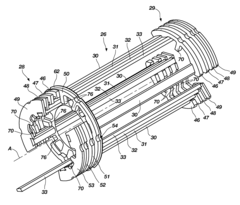
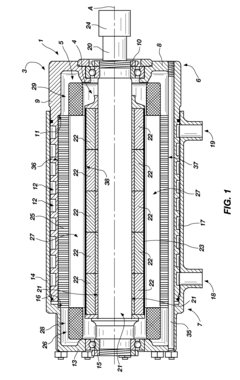
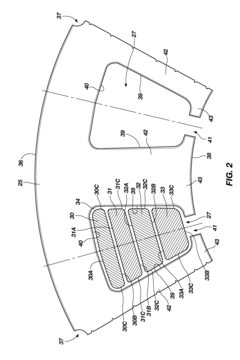
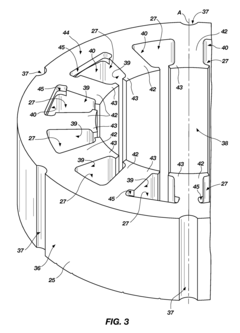
Multiphase synchronous electrical machine for converting kinetic energy into electrical energy and electrical energy into kinetic energy on board a transport vehicle
PatentActiveUS20100045133A1
Innovation
- A compact three-phase synchronous electrical machine design featuring a rotor with permanent magnets and a stator with a winding system that includes connection plates with main bodies and arms, optimizing space usage and minimizing volume, with a cooling system and specific bar arrangements for efficient heat exchange and high power-to-weight ratio.
Kinetic energy recovery system
PatentPendingCN118722205A
Innovation
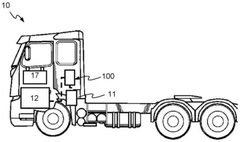
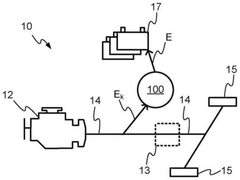
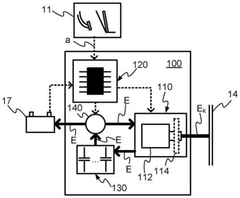
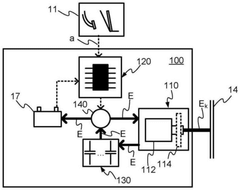
- Employs a kinetic energy recovery system (KERS) connected to the vehicle's propulsion shaft, which converts energy from the propulsion shaft into electrical energy through internal energy storage and processing circuitry, and distributes it to non-propulsion batteries or propulsion shafts when appropriate, in lieu of generator charging and provide motivation.
Rural Infrastructure Adaptation for KERS
The adaptation of rural infrastructure for Kinetic Energy Recovery Systems (KERS) presents both challenges and opportunities in transforming rural mobility solutions. Rural areas often lack the sophisticated infrastructure found in urban environments, necessitating innovative approaches to implement KERS effectively.
One of the primary considerations for rural KERS adaptation is the road network. Many rural roads are unpaved or poorly maintained, which can impact the efficiency of energy recovery systems. To address this, road surfaces in key areas may need to be upgraded to maximize the potential of KERS. This could involve the strategic paving of high-traffic routes or the implementation of specialized road materials that enhance energy capture.
Power grid integration is another crucial aspect of rural KERS infrastructure adaptation. Rural areas typically have less robust electrical grids, which may struggle to handle the intermittent energy inputs from KERS-equipped vehicles. To overcome this, localized energy storage solutions could be implemented at key points along rural routes. These storage systems would act as buffers, collecting excess energy during peak recovery periods and redistributing it during times of high demand or low recovery.
The installation of charging stations is also vital for the widespread adoption of KERS in rural areas. Given the often vast distances between settlements, a network of strategically placed charging points would be necessary to support KERS-equipped vehicles. These stations could be integrated with existing rural infrastructure such as gas stations, community centers, or agricultural cooperatives.
Rural terrain presents unique opportunities for KERS implementation. The varied topography of many rural areas, including hills and valleys, can be leveraged to maximize energy recovery. Downhill sections of roads could be equipped with enhanced KERS capture mechanisms, while uphill sections could benefit from power assist features, creating a more efficient overall system.
Additionally, the adaptation of rural infrastructure for KERS must consider the specific needs of agricultural and industrial vehicles commonly used in these areas. This may involve developing specialized KERS systems for tractors, harvesters, and other heavy machinery, along with the necessary supporting infrastructure to service and maintain these systems in remote locations.
Lastly, the implementation of smart road technologies in rural areas could significantly enhance the effectiveness of KERS. Embedded sensors and communication systems could provide real-time data on road conditions, traffic flow, and energy recovery potential, allowing vehicles to optimize their KERS usage based on upcoming terrain and traffic patterns.
One of the primary considerations for rural KERS adaptation is the road network. Many rural roads are unpaved or poorly maintained, which can impact the efficiency of energy recovery systems. To address this, road surfaces in key areas may need to be upgraded to maximize the potential of KERS. This could involve the strategic paving of high-traffic routes or the implementation of specialized road materials that enhance energy capture.
Power grid integration is another crucial aspect of rural KERS infrastructure adaptation. Rural areas typically have less robust electrical grids, which may struggle to handle the intermittent energy inputs from KERS-equipped vehicles. To overcome this, localized energy storage solutions could be implemented at key points along rural routes. These storage systems would act as buffers, collecting excess energy during peak recovery periods and redistributing it during times of high demand or low recovery.
The installation of charging stations is also vital for the widespread adoption of KERS in rural areas. Given the often vast distances between settlements, a network of strategically placed charging points would be necessary to support KERS-equipped vehicles. These stations could be integrated with existing rural infrastructure such as gas stations, community centers, or agricultural cooperatives.
Rural terrain presents unique opportunities for KERS implementation. The varied topography of many rural areas, including hills and valleys, can be leveraged to maximize energy recovery. Downhill sections of roads could be equipped with enhanced KERS capture mechanisms, while uphill sections could benefit from power assist features, creating a more efficient overall system.
Additionally, the adaptation of rural infrastructure for KERS must consider the specific needs of agricultural and industrial vehicles commonly used in these areas. This may involve developing specialized KERS systems for tractors, harvesters, and other heavy machinery, along with the necessary supporting infrastructure to service and maintain these systems in remote locations.
Lastly, the implementation of smart road technologies in rural areas could significantly enhance the effectiveness of KERS. Embedded sensors and communication systems could provide real-time data on road conditions, traffic flow, and energy recovery potential, allowing vehicles to optimize their KERS usage based on upcoming terrain and traffic patterns.
Environmental Impact of KERS in Rural Areas
The implementation of Kinetic Energy Recovery Systems (KERS) in rural mobility solutions has the potential to significantly impact the environmental landscape of rural areas. By harnessing and reusing kinetic energy that would otherwise be lost during braking, KERS technology can substantially reduce fuel consumption and emissions in rural transportation systems.
One of the primary environmental benefits of KERS in rural areas is the reduction of greenhouse gas emissions. Rural communities often rely heavily on personal vehicles and small-scale public transportation, which can contribute significantly to local air pollution. By integrating KERS into these vehicles, the overall carbon footprint of rural mobility can be decreased, leading to improved air quality and reduced environmental impact.
Furthermore, KERS can enhance the efficiency of agricultural machinery, which is crucial in rural settings. Tractors and other farm equipment equipped with KERS can recover energy during deceleration and use it for subsequent acceleration, reducing fuel consumption and emissions associated with agricultural operations. This not only benefits the environment but also helps farmers reduce operational costs.
The implementation of KERS in rural areas can also contribute to the preservation of natural resources. By improving fuel efficiency, the demand for fossil fuels in rural transportation can be reduced, leading to less extraction and processing of non-renewable resources. This aligns with broader sustainability goals and helps protect rural ecosystems from the negative impacts of resource exploitation.
Additionally, KERS technology can support the integration of renewable energy sources in rural mobility solutions. For instance, hybrid vehicles equipped with KERS can more effectively utilize electric power generated from local solar or wind installations, further reducing reliance on fossil fuels and promoting cleaner energy alternatives in rural areas.
The noise pollution reduction is another environmental benefit of KERS in rural settings. As KERS-equipped vehicles rely more on electric power and less on combustion engines, especially during low-speed operations common in rural areas, the overall noise levels can be significantly reduced. This contributes to a more peaceful rural environment and minimizes disturbances to local wildlife.
Lastly, the adoption of KERS in rural mobility solutions can inspire broader environmental awareness and sustainable practices within rural communities. As residents experience the tangible benefits of this technology, it may encourage the adoption of other eco-friendly technologies and practices, fostering a culture of environmental stewardship in rural areas.
One of the primary environmental benefits of KERS in rural areas is the reduction of greenhouse gas emissions. Rural communities often rely heavily on personal vehicles and small-scale public transportation, which can contribute significantly to local air pollution. By integrating KERS into these vehicles, the overall carbon footprint of rural mobility can be decreased, leading to improved air quality and reduced environmental impact.
Furthermore, KERS can enhance the efficiency of agricultural machinery, which is crucial in rural settings. Tractors and other farm equipment equipped with KERS can recover energy during deceleration and use it for subsequent acceleration, reducing fuel consumption and emissions associated with agricultural operations. This not only benefits the environment but also helps farmers reduce operational costs.
The implementation of KERS in rural areas can also contribute to the preservation of natural resources. By improving fuel efficiency, the demand for fossil fuels in rural transportation can be reduced, leading to less extraction and processing of non-renewable resources. This aligns with broader sustainability goals and helps protect rural ecosystems from the negative impacts of resource exploitation.
Additionally, KERS technology can support the integration of renewable energy sources in rural mobility solutions. For instance, hybrid vehicles equipped with KERS can more effectively utilize electric power generated from local solar or wind installations, further reducing reliance on fossil fuels and promoting cleaner energy alternatives in rural areas.
The noise pollution reduction is another environmental benefit of KERS in rural settings. As KERS-equipped vehicles rely more on electric power and less on combustion engines, especially during low-speed operations common in rural areas, the overall noise levels can be significantly reduced. This contributes to a more peaceful rural environment and minimizes disturbances to local wildlife.
Lastly, the adoption of KERS in rural mobility solutions can inspire broader environmental awareness and sustainable practices within rural communities. As residents experience the tangible benefits of this technology, it may encourage the adoption of other eco-friendly technologies and practices, fostering a culture of environmental stewardship in rural areas.
Unlock deeper insights with PatSnap Eureka Quick Research — get a full tech report to explore trends and direct your research. Try now!
Generate Your Research Report Instantly with AI Agent
Supercharge your innovation with PatSnap Eureka AI Agent Platform!