

How Nitrification Drives Nitrous Oxide Emissions?
SEP 10, 20259 MIN READ
Generate Your Research Report Instantly with AI Agent
PatSnap Eureka helps you evaluate technical feasibility & market potential.
Nitrification Process and N2O Emission Objectives
Nitrification represents a critical biogeochemical process within the global nitrogen cycle, serving as a significant pathway for the production of nitrous oxide (N2O), a potent greenhouse gas with approximately 300 times the warming potential of carbon dioxide. The evolution of our understanding of this process has progressed from basic recognition of nitrogen transformation to detailed molecular mechanisms that elucidate how nitrification contributes to atmospheric N2O emissions.
The nitrification process fundamentally involves the oxidation of ammonia (NH3) to nitrite (NO2-) and subsequently to nitrate (NO3-), primarily facilitated by two distinct groups of microorganisms: ammonia-oxidizing bacteria (AOB) or ammonia-oxidizing archaea (AOA) for the first step, and nitrite-oxidizing bacteria (NOB) for the second step. During these oxidation processes, N2O can be produced as a by-product through several pathways, including hydroxylamine oxidation and nitrite reduction.
Recent technological advancements have enabled more precise quantification and characterization of N2O emissions from nitrification processes across various ecosystems. Stable isotope techniques, molecular biology tools, and advanced analytical methods have collectively enhanced our ability to distinguish between different N2O production pathways and their relative contributions to total emissions.
The primary objective of current research in this field is to develop comprehensive models that accurately predict N2O emissions from nitrification under varying environmental conditions. This includes understanding how factors such as oxygen availability, pH, temperature, and substrate concentration influence the rate and pathways of N2O production during nitrification.
Another crucial goal is to identify effective mitigation strategies that can reduce N2O emissions without compromising agricultural productivity or ecosystem functions. This involves exploring nitrification inhibitors, optimizing fertilizer application methods, and developing novel microbial management approaches that minimize N2O production while maintaining efficient nitrogen cycling.
The integration of nitrification-related N2O emissions into global climate models represents another significant objective, requiring accurate quantification of emission factors across different ecosystems and management practices. This integration is essential for developing realistic climate change projections and effective mitigation policies.
Technological innovation aims to develop real-time monitoring systems for N2O emissions from nitrification processes, enabling adaptive management strategies that respond to changing environmental conditions. These systems would provide valuable data for refining emission models and validating mitigation approaches across diverse ecological contexts.
The nitrification process fundamentally involves the oxidation of ammonia (NH3) to nitrite (NO2-) and subsequently to nitrate (NO3-), primarily facilitated by two distinct groups of microorganisms: ammonia-oxidizing bacteria (AOB) or ammonia-oxidizing archaea (AOA) for the first step, and nitrite-oxidizing bacteria (NOB) for the second step. During these oxidation processes, N2O can be produced as a by-product through several pathways, including hydroxylamine oxidation and nitrite reduction.
Recent technological advancements have enabled more precise quantification and characterization of N2O emissions from nitrification processes across various ecosystems. Stable isotope techniques, molecular biology tools, and advanced analytical methods have collectively enhanced our ability to distinguish between different N2O production pathways and their relative contributions to total emissions.
The primary objective of current research in this field is to develop comprehensive models that accurately predict N2O emissions from nitrification under varying environmental conditions. This includes understanding how factors such as oxygen availability, pH, temperature, and substrate concentration influence the rate and pathways of N2O production during nitrification.
Another crucial goal is to identify effective mitigation strategies that can reduce N2O emissions without compromising agricultural productivity or ecosystem functions. This involves exploring nitrification inhibitors, optimizing fertilizer application methods, and developing novel microbial management approaches that minimize N2O production while maintaining efficient nitrogen cycling.
The integration of nitrification-related N2O emissions into global climate models represents another significant objective, requiring accurate quantification of emission factors across different ecosystems and management practices. This integration is essential for developing realistic climate change projections and effective mitigation policies.
Technological innovation aims to develop real-time monitoring systems for N2O emissions from nitrification processes, enabling adaptive management strategies that respond to changing environmental conditions. These systems would provide valuable data for refining emission models and validating mitigation approaches across diverse ecological contexts.
Market Analysis of N2O Emission Reduction Technologies
The global market for nitrous oxide (N2O) emission reduction technologies is experiencing significant growth, driven by increasing environmental regulations and corporate sustainability commitments. Currently valued at approximately $2.3 billion, this market is projected to reach $3.8 billion by 2028, representing a compound annual growth rate of 8.7%. This growth trajectory is primarily fueled by the agricultural sector, which accounts for nearly 70% of anthropogenic N2O emissions worldwide.
Agricultural demand for N2O reduction technologies is particularly strong in regions with intensive farming practices, including North America, Western Europe, and increasingly in China and India. The implementation of precision agriculture techniques and enhanced efficiency fertilizers has created a substantial market segment estimated at $1.1 billion in 2023.
Industrial applications represent another significant market segment, particularly in chemical production, wastewater treatment, and energy generation. These sectors collectively contribute about 25% of global N2O emissions and are increasingly subject to stringent regulatory controls, especially in developed economies. The industrial segment of N2O reduction technologies is valued at approximately $850 million and growing at 7.5% annually.
Regional market analysis reveals that Europe leads in adoption of N2O reduction technologies, accounting for 38% of the global market share. This dominance is largely attributed to the EU's ambitious climate policies, including the European Green Deal and specific nitrogen management directives. North America follows with 29% market share, while Asia-Pacific represents the fastest-growing regional market with a 10.2% annual growth rate.
Consumer willingness to pay premiums for low-emission agricultural products is creating additional market incentives. Studies indicate that environmentally conscious consumers are willing to pay 15-20% more for products with verified lower carbon footprints, including those with reduced N2O emissions in their production cycle.
Emerging economies present significant growth opportunities, particularly as they implement more stringent environmental regulations. Brazil, India, and China are expected to see market growth rates exceeding 12% annually through 2028, driven by a combination of regulatory pressure and increasing agricultural intensification.
Market barriers include high initial technology costs, lack of standardized measurement protocols for N2O emissions, and insufficient policy incentives in many regions. The return on investment period for many N2O reduction technologies currently ranges from 3-7 years, which remains a significant adoption hurdle for many potential end-users, particularly small and medium-sized agricultural operations.
Agricultural demand for N2O reduction technologies is particularly strong in regions with intensive farming practices, including North America, Western Europe, and increasingly in China and India. The implementation of precision agriculture techniques and enhanced efficiency fertilizers has created a substantial market segment estimated at $1.1 billion in 2023.
Industrial applications represent another significant market segment, particularly in chemical production, wastewater treatment, and energy generation. These sectors collectively contribute about 25% of global N2O emissions and are increasingly subject to stringent regulatory controls, especially in developed economies. The industrial segment of N2O reduction technologies is valued at approximately $850 million and growing at 7.5% annually.
Regional market analysis reveals that Europe leads in adoption of N2O reduction technologies, accounting for 38% of the global market share. This dominance is largely attributed to the EU's ambitious climate policies, including the European Green Deal and specific nitrogen management directives. North America follows with 29% market share, while Asia-Pacific represents the fastest-growing regional market with a 10.2% annual growth rate.
Consumer willingness to pay premiums for low-emission agricultural products is creating additional market incentives. Studies indicate that environmentally conscious consumers are willing to pay 15-20% more for products with verified lower carbon footprints, including those with reduced N2O emissions in their production cycle.
Emerging economies present significant growth opportunities, particularly as they implement more stringent environmental regulations. Brazil, India, and China are expected to see market growth rates exceeding 12% annually through 2028, driven by a combination of regulatory pressure and increasing agricultural intensification.
Market barriers include high initial technology costs, lack of standardized measurement protocols for N2O emissions, and insufficient policy incentives in many regions. The return on investment period for many N2O reduction technologies currently ranges from 3-7 years, which remains a significant adoption hurdle for many potential end-users, particularly small and medium-sized agricultural operations.
Current Status and Challenges in Nitrification Research
Nitrification research has advanced significantly in recent years, yet several critical challenges remain. The process of nitrification, whereby ammonia is oxidized to nitrite and subsequently to nitrate, is now recognized as a major contributor to nitrous oxide (N2O) emissions. Current research has established that both ammonia-oxidizing bacteria (AOB) and ammonia-oxidizing archaea (AOA) can produce N2O during nitrification, though their relative contributions vary across ecosystems.
The identification of key enzymes involved in nitrification pathways represents a significant breakthrough. Hydroxylamine oxidoreductase (HAO) and nitrite reductase (NIR) have been confirmed as crucial enzymes in N2O production during nitrification. However, the regulatory mechanisms controlling these enzymes under varying environmental conditions remain incompletely understood, presenting a major research challenge.
Methodological limitations continue to constrain progress in nitrification research. While isotopic techniques have improved our ability to trace nitrogen transformations, distinguishing between nitrification-derived and denitrification-derived N2O in complex environmental matrices remains difficult. The development of more sensitive and specific analytical methods is necessary to overcome this challenge.
Geographic disparities in nitrification research present another significant issue. Most comprehensive studies have been conducted in temperate agricultural systems, with tropical, arctic, and marine environments receiving comparatively less attention. This geographic bias limits our understanding of nitrification processes across diverse ecosystems and climate regimes.
The influence of climate change on nitrification dynamics represents an emerging research frontier. Rising temperatures, altered precipitation patterns, and extreme weather events are expected to significantly impact nitrification rates and associated N2O emissions, yet predictive models remain inadequate due to insufficient empirical data across varied environmental conditions.
Microbial community interactions in nitrification processes constitute another complex challenge. Recent research has revealed that nitrifiers operate within intricate microbial networks, where interactions with heterotrophs, plant roots, and other microorganisms can significantly influence nitrification rates and N2O production. Understanding these complex ecological interactions requires advanced molecular techniques and experimental approaches.
The development of effective mitigation strategies for nitrification-derived N2O emissions is hampered by incomplete mechanistic understanding. While nitrification inhibitors show promise in agricultural settings, their efficacy varies widely across soil types, climate conditions, and management practices. More targeted approaches based on fundamental nitrification mechanisms are needed to develop the next generation of mitigation technologies.
The identification of key enzymes involved in nitrification pathways represents a significant breakthrough. Hydroxylamine oxidoreductase (HAO) and nitrite reductase (NIR) have been confirmed as crucial enzymes in N2O production during nitrification. However, the regulatory mechanisms controlling these enzymes under varying environmental conditions remain incompletely understood, presenting a major research challenge.
Methodological limitations continue to constrain progress in nitrification research. While isotopic techniques have improved our ability to trace nitrogen transformations, distinguishing between nitrification-derived and denitrification-derived N2O in complex environmental matrices remains difficult. The development of more sensitive and specific analytical methods is necessary to overcome this challenge.
Geographic disparities in nitrification research present another significant issue. Most comprehensive studies have been conducted in temperate agricultural systems, with tropical, arctic, and marine environments receiving comparatively less attention. This geographic bias limits our understanding of nitrification processes across diverse ecosystems and climate regimes.
The influence of climate change on nitrification dynamics represents an emerging research frontier. Rising temperatures, altered precipitation patterns, and extreme weather events are expected to significantly impact nitrification rates and associated N2O emissions, yet predictive models remain inadequate due to insufficient empirical data across varied environmental conditions.
Microbial community interactions in nitrification processes constitute another complex challenge. Recent research has revealed that nitrifiers operate within intricate microbial networks, where interactions with heterotrophs, plant roots, and other microorganisms can significantly influence nitrification rates and N2O production. Understanding these complex ecological interactions requires advanced molecular techniques and experimental approaches.
The development of effective mitigation strategies for nitrification-derived N2O emissions is hampered by incomplete mechanistic understanding. While nitrification inhibitors show promise in agricultural settings, their efficacy varies widely across soil types, climate conditions, and management practices. More targeted approaches based on fundamental nitrification mechanisms are needed to develop the next generation of mitigation technologies.
Current Mitigation Strategies for N2O Emissions
01 Nitrification inhibitors to reduce N2O emissions
Nitrification inhibitors can be added to agricultural systems to slow the conversion of ammonium to nitrate by inhibiting the activity of nitrifying bacteria. This reduction in nitrification rates directly decreases nitrous oxide emissions from soil. Various compounds such as dicyandiamide (DCD) and 3,4-dimethylpyrazole phosphate (DMPP) have been developed as effective nitrification inhibitors that can be applied with fertilizers to mitigate N2O emissions while maintaining crop productivity.- Nitrification inhibitors to reduce N2O emissions: Nitrification inhibitors can be added to soil or fertilizers to slow down the conversion of ammonium to nitrate by inhibiting the activity of nitrifying bacteria. This reduction in nitrification rates leads to decreased nitrous oxide emissions from agricultural soils. Various compounds such as dicyandiamide (DCD) and 3,4-dimethylpyrazole phosphate (DMPP) have proven effective in reducing N2O emissions while maintaining crop yields.
- Wastewater treatment process optimization: Optimizing wastewater treatment processes can significantly reduce nitrous oxide emissions. This includes controlling dissolved oxygen levels, carbon-to-nitrogen ratios, and hydraulic retention times in biological nutrient removal systems. Advanced monitoring and control strategies help maintain optimal conditions for complete nitrification and denitrification, minimizing the formation of N2O as a byproduct during these processes.
- Microbial community management: Managing the microbial community composition in nitrification systems can help reduce nitrous oxide emissions. This involves promoting the growth of specific bacterial populations that produce less N2O during nitrification and denitrification processes. Strategies include bioaugmentation with specialized microbial consortia, maintaining optimal pH and temperature conditions, and providing selective growth substrates to favor desired microbial populations.
- Controlled-release fertilizer technologies: Controlled-release fertilizer technologies can reduce nitrous oxide emissions by synchronizing nitrogen release with plant uptake requirements. These technologies include polymer-coated fertilizers, nitrification inhibitor-infused products, and formulations with specific dissolution patterns. By providing nitrogen gradually over time, these fertilizers reduce excess nitrate in soil that would otherwise be subject to denitrification and N2O production.
- Monitoring and quantification methods: Advanced monitoring and quantification methods for nitrous oxide emissions from nitrification processes enable better management strategies. These include real-time gas analyzers, isotopic techniques to trace nitrogen transformations, and predictive modeling approaches. Accurate measurement of N2O emissions under different operational conditions allows for process optimization and validation of mitigation strategies in both agricultural and wastewater treatment contexts.
02 Wastewater treatment process optimization
Optimizing wastewater treatment processes can significantly reduce nitrous oxide emissions. This includes controlling dissolved oxygen levels, carbon-to-nitrogen ratios, and hydraulic retention times in biological treatment systems. Advanced process control strategies that monitor and adjust operational parameters in real-time can minimize conditions favorable for N2O production during nitrification and denitrification. Implementation of intermittent aeration or step-feed strategies can create conditions that suppress N2O formation while maintaining treatment efficiency.Expand Specific Solutions03 Microbial community management
Managing the microbial community composition in nitrification systems can help reduce nitrous oxide emissions. This involves selecting and enriching specific bacterial populations that have lower N2O production rates during ammonia oxidation. Bioaugmentation with specialized microbial consortia or creating conditions that favor complete nitrifiers over partial nitrifiers can reduce intermediate accumulation that leads to N2O formation. Maintaining optimal conditions for microbial activity ensures more complete conversion processes with fewer gaseous nitrogen losses.Expand Specific Solutions04 pH and temperature control strategies
Controlling pH and temperature in nitrification processes significantly impacts nitrous oxide emissions. Maintaining pH in the optimal range (7.5-8.5) for nitrifying bacteria reduces stress conditions that trigger N2O production. Similarly, temperature control within the mesophilic range optimizes nitrification efficiency while minimizing N2O formation. Implementation of buffering systems and temperature regulation equipment in treatment facilities helps maintain stable conditions that minimize emissions while maximizing nitrogen removal efficiency.Expand Specific Solutions05 Monitoring and quantification technologies
Advanced monitoring and quantification technologies enable better understanding and control of nitrous oxide emissions from nitrification processes. These include online gas analyzers, microsensors, and isotopic techniques that can detect N2O formation in real-time. Data-driven approaches using machine learning algorithms can predict emission patterns based on operational parameters, allowing for proactive control strategies. Comprehensive monitoring systems help identify emission hotspots and optimize process conditions to minimize the environmental impact of nitrification processes.Expand Specific Solutions
Key Organizations in N2O Emission Research
Nitrous oxide emissions from nitrification represent a critical environmental challenge at the intersection of agriculture, climate science, and industrial processes. The market is in a growth phase, with increasing regulatory pressure driving innovation. Current global market size for nitrification management technologies exceeds $5 billion annually, with projected growth of 7-9% through 2030. Technologically, the field shows moderate maturity with established players like Yara International and BASF leading commercial applications, while research institutions including Beijing University of Technology and Michigan Tech drive fundamental advances. Companies like DuPont and Sumitomo Chemical are developing specialized inhibitors, while AgResearch and KIST focus on biological approaches. The competitive landscape features both agricultural giants and specialized environmental technology firms like CECEP Guozhen, creating a dynamic innovation ecosystem addressing this critical emissions challenge.
Yara International ASA
Technical Solution: Yara International has developed comprehensive nitrification inhibitor technologies to address nitrous oxide emissions in agricultural settings. Their approach focuses on stabilized nitrogen fertilizers that contain compounds like DMPP (3,4-dimethylpyrazole phosphate) and nitrapyrin, which selectively inhibit the activity of ammonia-oxidizing bacteria in soil. These inhibitors target the first step of nitrification by blocking the ammonia monooxygenase enzyme, thereby reducing the conversion of ammonium to nitrite. Yara's research has demonstrated that these inhibitors can reduce N2O emissions by 30-50% in various agricultural systems while maintaining crop yields. Their technology includes precision application methods that optimize inhibitor concentration based on soil conditions, temperature, and moisture levels to maximize effectiveness across different agricultural environments. Yara has also developed monitoring systems that track nitrogen transformation processes in real-time, allowing farmers to adjust application rates based on actual field conditions.
Strengths: Extensive field testing across diverse agricultural systems provides robust validation of effectiveness. Their global distribution network enables widespread implementation of these technologies. Weaknesses: Effectiveness varies with soil conditions and climate, requiring region-specific formulations. Some inhibitors may have limited persistence in soil, necessitating repeated applications.
BASF Corp.
Technical Solution: BASF has pioneered advanced nitrification inhibition technology through their Vizura® and Limus® product lines, specifically designed to reduce nitrous oxide emissions from agricultural soils. Their approach targets the biological oxidation of ammonium to nitrate by Nitrosomonas bacteria, which is a critical step in the nitrification process that leads to N2O production. BASF's formulations contain active compounds like DMPP (3,4-dimethylpyrazole phosphate) that temporarily block the ammonia monooxygenase enzyme in nitrifying bacteria. Research conducted across multiple continents shows these inhibitors can reduce N2O emissions by up to 45% compared to conventional fertilization practices. BASF has also developed specialized coating technologies that allow for controlled release of the inhibitors, extending their effectiveness period in soil from weeks to months depending on environmental conditions. Their latest innovations include combination products that simultaneously address multiple nitrogen loss pathways, targeting both nitrification and urease activity to provide comprehensive nitrogen management solutions for farmers.
Strengths: Extensive global research network allows for rapid adaptation of formulations to different soil types and climatic conditions. Products are compatible with existing farm equipment, requiring minimal changes to current practices. Weaknesses: Higher initial cost compared to conventional fertilizers may limit adoption in developing regions. Performance can be inconsistent under extreme weather conditions or in highly variable soil environments.
Critical Nitrification Pathways and Mechanisms
Method for starting up and controlling a biological process for ammonium removal at low ammonium concentrations and low temperature through the use of a two stage autotrophic nitrogen removal process
PatentActiveEP3255016A1
Innovation
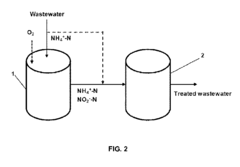
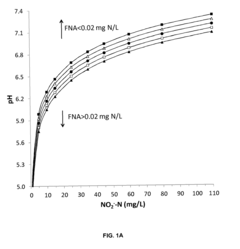
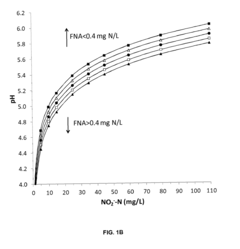
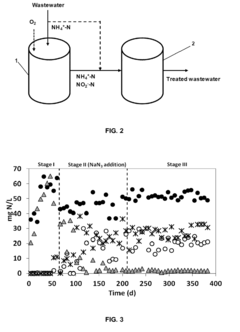
- A two-stage process involving Partial Nitritation and Anammox, where Free Nitrous Acid (FNA) is accumulated to inhibit NOB, and a controlled ammonium to nitrite ratio is maintained to favor Anammox bacteria activity, using separate reactors for each stage to enhance nitrogen removal efficiency.
Recombinant microorganism including genetic modification that increases expression of iron storage protein with heme structure, and method of reducing concentration of nitrogen oxide in sample using the same
PatentPendingUS20240228946A9
Innovation
- A recombinant microorganism with a genetic modification that increases the expression of an iron storage protein (ISP) with a heme structure is used to reduce nitrogen oxide concentrations, facilitating the conversion of NOx to N2 through a dissimilatory reduction process.


Environmental Impact Assessment of N2O Emissions
Nitrous oxide (N2O) emissions resulting from nitrification processes represent a significant environmental concern due to their potent greenhouse effect and ozone-depleting properties. N2O has a global warming potential approximately 298 times greater than carbon dioxide over a 100-year period, making its environmental impact disproportionately large relative to its atmospheric concentration.
Agricultural activities contribute approximately 60-70% of anthropogenic N2O emissions globally, primarily through nitrogen fertilizer application. When excess nitrogen is applied to soils, nitrification processes accelerate, leading to increased N2O production as a byproduct. These emissions have been documented to increase exponentially with nitrogen application rates, creating a non-linear relationship that complicates mitigation efforts.
The environmental consequences of N2O emissions extend beyond climate forcing. In the stratosphere, N2O breaks down to form nitrogen oxides that catalyze ozone depletion, contributing to the thinning of the protective ozone layer. Current estimates suggest that N2O is now the single most important ozone-depleting substance being emitted through human activities, surpassing many regulated chlorofluorocarbons.
Aquatic ecosystems suffer cascading effects from nitrification-driven N2O emissions. Nitrogen runoff from agricultural lands stimulates nitrification in water bodies, leading to eutrophication, harmful algal blooms, and hypoxic "dead zones." These conditions further enhance N2O production in aquatic environments, creating a positive feedback loop that amplifies environmental damage.
Soil health degradation represents another significant impact of intensive nitrification processes. The acidification of soils resulting from nitrification can reduce biodiversity, alter microbial community structures, and diminish ecosystem resilience. These changes can persist for decades, affecting long-term agricultural productivity and ecosystem functioning.
Regional variations in N2O emissions create disproportionate environmental impacts across different geographies. Tropical and subtropical regions with warm, moist conditions often experience higher nitrification rates and subsequent N2O emissions. This geographic disparity raises important environmental justice considerations, as climate impacts may be more severe in regions with lower adaptive capacity.
Mitigation strategies targeting nitrification-driven N2O emissions offer significant co-benefits for other environmental concerns. Precision agriculture techniques that optimize nitrogen application not only reduce N2O emissions but also minimize nitrate leaching into groundwater, improve air quality by reducing ammonia volatilization, and enhance overall nitrogen use efficiency in agricultural systems.
Agricultural activities contribute approximately 60-70% of anthropogenic N2O emissions globally, primarily through nitrogen fertilizer application. When excess nitrogen is applied to soils, nitrification processes accelerate, leading to increased N2O production as a byproduct. These emissions have been documented to increase exponentially with nitrogen application rates, creating a non-linear relationship that complicates mitigation efforts.
The environmental consequences of N2O emissions extend beyond climate forcing. In the stratosphere, N2O breaks down to form nitrogen oxides that catalyze ozone depletion, contributing to the thinning of the protective ozone layer. Current estimates suggest that N2O is now the single most important ozone-depleting substance being emitted through human activities, surpassing many regulated chlorofluorocarbons.
Aquatic ecosystems suffer cascading effects from nitrification-driven N2O emissions. Nitrogen runoff from agricultural lands stimulates nitrification in water bodies, leading to eutrophication, harmful algal blooms, and hypoxic "dead zones." These conditions further enhance N2O production in aquatic environments, creating a positive feedback loop that amplifies environmental damage.
Soil health degradation represents another significant impact of intensive nitrification processes. The acidification of soils resulting from nitrification can reduce biodiversity, alter microbial community structures, and diminish ecosystem resilience. These changes can persist for decades, affecting long-term agricultural productivity and ecosystem functioning.
Regional variations in N2O emissions create disproportionate environmental impacts across different geographies. Tropical and subtropical regions with warm, moist conditions often experience higher nitrification rates and subsequent N2O emissions. This geographic disparity raises important environmental justice considerations, as climate impacts may be more severe in regions with lower adaptive capacity.
Mitigation strategies targeting nitrification-driven N2O emissions offer significant co-benefits for other environmental concerns. Precision agriculture techniques that optimize nitrogen application not only reduce N2O emissions but also minimize nitrate leaching into groundwater, improve air quality by reducing ammonia volatilization, and enhance overall nitrogen use efficiency in agricultural systems.
Policy Framework for Greenhouse Gas Reduction
Addressing nitrous oxide (N2O) emissions requires a comprehensive policy framework that acknowledges the critical role of nitrification processes in agricultural and industrial sectors. Current international agreements, including the Paris Climate Accord and the Kyoto Protocol, have established foundational mechanisms for greenhouse gas reduction, but specific policies targeting N2O emissions from nitrification remain underdeveloped in many jurisdictions.
National-level policies vary significantly in their approach to N2O management. Leading countries such as Denmark, the Netherlands, and New Zealand have implemented agricultural emission reduction targets that specifically address nitrogen management practices. These policies include financial incentives for precision fertilizer application, mandatory reporting of nitrogen use efficiency, and subsidies for nitrification inhibitors that can reduce N2O formation during the ammonia oxidation process.
Regulatory frameworks generally fall into three categories: command-and-control regulations, market-based instruments, and voluntary programs. Command-and-control approaches include fertilizer application limits and mandatory best management practices. Market-based instruments, such as nitrogen taxes and cap-and-trade systems for N2O emissions, have shown promise in pilot programs but face implementation challenges due to measurement difficulties and resistance from agricultural stakeholders.
The effectiveness of policy interventions depends heavily on monitoring, reporting, and verification (MRV) systems. Advanced technologies including remote sensing, soil monitoring networks, and process-based models are increasingly being integrated into policy frameworks to improve accuracy in tracking nitrification-related emissions and policy compliance.
Subnational policies also play a crucial role, with regional governments in agricultural areas implementing targeted approaches. California's Healthy Soils Program and the European Union's Nitrates Directive represent successful examples of regional policies that indirectly address N2O emissions by promoting sustainable nitrogen management practices that minimize excess nitrification.
Future policy development requires greater integration of scientific understanding of nitrification pathways with practical governance mechanisms. Emerging policy innovations include outcome-based regulation that focuses on measured N2O reductions rather than prescribed practices, cross-sectoral nitrogen management strategies that address multiple nitrogen pollution issues simultaneously, and enhanced international cooperation through technology transfer and capacity building in developing nations where agricultural intensification is rapidly increasing nitrification-related emissions.
The most successful policy frameworks recognize the complex biological nature of nitrification processes and incorporate flexibility to account for variations in soil conditions, climate factors, and agricultural systems while maintaining clear accountability mechanisms for emission reductions.
National-level policies vary significantly in their approach to N2O management. Leading countries such as Denmark, the Netherlands, and New Zealand have implemented agricultural emission reduction targets that specifically address nitrogen management practices. These policies include financial incentives for precision fertilizer application, mandatory reporting of nitrogen use efficiency, and subsidies for nitrification inhibitors that can reduce N2O formation during the ammonia oxidation process.
Regulatory frameworks generally fall into three categories: command-and-control regulations, market-based instruments, and voluntary programs. Command-and-control approaches include fertilizer application limits and mandatory best management practices. Market-based instruments, such as nitrogen taxes and cap-and-trade systems for N2O emissions, have shown promise in pilot programs but face implementation challenges due to measurement difficulties and resistance from agricultural stakeholders.
The effectiveness of policy interventions depends heavily on monitoring, reporting, and verification (MRV) systems. Advanced technologies including remote sensing, soil monitoring networks, and process-based models are increasingly being integrated into policy frameworks to improve accuracy in tracking nitrification-related emissions and policy compliance.
Subnational policies also play a crucial role, with regional governments in agricultural areas implementing targeted approaches. California's Healthy Soils Program and the European Union's Nitrates Directive represent successful examples of regional policies that indirectly address N2O emissions by promoting sustainable nitrogen management practices that minimize excess nitrification.
Future policy development requires greater integration of scientific understanding of nitrification pathways with practical governance mechanisms. Emerging policy innovations include outcome-based regulation that focuses on measured N2O reductions rather than prescribed practices, cross-sectoral nitrogen management strategies that address multiple nitrogen pollution issues simultaneously, and enhanced international cooperation through technology transfer and capacity building in developing nations where agricultural intensification is rapidly increasing nitrification-related emissions.
The most successful policy frameworks recognize the complex biological nature of nitrification processes and incorporate flexibility to account for variations in soil conditions, climate factors, and agricultural systems while maintaining clear accountability mechanisms for emission reductions.
Unlock deeper insights with PatSnap Eureka Quick Research — get a full tech report to explore trends and direct your research. Try now!
Generate Your Research Report Instantly with AI Agent
Supercharge your innovation with PatSnap Eureka AI Agent Platform!