How Regenerative Braking Affects Vehicle Structural Integrity
AUG 15, 202510 MIN READ
Generate Your Research Report Instantly with AI Agent
PatSnap Eureka helps you evaluate technical feasibility & market potential.
Regenerative Braking Evolution and Objectives
Regenerative braking has evolved significantly since its inception in the early 20th century. Initially developed for electric vehicles, this technology has now become a cornerstone of energy efficiency in modern hybrid and electric vehicles. The primary objective of regenerative braking is to recover and store energy that would otherwise be lost as heat during conventional braking, thereby improving overall vehicle efficiency.
The evolution of regenerative braking can be traced through several key stages. In the 1960s and 1970s, the concept gained traction with the rise of environmental concerns and the need for more efficient transportation solutions. However, early systems were limited by the available energy storage technologies and control systems. The 1990s saw a resurgence of interest in regenerative braking with the introduction of hybrid vehicles, particularly the Toyota Prius, which popularized the technology for mass-market applications.
As the automotive industry has shifted towards electrification, regenerative braking systems have become increasingly sophisticated. Modern systems can recover a significant portion of the vehicle's kinetic energy, with some high-performance electric vehicles capable of recapturing up to 70% of braking energy. This evolution has been driven by advancements in power electronics, energy storage technologies, and intelligent control systems.
The objectives of regenerative braking have expanded beyond mere energy recovery. Today, these systems aim to seamlessly integrate with conventional friction brakes, provide a natural and responsive driving experience, and contribute to the overall durability and longevity of the vehicle. Additionally, regenerative braking plays a crucial role in extending the range of electric vehicles, a key factor in their widespread adoption.
However, the impact of regenerative braking on vehicle structural integrity has become an increasingly important consideration. The repeated cycles of energy recovery and dissipation can introduce new stress patterns and vibrations into the vehicle structure. This has led to the emergence of new design objectives, focusing on optimizing the vehicle's structural components to withstand the unique forces associated with regenerative braking.
Looking forward, the evolution of regenerative braking technology is likely to continue, with objectives shifting towards even greater energy recovery efficiency, improved integration with autonomous driving systems, and enhanced adaptability to various driving conditions. As vehicle electrification accelerates, the role of regenerative braking in maintaining structural integrity while maximizing energy efficiency will become increasingly critical, driving further innovation in this field.
The evolution of regenerative braking can be traced through several key stages. In the 1960s and 1970s, the concept gained traction with the rise of environmental concerns and the need for more efficient transportation solutions. However, early systems were limited by the available energy storage technologies and control systems. The 1990s saw a resurgence of interest in regenerative braking with the introduction of hybrid vehicles, particularly the Toyota Prius, which popularized the technology for mass-market applications.
As the automotive industry has shifted towards electrification, regenerative braking systems have become increasingly sophisticated. Modern systems can recover a significant portion of the vehicle's kinetic energy, with some high-performance electric vehicles capable of recapturing up to 70% of braking energy. This evolution has been driven by advancements in power electronics, energy storage technologies, and intelligent control systems.
The objectives of regenerative braking have expanded beyond mere energy recovery. Today, these systems aim to seamlessly integrate with conventional friction brakes, provide a natural and responsive driving experience, and contribute to the overall durability and longevity of the vehicle. Additionally, regenerative braking plays a crucial role in extending the range of electric vehicles, a key factor in their widespread adoption.
However, the impact of regenerative braking on vehicle structural integrity has become an increasingly important consideration. The repeated cycles of energy recovery and dissipation can introduce new stress patterns and vibrations into the vehicle structure. This has led to the emergence of new design objectives, focusing on optimizing the vehicle's structural components to withstand the unique forces associated with regenerative braking.
Looking forward, the evolution of regenerative braking technology is likely to continue, with objectives shifting towards even greater energy recovery efficiency, improved integration with autonomous driving systems, and enhanced adaptability to various driving conditions. As vehicle electrification accelerates, the role of regenerative braking in maintaining structural integrity while maximizing energy efficiency will become increasingly critical, driving further innovation in this field.
Market Demand Analysis for Regenerative Braking Systems
The market demand for regenerative braking systems has been steadily increasing in recent years, driven by several key factors. The automotive industry's shift towards electrification and the growing emphasis on energy efficiency have positioned regenerative braking as a crucial technology for modern vehicles. This system not only improves overall vehicle efficiency but also contributes to extended driving range in electric and hybrid vehicles, making it an attractive feature for both manufacturers and consumers.
In the electric vehicle (EV) segment, regenerative braking has become a standard feature, with the market expected to grow significantly as EV adoption rates continue to rise globally. Major automotive markets such as China, Europe, and North America are leading this trend, with government regulations and incentives further boosting demand for vehicles equipped with energy recovery systems.
The commercial vehicle sector, including buses and trucks, is also showing increased interest in regenerative braking technology. Fleet operators are recognizing the potential for fuel savings and reduced maintenance costs, particularly in urban environments with frequent stop-and-go traffic. This has led to a growing market for retrofitting existing fleets with regenerative braking systems, alongside the demand for new vehicles with this technology pre-installed.
Consumer awareness and preference for eco-friendly technologies are additional drivers of market demand. As environmental concerns become more prevalent, car buyers are increasingly considering fuel efficiency and carbon footprint when making purchasing decisions. Regenerative braking, with its ability to recapture energy that would otherwise be lost, aligns well with these consumer priorities.
The integration of regenerative braking with advanced driver assistance systems (ADAS) and autonomous driving technologies is opening up new market opportunities. As vehicles become more intelligent and connected, the role of regenerative braking in optimizing energy management and enhancing overall vehicle performance is becoming more significant.
However, the market demand is not without challenges. The additional cost associated with implementing regenerative braking systems, particularly in non-electric vehicles, can be a barrier to widespread adoption in price-sensitive segments. Additionally, the complexity of integrating these systems with existing vehicle architectures requires significant investment in research and development.
Despite these challenges, the long-term market outlook for regenerative braking systems remains positive. As technology advances and production scales up, costs are expected to decrease, making the systems more accessible across various vehicle categories. The ongoing focus on sustainability in the automotive industry suggests that regenerative braking will continue to be a key component in the evolution of vehicle design and energy efficiency strategies.
In the electric vehicle (EV) segment, regenerative braking has become a standard feature, with the market expected to grow significantly as EV adoption rates continue to rise globally. Major automotive markets such as China, Europe, and North America are leading this trend, with government regulations and incentives further boosting demand for vehicles equipped with energy recovery systems.
The commercial vehicle sector, including buses and trucks, is also showing increased interest in regenerative braking technology. Fleet operators are recognizing the potential for fuel savings and reduced maintenance costs, particularly in urban environments with frequent stop-and-go traffic. This has led to a growing market for retrofitting existing fleets with regenerative braking systems, alongside the demand for new vehicles with this technology pre-installed.
Consumer awareness and preference for eco-friendly technologies are additional drivers of market demand. As environmental concerns become more prevalent, car buyers are increasingly considering fuel efficiency and carbon footprint when making purchasing decisions. Regenerative braking, with its ability to recapture energy that would otherwise be lost, aligns well with these consumer priorities.
The integration of regenerative braking with advanced driver assistance systems (ADAS) and autonomous driving technologies is opening up new market opportunities. As vehicles become more intelligent and connected, the role of regenerative braking in optimizing energy management and enhancing overall vehicle performance is becoming more significant.
However, the market demand is not without challenges. The additional cost associated with implementing regenerative braking systems, particularly in non-electric vehicles, can be a barrier to widespread adoption in price-sensitive segments. Additionally, the complexity of integrating these systems with existing vehicle architectures requires significant investment in research and development.
Despite these challenges, the long-term market outlook for regenerative braking systems remains positive. As technology advances and production scales up, costs are expected to decrease, making the systems more accessible across various vehicle categories. The ongoing focus on sustainability in the automotive industry suggests that regenerative braking will continue to be a key component in the evolution of vehicle design and energy efficiency strategies.
Current Challenges in Vehicle Structural Integrity
The integration of regenerative braking systems in modern vehicles has introduced new challenges to maintaining structural integrity. As vehicles become more complex with the addition of electric powertrains and energy recovery systems, the traditional focus on crash safety and durability must now account for the unique stresses imposed by regenerative braking.
One of the primary challenges is the increased dynamic load on the vehicle's suspension and chassis components during regenerative braking events. The rapid deceleration and energy conversion process can create sudden changes in weight distribution and force application, potentially leading to accelerated wear on critical structural elements. This is particularly evident in the front suspension system, where the additional stress from regenerative braking can exacerbate fatigue in components such as control arms, ball joints, and bushings.
Furthermore, the integration of regenerative braking systems often requires modifications to the vehicle's braking system architecture. This can alter the balance between mechanical and regenerative braking, potentially affecting the vehicle's overall stability and handling characteristics. Engineers must carefully calibrate the interplay between these systems to ensure consistent and predictable braking performance without compromising structural integrity.
The added weight of regenerative braking components, including larger battery packs and electric motors, presents another significant challenge. This increased mass not only affects the vehicle's center of gravity but also places additional stress on the frame and body structure. Designers must optimize weight distribution and reinforce critical areas to maintain structural rigidity and crash safety standards while accommodating these new components.
Thermal management is a crucial concern in maintaining vehicle structural integrity with regenerative braking systems. The conversion of kinetic energy to electrical energy generates substantial heat, which must be effectively dissipated to prevent thermal stress on surrounding components. Inadequate thermal management can lead to premature degradation of materials, particularly in areas where high-strength, lightweight materials are used to offset the added weight of electric powertrains.
Vibration and noise control present additional challenges in vehicles equipped with regenerative braking. The unique frequency and amplitude of vibrations generated during energy recovery can propagate through the vehicle structure, potentially leading to increased fatigue in welded joints and fastened connections. This requires a comprehensive approach to vibration damping and isolation to preserve long-term structural integrity.
Lastly, the complexity of integrating regenerative braking systems with existing vehicle architectures poses challenges in maintaining consistent performance across various operating conditions. Factors such as temperature fluctuations, road surface conditions, and varying levels of battery charge can all impact the effectiveness of regenerative braking, potentially leading to uneven wear patterns on structural components over time.
One of the primary challenges is the increased dynamic load on the vehicle's suspension and chassis components during regenerative braking events. The rapid deceleration and energy conversion process can create sudden changes in weight distribution and force application, potentially leading to accelerated wear on critical structural elements. This is particularly evident in the front suspension system, where the additional stress from regenerative braking can exacerbate fatigue in components such as control arms, ball joints, and bushings.
Furthermore, the integration of regenerative braking systems often requires modifications to the vehicle's braking system architecture. This can alter the balance between mechanical and regenerative braking, potentially affecting the vehicle's overall stability and handling characteristics. Engineers must carefully calibrate the interplay between these systems to ensure consistent and predictable braking performance without compromising structural integrity.
The added weight of regenerative braking components, including larger battery packs and electric motors, presents another significant challenge. This increased mass not only affects the vehicle's center of gravity but also places additional stress on the frame and body structure. Designers must optimize weight distribution and reinforce critical areas to maintain structural rigidity and crash safety standards while accommodating these new components.
Thermal management is a crucial concern in maintaining vehicle structural integrity with regenerative braking systems. The conversion of kinetic energy to electrical energy generates substantial heat, which must be effectively dissipated to prevent thermal stress on surrounding components. Inadequate thermal management can lead to premature degradation of materials, particularly in areas where high-strength, lightweight materials are used to offset the added weight of electric powertrains.
Vibration and noise control present additional challenges in vehicles equipped with regenerative braking. The unique frequency and amplitude of vibrations generated during energy recovery can propagate through the vehicle structure, potentially leading to increased fatigue in welded joints and fastened connections. This requires a comprehensive approach to vibration damping and isolation to preserve long-term structural integrity.
Lastly, the complexity of integrating regenerative braking systems with existing vehicle architectures poses challenges in maintaining consistent performance across various operating conditions. Factors such as temperature fluctuations, road surface conditions, and varying levels of battery charge can all impact the effectiveness of regenerative braking, potentially leading to uneven wear patterns on structural components over time.
Existing Solutions for Structural Reinforcement
01 Structural design for regenerative braking systems
Regenerative braking systems require specific structural designs to ensure integrity and efficiency. This includes the integration of electric motors, power electronics, and energy storage systems within the vehicle's chassis. The structural design must account for the additional weight and distribution of these components while maintaining vehicle stability and safety.- Structural design for regenerative braking systems: Regenerative braking systems require specific structural designs to ensure integrity and efficiency. This includes the integration of electric motors, power electronics, and energy storage systems within the vehicle's chassis. The structural design must account for the additional weight and stress caused by these components while maintaining overall vehicle stability and safety.
- Brake system integration and control: Integrating regenerative braking with conventional friction braking systems is crucial for maintaining structural integrity. This involves developing control algorithms that balance the use of regenerative and friction braking, ensuring smooth transitions between the two systems, and preventing excessive wear on mechanical components. Advanced control systems can optimize energy recovery while maintaining vehicle stability and braking performance.
- Heat management and thermal stress reduction: Regenerative braking systems generate significant heat during operation, which can affect structural integrity. Effective heat management strategies, such as advanced cooling systems and heat-resistant materials, are essential to prevent thermal stress and maintain the longevity of components. This includes designing thermal pathways to dissipate heat from electric motors and power electronics efficiently.
- Energy storage system integration: The integration of energy storage systems, such as batteries or ultracapacitors, is critical for the structural integrity of regenerative braking systems. These components must be securely mounted and protected from physical damage and environmental factors. The structural design should account for weight distribution, crash safety, and ease of maintenance while maximizing energy storage capacity.
- Durability and fatigue resistance: Ensuring the long-term durability and fatigue resistance of regenerative braking components is essential for maintaining structural integrity. This involves using high-strength materials, advanced manufacturing techniques, and rigorous testing procedures to validate the system's performance under various operating conditions. Designers must consider factors such as vibration, thermal cycling, and mechanical stress to prevent premature failure of critical components.
02 Brake system integration and control
Integrating regenerative braking with conventional friction braking systems is crucial for structural integrity. This involves developing control algorithms that seamlessly transition between regenerative and friction braking, distributing braking force appropriately, and ensuring system reliability under various driving conditions.Expand Specific Solutions03 Heat management and thermal integrity
Regenerative braking systems generate significant heat during operation. Maintaining structural integrity requires effective heat management strategies, including thermal insulation, cooling systems, and materials selection to prevent degradation of components and ensure consistent performance.Expand Specific Solutions04 Energy storage system durability
The energy storage system, typically batteries or supercapacitors, must be structurally integrated to withstand the dynamic forces experienced during braking and acceleration. This includes robust mounting solutions, vibration isolation, and protection against environmental factors to ensure long-term durability and safety.Expand Specific Solutions05 Structural monitoring and fault detection
Implementing sensors and monitoring systems to continuously assess the structural integrity of regenerative braking components is essential. This includes real-time diagnostics, predictive maintenance algorithms, and fail-safe mechanisms to detect and respond to potential structural issues before they compromise vehicle safety.Expand Specific Solutions
Key Players in Regenerative Braking Industry
The regenerative braking technology market is in a growth phase, with increasing adoption in electric and hybrid vehicles. The market size is expanding rapidly, driven by the global shift towards electrification in the automotive industry. Technologically, regenerative braking systems are maturing, with major players like Hyundai Mobis, Robert Bosch, and ZF Active Safety leading innovation. Companies such as Ford, Hyundai, Kia, and Nissan are integrating advanced regenerative braking systems into their vehicle lineups, focusing on improving energy efficiency and vehicle range. While the technology is well-established, ongoing research and development efforts are aimed at enhancing system performance, durability, and integration with vehicle structural design to ensure long-term reliability and safety.
Robert Bosch GmbH
Technical Solution: Bosch has developed an innovative regenerative braking system that integrates with the vehicle's structural design to minimize impact on integrity. Their system utilizes a smart energy recovery module that adapts to different braking scenarios, optimizing energy recapture while reducing stress on the vehicle frame. The system employs advanced sensors and predictive algorithms to anticipate braking needs, allowing for smoother energy transitions and reduced wear on structural components[1]. Bosch's regenerative braking technology also incorporates a dynamic load distribution mechanism, which helps to evenly distribute the forces generated during braking across the vehicle's structure, minimizing localized stress points[3].
Strengths: Highly efficient energy recovery, reduced structural stress, and improved overall vehicle longevity. Weaknesses: Complex system integration may increase initial costs and potential for electronic failures.
Ford Motor Co.
Technical Solution: Ford has implemented a comprehensive regenerative braking system that focuses on maintaining structural integrity while maximizing energy recovery. Their approach involves a dual-mode braking system that seamlessly transitions between regenerative and traditional friction braking. This system utilizes adaptive damping technology to absorb and distribute braking forces more evenly across the vehicle's chassis[2]. Ford's regenerative braking also incorporates a smart thermal management system that prevents overheating of brake components, which could otherwise lead to structural weakening over time. Additionally, they have developed a lightweight brake-by-wire system that reduces the overall mass impact on the vehicle structure while enhancing braking responsiveness[4].
Strengths: Balanced approach to energy recovery and structural preservation, advanced thermal management. Weaknesses: May require more frequent software updates and potential for increased complexity in brake system maintenance.
Core Innovations in Regenerative Braking Design
Smart Regenerative Braking for Electric Vehicles
PatentInactiveUS20240317230A1
Innovation
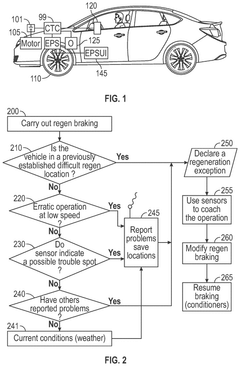
- A control system that detects difficult driving contexts using sensors and GPS, modifies regenerative braking by reducing or terminating it in known problematic locations, and resumes normal operation once the context changes, utilizing a database of reported issues and user input for optimization.
Vehicle, and integrated driving-braking control apparatus and method for vehicle
PatentPendingEP4538099A1
Innovation
- The integration of a cooperative regenerative brake function into the drive system, combined with strategically placed electric motor brakes, allows for coordinated control of braking across different wheels, reducing the need for multiple brake systems and enhancing braking safety.


Safety Standards and Regulations
The implementation of regenerative braking systems in vehicles has necessitated the development and adaptation of safety standards and regulations to ensure the structural integrity and overall safety of vehicles equipped with this technology. Regulatory bodies worldwide have recognized the unique challenges posed by regenerative braking and have responded by establishing comprehensive guidelines and requirements.
One of the primary concerns addressed by safety standards is the integration of regenerative braking with conventional friction braking systems. Regulations typically mandate a seamless transition between the two systems to maintain consistent and predictable braking performance. This includes requirements for brake blending algorithms and fail-safe mechanisms to ensure that vehicle deceleration remains smooth and controllable under all operating conditions.
Vehicle stability during regenerative braking is another critical aspect covered by safety standards. Regulations often specify maximum allowable torque values for regenerative braking to prevent wheel lock-up or loss of vehicle control, particularly on low-friction surfaces. Additionally, standards may require the implementation of advanced stability control systems that can modulate regenerative braking force based on real-time traction conditions.
The impact of regenerative braking on vehicle weight distribution and suspension dynamics has also been addressed in safety regulations. Standards often mandate that vehicles equipped with regenerative braking systems undergo rigorous testing to ensure that the additional components and altered weight distribution do not compromise handling characteristics or structural integrity during various driving scenarios, including emergency maneuvers and crash events.
Electromagnetic compatibility (EMC) is a crucial consideration in safety standards for regenerative braking systems. Regulations typically require extensive EMC testing to ensure that the high-power electrical components used in regenerative braking do not interfere with other vehicle systems or external electronic devices. This includes specifications for shielding, grounding, and EMI suppression techniques.
Battery safety is another key focus area in regulations pertaining to regenerative braking, particularly in electric and hybrid vehicles. Standards often dictate stringent requirements for battery management systems, thermal management, and crash protection to mitigate risks associated with the high-voltage systems used in regenerative braking.
Lastly, safety standards and regulations have evolved to address the unique maintenance and repair considerations of vehicles with regenerative braking systems. This includes requirements for diagnostic capabilities, service procedures, and technician training to ensure that these complex systems can be properly maintained and repaired throughout the vehicle's lifecycle without compromising structural integrity or safety performance.
One of the primary concerns addressed by safety standards is the integration of regenerative braking with conventional friction braking systems. Regulations typically mandate a seamless transition between the two systems to maintain consistent and predictable braking performance. This includes requirements for brake blending algorithms and fail-safe mechanisms to ensure that vehicle deceleration remains smooth and controllable under all operating conditions.
Vehicle stability during regenerative braking is another critical aspect covered by safety standards. Regulations often specify maximum allowable torque values for regenerative braking to prevent wheel lock-up or loss of vehicle control, particularly on low-friction surfaces. Additionally, standards may require the implementation of advanced stability control systems that can modulate regenerative braking force based on real-time traction conditions.
The impact of regenerative braking on vehicle weight distribution and suspension dynamics has also been addressed in safety regulations. Standards often mandate that vehicles equipped with regenerative braking systems undergo rigorous testing to ensure that the additional components and altered weight distribution do not compromise handling characteristics or structural integrity during various driving scenarios, including emergency maneuvers and crash events.
Electromagnetic compatibility (EMC) is a crucial consideration in safety standards for regenerative braking systems. Regulations typically require extensive EMC testing to ensure that the high-power electrical components used in regenerative braking do not interfere with other vehicle systems or external electronic devices. This includes specifications for shielding, grounding, and EMI suppression techniques.
Battery safety is another key focus area in regulations pertaining to regenerative braking, particularly in electric and hybrid vehicles. Standards often dictate stringent requirements for battery management systems, thermal management, and crash protection to mitigate risks associated with the high-voltage systems used in regenerative braking.
Lastly, safety standards and regulations have evolved to address the unique maintenance and repair considerations of vehicles with regenerative braking systems. This includes requirements for diagnostic capabilities, service procedures, and technician training to ensure that these complex systems can be properly maintained and repaired throughout the vehicle's lifecycle without compromising structural integrity or safety performance.
Environmental Impact Assessment
Regenerative braking systems have significant implications for the environmental impact of vehicles. This technology, which captures and stores energy typically lost during braking, contributes to improved fuel efficiency and reduced emissions. By converting kinetic energy into electrical energy, regenerative braking systems reduce the overall energy consumption of vehicles, particularly in urban environments with frequent stop-and-start traffic patterns.
The primary environmental benefit of regenerative braking is the reduction in greenhouse gas emissions. As the system allows vehicles to recapture energy that would otherwise be lost as heat, it decreases the amount of fuel required for operation. This translates to lower carbon dioxide emissions, a key contributor to global climate change. Studies have shown that regenerative braking can improve fuel economy by up to 20% in city driving conditions, leading to a proportional decrease in emissions.
Furthermore, regenerative braking systems contribute to the reduction of particulate matter emissions. Traditional friction-based braking systems generate brake dust, which consists of fine particles that can have negative impacts on air quality and human health. By reducing the reliance on friction brakes, regenerative braking systems help mitigate this source of pollution, particularly in urban areas where air quality is often a concern.
The environmental impact of regenerative braking extends beyond operational emissions. The technology also influences the lifecycle environmental footprint of vehicles. While the production of regenerative braking systems may require additional resources and energy compared to conventional braking systems, the long-term benefits often outweigh these initial costs. The reduced wear on brake components leads to less frequent replacement, minimizing the environmental impact associated with the production and disposal of brake parts.
However, it is important to consider the potential environmental trade-offs associated with regenerative braking systems. The production of batteries and other electrical components required for these systems can have environmental implications, including resource extraction and manufacturing emissions. Additionally, the disposal or recycling of these components at the end of the vehicle's life cycle must be carefully managed to minimize environmental impact.
In the context of electric and hybrid vehicles, regenerative braking plays a crucial role in extending battery range and reducing the overall energy demand. This indirectly contributes to environmental benefits by potentially reducing the need for larger battery capacities and the associated resource-intensive production processes. As the automotive industry continues to shift towards electrification, the environmental significance of regenerative braking is likely to increase.
Overall, while regenerative braking technology presents some challenges in terms of component production and end-of-life management, its positive impact on vehicle efficiency and emissions reduction makes it a valuable tool in mitigating the environmental impact of transportation. As the technology continues to evolve and become more widespread, its role in sustainable mobility solutions is expected to grow, contributing to broader efforts to reduce the environmental footprint of the automotive sector.
The primary environmental benefit of regenerative braking is the reduction in greenhouse gas emissions. As the system allows vehicles to recapture energy that would otherwise be lost as heat, it decreases the amount of fuel required for operation. This translates to lower carbon dioxide emissions, a key contributor to global climate change. Studies have shown that regenerative braking can improve fuel economy by up to 20% in city driving conditions, leading to a proportional decrease in emissions.
Furthermore, regenerative braking systems contribute to the reduction of particulate matter emissions. Traditional friction-based braking systems generate brake dust, which consists of fine particles that can have negative impacts on air quality and human health. By reducing the reliance on friction brakes, regenerative braking systems help mitigate this source of pollution, particularly in urban areas where air quality is often a concern.
The environmental impact of regenerative braking extends beyond operational emissions. The technology also influences the lifecycle environmental footprint of vehicles. While the production of regenerative braking systems may require additional resources and energy compared to conventional braking systems, the long-term benefits often outweigh these initial costs. The reduced wear on brake components leads to less frequent replacement, minimizing the environmental impact associated with the production and disposal of brake parts.
However, it is important to consider the potential environmental trade-offs associated with regenerative braking systems. The production of batteries and other electrical components required for these systems can have environmental implications, including resource extraction and manufacturing emissions. Additionally, the disposal or recycling of these components at the end of the vehicle's life cycle must be carefully managed to minimize environmental impact.
In the context of electric and hybrid vehicles, regenerative braking plays a crucial role in extending battery range and reducing the overall energy demand. This indirectly contributes to environmental benefits by potentially reducing the need for larger battery capacities and the associated resource-intensive production processes. As the automotive industry continues to shift towards electrification, the environmental significance of regenerative braking is likely to increase.
Overall, while regenerative braking technology presents some challenges in terms of component production and end-of-life management, its positive impact on vehicle efficiency and emissions reduction makes it a valuable tool in mitigating the environmental impact of transportation. As the technology continues to evolve and become more widespread, its role in sustainable mobility solutions is expected to grow, contributing to broader efforts to reduce the environmental footprint of the automotive sector.
Unlock deeper insights with PatSnap Eureka Quick Research — get a full tech report to explore trends and direct your research. Try now!
Generate Your Research Report Instantly with AI Agent
Supercharge your innovation with PatSnap Eureka AI Agent Platform!