How to Develop Cost-Effective Hypochlorous Acid Solutions?
AUG 4, 20259 MIN READ
Generate Your Research Report Instantly with AI Agent
PatSnap Eureka helps you evaluate technical feasibility & market potential.
HOCL Tech Background
Hypochlorous acid (HOCl) has a rich history dating back to its discovery in the early 19th century. Initially recognized for its disinfectant properties, HOCl has since evolved into a versatile solution with applications spanning healthcare, agriculture, and industrial processes. The technology behind HOCl production has undergone significant advancements, driven by the need for more efficient and cost-effective methods.
In recent years, the focus on developing cost-effective HOCl solutions has intensified due to growing demand in various sectors. The global market for HOCl-based products has experienced steady growth, propelled by increasing awareness of its benefits and expanding applications. This trend has prompted researchers and industry players to explore innovative approaches to HOCl production and formulation.
The evolution of HOCl technology can be traced through several key milestones. Early production methods relied on electrolysis of saltwater, which, while effective, were energy-intensive and costly. Subsequent developments introduced more efficient electrolytic cells and optimized salt concentrations, leading to improved yields and reduced energy consumption. Recent innovations have focused on enhancing stability and shelf life, addressing one of the primary challenges in HOCl commercialization.
Current technological goals in HOCl development center around three main areas: cost reduction, stability improvement, and scalability. Researchers are exploring novel electrode materials and cell designs to increase production efficiency and lower operational costs. Efforts to enhance HOCl stability without compromising efficacy involve investigating various additives and packaging solutions. Scalability remains a critical objective, with ongoing work to develop production systems that can meet growing industrial demands while maintaining consistent quality.
The pursuit of cost-effective HOCl solutions intersects with broader trends in sustainable chemistry and green technology. As environmental concerns gain prominence, there is increasing interest in HOCl as an eco-friendly alternative to traditional chemical disinfectants. This alignment with sustainability goals has further accelerated research and development efforts in the field.
Looking ahead, the technological trajectory for HOCl production is likely to involve integrating advanced materials science, electrochemistry, and process engineering. Emerging areas of focus include the development of novel catalyst materials, optimization of electrolytic processes through machine learning algorithms, and the exploration of continuous flow production methods. These advancements aim to address the current limitations in HOCl technology and pave the way for more widespread adoption across diverse industries.
In recent years, the focus on developing cost-effective HOCl solutions has intensified due to growing demand in various sectors. The global market for HOCl-based products has experienced steady growth, propelled by increasing awareness of its benefits and expanding applications. This trend has prompted researchers and industry players to explore innovative approaches to HOCl production and formulation.
The evolution of HOCl technology can be traced through several key milestones. Early production methods relied on electrolysis of saltwater, which, while effective, were energy-intensive and costly. Subsequent developments introduced more efficient electrolytic cells and optimized salt concentrations, leading to improved yields and reduced energy consumption. Recent innovations have focused on enhancing stability and shelf life, addressing one of the primary challenges in HOCl commercialization.
Current technological goals in HOCl development center around three main areas: cost reduction, stability improvement, and scalability. Researchers are exploring novel electrode materials and cell designs to increase production efficiency and lower operational costs. Efforts to enhance HOCl stability without compromising efficacy involve investigating various additives and packaging solutions. Scalability remains a critical objective, with ongoing work to develop production systems that can meet growing industrial demands while maintaining consistent quality.
The pursuit of cost-effective HOCl solutions intersects with broader trends in sustainable chemistry and green technology. As environmental concerns gain prominence, there is increasing interest in HOCl as an eco-friendly alternative to traditional chemical disinfectants. This alignment with sustainability goals has further accelerated research and development efforts in the field.
Looking ahead, the technological trajectory for HOCl production is likely to involve integrating advanced materials science, electrochemistry, and process engineering. Emerging areas of focus include the development of novel catalyst materials, optimization of electrolytic processes through machine learning algorithms, and the exploration of continuous flow production methods. These advancements aim to address the current limitations in HOCl technology and pave the way for more widespread adoption across diverse industries.
Market Demand Analysis
The market demand for cost-effective hypochlorous acid solutions has been steadily increasing across various industries due to its versatile applications and eco-friendly nature. Healthcare sectors, including hospitals, clinics, and dental practices, have shown significant interest in hypochlorous acid for its powerful disinfection properties. The ongoing global health concerns have further amplified the need for effective, safe, and affordable sanitizing solutions.
In the food and beverage industry, hypochlorous acid has gained traction as a non-toxic alternative to traditional sanitizers. Food processing plants, restaurants, and agricultural facilities are adopting these solutions to maintain hygiene standards while minimizing chemical residues. This shift is driven by consumer demand for cleaner, safer food production processes.
The water treatment sector represents another substantial market for hypochlorous acid solutions. Municipal water treatment facilities and industrial wastewater management systems are exploring cost-effective methods to purify water without harmful byproducts. Hypochlorous acid's ability to effectively disinfect water while being environmentally benign makes it an attractive option for sustainable water management practices.
Personal care and cosmetics industries have also recognized the potential of hypochlorous acid. Its gentle yet effective antimicrobial properties make it suitable for skincare products, particularly those targeting acne-prone or sensitive skin. The growing consumer preference for natural and non-irritating ingredients in personal care items is driving the demand in this sector.
The agriculture sector presents a promising market for hypochlorous acid solutions. Farmers and greenhouse operators are increasingly using these solutions for crop protection, seed treatment, and hydroponic systems. The push for reducing chemical pesticide use in agriculture aligns well with the properties of hypochlorous acid, creating opportunities for market expansion.
In the hospitality industry, hotels, cruise ships, and public venues are seeking cost-effective sanitizing solutions that can be safely used in high-traffic areas. The ability of hypochlorous acid to quickly and effectively disinfect surfaces without leaving harmful residues makes it an ideal choice for these applications.
The potential market size for cost-effective hypochlorous acid solutions is substantial, with projections indicating significant growth in the coming years. This growth is driven by increasing awareness of its benefits, stricter hygiene regulations across industries, and the global shift towards sustainable and environmentally friendly products. As research continues to uncover new applications and improve production methods, the market demand is expected to expand further, creating opportunities for innovation and market entry for companies developing cost-effective hypochlorous acid solutions.
In the food and beverage industry, hypochlorous acid has gained traction as a non-toxic alternative to traditional sanitizers. Food processing plants, restaurants, and agricultural facilities are adopting these solutions to maintain hygiene standards while minimizing chemical residues. This shift is driven by consumer demand for cleaner, safer food production processes.
The water treatment sector represents another substantial market for hypochlorous acid solutions. Municipal water treatment facilities and industrial wastewater management systems are exploring cost-effective methods to purify water without harmful byproducts. Hypochlorous acid's ability to effectively disinfect water while being environmentally benign makes it an attractive option for sustainable water management practices.
Personal care and cosmetics industries have also recognized the potential of hypochlorous acid. Its gentle yet effective antimicrobial properties make it suitable for skincare products, particularly those targeting acne-prone or sensitive skin. The growing consumer preference for natural and non-irritating ingredients in personal care items is driving the demand in this sector.
The agriculture sector presents a promising market for hypochlorous acid solutions. Farmers and greenhouse operators are increasingly using these solutions for crop protection, seed treatment, and hydroponic systems. The push for reducing chemical pesticide use in agriculture aligns well with the properties of hypochlorous acid, creating opportunities for market expansion.
In the hospitality industry, hotels, cruise ships, and public venues are seeking cost-effective sanitizing solutions that can be safely used in high-traffic areas. The ability of hypochlorous acid to quickly and effectively disinfect surfaces without leaving harmful residues makes it an ideal choice for these applications.
The potential market size for cost-effective hypochlorous acid solutions is substantial, with projections indicating significant growth in the coming years. This growth is driven by increasing awareness of its benefits, stricter hygiene regulations across industries, and the global shift towards sustainable and environmentally friendly products. As research continues to uncover new applications and improve production methods, the market demand is expected to expand further, creating opportunities for innovation and market entry for companies developing cost-effective hypochlorous acid solutions.
HOCL Production Challenges
The production of hypochlorous acid (HOCl) faces several significant challenges that impact its cost-effectiveness and widespread adoption. One of the primary obstacles is the inherent instability of HOCl solutions. The compound tends to decompose rapidly, especially when exposed to light, heat, or certain impurities. This instability necessitates careful handling, storage, and packaging, which can substantially increase production and distribution costs.
Another major challenge lies in the production process itself. Traditional methods of HOCl production often involve the use of expensive equipment and energy-intensive processes. Electrolysis, a common production technique, requires specialized electrodes and precise control of electrical parameters. The cost of these components and the energy consumption contribute significantly to the overall production expenses.
The purity of raw materials also presents a considerable challenge. HOCl production typically requires high-quality salt and water as inputs. Impurities in these materials can lead to unwanted side reactions, reducing the yield and quality of the final product. Ensuring a consistent supply of high-purity raw materials can be costly and logistically challenging, especially for large-scale production.
pH control is another critical factor in HOCl production. The effectiveness and stability of HOCl are highly dependent on maintaining the correct pH level. Achieving and maintaining the optimal pH range (typically between 5.5 and 6.5) throughout the production process and in the final product requires sophisticated monitoring and control systems, adding to the complexity and cost of production.
Scaling up production while maintaining quality and consistency poses additional challenges. As production volumes increase, ensuring uniform mixing, precise dosing of reactants, and consistent reaction conditions becomes more difficult. This often necessitates significant investments in advanced process control systems and larger, more complex production equipment.
Regulatory compliance adds another layer of complexity to HOCl production. As a disinfectant and sanitizing agent, HOCl is subject to various regulations and quality standards. Meeting these requirements often involves extensive testing, documentation, and quality control measures, all of which contribute to increased production costs.
Lastly, the competitive market landscape presents a challenge for cost-effective HOCl production. With numerous players in the market, there is constant pressure to reduce costs while maintaining product quality. This competition drives the need for continuous innovation in production methods and efficiency improvements, requiring ongoing investment in research and development.
Another major challenge lies in the production process itself. Traditional methods of HOCl production often involve the use of expensive equipment and energy-intensive processes. Electrolysis, a common production technique, requires specialized electrodes and precise control of electrical parameters. The cost of these components and the energy consumption contribute significantly to the overall production expenses.
The purity of raw materials also presents a considerable challenge. HOCl production typically requires high-quality salt and water as inputs. Impurities in these materials can lead to unwanted side reactions, reducing the yield and quality of the final product. Ensuring a consistent supply of high-purity raw materials can be costly and logistically challenging, especially for large-scale production.
pH control is another critical factor in HOCl production. The effectiveness and stability of HOCl are highly dependent on maintaining the correct pH level. Achieving and maintaining the optimal pH range (typically between 5.5 and 6.5) throughout the production process and in the final product requires sophisticated monitoring and control systems, adding to the complexity and cost of production.
Scaling up production while maintaining quality and consistency poses additional challenges. As production volumes increase, ensuring uniform mixing, precise dosing of reactants, and consistent reaction conditions becomes more difficult. This often necessitates significant investments in advanced process control systems and larger, more complex production equipment.
Regulatory compliance adds another layer of complexity to HOCl production. As a disinfectant and sanitizing agent, HOCl is subject to various regulations and quality standards. Meeting these requirements often involves extensive testing, documentation, and quality control measures, all of which contribute to increased production costs.
Lastly, the competitive market landscape presents a challenge for cost-effective HOCl production. With numerous players in the market, there is constant pressure to reduce costs while maintaining product quality. This competition drives the need for continuous innovation in production methods and efficiency improvements, requiring ongoing investment in research and development.
Current HOCL Solutions
01 Low-cost production methods
Various techniques have been developed to produce hypochlorous acid solutions cost-effectively. These methods often involve optimizing electrolysis processes, using inexpensive raw materials, or implementing efficient manufacturing systems. By reducing production costs, these approaches make hypochlorous acid solutions more economically viable for various applications.- Production methods for cost-effective hypochlorous acid solutions: Various production methods have been developed to create cost-effective hypochlorous acid solutions. These methods include electrolysis of salt water, chemical reactions involving chlorine and water, and on-site generation systems. By optimizing these production processes, manufacturers can reduce costs and increase the economic viability of hypochlorous acid solutions for various applications.
- Stabilization techniques for extended shelf life: Researchers have developed stabilization techniques to extend the shelf life of hypochlorous acid solutions, improving their cost-effectiveness. These techniques include pH adjustment, addition of stabilizing agents, and packaging innovations. By increasing the stability and longevity of the solutions, fewer resources are required for production and distribution, resulting in overall cost savings.
- Multi-functional applications to maximize value: Hypochlorous acid solutions have been found to be effective in multiple applications, including disinfection, wound care, and water treatment. By leveraging the versatility of these solutions, users can maximize their value and reduce the need for multiple specialized products. This multi-functionality contributes to the overall cost-effectiveness of hypochlorous acid solutions.
- Concentration optimization for specific uses: Research has focused on optimizing the concentration of hypochlorous acid solutions for specific applications. By tailoring the concentration to the intended use, manufacturers can ensure maximum efficacy while minimizing waste and unnecessary production costs. This approach helps to improve the overall cost-effectiveness of hypochlorous acid solutions across various industries.
- Sustainable production and packaging methods: Efforts have been made to develop sustainable production and packaging methods for hypochlorous acid solutions. These include using renewable energy sources for production, implementing closed-loop systems to minimize waste, and utilizing eco-friendly packaging materials. By adopting these sustainable practices, manufacturers can reduce long-term costs and improve the overall cost-effectiveness of hypochlorous acid solutions.
02 Stabilization techniques for extended shelf life
Researchers have developed methods to stabilize hypochlorous acid solutions, extending their shelf life and maintaining efficacy over longer periods. These techniques may involve pH adjustment, addition of stabilizing agents, or specialized packaging. Improved stability reduces waste and frequency of production, contributing to overall cost-effectiveness.Expand Specific Solutions03 Multi-functional applications
Hypochlorous acid solutions have been found to be effective in various applications, including disinfection, wound care, and water treatment. This versatility allows for economies of scale in production and distribution, as well as potential cost savings for end-users who can replace multiple products with a single solution.Expand Specific Solutions04 On-site generation systems
Development of compact, efficient on-site generation systems for hypochlorous acid solutions can significantly reduce transportation and storage costs. These systems allow for production of fresh solutions as needed, minimizing waste and ensuring consistent quality while potentially lowering overall expenses for large-scale users.Expand Specific Solutions05 Eco-friendly and sustainable production
Innovations in eco-friendly and sustainable production methods for hypochlorous acid solutions can lead to long-term cost savings. These approaches may include using renewable energy sources, implementing closed-loop systems, or utilizing waste products as raw materials. Such methods can reduce environmental impact while potentially lowering production costs over time.Expand Specific Solutions
Key Industry Players
The development of cost-effective hypochlorous acid solutions is in a growth phase, with increasing market demand driven by its versatile applications in disinfection and sanitation. The global market size is expanding, particularly in healthcare, water treatment, and agriculture sectors. Technologically, the field is advancing rapidly, with companies like WIAB WATER INNOVATION AB, Nantong Shanshui Biotechnology, and Guangzhou Jinglangyuan Environmental Protection Technology leading innovation. These firms are focusing on improving production efficiency, stability, and scalability of hypochlorous acid solutions. Established players such as Zep, Inc. and Aquaox, Inc. are also contributing to market maturity through their extensive experience and distribution networks, while newer entrants are driving competition and technological advancements.
Aquaox, Inc.
Technical Solution: Aquaox has developed a patented electrolysis process to produce stable hypochlorous acid solutions. Their technology utilizes a specialized membrane cell and precise control of pH and oxidation-reduction potential (ORP) to generate high-purity HOCl with concentrations up to 500 ppm[1]. The process is optimized for energy efficiency, using only salt, water, and electricity as inputs. Aquaox's systems can produce HOCl on-site, reducing transportation costs and improving shelf-life. They have also implemented automated monitoring and dosing systems to maintain consistent HOCl quality[2].
Strengths: On-site production reduces costs; high purity and stability of HOCl; automated quality control. Weaknesses: Initial equipment investment may be high; requires technical expertise to operate and maintain.
Zep, Inc.
Technical Solution: Zep has focused on developing cost-effective hypochlorous acid solutions through a combination of efficient production methods and innovative formulation techniques. Their approach involves using electrochemical activation (ECA) technology to produce HOCl from salt and water[3]. Zep has optimized the electrolysis process to minimize energy consumption while maximizing HOCl yield. Additionally, they have developed proprietary stabilization methods to extend the shelf-life of their HOCl products, reducing waste and improving cost-effectiveness[4]. Zep also employs advanced packaging technologies to prevent degradation and maintain product efficacy during storage and transportation.
Strengths: Efficient production process; extended product shelf-life; diverse application range. Weaknesses: May face competition from on-site generation systems; reliance on supply chain for distribution.
Core HOCL Innovations
Compositions, processes and systems to produce hypochlorous acid
PatentWO2023235881A1
Innovation
- A composition and process using shelf-stable alkali metal or alkaline earth hypochlorite salts combined with acid-form cation exchange resins, where the resin reacts with hypochlorite salts to produce hypochlorous acid, allowing for on-site generation with controlled pH and reduced dissolved solids, utilizing a modular system for efficient production.


System and Method for Making Hypochlorous Acid Using Saltwater with Sodium Bicarbonate
PatentActiveUS20210395904A1
Innovation
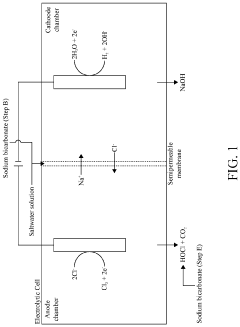
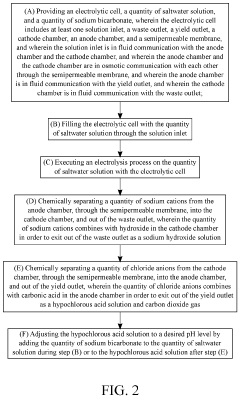
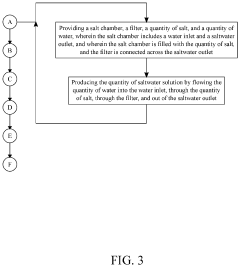
- Incorporating sodium bicarbonate into the saltwater electrolysis process using a semipermeable membrane to separate the solutions, which forms purer hypochlorous acid by reacting chloride ions with carbonic acid, thereby maintaining a higher pH and eliminating strong hydrochloric acid.
Cost Reduction Strategies
Developing cost-effective hypochlorous acid solutions requires a multifaceted approach to reduce expenses while maintaining product quality and efficacy. One key strategy is optimizing the production process. This can be achieved by implementing lean manufacturing principles, which minimize waste and improve efficiency. Automation of key production steps can significantly reduce labor costs and increase output consistency. Additionally, investing in energy-efficient equipment and processes can lead to substantial long-term savings in utility expenses.
Sourcing raw materials strategically is another crucial aspect of cost reduction. Establishing long-term relationships with suppliers can lead to better pricing and more stable supply chains. Bulk purchasing of key ingredients, when feasible, can also result in significant cost savings. Furthermore, exploring alternative suppliers or even considering vertical integration for critical components can provide more control over costs and quality.
Packaging and distribution costs can be minimized through innovative design and logistics optimization. Developing concentrated formulations can reduce packaging material requirements and shipping costs. Implementing just-in-time inventory management can help reduce warehousing expenses and minimize the risk of product expiration. Exploring eco-friendly packaging options may not only reduce costs but also appeal to environmentally conscious consumers.
Research and development efforts should focus on improving the stability and shelf life of hypochlorous acid solutions. Enhancing product longevity can reduce waste and the frequency of production runs, thereby lowering overall costs. Investigating novel stabilization techniques or formulations that maintain efficacy at lower concentrations can lead to more cost-effective products.
Leveraging economies of scale is a powerful strategy for cost reduction. As production volumes increase, fixed costs can be spread over a larger number of units, reducing the per-unit cost. This may involve expanding market reach or diversifying product applications to increase overall demand. Collaborating with other industries that use hypochlorous acid can also help achieve economies of scale in production and distribution.
Finally, implementing robust quality control measures can significantly reduce costs associated with product recalls, waste, and customer complaints. Investing in advanced testing equipment and procedures can help identify and address issues early in the production process, preventing costly mistakes and ensuring consistent product quality. Continuous improvement initiatives, such as Six Sigma or Total Quality Management, can drive ongoing cost reductions and efficiency gains throughout the organization.
Sourcing raw materials strategically is another crucial aspect of cost reduction. Establishing long-term relationships with suppliers can lead to better pricing and more stable supply chains. Bulk purchasing of key ingredients, when feasible, can also result in significant cost savings. Furthermore, exploring alternative suppliers or even considering vertical integration for critical components can provide more control over costs and quality.
Packaging and distribution costs can be minimized through innovative design and logistics optimization. Developing concentrated formulations can reduce packaging material requirements and shipping costs. Implementing just-in-time inventory management can help reduce warehousing expenses and minimize the risk of product expiration. Exploring eco-friendly packaging options may not only reduce costs but also appeal to environmentally conscious consumers.
Research and development efforts should focus on improving the stability and shelf life of hypochlorous acid solutions. Enhancing product longevity can reduce waste and the frequency of production runs, thereby lowering overall costs. Investigating novel stabilization techniques or formulations that maintain efficacy at lower concentrations can lead to more cost-effective products.
Leveraging economies of scale is a powerful strategy for cost reduction. As production volumes increase, fixed costs can be spread over a larger number of units, reducing the per-unit cost. This may involve expanding market reach or diversifying product applications to increase overall demand. Collaborating with other industries that use hypochlorous acid can also help achieve economies of scale in production and distribution.
Finally, implementing robust quality control measures can significantly reduce costs associated with product recalls, waste, and customer complaints. Investing in advanced testing equipment and procedures can help identify and address issues early in the production process, preventing costly mistakes and ensuring consistent product quality. Continuous improvement initiatives, such as Six Sigma or Total Quality Management, can drive ongoing cost reductions and efficiency gains throughout the organization.
Environmental Impact
The development of cost-effective hypochlorous acid solutions presents significant environmental implications that warrant careful consideration. Hypochlorous acid, a powerful disinfectant and oxidizing agent, offers numerous benefits in various applications, including water treatment, healthcare, and agriculture. However, its production and use also raise important environmental concerns.
One of the primary environmental advantages of hypochlorous acid solutions is their potential to reduce the reliance on more harmful chemical disinfectants. Unlike many traditional disinfectants, hypochlorous acid breaks down into simple, non-toxic components – primarily salt and water – minimizing the introduction of persistent chemicals into the environment. This characteristic makes it an attractive option for eco-conscious industries and consumers seeking to reduce their environmental footprint.
The production process of hypochlorous acid solutions, particularly when focused on cost-effectiveness, can lead to improved resource efficiency. By optimizing production methods and utilizing readily available raw materials, manufacturers can reduce energy consumption and minimize waste generation. This not only contributes to lower production costs but also aligns with broader sustainability goals.
However, the environmental impact of hypochlorous acid production is not without challenges. The electrolysis process, commonly used in its manufacture, requires significant energy input. As such, the overall environmental footprint of hypochlorous acid solutions is closely tied to the energy sources used in production. Transitioning to renewable energy sources for manufacturing could substantially mitigate this concern and further enhance the environmental profile of these solutions.
Water usage is another critical environmental factor to consider. While hypochlorous acid solutions are often touted for their effectiveness in water treatment, the production process itself can be water-intensive. Developing more water-efficient production methods is crucial for ensuring the overall sustainability of these solutions, particularly in water-stressed regions.
The potential for accidental releases during production, transportation, or use of hypochlorous acid solutions also merits attention. Although less harmful than many alternatives, concentrated forms can still pose risks to aquatic ecosystems if improperly managed. Implementing robust safety protocols and containment measures is essential to prevent environmental contamination.
In conclusion, the environmental impact of developing cost-effective hypochlorous acid solutions is multifaceted. While offering significant potential for reducing chemical pollution and improving sustainability in various sectors, careful consideration must be given to energy consumption, water usage, and safe handling practices. Balancing these factors is crucial for maximizing the environmental benefits while mitigating potential risks associated with the production and use of these solutions.
One of the primary environmental advantages of hypochlorous acid solutions is their potential to reduce the reliance on more harmful chemical disinfectants. Unlike many traditional disinfectants, hypochlorous acid breaks down into simple, non-toxic components – primarily salt and water – minimizing the introduction of persistent chemicals into the environment. This characteristic makes it an attractive option for eco-conscious industries and consumers seeking to reduce their environmental footprint.
The production process of hypochlorous acid solutions, particularly when focused on cost-effectiveness, can lead to improved resource efficiency. By optimizing production methods and utilizing readily available raw materials, manufacturers can reduce energy consumption and minimize waste generation. This not only contributes to lower production costs but also aligns with broader sustainability goals.
However, the environmental impact of hypochlorous acid production is not without challenges. The electrolysis process, commonly used in its manufacture, requires significant energy input. As such, the overall environmental footprint of hypochlorous acid solutions is closely tied to the energy sources used in production. Transitioning to renewable energy sources for manufacturing could substantially mitigate this concern and further enhance the environmental profile of these solutions.
Water usage is another critical environmental factor to consider. While hypochlorous acid solutions are often touted for their effectiveness in water treatment, the production process itself can be water-intensive. Developing more water-efficient production methods is crucial for ensuring the overall sustainability of these solutions, particularly in water-stressed regions.
The potential for accidental releases during production, transportation, or use of hypochlorous acid solutions also merits attention. Although less harmful than many alternatives, concentrated forms can still pose risks to aquatic ecosystems if improperly managed. Implementing robust safety protocols and containment measures is essential to prevent environmental contamination.
In conclusion, the environmental impact of developing cost-effective hypochlorous acid solutions is multifaceted. While offering significant potential for reducing chemical pollution and improving sustainability in various sectors, careful consideration must be given to energy consumption, water usage, and safe handling practices. Balancing these factors is crucial for maximizing the environmental benefits while mitigating potential risks associated with the production and use of these solutions.
Unlock deeper insights with PatSnap Eureka Quick Research — get a full tech report to explore trends and direct your research. Try now!
Generate Your Research Report Instantly with AI Agent
Supercharge your innovation with PatSnap Eureka AI Agent Platform!