How to Develop Unique Multiplexer Features for Specialized Needs?
JUL 13, 202510 MIN READ
Generate Your Research Report Instantly with AI Agent
PatSnap Eureka helps you evaluate technical feasibility & market potential.
Multiplexer Evolution and Objectives
Multiplexers have undergone significant evolution since their inception in the mid-20th century. Initially developed for telecommunications, these devices have expanded their applications across various industries, including computing, aerospace, and automotive sectors. The primary objective of multiplexer technology has been to efficiently combine multiple input signals into a single output channel, thereby optimizing data transmission and resource utilization.
The evolution of multiplexers has been driven by the increasing demand for higher data rates, improved signal integrity, and enhanced flexibility in signal routing. Early multiplexers were primarily analog devices, but the advent of digital technology led to the development of more sophisticated digital multiplexers. This transition marked a crucial milestone in multiplexer evolution, enabling more precise control over signal selection and manipulation.
As technology progressed, the focus shifted towards developing multiplexers with higher channel densities and faster switching speeds. The introduction of time-division multiplexing (TDM) and frequency-division multiplexing (FDM) techniques further expanded the capabilities of these devices, allowing for simultaneous transmission of multiple signals over a single channel.
In recent years, the objectives of multiplexer development have become increasingly specialized, driven by the unique needs of various industries. For instance, in the telecommunications sector, the goal has been to create multiplexers capable of handling the enormous bandwidth requirements of 5G and future network technologies. In the automotive industry, multiplexers are being designed to support advanced driver assistance systems (ADAS) and autonomous vehicles, with a focus on low latency and high reliability.
The emergence of software-defined networking (SDN) has introduced new objectives in multiplexer design, aiming to create more flexible and programmable devices that can adapt to changing network conditions in real-time. This has led to the development of intelligent multiplexers that can dynamically allocate bandwidth and prioritize traffic based on predefined rules or machine learning algorithms.
Looking ahead, the objectives for multiplexer evolution are centered around addressing the challenges posed by emerging technologies such as quantum computing, artificial intelligence, and the Internet of Things (IoT). These applications demand multiplexers with unprecedented levels of performance, energy efficiency, and integration capabilities. Additionally, there is a growing emphasis on developing multiplexers that can operate across a wider range of frequencies and environmental conditions, particularly for space and defense applications.
As we explore ways to develop unique multiplexer features for specialized needs, it is crucial to consider the diverse requirements of different industries and emerging technologies. This involves not only enhancing the core functionalities of multiplexers but also integrating advanced features such as built-in diagnostics, self-calibration, and adaptive signal processing. The ultimate goal is to create versatile, high-performance multiplexers that can meet the complex and evolving demands of modern technological ecosystems.
The evolution of multiplexers has been driven by the increasing demand for higher data rates, improved signal integrity, and enhanced flexibility in signal routing. Early multiplexers were primarily analog devices, but the advent of digital technology led to the development of more sophisticated digital multiplexers. This transition marked a crucial milestone in multiplexer evolution, enabling more precise control over signal selection and manipulation.
As technology progressed, the focus shifted towards developing multiplexers with higher channel densities and faster switching speeds. The introduction of time-division multiplexing (TDM) and frequency-division multiplexing (FDM) techniques further expanded the capabilities of these devices, allowing for simultaneous transmission of multiple signals over a single channel.
In recent years, the objectives of multiplexer development have become increasingly specialized, driven by the unique needs of various industries. For instance, in the telecommunications sector, the goal has been to create multiplexers capable of handling the enormous bandwidth requirements of 5G and future network technologies. In the automotive industry, multiplexers are being designed to support advanced driver assistance systems (ADAS) and autonomous vehicles, with a focus on low latency and high reliability.
The emergence of software-defined networking (SDN) has introduced new objectives in multiplexer design, aiming to create more flexible and programmable devices that can adapt to changing network conditions in real-time. This has led to the development of intelligent multiplexers that can dynamically allocate bandwidth and prioritize traffic based on predefined rules or machine learning algorithms.
Looking ahead, the objectives for multiplexer evolution are centered around addressing the challenges posed by emerging technologies such as quantum computing, artificial intelligence, and the Internet of Things (IoT). These applications demand multiplexers with unprecedented levels of performance, energy efficiency, and integration capabilities. Additionally, there is a growing emphasis on developing multiplexers that can operate across a wider range of frequencies and environmental conditions, particularly for space and defense applications.
As we explore ways to develop unique multiplexer features for specialized needs, it is crucial to consider the diverse requirements of different industries and emerging technologies. This involves not only enhancing the core functionalities of multiplexers but also integrating advanced features such as built-in diagnostics, self-calibration, and adaptive signal processing. The ultimate goal is to create versatile, high-performance multiplexers that can meet the complex and evolving demands of modern technological ecosystems.
Market Demand Analysis
The market demand for specialized multiplexer features is driven by the increasing complexity and diversity of communication systems across various industries. As data transmission requirements become more sophisticated, there is a growing need for multiplexers that can handle unique signal processing tasks and accommodate specific operational environments.
In the telecommunications sector, the rollout of 5G networks has created a surge in demand for multiplexers capable of managing high-frequency signals and supporting massive MIMO (Multiple-Input Multiple-Output) configurations. These specialized multiplexers must offer enhanced channel isolation, reduced insertion loss, and improved power handling capabilities to meet the stringent requirements of next-generation wireless infrastructure.
The aerospace and defense industries are seeking multiplexers with advanced features such as radiation hardening, extreme temperature tolerance, and miniaturization. These requirements stem from the need to deploy communication systems in harsh environments, including space-based applications and military operations in challenging terrains.
In the automotive sector, the rise of connected and autonomous vehicles is driving demand for multiplexers that can handle multiple sensor inputs, support high-speed data transfer for in-vehicle networks, and provide robust electromagnetic interference (EMI) protection. The ability to integrate multiplexer functionality with other automotive electronic components is also becoming increasingly important.
The industrial Internet of Things (IIoT) is another key market driver for specialized multiplexer features. As factories and manufacturing facilities become more interconnected, there is a growing need for multiplexers that can support real-time data aggregation from numerous sensors and control systems while operating reliably in harsh industrial environments.
Healthcare and medical devices represent an emerging market for specialized multiplexers. The development of advanced diagnostic equipment, telemedicine systems, and wearable health monitors requires multiplexers capable of handling sensitive biomedical signals, ensuring data integrity, and complying with stringent medical device regulations.
The financial services sector, particularly in high-frequency trading applications, demands multiplexers with ultra-low latency and precise timing capabilities. These features are critical for maintaining competitive advantages in algorithmic trading and data center operations.
As the demand for customized multiplexer solutions grows, manufacturers are increasingly focusing on modular and configurable designs. This approach allows for greater flexibility in addressing diverse market needs while maintaining cost-effectiveness in production.
Overall, the market for specialized multiplexer features is expected to expand significantly in the coming years, driven by technological advancements and the increasing need for tailored solutions across various industries. Companies that can innovate and deliver unique multiplexer features aligned with specific industry requirements are likely to gain a competitive edge in this evolving market landscape.
In the telecommunications sector, the rollout of 5G networks has created a surge in demand for multiplexers capable of managing high-frequency signals and supporting massive MIMO (Multiple-Input Multiple-Output) configurations. These specialized multiplexers must offer enhanced channel isolation, reduced insertion loss, and improved power handling capabilities to meet the stringent requirements of next-generation wireless infrastructure.
The aerospace and defense industries are seeking multiplexers with advanced features such as radiation hardening, extreme temperature tolerance, and miniaturization. These requirements stem from the need to deploy communication systems in harsh environments, including space-based applications and military operations in challenging terrains.
In the automotive sector, the rise of connected and autonomous vehicles is driving demand for multiplexers that can handle multiple sensor inputs, support high-speed data transfer for in-vehicle networks, and provide robust electromagnetic interference (EMI) protection. The ability to integrate multiplexer functionality with other automotive electronic components is also becoming increasingly important.
The industrial Internet of Things (IIoT) is another key market driver for specialized multiplexer features. As factories and manufacturing facilities become more interconnected, there is a growing need for multiplexers that can support real-time data aggregation from numerous sensors and control systems while operating reliably in harsh industrial environments.
Healthcare and medical devices represent an emerging market for specialized multiplexers. The development of advanced diagnostic equipment, telemedicine systems, and wearable health monitors requires multiplexers capable of handling sensitive biomedical signals, ensuring data integrity, and complying with stringent medical device regulations.
The financial services sector, particularly in high-frequency trading applications, demands multiplexers with ultra-low latency and precise timing capabilities. These features are critical for maintaining competitive advantages in algorithmic trading and data center operations.
As the demand for customized multiplexer solutions grows, manufacturers are increasingly focusing on modular and configurable designs. This approach allows for greater flexibility in addressing diverse market needs while maintaining cost-effectiveness in production.
Overall, the market for specialized multiplexer features is expected to expand significantly in the coming years, driven by technological advancements and the increasing need for tailored solutions across various industries. Companies that can innovate and deliver unique multiplexer features aligned with specific industry requirements are likely to gain a competitive edge in this evolving market landscape.
Technical Challenges
The development of unique multiplexer features for specialized needs presents several technical challenges that must be addressed. One of the primary obstacles is achieving high-speed data transmission while maintaining signal integrity. As data rates continue to increase, managing signal degradation, crosstalk, and electromagnetic interference becomes increasingly complex. Engineers must develop innovative techniques to mitigate these issues without compromising the multiplexer's performance or increasing its power consumption.
Another significant challenge lies in the miniaturization of multiplexer components. As devices become smaller and more compact, designing multiplexers that can fit into tight spaces while still delivering optimal performance is a formidable task. This requires advancements in materials science and manufacturing processes to create compact, yet highly efficient multiplexer architectures.
The need for flexibility and adaptability in multiplexer designs also poses a considerable challenge. Specialized applications often require customized features that can be easily integrated or modified without extensive redesign. Developing modular and reconfigurable multiplexer architectures that can accommodate a wide range of specialized needs without sacrificing performance or reliability is a complex undertaking.
Power efficiency is another critical concern in multiplexer development. As the demand for energy-efficient devices grows, engineers must find ways to reduce power consumption while maintaining or improving multiplexer performance. This involves optimizing circuit designs, implementing advanced power management techniques, and exploring new materials with better energy characteristics.
The integration of multiplexers with other system components presents additional challenges. Ensuring seamless interoperability with various interfaces, protocols, and control systems requires careful consideration of compatibility issues and the development of robust communication standards. This becomes particularly complex when dealing with legacy systems or emerging technologies that may have different requirements or specifications.
Thermal management is a crucial aspect that cannot be overlooked in multiplexer design. As data rates and component densities increase, managing heat dissipation becomes more challenging. Developing effective cooling solutions that do not compromise the multiplexer's form factor or performance is essential for ensuring long-term reliability and stability.
Lastly, the ever-present challenge of cost-effectiveness must be addressed. Developing unique multiplexer features often requires significant investment in research and development. Balancing the need for innovation with the economic constraints of production and market demands requires careful strategic planning and resource allocation. Engineers must find creative ways to implement advanced features while keeping manufacturing costs competitive and ensuring a viable return on investment for specialized applications.
Another significant challenge lies in the miniaturization of multiplexer components. As devices become smaller and more compact, designing multiplexers that can fit into tight spaces while still delivering optimal performance is a formidable task. This requires advancements in materials science and manufacturing processes to create compact, yet highly efficient multiplexer architectures.
The need for flexibility and adaptability in multiplexer designs also poses a considerable challenge. Specialized applications often require customized features that can be easily integrated or modified without extensive redesign. Developing modular and reconfigurable multiplexer architectures that can accommodate a wide range of specialized needs without sacrificing performance or reliability is a complex undertaking.
Power efficiency is another critical concern in multiplexer development. As the demand for energy-efficient devices grows, engineers must find ways to reduce power consumption while maintaining or improving multiplexer performance. This involves optimizing circuit designs, implementing advanced power management techniques, and exploring new materials with better energy characteristics.
The integration of multiplexers with other system components presents additional challenges. Ensuring seamless interoperability with various interfaces, protocols, and control systems requires careful consideration of compatibility issues and the development of robust communication standards. This becomes particularly complex when dealing with legacy systems or emerging technologies that may have different requirements or specifications.
Thermal management is a crucial aspect that cannot be overlooked in multiplexer design. As data rates and component densities increase, managing heat dissipation becomes more challenging. Developing effective cooling solutions that do not compromise the multiplexer's form factor or performance is essential for ensuring long-term reliability and stability.
Lastly, the ever-present challenge of cost-effectiveness must be addressed. Developing unique multiplexer features often requires significant investment in research and development. Balancing the need for innovation with the economic constraints of production and market demands requires careful strategic planning and resource allocation. Engineers must find creative ways to implement advanced features while keeping manufacturing costs competitive and ensuring a viable return on investment for specialized applications.
Current Multiplexer Solutions
01 Dynamic configuration and reconfiguration
Multiplexers can be dynamically configured and reconfigured to adapt to changing requirements or network conditions. This feature allows for flexible routing of data streams and efficient resource allocation in real-time, enhancing system adaptability and performance.- Dynamic reconfiguration capabilities: Multiplexers with dynamic reconfiguration capabilities allow for real-time adjustment of data routing and processing. This feature enables adaptive performance optimization, efficient resource allocation, and flexible system architecture, making the multiplexer more versatile and responsive to changing operational requirements.
- Integration with advanced signal processing: Modern multiplexers incorporate advanced signal processing techniques, such as digital signal processing (DSP) and machine learning algorithms. This integration enhances signal quality, reduces noise, and enables intelligent data handling, improving overall system performance and reliability.
- High-speed data transmission capabilities: Multiplexers designed for high-speed data transmission feature advanced modulation techniques, improved bandwidth utilization, and low-latency switching. These capabilities enable faster data transfer rates and support emerging high-bandwidth applications in telecommunications and networking.
- Enhanced security features: Multiplexers with built-in security features offer improved data protection and access control. These may include encryption capabilities, secure key management, and authentication mechanisms, ensuring the integrity and confidentiality of transmitted data in sensitive applications.
- Energy-efficient design: Modern multiplexers incorporate energy-efficient design principles, such as low-power modes, intelligent power management, and optimized circuit designs. These features reduce power consumption, heat generation, and overall operating costs, making them suitable for environmentally conscious and resource-constrained applications.
02 High-speed data transmission
Advanced multiplexers are designed to handle high-speed data transmission, enabling efficient communication in modern networks. These devices can process and route large volumes of data with minimal latency, making them suitable for applications requiring rapid data transfer and processing.Expand Specific Solutions03 Integration with optical systems
Multiplexers can be integrated with optical systems to enhance data transmission capabilities. This integration allows for the efficient handling of optical signals, enabling high-bandwidth communication over long distances and supporting advanced networking technologies.Expand Specific Solutions04 Intelligent routing and traffic management
Modern multiplexers incorporate intelligent routing and traffic management features. These capabilities allow for optimized data flow, prioritization of critical traffic, and efficient utilization of network resources, resulting in improved overall network performance and reliability.Expand Specific Solutions05 Enhanced security features
Multiplexers can include advanced security features to protect data during transmission. These may include encryption capabilities, access control mechanisms, and secure routing protocols, ensuring the confidentiality and integrity of sensitive information as it passes through the multiplexer.Expand Specific Solutions
Key Industry Players
The development of unique multiplexer features for specialized needs is currently in a growth phase, with increasing market demand driven by advancements in telecommunications and data processing. The global market size for multiplexers is expanding, fueled by the need for efficient data transmission and network optimization. Technologically, the field is evolving rapidly, with companies like Huawei Technologies, ZTE Corp., and Samsung Electronics leading innovation. These firms are investing heavily in R&D to create advanced multiplexing solutions for 5G networks and IoT applications. Other players like Alcatel Standard Electrica and NEC Corp. are also contributing to the technological maturity of the sector, focusing on specialized features for diverse industry requirements.
Sony Group Corp.
Technical Solution: Sony has developed a unique multiplexer technology for high-speed data transmission in consumer electronics and professional broadcast equipment. Their approach combines advanced signal processing techniques with proprietary hardware designs to achieve ultra-low latency multiplexing[10]. Sony's multiplexer incorporates adaptive equalization and forward error correction algorithms to maintain signal integrity over a wide range of transmission conditions. This technology has been crucial in enabling Sony's development of 8K video transmission systems and high-frame-rate live sports broadcasting solutions[11]. Additionally, Sony has implemented this multiplexer technology in their latest gaming consoles to enhance online multiplayer experiences[12].
Strengths: Ultra-low latency, adaptive signal processing, versatile applications in consumer and professional markets. Weaknesses: Potentially higher cost due to proprietary hardware, may require specialized knowledge for maintenance and upgrades.
NEC Corp.
Technical Solution: NEC has developed a specialized multiplexer solution for quantum communication networks. Their approach utilizes a combination of time-bin and polarization encoding to achieve high-dimensional quantum multiplexing[7]. This technology allows for the simultaneous transmission of multiple qubits over a single optical fiber, significantly increasing the capacity of quantum communication channels. NEC's multiplexer incorporates advanced error correction and entanglement purification techniques to maintain quantum coherence over long distances[8]. The company has successfully demonstrated this technology in field trials, achieving record-breaking quantum key distribution rates over metropolitan-scale fiber networks[9].
Strengths: Enables high-capacity quantum communication, maintains quantum coherence over long distances. Weaknesses: Highly specialized application, may have limited use outside of quantum communication networks.
Core Innovations
Multiplexer and receiver for dvb-t2/s2/c2 broadcasting system
PatentInactiveEP2472751A1
Innovation
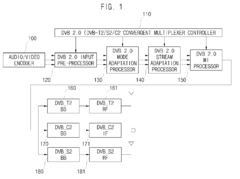
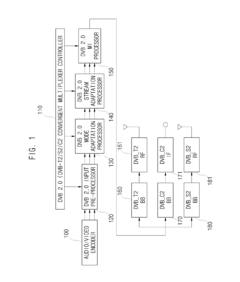
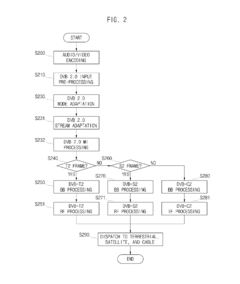
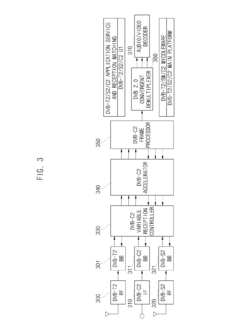
- A convergent multiplexer and variable receiver structure that can support all DVB standards, featuring an audio/video encoder, pre-processor, mode adaptation processor, stream adaptation processor, modulator interface processor, and RF modules, allowing for unified processing and transmission/reception across DVB-T2, DVB-S2, and DVB-C2 standards.
Patent
Innovation
- Customizable logic blocks for specialized multiplexing needs
- Adaptive power management for energy-efficient operation in varying load conditions
- Multi-protocol support within a single multiplexer architecture
Standardization Efforts
Standardization efforts in the field of multiplexer technology play a crucial role in ensuring interoperability, reliability, and consistency across various applications and industries. These efforts are particularly important when developing unique multiplexer features for specialized needs, as they provide a framework for innovation while maintaining compatibility with existing systems.
Several international organizations are at the forefront of multiplexer standardization. The International Telecommunication Union (ITU) has been instrumental in developing standards for telecommunications multiplexers, such as the G.703 and G.704 recommendations for digital interfaces. These standards define the electrical and functional characteristics of multiplexers, ensuring seamless integration in global communication networks.
In the realm of optical multiplexing, the Institute of Electrical and Electronics Engineers (IEEE) has made significant contributions. The IEEE 802.3 working group, for instance, has developed standards for Ethernet-based multiplexing technologies, including wavelength division multiplexing (WDM) in optical networks. These standards have been crucial in enabling the development of high-speed, high-capacity optical communication systems.
The International Electrotechnical Commission (IEC) has also been active in multiplexer standardization, particularly in industrial applications. Their standards cover aspects such as electromagnetic compatibility, environmental conditions, and safety requirements for multiplexers used in harsh industrial environments.
For specialized needs, industry-specific consortia often lead standardization efforts. For example, the MIPI Alliance focuses on interface specifications for mobile devices, including multiplexer standards for connecting various components within smartphones and tablets. Similarly, the PCI Special Interest Group (PCI-SIG) develops standards for PCIe multiplexing in computer systems.
When developing unique multiplexer features, adherence to these standards is essential. However, innovation often requires pushing the boundaries of existing standards. In such cases, companies and researchers work closely with standardization bodies to propose extensions or new standards that accommodate novel features while maintaining backward compatibility.
The process of standardization for new multiplexer features typically involves several stages. Initially, a technical proposal is submitted to the relevant standardization body. This is followed by a period of review, discussion, and refinement within working groups. Once consensus is reached, the proposed standard undergoes a formal approval process before being published and widely adopted.
Participation in standardization efforts can provide significant advantages for companies developing unique multiplexer features. It allows them to influence the direction of industry standards, ensure their innovations are compatible with broader ecosystems, and potentially gain early market advantages through standards-compliant products.
Several international organizations are at the forefront of multiplexer standardization. The International Telecommunication Union (ITU) has been instrumental in developing standards for telecommunications multiplexers, such as the G.703 and G.704 recommendations for digital interfaces. These standards define the electrical and functional characteristics of multiplexers, ensuring seamless integration in global communication networks.
In the realm of optical multiplexing, the Institute of Electrical and Electronics Engineers (IEEE) has made significant contributions. The IEEE 802.3 working group, for instance, has developed standards for Ethernet-based multiplexing technologies, including wavelength division multiplexing (WDM) in optical networks. These standards have been crucial in enabling the development of high-speed, high-capacity optical communication systems.
The International Electrotechnical Commission (IEC) has also been active in multiplexer standardization, particularly in industrial applications. Their standards cover aspects such as electromagnetic compatibility, environmental conditions, and safety requirements for multiplexers used in harsh industrial environments.
For specialized needs, industry-specific consortia often lead standardization efforts. For example, the MIPI Alliance focuses on interface specifications for mobile devices, including multiplexer standards for connecting various components within smartphones and tablets. Similarly, the PCI Special Interest Group (PCI-SIG) develops standards for PCIe multiplexing in computer systems.
When developing unique multiplexer features, adherence to these standards is essential. However, innovation often requires pushing the boundaries of existing standards. In such cases, companies and researchers work closely with standardization bodies to propose extensions or new standards that accommodate novel features while maintaining backward compatibility.
The process of standardization for new multiplexer features typically involves several stages. Initially, a technical proposal is submitted to the relevant standardization body. This is followed by a period of review, discussion, and refinement within working groups. Once consensus is reached, the proposed standard undergoes a formal approval process before being published and widely adopted.
Participation in standardization efforts can provide significant advantages for companies developing unique multiplexer features. It allows them to influence the direction of industry standards, ensure their innovations are compatible with broader ecosystems, and potentially gain early market advantages through standards-compliant products.
Energy Efficiency Considerations
Energy efficiency is a critical consideration in the development of unique multiplexer features for specialized needs. As data transmission demands continue to grow, the power consumption of multiplexing systems becomes increasingly significant. Addressing this challenge requires a multifaceted approach that combines innovative circuit design, advanced materials, and intelligent power management techniques.
One key strategy for improving energy efficiency in multiplexers is the implementation of low-power circuit designs. This involves optimizing the transistor-level architecture to minimize static and dynamic power consumption. Techniques such as clock gating, power gating, and voltage scaling can be employed to reduce power usage during periods of low activity or when certain multiplexer channels are not in use.
Advanced semiconductor materials and manufacturing processes also play a crucial role in enhancing energy efficiency. The adoption of silicon-on-insulator (SOI) technology or III-V compound semiconductors can lead to significant reductions in power consumption while maintaining or even improving performance. These materials offer lower parasitic capacitances and reduced leakage currents, contributing to overall power savings.
Thermal management is another important aspect of energy-efficient multiplexer design. Efficient heat dissipation not only improves reliability but also allows for higher performance within the same power envelope. Innovative cooling solutions, such as integrated micro-fluidic channels or advanced thermal interface materials, can help maintain optimal operating temperatures and reduce the need for energy-intensive cooling systems.
Intelligent power management algorithms can further enhance energy efficiency by dynamically adjusting the multiplexer's operating parameters based on real-time traffic patterns and system requirements. These algorithms can optimize power allocation across different channels, scale frequency and voltage dynamically, and implement sleep modes for inactive components.
The integration of energy harvesting technologies presents an exciting opportunity for improving the overall energy efficiency of multiplexer systems. By capturing and utilizing ambient energy sources such as vibrations, thermal gradients, or electromagnetic fields, it may be possible to supplement or even replace traditional power sources in certain applications, particularly in remote or hard-to-reach locations.
As specialized needs often require custom solutions, the development of application-specific integrated circuits (ASICs) for multiplexing can lead to significant energy efficiency gains. These tailored designs can eliminate unnecessary features and optimize power consumption for the specific use case, resulting in more efficient operation compared to general-purpose multiplexers.
One key strategy for improving energy efficiency in multiplexers is the implementation of low-power circuit designs. This involves optimizing the transistor-level architecture to minimize static and dynamic power consumption. Techniques such as clock gating, power gating, and voltage scaling can be employed to reduce power usage during periods of low activity or when certain multiplexer channels are not in use.
Advanced semiconductor materials and manufacturing processes also play a crucial role in enhancing energy efficiency. The adoption of silicon-on-insulator (SOI) technology or III-V compound semiconductors can lead to significant reductions in power consumption while maintaining or even improving performance. These materials offer lower parasitic capacitances and reduced leakage currents, contributing to overall power savings.
Thermal management is another important aspect of energy-efficient multiplexer design. Efficient heat dissipation not only improves reliability but also allows for higher performance within the same power envelope. Innovative cooling solutions, such as integrated micro-fluidic channels or advanced thermal interface materials, can help maintain optimal operating temperatures and reduce the need for energy-intensive cooling systems.
Intelligent power management algorithms can further enhance energy efficiency by dynamically adjusting the multiplexer's operating parameters based on real-time traffic patterns and system requirements. These algorithms can optimize power allocation across different channels, scale frequency and voltage dynamically, and implement sleep modes for inactive components.
The integration of energy harvesting technologies presents an exciting opportunity for improving the overall energy efficiency of multiplexer systems. By capturing and utilizing ambient energy sources such as vibrations, thermal gradients, or electromagnetic fields, it may be possible to supplement or even replace traditional power sources in certain applications, particularly in remote or hard-to-reach locations.
As specialized needs often require custom solutions, the development of application-specific integrated circuits (ASICs) for multiplexing can lead to significant energy efficiency gains. These tailored designs can eliminate unnecessary features and optimize power consumption for the specific use case, resulting in more efficient operation compared to general-purpose multiplexers.
Unlock deeper insights with PatSnap Eureka Quick Research — get a full tech report to explore trends and direct your research. Try now!
Generate Your Research Report Instantly with AI Agent
Supercharge your innovation with PatSnap Eureka AI Agent Platform!