

How to Fine-Tune Bridge Rectifiers for Optimum Performance
MAR 24, 20269 MIN READ
Generate Your Research Report Instantly with AI Agent
Patsnap Eureka helps you evaluate technical feasibility & market potential.
Bridge Rectifier Technology Background and Performance Goals
Bridge rectifier technology has evolved significantly since its inception in the early 20th century, emerging as a fundamental component in power electronics systems. The technology originated from the need to convert alternating current (AC) to direct current (DC) efficiently, addressing the growing demand for DC power in electronic devices and industrial applications. Early implementations utilized vacuum tubes and selenium rectifiers, which gradually gave way to silicon diodes in the 1950s, marking a pivotal transformation in rectification efficiency and reliability.
The evolution of bridge rectifier technology has been driven by continuous improvements in semiconductor materials and manufacturing processes. The transition from germanium to silicon diodes brought enhanced temperature stability and higher voltage handling capabilities. Subsequently, the development of Schottky diodes introduced faster switching speeds and lower forward voltage drops, while silicon carbide (SiC) and gallium nitride (GaN) technologies have pushed the boundaries of high-frequency and high-temperature operations.
Current technological trends focus on minimizing power losses, reducing electromagnetic interference, and enhancing thermal management. The integration of advanced packaging techniques, such as surface-mount technology and multi-chip modules, has enabled more compact and efficient designs. Additionally, the incorporation of intelligent control systems and real-time monitoring capabilities represents a significant advancement in optimizing rectifier performance dynamically.
The primary performance goals for modern bridge rectifiers center on achieving maximum efficiency while maintaining reliability and cost-effectiveness. Efficiency optimization targets include minimizing conduction losses through the selection of low forward voltage drop diodes and reducing switching losses by employing fast recovery diodes. Thermal management objectives focus on maintaining junction temperatures within safe operating limits through improved heat dissipation techniques and thermal interface materials.
Reliability enhancement goals encompass extending operational lifespan through robust design practices, implementing protection mechanisms against voltage spikes and overcurrent conditions, and ensuring consistent performance across varying environmental conditions. The pursuit of higher power density aims to deliver greater output power within smaller form factors, addressing the miniaturization demands of modern electronic systems.
Performance optimization also extends to harmonic distortion reduction and power factor improvement, which are crucial for meeting stringent power quality standards. Advanced filtering techniques and active power factor correction methods are increasingly integrated to achieve these objectives, ensuring compliance with international electromagnetic compatibility regulations while maximizing overall system efficiency.
The evolution of bridge rectifier technology has been driven by continuous improvements in semiconductor materials and manufacturing processes. The transition from germanium to silicon diodes brought enhanced temperature stability and higher voltage handling capabilities. Subsequently, the development of Schottky diodes introduced faster switching speeds and lower forward voltage drops, while silicon carbide (SiC) and gallium nitride (GaN) technologies have pushed the boundaries of high-frequency and high-temperature operations.
Current technological trends focus on minimizing power losses, reducing electromagnetic interference, and enhancing thermal management. The integration of advanced packaging techniques, such as surface-mount technology and multi-chip modules, has enabled more compact and efficient designs. Additionally, the incorporation of intelligent control systems and real-time monitoring capabilities represents a significant advancement in optimizing rectifier performance dynamically.
The primary performance goals for modern bridge rectifiers center on achieving maximum efficiency while maintaining reliability and cost-effectiveness. Efficiency optimization targets include minimizing conduction losses through the selection of low forward voltage drop diodes and reducing switching losses by employing fast recovery diodes. Thermal management objectives focus on maintaining junction temperatures within safe operating limits through improved heat dissipation techniques and thermal interface materials.
Reliability enhancement goals encompass extending operational lifespan through robust design practices, implementing protection mechanisms against voltage spikes and overcurrent conditions, and ensuring consistent performance across varying environmental conditions. The pursuit of higher power density aims to deliver greater output power within smaller form factors, addressing the miniaturization demands of modern electronic systems.
Performance optimization also extends to harmonic distortion reduction and power factor improvement, which are crucial for meeting stringent power quality standards. Advanced filtering techniques and active power factor correction methods are increasingly integrated to achieve these objectives, ensuring compliance with international electromagnetic compatibility regulations while maximizing overall system efficiency.
Market Demand for High-Performance Bridge Rectifier Solutions
The global power electronics market continues to experience robust growth, driven by increasing demand for energy-efficient solutions across multiple industries. Bridge rectifiers, as fundamental components in AC-to-DC conversion systems, represent a critical segment within this expanding market. The push toward renewable energy integration, electric vehicle adoption, and industrial automation has created substantial opportunities for high-performance rectifier solutions that can deliver superior efficiency, reliability, and thermal management.
Industrial applications constitute the largest market segment for high-performance bridge rectifiers, particularly in motor drives, welding equipment, and power supplies for manufacturing systems. The automotive sector has emerged as a rapidly growing market, with electric and hybrid vehicles requiring sophisticated rectification systems for battery charging infrastructure and onboard power conversion. Consumer electronics continue to demand compact, efficient rectifiers for power adapters, LED lighting systems, and home appliances.
Telecommunications infrastructure represents another significant market driver, as 5G network deployment requires reliable power conversion systems capable of handling varying load conditions while maintaining high efficiency. Data centers and server farms increasingly prioritize energy-efficient rectifier solutions to reduce operational costs and meet sustainability targets. The renewable energy sector, including solar inverters and wind power systems, demands rectifiers that can handle high-frequency switching and variable input conditions.
Market demand is increasingly focused on rectifiers that can operate at higher switching frequencies while minimizing power losses and electromagnetic interference. Customers seek solutions that offer improved thermal performance, reduced form factors, and enhanced reliability under harsh operating conditions. The trend toward wide bandgap semiconductors, such as silicon carbide and gallium nitride, has created new market opportunities for advanced rectifier designs that can leverage these materials' superior characteristics.
Emerging applications in wireless power transfer, electric aircraft, and grid-tied energy storage systems are creating niche but high-value market segments. These applications require specialized rectifier solutions with stringent performance requirements, including low ripple, fast transient response, and high power density. The market increasingly values integrated solutions that combine rectification with additional functions such as power factor correction and voltage regulation.
Industrial applications constitute the largest market segment for high-performance bridge rectifiers, particularly in motor drives, welding equipment, and power supplies for manufacturing systems. The automotive sector has emerged as a rapidly growing market, with electric and hybrid vehicles requiring sophisticated rectification systems for battery charging infrastructure and onboard power conversion. Consumer electronics continue to demand compact, efficient rectifiers for power adapters, LED lighting systems, and home appliances.
Telecommunications infrastructure represents another significant market driver, as 5G network deployment requires reliable power conversion systems capable of handling varying load conditions while maintaining high efficiency. Data centers and server farms increasingly prioritize energy-efficient rectifier solutions to reduce operational costs and meet sustainability targets. The renewable energy sector, including solar inverters and wind power systems, demands rectifiers that can handle high-frequency switching and variable input conditions.
Market demand is increasingly focused on rectifiers that can operate at higher switching frequencies while minimizing power losses and electromagnetic interference. Customers seek solutions that offer improved thermal performance, reduced form factors, and enhanced reliability under harsh operating conditions. The trend toward wide bandgap semiconductors, such as silicon carbide and gallium nitride, has created new market opportunities for advanced rectifier designs that can leverage these materials' superior characteristics.
Emerging applications in wireless power transfer, electric aircraft, and grid-tied energy storage systems are creating niche but high-value market segments. These applications require specialized rectifier solutions with stringent performance requirements, including low ripple, fast transient response, and high power density. The market increasingly values integrated solutions that combine rectification with additional functions such as power factor correction and voltage regulation.
Current State and Challenges in Bridge Rectifier Optimization
Bridge rectifier technology has reached a mature state in terms of basic functionality, yet significant challenges persist in achieving optimal performance across diverse applications. Current implementations predominantly utilize silicon-based diodes in full-wave rectification configurations, with emerging adoption of silicon carbide and gallium nitride semiconductors in high-frequency applications. The technology landscape shows a clear division between traditional low-frequency power supplies and advanced high-efficiency switching systems.
Modern bridge rectifiers face substantial efficiency limitations, particularly in low-voltage, high-current applications where forward voltage drops significantly impact overall system performance. Conventional silicon diodes exhibit forward voltage drops of 0.7V, resulting in power losses that become increasingly problematic as output voltages decrease. This challenge is compounded by thermal management issues, as heat dissipation requirements often necessitate oversized cooling systems that compromise system compactness and cost-effectiveness.
Electromagnetic interference represents another critical challenge in contemporary bridge rectifier optimization. High-frequency switching applications generate significant EMI, requiring complex filtering solutions that introduce additional losses and design complexity. The trade-off between switching speed and EMI compliance creates constraints that limit performance optimization potential, particularly in applications requiring both high efficiency and strict electromagnetic compatibility standards.
Reverse recovery characteristics of rectifier diodes present ongoing technical obstacles, especially in high-frequency applications. The stored charge in diode junctions during forward conduction creates reverse current spikes during switching transitions, leading to increased losses and potential circuit instability. This phenomenon becomes more pronounced at elevated switching frequencies, limiting the effectiveness of optimization strategies in modern power electronic systems.
Geographic distribution of advanced bridge rectifier technology development shows concentration in established semiconductor manufacturing regions, with leading research and production capabilities primarily located in Asia, Europe, and North America. However, emerging markets demonstrate increasing demand for optimized rectification solutions, creating supply chain challenges and technology transfer requirements that complicate global implementation of advanced optimization techniques.
Current optimization efforts are constrained by material limitations and manufacturing tolerances that prevent achievement of theoretical performance limits. The semiconductor industry continues to struggle with balancing cost considerations against performance improvements, particularly in applications where marginal efficiency gains must justify significant increases in component costs and design complexity.
Modern bridge rectifiers face substantial efficiency limitations, particularly in low-voltage, high-current applications where forward voltage drops significantly impact overall system performance. Conventional silicon diodes exhibit forward voltage drops of 0.7V, resulting in power losses that become increasingly problematic as output voltages decrease. This challenge is compounded by thermal management issues, as heat dissipation requirements often necessitate oversized cooling systems that compromise system compactness and cost-effectiveness.
Electromagnetic interference represents another critical challenge in contemporary bridge rectifier optimization. High-frequency switching applications generate significant EMI, requiring complex filtering solutions that introduce additional losses and design complexity. The trade-off between switching speed and EMI compliance creates constraints that limit performance optimization potential, particularly in applications requiring both high efficiency and strict electromagnetic compatibility standards.
Reverse recovery characteristics of rectifier diodes present ongoing technical obstacles, especially in high-frequency applications. The stored charge in diode junctions during forward conduction creates reverse current spikes during switching transitions, leading to increased losses and potential circuit instability. This phenomenon becomes more pronounced at elevated switching frequencies, limiting the effectiveness of optimization strategies in modern power electronic systems.
Geographic distribution of advanced bridge rectifier technology development shows concentration in established semiconductor manufacturing regions, with leading research and production capabilities primarily located in Asia, Europe, and North America. However, emerging markets demonstrate increasing demand for optimized rectification solutions, creating supply chain challenges and technology transfer requirements that complicate global implementation of advanced optimization techniques.
Current optimization efforts are constrained by material limitations and manufacturing tolerances that prevent achievement of theoretical performance limits. The semiconductor industry continues to struggle with balancing cost considerations against performance improvements, particularly in applications where marginal efficiency gains must justify significant increases in component costs and design complexity.
Existing Fine-Tuning Solutions for Bridge Rectifiers
01 Bridge rectifier circuit configurations and topologies
Various circuit configurations and topologies have been developed to improve bridge rectifier performance. These include modifications to the traditional four-diode bridge arrangement, alternative switching configurations, and novel circuit designs that optimize voltage conversion and reduce component count. Different topologies can be employed to achieve better efficiency, reduced voltage drop, and improved power handling capabilities in rectification applications.- Bridge rectifier circuit configurations and topologies: Various circuit configurations and topologies have been developed to improve bridge rectifier performance. These include modifications to the traditional four-diode bridge arrangement, alternative connection schemes, and novel circuit designs that optimize voltage conversion and current flow. Different topologies can be employed to reduce voltage drops, minimize power losses, and enhance overall rectification efficiency. These configurations may involve different arrangements of rectifying elements and connection methods to achieve improved performance characteristics.
- Advanced semiconductor materials and diode technologies: The performance of bridge rectifiers can be significantly enhanced through the use of advanced semiconductor materials and improved diode technologies. Modern rectifier designs incorporate specialized diode structures with reduced forward voltage drops and faster switching characteristics. These improvements result in lower power dissipation, reduced heat generation, and higher efficiency. The selection of appropriate semiconductor materials and diode types is crucial for optimizing rectifier performance in various applications, particularly in high-frequency and high-power scenarios.
- Thermal management and heat dissipation techniques: Effective thermal management is essential for maintaining optimal bridge rectifier performance and reliability. Various heat dissipation techniques have been developed, including improved packaging designs, heat sink configurations, and thermal interface materials. Proper thermal design ensures that rectifier components operate within safe temperature ranges, preventing thermal degradation and extending component lifespan. These techniques address the heat generated during rectification processes and help maintain consistent performance under varying load conditions.
- Control and regulation circuits for rectifier optimization: Integration of control and regulation circuits enhances bridge rectifier performance by providing active monitoring and adjustment capabilities. These circuits can include voltage regulation, current limiting, and protection features that optimize rectifier operation under different load conditions. Advanced control schemes enable adaptive performance adjustment, improved power factor correction, and enhanced stability. Such systems may incorporate feedback mechanisms and intelligent control algorithms to maintain optimal rectification performance across varying input and output conditions.
- Filtering and ripple reduction methods: Various filtering and ripple reduction methods have been developed to improve the output quality of bridge rectifiers. These techniques involve the use of capacitive and inductive filtering elements, smoothing circuits, and advanced filtering topologies to minimize output voltage ripple and improve DC output characteristics. Effective filtering is crucial for applications requiring stable DC voltage with minimal AC components. Different filtering approaches can be tailored to specific performance requirements, balancing factors such as response time, component size, and output quality.
02 Semiconductor materials and diode technologies for bridge rectifiers
The performance of bridge rectifiers is significantly influenced by the semiconductor materials and diode technologies used in their construction. Advanced materials and manufacturing processes enable the development of diodes with lower forward voltage drop, higher current handling capacity, and improved thermal characteristics. These technological improvements contribute to enhanced overall rectifier efficiency and reliability in power conversion applications.Expand Specific Solutions03 Thermal management and heat dissipation in bridge rectifiers
Effective thermal management is crucial for maintaining optimal bridge rectifier performance under various operating conditions. Design approaches include improved heat sink configurations, thermal coupling methods, and packaging techniques that facilitate better heat dissipation. Proper thermal design prevents component degradation, extends operational lifetime, and maintains consistent electrical characteristics across different load conditions and ambient temperatures.Expand Specific Solutions04 Control and protection circuits for bridge rectifiers
Integration of control and protection circuits enhances bridge rectifier performance and reliability. These circuits include voltage regulation mechanisms, overcurrent protection, surge suppression, and monitoring systems that ensure safe operation under fault conditions. Advanced control strategies can optimize rectifier operation for different load profiles and input voltage variations, improving overall system efficiency and protecting downstream components.Expand Specific Solutions05 Compact and integrated bridge rectifier designs
Modern bridge rectifier designs focus on miniaturization and integration to reduce size, weight, and cost while maintaining or improving performance. These designs incorporate multiple rectifying elements in single packages, utilize advanced packaging technologies, and employ integrated circuit techniques. Compact designs are particularly valuable in space-constrained applications and enable higher power density in power supply systems.Expand Specific Solutions
Key Players in Power Electronics and Rectifier Industry
The bridge rectifier optimization market represents a mature yet evolving segment within power electronics, currently in a consolidation phase driven by efficiency demands and miniaturization trends. The global market, valued at several billion dollars, spans automotive, industrial automation, consumer electronics, and renewable energy sectors. Technology maturity varies significantly across applications, with established players like Robert Bosch GmbH, Samsung Electronics, and Mitsubishi Electric leading automotive and consumer segments through advanced semiconductor integration. Meanwhile, specialized firms such as Enphase Energy focus on renewable energy applications, and companies like STMicroelectronics and Taiwan Semiconductor Manufacturing drive innovation in power semiconductor fabrication. Academic institutions including Zhejiang University and Harbin Institute of Technology contribute fundamental research in power conversion efficiency. The competitive landscape features both horizontal integration by major electronics manufacturers and vertical specialization by power electronics companies, with emerging players like Mornsun and Champion Microelectronic targeting niche applications through cost-effective solutions.
Robert Bosch GmbH
Technical Solution: Bosch implements advanced bridge rectifier optimization through intelligent switching control algorithms and adaptive gate timing mechanisms. Their approach focuses on minimizing switching losses by employing soft-switching techniques and optimized dead-time control. The company utilizes silicon carbide (SiC) and gallium nitride (GaN) power semiconductors to achieve higher efficiency ratings exceeding 98% in automotive applications. Their rectifier systems incorporate real-time thermal management with integrated temperature sensors and dynamic current limiting to prevent thermal runaway. Bosch's proprietary control algorithms adjust switching frequency based on load conditions, optimizing performance across varying operational scenarios while maintaining electromagnetic compatibility standards.
Strengths: Industry-leading efficiency ratings, robust thermal management, extensive automotive application experience. Weaknesses: Higher cost due to advanced materials, complex control algorithms requiring specialized expertise.
Samsung Electronics Co., Ltd.
Technical Solution: Samsung's bridge rectifier optimization strategy centers on advanced semiconductor fabrication techniques and integrated circuit design. They employ ultra-low forward voltage drop diodes manufactured using their proprietary 8nm FinFET process technology, achieving forward voltage drops as low as 0.3V. Their rectifier modules integrate smart power management ICs that dynamically adjust conduction angles and implement predictive switching algorithms. Samsung incorporates machine learning-based optimization that analyzes load patterns and automatically adjusts rectifier parameters for maximum efficiency. Their solutions feature integrated EMI filtering and power factor correction capabilities, with efficiency improvements of up to 15% compared to conventional designs through advanced packaging technologies and thermal interface materials.
Strengths: Cutting-edge semiconductor fabrication capabilities, AI-driven optimization, excellent integration with power management systems. Weaknesses: Limited focus on high-power industrial applications, primarily consumer electronics oriented.
Core Innovations in Bridge Rectifier Performance Optimization
Ideal diode bridge rectifying circuit and control method
PatentActiveUS20180097451A1
Innovation
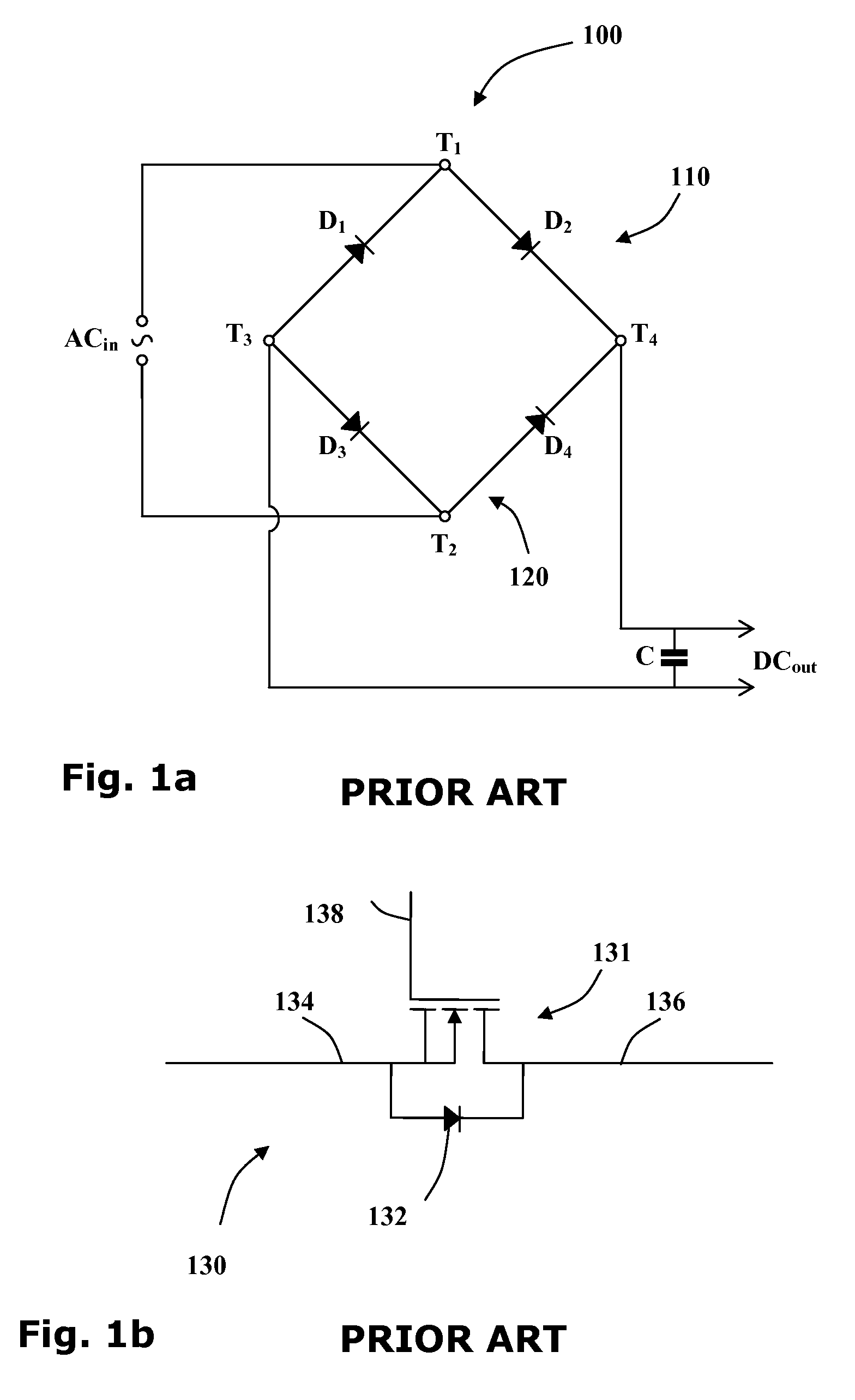
- A rectifying circuit employing an ideal diode bridge with MOSFETs, controlled by a processor-driven system that measures current and phase to determine conducting settings for the diodes, allowing for efficient conversion of AC to DC voltage while avoiding the limitations of conventional silicon diodes and MOSFET voltage ratings.


Bridge synchronous rectifier
PatentActiveUS8320143B2
Innovation
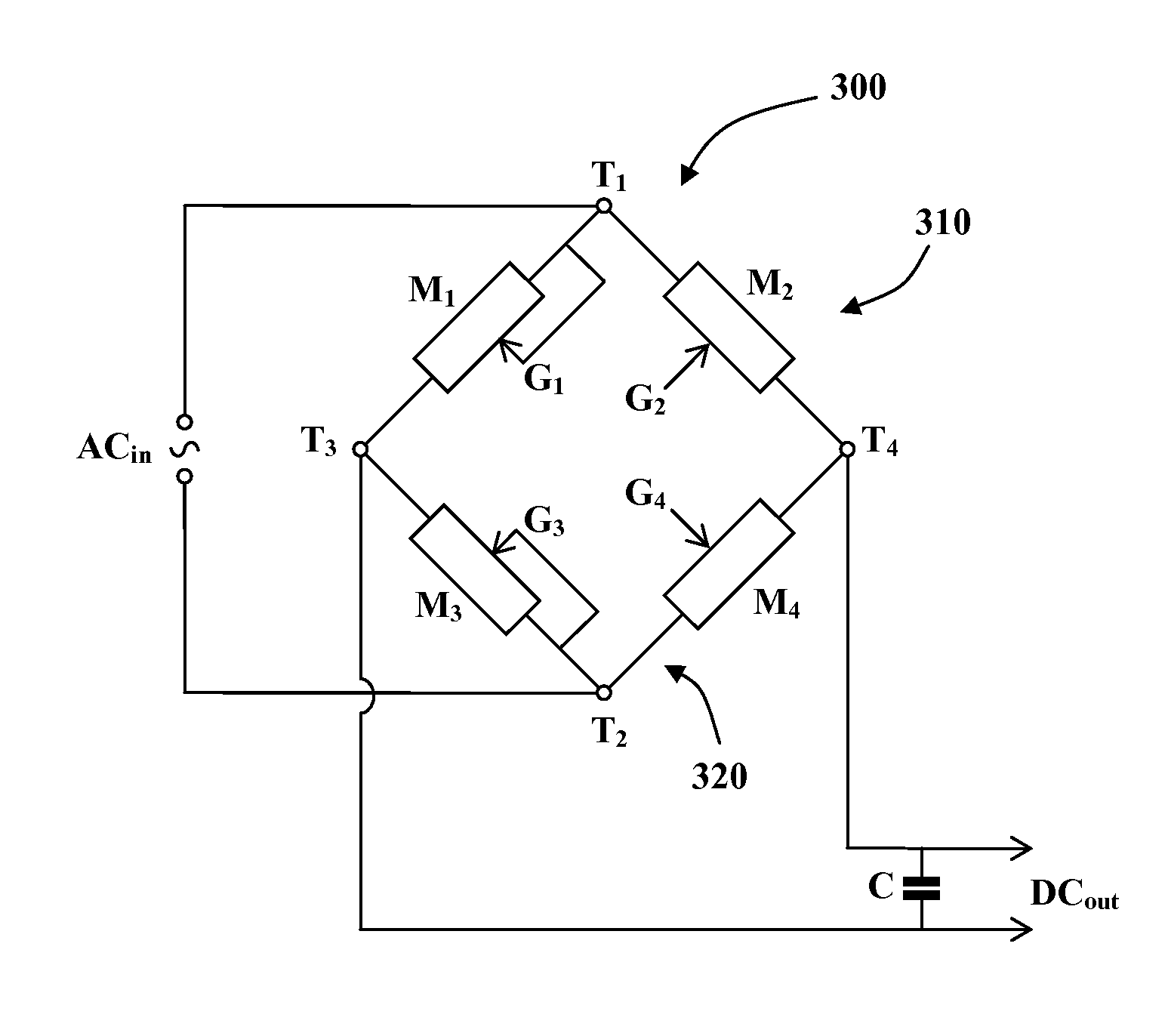
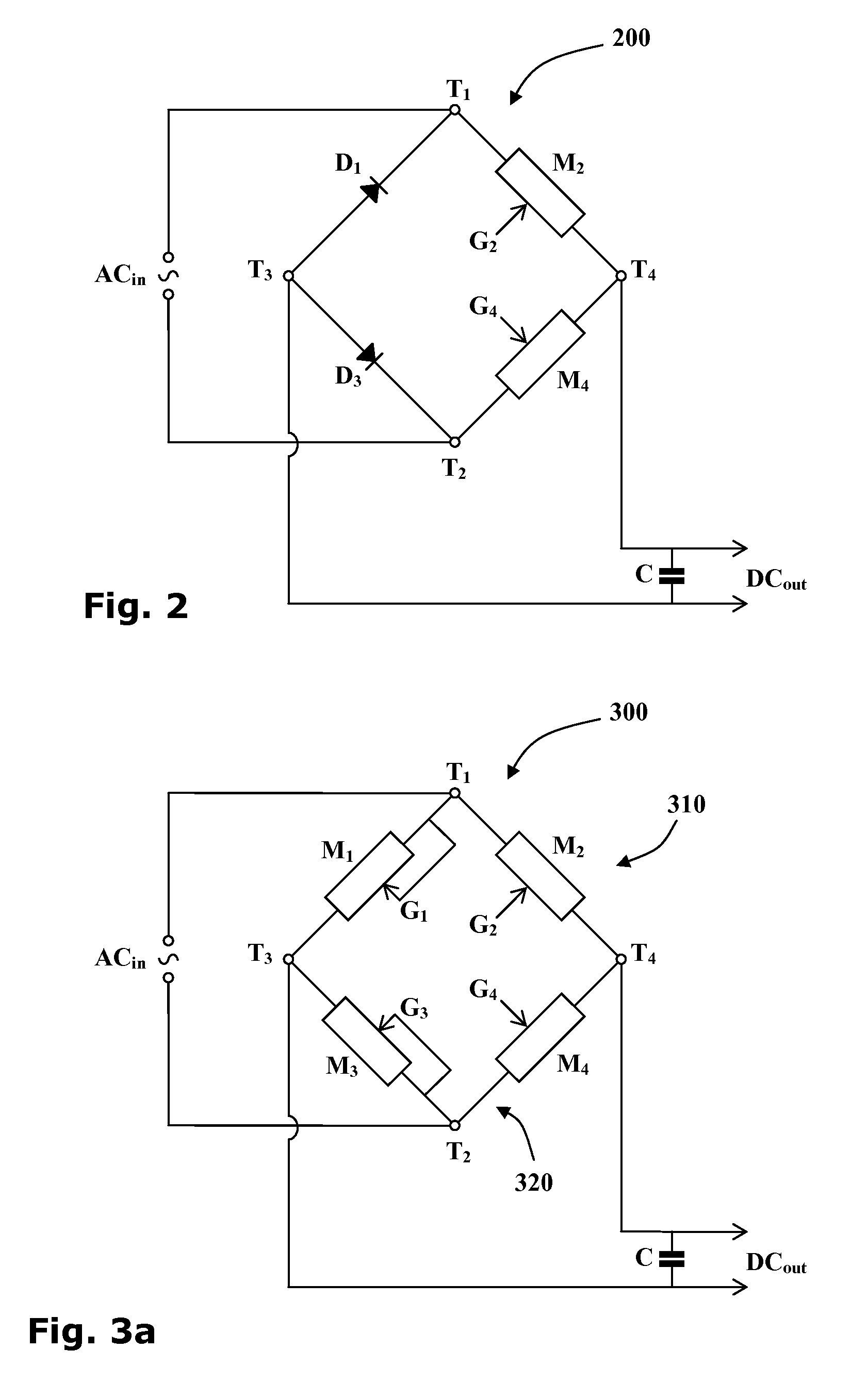
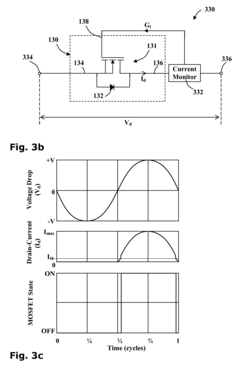
- A current-triggered synchronous rectifier is developed, utilizing MOSFET devices with a current monitor to switch between ON and OFF states based on predetermined current thresholds, replacing diodes in a full-wave rectifier configuration to minimize heat loss and prevent short circuits.
Power Electronics Standards and Compliance Requirements
Bridge rectifier optimization must comply with a comprehensive framework of international and regional power electronics standards that govern safety, electromagnetic compatibility, and performance characteristics. The primary standards include IEC 61000 series for electromagnetic compatibility, IEC 60950 for safety requirements, and IEEE 519 for harmonic distortion limits. These standards establish fundamental parameters for voltage regulation, current handling capacity, and thermal management that directly influence fine-tuning strategies.
Compliance with safety standards such as UL 1998 and EN 60950 requires specific attention to isolation requirements, creepage distances, and clearance specifications when optimizing bridge rectifier configurations. These safety parameters often constrain the physical layout and component selection during fine-tuning processes, particularly affecting heat sink design and component spacing. The standards mandate minimum insulation resistance values and dielectric strength requirements that must be maintained throughout the optimization process.
Electromagnetic interference and compatibility requirements under CISPR 22 and FCC Part 15 significantly impact bridge rectifier design optimization. These standards limit conducted and radiated emissions, necessitating careful consideration of switching frequency selection, snubber circuit design, and filtering requirements. Fine-tuning efforts must incorporate EMI suppression techniques while maintaining efficiency targets, often requiring iterative design adjustments to achieve compliance.
Harmonic distortion standards, particularly IEEE 519 and IEC 61000-3-2, establish total harmonic distortion limits that influence input current shaping and power factor correction strategies. Bridge rectifier optimization must consider these harmonic limits when selecting switching patterns, control algorithms, and passive component values. The standards define acceptable distortion levels across different frequency ranges, directly affecting the selection of inductance and capacitance values in the rectifier circuit.
Regional compliance variations add complexity to optimization strategies, as different markets may require adherence to specific national standards alongside international requirements. For instance, Chinese GB standards, Japanese JIS requirements, and European EN specifications may impose additional constraints on efficiency ratings, standby power consumption, and environmental operating conditions. These regional differences necessitate flexible design approaches that can accommodate multiple compliance frameworks while maintaining optimal performance characteristics across diverse market requirements.
Compliance with safety standards such as UL 1998 and EN 60950 requires specific attention to isolation requirements, creepage distances, and clearance specifications when optimizing bridge rectifier configurations. These safety parameters often constrain the physical layout and component selection during fine-tuning processes, particularly affecting heat sink design and component spacing. The standards mandate minimum insulation resistance values and dielectric strength requirements that must be maintained throughout the optimization process.
Electromagnetic interference and compatibility requirements under CISPR 22 and FCC Part 15 significantly impact bridge rectifier design optimization. These standards limit conducted and radiated emissions, necessitating careful consideration of switching frequency selection, snubber circuit design, and filtering requirements. Fine-tuning efforts must incorporate EMI suppression techniques while maintaining efficiency targets, often requiring iterative design adjustments to achieve compliance.
Harmonic distortion standards, particularly IEEE 519 and IEC 61000-3-2, establish total harmonic distortion limits that influence input current shaping and power factor correction strategies. Bridge rectifier optimization must consider these harmonic limits when selecting switching patterns, control algorithms, and passive component values. The standards define acceptable distortion levels across different frequency ranges, directly affecting the selection of inductance and capacitance values in the rectifier circuit.
Regional compliance variations add complexity to optimization strategies, as different markets may require adherence to specific national standards alongside international requirements. For instance, Chinese GB standards, Japanese JIS requirements, and European EN specifications may impose additional constraints on efficiency ratings, standby power consumption, and environmental operating conditions. These regional differences necessitate flexible design approaches that can accommodate multiple compliance frameworks while maintaining optimal performance characteristics across diverse market requirements.
Thermal Management Strategies for Optimized Bridge Rectifiers
Thermal management represents a critical aspect of bridge rectifier optimization, as excessive heat generation directly impacts performance, efficiency, and component longevity. The inherent voltage drops across diodes during conduction cycles generate substantial heat, particularly under high-current operations. This thermal energy accumulation can lead to junction temperature elevation, increased forward voltage drop, and potential thermal runaway conditions that compromise rectifier reliability.
Heat dissipation mechanisms in bridge rectifiers primarily involve conduction, convection, and radiation pathways. Conductive heat transfer occurs through the semiconductor substrate and mounting interfaces, making thermal interface materials and heat sink coupling crucial. The thermal resistance from junction to case and case to ambient determines the overall thermal performance, with typical silicon diodes exhibiting thermal resistance values ranging from 1.5 to 15°C/W depending on package configuration.
Advanced heat sink designs incorporate finned structures, heat pipes, and vapor chambers to enhance thermal conductivity. Aluminum and copper heat sinks remain prevalent due to their favorable thermal conductivity properties, with copper offering superior performance at higher cost. Surface area optimization through fin geometry and spacing calculations ensures maximum convective heat transfer while maintaining practical size constraints.
Active cooling solutions employ forced air circulation or liquid cooling systems for high-power applications. Fan-assisted cooling can reduce thermal resistance by 40-60% compared to passive solutions, while liquid cooling systems achieve even greater thermal performance for industrial and automotive applications requiring continuous high-current operation.
Thermal interface materials play a pivotal role in minimizing contact resistance between semiconductor packages and heat sinks. Modern thermal compounds, phase-change materials, and thermal pads offer thermal conductivity ranging from 1 to 15 W/mK, significantly impacting overall thermal management effectiveness.
Package-level innovations include exposed pad configurations, thermal vias, and integrated heat spreaders that facilitate direct heat extraction from the semiconductor die. These design approaches reduce thermal resistance and enable more compact rectifier implementations without compromising thermal performance.
Temperature monitoring and thermal protection circuits provide additional safety margins by implementing thermal shutdown mechanisms when junction temperatures exceed safe operating limits, ensuring long-term reliability and preventing catastrophic failures in demanding applications.
Heat dissipation mechanisms in bridge rectifiers primarily involve conduction, convection, and radiation pathways. Conductive heat transfer occurs through the semiconductor substrate and mounting interfaces, making thermal interface materials and heat sink coupling crucial. The thermal resistance from junction to case and case to ambient determines the overall thermal performance, with typical silicon diodes exhibiting thermal resistance values ranging from 1.5 to 15°C/W depending on package configuration.
Advanced heat sink designs incorporate finned structures, heat pipes, and vapor chambers to enhance thermal conductivity. Aluminum and copper heat sinks remain prevalent due to their favorable thermal conductivity properties, with copper offering superior performance at higher cost. Surface area optimization through fin geometry and spacing calculations ensures maximum convective heat transfer while maintaining practical size constraints.
Active cooling solutions employ forced air circulation or liquid cooling systems for high-power applications. Fan-assisted cooling can reduce thermal resistance by 40-60% compared to passive solutions, while liquid cooling systems achieve even greater thermal performance for industrial and automotive applications requiring continuous high-current operation.
Thermal interface materials play a pivotal role in minimizing contact resistance between semiconductor packages and heat sinks. Modern thermal compounds, phase-change materials, and thermal pads offer thermal conductivity ranging from 1 to 15 W/mK, significantly impacting overall thermal management effectiveness.
Package-level innovations include exposed pad configurations, thermal vias, and integrated heat spreaders that facilitate direct heat extraction from the semiconductor die. These design approaches reduce thermal resistance and enable more compact rectifier implementations without compromising thermal performance.
Temperature monitoring and thermal protection circuits provide additional safety margins by implementing thermal shutdown mechanisms when junction temperatures exceed safe operating limits, ensuring long-term reliability and preventing catastrophic failures in demanding applications.
Unlock deeper insights with Patsnap Eureka Quick Research — get a full tech report to explore trends and direct your research. Try now!
Generate Your Research Report Instantly with AI Agent
Supercharge your innovation with Patsnap Eureka AI Agent Platform!