

How to Model Thermal Runaway Events in Simulation Software
FEB 26, 20269 MIN READ
Generate Your Research Report Instantly with AI Agent
PatSnap Eureka helps you evaluate technical feasibility & market potential.
Thermal Runaway Modeling Background and Objectives
Thermal runaway represents one of the most critical safety concerns in modern energy storage systems, particularly lithium-ion batteries used in electric vehicles, grid storage, and consumer electronics. This phenomenon occurs when a battery cell experiences an uncontrolled temperature rise, leading to a cascade of exothermic reactions that can result in fire, explosion, or toxic gas release. The increasing adoption of high-energy-density battery systems across industries has elevated thermal runaway from a laboratory curiosity to a paramount engineering challenge requiring sophisticated modeling approaches.
The complexity of thermal runaway events stems from their multi-physics nature, involving electrochemical reactions, heat transfer, gas generation, and mechanical deformation occurring simultaneously across multiple time scales. Traditional experimental approaches, while essential for validation, are limited by safety constraints, high costs, and the difficulty of obtaining detailed internal measurements during runaway events. This has created an urgent need for advanced simulation capabilities that can predict, analyze, and mitigate thermal runaway risks during the design phase.
Current simulation software faces significant challenges in accurately capturing the intricate coupling between thermal, electrochemical, and mechanical phenomena that characterize thermal runaway. Existing models often rely on simplified assumptions or empirical correlations that may not adequately represent the complex reaction kinetics and heat generation mechanisms involved. The lack of standardized modeling frameworks has resulted in inconsistent approaches across the industry, limiting the reliability and comparability of simulation results.
The primary objective of developing comprehensive thermal runaway modeling capabilities is to enable predictive simulation of battery safety behavior under various abuse conditions, including overcharging, external heating, mechanical damage, and manufacturing defects. These models must accurately capture the initiation mechanisms, propagation dynamics, and thermal-mechanical coupling effects that govern runaway behavior. Additionally, the simulation framework should support multi-scale analysis, from individual cell behavior to module and pack-level thermal propagation.
A secondary objective involves establishing robust validation methodologies that can correlate simulation predictions with experimental observations while maintaining safety protocols. The modeling approach must also facilitate design optimization for thermal management systems, safety mechanisms, and cell-to-cell isolation strategies. Furthermore, the simulation tools should enable rapid parametric studies to evaluate the impact of material properties, cell design variations, and operating conditions on thermal runaway susceptibility, ultimately supporting the development of inherently safer battery technologies.
The complexity of thermal runaway events stems from their multi-physics nature, involving electrochemical reactions, heat transfer, gas generation, and mechanical deformation occurring simultaneously across multiple time scales. Traditional experimental approaches, while essential for validation, are limited by safety constraints, high costs, and the difficulty of obtaining detailed internal measurements during runaway events. This has created an urgent need for advanced simulation capabilities that can predict, analyze, and mitigate thermal runaway risks during the design phase.
Current simulation software faces significant challenges in accurately capturing the intricate coupling between thermal, electrochemical, and mechanical phenomena that characterize thermal runaway. Existing models often rely on simplified assumptions or empirical correlations that may not adequately represent the complex reaction kinetics and heat generation mechanisms involved. The lack of standardized modeling frameworks has resulted in inconsistent approaches across the industry, limiting the reliability and comparability of simulation results.
The primary objective of developing comprehensive thermal runaway modeling capabilities is to enable predictive simulation of battery safety behavior under various abuse conditions, including overcharging, external heating, mechanical damage, and manufacturing defects. These models must accurately capture the initiation mechanisms, propagation dynamics, and thermal-mechanical coupling effects that govern runaway behavior. Additionally, the simulation framework should support multi-scale analysis, from individual cell behavior to module and pack-level thermal propagation.
A secondary objective involves establishing robust validation methodologies that can correlate simulation predictions with experimental observations while maintaining safety protocols. The modeling approach must also facilitate design optimization for thermal management systems, safety mechanisms, and cell-to-cell isolation strategies. Furthermore, the simulation tools should enable rapid parametric studies to evaluate the impact of material properties, cell design variations, and operating conditions on thermal runaway susceptibility, ultimately supporting the development of inherently safer battery technologies.
Market Demand for Battery Safety Simulation Solutions
The global battery safety simulation market is experiencing unprecedented growth driven by the rapid expansion of electric vehicle adoption and energy storage system deployment. Automotive manufacturers are increasingly recognizing that thermal runaway modeling capabilities are no longer optional but essential for meeting stringent safety regulations and consumer expectations. The shift toward higher energy density battery chemistries has amplified the criticality of accurate thermal runaway prediction, creating substantial demand for sophisticated simulation tools.
Regulatory frameworks across major markets are establishing mandatory safety testing requirements that necessitate comprehensive thermal runaway analysis. The European Union's battery regulation and similar initiatives in North America and Asia are compelling manufacturers to demonstrate thorough understanding of thermal propagation mechanisms through validated simulation models. This regulatory pressure is translating into significant investment in advanced modeling capabilities.
The energy storage sector represents another major demand driver, particularly as grid-scale installations proliferate globally. Utility companies and energy storage developers require robust thermal runaway modeling to ensure system safety and optimize thermal management strategies. The increasing scale of these installations amplifies the potential consequences of thermal events, making accurate simulation capabilities indispensable for risk assessment and mitigation planning.
Consumer electronics manufacturers are also driving demand, especially as devices become more compact while requiring higher energy densities. The need to predict and prevent thermal runaway in confined spaces has created specific requirements for simulation tools capable of modeling complex thermal interactions in miniaturized battery systems.
The market demand extends beyond traditional simulation software to encompass integrated platforms that combine thermal runaway modeling with broader battery management system design tools. Companies are seeking comprehensive solutions that enable seamless integration of safety analysis into their overall product development workflows, rather than standalone simulation packages that require extensive data translation and interpretation.
Emerging applications in aerospace, marine, and industrial sectors are further expanding market opportunities. These industries demand specialized thermal runaway modeling capabilities that account for unique operating environments and safety requirements, creating niche but high-value market segments for specialized simulation solutions.
Regulatory frameworks across major markets are establishing mandatory safety testing requirements that necessitate comprehensive thermal runaway analysis. The European Union's battery regulation and similar initiatives in North America and Asia are compelling manufacturers to demonstrate thorough understanding of thermal propagation mechanisms through validated simulation models. This regulatory pressure is translating into significant investment in advanced modeling capabilities.
The energy storage sector represents another major demand driver, particularly as grid-scale installations proliferate globally. Utility companies and energy storage developers require robust thermal runaway modeling to ensure system safety and optimize thermal management strategies. The increasing scale of these installations amplifies the potential consequences of thermal events, making accurate simulation capabilities indispensable for risk assessment and mitigation planning.
Consumer electronics manufacturers are also driving demand, especially as devices become more compact while requiring higher energy densities. The need to predict and prevent thermal runaway in confined spaces has created specific requirements for simulation tools capable of modeling complex thermal interactions in miniaturized battery systems.
The market demand extends beyond traditional simulation software to encompass integrated platforms that combine thermal runaway modeling with broader battery management system design tools. Companies are seeking comprehensive solutions that enable seamless integration of safety analysis into their overall product development workflows, rather than standalone simulation packages that require extensive data translation and interpretation.
Emerging applications in aerospace, marine, and industrial sectors are further expanding market opportunities. These industries demand specialized thermal runaway modeling capabilities that account for unique operating environments and safety requirements, creating niche but high-value market segments for specialized simulation solutions.
Current State of Thermal Runaway Simulation Challenges
Thermal runaway simulation in current software platforms faces significant computational complexity challenges that limit accurate modeling capabilities. The multi-physics nature of thermal runaway events requires simultaneous consideration of electrochemical reactions, heat generation, gas evolution, and structural deformation. Most existing simulation tools struggle to integrate these coupled phenomena effectively, often requiring simplified assumptions that compromise model fidelity.
Current simulation software exhibits substantial limitations in capturing the rapid onset and propagation characteristics of thermal runaway events. The exponential nature of temperature rise during thermal runaway creates numerical instability issues in conventional finite element and finite difference solvers. Time step constraints become extremely restrictive, leading to prohibitively long computation times for practical engineering applications.
Material property modeling represents another critical challenge in contemporary thermal runaway simulation approaches. Battery materials exhibit highly nonlinear temperature-dependent properties, and accurate thermophysical data across the extreme temperature ranges encountered during thermal runaway remains scarce. Existing databases often lack comprehensive property sets for emerging battery chemistries, forcing engineers to rely on extrapolated or estimated values.
The multi-scale nature of thermal runaway phenomena poses significant modeling difficulties for current simulation frameworks. Events initiate at the molecular level within individual cells but propagate across battery pack architectures spanning meters. Bridging these length scales while maintaining computational efficiency requires sophisticated homogenization techniques that most commercial software packages do not adequately support.
Validation and verification of thermal runaway models present ongoing challenges due to the destructive nature of these events. Limited experimental data availability restricts model calibration opportunities, while safety concerns limit comprehensive testing scenarios. Current simulation tools often lack robust uncertainty quantification capabilities to address these data limitations systematically.
Existing software platforms also struggle with the stochastic aspects of thermal runaway initiation and propagation. Manufacturing variabilities, aging effects, and defect distributions significantly influence thermal runaway behavior, yet most current simulation approaches employ deterministic modeling frameworks that cannot capture these statistical variations effectively.
Current simulation software exhibits substantial limitations in capturing the rapid onset and propagation characteristics of thermal runaway events. The exponential nature of temperature rise during thermal runaway creates numerical instability issues in conventional finite element and finite difference solvers. Time step constraints become extremely restrictive, leading to prohibitively long computation times for practical engineering applications.
Material property modeling represents another critical challenge in contemporary thermal runaway simulation approaches. Battery materials exhibit highly nonlinear temperature-dependent properties, and accurate thermophysical data across the extreme temperature ranges encountered during thermal runaway remains scarce. Existing databases often lack comprehensive property sets for emerging battery chemistries, forcing engineers to rely on extrapolated or estimated values.
The multi-scale nature of thermal runaway phenomena poses significant modeling difficulties for current simulation frameworks. Events initiate at the molecular level within individual cells but propagate across battery pack architectures spanning meters. Bridging these length scales while maintaining computational efficiency requires sophisticated homogenization techniques that most commercial software packages do not adequately support.
Validation and verification of thermal runaway models present ongoing challenges due to the destructive nature of these events. Limited experimental data availability restricts model calibration opportunities, while safety concerns limit comprehensive testing scenarios. Current simulation tools often lack robust uncertainty quantification capabilities to address these data limitations systematically.
Existing software platforms also struggle with the stochastic aspects of thermal runaway initiation and propagation. Manufacturing variabilities, aging effects, and defect distributions significantly influence thermal runaway behavior, yet most current simulation approaches employ deterministic modeling frameworks that cannot capture these statistical variations effectively.
Existing Thermal Runaway Modeling Approaches
01 Thermal runaway detection and monitoring systems
Advanced detection systems utilize sensors and monitoring technologies to identify early signs of thermal runaway events in battery systems. These systems employ temperature sensors, voltage monitoring, and predictive algorithms to detect abnormal conditions before they escalate into dangerous situations. Real-time monitoring enables rapid response and intervention to prevent catastrophic failures.- Thermal runaway detection and monitoring systems: Advanced detection systems utilize sensors and monitoring technologies to identify early signs of thermal runaway events in battery systems. These systems employ temperature sensors, voltage monitoring, and predictive algorithms to detect abnormal conditions before they escalate into dangerous situations. Real-time monitoring enables rapid response and intervention to prevent catastrophic failures.
- Thermal management and cooling solutions: Effective thermal management systems are designed to dissipate heat and maintain optimal operating temperatures in battery packs and energy storage systems. These solutions include active cooling mechanisms, heat exchangers, phase change materials, and thermal interface materials that help prevent temperature escalation. Proper thermal regulation reduces the risk of thermal runaway by maintaining safe temperature ranges during normal operation and charging cycles.
- Safety barriers and containment structures: Physical barriers and containment designs are implemented to isolate and contain thermal runaway events when they occur. These structures include fire-resistant materials, thermal barriers between cells, venting systems, and explosion-proof enclosures. The containment approach prevents propagation of thermal runaway from one cell to adjacent cells, limiting the scope of damage and providing time for emergency response.
- Battery cell design and material improvements: Innovations in battery cell chemistry, electrode materials, and electrolyte formulations enhance thermal stability and reduce susceptibility to thermal runaway. Advanced materials with higher thermal stability, improved separators, and safer electrolyte compositions are developed to increase the thermal runaway threshold. Cell-level design modifications include optimized geometry and internal structures that improve heat dissipation and mechanical stability.
- Emergency response and mitigation systems: Automated safety systems are designed to respond immediately when thermal runaway is detected, including emergency shutdown procedures, fire suppression systems, and controlled venting mechanisms. These systems can disconnect power, activate cooling protocols, deploy fire retardant materials, and isolate affected modules. Integration with battery management systems enables coordinated responses that minimize damage and protect surrounding equipment and personnel.
02 Thermal management and cooling solutions
Effective thermal management systems are designed to dissipate heat and maintain optimal operating temperatures in battery packs and energy storage systems. These solutions include active cooling mechanisms, heat dissipation structures, and thermal interface materials that prevent temperature escalation. Advanced cooling technologies help maintain safe operating conditions and prevent the initiation of thermal runaway events.Expand Specific Solutions03 Safety barriers and containment structures
Physical barriers and containment designs are implemented to isolate and contain thermal runaway events, preventing propagation to adjacent cells or modules. These structures include fire-resistant materials, thermal insulation layers, and compartmentalization designs that limit the spread of heat and flames. Such safety features are critical in battery pack architecture to minimize damage and protect surrounding components.Expand Specific Solutions04 Battery cell design and material improvements
Innovations in battery cell chemistry and construction focus on inherently safer materials and designs that are less susceptible to thermal runaway. These improvements include the use of stable electrolytes, enhanced separator materials, and electrode compositions that reduce the likelihood of exothermic reactions. Material selection and cell architecture play crucial roles in preventing the initiation and propagation of thermal events.Expand Specific Solutions05 Emergency response and mitigation systems
Automated emergency response mechanisms are designed to activate upon detection of thermal runaway conditions, including fire suppression systems, venting mechanisms, and power disconnection protocols. These systems provide rapid intervention to mitigate the effects of thermal events and prevent escalation. Integration of multiple safety layers ensures comprehensive protection in critical applications such as electric vehicles and energy storage installations.Expand Specific Solutions
Key Players in Battery Simulation Software Industry
The thermal runaway modeling landscape represents a rapidly evolving sector driven by increasing electrification across automotive and energy storage industries. The market is experiencing significant growth as safety regulations tighten and battery deployment scales globally. Technology maturity varies considerably across players, with established automotive manufacturers like Tesla, Mercedes-Benz, and BYD leading in practical implementation, while specialized battery companies such as Cadenza Innovation and Jiangsu Zenergy focus on advanced cell-level solutions. Research institutions including Tsinghua University and Beijing Institute of Technology contribute fundamental modeling approaches, while industrial giants like Cummins and Rolls-Royce integrate thermal management into broader powertrain systems. Simulation software providers and testing companies like AVL List and Texas Instruments offer sophisticated modeling tools, indicating a maturing ecosystem where academic research, industrial application, and specialized software development converge to address critical battery safety challenges.
Mercedes-Benz Group AG
Technical Solution: Mercedes-Benz has developed sophisticated thermal runaway modeling capabilities as part of their EQS and EQC electric vehicle development programs. Their simulation approach combines ANSYS Fluent CFD modeling with custom electrochemical models to predict thermal behavior under various abuse conditions. The company's modeling framework includes detailed representation of battery pack architecture, cooling system performance, and structural fire barriers. Mercedes-Benz utilizes multi-scale modeling approaches, from individual cell thermal behavior to complete vehicle-level thermal management during emergency scenarios. Their simulation tools incorporate real-time thermal monitoring data from production vehicles to continuously refine model accuracy. The modeling framework includes integration with vehicle safety systems, emergency response protocols, and first responder guidance systems.
Strengths: Luxury vehicle focus enables advanced safety features, strong integration with vehicle systems, comprehensive validation through crash testing. Weaknesses: Higher cost tolerance may not translate to mass market applications, limited battery manufacturing experience.
Tesla, Inc.
Technical Solution: Tesla has developed comprehensive thermal runaway modeling approaches that integrate multi-physics simulations combining electrochemical, thermal, and mechanical phenomena. Their simulation framework incorporates detailed heat generation models from lithium-ion cells, including abuse conditions such as overcharging, overheating, and mechanical damage. The company utilizes computational fluid dynamics (CFD) coupled with electrochemical models to predict temperature distribution, gas generation, and thermal propagation between cells. Tesla's approach includes modeling of thermal management system responses, coolant flow dynamics, and emergency venting mechanisms. Their simulation software accounts for cell-to-cell thermal coupling, pack-level thermal barriers, and the effectiveness of fire suppression systems during thermal runaway events.
Strengths: Extensive real-world validation data from vehicle fleet, integrated approach covering cell to pack level, strong computational resources. Weaknesses: Proprietary models limit external validation, high computational complexity requires significant resources.
Core Innovations in Thermal Runaway Simulation Methods
Modeling method for thermal runaway-electrochemical coupling model for change in state of charge of lithium-ion battery during charging and discharging
PatentPendingUS20250278536A1
Innovation
- A modeling method is developed to establish a thermal runaway-electrochemical coupling model by integrating a three-dimensional thermal runaway model with a one-dimensional electrochemical model, using energy conservation equations and heat transfer coefficients to account for SOC changes, and defining SOC based on lithium concentration ratios.


Battery thermal runaway prediction
PatentPendingUS20250200244A1
Innovation
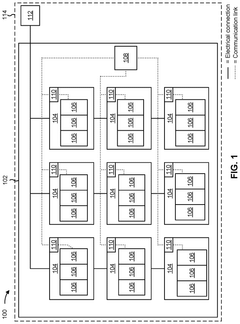
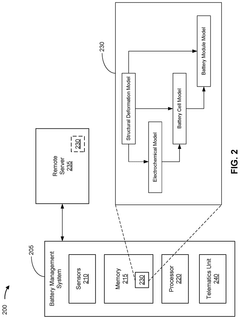
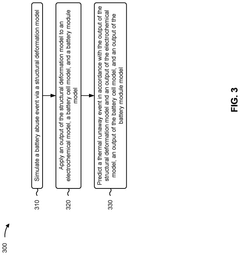
- A battery management system that includes processors and memories configured to monitor attributes of battery cells and predict thermal runaway events using a thermal runaway model that integrates structural deformation, electrochemical, battery cell, and battery module models to simulate abuse events and predict thermal runaway.
Safety Standards and Regulations for Battery Testing
The regulatory landscape for battery testing has evolved significantly in response to increasing concerns about thermal runaway incidents across various applications. International standards organizations have established comprehensive frameworks to ensure battery safety through rigorous testing protocols. The International Electrotechnical Commission (IEC) has developed IEC 62133 series standards specifically addressing safety requirements for portable sealed secondary cells and batteries. These standards mandate specific thermal abuse tests, including exposure to elevated temperatures and thermal shock conditions that can trigger runaway events.
The United Nations has implemented UN 38.3 transportation regulations, which require batteries to undergo a series of tests including thermal testing at 72°C for six hours. This standard is particularly crucial for lithium-ion batteries used in consumer electronics and electric vehicles. The thermal test requirements directly relate to simulation modeling needs, as manufacturers must demonstrate their products can withstand specified temperature conditions without entering thermal runaway.
Automotive applications are governed by additional standards such as ISO 12405 series and SAE J2464, which establish safety requirements for traction battery systems. These standards require thermal propagation testing and define acceptable temperature limits during normal operation and abuse conditions. The regulations specify that battery management systems must include thermal monitoring and protection mechanisms, creating direct requirements for accurate thermal modeling capabilities.
Regional regulatory bodies have also established specific requirements. The European Union's Battery Regulation (EU) 2023/1542 introduces new safety testing requirements and performance standards. Similarly, the U.S. Department of Transportation and Federal Aviation Administration have implemented specific thermal testing protocols for batteries used in transportation applications.
Testing laboratories must comply with accreditation standards such as ISO/IEC 17025, ensuring their thermal testing capabilities meet international quality requirements. These accreditation standards directly impact how simulation software must be validated against real-world testing results. The regulatory framework continues to evolve, with emerging standards addressing next-generation battery chemistries and applications, requiring continuous updates to simulation modeling approaches and validation methodologies.
The United Nations has implemented UN 38.3 transportation regulations, which require batteries to undergo a series of tests including thermal testing at 72°C for six hours. This standard is particularly crucial for lithium-ion batteries used in consumer electronics and electric vehicles. The thermal test requirements directly relate to simulation modeling needs, as manufacturers must demonstrate their products can withstand specified temperature conditions without entering thermal runaway.
Automotive applications are governed by additional standards such as ISO 12405 series and SAE J2464, which establish safety requirements for traction battery systems. These standards require thermal propagation testing and define acceptable temperature limits during normal operation and abuse conditions. The regulations specify that battery management systems must include thermal monitoring and protection mechanisms, creating direct requirements for accurate thermal modeling capabilities.
Regional regulatory bodies have also established specific requirements. The European Union's Battery Regulation (EU) 2023/1542 introduces new safety testing requirements and performance standards. Similarly, the U.S. Department of Transportation and Federal Aviation Administration have implemented specific thermal testing protocols for batteries used in transportation applications.
Testing laboratories must comply with accreditation standards such as ISO/IEC 17025, ensuring their thermal testing capabilities meet international quality requirements. These accreditation standards directly impact how simulation software must be validated against real-world testing results. The regulatory framework continues to evolve, with emerging standards addressing next-generation battery chemistries and applications, requiring continuous updates to simulation modeling approaches and validation methodologies.
Validation Methods for Thermal Runaway Models
Validation of thermal runaway models requires a comprehensive approach combining experimental data correlation, computational verification, and real-world scenario testing. The primary validation methodology involves comparing simulation predictions with controlled laboratory experiments using standardized test protocols such as UN38.3, IEC 62133, and UL 1973. These experiments provide baseline data for temperature profiles, gas generation rates, and propagation timing that serve as benchmarks for model accuracy assessment.
Experimental validation typically employs multi-scale testing approaches, ranging from single-cell calorimetry measurements to full battery pack assessments. Accelerating rate calorimetry (ARC) and differential scanning calorimetry (DSC) provide precise thermodynamic data for individual cell behavior, while larger-scale tests validate heat transfer mechanisms and thermal propagation patterns. Temperature measurement arrays, gas chromatography analysis, and high-speed imaging capture critical validation parameters during controlled thermal runaway events.
Statistical validation methods play a crucial role in quantifying model reliability and uncertainty. Root mean square error (RMSE) analysis, correlation coefficients, and confidence interval calculations establish quantitative measures of model performance. Monte Carlo simulations incorporating parameter uncertainties help assess model robustness across varying operating conditions and manufacturing tolerances.
Cross-validation techniques using independent datasets ensure model generalizability beyond initial calibration conditions. This involves testing validated models against different cell chemistries, form factors, and abuse scenarios not used during initial parameter estimation. Blind validation studies, where simulation teams predict experimental outcomes without prior knowledge of results, provide unbiased assessment of model predictive capabilities.
Field validation represents the ultimate test of model accuracy, comparing simulation predictions with real-world thermal events from battery management system data, incident reports, and post-mortem analyses. This validation level addresses the gap between controlled laboratory conditions and actual operating environments, accounting for factors such as aging effects, environmental variations, and system-level interactions that laboratory tests may not fully capture.
Experimental validation typically employs multi-scale testing approaches, ranging from single-cell calorimetry measurements to full battery pack assessments. Accelerating rate calorimetry (ARC) and differential scanning calorimetry (DSC) provide precise thermodynamic data for individual cell behavior, while larger-scale tests validate heat transfer mechanisms and thermal propagation patterns. Temperature measurement arrays, gas chromatography analysis, and high-speed imaging capture critical validation parameters during controlled thermal runaway events.
Statistical validation methods play a crucial role in quantifying model reliability and uncertainty. Root mean square error (RMSE) analysis, correlation coefficients, and confidence interval calculations establish quantitative measures of model performance. Monte Carlo simulations incorporating parameter uncertainties help assess model robustness across varying operating conditions and manufacturing tolerances.
Cross-validation techniques using independent datasets ensure model generalizability beyond initial calibration conditions. This involves testing validated models against different cell chemistries, form factors, and abuse scenarios not used during initial parameter estimation. Blind validation studies, where simulation teams predict experimental outcomes without prior knowledge of results, provide unbiased assessment of model predictive capabilities.
Field validation represents the ultimate test of model accuracy, comparing simulation predictions with real-world thermal events from battery management system data, incident reports, and post-mortem analyses. This validation level addresses the gap between controlled laboratory conditions and actual operating environments, accounting for factors such as aging effects, environmental variations, and system-level interactions that laboratory tests may not fully capture.
Unlock deeper insights with PatSnap Eureka Quick Research — get a full tech report to explore trends and direct your research. Try now!
Generate Your Research Report Instantly with AI Agent
Supercharge your innovation with PatSnap Eureka AI Agent Platform!