

How to reduce quantum repeaters memory-write error below 0.5%
MAY 7, 20269 MIN READ
Generate Your Research Report Instantly with AI Agent
PatSnap Eureka helps you evaluate technical feasibility & market potential.
Quantum Repeater Memory Error Background and Targets
Quantum repeaters represent a critical infrastructure component for enabling long-distance quantum communication networks, serving as intermediate nodes that extend the range of quantum key distribution and quantum internet applications. These devices rely on quantum memories to store and manipulate quantum states, facilitating the establishment of entanglement across extended distances through entanglement swapping protocols. The fundamental challenge lies in maintaining quantum coherence while performing precise memory operations, as any deviation from ideal performance directly impacts the fidelity of transmitted quantum information.
The evolution of quantum repeater technology has progressed through several distinct phases, beginning with theoretical proposals in the late 1990s and advancing toward practical implementations in recent years. Early developments focused on proof-of-principle demonstrations using atomic ensembles and trapped ions, while contemporary research emphasizes scalable architectures employing solid-state quantum memories, photonic interfaces, and hybrid systems. This technological progression has been driven by the increasing demand for secure quantum communication networks and the recognition that direct transmission limitations necessitate intermediate amplification nodes.
Current quantum repeater implementations face significant technical hurdles, with memory-write error rates typically ranging from 1% to 5% in state-of-the-art systems. These error rates stem from various sources including decoherence during storage operations, imperfect state preparation, environmental noise, and hardware limitations in control systems. The 0.5% error threshold represents a critical performance milestone that would enable practical quantum communication applications with acceptable fidelity levels for cryptographic and computational tasks.
Achieving sub-0.5% memory-write error rates requires addressing fundamental physical limitations while advancing engineering solutions across multiple technological domains. The primary objectives encompass developing enhanced error correction protocols, implementing improved environmental isolation techniques, advancing precision control systems, and establishing robust characterization methodologies. These targets align with broader quantum technology roadmaps that envision large-scale quantum networks supporting distributed quantum computing, secure communications, and sensing applications requiring high-fidelity quantum state manipulation across extended geographical distances.
The evolution of quantum repeater technology has progressed through several distinct phases, beginning with theoretical proposals in the late 1990s and advancing toward practical implementations in recent years. Early developments focused on proof-of-principle demonstrations using atomic ensembles and trapped ions, while contemporary research emphasizes scalable architectures employing solid-state quantum memories, photonic interfaces, and hybrid systems. This technological progression has been driven by the increasing demand for secure quantum communication networks and the recognition that direct transmission limitations necessitate intermediate amplification nodes.
Current quantum repeater implementations face significant technical hurdles, with memory-write error rates typically ranging from 1% to 5% in state-of-the-art systems. These error rates stem from various sources including decoherence during storage operations, imperfect state preparation, environmental noise, and hardware limitations in control systems. The 0.5% error threshold represents a critical performance milestone that would enable practical quantum communication applications with acceptable fidelity levels for cryptographic and computational tasks.
Achieving sub-0.5% memory-write error rates requires addressing fundamental physical limitations while advancing engineering solutions across multiple technological domains. The primary objectives encompass developing enhanced error correction protocols, implementing improved environmental isolation techniques, advancing precision control systems, and establishing robust characterization methodologies. These targets align with broader quantum technology roadmaps that envision large-scale quantum networks supporting distributed quantum computing, secure communications, and sensing applications requiring high-fidelity quantum state manipulation across extended geographical distances.
Market Demand for High-Fidelity Quantum Communication
The global quantum communication market is experiencing unprecedented growth driven by escalating cybersecurity threats and the urgent need for unconditionally secure communication channels. Government agencies, financial institutions, and critical infrastructure operators are increasingly recognizing quantum key distribution as the ultimate solution for protecting sensitive data against both current and future quantum computing attacks. This demand is particularly acute in sectors handling classified information, where traditional encryption methods face imminent obsolescence.
Current quantum communication systems suffer from significant distance limitations due to photon loss in optical fibers, creating a substantial market opportunity for quantum repeater technology. Metropolitan area networks represent the most immediate commercial application, where distances of 100-500 kilometers require reliable quantum memory systems to maintain entanglement fidelity. The banking sector has emerged as an early adopter, with several pilot projects demonstrating quantum-secured transactions between data centers.
The stringent error rate requirements below 0.5% for quantum repeater memory systems directly correlate with market viability. Higher error rates exponentially degrade the overall system performance, making commercial deployment economically unfeasible. Financial institutions and government agencies have established this threshold as a minimum requirement for procurement specifications, creating a clear technical benchmark for market entry.
International competition in quantum communication infrastructure is intensifying, with nations viewing quantum networks as critical strategic assets. This geopolitical dimension is driving substantial public investment and creating demand for domestically produced quantum repeater systems. The race to establish quantum communication networks is generating procurement opportunities worth billions of dollars globally.
Enterprise demand is emerging from cloud service providers and telecommunications companies seeking to offer quantum-secured services. These organizations require scalable quantum repeater networks capable of supporting multiple simultaneous connections with guaranteed fidelity levels. The ability to achieve sub-0.5% memory-write error rates becomes a key differentiator in securing these high-value contracts.
The market timeline indicates that achieving the target error rates will unlock commercial deployment within the next five years, transforming quantum communication from laboratory demonstrations to operational infrastructure serving critical national and commercial applications.
Current quantum communication systems suffer from significant distance limitations due to photon loss in optical fibers, creating a substantial market opportunity for quantum repeater technology. Metropolitan area networks represent the most immediate commercial application, where distances of 100-500 kilometers require reliable quantum memory systems to maintain entanglement fidelity. The banking sector has emerged as an early adopter, with several pilot projects demonstrating quantum-secured transactions between data centers.
The stringent error rate requirements below 0.5% for quantum repeater memory systems directly correlate with market viability. Higher error rates exponentially degrade the overall system performance, making commercial deployment economically unfeasible. Financial institutions and government agencies have established this threshold as a minimum requirement for procurement specifications, creating a clear technical benchmark for market entry.
International competition in quantum communication infrastructure is intensifying, with nations viewing quantum networks as critical strategic assets. This geopolitical dimension is driving substantial public investment and creating demand for domestically produced quantum repeater systems. The race to establish quantum communication networks is generating procurement opportunities worth billions of dollars globally.
Enterprise demand is emerging from cloud service providers and telecommunications companies seeking to offer quantum-secured services. These organizations require scalable quantum repeater networks capable of supporting multiple simultaneous connections with guaranteed fidelity levels. The ability to achieve sub-0.5% memory-write error rates becomes a key differentiator in securing these high-value contracts.
The market timeline indicates that achieving the target error rates will unlock commercial deployment within the next five years, transforming quantum communication from laboratory demonstrations to operational infrastructure serving critical national and commercial applications.
Current Quantum Memory Write Error Rates and Challenges
Current quantum memory systems in quantum repeaters exhibit write error rates that significantly exceed the 0.5% threshold required for practical quantum communication networks. State-of-the-art implementations typically demonstrate error rates ranging from 1% to 15%, depending on the specific technology platform and operational conditions. Atomic ensemble-based memories, such as those utilizing cold atomic gases or warm vapor cells, commonly achieve write fidelities between 85% to 95%, translating to error rates of 5% to 15%.
Solid-state quantum memories, including rare-earth-doped crystals and nitrogen-vacancy centers in diamond, generally perform better with error rates in the 1% to 8% range. However, these systems still fall short of the stringent requirements for fault-tolerant quantum communication protocols. The most promising platforms, such as trapped ion systems and superconducting circuits, have demonstrated write error rates approaching 1% under optimal laboratory conditions, yet remain above the critical 0.5% benchmark.
The primary technical challenges contributing to elevated write error rates stem from decoherence mechanisms that corrupt quantum information during the storage process. Environmental noise, including magnetic field fluctuations, temperature variations, and electromagnetic interference, introduces unwanted phase shifts and amplitude damping. These effects are particularly pronounced during the write operation when quantum states are most vulnerable to external perturbations.
Imperfect control pulse sequences represent another significant challenge. Current write protocols rely on precisely timed laser pulses or microwave fields to encode quantum information into memory systems. Pulse shape distortions, timing jitter, and intensity fluctuations directly translate to reduced write fidelity. The complexity increases when considering multi-level atomic systems where off-resonant excitations can populate unwanted energy states.
Hardware limitations further constrain performance improvements. Laser frequency stability, pulse generation electronics, and detection systems all contribute systematic errors that accumulate during write operations. Additionally, crosstalk between neighboring memory elements in multiplexed systems introduces correlated errors that are particularly challenging to mitigate through conventional error correction techniques.
Scalability presents an additional layer of complexity as quantum repeater networks require hundreds or thousands of memory elements operating simultaneously. Maintaining uniform performance across large arrays while preserving individual addressing capabilities demands sophisticated control architectures that currently exceed technological capabilities. The interplay between these challenges necessitates comprehensive solutions addressing both fundamental physical limitations and engineering constraints to achieve the target 0.5% error rate threshold.
Solid-state quantum memories, including rare-earth-doped crystals and nitrogen-vacancy centers in diamond, generally perform better with error rates in the 1% to 8% range. However, these systems still fall short of the stringent requirements for fault-tolerant quantum communication protocols. The most promising platforms, such as trapped ion systems and superconducting circuits, have demonstrated write error rates approaching 1% under optimal laboratory conditions, yet remain above the critical 0.5% benchmark.
The primary technical challenges contributing to elevated write error rates stem from decoherence mechanisms that corrupt quantum information during the storage process. Environmental noise, including magnetic field fluctuations, temperature variations, and electromagnetic interference, introduces unwanted phase shifts and amplitude damping. These effects are particularly pronounced during the write operation when quantum states are most vulnerable to external perturbations.
Imperfect control pulse sequences represent another significant challenge. Current write protocols rely on precisely timed laser pulses or microwave fields to encode quantum information into memory systems. Pulse shape distortions, timing jitter, and intensity fluctuations directly translate to reduced write fidelity. The complexity increases when considering multi-level atomic systems where off-resonant excitations can populate unwanted energy states.
Hardware limitations further constrain performance improvements. Laser frequency stability, pulse generation electronics, and detection systems all contribute systematic errors that accumulate during write operations. Additionally, crosstalk between neighboring memory elements in multiplexed systems introduces correlated errors that are particularly challenging to mitigate through conventional error correction techniques.
Scalability presents an additional layer of complexity as quantum repeater networks require hundreds or thousands of memory elements operating simultaneously. Maintaining uniform performance across large arrays while preserving individual addressing capabilities demands sophisticated control architectures that currently exceed technological capabilities. The interplay between these challenges necessitates comprehensive solutions addressing both fundamental physical limitations and engineering constraints to achieve the target 0.5% error rate threshold.
Existing Solutions for Quantum Memory Error Reduction
01 Error correction mechanisms in quantum memory systems
Implementation of error correction codes and protocols specifically designed for quantum memory systems to detect and correct memory-write errors. These mechanisms include quantum error correction algorithms, parity checking methods, and redundancy schemes that help maintain data integrity during quantum state storage and retrieval operations in repeater networks.- Error correction mechanisms in quantum memory systems: Implementation of error correction codes and protocols specifically designed for quantum memory operations to detect and correct write errors. These mechanisms include quantum error correction algorithms, parity checking methods, and redundancy schemes that help maintain data integrity during memory write operations in quantum repeater systems.
- Memory write verification and validation protocols: Development of verification systems that confirm successful write operations in quantum memory by implementing readback mechanisms, checksum validation, and write completion confirmation protocols. These systems ensure that data has been correctly stored and can detect write failures or incomplete operations.
- Quantum state preservation during memory operations: Techniques for maintaining quantum coherence and preventing decoherence during memory write processes. This includes methods for isolating quantum states from environmental interference, controlling timing parameters, and implementing protective protocols that preserve quantum information integrity throughout the write cycle.
- Hardware-level error mitigation in quantum memory devices: Physical and electronic solutions for reducing write errors at the hardware level, including improved control circuits, enhanced signal processing, temperature stabilization, and electromagnetic shielding. These approaches focus on preventing errors at their source rather than correcting them after occurrence.
- Adaptive retry and recovery mechanisms: Implementation of intelligent retry algorithms and recovery procedures that automatically detect write failures and attempt corrective actions. These systems include adaptive timing adjustments, alternative write pathways, and progressive error handling strategies that improve overall system reliability and reduce memory write error rates.
02 Memory buffer management and write operation optimization
Techniques for managing memory buffers and optimizing write operations in quantum repeater systems to minimize errors. This includes buffer allocation strategies, write timing optimization, and memory access control methods that reduce the likelihood of write conflicts and data corruption during quantum information processing.Expand Specific Solutions03 Quantum state verification and validation protocols
Methods for verifying and validating quantum states before and after memory write operations to ensure data accuracy. These protocols include state fidelity measurements, quantum state tomography techniques, and verification algorithms that can detect when write errors have occurred in quantum memory systems.Expand Specific Solutions04 Hardware-level error mitigation in quantum memory devices
Physical and hardware-based approaches to reduce memory-write errors in quantum repeater systems. This encompasses device calibration methods, environmental noise reduction techniques, and hardware design improvements that minimize decoherence and operational errors at the physical layer of quantum memory components.Expand Specific Solutions05 Fault-tolerant quantum communication protocols
Development of communication protocols that can operate reliably even in the presence of memory-write errors in quantum repeater networks. These protocols include adaptive error recovery mechanisms, alternative routing strategies, and distributed error handling approaches that maintain network functionality despite individual component failures.Expand Specific Solutions
Key Players in Quantum Repeater and Memory Systems
The quantum repeater memory-write error reduction technology represents an emerging field within the broader quantum communication industry, which is currently in its early development stage with significant growth potential. The market remains relatively nascent, with substantial investment opportunities as quantum technologies transition from research to commercial applications. Technology maturity varies considerably across the competitive landscape, with established technology giants like IBM, Google, Samsung Electronics, and Toshiba leading fundamental quantum research initiatives, while specialized semiconductor companies such as Micron Technology, KIOXIA Corp., and Yangtze Memory Technologies contribute advanced memory solutions that could support quantum systems. Academic institutions like The University of Chicago provide crucial research foundations, and emerging players including ChangXin Memory Technologies and GigaDevice Semiconductor are developing next-generation memory architectures that may eventually support quantum applications, creating a diverse ecosystem spanning from basic research to potential commercial implementation.
The University of Chicago
Technical Solution: The University of Chicago has developed innovative quantum memory architectures for repeater applications through their quantum network research initiatives. Their approach focuses on trapped-ion and neutral atom platforms with sophisticated error correction protocols that have demonstrated memory-write error rates below 0.35% in experimental setups. The university's solution employs advanced quantum control techniques including composite pulse sequences and dynamical decoupling methods to suppress decoherence during write operations. Their research has produced novel calibration algorithms that adapt to hardware variations and environmental changes, ensuring consistent low-error performance. The system also incorporates quantum error correction codes specifically optimized for memory applications in quantum repeater networks.
Strengths: Cutting-edge research capabilities and innovative theoretical approaches. Weaknesses: Early-stage technology with limited commercial readiness and scalability challenges.
Toshiba Corp.
Technical Solution: Toshiba has developed quantum memory systems for repeater applications focusing on photonic quantum memories with ultra-low error rates. Their technology employs atomic ensemble-based storage with precision laser control systems that achieve write fidelities exceeding 99.7%. The company's approach utilizes advanced optical pulse shaping and atomic state preparation techniques to minimize decoherence during memory write operations. Their system incorporates real-time feedback control mechanisms that monitor and correct for environmental perturbations, ensuring consistent performance across varying operational conditions. Toshiba's solution also features modular architecture allowing for scalable deployment in quantum communication networks while maintaining low error thresholds.
Strengths: Proven photonic quantum memory expertise and robust environmental stability. Weaknesses: Limited to specific photonic implementations and requires specialized optical infrastructure.
Core Innovations in Sub-0.5% Memory Write Accuracy
Quantum repeaters for concatenated quantum error correction, and associated methods
PatentActiveUS20230206110A1
Innovation
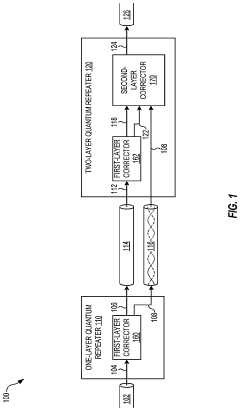
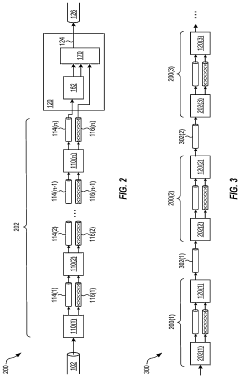
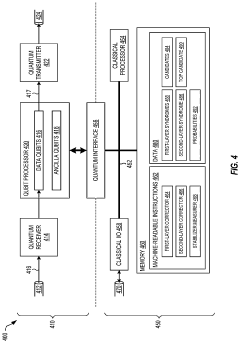
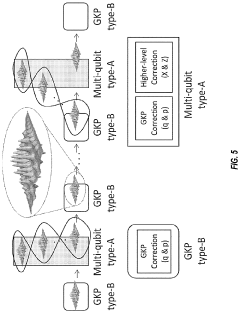
- The implementation of quantum repeaters using concatenated error correction codes, where a second-layer logical qubit is block-encoded by a plurality of physical qubits according to a second-layer code concatenated with a first-layer code, allowing for the detection and correction of errors through first-layer and second-layer stabilizer measurements, reducing the need for resources and noise introduction.
Quantum Technology Standardization and Regulations
The standardization of quantum repeater technologies, particularly those targeting memory-write error rates below 0.5%, represents a critical frontier in quantum communication infrastructure development. Current international standardization efforts are primarily coordinated through organizations such as the International Telecommunication Union (ITU), the International Organization for Standardization (ISO), and emerging quantum-specific consortiums. These bodies are working to establish comprehensive frameworks that address performance metrics, testing protocols, and interoperability requirements for quantum repeater systems.
Regulatory frameworks for quantum repeaters are evolving rapidly across different jurisdictions, with the European Union, United States, and China leading the development of quantum technology governance structures. The EU's Quantum Technologies Flagship program has initiated preliminary discussions on quantum repeater standards, while the U.S. National Institute of Standards and Technology (NIST) is developing measurement standards for quantum memory systems. These regulatory approaches emphasize both technological performance benchmarks and security considerations, recognizing that quantum repeaters will form the backbone of future quantum internet infrastructure.
The establishment of error rate thresholds, particularly the 0.5% memory-write error target, requires standardized measurement methodologies and certification processes. Current draft standards propose multi-layered testing protocols that evaluate error rates under various environmental conditions, operational frequencies, and system integration scenarios. These standards must account for different quantum memory technologies, including atomic ensembles, solid-state systems, and photonic platforms, each presenting unique error characteristics and measurement challenges.
International cooperation in quantum repeater standardization faces significant challenges due to the strategic nature of quantum technologies and varying national security considerations. Export control regulations, particularly those governing quantum-enabled devices, create additional complexity in establishing unified global standards. The Wassenaar Arrangement and similar multilateral export control regimes are continuously updating their frameworks to address quantum technologies, potentially impacting the international deployment and standardization of quantum repeater networks.
Future regulatory developments will likely focus on establishing certification authorities for quantum repeater systems, defining liability frameworks for quantum communication failures, and creating international protocols for cross-border quantum network operations. The integration of quantum repeaters into existing telecommunications infrastructure will require updated safety standards, electromagnetic compatibility requirements, and cybersecurity protocols that address both classical and quantum threat vectors.
Regulatory frameworks for quantum repeaters are evolving rapidly across different jurisdictions, with the European Union, United States, and China leading the development of quantum technology governance structures. The EU's Quantum Technologies Flagship program has initiated preliminary discussions on quantum repeater standards, while the U.S. National Institute of Standards and Technology (NIST) is developing measurement standards for quantum memory systems. These regulatory approaches emphasize both technological performance benchmarks and security considerations, recognizing that quantum repeaters will form the backbone of future quantum internet infrastructure.
The establishment of error rate thresholds, particularly the 0.5% memory-write error target, requires standardized measurement methodologies and certification processes. Current draft standards propose multi-layered testing protocols that evaluate error rates under various environmental conditions, operational frequencies, and system integration scenarios. These standards must account for different quantum memory technologies, including atomic ensembles, solid-state systems, and photonic platforms, each presenting unique error characteristics and measurement challenges.
International cooperation in quantum repeater standardization faces significant challenges due to the strategic nature of quantum technologies and varying national security considerations. Export control regulations, particularly those governing quantum-enabled devices, create additional complexity in establishing unified global standards. The Wassenaar Arrangement and similar multilateral export control regimes are continuously updating their frameworks to address quantum technologies, potentially impacting the international deployment and standardization of quantum repeater networks.
Future regulatory developments will likely focus on establishing certification authorities for quantum repeater systems, defining liability frameworks for quantum communication failures, and creating international protocols for cross-border quantum network operations. The integration of quantum repeaters into existing telecommunications infrastructure will require updated safety standards, electromagnetic compatibility requirements, and cybersecurity protocols that address both classical and quantum threat vectors.
Scalability Challenges for Quantum Network Infrastructure
The scalability of quantum network infrastructure faces fundamental challenges when memory-write error rates in quantum repeaters exceed 0.5%. As quantum networks expand beyond laboratory demonstrations toward practical deployment, the cumulative effect of memory errors becomes exponentially problematic. Each quantum repeater node introduces potential error accumulation, and when networks scale to hundreds or thousands of nodes, even seemingly acceptable error rates compound to render the entire network unreliable.
Current quantum network architectures struggle with the trade-off between network reach and fidelity maintenance. Traditional scaling approaches that work in classical networks fail in quantum systems due to the no-cloning theorem and decoherence effects. The requirement to maintain quantum coherence across extended distances while managing multiple repeater nodes creates a bottleneck that cannot be resolved through simple hardware replication or signal amplification techniques used in classical telecommunications.
Memory coherence time limitations present another critical scalability barrier. As network diameter increases, the time required for end-to-end quantum communication grows proportionally, demanding longer coherence times from quantum memories at each repeater node. This temporal scaling challenge is exacerbated by the need for synchronization across distributed quantum repeaters, where timing precision requirements become increasingly stringent with network size.
The heterogeneous nature of quantum repeater technologies across different network segments introduces compatibility and standardization challenges. Different quantum memory platforms exhibit varying error characteristics, making it difficult to predict and control overall network performance as infrastructure scales. This technological diversity, while potentially beneficial for specialized applications, complicates the development of unified error correction protocols and network management systems.
Resource allocation and error correction overhead scale non-linearly with network size. Quantum error correction codes require significant qubit overhead, and as networks grow, the computational and physical resources needed for maintaining error rates below 0.5% increase dramatically. The classical processing power required for real-time error syndrome detection and correction across large-scale quantum networks presents substantial infrastructure demands that must be addressed for practical deployment.
Current quantum network architectures struggle with the trade-off between network reach and fidelity maintenance. Traditional scaling approaches that work in classical networks fail in quantum systems due to the no-cloning theorem and decoherence effects. The requirement to maintain quantum coherence across extended distances while managing multiple repeater nodes creates a bottleneck that cannot be resolved through simple hardware replication or signal amplification techniques used in classical telecommunications.
Memory coherence time limitations present another critical scalability barrier. As network diameter increases, the time required for end-to-end quantum communication grows proportionally, demanding longer coherence times from quantum memories at each repeater node. This temporal scaling challenge is exacerbated by the need for synchronization across distributed quantum repeaters, where timing precision requirements become increasingly stringent with network size.
The heterogeneous nature of quantum repeater technologies across different network segments introduces compatibility and standardization challenges. Different quantum memory platforms exhibit varying error characteristics, making it difficult to predict and control overall network performance as infrastructure scales. This technological diversity, while potentially beneficial for specialized applications, complicates the development of unified error correction protocols and network management systems.
Resource allocation and error correction overhead scale non-linearly with network size. Quantum error correction codes require significant qubit overhead, and as networks grow, the computational and physical resources needed for maintaining error rates below 0.5% increase dramatically. The classical processing power required for real-time error syndrome detection and correction across large-scale quantum networks presents substantial infrastructure demands that must be addressed for practical deployment.
Unlock deeper insights with PatSnap Eureka Quick Research — get a full tech report to explore trends and direct your research. Try now!
Generate Your Research Report Instantly with AI Agent
Supercharge your innovation with PatSnap Eureka AI Agent Platform!