

Hydrogen Solid Storage Applications in Renewable Energy Systems
OCT 27, 20259 MIN READ
Generate Your Research Report Instantly with AI Agent
PatSnap Eureka helps you evaluate technical feasibility & market potential.
Hydrogen Storage Evolution and Objectives
Hydrogen storage technology has evolved significantly over the past decades, transitioning from conventional high-pressure gas cylinders to more sophisticated storage methods. The journey began in the 1970s with the oil crisis, which sparked interest in hydrogen as an alternative energy carrier. Early storage systems primarily relied on compressed gas or cryogenic liquid hydrogen, both presenting significant safety concerns and energy inefficiencies. The 1990s witnessed the emergence of metal hydrides as potential solid-state storage materials, offering improved safety profiles but limited by weight constraints.
The 2000s marked a pivotal shift with increased research into chemical hydrides and complex metal hydrides, alongside the development of carbon-based nanomaterials for hydrogen adsorption. This period saw substantial government investments globally, particularly from the US Department of Energy and the European Union's Hydrogen Initiative, establishing ambitious targets for storage capacity and system efficiency.
Recent advancements have focused on metal-organic frameworks (MOFs), covalent organic frameworks (COFs), and clathrate compounds, which demonstrate promising hydrogen uptake characteristics under moderate conditions. The integration of catalyst technologies has further enhanced the kinetics of hydrogen absorption and release, addressing one of the persistent challenges in solid-state storage systems.
The primary objective of current hydrogen solid storage research is to develop materials and systems that meet the technical targets established by international energy agencies: gravimetric capacity exceeding 6.5 wt%, volumetric capacity above 50 g/L, operating temperatures between -40°C and 85°C, and cycling stability of at least 1,500 cycles. These parameters are essential for practical implementation in renewable energy systems, particularly for grid-scale energy storage applications.
Beyond technical specifications, research aims to achieve cost-effectiveness, with targets below $333/kg H₂ stored, making hydrogen competitive with conventional energy storage technologies. Safety considerations remain paramount, with objectives to eliminate risks associated with hydrogen embrittlement, spontaneous ignition, and thermal management during charging and discharging cycles.
The strategic goal extends to creating integrated systems where hydrogen storage seamlessly connects intermittent renewable energy sources with end-use applications. This includes developing intelligent control systems that optimize hydrogen production during peak renewable generation periods and facilitate efficient release during demand surges, thereby enhancing grid stability and resilience.
As renewable energy penetration increases globally, hydrogen solid storage technology aims to provide the missing link in long-duration energy storage, enabling seasonal energy shifting and providing backup power during extended periods of low renewable generation, ultimately facilitating the transition to a carbon-neutral energy ecosystem.
The 2000s marked a pivotal shift with increased research into chemical hydrides and complex metal hydrides, alongside the development of carbon-based nanomaterials for hydrogen adsorption. This period saw substantial government investments globally, particularly from the US Department of Energy and the European Union's Hydrogen Initiative, establishing ambitious targets for storage capacity and system efficiency.
Recent advancements have focused on metal-organic frameworks (MOFs), covalent organic frameworks (COFs), and clathrate compounds, which demonstrate promising hydrogen uptake characteristics under moderate conditions. The integration of catalyst technologies has further enhanced the kinetics of hydrogen absorption and release, addressing one of the persistent challenges in solid-state storage systems.
The primary objective of current hydrogen solid storage research is to develop materials and systems that meet the technical targets established by international energy agencies: gravimetric capacity exceeding 6.5 wt%, volumetric capacity above 50 g/L, operating temperatures between -40°C and 85°C, and cycling stability of at least 1,500 cycles. These parameters are essential for practical implementation in renewable energy systems, particularly for grid-scale energy storage applications.
Beyond technical specifications, research aims to achieve cost-effectiveness, with targets below $333/kg H₂ stored, making hydrogen competitive with conventional energy storage technologies. Safety considerations remain paramount, with objectives to eliminate risks associated with hydrogen embrittlement, spontaneous ignition, and thermal management during charging and discharging cycles.
The strategic goal extends to creating integrated systems where hydrogen storage seamlessly connects intermittent renewable energy sources with end-use applications. This includes developing intelligent control systems that optimize hydrogen production during peak renewable generation periods and facilitate efficient release during demand surges, thereby enhancing grid stability and resilience.
As renewable energy penetration increases globally, hydrogen solid storage technology aims to provide the missing link in long-duration energy storage, enabling seasonal energy shifting and providing backup power during extended periods of low renewable generation, ultimately facilitating the transition to a carbon-neutral energy ecosystem.
Market Analysis for Hydrogen Solid Storage Solutions
The global market for hydrogen solid storage solutions is experiencing significant growth, driven by the increasing adoption of renewable energy systems and the push for decarbonization across various sectors. As of 2023, the market valuation stands at approximately $420 million, with projections indicating a compound annual growth rate (CAGR) of 6.8% through 2030, potentially reaching $680 million by the end of the decade.
The demand for hydrogen solid storage technologies is primarily concentrated in regions with advanced renewable energy infrastructure and ambitious carbon reduction targets. Europe currently leads the market with a 38% share, followed by North America (27%) and Asia-Pacific (24%), with the latter showing the fastest growth trajectory due to aggressive clean energy initiatives in countries like Japan, South Korea, and China.
Key market segments for hydrogen solid storage applications include stationary power generation (42%), transportation (31%), and industrial processes (18%). The stationary power segment is particularly promising due to the increasing integration of intermittent renewable energy sources like solar and wind into existing grid systems, necessitating efficient energy storage solutions to balance supply and demand fluctuations.
Consumer demand patterns reveal a growing preference for modular and scalable storage solutions that can be deployed across various applications. End-users are increasingly prioritizing systems with higher gravimetric and volumetric storage capacities, faster absorption/desorption kinetics, and improved cycling stability. Price sensitivity remains high, with current costs of $500-700 per kilogram of stored hydrogen representing a significant barrier to widespread adoption.
Market research indicates that the total addressable market for hydrogen storage in renewable energy systems could reach $1.2 billion by 2035, contingent upon technological advancements that improve efficiency and reduce costs. The most substantial growth opportunities exist in grid-scale energy storage applications, where hydrogen can provide seasonal storage capabilities that batteries cannot match.
Regulatory frameworks are increasingly favorable, with 27 countries having established hydrogen strategies that include provisions for storage technologies. Investment in the sector has seen a 35% year-over-year increase, with venture capital and corporate R&D funding reaching $850 million in 2022, signaling strong confidence in the market's future prospects.
Customer pain points primarily revolve around high initial capital expenditure, limited operational experience with newer technologies, and concerns about safety and reliability. Market surveys indicate that solutions addressing these concerns while demonstrating clear return on investment metrics will capture significant market share in the coming years.
The demand for hydrogen solid storage technologies is primarily concentrated in regions with advanced renewable energy infrastructure and ambitious carbon reduction targets. Europe currently leads the market with a 38% share, followed by North America (27%) and Asia-Pacific (24%), with the latter showing the fastest growth trajectory due to aggressive clean energy initiatives in countries like Japan, South Korea, and China.
Key market segments for hydrogen solid storage applications include stationary power generation (42%), transportation (31%), and industrial processes (18%). The stationary power segment is particularly promising due to the increasing integration of intermittent renewable energy sources like solar and wind into existing grid systems, necessitating efficient energy storage solutions to balance supply and demand fluctuations.
Consumer demand patterns reveal a growing preference for modular and scalable storage solutions that can be deployed across various applications. End-users are increasingly prioritizing systems with higher gravimetric and volumetric storage capacities, faster absorption/desorption kinetics, and improved cycling stability. Price sensitivity remains high, with current costs of $500-700 per kilogram of stored hydrogen representing a significant barrier to widespread adoption.
Market research indicates that the total addressable market for hydrogen storage in renewable energy systems could reach $1.2 billion by 2035, contingent upon technological advancements that improve efficiency and reduce costs. The most substantial growth opportunities exist in grid-scale energy storage applications, where hydrogen can provide seasonal storage capabilities that batteries cannot match.
Regulatory frameworks are increasingly favorable, with 27 countries having established hydrogen strategies that include provisions for storage technologies. Investment in the sector has seen a 35% year-over-year increase, with venture capital and corporate R&D funding reaching $850 million in 2022, signaling strong confidence in the market's future prospects.
Customer pain points primarily revolve around high initial capital expenditure, limited operational experience with newer technologies, and concerns about safety and reliability. Market surveys indicate that solutions addressing these concerns while demonstrating clear return on investment metrics will capture significant market share in the coming years.
Global Hydrogen Storage Technology Landscape and Barriers
The global hydrogen storage landscape is characterized by diverse technological approaches, with solid storage emerging as a promising solution for renewable energy integration. Currently, compressed gas and liquid hydrogen dominate commercial applications, accounting for approximately 90% of hydrogen storage implementations worldwide. However, these methods face significant efficiency and safety challenges, with compressed storage requiring high-pressure tanks (350-700 bar) and liquid storage demanding cryogenic temperatures (-253°C).
Solid-state hydrogen storage technologies, including metal hydrides, complex hydrides, and chemical hydrogen carriers, represent approximately 8% of research focus but less than 2% of commercial deployments. These technologies offer theoretical volumetric densities 2-3 times higher than liquid hydrogen, making them particularly attractive for space-constrained renewable energy systems.
Major technological barriers for solid hydrogen storage include insufficient gravimetric capacity (currently 4-6 wt% versus the 9 wt% target for practical applications), slow kinetics of hydrogen absorption/desorption, and thermal management challenges during the loading/unloading processes. Most current materials require temperatures above 300°C for hydrogen release, creating significant energy penalties in renewable energy applications.
Geographic distribution of hydrogen storage technology development shows concentration in specific regions, with Japan, Germany, and the United States leading in patent filings for solid storage technologies. China has rapidly increased research output, with annual patent applications growing 300% between 2015-2022, primarily focused on metal hydride materials.
Regulatory barriers present additional challenges, with inconsistent safety standards across regions creating market fragmentation. The European Union's Hydrogen Strategy provides the most comprehensive regulatory framework, while many developing nations lack specific hydrogen storage regulations, limiting technology deployment.
Economic barriers remain substantial, with solid storage systems costing approximately $500-1,500/kg H₂ stored, significantly higher than the US Department of Energy's target of $300/kg. Material costs constitute 40-60% of total system expenses, with rare earth elements in many promising compounds creating supply chain vulnerabilities.
Integration challenges with renewable energy systems represent another significant barrier, as fluctuating power from wind and solar creates operational difficulties for hydrogen production and storage systems. Current solid storage technologies typically require stable temperature and pressure conditions that are difficult to maintain with intermittent renewable sources, necessitating complex buffer systems that increase overall system costs by 25-40%.
Solid-state hydrogen storage technologies, including metal hydrides, complex hydrides, and chemical hydrogen carriers, represent approximately 8% of research focus but less than 2% of commercial deployments. These technologies offer theoretical volumetric densities 2-3 times higher than liquid hydrogen, making them particularly attractive for space-constrained renewable energy systems.
Major technological barriers for solid hydrogen storage include insufficient gravimetric capacity (currently 4-6 wt% versus the 9 wt% target for practical applications), slow kinetics of hydrogen absorption/desorption, and thermal management challenges during the loading/unloading processes. Most current materials require temperatures above 300°C for hydrogen release, creating significant energy penalties in renewable energy applications.
Geographic distribution of hydrogen storage technology development shows concentration in specific regions, with Japan, Germany, and the United States leading in patent filings for solid storage technologies. China has rapidly increased research output, with annual patent applications growing 300% between 2015-2022, primarily focused on metal hydride materials.
Regulatory barriers present additional challenges, with inconsistent safety standards across regions creating market fragmentation. The European Union's Hydrogen Strategy provides the most comprehensive regulatory framework, while many developing nations lack specific hydrogen storage regulations, limiting technology deployment.
Economic barriers remain substantial, with solid storage systems costing approximately $500-1,500/kg H₂ stored, significantly higher than the US Department of Energy's target of $300/kg. Material costs constitute 40-60% of total system expenses, with rare earth elements in many promising compounds creating supply chain vulnerabilities.
Integration challenges with renewable energy systems represent another significant barrier, as fluctuating power from wind and solar creates operational difficulties for hydrogen production and storage systems. Current solid storage technologies typically require stable temperature and pressure conditions that are difficult to maintain with intermittent renewable sources, necessitating complex buffer systems that increase overall system costs by 25-40%.
Current Solid-State Hydrogen Storage Methodologies
01 Metal hydride-based hydrogen storage materials
Metal hydrides are compounds formed by hydrogen and metals that can store hydrogen in a solid state. These materials can absorb hydrogen under pressure and release it when heated. Metal hydride-based storage systems offer advantages such as high volumetric hydrogen density and safe storage conditions. Various metal alloys and compositions are being developed to optimize hydrogen storage capacity, absorption/desorption kinetics, and cycling stability.- Metal hydride-based hydrogen storage materials: Metal hydrides are compounds formed when hydrogen combines with metals, offering a safe and efficient method for hydrogen storage. These materials can absorb and release hydrogen through chemical reactions, providing high storage density. Various metal alloys and compositions are used to optimize hydrogen capacity, absorption/desorption kinetics, and cycling stability. Research focuses on improving these materials' performance through composition adjustments and structural modifications.
- Carbon-based hydrogen storage materials: Carbon-based materials such as activated carbon, carbon nanotubes, and graphene are being developed for hydrogen storage applications. These materials store hydrogen through physical adsorption mechanisms, offering advantages like lightweight structure and potentially high surface areas. Modifications to carbon structures, including doping with other elements or creating specific pore architectures, can enhance hydrogen storage capacity and improve adsorption/desorption characteristics at practical temperatures and pressures.
- Metal-organic frameworks for hydrogen storage: Metal-organic frameworks (MOFs) represent a promising class of porous materials for hydrogen storage. These crystalline structures consist of metal ions coordinated to organic ligands, creating highly porous networks with tunable pore sizes and chemical functionalities. MOFs can store hydrogen through physisorption mechanisms and offer exceptionally high surface areas. Research focuses on designing MOFs with optimized pore structures, metal centers, and functional groups to maximize hydrogen uptake under practical conditions.
- Hydrogen storage systems and devices: Various engineering solutions and devices have been developed for practical hydrogen storage applications. These systems integrate storage materials with heat management components, pressure regulation mechanisms, and safety features. Innovations include compact storage tanks, modular designs for scalability, and integrated systems that optimize hydrogen charging and discharging processes. These technologies address challenges related to thermal management, pressure control, and system integration for various applications including vehicles and stationary power systems.
- Composite and hybrid hydrogen storage materials: Composite and hybrid materials combine different hydrogen storage mechanisms to overcome limitations of single-material approaches. These materials may integrate metal hydrides with carbon structures, catalysts, or other functional components to enhance performance. Research focuses on creating synergistic effects between components to improve hydrogen capacity, kinetics, and cycling stability. Nanostructuring and catalyst incorporation are common strategies to enhance hydrogen sorption properties and address challenges related to heat management during hydrogen uptake and release.
02 Carbon-based hydrogen storage materials
Carbon-based materials such as activated carbon, carbon nanotubes, and graphene are being investigated for hydrogen storage applications. These materials can adsorb hydrogen molecules on their surfaces through physical adsorption (physisorption). The high surface area and pore structure of carbon materials make them promising candidates for hydrogen storage. Research focuses on modifying carbon structures to enhance hydrogen uptake capacity and improve adsorption properties at practical temperatures and pressures.Expand Specific Solutions03 Complex hydride hydrogen storage systems
Complex hydrides, including borohydrides, alanates, and amides, are being developed as hydrogen storage materials. These compounds typically contain light elements such as lithium, sodium, or magnesium combined with hydrogen and other elements. Complex hydrides can achieve high gravimetric hydrogen storage capacities but often face challenges related to hydrogen release kinetics and reversibility. Research is focused on catalyst development and material modifications to address these limitations.Expand Specific Solutions04 Hydrogen storage tank and system design
Engineering solutions for solid-state hydrogen storage systems involve specialized tank designs, heat management systems, and pressure control mechanisms. These systems must address challenges related to heat transfer during hydrogen absorption/desorption, mechanical stress from material expansion, and safety considerations. Innovations include composite tanks, integrated cooling systems, and modular designs that optimize weight, volume, and hydrogen delivery rates for various applications including vehicles and stationary power systems.Expand Specific Solutions05 Novel composite and hybrid hydrogen storage materials
Hybrid and composite materials combine different hydrogen storage mechanisms to overcome limitations of single-material approaches. These may include metal-organic frameworks (MOFs), nanostructured composites, and catalyst-enhanced systems. By integrating multiple materials with complementary properties, these systems aim to achieve improved hydrogen storage capacity, faster kinetics, and better cycling stability at moderate temperatures and pressures. Research focuses on optimizing material interfaces and synergistic effects between components.Expand Specific Solutions
Leading Companies and Research Institutions in Hydrogen Storage
The hydrogen solid storage market in renewable energy systems is currently in an early growth phase, characterized by significant R&D investments but limited commercial deployment. The global market size is projected to expand substantially as hydrogen gains importance in clean energy transitions, with estimates suggesting multi-billion dollar growth potential by 2030. Technologically, the field shows varying maturity levels across different storage approaches. Leading players include specialized hydrogen technology companies like Hydrogenious LOHC Technologies and Ergosup, alongside major industrial conglomerates such as Hitachi and General Motors. Academic institutions including the National University of Singapore, University of Birmingham, and Zhejiang University are driving fundamental research advances. The competitive landscape features collaboration between research institutions and commercial entities to overcome technical challenges in storage density, cycle stability, and cost-effectiveness.
Hydrogenious Lohc Technologies GmbH
Technical Solution: Hydrogenious has pioneered the Liquid Organic Hydrogen Carrier (LOHC) technology for hydrogen storage in renewable energy systems. Their proprietary StorageBOX and ReleaseBOX systems utilize dibenzyltoluene as the carrier medium, which chemically binds hydrogen through an exothermic hydrogenation process at 150-200°C and 30-50 bar pressure. The hydrogen is later released through an endothermic dehydrogenation process when needed. This technology enables hydrogen to be stored in a liquid form at ambient conditions (similar to diesel fuel), eliminating the need for cryogenic cooling or high-pressure vessels. Their systems can store approximately 57 kg of hydrogen per cubic meter of LOHC, with a storage efficiency of around 90%. The company has implemented this technology in several demonstration projects across Europe, including integration with renewable energy microgrids where excess solar and wind power is converted to hydrogen and stored in their LOHC systems.
Strengths: Ambient temperature and pressure storage eliminates need for expensive compression or liquefaction infrastructure; liquid form allows use of existing fuel logistics chains; non-explosive and non-toxic carrier medium enhances safety; scalable from kilowatt to megawatt applications. Weaknesses: Energy required for hydrogen release (dehydrogenation) reduces overall system efficiency; catalyst materials contain precious metals increasing costs; technology still has higher CAPEX compared to conventional storage methods.
Hitachi Ltd.
Technical Solution: Hitachi has developed an advanced metal hydride-based hydrogen storage system specifically designed for renewable energy integration. Their technology utilizes specialized Ti-Mn based AB2-type alloys that can absorb and release hydrogen through reversible chemical reactions. The system operates at moderate pressures (10-30 bar) and temperatures (20-80°C), achieving hydrogen storage densities of approximately 1.5 wt% with over 2,000 charge-discharge cycles demonstrated in field tests. Hitachi's innovation includes a proprietary heat management system that recovers and utilizes the exothermic heat generated during hydrogen absorption, improving overall system efficiency by up to 15%. Their modular design allows for scalable implementation, from small residential systems paired with rooftop solar (5-10kW) to larger grid-scale applications (MW range). The company has successfully deployed this technology in multiple demonstration projects in Japan, including a 700kW system integrated with a wind farm that provides grid stabilization services and emergency backup power.
Strengths: Moderate operating conditions reduce system complexity and energy requirements; excellent safety profile due to inherent stability of metal hydrides; high volumetric hydrogen density exceeds compressed gas storage; heat integration improves overall system efficiency. Weaknesses: Limited gravimetric hydrogen density (1.5 wt%) results in heavier storage systems; relatively high cost of specialty metal alloys impacts economic viability; performance degradation over extended cycling requires periodic maintenance.
Critical Patents and Breakthroughs in Metal Hydride Technologies
Hydrogen Based Renewable Energy Storage System
PatentInactiveUS20220109173A1
Innovation
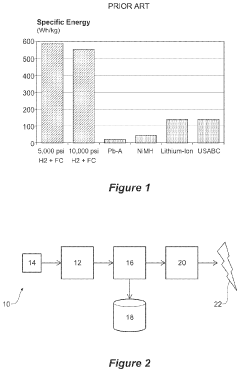
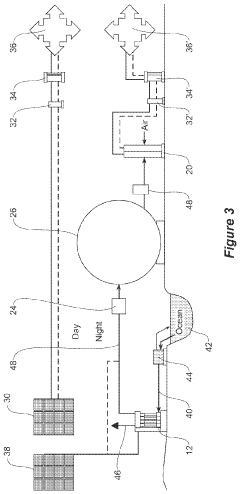
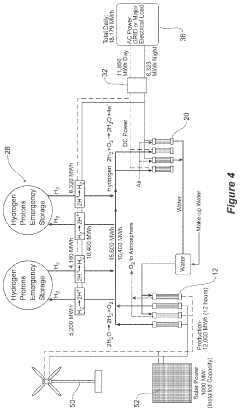
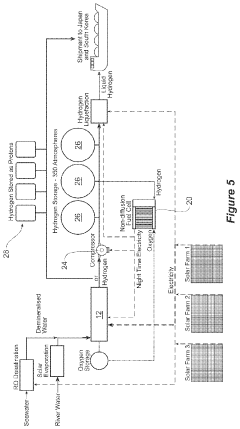
- A renewable energy storage system using hydrogen as a medium, where renewable energy is used for electrolyzing water to produce hydrogen, which is stored and converted back into electricity using a hydrogen fuel cell, enabling efficient grid-scale energy storage and release.
Magnesium-based solid hydrogen storage material with liquid phase regulation function and preparation method thereof
PatentPendingUS20240140787A1
Innovation
- A magnesium-based solid hydrogen storage material with a liquid phase regulation function is developed using a 95% magnesium hydride (MgH2) and 5% lithium borohydride (LiBH4) composite system, where LiBH4 is uniformly embedded on the surface of MgH2, enhancing hydrogen transfer channels and maintaining dispersion stability through a simple ball milling process.


Integration Challenges with Renewable Energy Infrastructure
The integration of hydrogen solid storage systems with renewable energy infrastructure presents significant technical and operational challenges. Current renewable energy systems, primarily designed for electricity generation and distribution, require substantial modifications to accommodate hydrogen production, storage, and utilization pathways. The intermittent nature of renewable sources like solar and wind creates fluctuating energy outputs that complicate the consistent operation of electrolyzers for hydrogen production, necessitating advanced control systems and buffer mechanisms.
Physical integration constraints also pose considerable challenges. Hydrogen solid storage systems require specific temperature and pressure conditions that must be maintained within renewable energy installations, often demanding additional energy inputs that can reduce overall system efficiency. The space requirements for solid storage materials and associated equipment may conflict with existing renewable infrastructure layouts, particularly in space-constrained installations like offshore wind farms or urban solar arrays.
Safety considerations represent another critical integration challenge. The combination of hydrogen storage with electrical generation systems introduces potential hazards that require sophisticated monitoring systems, specialized safety protocols, and possibly regulatory adaptations. These safety measures add complexity and cost to integrated systems, potentially limiting widespread adoption.
From an operational perspective, the different response times between renewable generation and hydrogen storage systems create temporal mismatches. While renewable sources may rapidly change output based on environmental conditions, solid storage systems typically have slower absorption and desorption kinetics, requiring buffer systems or hybrid approaches to ensure system stability.
Grid compatibility issues further complicate integration efforts. Existing grid infrastructure is primarily designed for electrical energy transmission, not hydrogen or thermal energy associated with solid storage systems. This necessitates either parallel infrastructure development or innovative approaches to utilize existing networks for multiple energy carriers.
Economic viability remains perhaps the most significant barrier to integration. The combined capital costs of renewable generation and hydrogen solid storage systems often exceed conventional alternatives, while operational complexities increase maintenance requirements and associated costs. Without supportive policy frameworks or significant technological breakthroughs, achieving cost-competitive integrated systems remains challenging for widespread commercial deployment.
Physical integration constraints also pose considerable challenges. Hydrogen solid storage systems require specific temperature and pressure conditions that must be maintained within renewable energy installations, often demanding additional energy inputs that can reduce overall system efficiency. The space requirements for solid storage materials and associated equipment may conflict with existing renewable infrastructure layouts, particularly in space-constrained installations like offshore wind farms or urban solar arrays.
Safety considerations represent another critical integration challenge. The combination of hydrogen storage with electrical generation systems introduces potential hazards that require sophisticated monitoring systems, specialized safety protocols, and possibly regulatory adaptations. These safety measures add complexity and cost to integrated systems, potentially limiting widespread adoption.
From an operational perspective, the different response times between renewable generation and hydrogen storage systems create temporal mismatches. While renewable sources may rapidly change output based on environmental conditions, solid storage systems typically have slower absorption and desorption kinetics, requiring buffer systems or hybrid approaches to ensure system stability.
Grid compatibility issues further complicate integration efforts. Existing grid infrastructure is primarily designed for electrical energy transmission, not hydrogen or thermal energy associated with solid storage systems. This necessitates either parallel infrastructure development or innovative approaches to utilize existing networks for multiple energy carriers.
Economic viability remains perhaps the most significant barrier to integration. The combined capital costs of renewable generation and hydrogen solid storage systems often exceed conventional alternatives, while operational complexities increase maintenance requirements and associated costs. Without supportive policy frameworks or significant technological breakthroughs, achieving cost-competitive integrated systems remains challenging for widespread commercial deployment.
Safety and Regulatory Framework for Hydrogen Storage Systems
The regulatory landscape for hydrogen storage systems is evolving rapidly as hydrogen gains prominence in renewable energy applications. International standards such as ISO/TC 197 and IEC/TC 105 provide foundational guidelines for hydrogen technologies, while regional frameworks like the European Union's Hydrogen Strategy establish comprehensive safety protocols. In the United States, the Department of Energy's Hydrogen Program Plan outlines safety requirements, complemented by NFPA 2 (Hydrogen Technologies Code) which addresses specific installation and handling procedures for solid storage systems.
Risk assessment methodologies for hydrogen solid storage systems must account for unique challenges including thermal management during absorption/desorption cycles, potential for dust explosions with metal hydride materials, and pressure management during hydrogen release. These assessments typically employ HAZOP (Hazard and Operability) studies and FMEA (Failure Mode and Effects Analysis) to identify critical safety points throughout the system lifecycle.
Material compatibility represents a significant safety consideration, as hydrogen embrittlement can compromise structural integrity of containment vessels and piping systems. Regulatory frameworks increasingly mandate specific material selection criteria and regular inspection protocols to mitigate these risks. For metal hydride storage systems, additional requirements address potential pyrophoric reactions upon air exposure and heat management during charging/discharging cycles.
Ventilation and leak detection requirements form another critical regulatory component. Most frameworks mandate hydrogen sensors with specific sensitivity thresholds (typically 0.4-1% hydrogen concentration), redundant detection systems, and automated emergency shutdown capabilities. For indoor installations, ventilation systems must achieve minimum air exchange rates calculated based on maximum potential release volumes.
Training and certification programs for personnel working with hydrogen storage systems are becoming standardized across jurisdictions. These typically include specialized modules on solid storage technologies, emergency response procedures, and system maintenance protocols. The European Hydrogen Safety Panel and similar bodies in other regions provide certification frameworks that are increasingly becoming mandatory for system operators.
Emerging regulatory trends focus on lifecycle management, including decommissioning and recycling of solid storage materials. Environmental impact assessments are increasingly required, particularly for systems using rare earth elements or potentially toxic compounds. Additionally, regulatory frameworks are evolving to address integration challenges when hydrogen storage systems interface with other renewable energy components, establishing clear boundaries of responsibility and safety protocols at system interfaces.
Risk assessment methodologies for hydrogen solid storage systems must account for unique challenges including thermal management during absorption/desorption cycles, potential for dust explosions with metal hydride materials, and pressure management during hydrogen release. These assessments typically employ HAZOP (Hazard and Operability) studies and FMEA (Failure Mode and Effects Analysis) to identify critical safety points throughout the system lifecycle.
Material compatibility represents a significant safety consideration, as hydrogen embrittlement can compromise structural integrity of containment vessels and piping systems. Regulatory frameworks increasingly mandate specific material selection criteria and regular inspection protocols to mitigate these risks. For metal hydride storage systems, additional requirements address potential pyrophoric reactions upon air exposure and heat management during charging/discharging cycles.
Ventilation and leak detection requirements form another critical regulatory component. Most frameworks mandate hydrogen sensors with specific sensitivity thresholds (typically 0.4-1% hydrogen concentration), redundant detection systems, and automated emergency shutdown capabilities. For indoor installations, ventilation systems must achieve minimum air exchange rates calculated based on maximum potential release volumes.
Training and certification programs for personnel working with hydrogen storage systems are becoming standardized across jurisdictions. These typically include specialized modules on solid storage technologies, emergency response procedures, and system maintenance protocols. The European Hydrogen Safety Panel and similar bodies in other regions provide certification frameworks that are increasingly becoming mandatory for system operators.
Emerging regulatory trends focus on lifecycle management, including decommissioning and recycling of solid storage materials. Environmental impact assessments are increasingly required, particularly for systems using rare earth elements or potentially toxic compounds. Additionally, regulatory frameworks are evolving to address integration challenges when hydrogen storage systems interface with other renewable energy components, establishing clear boundaries of responsibility and safety protocols at system interfaces.
Unlock deeper insights with PatSnap Eureka Quick Research — get a full tech report to explore trends and direct your research. Try now!
Generate Your Research Report Instantly with AI Agent
Supercharge your innovation with PatSnap Eureka AI Agent Platform!