

Hyperdimensional Vs Reservoir Computing: Use Cases in Signal Forecasting
JUN 4, 202610 MIN READ
Generate Your Research Report Instantly with AI Agent
PatSnap Eureka helps you evaluate technical feasibility & market potential.
Hyperdimensional and Reservoir Computing Background and Objectives
Hyperdimensional Computing (HDC) emerged in the early 2000s as a brain-inspired computational paradigm that leverages high-dimensional vector spaces to represent and manipulate information. This approach mimics the distributed representation mechanisms observed in biological neural systems, where information is encoded in patterns across thousands of dimensions. The fundamental principle relies on the mathematical properties of high-dimensional spaces, where vectors become nearly orthogonal and exhibit unique statistical behaviors that enable robust information processing.
Reservoir Computing (RC) developed simultaneously as a recurrent neural network framework, encompassing Echo State Networks and Liquid State Machines. This paradigm utilizes a fixed, randomly connected reservoir of computational nodes that project input signals into a high-dimensional dynamic space. The reservoir's temporal dynamics capture complex patterns in sequential data, while only the output layer requires training, significantly reducing computational overhead compared to traditional recurrent networks.
Both computing paradigms have evolved to address critical challenges in signal forecasting applications, where traditional machine learning approaches often struggle with temporal dependencies, noise resilience, and computational efficiency. The convergence of these technologies represents a significant shift toward neuromorphic computing solutions that can process streaming data in real-time while maintaining low power consumption.
The primary objective of comparing HDC and RC in signal forecasting contexts centers on identifying optimal deployment scenarios for each approach. HDC excels in applications requiring rapid learning, few-shot adaptation, and hardware-efficient implementations, particularly in edge computing environments. Its symbolic representation capabilities make it suitable for interpretable forecasting models where understanding the decision process is crucial.
RC demonstrates superior performance in capturing long-term temporal dependencies and handling complex dynamical systems. Its reservoir dynamics naturally encode memory of past inputs, making it particularly effective for forecasting applications involving chaotic or nonlinear signal patterns. The objective extends to evaluating how these complementary strengths can be leveraged across different signal types, from financial time series to sensor data streams.
The ultimate goal involves establishing a comprehensive framework for selecting between HDC and RC based on specific forecasting requirements, including accuracy demands, computational constraints, interpretability needs, and deployment environments. This comparative analysis aims to guide practitioners in making informed decisions when implementing neuromorphic computing solutions for signal forecasting applications.
Reservoir Computing (RC) developed simultaneously as a recurrent neural network framework, encompassing Echo State Networks and Liquid State Machines. This paradigm utilizes a fixed, randomly connected reservoir of computational nodes that project input signals into a high-dimensional dynamic space. The reservoir's temporal dynamics capture complex patterns in sequential data, while only the output layer requires training, significantly reducing computational overhead compared to traditional recurrent networks.
Both computing paradigms have evolved to address critical challenges in signal forecasting applications, where traditional machine learning approaches often struggle with temporal dependencies, noise resilience, and computational efficiency. The convergence of these technologies represents a significant shift toward neuromorphic computing solutions that can process streaming data in real-time while maintaining low power consumption.
The primary objective of comparing HDC and RC in signal forecasting contexts centers on identifying optimal deployment scenarios for each approach. HDC excels in applications requiring rapid learning, few-shot adaptation, and hardware-efficient implementations, particularly in edge computing environments. Its symbolic representation capabilities make it suitable for interpretable forecasting models where understanding the decision process is crucial.
RC demonstrates superior performance in capturing long-term temporal dependencies and handling complex dynamical systems. Its reservoir dynamics naturally encode memory of past inputs, making it particularly effective for forecasting applications involving chaotic or nonlinear signal patterns. The objective extends to evaluating how these complementary strengths can be leveraged across different signal types, from financial time series to sensor data streams.
The ultimate goal involves establishing a comprehensive framework for selecting between HDC and RC based on specific forecasting requirements, including accuracy demands, computational constraints, interpretability needs, and deployment environments. This comparative analysis aims to guide practitioners in making informed decisions when implementing neuromorphic computing solutions for signal forecasting applications.
Market Demand for Advanced Signal Forecasting Solutions
The global signal forecasting market is experiencing unprecedented growth driven by the exponential increase in data generation across industries and the critical need for predictive analytics. Traditional forecasting methods are increasingly inadequate for handling complex, high-dimensional signals in real-time applications, creating substantial demand for advanced computational approaches like hyperdimensional computing and reservoir computing.
Financial services represent one of the largest market segments demanding sophisticated signal forecasting solutions. High-frequency trading, risk management, and algorithmic trading systems require millisecond-level predictions with exceptional accuracy. The volatility and complexity of financial markets have pushed institutions to seek alternatives to conventional time series analysis methods, driving adoption of neuromorphic and brain-inspired computing paradigms.
Industrial IoT and manufacturing sectors are experiencing rapid expansion in signal forecasting applications. Smart factories generate massive volumes of sensor data requiring real-time analysis for predictive maintenance, quality control, and process optimization. The ability to forecast equipment failures, production anomalies, and supply chain disruptions has become critical for maintaining competitive advantage and operational efficiency.
Healthcare and biomedical applications constitute another high-growth segment. Medical device manufacturers and healthcare providers increasingly rely on advanced signal processing for patient monitoring, diagnostic imaging, and treatment optimization. Electroencephalography, electrocardiography, and other physiological signal analysis applications demand robust forecasting capabilities that can handle noise, artifacts, and individual patient variations.
Telecommunications and networking infrastructure providers face growing pressure to optimize network performance and predict traffic patterns. The deployment of 5G networks and edge computing architectures requires sophisticated signal forecasting to manage bandwidth allocation, reduce latency, and ensure quality of service. Network operators seek solutions that can adapt to dynamic conditions while maintaining low computational overhead.
The automotive industry, particularly autonomous vehicle development, represents an emerging high-value market segment. Advanced driver assistance systems and self-driving technologies require real-time processing of multiple sensor inputs including radar, lidar, and camera signals. The safety-critical nature of these applications demands forecasting solutions with proven reliability and fault tolerance.
Energy sector applications, including smart grid management and renewable energy integration, are driving demand for forecasting solutions capable of handling intermittent and variable signals. Power grid operators require accurate predictions of energy demand and supply fluctuations to maintain stability and optimize resource allocation across distributed energy systems.
Financial services represent one of the largest market segments demanding sophisticated signal forecasting solutions. High-frequency trading, risk management, and algorithmic trading systems require millisecond-level predictions with exceptional accuracy. The volatility and complexity of financial markets have pushed institutions to seek alternatives to conventional time series analysis methods, driving adoption of neuromorphic and brain-inspired computing paradigms.
Industrial IoT and manufacturing sectors are experiencing rapid expansion in signal forecasting applications. Smart factories generate massive volumes of sensor data requiring real-time analysis for predictive maintenance, quality control, and process optimization. The ability to forecast equipment failures, production anomalies, and supply chain disruptions has become critical for maintaining competitive advantage and operational efficiency.
Healthcare and biomedical applications constitute another high-growth segment. Medical device manufacturers and healthcare providers increasingly rely on advanced signal processing for patient monitoring, diagnostic imaging, and treatment optimization. Electroencephalography, electrocardiography, and other physiological signal analysis applications demand robust forecasting capabilities that can handle noise, artifacts, and individual patient variations.
Telecommunications and networking infrastructure providers face growing pressure to optimize network performance and predict traffic patterns. The deployment of 5G networks and edge computing architectures requires sophisticated signal forecasting to manage bandwidth allocation, reduce latency, and ensure quality of service. Network operators seek solutions that can adapt to dynamic conditions while maintaining low computational overhead.
The automotive industry, particularly autonomous vehicle development, represents an emerging high-value market segment. Advanced driver assistance systems and self-driving technologies require real-time processing of multiple sensor inputs including radar, lidar, and camera signals. The safety-critical nature of these applications demands forecasting solutions with proven reliability and fault tolerance.
Energy sector applications, including smart grid management and renewable energy integration, are driving demand for forecasting solutions capable of handling intermittent and variable signals. Power grid operators require accurate predictions of energy demand and supply fluctuations to maintain stability and optimize resource allocation across distributed energy systems.
Current State and Challenges in HD and RC Technologies
Hyperdimensional Computing has emerged as a promising neuromorphic computing paradigm that leverages high-dimensional vector spaces to represent and manipulate information. Current HD implementations utilize vectors with dimensions ranging from 1,000 to 10,000, enabling robust pattern recognition and classification tasks. The technology has demonstrated particular strength in handling noisy data and providing fault-tolerant computation through distributed representations.
Reservoir Computing represents a mature approach within the recurrent neural network family, featuring a fixed, randomly connected reservoir of nodes with only the output layer requiring training. This architecture significantly reduces computational complexity while maintaining competitive performance in temporal pattern recognition. RC systems have shown exceptional capabilities in processing sequential data and capturing complex dynamical behaviors.
In signal forecasting applications, both technologies face distinct implementation challenges. HD computing struggles with the computational overhead of high-dimensional vector operations, particularly in real-time processing scenarios. The binding and bundling operations, while mathematically elegant, require substantial memory bandwidth and processing power. Additionally, determining optimal vector dimensions for specific forecasting tasks remains an empirical challenge without established theoretical frameworks.
Reservoir Computing encounters different obstacles, primarily related to reservoir design and parameter optimization. The echo state property, crucial for stable operation, requires careful tuning of spectral radius and connectivity patterns. Memory capacity limitations constrain the system's ability to capture long-term dependencies in time series data, affecting forecasting accuracy for signals with extended temporal correlations.
Both technologies face scalability challenges when deployed in industrial environments. HD computing requires specialized hardware architectures to efficiently handle vector operations, while RC systems demand careful reservoir sizing to balance computational efficiency with performance requirements. Integration with existing signal processing pipelines presents additional complexity, particularly regarding data preprocessing and output interpretation.
The current technological landscape reveals a geographical concentration of research efforts, with HD computing primarily advancing in European and North American institutions, while RC development shows broader global distribution. This disparity affects knowledge transfer and collaborative development opportunities, potentially limiting cross-pollination of innovative approaches between the two paradigms.
Reservoir Computing represents a mature approach within the recurrent neural network family, featuring a fixed, randomly connected reservoir of nodes with only the output layer requiring training. This architecture significantly reduces computational complexity while maintaining competitive performance in temporal pattern recognition. RC systems have shown exceptional capabilities in processing sequential data and capturing complex dynamical behaviors.
In signal forecasting applications, both technologies face distinct implementation challenges. HD computing struggles with the computational overhead of high-dimensional vector operations, particularly in real-time processing scenarios. The binding and bundling operations, while mathematically elegant, require substantial memory bandwidth and processing power. Additionally, determining optimal vector dimensions for specific forecasting tasks remains an empirical challenge without established theoretical frameworks.
Reservoir Computing encounters different obstacles, primarily related to reservoir design and parameter optimization. The echo state property, crucial for stable operation, requires careful tuning of spectral radius and connectivity patterns. Memory capacity limitations constrain the system's ability to capture long-term dependencies in time series data, affecting forecasting accuracy for signals with extended temporal correlations.
Both technologies face scalability challenges when deployed in industrial environments. HD computing requires specialized hardware architectures to efficiently handle vector operations, while RC systems demand careful reservoir sizing to balance computational efficiency with performance requirements. Integration with existing signal processing pipelines presents additional complexity, particularly regarding data preprocessing and output interpretation.
The current technological landscape reveals a geographical concentration of research efforts, with HD computing primarily advancing in European and North American institutions, while RC development shows broader global distribution. This disparity affects knowledge transfer and collaborative development opportunities, potentially limiting cross-pollination of innovative approaches between the two paradigms.
Existing HD vs RC Solutions for Signal Forecasting
01 Hyperdimensional computing architectures for signal processing
Implementation of high-dimensional vector spaces and hyperdimensional computing paradigms to enhance signal processing capabilities. These architectures utilize distributed representations and holographic reduced representations to improve computational efficiency and accuracy in signal forecasting applications. The approach leverages the mathematical properties of high-dimensional spaces to encode and process temporal signal patterns.- Hyperdimensional computing architectures for signal processing: Implementation of high-dimensional vector spaces and hyperdimensional computing paradigms to enhance signal processing capabilities. These architectures utilize distributed representations and holographic reduced representations to improve computational efficiency and accuracy in signal forecasting applications. The approach leverages the mathematical properties of high-dimensional spaces to encode and process temporal signal patterns.
- Reservoir computing neural network implementations: Development of reservoir computing systems that utilize recurrent neural network architectures with fixed random connections for temporal signal processing. These systems employ echo state networks and liquid state machines to create dynamic reservoirs that can capture complex temporal dependencies in signal data, leading to improved forecasting accuracy through efficient training of only output weights.
- Hybrid computing models combining multiple paradigms: Integration of different computational approaches including neuromorphic computing, quantum-inspired algorithms, and traditional machine learning methods to create hybrid systems for signal forecasting. These models combine the strengths of various computing paradigms to achieve superior prediction accuracy and handle complex signal patterns that individual methods cannot effectively process.
- Adaptive learning algorithms for dynamic signal environments: Development of adaptive learning mechanisms that can adjust to changing signal characteristics and environmental conditions in real-time. These algorithms incorporate online learning capabilities, adaptive filtering techniques, and dynamic parameter adjustment to maintain high forecasting accuracy even when signal properties evolve over time or in the presence of noise and interference.
- Hardware optimization and implementation strategies: Specialized hardware architectures and optimization techniques designed to efficiently implement advanced computing models for signal forecasting applications. These implementations focus on reducing computational complexity, improving processing speed, and minimizing power consumption while maintaining high accuracy levels. The strategies include parallel processing architectures, specialized chip designs, and optimized memory management systems.
02 Reservoir computing neural network implementations
Application of reservoir computing methodologies using recurrent neural networks with fixed random connections for temporal signal prediction. These systems employ echo state networks and liquid state machines to process sequential data with improved forecasting accuracy. The reservoir acts as a dynamic system that transforms input signals into high-dimensional representations suitable for linear readout mechanisms.Expand Specific Solutions03 Hybrid computing models combining multiple paradigms
Integration of different computing approaches including neuromorphic processing, quantum-inspired algorithms, and traditional machine learning methods to achieve superior signal forecasting performance. These hybrid systems combine the strengths of various computational models to handle complex temporal dependencies and non-linear signal characteristics more effectively.Expand Specific Solutions04 Adaptive learning algorithms for forecasting optimization
Development of self-adapting algorithms that continuously optimize forecasting parameters based on signal characteristics and prediction accuracy feedback. These methods incorporate online learning techniques, adaptive filtering, and dynamic model selection to maintain high forecasting accuracy across varying signal conditions and temporal patterns.Expand Specific Solutions05 Hardware acceleration and implementation strategies
Specialized hardware architectures and acceleration techniques designed to improve the computational efficiency of signal forecasting systems. These implementations focus on parallel processing capabilities, memory optimization, and real-time processing requirements to achieve faster and more accurate signal predictions in practical applications.Expand Specific Solutions
Key Players in HD and RC Signal Processing Industry
The hyperdimensional versus reservoir computing landscape for signal forecasting represents an emerging technological battleground in the early development stage, with significant growth potential driven by increasing demand for efficient neural computation paradigms. The market remains nascent but shows promise across multiple sectors including energy, semiconductor, and telecommunications. Technology maturity varies considerably among key players: established technology giants like IBM, Toshiba, NEC, and Fujitsu leverage their computational infrastructure expertise, while specialized firms such as D-Wave Systems pioneer quantum-enhanced approaches. Research institutions including University of Tokyo, Peking University, and University of Zurich contribute foundational algorithmic advances. Energy sector leaders like Saudi Arabian Oil, Schlumberger, and Halliburton explore applications in geological signal processing and predictive maintenance, while semiconductor specialists like Imec and Institute of Microelectronics focus on hardware optimization for neuromorphic implementations.
HRL Laboratories LLC
Technical Solution: HRL Laboratories has conducted pioneering research in both hyperdimensional computing and reservoir computing for signal forecasting applications, particularly in defense and aerospace contexts. Their work focuses on developing brain-inspired computing architectures that can process complex temporal signals with high accuracy and robustness. HRL's implementations utilize memristive crossbar arrays to create large-scale reservoir networks while incorporating hyperdimensional vector operations for efficient pattern matching and signal classification. Their systems are designed to handle multi-modal sensor data fusion and real-time signal prediction in challenging operational environments where traditional computing approaches may fail.
Strengths: Cutting-edge research capabilities, defense-grade reliability requirements, innovative hardware-software co-design. Weaknesses: Limited commercial availability, higher costs due to specialized applications, restricted technology transfer.
Toshiba Corp.
Technical Solution: Toshiba has invested significantly in neuromorphic computing research, developing specialized hardware and algorithms for signal forecasting using both hyperdimensional and reservoir computing approaches. Their Simulated Bifurcation Algorithm incorporates reservoir-like dynamics for solving complex optimization problems in signal prediction tasks. The company's research emphasizes energy-efficient implementations suitable for battery-powered devices and IoT applications. Toshiba's approach integrates memristive devices with hyperdimensional computing principles to create low-power, high-performance signal processing systems capable of real-time forecasting in resource-constrained environments.
Strengths: Energy-efficient implementations, strong hardware integration capabilities, focus on practical applications. Weaknesses: Smaller research ecosystem, limited software development tools compared to major competitors.
Core Innovations in HD and RC Algorithm Design
Adaptive hyperdimensional computing for noise-resilient on-device time series forecasting
PatentPendingUS20260141286A1
Innovation
- An Adaptive Hyperdimensional Forecasting System that integrates Hyperdimensional Computing (HDC) with Kalman Filters (KF) for efficient, single-pass time series forecasting, using binary operations to update forecasting weights and handle noise, while maintaining robustness.


Hybrid architecture system and method for high-dimensional sequence processing
PatentActiveUS20180253640A1
Innovation
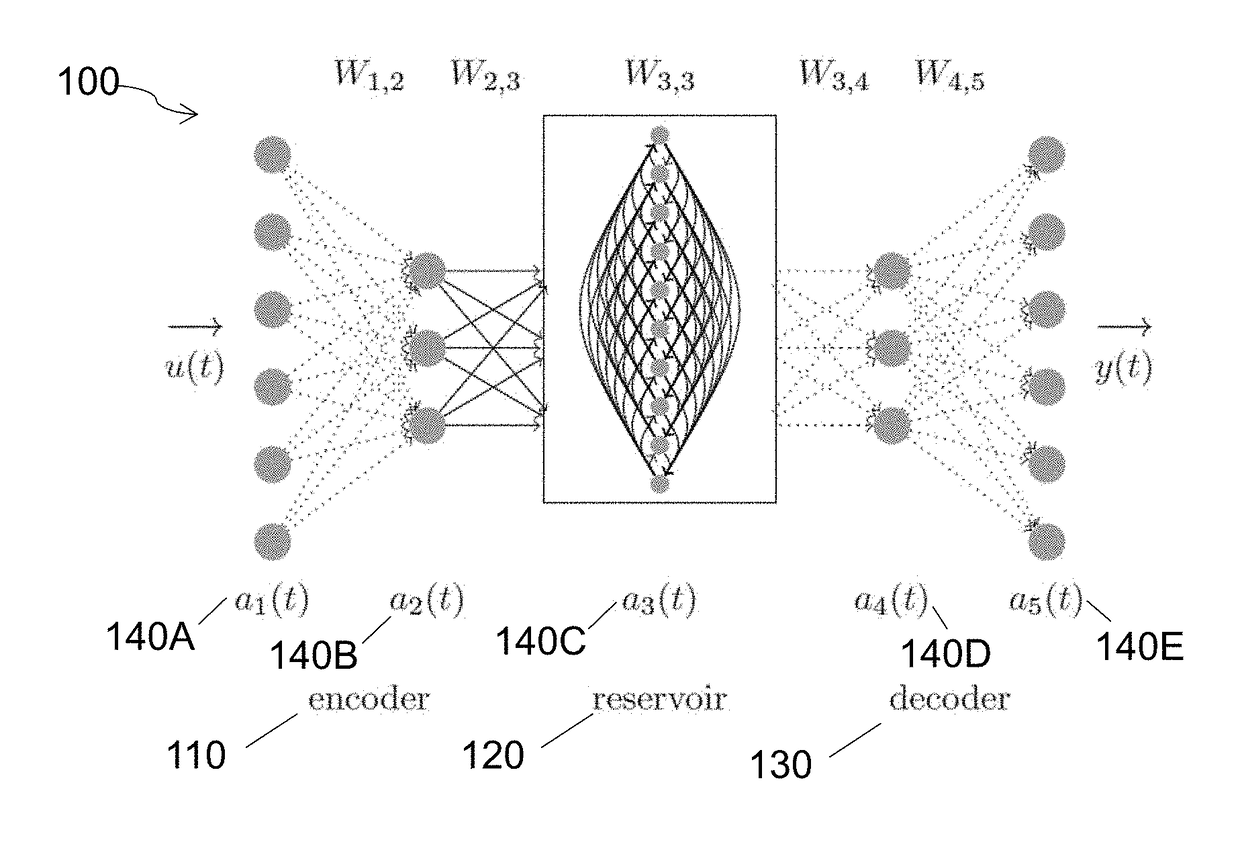
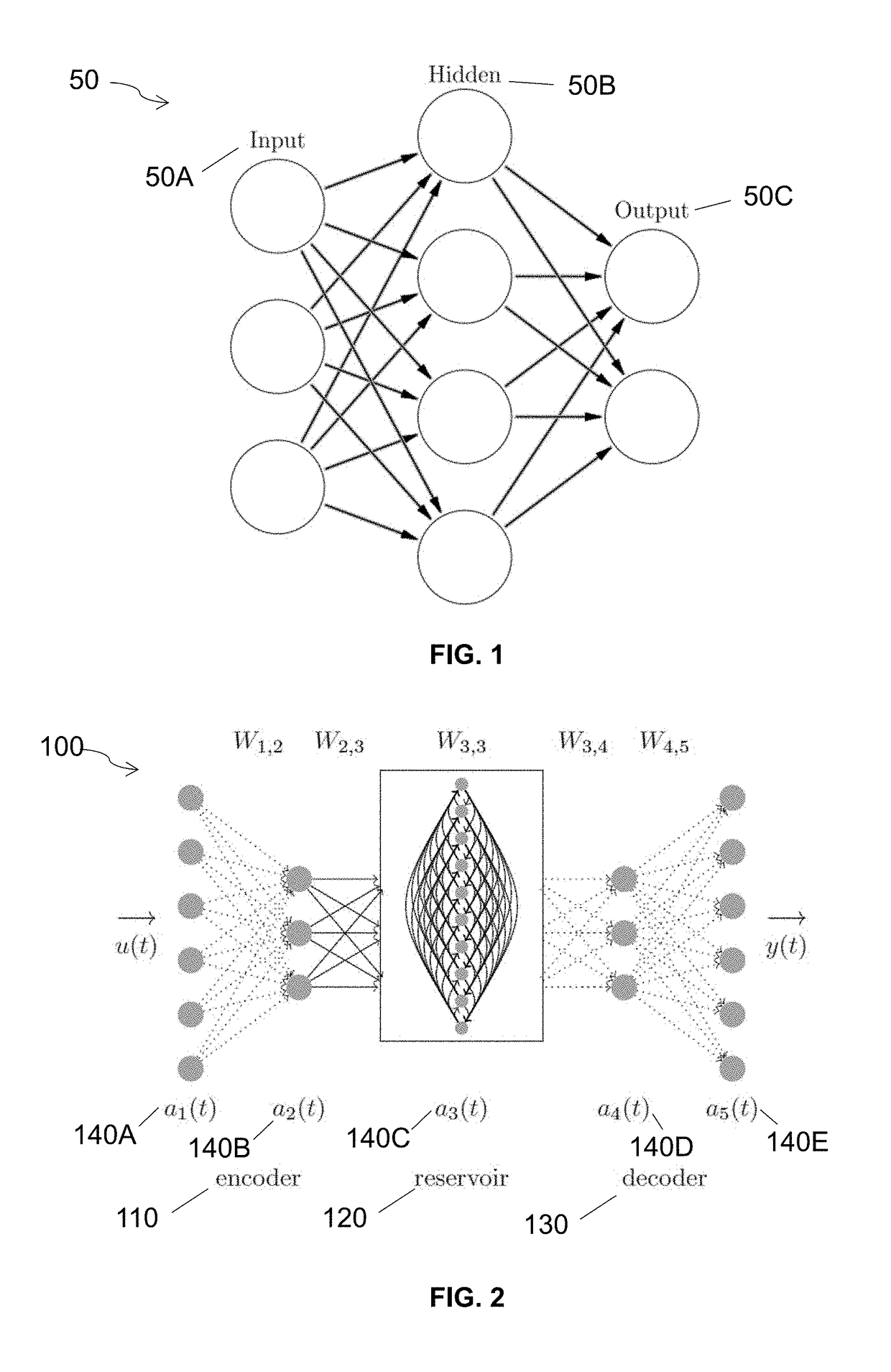
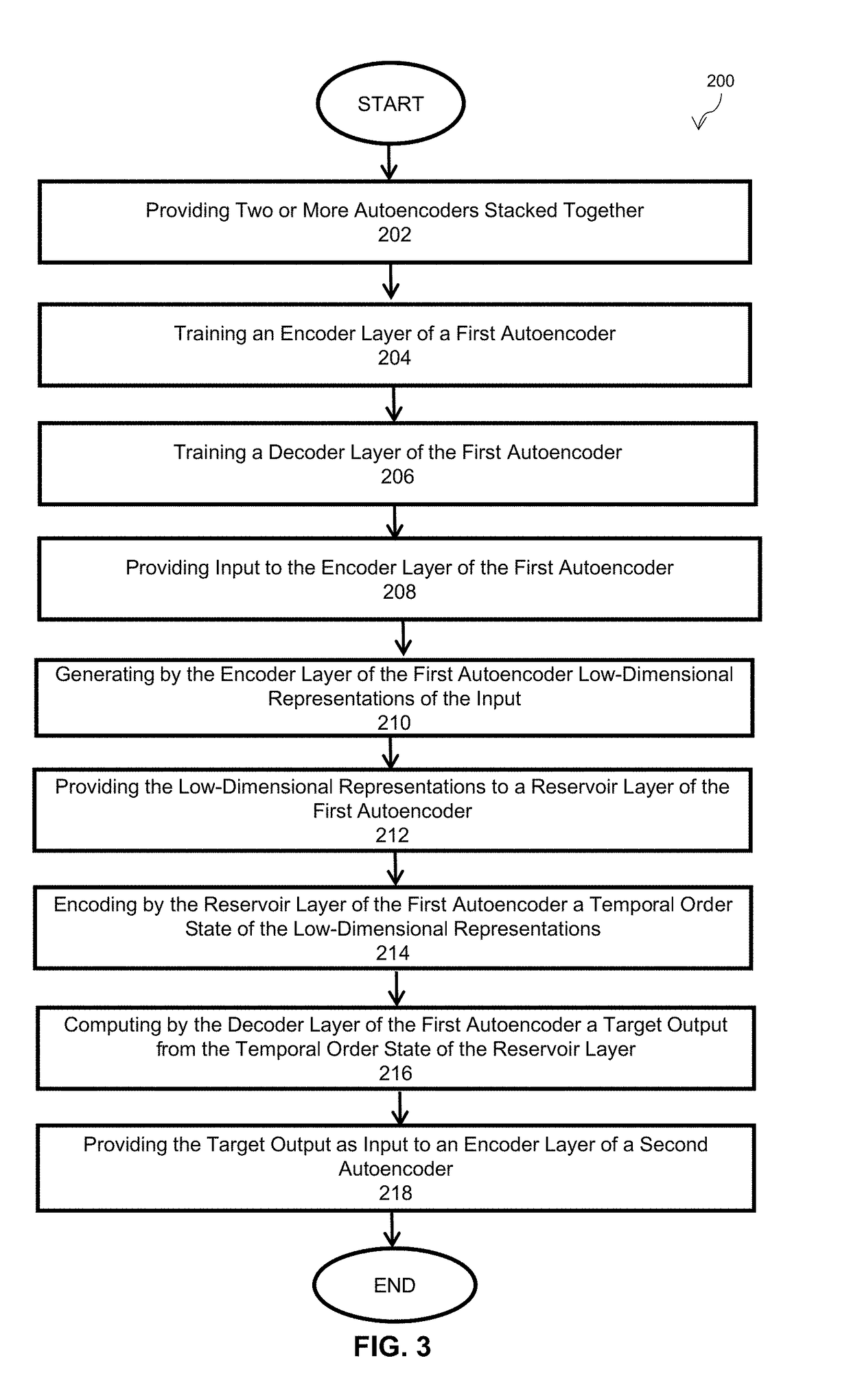
- A hybrid architecture combining stacked autoencoders for dimensionality reduction and a deep echo state layer to generate short-term memory, enabling efficient processing of high-dimensional inputs through modular and fast learning, suitable for applications like video prediction and object detection.

Hardware Implementation Considerations for Edge Computing
When deploying hyperdimensional computing and reservoir computing systems for signal forecasting at the edge, hardware implementation presents distinct challenges and opportunities that significantly impact system performance and feasibility.
Hyperdimensional computing demonstrates exceptional compatibility with edge hardware due to its inherent simplicity and fault tolerance. The binary or bipolar nature of hypervectors enables efficient implementation on low-power processors and specialized hardware accelerators. Field-programmable gate arrays (FPGAs) prove particularly suitable for HDC implementations, as the bitwise operations can be parallelized effectively across configurable logic blocks. The memory requirements for HDC are relatively modest, with hypervector dimensions typically ranging from 1,000 to 10,000 bits, making it feasible for resource-constrained edge devices.
Reservoir computing implementations face more complex hardware considerations, particularly regarding the physical reservoir construction. Traditional software-based reservoirs require significant computational resources for matrix operations and state updates, potentially limiting their applicability on ultra-low-power edge devices. However, emerging physical reservoir implementations using memristive devices, optical systems, or neuromorphic chips offer promising alternatives that can dramatically reduce power consumption while maintaining computational effectiveness.
Power efficiency represents a critical differentiator between these approaches in edge environments. HDC systems typically consume minimal power due to their reliance on simple Boolean operations and sparse connectivity patterns. The absence of complex multiplication operations makes HDC particularly attractive for battery-powered IoT devices and remote sensing applications where energy harvesting capabilities are limited.
Memory bandwidth requirements vary significantly between the two paradigms. HDC systems benefit from their ability to perform in-memory computing, reducing data movement overhead. Conversely, traditional reservoir computing implementations often require frequent memory access for weight updates and state management, potentially creating bottlenecks in bandwidth-limited edge environments.
Latency considerations favor both approaches for different reasons. HDC offers predictable, low-latency inference due to its straightforward computational pipeline. Reservoir computing can achieve competitive latency when implemented with appropriate hardware acceleration, particularly when leveraging specialized neuromorphic processors designed for recurrent neural network operations.
The scalability of these implementations on edge hardware depends heavily on the specific application requirements. HDC systems scale gracefully with increasing hypervector dimensions, while reservoir computing scalability is constrained by the reservoir size and connectivity patterns, which directly impact memory and computational requirements.
Hyperdimensional computing demonstrates exceptional compatibility with edge hardware due to its inherent simplicity and fault tolerance. The binary or bipolar nature of hypervectors enables efficient implementation on low-power processors and specialized hardware accelerators. Field-programmable gate arrays (FPGAs) prove particularly suitable for HDC implementations, as the bitwise operations can be parallelized effectively across configurable logic blocks. The memory requirements for HDC are relatively modest, with hypervector dimensions typically ranging from 1,000 to 10,000 bits, making it feasible for resource-constrained edge devices.
Reservoir computing implementations face more complex hardware considerations, particularly regarding the physical reservoir construction. Traditional software-based reservoirs require significant computational resources for matrix operations and state updates, potentially limiting their applicability on ultra-low-power edge devices. However, emerging physical reservoir implementations using memristive devices, optical systems, or neuromorphic chips offer promising alternatives that can dramatically reduce power consumption while maintaining computational effectiveness.
Power efficiency represents a critical differentiator between these approaches in edge environments. HDC systems typically consume minimal power due to their reliance on simple Boolean operations and sparse connectivity patterns. The absence of complex multiplication operations makes HDC particularly attractive for battery-powered IoT devices and remote sensing applications where energy harvesting capabilities are limited.
Memory bandwidth requirements vary significantly between the two paradigms. HDC systems benefit from their ability to perform in-memory computing, reducing data movement overhead. Conversely, traditional reservoir computing implementations often require frequent memory access for weight updates and state management, potentially creating bottlenecks in bandwidth-limited edge environments.
Latency considerations favor both approaches for different reasons. HDC offers predictable, low-latency inference due to its straightforward computational pipeline. Reservoir computing can achieve competitive latency when implemented with appropriate hardware acceleration, particularly when leveraging specialized neuromorphic processors designed for recurrent neural network operations.
The scalability of these implementations on edge hardware depends heavily on the specific application requirements. HDC systems scale gracefully with increasing hypervector dimensions, while reservoir computing scalability is constrained by the reservoir size and connectivity patterns, which directly impact memory and computational requirements.
Energy Efficiency Optimization in Neuromorphic Forecasting
Energy efficiency represents a critical optimization frontier in neuromorphic forecasting systems, particularly when comparing hyperdimensional computing (HDC) and reservoir computing (RC) architectures for signal prediction tasks. The inherent computational paradigms of these approaches offer distinct advantages in power consumption profiles, making energy optimization a decisive factor in deployment scenarios ranging from edge devices to large-scale data centers.
Hyperdimensional computing demonstrates exceptional energy efficiency through its binary vector operations and minimal precision requirements. The architecture leverages high-dimensional binary representations that enable computations using simple Boolean operations, significantly reducing power consumption compared to traditional floating-point arithmetic. Memory access patterns in HDC are highly regular and predictable, minimizing cache misses and reducing dynamic power consumption. The encoding phase, while computationally intensive, can be optimized through parallel processing, and the similarity matching operations require only lightweight XOR and population count operations.
Reservoir computing architectures present different energy optimization opportunities, primarily through their sparse connectivity patterns and event-driven computation models. The reservoir's fixed random weights eliminate the need for energy-intensive training algorithms during operation, while the sparse neural network topology reduces both computational complexity and memory bandwidth requirements. Neuromorphic implementations of RC can leverage spike-based processing, where neurons activate only when necessary, dramatically reducing idle power consumption compared to continuously active traditional neural networks.
Power scaling characteristics differ significantly between these paradigms. HDC systems exhibit linear scaling with vector dimensionality and vocabulary size, making energy consumption highly predictable and manageable. The computational load remains constant regardless of temporal sequence length, providing stable power profiles for continuous forecasting applications. Conversely, RC systems demonstrate dynamic power scaling based on input signal characteristics and reservoir activation patterns, offering potential energy savings during periods of low signal complexity.
Hardware acceleration strategies further differentiate energy optimization approaches. HDC benefits from specialized binary processing units and content-addressable memory architectures that can perform similarity searches with minimal energy overhead. Custom silicon implementations can achieve significant power reductions through dedicated hyperdimensional vector processing units. RC implementations leverage neuromorphic chips with analog computing elements and event-driven architectures, enabling ultra-low power operation through biological-inspired processing paradigms.
The temporal dynamics of forecasting tasks influence energy optimization strategies differently across architectures. HDC maintains consistent energy consumption regardless of prediction horizon, while RC systems can adapt their computational intensity based on required forecasting accuracy and temporal dependencies. This adaptive capability allows RC implementations to dynamically trade prediction accuracy for energy savings, particularly valuable in battery-constrained applications where forecasting precision requirements may vary based on operational context.
Hyperdimensional computing demonstrates exceptional energy efficiency through its binary vector operations and minimal precision requirements. The architecture leverages high-dimensional binary representations that enable computations using simple Boolean operations, significantly reducing power consumption compared to traditional floating-point arithmetic. Memory access patterns in HDC are highly regular and predictable, minimizing cache misses and reducing dynamic power consumption. The encoding phase, while computationally intensive, can be optimized through parallel processing, and the similarity matching operations require only lightweight XOR and population count operations.
Reservoir computing architectures present different energy optimization opportunities, primarily through their sparse connectivity patterns and event-driven computation models. The reservoir's fixed random weights eliminate the need for energy-intensive training algorithms during operation, while the sparse neural network topology reduces both computational complexity and memory bandwidth requirements. Neuromorphic implementations of RC can leverage spike-based processing, where neurons activate only when necessary, dramatically reducing idle power consumption compared to continuously active traditional neural networks.
Power scaling characteristics differ significantly between these paradigms. HDC systems exhibit linear scaling with vector dimensionality and vocabulary size, making energy consumption highly predictable and manageable. The computational load remains constant regardless of temporal sequence length, providing stable power profiles for continuous forecasting applications. Conversely, RC systems demonstrate dynamic power scaling based on input signal characteristics and reservoir activation patterns, offering potential energy savings during periods of low signal complexity.
Hardware acceleration strategies further differentiate energy optimization approaches. HDC benefits from specialized binary processing units and content-addressable memory architectures that can perform similarity searches with minimal energy overhead. Custom silicon implementations can achieve significant power reductions through dedicated hyperdimensional vector processing units. RC implementations leverage neuromorphic chips with analog computing elements and event-driven architectures, enabling ultra-low power operation through biological-inspired processing paradigms.
The temporal dynamics of forecasting tasks influence energy optimization strategies differently across architectures. HDC maintains consistent energy consumption regardless of prediction horizon, while RC systems can adapt their computational intensity based on required forecasting accuracy and temporal dependencies. This adaptive capability allows RC implementations to dynamically trade prediction accuracy for energy savings, particularly valuable in battery-constrained applications where forecasting precision requirements may vary based on operational context.
Unlock deeper insights with PatSnap Eureka Quick Research — get a full tech report to explore trends and direct your research. Try now!
Generate Your Research Report Instantly with AI Agent
Supercharge your innovation with PatSnap Eureka AI Agent Platform!