

Implementing Strategic Multiplexer Changes for Rapid Tech Evolution
JUL 13, 20259 MIN READ
Generate Your Research Report Instantly with AI Agent
PatSnap Eureka helps you evaluate technical feasibility & market potential.
Multiplexer Evolution
The evolution of multiplexers has been a critical factor in the rapid advancement of digital technology. Initially developed as simple signal selectors, multiplexers have undergone significant transformations to meet the increasing demands of modern computing and communication systems.
In the early stages, multiplexers were primarily used for basic signal routing in telecommunications. As technology progressed, they evolved to handle more complex data streams and higher bandwidths. The introduction of time-division multiplexing (TDM) marked a significant milestone, allowing multiple data streams to share a single communication channel by allocating time slots to each stream.
The advent of wavelength-division multiplexing (WDM) in optical communications revolutionized data transmission capabilities. This technology enabled multiple optical signals to be transmitted simultaneously over a single fiber, dramatically increasing bandwidth and paving the way for high-speed internet and telecommunications networks.
As digital systems became more sophisticated, multiplexers evolved to incorporate programmable logic, leading to the development of field-programmable gate arrays (FPGAs). These devices allowed for dynamic reconfiguration of multiplexing schemes, providing unprecedented flexibility in system design and enabling rapid prototyping of complex digital circuits.
The rise of mobile communications and the Internet of Things (IoT) has driven further innovation in multiplexer technology. Modern multiplexers now incorporate advanced features such as power management, signal integrity enhancement, and built-in self-test capabilities. These improvements have been crucial in supporting the miniaturization of electronic devices and the development of energy-efficient systems.
Recent advancements in multiplexer design have focused on increasing data rates while reducing power consumption. The integration of multiplexers with high-speed serializer/deserializer (SerDes) circuits has enabled data rates exceeding 100 Gbps, essential for next-generation data centers and 5G networks.
Looking ahead, the evolution of multiplexers is likely to continue in parallel with emerging technologies such as quantum computing and neuromorphic systems. Research is underway to develop multiplexers capable of handling quantum information, potentially revolutionizing the field of quantum communication and cryptography.
In the early stages, multiplexers were primarily used for basic signal routing in telecommunications. As technology progressed, they evolved to handle more complex data streams and higher bandwidths. The introduction of time-division multiplexing (TDM) marked a significant milestone, allowing multiple data streams to share a single communication channel by allocating time slots to each stream.
The advent of wavelength-division multiplexing (WDM) in optical communications revolutionized data transmission capabilities. This technology enabled multiple optical signals to be transmitted simultaneously over a single fiber, dramatically increasing bandwidth and paving the way for high-speed internet and telecommunications networks.
As digital systems became more sophisticated, multiplexers evolved to incorporate programmable logic, leading to the development of field-programmable gate arrays (FPGAs). These devices allowed for dynamic reconfiguration of multiplexing schemes, providing unprecedented flexibility in system design and enabling rapid prototyping of complex digital circuits.
The rise of mobile communications and the Internet of Things (IoT) has driven further innovation in multiplexer technology. Modern multiplexers now incorporate advanced features such as power management, signal integrity enhancement, and built-in self-test capabilities. These improvements have been crucial in supporting the miniaturization of electronic devices and the development of energy-efficient systems.
Recent advancements in multiplexer design have focused on increasing data rates while reducing power consumption. The integration of multiplexers with high-speed serializer/deserializer (SerDes) circuits has enabled data rates exceeding 100 Gbps, essential for next-generation data centers and 5G networks.
Looking ahead, the evolution of multiplexers is likely to continue in parallel with emerging technologies such as quantum computing and neuromorphic systems. Research is underway to develop multiplexers capable of handling quantum information, potentially revolutionizing the field of quantum communication and cryptography.
Market Demand Analysis
The market demand for strategic multiplexer changes in rapid tech evolution has been growing exponentially in recent years. This surge is primarily driven by the increasing complexity of technological systems and the need for more efficient and flexible data management solutions. As industries across various sectors continue to digitize and automate their operations, the demand for advanced multiplexing technologies has become more pronounced.
One of the key factors fueling this demand is the rapid expansion of data-intensive applications, such as artificial intelligence, machine learning, and the Internet of Things (IoT). These technologies require robust and adaptable multiplexing solutions to handle the massive volumes of data being generated and processed in real-time. The ability to efficiently route and manage data streams has become crucial for organizations looking to maintain a competitive edge in the digital landscape.
The telecommunications sector, in particular, has been a significant driver of market demand for strategic multiplexer changes. With the ongoing rollout of 5G networks and the anticipated transition to 6G in the coming years, there is a pressing need for more sophisticated multiplexing technologies that can support higher data rates, lower latency, and increased network capacity. This demand extends beyond traditional telecom operators to include cloud service providers, data centers, and enterprise networks.
In the automotive industry, the rise of connected and autonomous vehicles has created a new market for advanced multiplexing solutions. These vehicles require complex sensor systems and real-time data processing capabilities, necessitating the implementation of strategic multiplexer changes to ensure efficient communication between various vehicle components and external networks.
The healthcare sector has also emerged as a significant market for multiplexing technologies, particularly in the wake of the global pandemic. Telemedicine, remote patient monitoring, and the integration of medical devices with hospital information systems have all contributed to the increased demand for robust and secure multiplexing solutions.
Market analysis indicates that the global multiplexer market is expected to experience substantial growth in the coming years. This growth is attributed to the increasing adoption of cloud computing, the proliferation of smart devices, and the ongoing digital transformation across industries. Additionally, the push towards edge computing and the need for more efficient data processing at the network edge are driving the demand for innovative multiplexing technologies.
As organizations seek to optimize their network infrastructure and improve data management capabilities, the market for strategic multiplexer changes is likely to continue its upward trajectory. This trend is further reinforced by the growing emphasis on network security and the need for more resilient and adaptable communication systems in an increasingly interconnected world.
One of the key factors fueling this demand is the rapid expansion of data-intensive applications, such as artificial intelligence, machine learning, and the Internet of Things (IoT). These technologies require robust and adaptable multiplexing solutions to handle the massive volumes of data being generated and processed in real-time. The ability to efficiently route and manage data streams has become crucial for organizations looking to maintain a competitive edge in the digital landscape.
The telecommunications sector, in particular, has been a significant driver of market demand for strategic multiplexer changes. With the ongoing rollout of 5G networks and the anticipated transition to 6G in the coming years, there is a pressing need for more sophisticated multiplexing technologies that can support higher data rates, lower latency, and increased network capacity. This demand extends beyond traditional telecom operators to include cloud service providers, data centers, and enterprise networks.
In the automotive industry, the rise of connected and autonomous vehicles has created a new market for advanced multiplexing solutions. These vehicles require complex sensor systems and real-time data processing capabilities, necessitating the implementation of strategic multiplexer changes to ensure efficient communication between various vehicle components and external networks.
The healthcare sector has also emerged as a significant market for multiplexing technologies, particularly in the wake of the global pandemic. Telemedicine, remote patient monitoring, and the integration of medical devices with hospital information systems have all contributed to the increased demand for robust and secure multiplexing solutions.
Market analysis indicates that the global multiplexer market is expected to experience substantial growth in the coming years. This growth is attributed to the increasing adoption of cloud computing, the proliferation of smart devices, and the ongoing digital transformation across industries. Additionally, the push towards edge computing and the need for more efficient data processing at the network edge are driving the demand for innovative multiplexing technologies.
As organizations seek to optimize their network infrastructure and improve data management capabilities, the market for strategic multiplexer changes is likely to continue its upward trajectory. This trend is further reinforced by the growing emphasis on network security and the need for more resilient and adaptable communication systems in an increasingly interconnected world.
Technical Challenges
The implementation of strategic multiplexer changes for rapid tech evolution faces several significant technical challenges. These challenges stem from the complex nature of multiplexer systems and the need for seamless integration with evolving technologies.
One of the primary challenges is the optimization of signal routing and bandwidth allocation. As technology evolves rapidly, multiplexers must adapt to handle increasing data rates and more complex signal types. This requires sophisticated algorithms and hardware designs to efficiently manage signal paths and minimize latency. The development of adaptive routing mechanisms that can dynamically adjust to changing network conditions and traffic patterns is crucial but technically demanding.
Another major hurdle is maintaining signal integrity across a wide range of frequencies and data rates. As multiplexers are required to handle higher frequencies and faster data transmission, issues such as crosstalk, signal attenuation, and electromagnetic interference become more pronounced. Addressing these challenges requires advanced signal processing techniques and innovative materials for shielding and isolation.
Compatibility and interoperability present additional technical obstacles. With the rapid evolution of technology, multiplexers must be designed to work seamlessly with both legacy systems and emerging technologies. This necessitates the development of flexible architectures and protocols that can adapt to various standards and interfaces. Ensuring backward compatibility while simultaneously supporting future technologies is a complex balancing act that demands careful engineering and foresight.
Power consumption and heat dissipation are also critical concerns, particularly as multiplexers are integrated into smaller form factors and more power-sensitive applications. Designing energy-efficient multiplexer systems that can operate reliably under various environmental conditions requires innovative cooling solutions and power management techniques.
The implementation of software-defined networking (SDN) capabilities in multiplexers introduces its own set of challenges. Developing robust control planes that can manage the dynamic reconfiguration of multiplexer resources in real-time requires sophisticated software architectures and protocols. Ensuring the security and reliability of these software-controlled systems adds another layer of complexity to the design process.
Lastly, the integration of artificial intelligence and machine learning algorithms into multiplexer systems for predictive maintenance, automated optimization, and adaptive routing presents both opportunities and challenges. Developing AI models that can effectively analyze and respond to complex network conditions in real-time requires significant computational resources and advanced algorithms, pushing the boundaries of current multiplexer technologies.
One of the primary challenges is the optimization of signal routing and bandwidth allocation. As technology evolves rapidly, multiplexers must adapt to handle increasing data rates and more complex signal types. This requires sophisticated algorithms and hardware designs to efficiently manage signal paths and minimize latency. The development of adaptive routing mechanisms that can dynamically adjust to changing network conditions and traffic patterns is crucial but technically demanding.
Another major hurdle is maintaining signal integrity across a wide range of frequencies and data rates. As multiplexers are required to handle higher frequencies and faster data transmission, issues such as crosstalk, signal attenuation, and electromagnetic interference become more pronounced. Addressing these challenges requires advanced signal processing techniques and innovative materials for shielding and isolation.
Compatibility and interoperability present additional technical obstacles. With the rapid evolution of technology, multiplexers must be designed to work seamlessly with both legacy systems and emerging technologies. This necessitates the development of flexible architectures and protocols that can adapt to various standards and interfaces. Ensuring backward compatibility while simultaneously supporting future technologies is a complex balancing act that demands careful engineering and foresight.
Power consumption and heat dissipation are also critical concerns, particularly as multiplexers are integrated into smaller form factors and more power-sensitive applications. Designing energy-efficient multiplexer systems that can operate reliably under various environmental conditions requires innovative cooling solutions and power management techniques.
The implementation of software-defined networking (SDN) capabilities in multiplexers introduces its own set of challenges. Developing robust control planes that can manage the dynamic reconfiguration of multiplexer resources in real-time requires sophisticated software architectures and protocols. Ensuring the security and reliability of these software-controlled systems adds another layer of complexity to the design process.
Lastly, the integration of artificial intelligence and machine learning algorithms into multiplexer systems for predictive maintenance, automated optimization, and adaptive routing presents both opportunities and challenges. Developing AI models that can effectively analyze and respond to complex network conditions in real-time requires significant computational resources and advanced algorithms, pushing the boundaries of current multiplexer technologies.
Current Solutions
01 Advanced multiplexing techniques for strategic data management
Strategic multiplexer technology has evolved to incorporate advanced techniques for efficient data management. These innovations focus on improving data transmission, processing, and storage capabilities in complex systems. The advancements enable better resource allocation, enhanced performance, and increased scalability in various applications, including telecommunications, network infrastructure, and data centers.- Advanced multiplexing techniques for strategic data management: Strategic multiplexer technology has evolved to incorporate advanced techniques for efficient data management. These innovations focus on improving data transmission, processing, and storage capabilities in complex systems. The advancements enable better resource allocation, enhanced performance, and increased scalability in various applications, including telecommunications, network infrastructure, and data centers.
- Intelligent decision-making systems in strategic multiplexers: Modern strategic multiplexers incorporate intelligent decision-making systems that utilize machine learning and artificial intelligence algorithms. These systems can analyze complex data patterns, predict outcomes, and make real-time decisions to optimize resource allocation and performance. This evolution enables more efficient and adaptive multiplexing strategies in dynamic environments, improving overall system reliability and effectiveness.
- Integration of strategic multiplexers in business process management: Strategic multiplexer technology has been integrated into business process management systems to enhance operational efficiency and decision-making. This evolution allows for better coordination of resources, improved workflow management, and more effective strategic planning. By leveraging multiplexer capabilities, organizations can streamline their processes, reduce costs, and respond more quickly to changing market conditions.
- Enhanced security features in strategic multiplexer systems: The evolution of strategic multiplexer technology has led to the development of advanced security features. These innovations include improved encryption methods, secure data routing protocols, and enhanced authentication mechanisms. By incorporating these security measures, strategic multiplexers can better protect sensitive information, prevent unauthorized access, and ensure the integrity of data transmission in various applications, from financial systems to critical infrastructure.
- Integration of strategic multiplexers with emerging technologies: Strategic multiplexer technology has evolved to integrate with emerging technologies such as Internet of Things (IoT), 5G networks, and edge computing. This integration enables more efficient data handling, reduced latency, and improved connectivity in complex systems. By leveraging these synergies, strategic multiplexers can support a wide range of applications, from smart cities to industrial automation, enhancing overall system performance and capabilities.
02 AI-driven multiplexer optimization for strategic decision-making
Artificial intelligence is being integrated into multiplexer systems to optimize strategic decision-making processes. These AI-enhanced multiplexers can analyze complex data streams, identify patterns, and make real-time adjustments to improve overall system performance. This technology is particularly useful in business intelligence, financial forecasting, and operational planning scenarios.Expand Specific Solutions03 Adaptive multiplexing for dynamic resource allocation
The evolution of strategic multiplexer technology includes the development of adaptive systems that can dynamically allocate resources based on changing demands. These systems use sophisticated algorithms to monitor network traffic, user requirements, and system performance, adjusting multiplexing parameters in real-time to optimize resource utilization and maintain quality of service across various applications.Expand Specific Solutions04 Integration of blockchain in multiplexer security protocols
Blockchain technology is being incorporated into multiplexer security protocols to enhance data integrity and traceability. This integration provides a decentralized and tamper-resistant approach to managing multiplexed data streams, ensuring secure and transparent operations in sensitive applications such as financial transactions, supply chain management, and secure communications.Expand Specific Solutions05 Quantum-inspired multiplexing for next-generation strategic systems
Research is being conducted on quantum-inspired multiplexing techniques to push the boundaries of strategic system capabilities. These advanced concepts aim to leverage quantum principles to dramatically increase data processing speeds, enhance encryption methods, and enable ultra-high-capacity data transmission. While still in early stages, this technology holds promise for revolutionizing strategic multiplexer applications in fields such as cryptography, high-performance computing, and advanced telecommunications.Expand Specific Solutions
Industry Leaders
The strategic multiplexer technology landscape is in a dynamic growth phase, with a rapidly expanding market and evolving technological maturity. Key players like Huawei, ZTE, Samsung, and Nokia are driving innovation in this space. The market is characterized by intense competition among established telecom equipment manufacturers and emerging tech giants. As the technology matures, we're seeing increased integration of AI and machine learning capabilities, with companies like Qualcomm and Intel pushing the boundaries of multiplexer efficiency and performance. The global rollout of 5G networks is further accelerating demand, creating opportunities for both hardware and software solutions in this domain.
Huawei Technologies Co., Ltd.
Technical Solution: Huawei has developed a strategic multiplexer solution called "Intelligent OptiX Network" for rapid tech evolution. This solution integrates AI and machine learning algorithms to dynamically allocate network resources based on real-time traffic demands[1]. The system employs advanced optical cross-connect (OXC) technology, allowing for flexible wavelength routing and switching[2]. Huawei's multiplexer can handle up to 32 Tbps of traffic per fiber pair, significantly increasing network capacity[3]. The solution also incorporates software-defined networking (SDN) principles, enabling centralized control and programmability for quick adaptation to changing network requirements[4].
Strengths: High capacity, AI-driven resource allocation, flexible routing. Weaknesses: Potential vendor lock-in, high initial implementation costs.
Samsung Electronics Co., Ltd.
Technical Solution: Samsung has introduced a strategic multiplexer technology called "Smart Network Fabric" for rapid tech evolution. This solution utilizes advanced silicon photonics and integrated circuit design to create high-density, low-power multiplexers[5]. The system can support up to 64 wavelength channels per fiber, each operating at 100 Gbps, resulting in a total capacity of 6.4 Tbps per fiber[6]. Samsung's multiplexer incorporates machine learning algorithms for predictive maintenance and automatic fault detection, enhancing network reliability[7]. The solution also features a modular design, allowing for easy upgrades and scalability as technology evolves[8].
Strengths: High-density design, energy efficiency, scalability. Weaknesses: Limited ecosystem compared to some competitors, potential heat management issues in dense deployments.
Key Innovations
Systems and methods for optimizing telemetry configuration
PatentPendingUS20250021500A1
Innovation
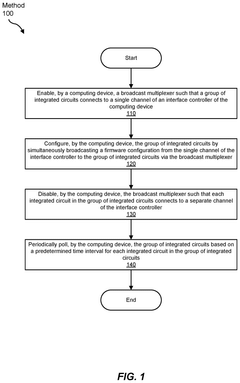
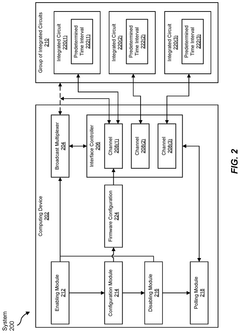
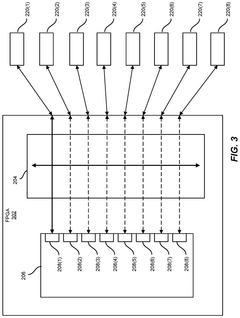
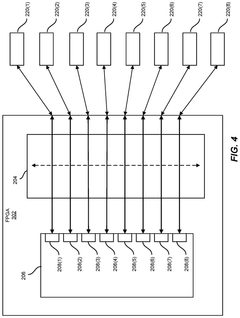
- The integration of broadcast multiplexers with interface controllers enables simultaneous firmware configuration and parallel telemetry polling by aggregating multiple integrated circuits to a single channel, allowing for efficient firmware download and independent polling of each device, thereby optimizing telemetry configurations and reducing host CPU load.
Quickly reconfigurable wavelength division muliplexer
PatentInactiveEP0506567A1
Innovation
- A rapidly reconfigurable wavelength multiplexing device featuring a switching matrix with controllable optical couplers in a tree structure, programmable control logic, and modulation means to select and manage multiple wavelengths, enabling high-speed switching and packet communication.


Implementation Strategy
The implementation strategy for strategic multiplexer changes to facilitate rapid tech evolution requires a multi-faceted approach. Initially, a comprehensive assessment of the current multiplexer infrastructure is essential to identify areas that require enhancement or replacement. This evaluation should consider factors such as bandwidth capacity, latency, scalability, and compatibility with emerging technologies.
Following the assessment, a phased implementation plan should be developed. This plan should prioritize critical areas that will yield the most significant improvements in network performance and flexibility. The first phase may focus on upgrading core multiplexer components to support higher data rates and more advanced modulation schemes. This could involve the deployment of software-defined networking (SDN) capabilities to enable more dynamic and programmable network configurations.
Concurrently, it is crucial to establish a robust testing and validation framework. This framework should include both simulated environments and controlled real-world trials to ensure that the new multiplexer configurations perform as expected under various network conditions. Rigorous testing will help identify potential issues early in the implementation process and allow for necessary adjustments before full-scale deployment.
As the implementation progresses, it is vital to maintain seamless integration with existing systems. This may require the development of custom interfaces or middleware solutions to bridge legacy equipment with new multiplexer technologies. Additionally, implementing redundancy and failover mechanisms will be critical to maintaining network reliability during the transition period.
Training and knowledge transfer should be an integral part of the implementation strategy. Technical staff must be thoroughly educated on the new multiplexer technologies, operational procedures, and troubleshooting techniques. This will ensure smooth adoption and minimize disruptions during and after the implementation process.
Lastly, a continuous monitoring and optimization plan should be established. This plan should leverage advanced analytics and machine learning algorithms to proactively identify performance bottlenecks, predict potential failures, and suggest optimizations. By implementing an adaptive approach, the multiplexer infrastructure can evolve rapidly in response to changing technological landscapes and business requirements.
Following the assessment, a phased implementation plan should be developed. This plan should prioritize critical areas that will yield the most significant improvements in network performance and flexibility. The first phase may focus on upgrading core multiplexer components to support higher data rates and more advanced modulation schemes. This could involve the deployment of software-defined networking (SDN) capabilities to enable more dynamic and programmable network configurations.
Concurrently, it is crucial to establish a robust testing and validation framework. This framework should include both simulated environments and controlled real-world trials to ensure that the new multiplexer configurations perform as expected under various network conditions. Rigorous testing will help identify potential issues early in the implementation process and allow for necessary adjustments before full-scale deployment.
As the implementation progresses, it is vital to maintain seamless integration with existing systems. This may require the development of custom interfaces or middleware solutions to bridge legacy equipment with new multiplexer technologies. Additionally, implementing redundancy and failover mechanisms will be critical to maintaining network reliability during the transition period.
Training and knowledge transfer should be an integral part of the implementation strategy. Technical staff must be thoroughly educated on the new multiplexer technologies, operational procedures, and troubleshooting techniques. This will ensure smooth adoption and minimize disruptions during and after the implementation process.
Lastly, a continuous monitoring and optimization plan should be established. This plan should leverage advanced analytics and machine learning algorithms to proactively identify performance bottlenecks, predict potential failures, and suggest optimizations. By implementing an adaptive approach, the multiplexer infrastructure can evolve rapidly in response to changing technological landscapes and business requirements.
Performance Metrics
Performance metrics play a crucial role in evaluating the effectiveness of strategic multiplexer changes for rapid tech evolution. These metrics provide quantifiable measures to assess the impact of implemented changes on system performance, efficiency, and overall technological advancement.
One key performance metric is latency reduction. By implementing strategic multiplexer changes, organizations aim to minimize the delay between input and output signals. This metric is particularly important in time-sensitive applications, such as real-time data processing and high-frequency trading. Measuring latency improvements can demonstrate the tangible benefits of multiplexer optimizations.
Throughput enhancement is another critical metric. Strategic multiplexer changes should result in increased data transmission rates, allowing for more efficient utilization of available bandwidth. This metric is often expressed in terms of bits per second (bps) or packets per second (pps), providing a clear indication of system capacity improvements.
Power efficiency is an increasingly important performance metric, especially in the context of sustainable technology evolution. Multiplexer changes that lead to reduced power consumption while maintaining or improving performance are highly valued. This metric can be measured in terms of energy consumption per unit of data processed or transmitted.
Scalability is a key performance indicator for rapidly evolving technologies. The ability of multiplexer systems to handle increasing loads and adapt to growing demands is crucial. Metrics related to scalability include the system's capacity to maintain performance levels under varying workloads and its ability to accommodate additional inputs or outputs without significant degradation.
Reliability and fault tolerance are essential metrics in assessing the robustness of multiplexer implementations. These metrics evaluate the system's ability to maintain consistent performance in the face of component failures or unexpected conditions. Mean Time Between Failures (MTBF) and Mean Time To Recovery (MTTR) are commonly used reliability metrics.
Signal integrity is a critical performance metric, particularly in high-speed digital systems. Strategic multiplexer changes should aim to minimize signal distortion, crosstalk, and electromagnetic interference. Metrics such as bit error rate (BER) and signal-to-noise ratio (SNR) are used to quantify signal quality improvements.
Flexibility and adaptability metrics assess the multiplexer system's ability to accommodate diverse input types and rapidly changing technological landscapes. These metrics may include the range of supported protocols, the ease of reconfiguration, and the system's compatibility with emerging standards.
By carefully monitoring and analyzing these performance metrics, organizations can effectively evaluate the success of their strategic multiplexer changes and guide future technological evolution efforts. Regular benchmarking against industry standards and competitors' performance can provide valuable insights into the relative effectiveness of implemented strategies.
One key performance metric is latency reduction. By implementing strategic multiplexer changes, organizations aim to minimize the delay between input and output signals. This metric is particularly important in time-sensitive applications, such as real-time data processing and high-frequency trading. Measuring latency improvements can demonstrate the tangible benefits of multiplexer optimizations.
Throughput enhancement is another critical metric. Strategic multiplexer changes should result in increased data transmission rates, allowing for more efficient utilization of available bandwidth. This metric is often expressed in terms of bits per second (bps) or packets per second (pps), providing a clear indication of system capacity improvements.
Power efficiency is an increasingly important performance metric, especially in the context of sustainable technology evolution. Multiplexer changes that lead to reduced power consumption while maintaining or improving performance are highly valued. This metric can be measured in terms of energy consumption per unit of data processed or transmitted.
Scalability is a key performance indicator for rapidly evolving technologies. The ability of multiplexer systems to handle increasing loads and adapt to growing demands is crucial. Metrics related to scalability include the system's capacity to maintain performance levels under varying workloads and its ability to accommodate additional inputs or outputs without significant degradation.
Reliability and fault tolerance are essential metrics in assessing the robustness of multiplexer implementations. These metrics evaluate the system's ability to maintain consistent performance in the face of component failures or unexpected conditions. Mean Time Between Failures (MTBF) and Mean Time To Recovery (MTTR) are commonly used reliability metrics.
Signal integrity is a critical performance metric, particularly in high-speed digital systems. Strategic multiplexer changes should aim to minimize signal distortion, crosstalk, and electromagnetic interference. Metrics such as bit error rate (BER) and signal-to-noise ratio (SNR) are used to quantify signal quality improvements.
Flexibility and adaptability metrics assess the multiplexer system's ability to accommodate diverse input types and rapidly changing technological landscapes. These metrics may include the range of supported protocols, the ease of reconfiguration, and the system's compatibility with emerging standards.
By carefully monitoring and analyzing these performance metrics, organizations can effectively evaluate the success of their strategic multiplexer changes and guide future technological evolution efforts. Regular benchmarking against industry standards and competitors' performance can provide valuable insights into the relative effectiveness of implemented strategies.
Unlock deeper insights with PatSnap Eureka Quick Research — get a full tech report to explore trends and direct your research. Try now!
Generate Your Research Report Instantly with AI Agent
Supercharge your innovation with PatSnap Eureka AI Agent Platform!