Ion Selective Electrode in Coatings: Adhesion Strength Validation
MAR 8, 20269 MIN READ
Generate Your Research Report Instantly with AI Agent
PatSnap Eureka helps you evaluate technical feasibility & market potential.
Ion Selective Electrode Coating Technology Background and Objectives
Ion selective electrodes (ISEs) represent a cornerstone technology in analytical chemistry, enabling precise measurement of specific ion concentrations in various solutions. The evolution of ISE technology has progressed from simple glass membrane electrodes in the early 20th century to sophisticated solid-state and polymer membrane systems. This technological advancement has been driven by the increasing demand for real-time, in-situ monitoring capabilities across diverse industrial applications.
The integration of ISE technology into coating systems emerged as a natural progression to address the limitations of traditional electrochemical sensors in harsh environments. Conventional ISEs often suffer from mechanical fragility, limited operational lifespan, and susceptibility to interference from environmental factors. The development of ISE-embedded coatings represents a paradigm shift toward creating robust, durable sensing platforms that can withstand challenging operational conditions while maintaining analytical precision.
Current technological trends indicate a strong movement toward miniaturization and enhanced durability of electrochemical sensing systems. The incorporation of nanomaterials, advanced polymer matrices, and novel membrane compositions has significantly expanded the operational envelope of ISE technology. These developments have enabled the creation of coating-integrated sensors capable of functioning in extreme temperatures, corrosive environments, and high-pressure conditions.
The primary objective of ISE coating technology centers on achieving seamless integration between the sensing element and the protective coating matrix while preserving electrochemical functionality. This integration must ensure optimal ion transport pathways, maintain electrode selectivity, and provide long-term stability under operational stress. The coating serves dual purposes: protecting the sensitive electrode components from environmental degradation and enabling deployment in applications where traditional ISE configurations would be impractical.
A critical technical challenge lies in validating the adhesion strength between the ISE components and the coating matrix. Poor adhesion can lead to delamination, compromised sensing performance, and premature failure of the entire system. The adhesion validation process must account for thermal cycling, chemical exposure, mechanical stress, and long-term aging effects that could compromise the integrity of the ISE-coating interface.
The ultimate goal involves developing standardized methodologies for assessing adhesion strength that correlate directly with real-world performance metrics. This requires establishing quantitative relationships between adhesion parameters and sensor reliability, accuracy, and operational lifespan. Success in this endeavor will enable widespread adoption of ISE coating technology across industries requiring robust, long-term electrochemical monitoring solutions.
The integration of ISE technology into coating systems emerged as a natural progression to address the limitations of traditional electrochemical sensors in harsh environments. Conventional ISEs often suffer from mechanical fragility, limited operational lifespan, and susceptibility to interference from environmental factors. The development of ISE-embedded coatings represents a paradigm shift toward creating robust, durable sensing platforms that can withstand challenging operational conditions while maintaining analytical precision.
Current technological trends indicate a strong movement toward miniaturization and enhanced durability of electrochemical sensing systems. The incorporation of nanomaterials, advanced polymer matrices, and novel membrane compositions has significantly expanded the operational envelope of ISE technology. These developments have enabled the creation of coating-integrated sensors capable of functioning in extreme temperatures, corrosive environments, and high-pressure conditions.
The primary objective of ISE coating technology centers on achieving seamless integration between the sensing element and the protective coating matrix while preserving electrochemical functionality. This integration must ensure optimal ion transport pathways, maintain electrode selectivity, and provide long-term stability under operational stress. The coating serves dual purposes: protecting the sensitive electrode components from environmental degradation and enabling deployment in applications where traditional ISE configurations would be impractical.
A critical technical challenge lies in validating the adhesion strength between the ISE components and the coating matrix. Poor adhesion can lead to delamination, compromised sensing performance, and premature failure of the entire system. The adhesion validation process must account for thermal cycling, chemical exposure, mechanical stress, and long-term aging effects that could compromise the integrity of the ISE-coating interface.
The ultimate goal involves developing standardized methodologies for assessing adhesion strength that correlate directly with real-world performance metrics. This requires establishing quantitative relationships between adhesion parameters and sensor reliability, accuracy, and operational lifespan. Success in this endeavor will enable widespread adoption of ISE coating technology across industries requiring robust, long-term electrochemical monitoring solutions.
Market Demand for ISE Coating Applications
The global market for ion selective electrode (ISE) coating applications is experiencing significant growth driven by increasing demands across multiple industrial sectors. The healthcare and medical device industry represents one of the most substantial market segments, where ISE coatings are essential for developing reliable biosensors, implantable devices, and point-of-care diagnostic equipment. These applications require coatings with exceptional adhesion strength to ensure long-term stability and accurate measurements in biological environments.
Industrial process monitoring constitutes another major market driver, particularly in chemical manufacturing, water treatment, and environmental monitoring sectors. Companies are increasingly adopting ISE-based sensors for real-time monitoring of ion concentrations in various processes, creating substantial demand for durable coating solutions that can withstand harsh industrial conditions while maintaining measurement accuracy.
The automotive industry is emerging as a significant growth area for ISE coating applications, particularly in electric vehicle battery management systems and exhaust gas monitoring. As environmental regulations become more stringent globally, the demand for reliable ion-selective sensors with robust coating systems continues to expand. These applications require coatings that can maintain adhesion strength under extreme temperature variations and mechanical stress.
Water quality monitoring represents a rapidly expanding market segment, driven by increasing environmental awareness and regulatory requirements. Municipal water treatment facilities, industrial wastewater management, and agricultural monitoring systems are adopting ISE-based sensors at an accelerating pace. The reliability of these sensors heavily depends on coating adhesion strength, as failure can result in measurement drift and costly maintenance.
The pharmaceutical and biotechnology sectors are driving demand for specialized ISE coating applications in drug development and quality control processes. These applications require coatings with exceptional chemical resistance and long-term stability, making adhesion strength validation critical for market acceptance.
Emerging applications in food and beverage quality control, soil analysis for precision agriculture, and marine environmental monitoring are creating new market opportunities. These diverse applications share common requirements for coating durability and reliability, emphasizing the importance of validated adhesion strength in ISE coating technologies.
Industrial process monitoring constitutes another major market driver, particularly in chemical manufacturing, water treatment, and environmental monitoring sectors. Companies are increasingly adopting ISE-based sensors for real-time monitoring of ion concentrations in various processes, creating substantial demand for durable coating solutions that can withstand harsh industrial conditions while maintaining measurement accuracy.
The automotive industry is emerging as a significant growth area for ISE coating applications, particularly in electric vehicle battery management systems and exhaust gas monitoring. As environmental regulations become more stringent globally, the demand for reliable ion-selective sensors with robust coating systems continues to expand. These applications require coatings that can maintain adhesion strength under extreme temperature variations and mechanical stress.
Water quality monitoring represents a rapidly expanding market segment, driven by increasing environmental awareness and regulatory requirements. Municipal water treatment facilities, industrial wastewater management, and agricultural monitoring systems are adopting ISE-based sensors at an accelerating pace. The reliability of these sensors heavily depends on coating adhesion strength, as failure can result in measurement drift and costly maintenance.
The pharmaceutical and biotechnology sectors are driving demand for specialized ISE coating applications in drug development and quality control processes. These applications require coatings with exceptional chemical resistance and long-term stability, making adhesion strength validation critical for market acceptance.
Emerging applications in food and beverage quality control, soil analysis for precision agriculture, and marine environmental monitoring are creating new market opportunities. These diverse applications share common requirements for coating durability and reliability, emphasizing the importance of validated adhesion strength in ISE coating technologies.
Current ISE Coating Adhesion Challenges and Status
Ion selective electrode (ISE) coating adhesion represents a critical technical bottleneck in the development of reliable electrochemical sensors. Current challenges primarily stem from the fundamental incompatibility between hydrophilic electrode substrates and hydrophobic polymer-based ISE membranes. This interface mismatch creates weak van der Waals interactions that are insufficient for long-term stability under operational conditions.
The predominant adhesion failure mechanisms include delamination at the electrode-membrane interface, particularly under cyclic temperature variations and prolonged aqueous exposure. Traditional ISE coatings exhibit adhesion strengths ranging from 0.5 to 2.5 MPa, which falls significantly below the 5-10 MPa threshold required for industrial applications. This inadequacy becomes more pronounced in harsh environments involving pH extremes, high ionic strength solutions, or mechanical stress.
Current surface preparation methodologies rely heavily on chemical etching and silanization processes to enhance substrate wettability. However, these approaches often introduce surface roughness inconsistencies and create potential contamination sites that compromise long-term performance. The lack of standardized adhesion testing protocols further complicates the evaluation and comparison of different coating systems across research institutions and manufacturers.
Polymer matrix degradation presents another significant challenge, particularly for plasticized PVC-based ISE membranes. Plasticizer leaching occurs within 30-90 days of deployment, leading to membrane brittleness and subsequent adhesion failure. Alternative polymer systems, including polyurethane and silicone-based matrices, show improved mechanical properties but often sacrifice ionic selectivity and response time characteristics.
The integration of nanostructured adhesion promoters has emerged as a promising approach, yet scalability and cost-effectiveness remain unresolved. Current research indicates that functionalized carbon nanotubes and graphene oxide can improve adhesion strength by 40-60%, but their incorporation introduces manufacturing complexity and potential biocompatibility concerns for medical applications.
Existing quality control measures for ISE coating adhesion rely primarily on pull-off testing and cross-hatch adhesion assessments. These methods provide limited insight into long-term durability and fail to predict performance under dynamic operational conditions. The absence of accelerated aging protocols specifically designed for ISE systems further hampers the development of robust coating solutions with predictable service lifetimes.
The predominant adhesion failure mechanisms include delamination at the electrode-membrane interface, particularly under cyclic temperature variations and prolonged aqueous exposure. Traditional ISE coatings exhibit adhesion strengths ranging from 0.5 to 2.5 MPa, which falls significantly below the 5-10 MPa threshold required for industrial applications. This inadequacy becomes more pronounced in harsh environments involving pH extremes, high ionic strength solutions, or mechanical stress.
Current surface preparation methodologies rely heavily on chemical etching and silanization processes to enhance substrate wettability. However, these approaches often introduce surface roughness inconsistencies and create potential contamination sites that compromise long-term performance. The lack of standardized adhesion testing protocols further complicates the evaluation and comparison of different coating systems across research institutions and manufacturers.
Polymer matrix degradation presents another significant challenge, particularly for plasticized PVC-based ISE membranes. Plasticizer leaching occurs within 30-90 days of deployment, leading to membrane brittleness and subsequent adhesion failure. Alternative polymer systems, including polyurethane and silicone-based matrices, show improved mechanical properties but often sacrifice ionic selectivity and response time characteristics.
The integration of nanostructured adhesion promoters has emerged as a promising approach, yet scalability and cost-effectiveness remain unresolved. Current research indicates that functionalized carbon nanotubes and graphene oxide can improve adhesion strength by 40-60%, but their incorporation introduces manufacturing complexity and potential biocompatibility concerns for medical applications.
Existing quality control measures for ISE coating adhesion rely primarily on pull-off testing and cross-hatch adhesion assessments. These methods provide limited insight into long-term durability and fail to predict performance under dynamic operational conditions. The absence of accelerated aging protocols specifically designed for ISE systems further hampers the development of robust coating solutions with predictable service lifetimes.
Current ISE Coating Adhesion Solutions
01 Adhesive layer composition for ion selective electrodes
The adhesion strength of ion selective electrodes can be improved through specific adhesive layer compositions. These compositions may include polymeric materials, hydrogels, or specialized bonding agents that create a strong interface between the ion-selective membrane and the electrode substrate. The adhesive layer must maintain chemical stability while providing mechanical strength to prevent delamination during use.- Adhesive layer composition for ion selective electrodes: The adhesion strength of ion selective electrodes can be improved through specific adhesive layer compositions. These compositions may include polymeric materials, hydrogels, or specialized bonding agents that create strong interfacial bonds between the electrode membrane and the substrate. The adhesive layer must maintain ionic conductivity while providing mechanical stability and long-term adhesion under various environmental conditions including aqueous solutions.
- Surface treatment and modification techniques: Enhancement of adhesion strength can be achieved through surface treatment methods applied to either the electrode membrane or the substrate. These techniques may include plasma treatment, chemical etching, corona discharge, or application of primer layers. Such modifications increase surface energy and create reactive sites that promote stronger bonding between the ion selective membrane and supporting structures.
- Mechanical anchoring and structural design: Physical design features can significantly improve the adhesion strength of ion selective electrodes. This includes the use of mechanical interlocking structures, porous substrates that allow penetration of adhesive materials, or specific geometric configurations that increase contact area. The structural design approach provides mechanical reinforcement in addition to chemical bonding.
- Membrane matrix formulation for enhanced adhesion: The formulation of the ion selective membrane matrix itself can be optimized to improve adhesion properties. This involves incorporating specific plasticizers, cross-linking agents, or adhesion promoters directly into the membrane composition. The membrane chemistry is designed to create inherent compatibility with substrate materials while maintaining ion selectivity and electrochemical performance.
- Testing and quality control methods for adhesion strength: Standardized methods for measuring and ensuring adequate adhesion strength of ion selective electrodes include peel tests, shear strength measurements, and long-term stability assessments under operational conditions. These quality control procedures ensure that electrodes meet minimum adhesion requirements for their intended applications and can withstand mechanical stress, temperature variations, and chemical exposure during use.
02 Surface treatment and modification techniques
Enhancing adhesion strength involves surface treatment methods applied to either the electrode substrate or the ion-selective membrane. These techniques may include plasma treatment, chemical etching, or application of coupling agents that improve interfacial bonding. Surface roughening and functionalization create mechanical interlocking and chemical bonding sites that significantly increase adhesion strength.Expand Specific Solutions03 Membrane matrix formulation for improved adhesion
The formulation of the ion-selective membrane matrix itself can be optimized to enhance adhesion to the electrode substrate. This includes selection of appropriate plasticizers, polymeric matrices, and additives that promote compatibility and bonding with the underlying electrode material. The membrane composition affects both the mechanical properties and the interfacial adhesion strength.Expand Specific Solutions04 Intermediate bonding layers and primers
Implementation of intermediate bonding layers or primer coatings between the electrode substrate and ion-selective membrane can significantly improve adhesion strength. These layers act as compatibility promoters that bridge the chemical and physical properties of the two materials. The intermediate layers may contain bifunctional compounds that bond to both surfaces simultaneously.Expand Specific Solutions05 Mechanical reinforcement and structural design
Adhesion strength can be enhanced through mechanical reinforcement strategies and optimized structural design of the electrode assembly. This includes the use of support structures, edge sealing techniques, and geometric configurations that distribute stress more evenly across the adhesive interface. Mechanical anchoring features and multi-layer constructions provide additional stability and prevent interfacial failure.Expand Specific Solutions
Key Players in ISE and Coating Industry
The ion selective electrode technology for coating adhesion strength validation represents an emerging niche within the broader coatings and materials testing industry, currently in its early development stage with significant growth potential. The market encompasses diverse sectors from automotive to electronics, driven by increasing quality control demands and regulatory requirements for coating performance validation. Technology maturity varies considerably across market participants, with established industrial giants like Hitachi High-Tech America, BASF Coatings GmbH, and 3M Innovative Properties demonstrating advanced capabilities in measurement systems and coating formulations. Japanese companies including Nippon Paint, Nitto Denko, and Horiba Ltd. showcase sophisticated materials science expertise, while automotive manufacturers like Honda Motor and Tata Motors drive application-specific requirements. Academic institutions such as Zhejiang University and Guangzhou University contribute fundamental research, though commercial implementation remains limited. The competitive landscape suggests a fragmented market with opportunities for specialized solution providers to bridge the gap between research capabilities and industrial applications.
PPG Industries Ohio, Inc.
Technical Solution: PPG Industries has pioneered the integration of ion selective electrodes into automotive and aerospace coatings for adhesion strength validation. Their technology focuses on pH-sensitive electrodes that monitor alkaline conditions at coating interfaces, which correlate with adhesion degradation. The system incorporates wireless transmission capabilities for remote monitoring of coating integrity. Their validation protocol combines traditional adhesion testing methods with continuous electrochemical monitoring to establish predictive models for coating failure. The technology has been successfully implemented in marine coatings where salt water exposure creates challenging adhesion conditions. PPG's approach emphasizes long-term stability of the electrode-coating interface.
Strengths: Market leadership in industrial coatings, established customer base and distribution network. Weaknesses: Limited to specific coating chemistries, requires specialized application equipment.
3M Innovative Properties Co.
Technical Solution: 3M has developed advanced ion selective electrode technologies integrated into coating systems for real-time corrosion monitoring and adhesion validation. Their approach utilizes micro-encapsulated ion selective electrodes embedded within protective coatings that can detect ionic changes at the coating-substrate interface. The technology employs specialized polymer matrices that maintain electrode functionality while ensuring mechanical integrity of the coating system. Their validation methodology includes electrochemical impedance spectroscopy combined with pull-off adhesion testing to correlate ionic activity with coating delamination events. The system demonstrates capability to predict coating failure before visible degradation occurs.
Strengths: Proven track record in adhesive technologies and coating systems, extensive R&D capabilities. Weaknesses: High development costs and complex manufacturing processes for embedded electrode systems.
Core Adhesion Validation Patents and Technologies
Ion-selective electrodes
PatentInactiveUS20050191428A1
Innovation
- A stable, compact ion-selective electrode design featuring a water-impermeable substrate, an electrically conductive metal/metal salt layer, a hydrophobic conductive layer with ions for stable potential, an ion-selective layer, and a water-impermeable barrier layer to prevent exposure to aqueous solutions, eliminating the need for calibration and reducing equilibration time.
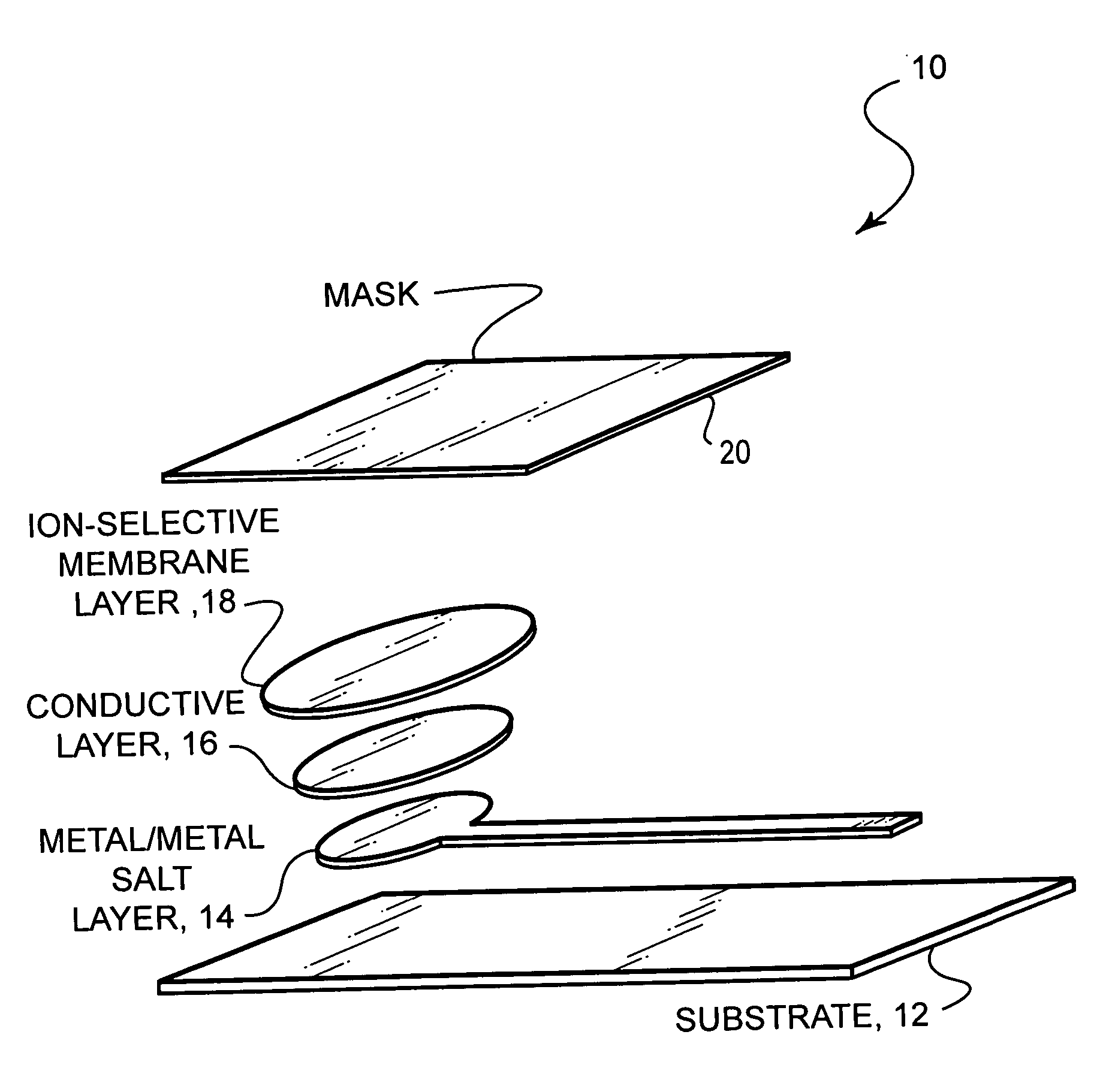
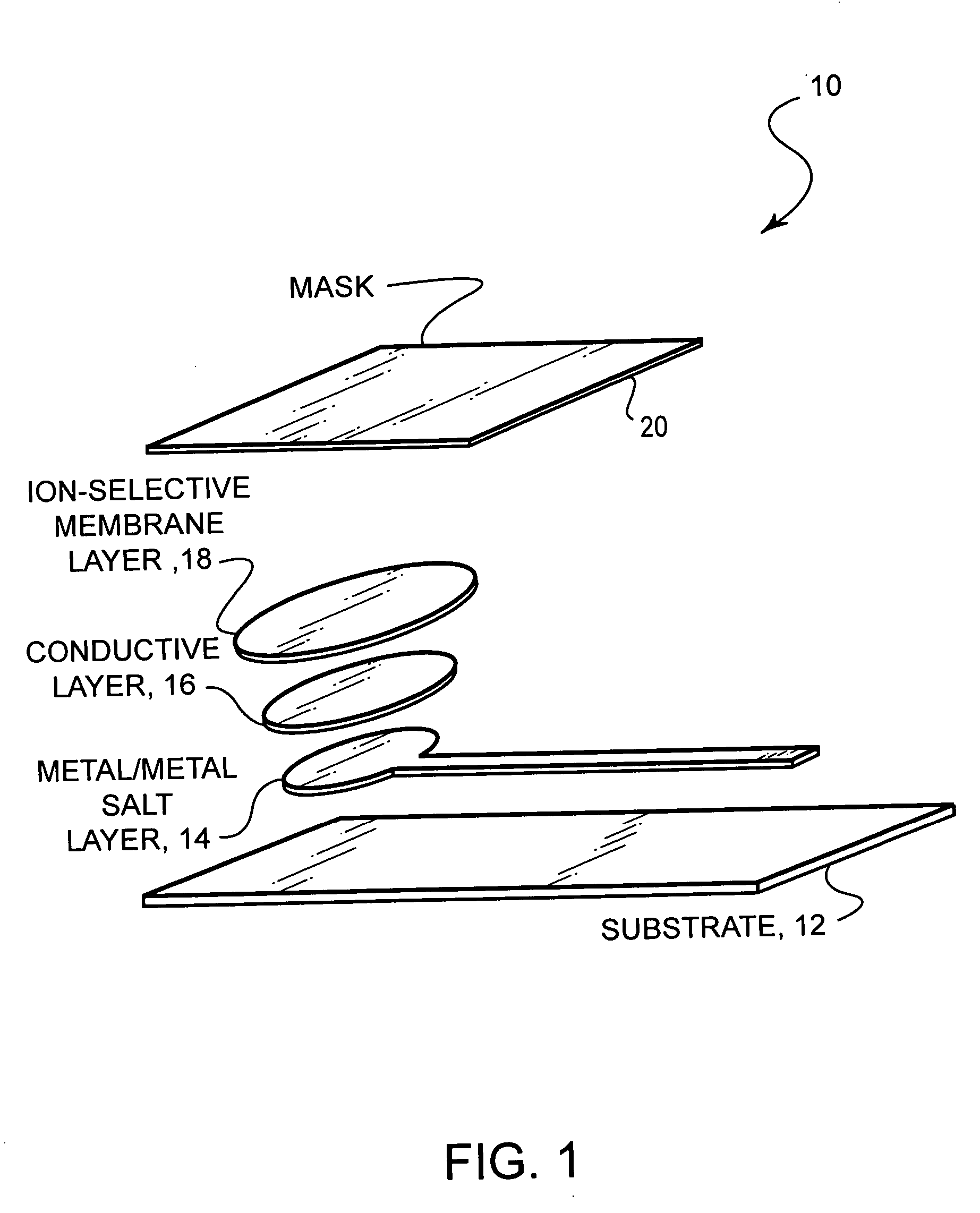
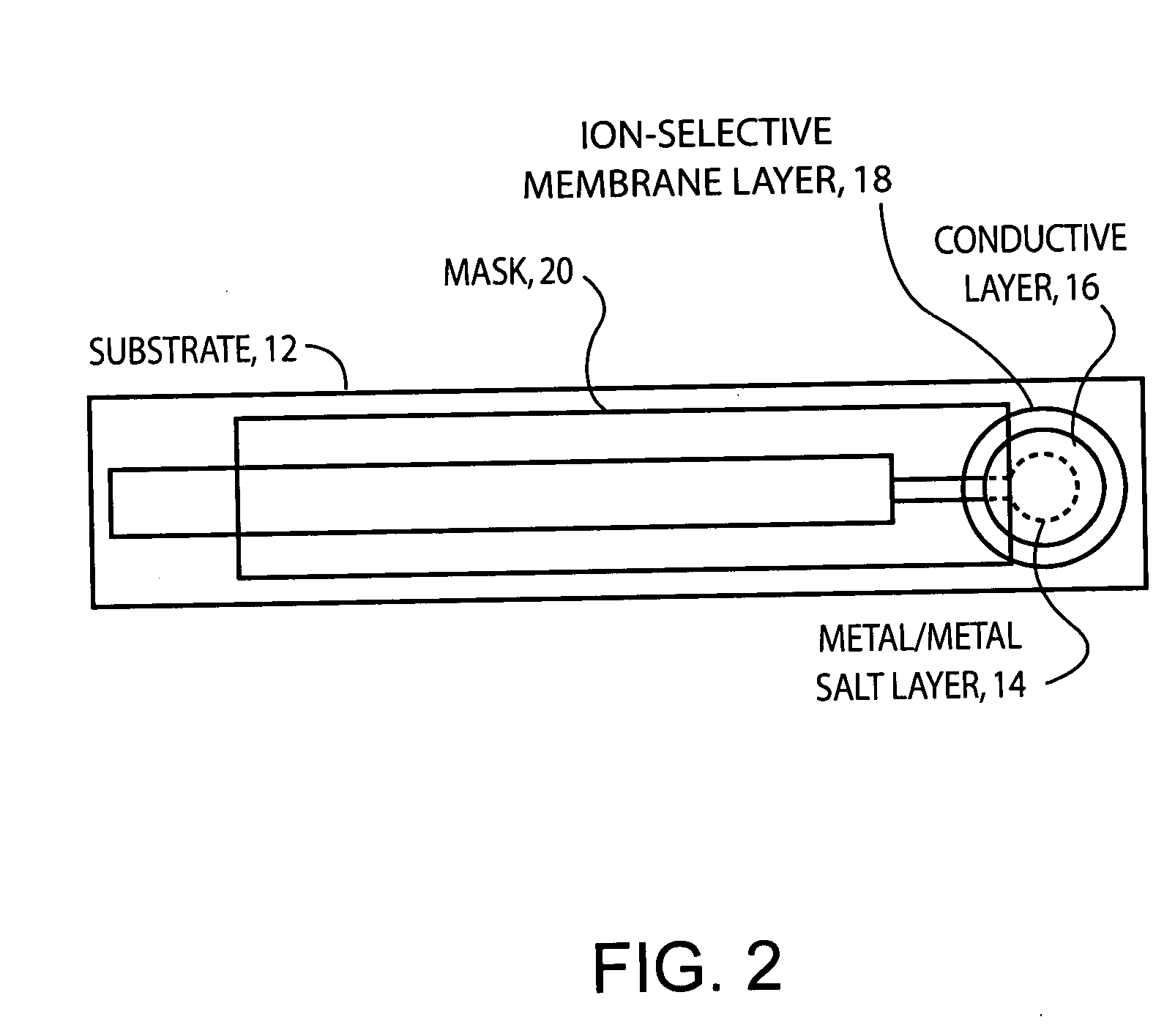

Ion-selective electrode and electrolyte concentration determination device
PatentWO2020208960A1
Innovation
- Using methyl methacrylate acrylonitrile butadiene styrene (MABS) resin for the housing, which has a solubility parameter (SP value) of 19.5 to 21.5, to suppress plasticizer migration and maintain adhesion with the sensitive membrane, while providing stability and long-term performance.


Standardization for ISE Coating Testing Methods
The standardization of testing methods for ion selective electrode (ISE) coatings represents a critical gap in current quality assurance frameworks. While traditional coating adhesion tests such as ASTM D3359 (cross-cut test) and ISO 4624 (pull-off test) provide general adhesion measurements, they fail to address the unique requirements of ISE-integrated coatings where electrochemical functionality must be preserved alongside mechanical integrity.
Current standardization efforts face significant challenges due to the multifunctional nature of ISE coatings. Unlike conventional protective coatings, ISE-embedded systems require simultaneous evaluation of adhesion strength, ionic permeability, electrode response time, and selectivity coefficient stability. The absence of unified testing protocols has resulted in inconsistent quality metrics across manufacturers and research institutions, hampering widespread commercial adoption.
International standards organizations including ASTM, ISO, and IEC have begun preliminary discussions on developing specialized testing frameworks for smart coatings. However, consensus remains elusive regarding critical parameters such as environmental conditioning protocols, acceptable adhesion strength thresholds for different substrate materials, and standardized methods for correlating mechanical adhesion with electrochemical performance degradation.
The development of standardized testing methods must address several key technical considerations. Test specimen preparation protocols need standardization to ensure reproducible surface conditions and coating thickness uniformity. Environmental exposure conditions during testing require careful definition, particularly regarding temperature cycling, humidity exposure, and chemical compatibility with various electrolyte solutions commonly encountered in ISE applications.
Emerging standardization initiatives propose multi-stage testing protocols that combine traditional mechanical adhesion assessment with electrochemical performance validation. These hybrid approaches typically involve initial adhesion strength measurement using modified pull-off tests, followed by electrochemical impedance spectroscopy to evaluate coating integrity and ISE functionality preservation.
The establishment of standardized testing methods will significantly accelerate market acceptance of ISE coating technologies by providing manufacturers with clear quality benchmarks and enabling regulatory compliance in critical applications such as medical devices and environmental monitoring systems. Collaborative efforts between industry stakeholders and standards organizations are essential to develop comprehensive testing protocols that balance practical implementation requirements with rigorous technical validation needs.
Current standardization efforts face significant challenges due to the multifunctional nature of ISE coatings. Unlike conventional protective coatings, ISE-embedded systems require simultaneous evaluation of adhesion strength, ionic permeability, electrode response time, and selectivity coefficient stability. The absence of unified testing protocols has resulted in inconsistent quality metrics across manufacturers and research institutions, hampering widespread commercial adoption.
International standards organizations including ASTM, ISO, and IEC have begun preliminary discussions on developing specialized testing frameworks for smart coatings. However, consensus remains elusive regarding critical parameters such as environmental conditioning protocols, acceptable adhesion strength thresholds for different substrate materials, and standardized methods for correlating mechanical adhesion with electrochemical performance degradation.
The development of standardized testing methods must address several key technical considerations. Test specimen preparation protocols need standardization to ensure reproducible surface conditions and coating thickness uniformity. Environmental exposure conditions during testing require careful definition, particularly regarding temperature cycling, humidity exposure, and chemical compatibility with various electrolyte solutions commonly encountered in ISE applications.
Emerging standardization initiatives propose multi-stage testing protocols that combine traditional mechanical adhesion assessment with electrochemical performance validation. These hybrid approaches typically involve initial adhesion strength measurement using modified pull-off tests, followed by electrochemical impedance spectroscopy to evaluate coating integrity and ISE functionality preservation.
The establishment of standardized testing methods will significantly accelerate market acceptance of ISE coating technologies by providing manufacturers with clear quality benchmarks and enabling regulatory compliance in critical applications such as medical devices and environmental monitoring systems. Collaborative efforts between industry stakeholders and standards organizations are essential to develop comprehensive testing protocols that balance practical implementation requirements with rigorous technical validation needs.
Environmental Impact of ISE Coating Materials
The environmental implications of ion selective electrode coating materials represent a critical consideration in the development and deployment of adhesion strength validation systems. Traditional ISE coating materials often incorporate heavy metals, organic solvents, and synthetic polymers that pose significant environmental risks throughout their lifecycle. Mercury-based electrodes, while historically effective, present substantial toxicity concerns during manufacturing, application, and disposal phases. Similarly, lead-containing materials and cadmium-based compounds used in certain ISE formulations contribute to soil and water contamination when improperly managed.
Manufacturing processes for ISE coating materials typically involve energy-intensive procedures and generate chemical waste streams containing volatile organic compounds and hazardous byproducts. The production of polymer matrices, plasticizers, and ionophores requires substantial resource consumption and often relies on petroleum-derived feedstocks. Solvent-based coating systems release significant quantities of VOCs during application and curing processes, contributing to air quality degradation and potential occupational health hazards.
The operational phase environmental impact varies considerably based on coating composition and application environment. Leaching of toxic components from ISE coatings into surrounding media represents a primary concern, particularly in aquatic environments or soil contact applications. Plasticizer migration and ionophore degradation can result in persistent organic pollutants entering ecosystems. Additionally, the electrochemical processes inherent to ISE operation may generate reactive species that interact with environmental matrices.
End-of-life disposal challenges are particularly acute for ISE coating systems due to their complex material composition and potential contamination with analytes from operational use. Conventional waste treatment methods often prove inadequate for safely processing these materials, necessitating specialized disposal protocols. The lack of established recycling pathways for ISE components further exacerbates environmental burden.
Emerging sustainable alternatives focus on bio-based polymers, water-based formulations, and heavy metal-free electrode designs. Green chemistry approaches emphasize reduced toxicity, improved biodegradability, and renewable resource utilization. However, these alternatives must maintain the precision and reliability required for adhesion strength validation applications while demonstrating comparable environmental performance improvements.
Manufacturing processes for ISE coating materials typically involve energy-intensive procedures and generate chemical waste streams containing volatile organic compounds and hazardous byproducts. The production of polymer matrices, plasticizers, and ionophores requires substantial resource consumption and often relies on petroleum-derived feedstocks. Solvent-based coating systems release significant quantities of VOCs during application and curing processes, contributing to air quality degradation and potential occupational health hazards.
The operational phase environmental impact varies considerably based on coating composition and application environment. Leaching of toxic components from ISE coatings into surrounding media represents a primary concern, particularly in aquatic environments or soil contact applications. Plasticizer migration and ionophore degradation can result in persistent organic pollutants entering ecosystems. Additionally, the electrochemical processes inherent to ISE operation may generate reactive species that interact with environmental matrices.
End-of-life disposal challenges are particularly acute for ISE coating systems due to their complex material composition and potential contamination with analytes from operational use. Conventional waste treatment methods often prove inadequate for safely processing these materials, necessitating specialized disposal protocols. The lack of established recycling pathways for ISE components further exacerbates environmental burden.
Emerging sustainable alternatives focus on bio-based polymers, water-based formulations, and heavy metal-free electrode designs. Green chemistry approaches emphasize reduced toxicity, improved biodegradability, and renewable resource utilization. However, these alternatives must maintain the precision and reliability required for adhesion strength validation applications while demonstrating comparable environmental performance improvements.
Unlock deeper insights with PatSnap Eureka Quick Research — get a full tech report to explore trends and direct your research. Try now!
Generate Your Research Report Instantly with AI Agent
Supercharge your innovation with PatSnap Eureka AI Agent Platform!