
Ion Selective Electrode in Environmental Science: Detection Effectiveness
MAR 8, 20269 MIN READ
Generate Your Research Report Instantly with AI Agent
Patsnap Eureka helps you evaluate technical feasibility & market potential.
Ion Electrode Environmental Detection Background and Objectives
Ion selective electrodes have emerged as pivotal analytical instruments in environmental monitoring, representing a convergence of electrochemical principles and environmental science applications. These sensors operate on the fundamental principle of selective ion recognition through specialized membrane materials that exhibit preferential permeability to target ions, generating measurable electrical potentials proportional to ion concentrations in environmental matrices.
The historical development of ion selective electrode technology traces back to the 1960s with the introduction of glass membrane electrodes for pH measurement, subsequently expanding to encompass a diverse array of ion-specific sensors. Early applications focused primarily on laboratory-based water quality assessment, but technological advances have progressively enabled field deployment and real-time monitoring capabilities.
Environmental contamination presents increasingly complex challenges requiring sophisticated detection methodologies capable of identifying trace-level pollutants across diverse matrices including surface water, groundwater, soil extracts, and atmospheric condensates. Traditional analytical approaches often involve time-intensive sample preparation and laboratory-based instrumentation, creating temporal gaps between sample collection and results availability that may compromise environmental protection responses.
The primary objective of advancing ion selective electrode technology in environmental applications centers on enhancing detection effectiveness through improved selectivity, sensitivity, and stability characteristics. Selectivity enhancement aims to minimize interference from competing ions commonly present in environmental samples, while sensitivity improvements target lower detection limits necessary for regulatory compliance and early contamination warning systems.
Stability objectives encompass both short-term measurement precision and long-term sensor durability under varying environmental conditions including temperature fluctuations, pH variations, and exposure to potentially fouling substances. These stability improvements are essential for continuous monitoring applications where sensor replacement frequency directly impacts operational costs and data continuity.
Contemporary research objectives also emphasize miniaturization and integration capabilities, enabling deployment in remote locations and incorporation into wireless sensor networks for comprehensive environmental surveillance. The development of multi-ion detection platforms represents another strategic objective, allowing simultaneous monitoring of multiple contaminants through single sensor systems, thereby reducing deployment complexity and operational costs while expanding monitoring scope.
The historical development of ion selective electrode technology traces back to the 1960s with the introduction of glass membrane electrodes for pH measurement, subsequently expanding to encompass a diverse array of ion-specific sensors. Early applications focused primarily on laboratory-based water quality assessment, but technological advances have progressively enabled field deployment and real-time monitoring capabilities.
Environmental contamination presents increasingly complex challenges requiring sophisticated detection methodologies capable of identifying trace-level pollutants across diverse matrices including surface water, groundwater, soil extracts, and atmospheric condensates. Traditional analytical approaches often involve time-intensive sample preparation and laboratory-based instrumentation, creating temporal gaps between sample collection and results availability that may compromise environmental protection responses.
The primary objective of advancing ion selective electrode technology in environmental applications centers on enhancing detection effectiveness through improved selectivity, sensitivity, and stability characteristics. Selectivity enhancement aims to minimize interference from competing ions commonly present in environmental samples, while sensitivity improvements target lower detection limits necessary for regulatory compliance and early contamination warning systems.
Stability objectives encompass both short-term measurement precision and long-term sensor durability under varying environmental conditions including temperature fluctuations, pH variations, and exposure to potentially fouling substances. These stability improvements are essential for continuous monitoring applications where sensor replacement frequency directly impacts operational costs and data continuity.
Contemporary research objectives also emphasize miniaturization and integration capabilities, enabling deployment in remote locations and incorporation into wireless sensor networks for comprehensive environmental surveillance. The development of multi-ion detection platforms represents another strategic objective, allowing simultaneous monitoring of multiple contaminants through single sensor systems, thereby reducing deployment complexity and operational costs while expanding monitoring scope.
Market Demand for Environmental Ion Detection Solutions
The global environmental monitoring market has experienced substantial growth driven by increasing regulatory pressures and heightened environmental awareness. Governments worldwide are implementing stricter environmental protection policies, creating mandatory requirements for continuous monitoring of water quality, soil contamination, and air pollution. This regulatory landscape has established a robust foundation for ion-selective electrode technologies, as these devices provide essential capabilities for detecting specific ionic species in environmental matrices.
Water quality monitoring represents the largest segment within the environmental ion detection market. Municipal water treatment facilities, industrial discharge monitoring systems, and groundwater assessment programs require reliable detection of various ions including nitrates, phosphates, heavy metals, and chlorides. The growing concerns over drinking water safety and the need to comply with environmental discharge standards have intensified demand for accurate, real-time ion detection solutions.
Industrial applications constitute another significant demand driver, particularly in sectors such as mining, petrochemicals, and manufacturing. These industries face increasing scrutiny regarding their environmental impact and must demonstrate compliance with discharge regulations. Ion-selective electrodes offer cost-effective solutions for continuous monitoring of process streams and effluent quality, enabling companies to maintain regulatory compliance while optimizing their operations.
The agricultural sector presents emerging opportunities for ion detection technologies, driven by precision farming initiatives and sustainable agriculture practices. Farmers and agricultural consultants increasingly recognize the importance of soil nutrient monitoring and irrigation water quality assessment. Ion-selective electrodes provide practical tools for measuring soil pH, nutrient levels, and salinity, supporting data-driven agricultural decisions.
Climate change concerns and environmental sustainability initiatives have further amplified market demand. Organizations across various sectors are implementing comprehensive environmental monitoring programs to track their ecological footprint and demonstrate corporate responsibility. This trend has created opportunities for portable and field-deployable ion detection systems that can support environmental assessment activities.
The market also benefits from technological convergence trends, where traditional analytical methods are being supplemented or replaced by more efficient electrochemical sensing approaches. The integration of ion-selective electrodes with digital platforms and data management systems has enhanced their appeal to end-users seeking comprehensive environmental monitoring solutions.
Water quality monitoring represents the largest segment within the environmental ion detection market. Municipal water treatment facilities, industrial discharge monitoring systems, and groundwater assessment programs require reliable detection of various ions including nitrates, phosphates, heavy metals, and chlorides. The growing concerns over drinking water safety and the need to comply with environmental discharge standards have intensified demand for accurate, real-time ion detection solutions.
Industrial applications constitute another significant demand driver, particularly in sectors such as mining, petrochemicals, and manufacturing. These industries face increasing scrutiny regarding their environmental impact and must demonstrate compliance with discharge regulations. Ion-selective electrodes offer cost-effective solutions for continuous monitoring of process streams and effluent quality, enabling companies to maintain regulatory compliance while optimizing their operations.
The agricultural sector presents emerging opportunities for ion detection technologies, driven by precision farming initiatives and sustainable agriculture practices. Farmers and agricultural consultants increasingly recognize the importance of soil nutrient monitoring and irrigation water quality assessment. Ion-selective electrodes provide practical tools for measuring soil pH, nutrient levels, and salinity, supporting data-driven agricultural decisions.
Climate change concerns and environmental sustainability initiatives have further amplified market demand. Organizations across various sectors are implementing comprehensive environmental monitoring programs to track their ecological footprint and demonstrate corporate responsibility. This trend has created opportunities for portable and field-deployable ion detection systems that can support environmental assessment activities.
The market also benefits from technological convergence trends, where traditional analytical methods are being supplemented or replaced by more efficient electrochemical sensing approaches. The integration of ion-selective electrodes with digital platforms and data management systems has enhanced their appeal to end-users seeking comprehensive environmental monitoring solutions.
Current ISE Performance and Detection Limitations
Ion selective electrodes have established themselves as fundamental analytical tools in environmental monitoring, offering real-time detection capabilities for various ionic species in complex matrices. Current ISE technology demonstrates remarkable selectivity for target ions, with detection limits reaching nanomolar concentrations for certain analytes such as fluoride, nitrate, and heavy metal ions. Modern ISE systems can achieve response times of seconds to minutes, making them suitable for continuous monitoring applications in water treatment facilities and environmental assessment programs.
The performance characteristics of contemporary ISEs vary significantly depending on the target analyte and membrane composition. Solid-state electrodes typically exhibit detection limits in the range of 10^-6 to 10^-8 M for heavy metals like lead and copper, while liquid membrane electrodes can achieve even lower detection thresholds for specific organic pollutants. Temperature stability has improved considerably, with many commercial ISEs maintaining consistent performance across temperature ranges of 0-60°C, though calibration drift remains a concern in long-term deployments.
Despite these advances, several critical limitations constrain ISE effectiveness in environmental applications. Interference from competing ions represents the most significant challenge, particularly in complex environmental matrices containing multiple ionic species. The Nicolsky-Eisenman equation describes these interference effects, but practical selectivity coefficients often deviate from theoretical predictions due to membrane aging and fouling. Matrix effects from organic matter, suspended solids, and varying ionic strength can substantially impact measurement accuracy and precision.
Membrane fouling emerges as another primary limitation, especially in natural water systems containing high concentrations of organic compounds, biofilms, or particulate matter. This fouling leads to gradual response degradation, increased response times, and baseline drift that necessitates frequent recalibration. The problem becomes particularly acute in wastewater monitoring applications where protein adsorption and microbial growth on electrode surfaces significantly compromise long-term stability.
Calibration stability presents ongoing challenges for field deployment scenarios. Most ISEs require regular recalibration using standard solutions, which can be impractical for remote monitoring stations or continuous operation requirements. Temperature compensation mechanisms, while available, often prove insufficient for maintaining accuracy across seasonal temperature variations encountered in environmental monitoring.
Detection range limitations also constrain ISE applicability in certain environmental contexts. While some electrodes perform excellently at moderate concentration levels, they may exhibit poor linearity or excessive noise at the ultra-low concentrations often encountered in pristine environmental samples or when detecting trace contaminants. Additionally, pH dependency affects many ISE measurements, requiring careful buffer control or pH correction algorithms that add complexity to field measurements.
The performance characteristics of contemporary ISEs vary significantly depending on the target analyte and membrane composition. Solid-state electrodes typically exhibit detection limits in the range of 10^-6 to 10^-8 M for heavy metals like lead and copper, while liquid membrane electrodes can achieve even lower detection thresholds for specific organic pollutants. Temperature stability has improved considerably, with many commercial ISEs maintaining consistent performance across temperature ranges of 0-60°C, though calibration drift remains a concern in long-term deployments.
Despite these advances, several critical limitations constrain ISE effectiveness in environmental applications. Interference from competing ions represents the most significant challenge, particularly in complex environmental matrices containing multiple ionic species. The Nicolsky-Eisenman equation describes these interference effects, but practical selectivity coefficients often deviate from theoretical predictions due to membrane aging and fouling. Matrix effects from organic matter, suspended solids, and varying ionic strength can substantially impact measurement accuracy and precision.
Membrane fouling emerges as another primary limitation, especially in natural water systems containing high concentrations of organic compounds, biofilms, or particulate matter. This fouling leads to gradual response degradation, increased response times, and baseline drift that necessitates frequent recalibration. The problem becomes particularly acute in wastewater monitoring applications where protein adsorption and microbial growth on electrode surfaces significantly compromise long-term stability.
Calibration stability presents ongoing challenges for field deployment scenarios. Most ISEs require regular recalibration using standard solutions, which can be impractical for remote monitoring stations or continuous operation requirements. Temperature compensation mechanisms, while available, often prove insufficient for maintaining accuracy across seasonal temperature variations encountered in environmental monitoring.
Detection range limitations also constrain ISE applicability in certain environmental contexts. While some electrodes perform excellently at moderate concentration levels, they may exhibit poor linearity or excessive noise at the ultra-low concentrations often encountered in pristine environmental samples or when detecting trace contaminants. Additionally, pH dependency affects many ISE measurements, requiring careful buffer control or pH correction algorithms that add complexity to field measurements.
Existing ISE Solutions for Environmental Applications
01 Electrode membrane composition and ion-selective materials
The effectiveness of ion selective electrodes can be enhanced through optimized membrane compositions incorporating specific ion-selective materials. These materials are designed to selectively interact with target ions while minimizing interference from other species. The membrane composition may include polymeric matrices, ionophores, and plasticizers that improve selectivity, sensitivity, and response time of the electrode.- Ion-selective electrode membrane composition and structure: The effectiveness of ion-selective electrodes can be enhanced through optimized membrane compositions incorporating specific ionophores, plasticizers, and polymer matrices. The membrane structure plays a crucial role in determining selectivity, sensitivity, and response time. Various materials including PVC-based membranes, polyurethane matrices, and specialized ion-exchange materials can be utilized to improve detection performance for specific target ions.
- Signal processing and measurement methods: Advanced signal processing techniques and measurement methodologies significantly improve the detection effectiveness of ion-selective electrodes. This includes calibration procedures, temperature compensation mechanisms, drift correction algorithms, and noise reduction methods. Digital signal processing and automated measurement systems enhance accuracy and reliability of ion concentration determinations.
- Multi-ion detection and sensor array systems: Integration of multiple ion-selective electrodes into array configurations enables simultaneous detection of various ions, improving overall analytical effectiveness. Sensor arrays with different selectivity patterns combined with pattern recognition algorithms provide enhanced discrimination capabilities and cross-sensitivity compensation. These systems offer improved accuracy for complex sample analysis.
- Electrode surface modification and regeneration: Surface modification techniques and regeneration methods extend electrode lifetime and maintain detection effectiveness over prolonged use. This includes surface treatment procedures, conditioning protocols, and methods for restoring electrode response characteristics. Proper maintenance and regeneration strategies ensure consistent performance and reduce measurement drift.
- Application-specific electrode designs for enhanced detection: Specialized electrode designs tailored for specific applications improve detection effectiveness in challenging environments. This includes miniaturized electrodes for small sample volumes, flow-through configurations for continuous monitoring, and robust designs for harsh conditions. Application-specific optimizations address particular analytical requirements such as rapid response, low detection limits, or operation in complex matrices.
02 Signal processing and measurement circuitry
Detection effectiveness is improved through advanced signal processing techniques and measurement circuitry designs. These systems incorporate amplification, noise reduction, and calibration methods to enhance the accuracy and reliability of ion concentration measurements. The circuitry may include reference electrodes, impedance matching components, and digital signal processing units that optimize the electrode response.Expand Specific Solutions03 Multi-ion detection and array configurations
Enhanced detection effectiveness can be achieved through multi-ion sensing capabilities and array-based electrode configurations. These systems allow simultaneous detection of multiple ionic species, improving analytical throughput and providing comprehensive sample analysis. Array designs enable spatial resolution and pattern recognition for complex sample matrices.Expand Specific Solutions04 Calibration and interference compensation methods
Detection effectiveness is maintained through systematic calibration procedures and interference compensation techniques. These methods account for temperature variations, ionic strength effects, and cross-sensitivity to non-target ions. Compensation algorithms and reference measurement protocols ensure accurate and stable readings across varying sample conditions.Expand Specific Solutions05 Miniaturization and integration technologies
Modern ion selective electrodes benefit from miniaturization and integration with microfluidic or lab-on-chip platforms. These advances enable portable detection systems with reduced sample volumes, faster response times, and improved detection limits. Integration technologies facilitate automated sample handling and real-time monitoring applications.Expand Specific Solutions
Key Players in ISE and Environmental Monitoring Industry
The ion selective electrode (ISE) technology for environmental detection represents a mature market in its growth phase, driven by increasing environmental monitoring regulations and water quality concerns. The market demonstrates significant scale with established players like Beckman Coulter, Roche Diagnostics, and Siemens Healthcare Diagnostics leading in analytical instrumentation, while specialized companies such as Endress+Hauser Conducta and Unisense focus on dedicated sensor solutions. Technology maturity varies across segments, with traditional ISE systems being well-established, while companies like Oxford Biosensors and CSEM are advancing next-generation electrochemical sensing platforms. The competitive landscape includes major multinational corporations (Hitachi High-Tech, FUJIFILM, Toshiba), specialized sensor manufacturers, and emerging technology developers, indicating a dynamic ecosystem with opportunities for both incremental improvements and breakthrough innovations in detection sensitivity and field deployment capabilities.
Hitachi High-Tech America, Inc.
Technical Solution: Hitachi High-Tech develops sophisticated analytical instrumentation including ion selective electrode systems integrated with advanced data acquisition and processing capabilities. Their environmental monitoring solutions combine ISE technology with automated sampling systems and real-time data transmission for continuous environmental surveillance. The company's approach emphasizes multi-parameter detection capabilities, allowing simultaneous measurement of multiple ionic species with high precision and accuracy. Their systems are designed for deployment in remote environmental monitoring stations with minimal maintenance requirements.
Strengths: Advanced automation and data integration capabilities, robust multi-parameter detection systems. Weaknesses: High initial investment costs, complexity may require specialized technical support for optimal operation.
Endress+Hauser Conducta GmbH+Co. KG
Technical Solution: Endress+Hauser develops advanced ion selective electrode systems specifically designed for environmental monitoring applications. Their technology features robust sensor designs with enhanced selectivity coefficients and extended operational lifespans in harsh environmental conditions. The company's ISE solutions incorporate digital signal processing and automatic temperature compensation to ensure accurate measurements across varying environmental parameters. Their electrodes demonstrate superior performance in detecting heavy metals, nutrients, and other critical ions in water bodies, with detection limits reaching parts-per-billion levels for many analytes.
Strengths: Industry-leading durability and reliability in harsh environmental conditions, comprehensive digital integration capabilities. Weaknesses: Higher cost compared to basic ISE solutions, requires specialized maintenance protocols.
Core Innovations in ISE Detection Effectiveness
Voltammetric ion sensor
PatentInactiveEP1800116A1
Innovation
- A voltammetric ion sensor using a sensing electrode with an electrically conducting support coated with a support matrix containing an electroactive species and an ionophore, allowing for rapid and selective ion detection in small sample volumes by measuring the potential at which current peaks occur during a voltammetric scan.
Ion-selective electrodes
PatentInactiveUS20050191428A1
Innovation
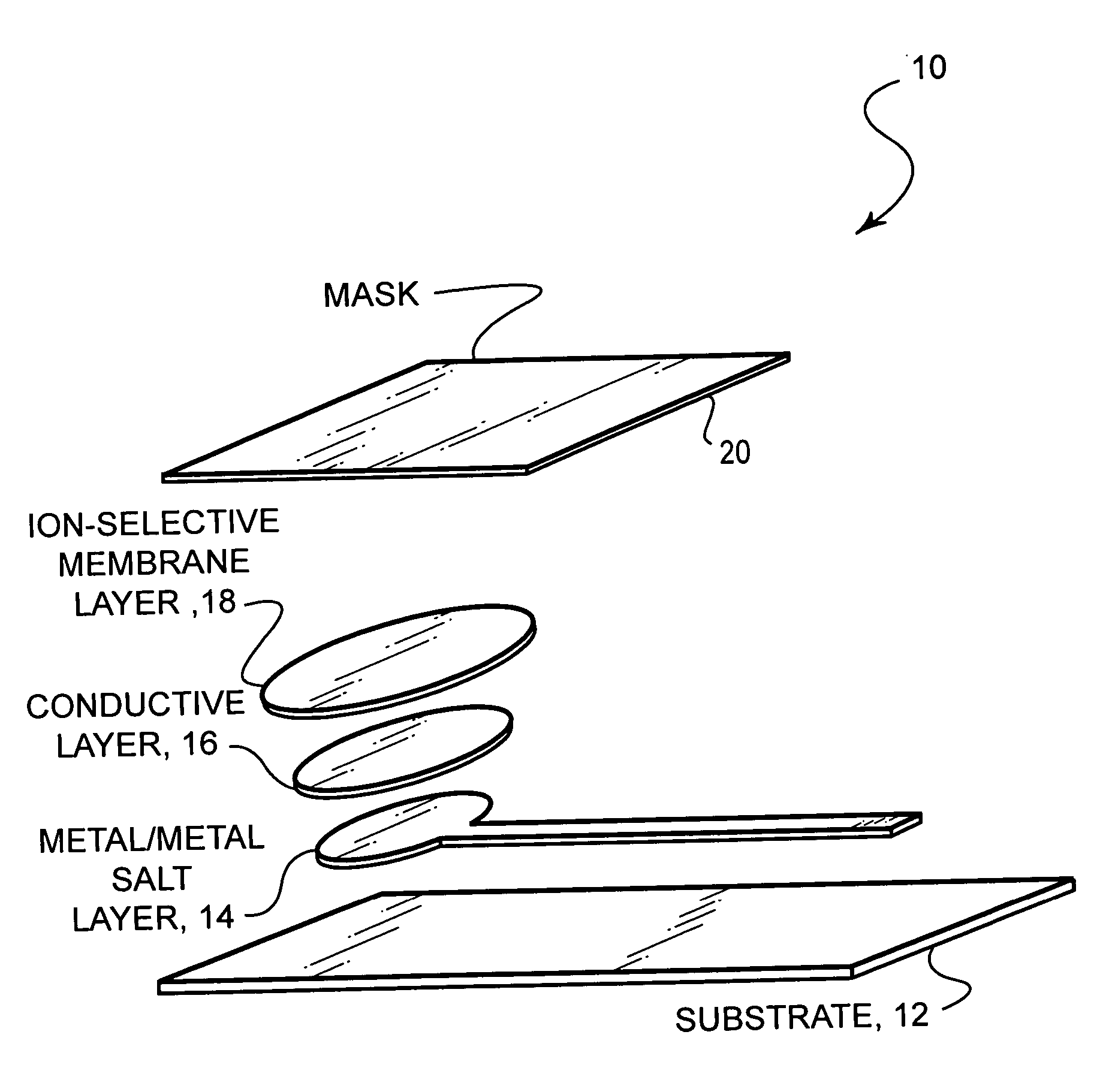
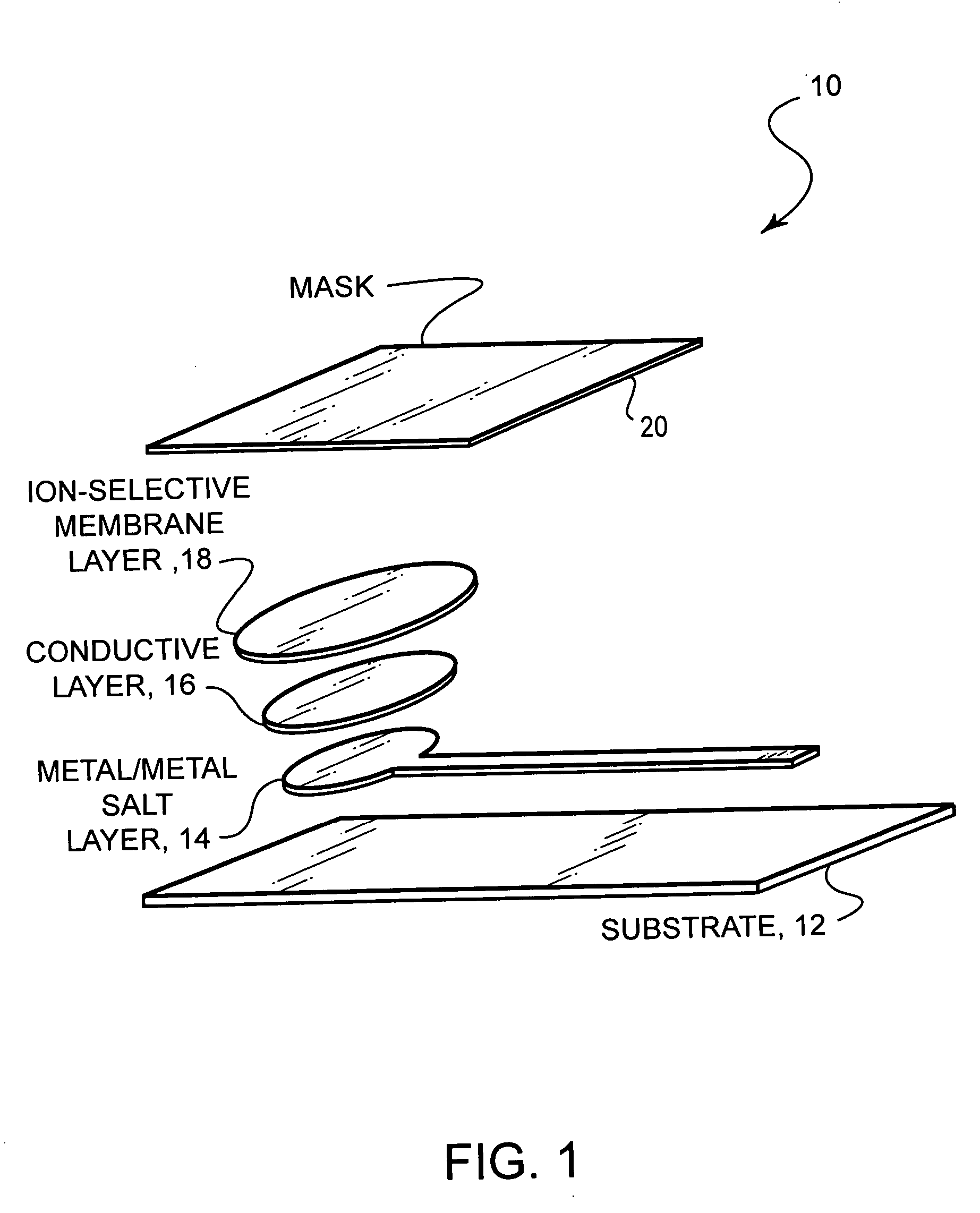
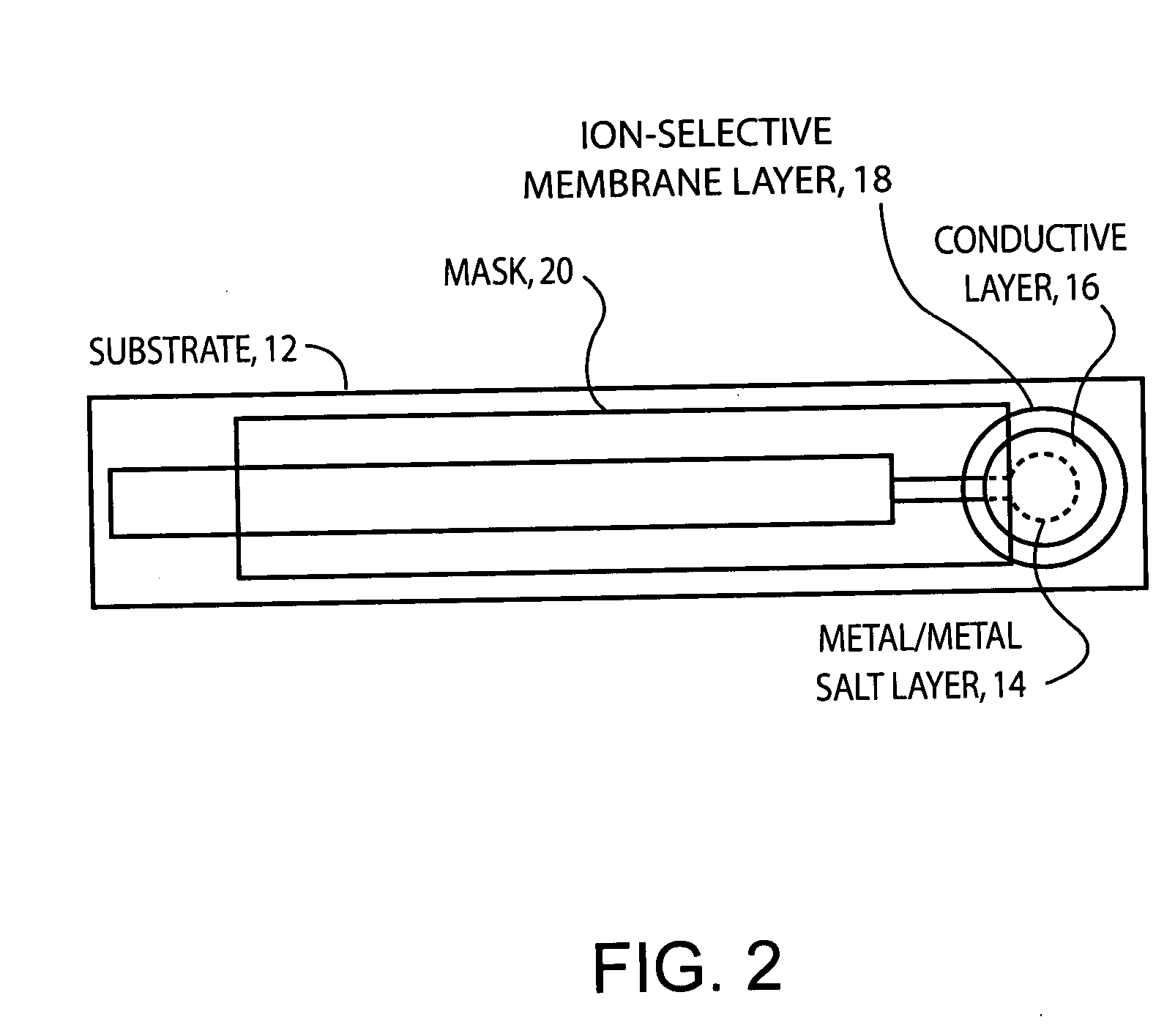
- A stable, compact ion-selective electrode design featuring a water-impermeable substrate, an electrically conductive metal/metal salt layer, a hydrophobic conductive layer with ions for stable potential, an ion-selective layer, and a water-impermeable barrier layer to prevent exposure to aqueous solutions, eliminating the need for calibration and reducing equilibration time.

Environmental Regulations for Ion Detection Standards
Environmental regulations for ion detection standards have evolved significantly over the past decades, driven by increasing awareness of water quality impacts on public health and ecosystem integrity. The regulatory landscape encompasses multiple jurisdictions, with the United States Environmental Protection Agency (EPA), European Environment Agency (EEA), and World Health Organization (WHO) establishing comprehensive frameworks for ion monitoring in various environmental matrices.
The EPA's Safe Drinking Water Act mandates maximum contaminant levels for numerous ionic species, including nitrates (10 mg/L as nitrogen), fluoride (4.0 mg/L), and various heavy metal ions such as lead (0.015 mg/L) and cadmium (0.005 mg/L). These stringent limits necessitate detection methods capable of achieving sub-ppm sensitivity with high selectivity, positioning ion selective electrodes as critical analytical tools for regulatory compliance monitoring.
European Union directives, particularly the Water Framework Directive (2000/60/EC) and Drinking Water Directive (2020/2184), establish similar but often more restrictive standards. The EU's approach emphasizes continuous monitoring capabilities, requiring real-time or near-real-time detection systems that can provide immediate alerts when ion concentrations exceed permissible limits. This regulatory emphasis on continuous monitoring has accelerated the development of robust, field-deployable ion selective electrode systems.
International standards organizations, including ISO and ASTM, have developed specific protocols for ion detection methodologies. ISO 14911 provides guidelines for ion chromatography methods, while ASTM D4327 outlines procedures for anion determination using ion selective electrodes. These standards specify calibration procedures, quality assurance protocols, and acceptable measurement uncertainties, typically requiring detection limits at least ten times lower than regulatory thresholds.
Emerging regulatory trends focus on previously unregulated ionic contaminants, including per- and polyfluoroalkyl substances (PFAS) and pharmaceutical residues. Recent EPA advisories for PFOA and PFOS at 70 parts per trillion demonstrate the increasing demand for ultra-sensitive detection capabilities. Additionally, regulations are expanding to cover broader environmental matrices beyond drinking water, including groundwater, surface water, and soil pore water monitoring.
The regulatory framework also addresses method validation requirements, mandating that analytical techniques demonstrate accuracy, precision, and reliability under field conditions. This has driven innovation in ion selective electrode technology, particularly in developing sensors with enhanced stability, reduced interference susceptibility, and extended operational lifespans to meet stringent quality assurance demands.
The EPA's Safe Drinking Water Act mandates maximum contaminant levels for numerous ionic species, including nitrates (10 mg/L as nitrogen), fluoride (4.0 mg/L), and various heavy metal ions such as lead (0.015 mg/L) and cadmium (0.005 mg/L). These stringent limits necessitate detection methods capable of achieving sub-ppm sensitivity with high selectivity, positioning ion selective electrodes as critical analytical tools for regulatory compliance monitoring.
European Union directives, particularly the Water Framework Directive (2000/60/EC) and Drinking Water Directive (2020/2184), establish similar but often more restrictive standards. The EU's approach emphasizes continuous monitoring capabilities, requiring real-time or near-real-time detection systems that can provide immediate alerts when ion concentrations exceed permissible limits. This regulatory emphasis on continuous monitoring has accelerated the development of robust, field-deployable ion selective electrode systems.
International standards organizations, including ISO and ASTM, have developed specific protocols for ion detection methodologies. ISO 14911 provides guidelines for ion chromatography methods, while ASTM D4327 outlines procedures for anion determination using ion selective electrodes. These standards specify calibration procedures, quality assurance protocols, and acceptable measurement uncertainties, typically requiring detection limits at least ten times lower than regulatory thresholds.
Emerging regulatory trends focus on previously unregulated ionic contaminants, including per- and polyfluoroalkyl substances (PFAS) and pharmaceutical residues. Recent EPA advisories for PFOA and PFOS at 70 parts per trillion demonstrate the increasing demand for ultra-sensitive detection capabilities. Additionally, regulations are expanding to cover broader environmental matrices beyond drinking water, including groundwater, surface water, and soil pore water monitoring.
The regulatory framework also addresses method validation requirements, mandating that analytical techniques demonstrate accuracy, precision, and reliability under field conditions. This has driven innovation in ion selective electrode technology, particularly in developing sensors with enhanced stability, reduced interference susceptibility, and extended operational lifespans to meet stringent quality assurance demands.
Sustainability Considerations in ISE Manufacturing
The manufacturing of ion selective electrodes presents significant sustainability challenges that require comprehensive evaluation across the entire production lifecycle. Traditional ISE manufacturing processes often rely on materials and methods that pose environmental concerns, necessitating a shift toward more sustainable approaches to align with global environmental protection goals.
Raw material sourcing represents a critical sustainability consideration in ISE production. Many electrodes require rare earth elements, precious metals like silver and platinum, and specialized polymeric materials that involve energy-intensive extraction and processing. The mining of these materials often results in substantial environmental degradation, including habitat destruction and water contamination. Manufacturers are increasingly exploring alternative materials and recycling programs to reduce dependency on virgin raw materials while maintaining electrode performance standards.
Energy consumption during manufacturing processes constitutes another major sustainability factor. The production of ISE components, particularly membrane fabrication and electrode assembly, requires high-temperature processing and precision manufacturing techniques that consume significant amounts of energy. Advanced manufacturing facilities are implementing renewable energy sources and optimizing production processes to minimize their carbon footprint while maintaining quality standards.
Waste management and chemical disposal present ongoing challenges in ISE manufacturing. The production process generates various chemical wastes, including solvents, unreacted monomers, and defective components containing hazardous materials. Implementing closed-loop manufacturing systems and developing biodegradable or recyclable electrode components are becoming essential strategies for reducing environmental impact.
End-of-life considerations are gaining prominence as ISE usage expands in environmental monitoring applications. Developing electrodes with longer operational lifespans, designing components for easier disassembly and material recovery, and establishing take-back programs represent crucial steps toward circular economy principles. Some manufacturers are exploring biodegradable membrane materials and reducing the use of toxic components to facilitate safer disposal.
The integration of green chemistry principles into ISE manufacturing processes offers promising pathways for sustainability improvement. This includes developing water-based manufacturing processes, eliminating toxic solvents, and designing electrodes using environmentally benign materials without compromising analytical performance. These approaches not only reduce environmental impact but also improve workplace safety and reduce regulatory compliance costs.
Raw material sourcing represents a critical sustainability consideration in ISE production. Many electrodes require rare earth elements, precious metals like silver and platinum, and specialized polymeric materials that involve energy-intensive extraction and processing. The mining of these materials often results in substantial environmental degradation, including habitat destruction and water contamination. Manufacturers are increasingly exploring alternative materials and recycling programs to reduce dependency on virgin raw materials while maintaining electrode performance standards.
Energy consumption during manufacturing processes constitutes another major sustainability factor. The production of ISE components, particularly membrane fabrication and electrode assembly, requires high-temperature processing and precision manufacturing techniques that consume significant amounts of energy. Advanced manufacturing facilities are implementing renewable energy sources and optimizing production processes to minimize their carbon footprint while maintaining quality standards.
Waste management and chemical disposal present ongoing challenges in ISE manufacturing. The production process generates various chemical wastes, including solvents, unreacted monomers, and defective components containing hazardous materials. Implementing closed-loop manufacturing systems and developing biodegradable or recyclable electrode components are becoming essential strategies for reducing environmental impact.
End-of-life considerations are gaining prominence as ISE usage expands in environmental monitoring applications. Developing electrodes with longer operational lifespans, designing components for easier disassembly and material recovery, and establishing take-back programs represent crucial steps toward circular economy principles. Some manufacturers are exploring biodegradable membrane materials and reducing the use of toxic components to facilitate safer disposal.
The integration of green chemistry principles into ISE manufacturing processes offers promising pathways for sustainability improvement. This includes developing water-based manufacturing processes, eliminating toxic solvents, and designing electrodes using environmentally benign materials without compromising analytical performance. These approaches not only reduce environmental impact but also improve workplace safety and reduce regulatory compliance costs.
Unlock deeper insights with Patsnap Eureka Quick Research — get a full tech report to explore trends and direct your research. Try now!
Generate Your Research Report Instantly with AI Agent
Supercharge your innovation with Patsnap Eureka AI Agent Platform!