Ionizing Rays vs X-Rays: Detection Efficiency
MAR 16, 20269 MIN READ
Generate Your Research Report Instantly with AI Agent
Patsnap Eureka helps you evaluate technical feasibility & market potential.
Ionizing and X-Ray Detection Background and Objectives
The detection of ionizing radiation has been a cornerstone of scientific advancement since the discovery of X-rays by Wilhelm Röntgen in 1895 and the subsequent identification of radioactive decay by Henri Becquerel in 1896. These foundational discoveries established the fundamental principles that continue to drive innovation in radiation detection technologies today. The field has evolved from simple photographic plate detection methods to sophisticated electronic systems capable of real-time analysis and precise energy discrimination.
Ionizing radiation encompasses a broad spectrum of electromagnetic and particle radiation, including alpha particles, beta particles, gamma rays, and X-rays. While X-rays represent a specific subset of ionizing radiation characterized by their electromagnetic nature and typical energy ranges of 100 eV to 100 keV, the broader category of ionizing radiation extends to much higher energies and includes both electromagnetic and particulate forms. This distinction is crucial for understanding detection efficiency challenges, as different radiation types interact with matter through varying mechanisms.
The evolution of detection technologies has been driven by the need for improved sensitivity, energy resolution, and response time across diverse applications. Early gas-filled detectors such as Geiger-Müller counters provided basic detection capabilities but lacked energy discrimination. The development of scintillation detectors in the 1940s marked a significant advancement, offering better energy resolution and faster response times. Semiconductor detectors, particularly silicon and germanium-based systems, emerged in the 1960s and revolutionized the field by providing superior energy resolution and compact form factors.
Contemporary detection objectives focus on achieving optimal efficiency across the entire ionizing radiation spectrum while maintaining practical considerations such as cost-effectiveness, portability, and operational stability. The primary technical challenge lies in developing detection systems that can efficiently capture and accurately measure radiation across vastly different energy ranges and interaction mechanisms. For X-ray detection, the emphasis is on maximizing photon absorption efficiency and minimizing noise, while broader ionizing radiation detection requires accommodation of diverse particle types and energy distributions.
Modern applications demand detection systems capable of simultaneous multi-energy analysis, real-time processing, and integration with digital analysis platforms. The objectives extend beyond simple detection to include precise energy spectroscopy, spatial resolution, and temporal analysis capabilities that support advanced imaging, security screening, and scientific research applications.
Ionizing radiation encompasses a broad spectrum of electromagnetic and particle radiation, including alpha particles, beta particles, gamma rays, and X-rays. While X-rays represent a specific subset of ionizing radiation characterized by their electromagnetic nature and typical energy ranges of 100 eV to 100 keV, the broader category of ionizing radiation extends to much higher energies and includes both electromagnetic and particulate forms. This distinction is crucial for understanding detection efficiency challenges, as different radiation types interact with matter through varying mechanisms.
The evolution of detection technologies has been driven by the need for improved sensitivity, energy resolution, and response time across diverse applications. Early gas-filled detectors such as Geiger-Müller counters provided basic detection capabilities but lacked energy discrimination. The development of scintillation detectors in the 1940s marked a significant advancement, offering better energy resolution and faster response times. Semiconductor detectors, particularly silicon and germanium-based systems, emerged in the 1960s and revolutionized the field by providing superior energy resolution and compact form factors.
Contemporary detection objectives focus on achieving optimal efficiency across the entire ionizing radiation spectrum while maintaining practical considerations such as cost-effectiveness, portability, and operational stability. The primary technical challenge lies in developing detection systems that can efficiently capture and accurately measure radiation across vastly different energy ranges and interaction mechanisms. For X-ray detection, the emphasis is on maximizing photon absorption efficiency and minimizing noise, while broader ionizing radiation detection requires accommodation of diverse particle types and energy distributions.
Modern applications demand detection systems capable of simultaneous multi-energy analysis, real-time processing, and integration with digital analysis platforms. The objectives extend beyond simple detection to include precise energy spectroscopy, spatial resolution, and temporal analysis capabilities that support advanced imaging, security screening, and scientific research applications.
Market Demand for Advanced Radiation Detection Systems
The global radiation detection systems market is experiencing unprecedented growth driven by escalating security concerns, expanding medical imaging applications, and increasing nuclear power utilization worldwide. Healthcare sectors represent the largest demand segment, where advanced detection systems are essential for diagnostic imaging, cancer treatment monitoring, and radiation therapy applications. The superior detection efficiency requirements in medical environments have created substantial market opportunities for next-generation detection technologies.
Industrial applications constitute another significant demand driver, particularly in nuclear power plants, manufacturing facilities, and research institutions. These sectors require highly sensitive detection systems capable of distinguishing between different radiation types while maintaining operational reliability under challenging environmental conditions. The growing emphasis on workplace safety regulations and radiation monitoring compliance has further amplified market demand.
Security and defense applications have emerged as rapidly expanding market segments, fueled by heightened concerns over radiological threats and nuclear material trafficking. Border security agencies, airports, and critical infrastructure facilities increasingly deploy advanced radiation detection systems with enhanced discrimination capabilities. The ability to differentiate between ionizing rays and X-rays with high efficiency has become a critical requirement for these applications.
The medical imaging market specifically demands detection systems with superior spatial resolution and reduced radiation exposure for patients. This has driven significant investment in detector technologies that can achieve higher detection efficiency while minimizing false positives. Emerging applications in personalized medicine and real-time imaging guidance during surgical procedures are creating new market niches.
Environmental monitoring represents an expanding application area, particularly following increased awareness of radiation contamination risks. Government agencies and environmental organizations require portable, highly sensitive detection systems capable of continuous monitoring across diverse geographical locations. The market demand extends to both fixed installation systems and mobile detection units.
Research and development institutions constitute a specialized but growing market segment, requiring cutting-edge detection systems for fundamental research in nuclear physics, materials science, and radiation biology. These applications often demand customized solutions with exceptional detection efficiency and precise energy discrimination capabilities.
The convergence of artificial intelligence and machine learning technologies with radiation detection systems has opened new market opportunities, enabling automated threat identification and enhanced detection accuracy across various application domains.
Industrial applications constitute another significant demand driver, particularly in nuclear power plants, manufacturing facilities, and research institutions. These sectors require highly sensitive detection systems capable of distinguishing between different radiation types while maintaining operational reliability under challenging environmental conditions. The growing emphasis on workplace safety regulations and radiation monitoring compliance has further amplified market demand.
Security and defense applications have emerged as rapidly expanding market segments, fueled by heightened concerns over radiological threats and nuclear material trafficking. Border security agencies, airports, and critical infrastructure facilities increasingly deploy advanced radiation detection systems with enhanced discrimination capabilities. The ability to differentiate between ionizing rays and X-rays with high efficiency has become a critical requirement for these applications.
The medical imaging market specifically demands detection systems with superior spatial resolution and reduced radiation exposure for patients. This has driven significant investment in detector technologies that can achieve higher detection efficiency while minimizing false positives. Emerging applications in personalized medicine and real-time imaging guidance during surgical procedures are creating new market niches.
Environmental monitoring represents an expanding application area, particularly following increased awareness of radiation contamination risks. Government agencies and environmental organizations require portable, highly sensitive detection systems capable of continuous monitoring across diverse geographical locations. The market demand extends to both fixed installation systems and mobile detection units.
Research and development institutions constitute a specialized but growing market segment, requiring cutting-edge detection systems for fundamental research in nuclear physics, materials science, and radiation biology. These applications often demand customized solutions with exceptional detection efficiency and precise energy discrimination capabilities.
The convergence of artificial intelligence and machine learning technologies with radiation detection systems has opened new market opportunities, enabling automated threat identification and enhanced detection accuracy across various application domains.
Current Detection Efficiency Challenges and Limitations
Detection efficiency in ionizing radiation and X-ray systems faces fundamental limitations rooted in the physics of radiation-matter interactions. Current detector technologies struggle with the inherent trade-off between detection sensitivity and energy resolution, particularly when distinguishing between different types of ionizing radiation and X-rays of varying energies. This challenge becomes more pronounced in mixed radiation environments where both ionizing particles and X-rays are present simultaneously.
Scintillator-based detection systems, while widely adopted, suffer from light collection inefficiencies and temperature-dependent performance variations. The conversion process from radiation energy to visible light introduces statistical fluctuations that degrade overall detection accuracy. Additionally, scintillation materials exhibit different response characteristics for ionizing particles versus X-rays, making unified detection protocols challenging to implement effectively.
Semiconductor detectors face significant obstacles related to charge collection efficiency and electronic noise interference. Silicon and germanium-based systems demonstrate excellent energy resolution for X-rays but show reduced performance when detecting heavy ionizing particles due to charge trapping effects and radiation damage accumulation. The dead time associated with charge collection processes further limits detection rates in high-flux environments.
Gas-filled detectors encounter pressure and temperature stability issues that directly impact detection consistency. The avalanche multiplication process in proportional counters introduces gain variations that affect the discrimination between ionizing radiation and X-ray events. Quenching gas degradation over time leads to progressive performance deterioration, requiring frequent calibration and maintenance procedures.
Cross-sensitivity represents a major limitation across all detector types, where the response to one radiation type interferes with accurate measurement of another. This phenomenon is particularly problematic in applications requiring simultaneous detection and differentiation of ionizing particles and X-rays. Current compensation algorithms often introduce additional uncertainties rather than providing reliable corrections.
Environmental factors such as electromagnetic interference, mechanical vibrations, and ambient radiation background significantly impact detection efficiency. Shielding requirements to minimize these effects often compromise detector accessibility and increase system complexity. The integration of multiple detector technologies to overcome individual limitations introduces synchronization challenges and increases overall system cost and maintenance requirements.
Scintillator-based detection systems, while widely adopted, suffer from light collection inefficiencies and temperature-dependent performance variations. The conversion process from radiation energy to visible light introduces statistical fluctuations that degrade overall detection accuracy. Additionally, scintillation materials exhibit different response characteristics for ionizing particles versus X-rays, making unified detection protocols challenging to implement effectively.
Semiconductor detectors face significant obstacles related to charge collection efficiency and electronic noise interference. Silicon and germanium-based systems demonstrate excellent energy resolution for X-rays but show reduced performance when detecting heavy ionizing particles due to charge trapping effects and radiation damage accumulation. The dead time associated with charge collection processes further limits detection rates in high-flux environments.
Gas-filled detectors encounter pressure and temperature stability issues that directly impact detection consistency. The avalanche multiplication process in proportional counters introduces gain variations that affect the discrimination between ionizing radiation and X-ray events. Quenching gas degradation over time leads to progressive performance deterioration, requiring frequent calibration and maintenance procedures.
Cross-sensitivity represents a major limitation across all detector types, where the response to one radiation type interferes with accurate measurement of another. This phenomenon is particularly problematic in applications requiring simultaneous detection and differentiation of ionizing particles and X-rays. Current compensation algorithms often introduce additional uncertainties rather than providing reliable corrections.
Environmental factors such as electromagnetic interference, mechanical vibrations, and ambient radiation background significantly impact detection efficiency. Shielding requirements to minimize these effects often compromise detector accessibility and increase system complexity. The integration of multiple detector technologies to overcome individual limitations introduces synchronization challenges and increases overall system cost and maintenance requirements.
Existing Detection Efficiency Enhancement Solutions
01 Scintillator materials for enhanced detection efficiency
Detection efficiency can be improved through the use of advanced scintillator materials that convert ionizing radiation and X-rays into visible light with high quantum efficiency. These materials include rare earth-doped crystals, ceramic scintillators, and composite structures that optimize light output and energy resolution. The selection of appropriate scintillator compositions and crystal structures directly impacts the detector's sensitivity and response time for both ionizing rays and X-rays.- Scintillator materials for enhanced detection efficiency: The use of advanced scintillator materials, including rare earth-doped compounds and crystalline structures, can significantly improve the detection efficiency of ionizing rays and X-rays. These materials convert high-energy radiation into visible light with high quantum efficiency, enabling more sensitive detection. The optimization of scintillator composition, crystal structure, and thickness plays a crucial role in maximizing light output and energy resolution for various radiation detection applications.
- Semiconductor-based direct conversion detectors: Direct conversion detector technologies utilize semiconductor materials that directly convert ionizing radiation into electrical signals without intermediate light conversion steps. These detectors offer improved spatial resolution and detection efficiency by eliminating photon conversion losses. The selection of appropriate semiconductor materials with suitable bandgap energies and charge carrier mobility characteristics is essential for optimizing detection performance across different energy ranges of ionizing radiation.
- Multi-layer detector configurations: Multi-layer detector architectures employ stacked arrangements of different detection materials or multiple detection stages to enhance overall detection efficiency. This approach allows for improved energy discrimination, increased stopping power for high-energy radiation, and better signal-to-noise ratios. The strategic combination of materials with complementary detection properties enables comprehensive coverage across broad energy spectra while maintaining high spatial resolution.
- Gas-filled ionization chambers and proportional counters: Gas-filled detection systems utilize ionization chambers or proportional counters filled with specific gas mixtures to detect ionizing radiation through gas ionization processes. The choice of gas composition, pressure, and chamber geometry significantly affects detection efficiency and energy resolution. These detectors are particularly effective for specific radiation types and energy ranges, offering advantages in terms of large detection volumes and real-time monitoring capabilities.
- Signal processing and readout electronics optimization: Advanced signal processing techniques and optimized readout electronics are critical for maximizing detection efficiency by reducing electronic noise, improving signal discrimination, and enabling faster data acquisition rates. The implementation of sophisticated amplification circuits, digital signal processing algorithms, and multi-channel readout systems enhances the overall detector performance. These technological improvements allow for better energy resolution, higher count rates, and more accurate radiation measurements across various detection applications.
02 Semiconductor-based direct conversion detectors
Direct conversion detection systems utilize semiconductor materials that directly convert incident radiation into electrical signals without intermediate light conversion steps. These detectors offer improved spatial resolution and detection efficiency through optimized material properties such as high atomic number, appropriate bandgap energy, and low leakage current. The technology enables precise measurement of radiation energy and intensity across various energy ranges.Expand Specific Solutions03 Multi-layer detector configurations
Enhanced detection efficiency is achieved through multi-layer detector architectures that combine different materials with complementary absorption characteristics. These configurations optimize detection across broad energy spectra by utilizing sequential layers that capture radiation at different energy levels. The design includes considerations for layer thickness, material composition, and interface optimization to maximize overall detection performance.Expand Specific Solutions04 Signal processing and noise reduction techniques
Detection efficiency improvements are realized through advanced signal processing algorithms and electronic noise reduction methods. These techniques include pulse shaping, digital filtering, and coincidence detection that enhance signal-to-noise ratios and enable accurate identification of radiation events. The integration of sophisticated readout electronics and data acquisition systems contributes to improved detection sensitivity and reduced false positives.Expand Specific Solutions05 Geometric optimization and collimation systems
Detection efficiency is enhanced through optimized detector geometry and collimation systems that maximize radiation capture while minimizing scatter and background interference. Design considerations include detector size, shape, positioning, and the implementation of anti-scatter grids or focused collimators. These geometric factors combined with proper shielding arrangements significantly improve the detector's ability to accurately measure incident radiation.Expand Specific Solutions
Key Players in Radiation Detection Industry
The ionizing rays versus X-rays detection efficiency field represents a mature technology sector experiencing steady growth driven by healthcare modernization and security applications. Major established players including Hitachi Ltd., Toshiba Corp., Siemens Healthineers AG, and Koninklijke Philips NV dominate the medical imaging market with advanced detector technologies. The competitive landscape shows high technological maturity, with companies like Canon Inc., GE Healthcare AS, and Hamamatsu Photonics KK offering sophisticated detection systems. Emerging players such as XpectVision Technology and X-Scan Imaging Corp. are introducing photon-counting innovations, while security-focused companies like Smiths Detection Ltd. expand industrial applications. The market demonstrates strong consolidation trends, evidenced by Canon's acquisition of Toshiba Medical Systems, indicating a competitive environment where technological advancement and strategic partnerships drive market positioning in this established billion-dollar industry.
Siemens Healthineers AG
Technical Solution: Siemens Healthineers has developed advanced photon-counting detector technology that significantly improves detection efficiency for both ionizing rays and X-rays. Their SOMATOM Force CT scanner utilizes dual-source technology with tin filtration to optimize spectral separation and reduce radiation dose while maintaining high image quality. The company's detector systems employ direct conversion materials like cadmium telluride (CdTe) and cadmium zinc telluride (CZT) that offer superior quantum detection efficiency compared to traditional indirect conversion detectors. Their FAST platform integrates AI-powered dose optimization algorithms that automatically adjust exposure parameters based on patient anatomy and clinical requirements, achieving up to 60% dose reduction while preserving diagnostic image quality.
Strengths: Market-leading photon-counting technology, comprehensive AI integration for dose optimization. Weaknesses: High system costs, complex calibration requirements for spectral imaging applications.
Koninklijke Philips NV
Technical Solution: Philips has developed the IQon Spectral CT platform featuring dual-layer detector technology that simultaneously captures low and high-energy photon information, improving detection efficiency for spectral imaging applications. Their detector system combines a top layer of zinc selenide (ZnSe) scintillator for low-energy photon detection with a bottom layer of gadolinium oxysulfide (GOS) for high-energy detection. This approach achieves 100% dose utilization as all photons contribute to both conventional and spectral images. The company's IMR (Iterative Model Reconstruction) technology reduces noise by up to 80% while maintaining spatial resolution, enabling routine spectral imaging at standard dose levels. Their DoseWise portal provides comprehensive radiation dose monitoring and optimization tools that help healthcare providers maintain ALARA principles while maximizing diagnostic information extraction from each examination.
Strengths: Innovative dual-layer detector design, 100% dose utilization for spectral imaging, robust dose management platform. Weaknesses: Limited energy separation compared to photon-counting systems, spectral resolution constraints inherent to dual-layer approach.
Core Innovations in Ionizing vs X-Ray Detection
System for detecting gamma rays or x-rays with improved collimation
PatentInactiveEP4521143A1
Innovation
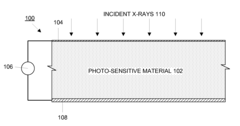
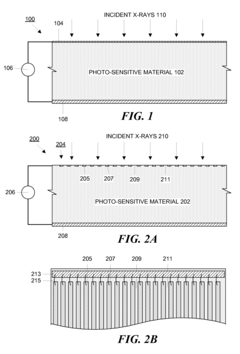
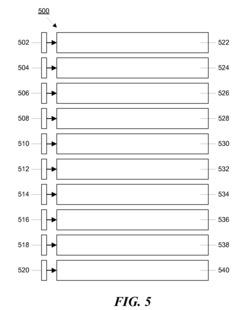
- A system comprising two monolithic non-pixelated detectors aligned along a main axis, with a control unit that selects events based on coincidence detection within 2 ns, and employs electronic collimation through energy thresholding to achieve directional sensitivity without a physical collimator.


X-ray detection system for wavelength dispersive and energy dispersive spectroscopy and electron beam applications
PatentActiveUS7928400B1
Innovation
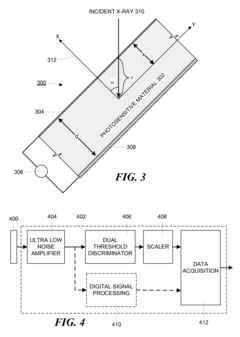
- A solid-state avalanche photodiode detector with a thin conductive entrance window and tilting mechanism, combined with advanced signal processing circuits, enhances the detection efficiency for both 'light' and 'heavy' elements by increasing absorption depth and count rates.
Radiation Safety Regulations and Compliance Standards
The regulatory landscape governing ionizing radiation and X-ray detection systems is characterized by a complex framework of international, national, and regional standards designed to ensure public safety and occupational health protection. The International Atomic Energy Agency (IAEA) serves as the primary global authority, establishing fundamental safety principles through publications such as GSR Part 3, which outlines international basic safety standards for protection against ionizing radiation. These guidelines form the foundation for national regulatory frameworks worldwide.
In the United States, the Nuclear Regulatory Commission (NRC) and the Food and Drug Administration (FDA) jointly oversee radiation detection equipment regulations. The NRC's 10 CFR Part 20 establishes radiation protection standards, while FDA's 21 CFR Part 1020 specifically addresses performance standards for ionizing radiation emitting products. The Environmental Protection Agency (EPA) also contributes through Federal Guidance Reports that establish protective action guidelines for emergency response scenarios involving radiation detection systems.
European Union member states operate under the Euratom Basic Safety Standards Directive 2013/59/EURATOM, which harmonizes radiation protection requirements across the region. This directive mandates specific performance criteria for detection equipment used in medical, industrial, and security applications. Individual member states implement these standards through national legislation, such as the UK's Ionising Radiations Regulations 2017 and Germany's Radiation Protection Ordinance.
Detection efficiency requirements vary significantly based on application context and radiation type. Medical imaging systems must comply with IEC 60601 series standards, which specify minimum detection thresholds and image quality parameters. Security screening applications follow different protocols, with the Transportation Security Administration (TSA) and equivalent international bodies establishing performance benchmarks for baggage and cargo inspection systems.
Compliance verification involves rigorous testing protocols including sensitivity measurements, false alarm rate assessments, and long-term stability evaluations. Manufacturers must demonstrate adherence to ANSI N42 standards for radiation detection instruments, which specify testing methodologies for different detector technologies. Regular calibration requirements, typically mandated annually or bi-annually, ensure continued compliance throughout equipment lifecycle.
Quality assurance programs mandated by regulatory bodies require comprehensive documentation of detection system performance, including efficiency metrics for various radiation energies and source configurations. These programs often incorporate statistical process control methods to monitor detection capability trends and identify potential degradation before safety thresholds are compromised.
In the United States, the Nuclear Regulatory Commission (NRC) and the Food and Drug Administration (FDA) jointly oversee radiation detection equipment regulations. The NRC's 10 CFR Part 20 establishes radiation protection standards, while FDA's 21 CFR Part 1020 specifically addresses performance standards for ionizing radiation emitting products. The Environmental Protection Agency (EPA) also contributes through Federal Guidance Reports that establish protective action guidelines for emergency response scenarios involving radiation detection systems.
European Union member states operate under the Euratom Basic Safety Standards Directive 2013/59/EURATOM, which harmonizes radiation protection requirements across the region. This directive mandates specific performance criteria for detection equipment used in medical, industrial, and security applications. Individual member states implement these standards through national legislation, such as the UK's Ionising Radiations Regulations 2017 and Germany's Radiation Protection Ordinance.
Detection efficiency requirements vary significantly based on application context and radiation type. Medical imaging systems must comply with IEC 60601 series standards, which specify minimum detection thresholds and image quality parameters. Security screening applications follow different protocols, with the Transportation Security Administration (TSA) and equivalent international bodies establishing performance benchmarks for baggage and cargo inspection systems.
Compliance verification involves rigorous testing protocols including sensitivity measurements, false alarm rate assessments, and long-term stability evaluations. Manufacturers must demonstrate adherence to ANSI N42 standards for radiation detection instruments, which specify testing methodologies for different detector technologies. Regular calibration requirements, typically mandated annually or bi-annually, ensure continued compliance throughout equipment lifecycle.
Quality assurance programs mandated by regulatory bodies require comprehensive documentation of detection system performance, including efficiency metrics for various radiation energies and source configurations. These programs often incorporate statistical process control methods to monitor detection capability trends and identify potential degradation before safety thresholds are compromised.
AI-Enhanced Detection Algorithm Development Trends
The integration of artificial intelligence into radiation detection systems represents a paradigmatic shift in how ionizing rays and X-rays are identified, classified, and analyzed. Machine learning algorithms have emerged as powerful tools to enhance detection efficiency by processing complex spectral data patterns that traditional methods often struggle to interpret accurately. Deep learning architectures, particularly convolutional neural networks and recurrent neural networks, are being increasingly deployed to distinguish between different radiation signatures and improve signal-to-noise ratios in real-time detection scenarios.
Current AI-enhanced detection algorithms focus on adaptive threshold optimization, where machine learning models continuously adjust detection parameters based on environmental conditions and background radiation levels. These systems employ reinforcement learning techniques to minimize false positive rates while maximizing sensitivity to target radiation sources. Advanced feature extraction methods utilize wavelet transforms and principal component analysis to identify subtle spectral characteristics that differentiate ionizing radiation from X-ray emissions.
The development trajectory shows a clear evolution from rule-based expert systems to sophisticated neural network architectures capable of multi-modal sensor fusion. Recent breakthroughs include the implementation of transformer-based models that can process temporal sequences of radiation measurements, enabling predictive detection capabilities and anomaly identification. These algorithms demonstrate superior performance in distinguishing between natural background radiation, medical X-ray sources, and potentially hazardous ionizing radiation events.
Emerging trends indicate a shift toward edge computing implementations, where AI algorithms are embedded directly into detection hardware to enable autonomous decision-making without cloud connectivity. Federated learning approaches are being explored to train detection models across distributed sensor networks while maintaining data privacy and security protocols. Additionally, explainable AI techniques are being integrated to provide transparent decision-making processes, crucial for regulatory compliance and operator confidence in critical detection scenarios.
The convergence of quantum computing principles with classical machine learning is opening new possibilities for ultra-fast spectral analysis and pattern recognition in radiation detection applications.
Current AI-enhanced detection algorithms focus on adaptive threshold optimization, where machine learning models continuously adjust detection parameters based on environmental conditions and background radiation levels. These systems employ reinforcement learning techniques to minimize false positive rates while maximizing sensitivity to target radiation sources. Advanced feature extraction methods utilize wavelet transforms and principal component analysis to identify subtle spectral characteristics that differentiate ionizing radiation from X-ray emissions.
The development trajectory shows a clear evolution from rule-based expert systems to sophisticated neural network architectures capable of multi-modal sensor fusion. Recent breakthroughs include the implementation of transformer-based models that can process temporal sequences of radiation measurements, enabling predictive detection capabilities and anomaly identification. These algorithms demonstrate superior performance in distinguishing between natural background radiation, medical X-ray sources, and potentially hazardous ionizing radiation events.
Emerging trends indicate a shift toward edge computing implementations, where AI algorithms are embedded directly into detection hardware to enable autonomous decision-making without cloud connectivity. Federated learning approaches are being explored to train detection models across distributed sensor networks while maintaining data privacy and security protocols. Additionally, explainable AI techniques are being integrated to provide transparent decision-making processes, crucial for regulatory compliance and operator confidence in critical detection scenarios.
The convergence of quantum computing principles with classical machine learning is opening new possibilities for ultra-fast spectral analysis and pattern recognition in radiation detection applications.
Unlock deeper insights with Patsnap Eureka Quick Research — get a full tech report to explore trends and direct your research. Try now!
Generate Your Research Report Instantly with AI Agent
Supercharge your innovation with Patsnap Eureka AI Agent Platform!