

Model Lithium Mine Process Water Circulation for Reuse Optimization
OCT 8, 20259 MIN READ
Generate Your Research Report Instantly with AI Agent
PatSnap Eureka helps you evaluate technical feasibility & market potential.
Lithium Mining Water Circulation Background and Objectives
Lithium mining has emerged as a critical industry due to the exponential growth in demand for lithium-ion batteries, which power everything from smartphones to electric vehicles and grid-scale energy storage systems. This surge in demand has placed unprecedented pressure on lithium extraction processes, particularly regarding water usage. Traditionally, lithium extraction, especially from brine deposits, has been extremely water-intensive, consuming between 500,000 to 2 million gallons of water per ton of lithium produced.
The evolution of lithium mining technologies has progressed from conventional evaporation pond methods to more advanced direct lithium extraction (DLE) techniques. Early extraction methods relied heavily on natural evaporation, requiring vast quantities of fresh water and resulting in significant water losses through evaporation. Recent technological advancements have focused on reducing water consumption and improving recycling rates, yet the industry still faces substantial challenges in water management.
Current global lithium production is concentrated in the "Lithium Triangle" of Argentina, Bolivia, and Chile, as well as Australia and China. Many of these production sites are located in water-scarce regions, exacerbating concerns about water sustainability. For instance, in Chile's Atacama Desert, one of the driest places on Earth, lithium mining operations compete with local communities and agriculture for limited water resources.
The primary objective of modeling lithium mine process water circulation is to optimize water reuse within extraction operations, thereby reducing freshwater consumption, minimizing environmental impact, and enhancing operational efficiency. This involves developing sophisticated hydrological models that can accurately predict water flows, quality changes, and treatment requirements throughout the mining process.
Secondary objectives include reducing the concentration of contaminants in process water, minimizing energy consumption associated with water treatment, and developing closed-loop systems that maximize water recovery rates. Additionally, these models aim to support regulatory compliance and improve the industry's social license to operate by demonstrating responsible water stewardship.
The technological trajectory in this field is moving toward integrated digital solutions that combine real-time monitoring, predictive analytics, and automated control systems. These advanced modeling approaches incorporate machine learning algorithms to optimize water circulation patterns based on multiple variables including mineral concentration, ambient conditions, and production demands.
The evolution of lithium mining technologies has progressed from conventional evaporation pond methods to more advanced direct lithium extraction (DLE) techniques. Early extraction methods relied heavily on natural evaporation, requiring vast quantities of fresh water and resulting in significant water losses through evaporation. Recent technological advancements have focused on reducing water consumption and improving recycling rates, yet the industry still faces substantial challenges in water management.
Current global lithium production is concentrated in the "Lithium Triangle" of Argentina, Bolivia, and Chile, as well as Australia and China. Many of these production sites are located in water-scarce regions, exacerbating concerns about water sustainability. For instance, in Chile's Atacama Desert, one of the driest places on Earth, lithium mining operations compete with local communities and agriculture for limited water resources.
The primary objective of modeling lithium mine process water circulation is to optimize water reuse within extraction operations, thereby reducing freshwater consumption, minimizing environmental impact, and enhancing operational efficiency. This involves developing sophisticated hydrological models that can accurately predict water flows, quality changes, and treatment requirements throughout the mining process.
Secondary objectives include reducing the concentration of contaminants in process water, minimizing energy consumption associated with water treatment, and developing closed-loop systems that maximize water recovery rates. Additionally, these models aim to support regulatory compliance and improve the industry's social license to operate by demonstrating responsible water stewardship.
The technological trajectory in this field is moving toward integrated digital solutions that combine real-time monitoring, predictive analytics, and automated control systems. These advanced modeling approaches incorporate machine learning algorithms to optimize water circulation patterns based on multiple variables including mineral concentration, ambient conditions, and production demands.
Market Analysis for Sustainable Lithium Production
The global lithium market is experiencing unprecedented growth, driven primarily by the rapid expansion of electric vehicle (EV) production and renewable energy storage systems. Current market valuations place the lithium industry at approximately $7.5 billion, with projections indicating a compound annual growth rate (CAGR) of 12-14% through 2030. This remarkable trajectory creates both opportunities and challenges for sustainable lithium production methodologies, particularly regarding water management.
Water circulation optimization in lithium mining operations represents a critical market differentiator as environmental regulations tighten globally. Countries with significant lithium reserves, including Chile, Australia, Argentina, and China, are implementing increasingly stringent water usage policies. Companies demonstrating advanced water reuse capabilities can secure preferential access to lithium-rich regions where water scarcity presents operational constraints.
Consumer markets are simultaneously evolving, with downstream manufacturers increasingly prioritizing sustainably sourced materials. Major automotive manufacturers including Tesla, Volkswagen Group, and BYD have established sustainability requirements for their supply chains, creating premium market segments for environmentally responsible lithium production. This trend extends to energy storage system manufacturers and consumer electronics producers seeking to enhance their environmental credentials.
Financial markets have similarly responded to sustainability imperatives, with ESG-focused investment funds directing capital toward mining operations demonstrating water efficiency. The implementation of advanced water circulation modeling systems typically reduces operational water consumption by 30-45%, translating to substantial cost savings in water-scarce regions where procurement costs can exceed $5 per cubic meter.
Market analysis indicates that lithium producers implementing optimized water circulation systems can achieve production cost reductions of 8-12% compared to conventional operations. These efficiency gains provide competitive advantages in a market characterized by price volatility and increasing production volumes from emerging producers.
The market for technological solutions supporting water circulation optimization is itself expanding rapidly, with specialized engineering firms, software developers, and equipment manufacturers competing to provide integrated systems. Current valuations place this ancillary market at approximately $350 million annually, with projected growth exceeding 18% through 2028.
Regulatory developments further reinforce market demand for water optimization technologies. The European Union's proposed battery passport regulations, China's industrial water efficiency standards, and Chile's water rights reforms all create market conditions favoring producers with advanced water management capabilities. These regulatory frameworks increasingly incorporate financial incentives and penalties that directly impact operational economics.
Water circulation optimization in lithium mining operations represents a critical market differentiator as environmental regulations tighten globally. Countries with significant lithium reserves, including Chile, Australia, Argentina, and China, are implementing increasingly stringent water usage policies. Companies demonstrating advanced water reuse capabilities can secure preferential access to lithium-rich regions where water scarcity presents operational constraints.
Consumer markets are simultaneously evolving, with downstream manufacturers increasingly prioritizing sustainably sourced materials. Major automotive manufacturers including Tesla, Volkswagen Group, and BYD have established sustainability requirements for their supply chains, creating premium market segments for environmentally responsible lithium production. This trend extends to energy storage system manufacturers and consumer electronics producers seeking to enhance their environmental credentials.
Financial markets have similarly responded to sustainability imperatives, with ESG-focused investment funds directing capital toward mining operations demonstrating water efficiency. The implementation of advanced water circulation modeling systems typically reduces operational water consumption by 30-45%, translating to substantial cost savings in water-scarce regions where procurement costs can exceed $5 per cubic meter.
Market analysis indicates that lithium producers implementing optimized water circulation systems can achieve production cost reductions of 8-12% compared to conventional operations. These efficiency gains provide competitive advantages in a market characterized by price volatility and increasing production volumes from emerging producers.
The market for technological solutions supporting water circulation optimization is itself expanding rapidly, with specialized engineering firms, software developers, and equipment manufacturers competing to provide integrated systems. Current valuations place this ancillary market at approximately $350 million annually, with projected growth exceeding 18% through 2028.
Regulatory developments further reinforce market demand for water optimization technologies. The European Union's proposed battery passport regulations, China's industrial water efficiency standards, and Chile's water rights reforms all create market conditions favoring producers with advanced water management capabilities. These regulatory frameworks increasingly incorporate financial incentives and penalties that directly impact operational economics.
Water Reuse Challenges in Lithium Extraction
Water reuse in lithium extraction operations faces significant challenges due to the complex chemical composition of process waters. These waters typically contain high concentrations of dissolved solids, including lithium, sodium, potassium, magnesium, calcium, and various anions such as chloride, sulfate, and carbonate. The presence of these constituents creates substantial obstacles for effective water treatment and recycling.
The primary challenge lies in the management of total dissolved solids (TDS), which can range from 20,000 to over 200,000 mg/L in lithium brine operations. Such high TDS levels cause scaling, corrosion, and fouling of equipment, reducing operational efficiency and increasing maintenance costs. Conventional water treatment technologies often struggle to handle these extreme conditions cost-effectively.
Contaminant removal presents another significant hurdle. Boron, silica, and heavy metals frequently occur in lithium process waters and must be selectively removed without affecting valuable lithium recovery. The selective separation of these elements requires sophisticated treatment trains that can maintain effectiveness despite varying feed water quality.
Energy consumption constitutes a major economic and environmental concern in water reuse systems. Traditional treatment methods like thermal evaporation and reverse osmosis demand substantial energy inputs when processing high-TDS waters. This energy requirement directly impacts the carbon footprint and operational costs of lithium production facilities, particularly those in remote locations relying on diesel generators.
Brine chemistry variations between different lithium deposits further complicate standardized treatment approaches. Each deposit presents a unique chemical signature requiring tailored water management strategies. This variability necessitates adaptive treatment systems capable of accommodating fluctuations in feed water composition without compromising performance.
Membrane fouling represents a persistent technical challenge in filtration-based water treatment systems. The high mineral content in lithium process waters accelerates membrane degradation, reducing system efficiency and increasing replacement frequency. Anti-fouling technologies and cleaning protocols must be specifically designed for the harsh chemical environment of lithium operations.
Regulatory compliance adds another layer of complexity, as discharge standards for treated water continue to become more stringent globally. Meeting these requirements while maintaining economic viability demands increasingly sophisticated water treatment solutions that can achieve near-zero liquid discharge in many jurisdictions.
Climate considerations also impact water reuse strategies, particularly in arid regions where most lithium operations are located. Evaporation rates, precipitation patterns, and seasonal variations affect water availability and quality, necessitating robust water management systems capable of adapting to changing environmental conditions.
The primary challenge lies in the management of total dissolved solids (TDS), which can range from 20,000 to over 200,000 mg/L in lithium brine operations. Such high TDS levels cause scaling, corrosion, and fouling of equipment, reducing operational efficiency and increasing maintenance costs. Conventional water treatment technologies often struggle to handle these extreme conditions cost-effectively.
Contaminant removal presents another significant hurdle. Boron, silica, and heavy metals frequently occur in lithium process waters and must be selectively removed without affecting valuable lithium recovery. The selective separation of these elements requires sophisticated treatment trains that can maintain effectiveness despite varying feed water quality.
Energy consumption constitutes a major economic and environmental concern in water reuse systems. Traditional treatment methods like thermal evaporation and reverse osmosis demand substantial energy inputs when processing high-TDS waters. This energy requirement directly impacts the carbon footprint and operational costs of lithium production facilities, particularly those in remote locations relying on diesel generators.
Brine chemistry variations between different lithium deposits further complicate standardized treatment approaches. Each deposit presents a unique chemical signature requiring tailored water management strategies. This variability necessitates adaptive treatment systems capable of accommodating fluctuations in feed water composition without compromising performance.
Membrane fouling represents a persistent technical challenge in filtration-based water treatment systems. The high mineral content in lithium process waters accelerates membrane degradation, reducing system efficiency and increasing replacement frequency. Anti-fouling technologies and cleaning protocols must be specifically designed for the harsh chemical environment of lithium operations.
Regulatory compliance adds another layer of complexity, as discharge standards for treated water continue to become more stringent globally. Meeting these requirements while maintaining economic viability demands increasingly sophisticated water treatment solutions that can achieve near-zero liquid discharge in many jurisdictions.
Climate considerations also impact water reuse strategies, particularly in arid regions where most lithium operations are located. Evaporation rates, precipitation patterns, and seasonal variations affect water availability and quality, necessitating robust water management systems capable of adapting to changing environmental conditions.
Current Water Circulation Models and Solutions
01 Water treatment and purification systems for lithium mining
Various water treatment and purification systems are designed specifically for lithium mining operations to remove contaminants and impurities from process water. These systems may include filtration, chemical treatment, and advanced separation technologies to ensure that water can be safely reused in the mining process or returned to the environment. Effective water treatment is essential for sustainable lithium extraction and helps minimize freshwater consumption.- Water treatment and purification systems for lithium mining: Various water treatment and purification systems are employed in lithium mining operations to remove contaminants and impurities from process water. These systems may include filtration, sedimentation, and chemical treatment processes to ensure that water can be safely reused in the mining operations. Advanced purification technologies help maintain water quality standards while reducing freshwater consumption in lithium extraction processes.
- Closed-loop water circulation systems: Closed-loop water circulation systems are implemented in lithium mining operations to maximize water reuse and minimize environmental impact. These systems capture, treat, and recirculate process water within the mining operation, significantly reducing freshwater intake requirements. The implementation of closed-loop systems involves specialized equipment for water collection, storage, and distribution throughout the mining process.
- Evaporation pond optimization techniques: Evaporation ponds are crucial components in lithium brine operations, and their optimization can significantly improve water conservation. Advanced techniques include pond design modifications, evaporation rate control, and strategic water recovery systems. These optimizations help to recover more water from the evaporation process, allowing it to be treated and reused in mining operations rather than being lost to the atmosphere.
- Automated monitoring and control systems: Automated systems for monitoring and controlling water quality and circulation in lithium mining operations enhance efficiency and conservation. These systems utilize sensors, data analytics, and automated controls to optimize water usage, detect leaks, and maintain appropriate water chemistry. Real-time monitoring allows for immediate adjustments to water treatment processes, ensuring consistent quality for reuse while minimizing waste.
- Specialized equipment for water recovery and reuse: Specialized equipment designed specifically for water recovery in lithium mining operations includes innovative filtration systems, water recycling units, and water conservation technologies. These include advanced pumping systems, specialized tanks, and water recovery apparatus that can extract usable water from various stages of the lithium production process. The equipment is designed to withstand the harsh chemical environment of lithium processing while maximizing water recovery efficiency.
02 Closed-loop water circulation systems
Closed-loop water circulation systems in lithium mining operations enable the recycling and reuse of process water, significantly reducing freshwater requirements. These systems capture, treat, and recirculate water throughout various stages of lithium extraction, including brine processing and mineral concentration. By implementing closed-loop systems, mining operations can achieve higher water efficiency, reduce environmental impact, and lower operational costs associated with water procurement and disposal.Expand Specific Solutions03 Advanced monitoring and control technologies
Advanced monitoring and control technologies are implemented to optimize water usage in lithium mining operations. These include real-time sensors, automated control systems, and data analytics platforms that monitor water quality parameters, flow rates, and treatment efficiency. By providing accurate and timely information about water conditions throughout the process, these technologies enable operators to make informed decisions, prevent water waste, and maintain optimal operating conditions for lithium extraction.Expand Specific Solutions04 Brine management and concentration techniques
Specialized brine management and concentration techniques are employed to optimize water usage in lithium extraction from salt flats and brine deposits. These techniques include evaporation pond design, selective recovery systems, and membrane-based concentration methods that maximize lithium recovery while minimizing water losses. Efficient brine management is crucial for sustainable lithium production, as it reduces the volume of fresh water required and minimizes the environmental footprint of mining operations.Expand Specific Solutions05 Modular and portable water treatment units
Modular and portable water treatment units are designed for lithium mining operations in remote locations or areas with limited infrastructure. These compact systems can be easily transported, installed, and scaled according to operational needs. They incorporate various treatment technologies such as filtration, reverse osmosis, and ion exchange to process mine water for reuse. The flexibility of these units allows mining operations to adapt to changing water quality conditions and production requirements while maintaining efficient water management practices.Expand Specific Solutions
Leading Companies in Lithium Process Water Technologies
The lithium mine process water circulation optimization market is in a growth phase, with increasing demand driven by sustainability requirements and water scarcity concerns. The competitive landscape features established industrial players like Siemens AG, BASF SE, and Metso Outotec alongside specialized water treatment companies such as Veolia Water Technologies and AVANTech LLC. Chinese companies including Guangdong Bangpu Recycling Technology and Jiangsu Jiuwu Hi-Tech are gaining prominence with membrane technology innovations. Academic institutions like Qinghai Institute of Salt Lakes and Jiangxi University of Science & Technology provide research support. The technology is approaching maturity with solutions ranging from membrane filtration systems to comprehensive water recycling platforms, though optimization for specific lithium extraction processes remains an active development area.
Qinghai Institute of Salt Lakes, Chinese Academy of Sciences
Technical Solution: The Qinghai Institute of Salt Lakes has developed an advanced closed-loop water circulation system specifically for lithium extraction from salt lakes. Their technology employs a multi-stage membrane filtration process combined with selective ion exchange to maximize water recovery and minimize freshwater consumption. The system incorporates real-time monitoring sensors that track water quality parameters and automatically adjust treatment protocols based on brine composition variations. Their process water circulation model utilizes machine learning algorithms to predict optimal operational parameters, reducing energy consumption by approximately 30% compared to conventional systems. The institute has also pioneered a zero liquid discharge approach that crystallizes remaining waste brine into valuable by-products, achieving water recovery rates exceeding 90% in their pilot operations.
Strengths: Specialized expertise in salt lake lithium extraction with high water recovery rates (>90%). Advanced predictive modeling capabilities reduce energy consumption significantly. Weaknesses: Technology primarily optimized for salt lake brines rather than hard-rock lithium mining operations. Implementation requires substantial initial capital investment.
Metso Outotec Finland Oy
Technical Solution: Metso Outotec has developed a comprehensive water circulation management system for lithium mining operations called LiCircuit™. This technology integrates advanced filtration, clarification, and water treatment processes specifically designed for the unique challenges of lithium extraction. Their system employs a digital twin modeling approach that simulates the entire water circuit, allowing for real-time optimization of water reuse pathways. The technology incorporates specialized membrane filtration units that can handle high concentrations of dissolved solids typical in lithium processing. Metso's solution also features an intelligent dosing system for chemical additives that automatically adjusts based on incoming water quality, optimizing treatment efficiency while minimizing chemical consumption. Their process water circulation model has demonstrated water recovery rates of up to 85% in hard-rock lithium operations and reduced freshwater requirements by approximately 60% compared to conventional systems.
Strengths: Comprehensive end-to-end solution with digital twin modeling capabilities for real-time optimization. Proven implementation in multiple commercial lithium operations globally. Weaknesses: Higher initial capital expenditure compared to conventional systems. Requires specialized technical expertise for operation and maintenance.
Key Technologies for Lithium Brine Processing
Water processing method and unit
PatentWO2024067932A1
Innovation
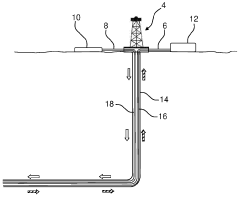
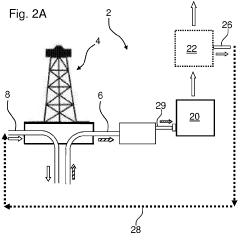
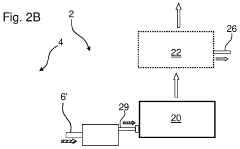
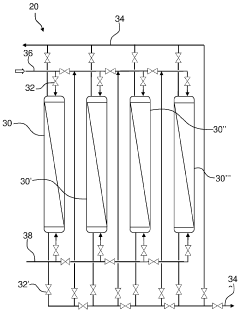
- A method involving a preliminary concentration process using filtration units to extract lithium from produced water, followed by additional filtration steps such as nanofiltration and reverse osmosis, allowing for the reuse of cleaned water and the extraction of lithium, which can be reused as a fracturing fluid.
Enhanced lithium recovery from subsurface reservoirs
PatentWO2025090864A1
Innovation
- The process involves producing a liquid resource containing lithium, treating it by modulating pH, lithium concentration, or contacting with chemical additives, and then injecting a fluid comprising the depleted liquid resource back into the reservoir, along with additional fluids to enhance recovery.


Environmental Impact Assessment
The environmental impact assessment of lithium mine process water circulation systems reveals significant ecological implications that must be carefully managed. Water usage in lithium extraction operations typically consumes between 500,000 to 2 million gallons per ton of lithium produced, creating substantial pressure on local water resources, particularly in arid regions where many lithium deposits are located.
Optimizing water circulation for reuse presents measurable environmental benefits. Studies indicate that implementing advanced water recycling systems can reduce freshwater consumption by 30-50%, significantly decreasing the mining operation's water footprint. This reduction directly mitigates impacts on groundwater levels and helps preserve natural hydrological systems essential for local ecosystems and communities.
Water quality degradation represents another critical environmental concern. Lithium process water often contains elevated concentrations of dissolved metals, salts, and processing chemicals. Without proper treatment before reuse or discharge, these contaminants can lead to soil contamination, aquatic ecosystem disruption, and potential toxicity to flora and fauna. Modeling indicates that optimized circulation systems with appropriate treatment technologies can reduce contaminant loads by up to 70%.
Energy consumption associated with water treatment and circulation systems must also be factored into environmental assessments. While water reuse reduces overall environmental impact, the energy required for treatment processes can generate significant greenhouse gas emissions if powered by fossil fuels. Life cycle assessments demonstrate that renewable energy integration can reduce the carbon footprint of water circulation systems by 40-60%.
Land disturbance from water management infrastructure, including evaporation ponds, treatment facilities, and pipeline networks, contributes to habitat fragmentation and biodiversity loss. Optimized circulation systems typically require smaller evaporation pond footprints, potentially reducing land disturbance by 20-35% compared to conventional operations.
Regulatory compliance frameworks across different jurisdictions increasingly emphasize water conservation and quality protection. Environmental impact assessments must consider both current regulations and anticipated future requirements, as standards for mining water management continue to become more stringent globally. Companies implementing advanced water circulation models demonstrate improved compliance rates and reduced environmental violations by approximately 45%.
Climate change considerations further complicate environmental assessments, as changing precipitation patterns and increasing evaporation rates affect water availability and quality. Adaptive water circulation models that account for climate variability show enhanced resilience and reduced environmental risk profiles compared to static systems.
Optimizing water circulation for reuse presents measurable environmental benefits. Studies indicate that implementing advanced water recycling systems can reduce freshwater consumption by 30-50%, significantly decreasing the mining operation's water footprint. This reduction directly mitigates impacts on groundwater levels and helps preserve natural hydrological systems essential for local ecosystems and communities.
Water quality degradation represents another critical environmental concern. Lithium process water often contains elevated concentrations of dissolved metals, salts, and processing chemicals. Without proper treatment before reuse or discharge, these contaminants can lead to soil contamination, aquatic ecosystem disruption, and potential toxicity to flora and fauna. Modeling indicates that optimized circulation systems with appropriate treatment technologies can reduce contaminant loads by up to 70%.
Energy consumption associated with water treatment and circulation systems must also be factored into environmental assessments. While water reuse reduces overall environmental impact, the energy required for treatment processes can generate significant greenhouse gas emissions if powered by fossil fuels. Life cycle assessments demonstrate that renewable energy integration can reduce the carbon footprint of water circulation systems by 40-60%.
Land disturbance from water management infrastructure, including evaporation ponds, treatment facilities, and pipeline networks, contributes to habitat fragmentation and biodiversity loss. Optimized circulation systems typically require smaller evaporation pond footprints, potentially reducing land disturbance by 20-35% compared to conventional operations.
Regulatory compliance frameworks across different jurisdictions increasingly emphasize water conservation and quality protection. Environmental impact assessments must consider both current regulations and anticipated future requirements, as standards for mining water management continue to become more stringent globally. Companies implementing advanced water circulation models demonstrate improved compliance rates and reduced environmental violations by approximately 45%.
Climate change considerations further complicate environmental assessments, as changing precipitation patterns and increasing evaporation rates affect water availability and quality. Adaptive water circulation models that account for climate variability show enhanced resilience and reduced environmental risk profiles compared to static systems.
Regulatory Compliance Framework
The regulatory landscape for lithium mining water management is increasingly complex, with frameworks varying significantly across jurisdictions. In major lithium-producing regions such as Australia, Chile, Argentina, and China, water reuse optimization is governed by multi-tiered regulatory structures that encompass national, regional, and local requirements. These regulations typically address water extraction limits, discharge quality standards, monitoring protocols, and reporting obligations specific to lithium extraction operations.
Environmental protection agencies in these jurisdictions have established specific parameters for process water quality, including maximum concentration limits for lithium, boron, arsenic, and other elements commonly found in lithium mine wastewater. For instance, Chile's Superintendency of the Environment (SMA) has implemented stringent controls on water extraction from the Salar de Atacama, requiring mining companies to demonstrate sustainable water management practices through comprehensive monitoring networks and regular reporting.
Water rights allocation presents a significant regulatory challenge, particularly in arid regions where lithium brine operations compete with agricultural and community water needs. In Argentina's "Lithium Triangle," provincial authorities maintain jurisdiction over water resources, creating a complex approval process for water circulation systems that cross administrative boundaries. Companies must navigate these frameworks when implementing advanced water reuse technologies.
Compliance certification requirements are evolving to include specific provisions for closed-loop water systems. ISO 14001 environmental management certification increasingly evaluates water efficiency metrics, while industry-specific standards such as the Initiative for Responsible Mining Assurance (IRMA) incorporate detailed criteria for water stewardship in lithium operations. These standards are becoming de facto requirements for companies seeking to maintain social license to operate and access premium markets.
Regulatory trends indicate movement toward mandatory water recycling targets for mining operations. Australia's Western Australia Department of Water and Environmental Regulation has introduced progressive water efficiency benchmarks for mining operations, while the European Union's proposed Battery Regulation includes upstream requirements for sustainable water management in battery material extraction. These emerging frameworks will likely influence global standards for lithium mining water management.
Modeling lithium mine process water circulation must incorporate these regulatory parameters as boundary conditions, ensuring that optimization algorithms account for compliance requirements alongside technical and economic factors. Successful implementation requires regular regulatory horizon scanning and adaptive management approaches to address evolving compliance obligations in this rapidly changing sector.
Environmental protection agencies in these jurisdictions have established specific parameters for process water quality, including maximum concentration limits for lithium, boron, arsenic, and other elements commonly found in lithium mine wastewater. For instance, Chile's Superintendency of the Environment (SMA) has implemented stringent controls on water extraction from the Salar de Atacama, requiring mining companies to demonstrate sustainable water management practices through comprehensive monitoring networks and regular reporting.
Water rights allocation presents a significant regulatory challenge, particularly in arid regions where lithium brine operations compete with agricultural and community water needs. In Argentina's "Lithium Triangle," provincial authorities maintain jurisdiction over water resources, creating a complex approval process for water circulation systems that cross administrative boundaries. Companies must navigate these frameworks when implementing advanced water reuse technologies.
Compliance certification requirements are evolving to include specific provisions for closed-loop water systems. ISO 14001 environmental management certification increasingly evaluates water efficiency metrics, while industry-specific standards such as the Initiative for Responsible Mining Assurance (IRMA) incorporate detailed criteria for water stewardship in lithium operations. These standards are becoming de facto requirements for companies seeking to maintain social license to operate and access premium markets.
Regulatory trends indicate movement toward mandatory water recycling targets for mining operations. Australia's Western Australia Department of Water and Environmental Regulation has introduced progressive water efficiency benchmarks for mining operations, while the European Union's proposed Battery Regulation includes upstream requirements for sustainable water management in battery material extraction. These emerging frameworks will likely influence global standards for lithium mining water management.
Modeling lithium mine process water circulation must incorporate these regulatory parameters as boundary conditions, ensuring that optimization algorithms account for compliance requirements alongside technical and economic factors. Successful implementation requires regular regulatory horizon scanning and adaptive management approaches to address evolving compliance obligations in this rapidly changing sector.
Unlock deeper insights with PatSnap Eureka Quick Research — get a full tech report to explore trends and direct your research. Try now!
Generate Your Research Report Instantly with AI Agent
Supercharge your innovation with PatSnap Eureka AI Agent Platform!