

Multiphysics Simulation vs Time Step Selection
MAR 26, 20269 MIN READ
Generate Your Research Report Instantly with AI Agent
PatSnap Eureka helps you evaluate technical feasibility & market potential.
Multiphysics Simulation Background and Time Step Objectives
Multiphysics simulation has emerged as a critical computational methodology for modeling complex engineering systems where multiple physical phenomena interact simultaneously. This approach addresses the inherent limitations of single-physics simulations by capturing the coupled behavior of thermal, mechanical, electromagnetic, fluid dynamic, and chemical processes that occur in real-world applications. The evolution of multiphysics simulation began in the 1960s with early finite element methods, progressing through the development of coupled field solvers in the 1980s, and reaching sophisticated integrated platforms by the 2000s.
The fundamental challenge in multiphysics simulation lies in managing the disparate time scales and spatial scales inherent to different physical processes. While thermal diffusion may occur over seconds or minutes, electromagnetic wave propagation happens in microseconds, and mechanical vibrations operate in milliseconds. This temporal disparity creates computational complexity that directly impacts simulation accuracy and efficiency.
Time step selection represents the cornerstone of successful multiphysics simulation, serving as the bridge between computational feasibility and physical accuracy. The time step determines how frequently the simulation updates the solution across all coupled physics domains, directly influencing numerical stability, convergence behavior, and computational cost. Inappropriate time step selection can lead to numerical instabilities, solution divergence, or excessive computational overhead that renders simulations impractical.
The primary objective of optimal time step selection is to achieve numerical stability across all coupled physics while maintaining computational efficiency. This requires balancing the Courant-Friedrichs-Lewy (CFL) conditions for different physical phenomena, ensuring that information propagation speeds are properly resolved without over-constraining the simulation. Advanced adaptive time stepping algorithms aim to dynamically adjust temporal resolution based on solution gradients and coupling strength between physics domains.
Contemporary research focuses on developing intelligent time step control mechanisms that can automatically identify critical coupling events and adjust temporal discretization accordingly. These objectives include minimizing computational cost while preserving solution accuracy, maintaining synchronization between different physics solvers, and enabling real-time simulation capabilities for industrial applications requiring rapid design iterations.
The fundamental challenge in multiphysics simulation lies in managing the disparate time scales and spatial scales inherent to different physical processes. While thermal diffusion may occur over seconds or minutes, electromagnetic wave propagation happens in microseconds, and mechanical vibrations operate in milliseconds. This temporal disparity creates computational complexity that directly impacts simulation accuracy and efficiency.
Time step selection represents the cornerstone of successful multiphysics simulation, serving as the bridge between computational feasibility and physical accuracy. The time step determines how frequently the simulation updates the solution across all coupled physics domains, directly influencing numerical stability, convergence behavior, and computational cost. Inappropriate time step selection can lead to numerical instabilities, solution divergence, or excessive computational overhead that renders simulations impractical.
The primary objective of optimal time step selection is to achieve numerical stability across all coupled physics while maintaining computational efficiency. This requires balancing the Courant-Friedrichs-Lewy (CFL) conditions for different physical phenomena, ensuring that information propagation speeds are properly resolved without over-constraining the simulation. Advanced adaptive time stepping algorithms aim to dynamically adjust temporal resolution based on solution gradients and coupling strength between physics domains.
Contemporary research focuses on developing intelligent time step control mechanisms that can automatically identify critical coupling events and adjust temporal discretization accordingly. These objectives include minimizing computational cost while preserving solution accuracy, maintaining synchronization between different physics solvers, and enabling real-time simulation capabilities for industrial applications requiring rapid design iterations.
Market Demand for Advanced Multiphysics Simulation Solutions
The global multiphysics simulation market is experiencing unprecedented growth driven by increasing complexity in engineering design challenges across multiple industries. Organizations are demanding more sophisticated simulation capabilities that can accurately model coupled physical phenomena while maintaining computational efficiency. This demand stems from the critical need to reduce product development cycles, minimize physical prototyping costs, and achieve higher levels of design optimization in competitive markets.
Aerospace and automotive industries represent the largest market segments for advanced multiphysics simulation solutions. These sectors require comprehensive modeling of fluid-structure interactions, thermal-mechanical coupling, and electromagnetic effects simultaneously. The growing emphasis on electric vehicle development and sustainable aviation technologies has intensified the need for precise time step selection methodologies that can handle multi-scale temporal phenomena effectively.
Manufacturing industries are increasingly adopting multiphysics simulation to optimize production processes and predict material behavior under complex operating conditions. The semiconductor industry particularly demands advanced simulation capabilities for thermal management, electromagnetic compatibility, and mechanical stress analysis during chip design and packaging processes. These applications require sophisticated time stepping algorithms that can resolve vastly different time scales within a single simulation framework.
Energy sector applications, including renewable energy systems and nuclear power generation, drive substantial demand for robust multiphysics simulation platforms. Wind turbine design, solar panel optimization, and battery thermal management require accurate coupling between fluid dynamics, heat transfer, and structural mechanics. The challenge of selecting appropriate time steps for these coupled systems has become a critical factor in simulation accuracy and computational cost management.
The pharmaceutical and biomedical industries are emerging as significant growth markets for multiphysics simulation solutions. Drug delivery systems, medical device design, and tissue engineering applications require sophisticated modeling of biological processes coupled with mechanical and chemical phenomena. These applications demand adaptive time stepping strategies that can accommodate the complex temporal dynamics inherent in biological systems.
Market research indicates strong demand for cloud-based multiphysics simulation platforms that can leverage distributed computing resources for large-scale problems. Organizations seek solutions that provide automated time step selection algorithms, reducing the expertise barrier for effective simulation deployment. The integration of artificial intelligence and machine learning techniques for optimizing time step selection represents a rapidly growing market segment with substantial commercial potential.
Aerospace and automotive industries represent the largest market segments for advanced multiphysics simulation solutions. These sectors require comprehensive modeling of fluid-structure interactions, thermal-mechanical coupling, and electromagnetic effects simultaneously. The growing emphasis on electric vehicle development and sustainable aviation technologies has intensified the need for precise time step selection methodologies that can handle multi-scale temporal phenomena effectively.
Manufacturing industries are increasingly adopting multiphysics simulation to optimize production processes and predict material behavior under complex operating conditions. The semiconductor industry particularly demands advanced simulation capabilities for thermal management, electromagnetic compatibility, and mechanical stress analysis during chip design and packaging processes. These applications require sophisticated time stepping algorithms that can resolve vastly different time scales within a single simulation framework.
Energy sector applications, including renewable energy systems and nuclear power generation, drive substantial demand for robust multiphysics simulation platforms. Wind turbine design, solar panel optimization, and battery thermal management require accurate coupling between fluid dynamics, heat transfer, and structural mechanics. The challenge of selecting appropriate time steps for these coupled systems has become a critical factor in simulation accuracy and computational cost management.
The pharmaceutical and biomedical industries are emerging as significant growth markets for multiphysics simulation solutions. Drug delivery systems, medical device design, and tissue engineering applications require sophisticated modeling of biological processes coupled with mechanical and chemical phenomena. These applications demand adaptive time stepping strategies that can accommodate the complex temporal dynamics inherent in biological systems.
Market research indicates strong demand for cloud-based multiphysics simulation platforms that can leverage distributed computing resources for large-scale problems. Organizations seek solutions that provide automated time step selection algorithms, reducing the expertise barrier for effective simulation deployment. The integration of artificial intelligence and machine learning techniques for optimizing time step selection represents a rapidly growing market segment with substantial commercial potential.
Current Challenges in Time Step Selection for Multiphysics
Time step selection in multiphysics simulations presents a complex array of challenges that significantly impact computational efficiency and solution accuracy. The fundamental difficulty arises from the inherent multi-scale nature of coupled physical phenomena, where different physics domains operate on vastly different temporal scales. This temporal disparity creates a computational bottleneck that requires sophisticated approaches to achieve stable and accurate solutions.
The stability constraint represents one of the most critical challenges in multiphysics time stepping. Each physical domain imposes its own stability requirements, often governed by different mathematical formulations such as hyperbolic, parabolic, or elliptic partial differential equations. The overall system stability is typically dictated by the most restrictive domain, forcing the entire simulation to adopt extremely small time steps that may be unnecessary for other coupled physics. This phenomenon, known as stiffness, can lead to computational inefficiencies where certain physics are over-resolved while others remain under-resolved.
Accuracy preservation across multiple physics domains introduces another layer of complexity. Different physical phenomena exhibit varying sensitivities to temporal discretization errors, and maintaining consistent accuracy levels across all domains requires careful consideration of error propagation mechanisms. The coupling between physics can amplify discretization errors, leading to non-physical solutions or convergence failures. Traditional single-physics time stepping strategies often prove inadequate when applied to strongly coupled multiphysics systems.
The coupling strength between different physics significantly influences time step selection strategies. Loosely coupled systems may tolerate larger time steps with subcycling approaches, while tightly coupled phenomena require more sophisticated implicit or semi-implicit schemes. Determining the appropriate coupling strength and selecting corresponding time stepping strategies remains a challenging task that often requires domain expertise and extensive numerical experimentation.
Adaptive time stepping mechanisms face additional complications in multiphysics environments. Error estimation becomes more complex when multiple physics contribute to the overall solution error, and traditional error indicators may not capture the full picture of solution quality. The challenge lies in developing robust error estimators that can account for coupling effects and provide reliable guidance for time step adaptation across all physics domains.
Computational load balancing presents practical implementation challenges, particularly in parallel computing environments. Different physics may have varying computational costs per time step, and synchronization requirements between coupled domains can create bottlenecks that limit scalability. The challenge extends to memory management and data transfer optimization when dealing with large-scale multiphysics simulations that require frequent information exchange between different physics solvers.
The stability constraint represents one of the most critical challenges in multiphysics time stepping. Each physical domain imposes its own stability requirements, often governed by different mathematical formulations such as hyperbolic, parabolic, or elliptic partial differential equations. The overall system stability is typically dictated by the most restrictive domain, forcing the entire simulation to adopt extremely small time steps that may be unnecessary for other coupled physics. This phenomenon, known as stiffness, can lead to computational inefficiencies where certain physics are over-resolved while others remain under-resolved.
Accuracy preservation across multiple physics domains introduces another layer of complexity. Different physical phenomena exhibit varying sensitivities to temporal discretization errors, and maintaining consistent accuracy levels across all domains requires careful consideration of error propagation mechanisms. The coupling between physics can amplify discretization errors, leading to non-physical solutions or convergence failures. Traditional single-physics time stepping strategies often prove inadequate when applied to strongly coupled multiphysics systems.
The coupling strength between different physics significantly influences time step selection strategies. Loosely coupled systems may tolerate larger time steps with subcycling approaches, while tightly coupled phenomena require more sophisticated implicit or semi-implicit schemes. Determining the appropriate coupling strength and selecting corresponding time stepping strategies remains a challenging task that often requires domain expertise and extensive numerical experimentation.
Adaptive time stepping mechanisms face additional complications in multiphysics environments. Error estimation becomes more complex when multiple physics contribute to the overall solution error, and traditional error indicators may not capture the full picture of solution quality. The challenge lies in developing robust error estimators that can account for coupling effects and provide reliable guidance for time step adaptation across all physics domains.
Computational load balancing presents practical implementation challenges, particularly in parallel computing environments. Different physics may have varying computational costs per time step, and synchronization requirements between coupled domains can create bottlenecks that limit scalability. The challenge extends to memory management and data transfer optimization when dealing with large-scale multiphysics simulations that require frequent information exchange between different physics solvers.
Existing Time Step Selection Algorithms and Strategies
01 Adaptive time step control based on convergence criteria
Methods for dynamically adjusting simulation time steps based on convergence monitoring and error estimation. The time step size is automatically modified during simulation runtime according to solution stability and accuracy requirements. This approach ensures optimal balance between computational efficiency and result precision by increasing time steps when solutions converge quickly and decreasing them when convergence is slow or unstable.- Adaptive time step control based on convergence criteria: Methods for dynamically adjusting simulation time steps based on convergence monitoring and error estimation. The time step size is automatically modified during simulation runtime according to solution stability and accuracy requirements. This approach ensures optimal balance between computational efficiency and result precision by increasing time steps when solutions converge quickly and decreasing them when convergence is slow or unstable.
- Multi-scale temporal coupling strategies: Techniques for handling different physical phenomena operating at disparate time scales within a single simulation. Different physics domains are solved using independent time stepping schemes that are synchronized at coupling intervals. This enables efficient simulation of systems where some phenomena require fine temporal resolution while others can be solved with larger time steps, reducing overall computational cost.
- Stability-based time step determination: Methods for selecting time steps based on numerical stability analysis of the coupled physics equations. The maximum stable time step is calculated from characteristic time constants, mesh properties, and material parameters of each physics domain. Stability criteria such as CFL conditions and eigenvalue analysis are employed to prevent numerical instabilities and ensure solution accuracy throughout the simulation.
- Event-driven time stepping mechanisms: Approaches that adjust time steps based on detection of specific physical events or threshold crossings during simulation. Time step sizes are refined when rapid changes in field variables occur or when approaching critical transitions. This method allows for efficient time progression during quasi-steady periods while capturing transient phenomena with appropriate temporal resolution.
- Parallel and distributed time integration schemes: Techniques for implementing time stepping in parallel computing environments for multiphysics simulations. Different spatial domains or physics modules are advanced in time concurrently with periodic synchronization. These methods include domain decomposition with local time stepping, predictor-corrector schemes for parallel execution, and load balancing strategies to optimize computational resource utilization across distributed systems.
02 Multi-scale temporal coupling strategies
Techniques for handling different physical phenomena operating at disparate time scales within a single simulation. Different physics domains are solved with independent time step sizes that are synchronized at coupling intervals. This enables efficient simulation of systems where some phenomena require fine temporal resolution while others can be solved with larger time steps, reducing overall computational cost.Expand Specific Solutions03 Stability-based time step determination
Methods for selecting time steps based on numerical stability analysis of the coupled physics equations. The approach involves calculating stability limits such as CFL conditions for each physics domain and selecting time steps that satisfy all stability constraints. This ensures that the simulation remains numerically stable throughout the computation while maximizing the allowable time step size.Expand Specific Solutions04 Error-driven time step refinement
Approaches that utilize local and global error estimates to guide time step selection during multiphysics simulations. The method monitors solution errors and automatically refines or coarsens the time step to maintain error within specified tolerances. This adaptive strategy optimizes computational resources by using smaller time steps only when and where needed to achieve desired accuracy levels.Expand Specific Solutions05 Physics-specific time integration schemes
Implementation of specialized time stepping algorithms tailored to specific physics domains within multiphysics simulations. Different numerical integration methods and time step sizes are employed for each physics component based on their characteristic time scales and stiffness properties. The approach includes implicit-explicit coupling strategies and subcycling techniques to efficiently handle the temporal requirements of each physical phenomenon.Expand Specific Solutions
Key Players in Multiphysics Simulation Software Industry
The multiphysics simulation and time step selection domain represents a mature but rapidly evolving market driven by increasing computational complexity across industries. The competitive landscape spans multiple sectors including energy infrastructure, oil and gas, semiconductor design, and engineering software, with market participants ranging from established technology giants to specialized simulation companies. Major players like Siemens AG and ANSYS Inc. dominate the engineering simulation software space, while companies such as Schlumberger and ExxonMobil lead in energy sector applications. Technology maturity varies significantly across segments, with traditional simulation approaches being well-established while advanced multiphysics coupling and adaptive time-stepping remain areas of active development. Chinese state enterprises like State Grid Corp. and research institutions including Beihang University contribute substantial R&D investments, particularly in power systems applications. The market demonstrates strong growth potential driven by digital transformation initiatives, with companies like Microsoft Technology Licensing LLC and Synopsys Inc. integrating cloud computing and AI-enhanced simulation capabilities to address increasingly complex multiphysics problems requiring sophisticated time step optimization strategies.
Exxonmobil Upstream Research Co.
Technical Solution: ExxonMobil develops proprietary multiphysics simulation technologies for reservoir modeling and petroleum engineering applications with advanced time step selection strategies. Their reservoir simulation frameworks incorporate adaptive time stepping algorithms specifically designed for coupled flow, transport, and geomechanical processes. The company's simulation tools feature sophisticated time step control mechanisms that account for fluid flow dynamics, phase transitions, and rock deformation in subsurface environments. Their multiphysics approach integrates thermal, chemical, and mechanical processes with coordinated temporal discretization schemes. The time step selection methodology incorporates geological constraints, well control events, and production optimization criteria. ExxonMobil's simulation platform utilizes predictive algorithms to anticipate critical events and adjust time steps proactively to maintain solution stability and accuracy in complex reservoir systems with multiple interacting physical phenomena.
Strengths: Deep domain expertise in subsurface multiphysics and extensive field validation data. Weaknesses: Proprietary solutions with limited availability outside petroleum industry applications.
Siemens Industry Software NV
Technical Solution: Siemens offers advanced multiphysics simulation through Simcenter portfolio with intelligent time step selection mechanisms. Their solutions integrate computational fluid dynamics, structural analysis, and thermal simulation with automated time step optimization algorithms. The software features predictive time step adjustment based on solution stability analysis and convergence monitoring. Simcenter STAR-CCM+ incorporates advanced temporal discretization schemes with adaptive time stepping for transient multiphysics problems. The platform utilizes machine learning-enhanced algorithms to predict optimal time step sizes based on historical simulation data and physical constraints. Their approach combines traditional numerical stability criteria with modern AI-driven optimization techniques to minimize computational cost while ensuring solution accuracy across coupled physics domains.
Strengths: Strong integration with CAD tools and robust industrial applications. Weaknesses: Limited open-source flexibility and dependency on proprietary formats.
Core Innovations in Adaptive Time Stepping Technologies
Method, apparatus and computer program for multiple time stepping simulation of a thermodynamic system
PatentInactiveUS20110010145A1
Innovation
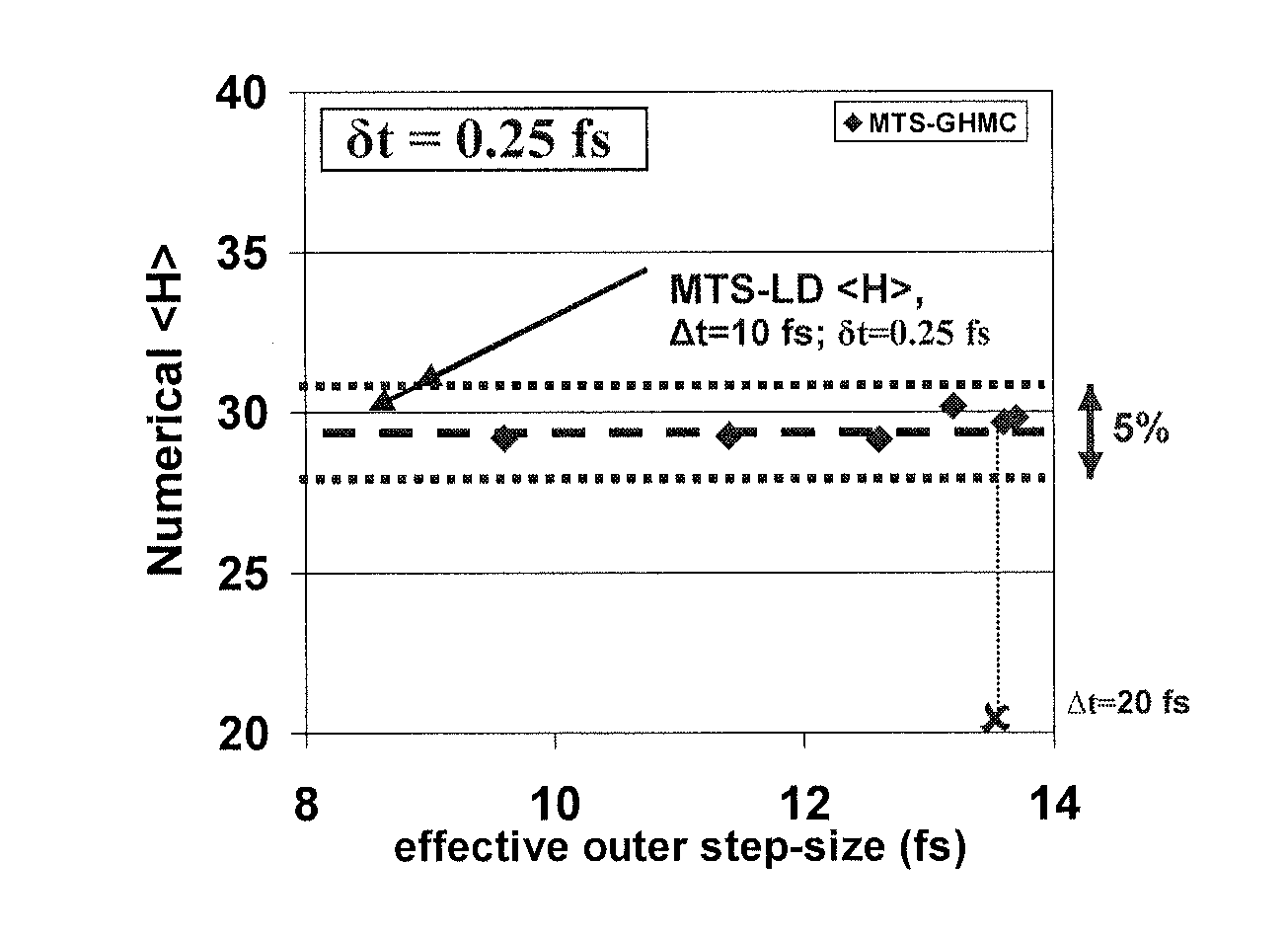
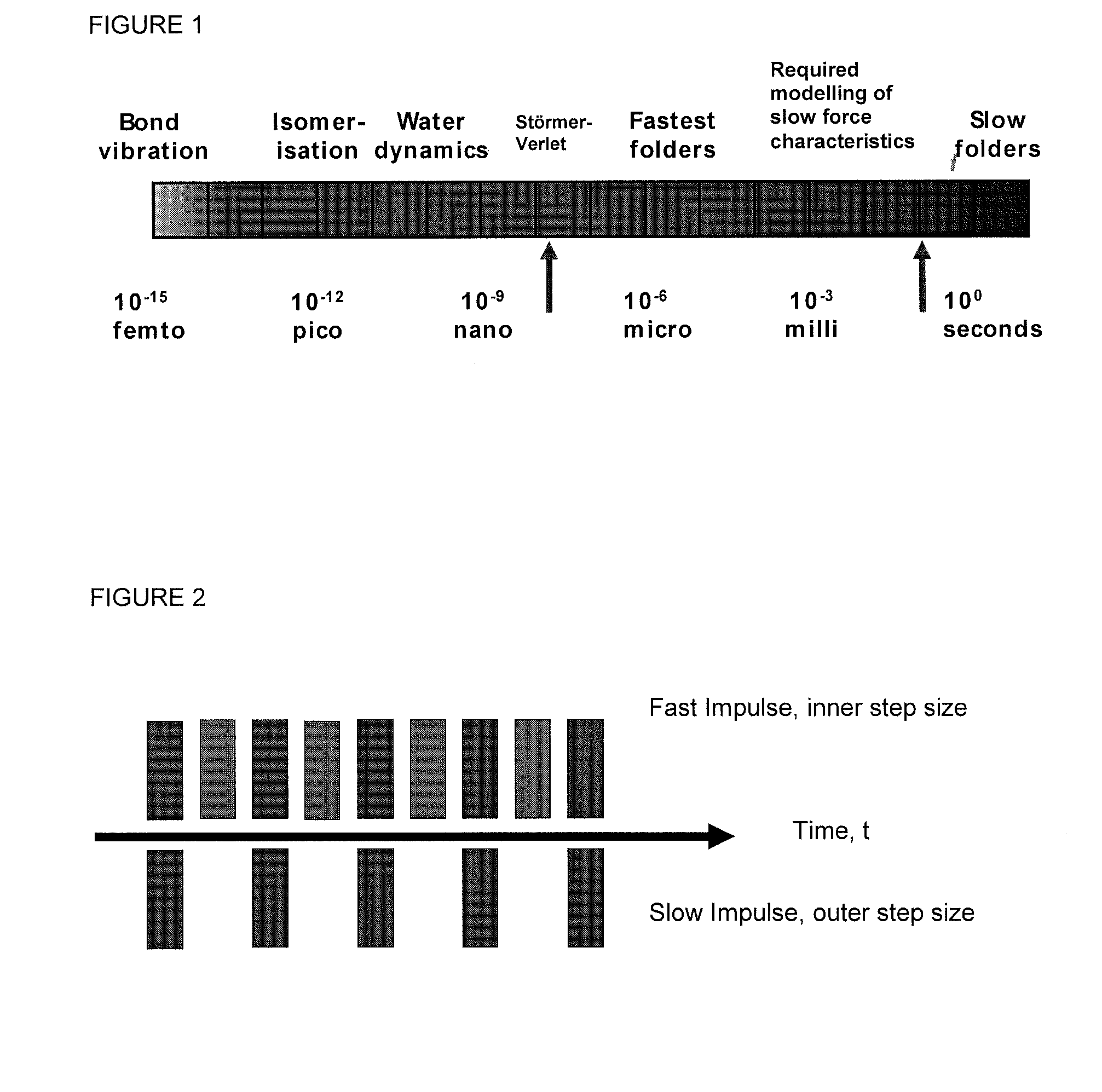
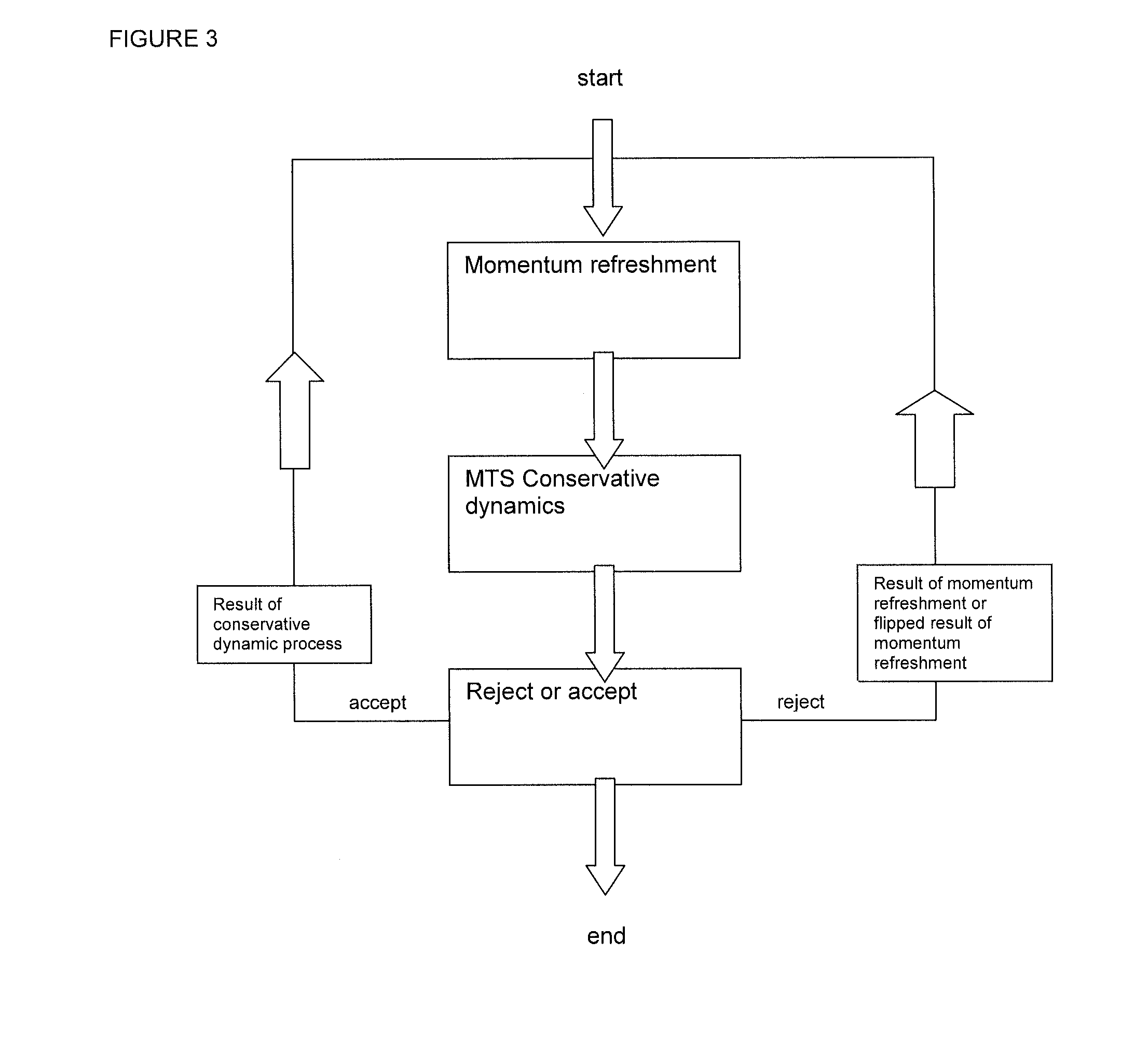
- The MTS-GHMC method combines momentum refreshment with mollified impulse multiple time stepping and Monte Carlo processes to efficiently simulate thermodynamic systems by separating quickly and slowly varying energy parts, allowing for accurate temperature control and reduced computational burden.

Intelligent time-stepping for numerical simulations
PatentWO2021226126A1
Innovation
- The implementation of a machine learning-based time-step selection strategy that analyzes mathematical and physical system states to predict optimally sized time-steps, using AI and ML techniques to generate confident and efficient time-step sizes, thereby avoiding unnecessary iterations and improving simulation speed.


Computational Performance Standards and Benchmarks
Establishing robust computational performance standards for multiphysics simulations requires comprehensive benchmarking frameworks that account for the complex interplay between time step selection and overall system efficiency. Current industry standards primarily focus on single-physics benchmarks, which inadequately represent the computational challenges inherent in coupled field problems where temporal discretization significantly impacts both accuracy and performance.
The IEEE Standard 1730-2010 for Distributed Simulation Engineering and Execution Process provides foundational guidelines, yet lacks specific provisions for multiphysics time stepping strategies. Similarly, the SPEC High Performance Group benchmarks, while valuable for general computational assessment, do not address the unique performance characteristics of adaptive time stepping algorithms commonly employed in multiphysics applications.
Performance metrics for multiphysics simulations must encompass multiple dimensions beyond traditional computational speed measurements. Key performance indicators include temporal convergence rates, memory utilization efficiency during time step adaptation, load balancing effectiveness across coupled physics domains, and scalability characteristics under varying temporal resolution requirements. These metrics become particularly critical when evaluating implicit-explicit coupling schemes where different physics components operate on disparate time scales.
Benchmark suites specifically designed for multiphysics applications are emerging, with notable contributions from organizations such as the Center for Exascale Simulation of Plasma-Coupled Combustion and the Multiphysics Object-Oriented Simulation Environment community. These benchmarks incorporate standardized test cases that evaluate performance across various time stepping strategies, including fixed time step methods, adaptive algorithms, and subcycling approaches.
Industry adoption of standardized performance benchmarks remains inconsistent, with many organizations developing proprietary evaluation criteria. This fragmentation hinders meaningful performance comparisons and impedes the development of optimized time stepping algorithms. Establishing universally accepted benchmarks requires collaboration between academic institutions, software vendors, and end-user communities to define representative test cases that reflect real-world multiphysics simulation requirements while maintaining computational tractability for routine performance evaluation.
The IEEE Standard 1730-2010 for Distributed Simulation Engineering and Execution Process provides foundational guidelines, yet lacks specific provisions for multiphysics time stepping strategies. Similarly, the SPEC High Performance Group benchmarks, while valuable for general computational assessment, do not address the unique performance characteristics of adaptive time stepping algorithms commonly employed in multiphysics applications.
Performance metrics for multiphysics simulations must encompass multiple dimensions beyond traditional computational speed measurements. Key performance indicators include temporal convergence rates, memory utilization efficiency during time step adaptation, load balancing effectiveness across coupled physics domains, and scalability characteristics under varying temporal resolution requirements. These metrics become particularly critical when evaluating implicit-explicit coupling schemes where different physics components operate on disparate time scales.
Benchmark suites specifically designed for multiphysics applications are emerging, with notable contributions from organizations such as the Center for Exascale Simulation of Plasma-Coupled Combustion and the Multiphysics Object-Oriented Simulation Environment community. These benchmarks incorporate standardized test cases that evaluate performance across various time stepping strategies, including fixed time step methods, adaptive algorithms, and subcycling approaches.
Industry adoption of standardized performance benchmarks remains inconsistent, with many organizations developing proprietary evaluation criteria. This fragmentation hinders meaningful performance comparisons and impedes the development of optimized time stepping algorithms. Establishing universally accepted benchmarks requires collaboration between academic institutions, software vendors, and end-user communities to define representative test cases that reflect real-world multiphysics simulation requirements while maintaining computational tractability for routine performance evaluation.
Stability Analysis Methods for Multiphysics Time Integration
Stability analysis in multiphysics time integration represents a critical computational challenge that directly impacts the reliability and accuracy of coupled field simulations. The fundamental complexity arises from the interaction between different physical phenomena operating at disparate temporal scales, where each subsystem may exhibit distinct stability characteristics that can influence the overall system behavior.
Linear stability analysis serves as the primary theoretical framework for evaluating time integration schemes in multiphysics contexts. This approach involves linearizing the coupled system around equilibrium states and examining the eigenvalue spectrum of the resulting Jacobian matrix. The spectral radius criterion provides essential insights into stability boundaries, where eigenvalues with positive real parts indicate potential instability. For multiphysics applications, this analysis becomes particularly complex due to the coupling terms that introduce additional eigenvalue clusters corresponding to different physical processes.
Energy-based stability methods offer an alternative approach that focuses on the conservation properties of the numerical scheme. These methods examine whether the discrete energy of the system remains bounded over time, providing a more physically intuitive stability assessment. The energy method is particularly valuable for nonlinear multiphysics problems where linear analysis may be insufficient, as it can capture stability behavior in the presence of large perturbations and nonlinear coupling effects.
Numerical stability indicators have emerged as practical tools for real-time stability monitoring during simulation execution. These indicators typically track quantities such as solution growth rates, residual convergence patterns, and spectral properties of iteration matrices. Advanced indicators incorporate machine learning techniques to predict stability issues before they manifest as simulation failures, enabling adaptive time step adjustment strategies.
The von Neumann stability analysis, while traditionally applied to single-physics problems, has been extended to multiphysics scenarios through careful consideration of coupling interfaces. This Fourier-based approach examines how numerical errors propagate through the discretized system, providing frequency-dependent stability bounds that are crucial for understanding high-frequency instabilities often encountered in coupled simulations.
Modern stability analysis frameworks increasingly incorporate uncertainty quantification methods to account for parameter variations and modeling uncertainties inherent in multiphysics systems. These probabilistic approaches provide robust stability assessments that consider the statistical distribution of system parameters, offering more reliable guidance for time step selection in practical engineering applications where exact parameter values may be unknown or variable.
Linear stability analysis serves as the primary theoretical framework for evaluating time integration schemes in multiphysics contexts. This approach involves linearizing the coupled system around equilibrium states and examining the eigenvalue spectrum of the resulting Jacobian matrix. The spectral radius criterion provides essential insights into stability boundaries, where eigenvalues with positive real parts indicate potential instability. For multiphysics applications, this analysis becomes particularly complex due to the coupling terms that introduce additional eigenvalue clusters corresponding to different physical processes.
Energy-based stability methods offer an alternative approach that focuses on the conservation properties of the numerical scheme. These methods examine whether the discrete energy of the system remains bounded over time, providing a more physically intuitive stability assessment. The energy method is particularly valuable for nonlinear multiphysics problems where linear analysis may be insufficient, as it can capture stability behavior in the presence of large perturbations and nonlinear coupling effects.
Numerical stability indicators have emerged as practical tools for real-time stability monitoring during simulation execution. These indicators typically track quantities such as solution growth rates, residual convergence patterns, and spectral properties of iteration matrices. Advanced indicators incorporate machine learning techniques to predict stability issues before they manifest as simulation failures, enabling adaptive time step adjustment strategies.
The von Neumann stability analysis, while traditionally applied to single-physics problems, has been extended to multiphysics scenarios through careful consideration of coupling interfaces. This Fourier-based approach examines how numerical errors propagate through the discretized system, providing frequency-dependent stability bounds that are crucial for understanding high-frequency instabilities often encountered in coupled simulations.
Modern stability analysis frameworks increasingly incorporate uncertainty quantification methods to account for parameter variations and modeling uncertainties inherent in multiphysics systems. These probabilistic approaches provide robust stability assessments that consider the statistical distribution of system parameters, offering more reliable guidance for time step selection in practical engineering applications where exact parameter values may be unknown or variable.
Unlock deeper insights with PatSnap Eureka Quick Research — get a full tech report to explore trends and direct your research. Try now!
Generate Your Research Report Instantly with AI Agent
Supercharge your innovation with PatSnap Eureka AI Agent Platform!