Multiplexer Considerations for Optimizing Communication Networks
JUL 13, 20259 MIN READ
Generate Your Research Report Instantly with AI Agent
Patsnap Eureka helps you evaluate technical feasibility & market potential.
Multiplexer Evolution and Objectives
Multiplexers have played a pivotal role in the evolution of communication networks since their inception in the mid-20th century. Initially developed to address the need for efficient utilization of transmission lines, multiplexers have undergone significant advancements to meet the ever-increasing demands of modern communication systems.
The primary objective of multiplexers in optimizing communication networks is to enhance the efficiency and capacity of data transmission. By combining multiple input signals into a single output signal, multiplexers enable the simultaneous transmission of multiple data streams over a single communication channel. This capability has been instrumental in maximizing the utilization of available bandwidth and reducing the overall cost of network infrastructure.
Throughout their evolution, multiplexers have adapted to various technological shifts in the communication landscape. The transition from analog to digital systems marked a significant milestone, leading to the development of time-division multiplexing (TDM) and frequency-division multiplexing (FDM) techniques. These advancements allowed for more precise control over data transmission and improved signal quality.
As network demands continued to grow, wavelength-division multiplexing (WDM) emerged as a groundbreaking technology in optical communication systems. WDM multiplexers enabled the transmission of multiple optical signals at different wavelengths over a single fiber, dramatically increasing the capacity of fiber-optic networks. This innovation paved the way for the exponential growth of internet bandwidth and the proliferation of high-speed data services.
In recent years, the focus of multiplexer development has shifted towards supporting emerging technologies such as 5G networks, Internet of Things (IoT) devices, and cloud computing. The objectives now include achieving higher data rates, lower latency, and improved spectral efficiency. Advanced multiplexing techniques like Orthogonal Frequency-Division Multiplexing (OFDM) and Spatial Multiplexing in MIMO systems have been developed to meet these challenges.
Looking ahead, the evolution of multiplexers is expected to continue in parallel with advancements in quantum communication, terahertz communication, and beyond 5G technologies. The objectives for future multiplexer development include supporting ultra-high bandwidth applications, enabling seamless integration with AI-driven network management systems, and facilitating the convergence of diverse communication technologies.
In conclusion, the evolution of multiplexers has been driven by the constant need to optimize communication networks, with objectives shifting from basic channel utilization to supporting complex, high-capacity, and low-latency communication systems. As we move towards more advanced and interconnected networks, multiplexers will continue to play a crucial role in shaping the future of global communications.
The primary objective of multiplexers in optimizing communication networks is to enhance the efficiency and capacity of data transmission. By combining multiple input signals into a single output signal, multiplexers enable the simultaneous transmission of multiple data streams over a single communication channel. This capability has been instrumental in maximizing the utilization of available bandwidth and reducing the overall cost of network infrastructure.
Throughout their evolution, multiplexers have adapted to various technological shifts in the communication landscape. The transition from analog to digital systems marked a significant milestone, leading to the development of time-division multiplexing (TDM) and frequency-division multiplexing (FDM) techniques. These advancements allowed for more precise control over data transmission and improved signal quality.
As network demands continued to grow, wavelength-division multiplexing (WDM) emerged as a groundbreaking technology in optical communication systems. WDM multiplexers enabled the transmission of multiple optical signals at different wavelengths over a single fiber, dramatically increasing the capacity of fiber-optic networks. This innovation paved the way for the exponential growth of internet bandwidth and the proliferation of high-speed data services.
In recent years, the focus of multiplexer development has shifted towards supporting emerging technologies such as 5G networks, Internet of Things (IoT) devices, and cloud computing. The objectives now include achieving higher data rates, lower latency, and improved spectral efficiency. Advanced multiplexing techniques like Orthogonal Frequency-Division Multiplexing (OFDM) and Spatial Multiplexing in MIMO systems have been developed to meet these challenges.
Looking ahead, the evolution of multiplexers is expected to continue in parallel with advancements in quantum communication, terahertz communication, and beyond 5G technologies. The objectives for future multiplexer development include supporting ultra-high bandwidth applications, enabling seamless integration with AI-driven network management systems, and facilitating the convergence of diverse communication technologies.
In conclusion, the evolution of multiplexers has been driven by the constant need to optimize communication networks, with objectives shifting from basic channel utilization to supporting complex, high-capacity, and low-latency communication systems. As we move towards more advanced and interconnected networks, multiplexers will continue to play a crucial role in shaping the future of global communications.
Network Optimization Demand Analysis
The demand for network optimization in communication networks has been steadily increasing due to the exponential growth in data traffic, the proliferation of connected devices, and the emergence of new technologies such as 5G and IoT. This surge in demand is driven by several factors, including the need for higher bandwidth, lower latency, and improved reliability in both wired and wireless networks.
In the enterprise sector, businesses are seeking ways to enhance their network performance to support mission-critical applications, cloud services, and remote work environments. The COVID-19 pandemic has accelerated this trend, with many organizations adopting hybrid work models that require robust and flexible network infrastructures. As a result, there is a growing market for network optimization solutions that can efficiently manage traffic, prioritize critical data, and ensure seamless connectivity across distributed environments.
Telecommunications providers are also facing increasing pressure to optimize their networks to meet the rising consumer expectations for high-quality, uninterrupted services. With the rollout of 5G networks, there is a significant demand for solutions that can handle the massive increase in data throughput and support new use cases such as augmented reality, virtual reality, and autonomous vehicles. This has led to a focus on technologies that can maximize spectrum efficiency and network capacity.
The Internet of Things (IoT) ecosystem is another major driver of network optimization demand. As billions of devices become connected, networks must be able to handle the vast amount of data generated by sensors and smart devices. This requires intelligent traffic management and efficient data routing to prevent network congestion and ensure timely delivery of critical information.
In the context of multiplexer considerations, there is a growing need for advanced multiplexing techniques that can efficiently combine multiple data streams onto a single transmission medium. This is particularly important in fiber optic networks, where maximizing the utilization of existing infrastructure is crucial. Wavelength Division Multiplexing (WDM) and Dense Wavelength Division Multiplexing (DWDM) technologies are in high demand as they allow for significant increases in network capacity without the need for laying new fiber.
The market for Software-Defined Networking (SDN) and Network Function Virtualization (NFV) solutions is also expanding rapidly. These technologies enable more flexible and dynamic network management, allowing for real-time optimization based on changing traffic patterns and network conditions. As organizations seek to reduce operational costs and improve agility, the demand for programmable networks that can be easily reconfigured and optimized is on the rise.
In the enterprise sector, businesses are seeking ways to enhance their network performance to support mission-critical applications, cloud services, and remote work environments. The COVID-19 pandemic has accelerated this trend, with many organizations adopting hybrid work models that require robust and flexible network infrastructures. As a result, there is a growing market for network optimization solutions that can efficiently manage traffic, prioritize critical data, and ensure seamless connectivity across distributed environments.
Telecommunications providers are also facing increasing pressure to optimize their networks to meet the rising consumer expectations for high-quality, uninterrupted services. With the rollout of 5G networks, there is a significant demand for solutions that can handle the massive increase in data throughput and support new use cases such as augmented reality, virtual reality, and autonomous vehicles. This has led to a focus on technologies that can maximize spectrum efficiency and network capacity.
The Internet of Things (IoT) ecosystem is another major driver of network optimization demand. As billions of devices become connected, networks must be able to handle the vast amount of data generated by sensors and smart devices. This requires intelligent traffic management and efficient data routing to prevent network congestion and ensure timely delivery of critical information.
In the context of multiplexer considerations, there is a growing need for advanced multiplexing techniques that can efficiently combine multiple data streams onto a single transmission medium. This is particularly important in fiber optic networks, where maximizing the utilization of existing infrastructure is crucial. Wavelength Division Multiplexing (WDM) and Dense Wavelength Division Multiplexing (DWDM) technologies are in high demand as they allow for significant increases in network capacity without the need for laying new fiber.
The market for Software-Defined Networking (SDN) and Network Function Virtualization (NFV) solutions is also expanding rapidly. These technologies enable more flexible and dynamic network management, allowing for real-time optimization based on changing traffic patterns and network conditions. As organizations seek to reduce operational costs and improve agility, the demand for programmable networks that can be easily reconfigured and optimized is on the rise.
Multiplexer Technology Landscape
Multiplexer technology has evolved significantly over the past few decades, playing a crucial role in optimizing communication networks. The landscape of multiplexer technology is characterized by continuous advancements in both hardware and software components, driven by the ever-increasing demand for higher data transmission rates and more efficient network utilization.
In the realm of hardware, traditional Time Division Multiplexing (TDM) systems have given way to more sophisticated Wavelength Division Multiplexing (WDM) technologies. WDM has revolutionized optical communication networks by allowing multiple data streams to be transmitted simultaneously over a single fiber optic cable, dramatically increasing bandwidth capacity. The progression from Coarse WDM (CWDM) to Dense WDM (DWDM) has further enhanced the capabilities of optical networks, enabling the transmission of up to 96 channels on a single fiber.
Software-defined networking (SDN) has emerged as a game-changer in the multiplexer technology landscape. By decoupling the control plane from the data plane, SDN allows for more flexible and dynamic network management. This paradigm shift has led to the development of intelligent multiplexing systems that can adapt to changing network conditions in real-time, optimizing resource allocation and improving overall network performance.
The convergence of multiplexer technology with artificial intelligence and machine learning algorithms has opened up new possibilities for predictive maintenance and automated network optimization. These advanced systems can analyze vast amounts of network data to identify potential bottlenecks, predict equipment failures, and suggest optimal routing paths, thereby enhancing the reliability and efficiency of communication networks.
In recent years, the focus has shifted towards developing multiplexers capable of handling the increased data demands of 5G and future 6G networks. This has led to innovations in areas such as massive MIMO (Multiple-Input Multiple-Output) technology and beamforming techniques, which allow for more efficient spectrum utilization and improved signal quality in wireless communication systems.
The multiplexer technology landscape is also being shaped by the growing emphasis on energy efficiency and sustainability. Manufacturers are developing green multiplexing solutions that consume less power while maintaining high performance, aligning with global initiatives to reduce the carbon footprint of telecommunications infrastructure.
As we look towards the future, emerging technologies such as quantum multiplexing hold the promise of revolutionizing the field once again. By leveraging the principles of quantum mechanics, these systems have the potential to achieve unprecedented levels of data transmission capacity and security, paving the way for the next generation of ultra-high-speed communication networks.
In the realm of hardware, traditional Time Division Multiplexing (TDM) systems have given way to more sophisticated Wavelength Division Multiplexing (WDM) technologies. WDM has revolutionized optical communication networks by allowing multiple data streams to be transmitted simultaneously over a single fiber optic cable, dramatically increasing bandwidth capacity. The progression from Coarse WDM (CWDM) to Dense WDM (DWDM) has further enhanced the capabilities of optical networks, enabling the transmission of up to 96 channels on a single fiber.
Software-defined networking (SDN) has emerged as a game-changer in the multiplexer technology landscape. By decoupling the control plane from the data plane, SDN allows for more flexible and dynamic network management. This paradigm shift has led to the development of intelligent multiplexing systems that can adapt to changing network conditions in real-time, optimizing resource allocation and improving overall network performance.
The convergence of multiplexer technology with artificial intelligence and machine learning algorithms has opened up new possibilities for predictive maintenance and automated network optimization. These advanced systems can analyze vast amounts of network data to identify potential bottlenecks, predict equipment failures, and suggest optimal routing paths, thereby enhancing the reliability and efficiency of communication networks.
In recent years, the focus has shifted towards developing multiplexers capable of handling the increased data demands of 5G and future 6G networks. This has led to innovations in areas such as massive MIMO (Multiple-Input Multiple-Output) technology and beamforming techniques, which allow for more efficient spectrum utilization and improved signal quality in wireless communication systems.
The multiplexer technology landscape is also being shaped by the growing emphasis on energy efficiency and sustainability. Manufacturers are developing green multiplexing solutions that consume less power while maintaining high performance, aligning with global initiatives to reduce the carbon footprint of telecommunications infrastructure.
As we look towards the future, emerging technologies such as quantum multiplexing hold the promise of revolutionizing the field once again. By leveraging the principles of quantum mechanics, these systems have the potential to achieve unprecedented levels of data transmission capacity and security, paving the way for the next generation of ultra-high-speed communication networks.
Current Multiplexing Solutions
01 Optimization of multiplexer architecture
Improving the design and structure of multiplexers to enhance performance and efficiency. This includes optimizing the layout, reducing signal interference, and improving signal routing to minimize latency and power consumption.- Optimization of multiplexer architecture: Improving the design and structure of multiplexers to enhance performance and efficiency. This includes optimizing the layout, reducing signal interference, and improving signal routing to minimize latency and power consumption.
- Adaptive multiplexing techniques: Implementing adaptive algorithms and techniques to dynamically adjust multiplexer settings based on network conditions and traffic patterns. This approach allows for more efficient use of bandwidth and improved overall system performance.
- Integration of optical multiplexing technologies: Incorporating optical multiplexing technologies, such as wavelength division multiplexing (WDM), to increase data transmission capacity and speed in optical communication systems. This approach allows for multiple signals to be transmitted simultaneously over a single optical fiber.
- Energy-efficient multiplexer designs: Developing low-power multiplexer designs to reduce energy consumption in electronic devices and communication systems. This includes optimizing circuit designs, implementing power-saving modes, and using advanced semiconductor technologies.
- Multiplexer optimization for specific applications: Tailoring multiplexer designs for specific applications such as medical imaging, wireless communications, and high-speed data networks. This approach involves optimizing multiplexer parameters and features to meet the unique requirements of each application, resulting in improved performance and efficiency.
02 Dynamic reconfiguration of multiplexers
Implementing adaptive multiplexing techniques that allow for real-time reconfiguration based on network conditions or data traffic patterns. This enables more efficient use of resources and improved overall system performance.Expand Specific Solutions03 Integration of multiplexers with optical systems
Combining multiplexer technology with optical communication systems to achieve higher data transmission rates and improved signal quality. This includes optimizing multiplexers for use in fiber optic networks and wavelength division multiplexing systems.Expand Specific Solutions04 Energy-efficient multiplexer designs
Developing low-power multiplexer architectures and techniques to reduce energy consumption in communication systems. This involves optimizing circuit designs, implementing power-saving modes, and utilizing advanced semiconductor technologies.Expand Specific Solutions05 Multiplexer optimization for specific applications
Tailoring multiplexer designs for specific use cases such as medical imaging, wireless communications, or high-speed data networks. This includes optimizing multiplexers for factors like signal integrity, bandwidth utilization, and compatibility with existing infrastructure.Expand Specific Solutions
Key Multiplexer Manufacturers
The multiplexer technology for optimizing communication networks is in a mature stage of development, with a large and competitive market. The global market size for multiplexers is substantial, driven by the increasing demand for high-speed data transmission and network efficiency. Key players like Ericsson, Qualcomm, Huawei, and NTT are at the forefront of innovation, continuously improving multiplexer technology. These companies have demonstrated high technical maturity, offering advanced solutions that address the growing complexity of communication networks. The competition is intense, with firms like Apple, Sony, and Cisco also contributing to the field, pushing for further advancements in multiplexer design and integration with emerging technologies such as 5G and IoT.
Telefonaktiebolaget LM Ericsson
Technical Solution: Ericsson's multiplexer technology focuses on Time Division Multiplexing (TDM) and Wavelength Division Multiplexing (WDM) for both radio and fixed networks. Their solutions include advanced Reconfigurable Optical Add-Drop Multiplexers (ROADMs) that enable dynamic wavelength routing in optical networks[4]. Ericsson has also developed packet-optical transport systems that combine Ethernet, MPLS, and WDM technologies for efficient data transmission[5]. The company's multiplexers incorporate machine learning algorithms for predictive maintenance and automated fault detection, improving network reliability and reducing downtime[6].
Strengths: Comprehensive solutions for both radio and fixed networks, strong integration with 5G infrastructure. Weaknesses: Complex systems may require specialized training for operation and maintenance.
QUALCOMM, Inc.
Technical Solution: Qualcomm's approach to multiplexing in communication networks centers on their 5G NR (New Radio) technology. They have developed advanced Massive MIMO (Multiple-Input Multiple-Output) systems that use spatial multiplexing to significantly increase network capacity and spectral efficiency[7]. Qualcomm's multiplexer solutions also incorporate carrier aggregation techniques, allowing devices to simultaneously use multiple frequency bands for improved data rates[8]. Their technology supports both Time Division Duplex (TDD) and Frequency Division Duplex (FDD) modes, providing flexibility for different network configurations[9].
Strengths: Strong focus on mobile and wireless technologies, leading position in 5G chipsets. Weaknesses: Less presence in fixed network infrastructure compared to some competitors.
Innovative Multiplexing Patents
Communication network multiplexer grooming optimization
PatentActiveUS20190372843A1
Innovation
- A system and method for optimizing multiplexer grooming by determining optimization values for various configurations, identifying the highest-ranked configuration, and configuring multiplexers to achieve lowest overall cost or highest utilization, using a grooming optimization system that includes modules for multiplexer configuration access, optimization, and discrete event simulation.
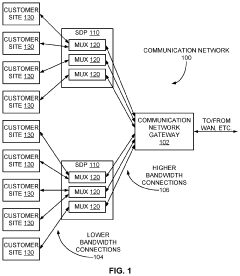
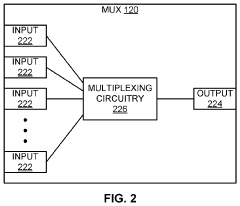
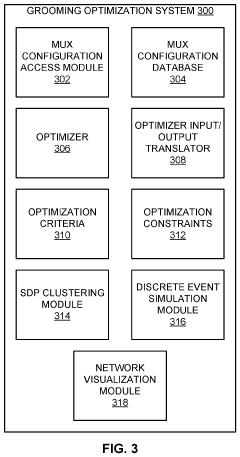
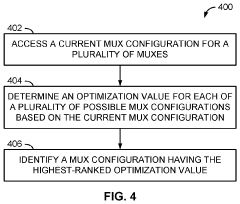
Multiplexer and Modulation Arrangements for Multi-Carrier Optical Modems
PatentActiveUS20120251120A1
Innovation
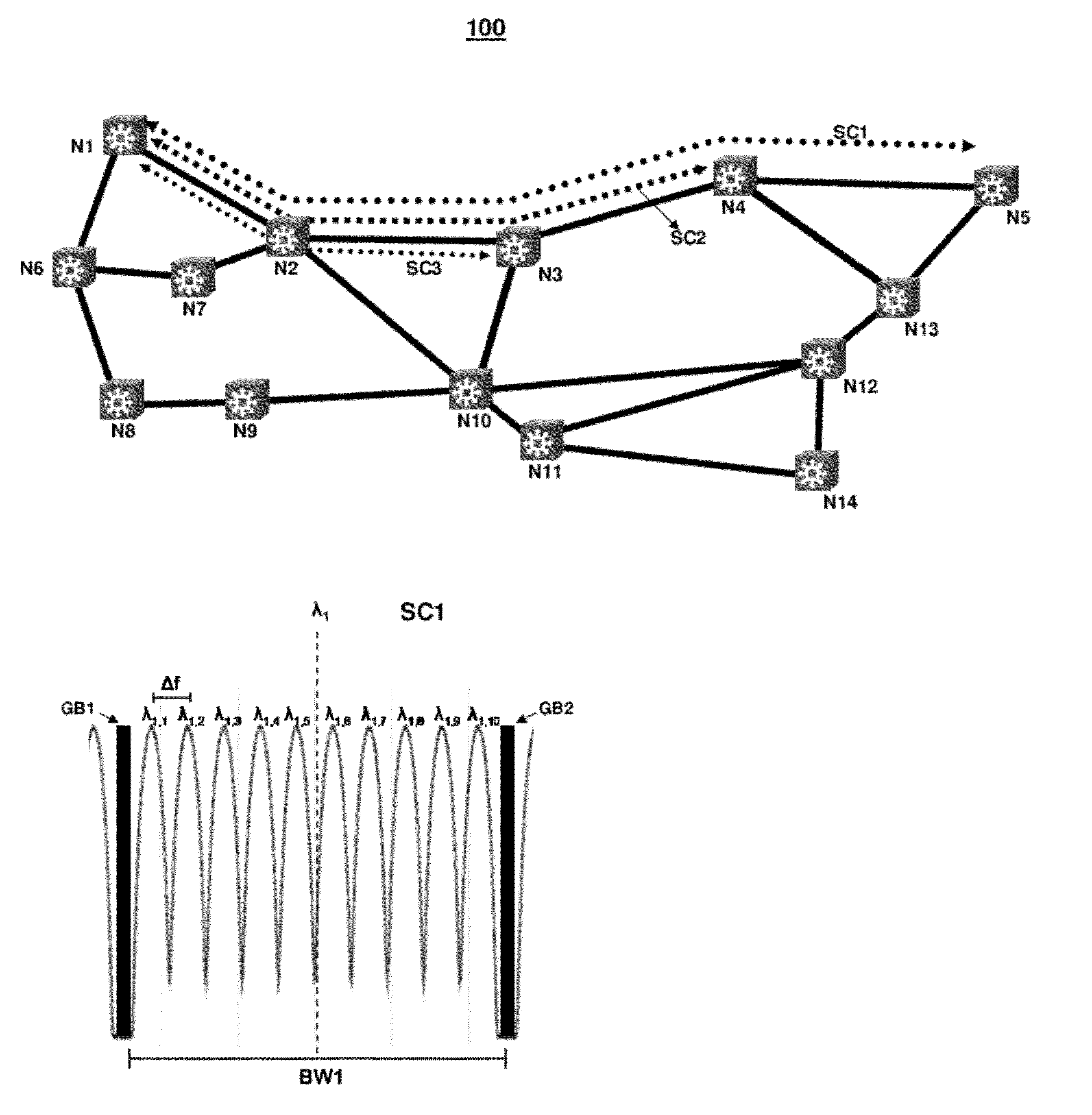
- The system employs an optical transmitter that selectively modulates optical signals using different modulation formats for each superchannel, allowing for flexible modulation based on distance requirements and optimizing channel spacing to maintain a constant data rate, thereby minimizing spectral bandwidth and maximizing spectral efficiency.

Network Performance Metrics
Network performance metrics are crucial indicators for evaluating the efficiency and effectiveness of communication networks, particularly when considering multiplexer implementations. These metrics provide quantitative measures of various aspects of network operation, enabling network engineers and administrators to assess, optimize, and troubleshoot network performance.
One of the primary metrics is throughput, which measures the amount of data successfully transmitted through the network in a given time period. In multiplexer-based networks, throughput is particularly important as it reflects the system's ability to efficiently combine and transmit multiple data streams. Closely related to throughput is bandwidth utilization, which indicates how effectively the available network capacity is being used.
Latency is another critical metric, representing the time delay between sending and receiving data. In multiplexer systems, minimizing latency is essential for maintaining real-time communication capabilities. Jitter, the variation in latency over time, is also a key consideration, especially for time-sensitive applications such as voice and video communications.
Packet loss rate is a metric that measures the percentage of data packets that fail to reach their destination. High packet loss can significantly degrade network performance and user experience. In multiplexer environments, managing packet loss becomes more complex due to the aggregation of multiple data streams.
Bit error rate (BER) is particularly relevant in digital communication systems, including those employing multiplexers. It quantifies the number of bit errors per unit time, providing insight into the overall signal quality and integrity of the transmitted data.
Quality of Service (QoS) metrics are essential for assessing how well the network meets the specific requirements of different applications and services. This includes metrics such as packet delay variation, which is crucial for maintaining consistent performance in multiplexed networks.
Network availability and reliability metrics, such as mean time between failures (MTBF) and mean time to repair (MTTR), are vital for evaluating the overall stability and robustness of the network infrastructure. These metrics are particularly important in multiplexer systems where multiple data streams rely on shared network resources.
Scalability metrics help assess how well the network can handle increased load and additional users or services. This is especially relevant when considering the implementation of multiplexers to expand network capacity.
By carefully monitoring and analyzing these performance metrics, network operators can make informed decisions about multiplexer configurations, capacity planning, and network optimization strategies. This data-driven approach ensures that communication networks can meet the evolving demands of modern applications while maintaining high levels of performance and reliability.
One of the primary metrics is throughput, which measures the amount of data successfully transmitted through the network in a given time period. In multiplexer-based networks, throughput is particularly important as it reflects the system's ability to efficiently combine and transmit multiple data streams. Closely related to throughput is bandwidth utilization, which indicates how effectively the available network capacity is being used.
Latency is another critical metric, representing the time delay between sending and receiving data. In multiplexer systems, minimizing latency is essential for maintaining real-time communication capabilities. Jitter, the variation in latency over time, is also a key consideration, especially for time-sensitive applications such as voice and video communications.
Packet loss rate is a metric that measures the percentage of data packets that fail to reach their destination. High packet loss can significantly degrade network performance and user experience. In multiplexer environments, managing packet loss becomes more complex due to the aggregation of multiple data streams.
Bit error rate (BER) is particularly relevant in digital communication systems, including those employing multiplexers. It quantifies the number of bit errors per unit time, providing insight into the overall signal quality and integrity of the transmitted data.
Quality of Service (QoS) metrics are essential for assessing how well the network meets the specific requirements of different applications and services. This includes metrics such as packet delay variation, which is crucial for maintaining consistent performance in multiplexed networks.
Network availability and reliability metrics, such as mean time between failures (MTBF) and mean time to repair (MTTR), are vital for evaluating the overall stability and robustness of the network infrastructure. These metrics are particularly important in multiplexer systems where multiple data streams rely on shared network resources.
Scalability metrics help assess how well the network can handle increased load and additional users or services. This is especially relevant when considering the implementation of multiplexers to expand network capacity.
By carefully monitoring and analyzing these performance metrics, network operators can make informed decisions about multiplexer configurations, capacity planning, and network optimization strategies. This data-driven approach ensures that communication networks can meet the evolving demands of modern applications while maintaining high levels of performance and reliability.
Multiplexer Energy Efficiency
Energy efficiency has become a critical consideration in the design and optimization of multiplexers for communication networks. As data traffic continues to grow exponentially, the power consumption of network equipment, including multiplexers, has become a significant concern for both environmental and economic reasons. Multiplexers play a crucial role in combining multiple input signals into a single output signal, enabling efficient use of network resources. However, their operation can consume substantial amounts of energy, particularly in high-capacity systems.
To address this challenge, researchers and engineers have been focusing on developing energy-efficient multiplexer technologies. One approach involves the use of advanced semiconductor materials and fabrication processes to reduce power consumption at the component level. For instance, the adoption of silicon photonics in optical multiplexers has shown promising results in reducing energy consumption while maintaining high performance.
Another strategy for improving multiplexer energy efficiency is the implementation of intelligent power management systems. These systems can dynamically adjust the power consumption of multiplexer components based on traffic load and network conditions. By scaling power usage according to demand, significant energy savings can be achieved during periods of low network activity.
The integration of energy-efficient algorithms in multiplexer control systems has also proven effective. These algorithms optimize signal routing and resource allocation, minimizing unnecessary signal processing and reducing overall power consumption. Additionally, the development of low-power modulation schemes specifically designed for multiplexer applications has contributed to improved energy efficiency.
Thermal management is another crucial aspect of multiplexer energy efficiency. Advanced cooling technologies, such as liquid cooling and phase-change materials, are being employed to dissipate heat more effectively, thereby reducing the energy required for temperature control. Furthermore, the use of energy-harvesting techniques to capture and reuse waste heat from multiplexer operations is an emerging area of research with potential for significant energy savings.
As the demand for higher data rates and network capacity continues to grow, the importance of multiplexer energy efficiency will only increase. Future developments in this area are likely to focus on holistic approaches that combine hardware optimizations, intelligent software controls, and innovative system-level designs to achieve unprecedented levels of energy efficiency in communication networks.
To address this challenge, researchers and engineers have been focusing on developing energy-efficient multiplexer technologies. One approach involves the use of advanced semiconductor materials and fabrication processes to reduce power consumption at the component level. For instance, the adoption of silicon photonics in optical multiplexers has shown promising results in reducing energy consumption while maintaining high performance.
Another strategy for improving multiplexer energy efficiency is the implementation of intelligent power management systems. These systems can dynamically adjust the power consumption of multiplexer components based on traffic load and network conditions. By scaling power usage according to demand, significant energy savings can be achieved during periods of low network activity.
The integration of energy-efficient algorithms in multiplexer control systems has also proven effective. These algorithms optimize signal routing and resource allocation, minimizing unnecessary signal processing and reducing overall power consumption. Additionally, the development of low-power modulation schemes specifically designed for multiplexer applications has contributed to improved energy efficiency.
Thermal management is another crucial aspect of multiplexer energy efficiency. Advanced cooling technologies, such as liquid cooling and phase-change materials, are being employed to dissipate heat more effectively, thereby reducing the energy required for temperature control. Furthermore, the use of energy-harvesting techniques to capture and reuse waste heat from multiplexer operations is an emerging area of research with potential for significant energy savings.
As the demand for higher data rates and network capacity continues to grow, the importance of multiplexer energy efficiency will only increase. Future developments in this area are likely to focus on holistic approaches that combine hardware optimizations, intelligent software controls, and innovative system-level designs to achieve unprecedented levels of energy efficiency in communication networks.
Unlock deeper insights with Patsnap Eureka Quick Research — get a full tech report to explore trends and direct your research. Try now!
Generate Your Research Report Instantly with AI Agent
Supercharge your innovation with Patsnap Eureka AI Agent Platform!